Pesquisa realizada no Programa de Cirurgia de Epilepsia do Hospital de Clínicas da Universidade Federal do Paraná, Curitiba PR, Brasil (UFPR): 1Psicóloga UFPR; 2Diretora do Serviço de Psicologia do Instituto do Coração do Hospital das Clínicas da Faculdade de Medicina da Universidade de São Paulo SP Brasil (INCOR USP); 3Chefe do Serviço de Eletroencefalografia UFPR; 4Coordenador do Programa de Cirurgia de Epilepsia UFPR.
Received 18 September 2003, received in final form 13 February 2004. Accepted 18 March 2004.
Dra. Maria Joana Mäder - Hospital de Clínicas UFPR - Rua General Carneiro 181 - 80060-900 Curitiba PR - Brasil. E-mail: [email protected]
THE WADA TEST
Contributions to standardization of the stimulus
for language and memory assessment
Maria Joana Mäder
1, Bellkiss Wilma Romano
2,
Luciano De Paola
3, Carlos Eduardo Soares Silvado
4ABSTRACT - The Wada Test (WT) is part of the presurgical evaluation for refractory epilepsy. The WT is not standardized and the protocols differ in important ways, including stimulus type of material presented for memory testing, timing of presentations and methods of assessment. The aim of this study was to con-tribute to establish parameters for a WT to Brazilian population investigating the performance of 100 nor-mal subjects, without medication. Two parallel models were used based on Montreal Procedure adapted from Gail Risse’s (MEG-MN,EUA) protocol. The proportions of correct responses of normal subjects sub-mitted to two parallel WT models were investigated and the two models were compared. The results showed that the two models are similar but significant differences among the stimulus type were observed. The results suggest that the stimulus type may influence the results of the WT and should be considered when constructing models and comparing different protocols.
KEY WORDS: neuropsychology, amobarbital test, epilepsy, memory,Wada test.
Teste de Wada: contribuição para normatização dos estímulos para avaliação de linguagem e memória
RESUMO - O Teste de Wada (TW) é parte integrante da avaliação pré-cirúrgica para epilepsias de difícil controle. O TW não é padronizado e os protocolos diferem em vários aspectos, incluindo tipos de estímu-los para avaliação de memória, tempo de apresentação e metodologia de avaliação. O objetivo deste estu-do foi contribuir no estabelecimento de parâmetros para utilização TW para a população brasileira, inves-tigando o desempenho de 100 controles normais, sem medicação. Dois modelos (Modelos A e B) foram utilizados, baseados no Procedimento de Montreal e adaptadas do protocolo de Gail Risse (MEG-MN,EUA). Foram observadas as proporções de acerto dos sujeitos normais para os modelos de TW, em seguida, os dois modelos foram comparados entre si. Os resultados demonstraram que os dois modelos são similares mas, observaram-se significativas diferenças entre os tipos de estímulos. Os resultados sugerem que tipos de estímulos podem influenciar os resultados do TW e esses dados devem ser considerados na construção de modelos e comparações entre diferentes protocolos.
PALAVRAS-CHAVE: neuropsicologia, teste do amobarbital, epilepsia, memória, teste de Wada.
Most epilepsy patients’ seizures may be con-trolled by proper medication. Those whose seizures cannot be controlled by the available drugs are sur-gery candidates; however, not all patients with such characteristics may truly benefit from sur-gery1. For a correct indication for surgery in
refrac-tory epilepsies, especially of the temporal lobe, a thorough investigation is required, involving a
areas. MRI enables the assessment of hippocam-pal structures, indicating if there is mesial tempo-ral sclerosis. Neuropsychological evaluation aims at investigating cognitive functions, especially ma-terial-specific memory, evidencing signs of function location and lateralization2,3.The WT basically
con-sists of evaluating language and memory, while each cerebral hemisphere is temporarily inactivat-ed by an injection of amobarbital into the inter-nal carotid artery, so that both brain hemispheres can be evaluated independently. By anesthetiz-ing one of the hemispheres it is possible to evalu-ate the other’s function, providing data on langua-ge and memory lateralization. While the left hemis-phere is anesthetized, the right hemishemis-phere is in char-ge of memorizing information and vice-versa4-6.
Technically, the exam is performed by placing a catheter into the internal carotid arteries through a puncture in the femoral artery. The catheter is positioned in the internal carotid artery and amo-barbital is injected. The hemisphere ipsilateral to the side of proposed surgery is anesthetized first. Since amobarbital is a fast acting barbiturate, the time the patient remains anesthetized (and con-sequently the testing time) is limited to a few min-utes. Anesthetic efficacy can be determined by the time it takes for full return of motor function, and the presence of memory and language can only be interpreted while the opposite hemisphere is paralyzed, which is clinically measured by the mo-tor strength of the contralateral upper limb7.
Although most multidisciplinary teams who specialize in epilepsy surgery use the WT for evalua-tion of both memory and language, the way results are interpreted, as weel as the amount of amobar-bital used tend to vary considerably. There are sig-nificant variations among the criteria used to consi-der positive or negative results. Some protocols base the final result on the correct answer rate (correct-ly memorized stimuli), while others base the results on the asymmetry between the correct answer ra-te obtained in both hemispheres8,9. A more detailed
review on the WT’s history and different protocols may be found in a previous publication10.
Consi-dering those aspects, a study was carried out to investigate normal subjects’ responses to WT mod-els: Model A and Model B. The structure of the exam was based on the exam created by Risse and collaborators11, but using different words and
pic-tures. The words were selected among nouns, adjectives, adverbs and verbs, terms that are com-mon in the vocabulary but difficult to see as an ima-ge, that is, difficult to associate to an image or
object. The pictures in Risse’s protocol are black and white outline designs but we chose to use colored pictures of objects, animals or plants.
The overall objective of this study was to provi-de a parameter of two WT moprovi-dels to be used for the Brazilian population. The first specific objecti-ve was to check the correct answer rate among a population that had had elementary and second-ary education, for language and memory stimuli, with both WT models (Model A and Model B). The second specific objective was to compare subjects’ performance in both models, checking the consis-tency of results to evaluate asymmetry of perform-ance between the two hemispheres. Lastly, the third specific objective was to compare correct answer rates among different types of stimuli.
METHOD
The WT protocol used in our study was the Montreal Procedure with an additional interview stage; part of the stimuli were adapted from Risse’s Protocol11, from
the Minnesota Epilepsy Group (Saint Paul, MN, USA). One hundred subjects with elementary and second-ary education (either complete or incomplete), of both genders, ages ranging from 18 and 50, were recruited among the employees and volunteers of HC UFPR (Uni-versity Hospital of the Federal Uni(Uni-versity of Paraná). We chose as eligible subjects those who had no neurolo-gical complaints or symptoms, and whose results were equal or above the cut-off point proposed by Bertolucci et al.12for the Mini Mental Status Examination (MMSE).
All subjects agreed with Informed Consent before start-ing the test sessions.
Although the subjects were off medication, the pro-cedure followed the same stimuli presentation order in the real situation of the WT. The time interval between stimuli presentation and patient recall, as well as the time between application of the two models were filled with short distractive tasks.
Model A consisted in presenting two series of stim-uli, for 5 five seconds each, in the following order: 2 col-ored objects of original size and shape; 2 words to read and repeat; 2 abstract designs and 2 pictures of common objects. In between the two series, simple tasks of lan-guage stimulation were introduced, e.g. asking sub-jects to name the days of the week and identify geome-trical shapes.
After the second series of stimuli was presented, the Trail Making Test13,14was introduced as the distractive
answers. Soon after, cards with 4 words each were pre-sented and subjects were asked to recognize them giv-ing multiple choice answers. Each abstract drawgiv-ing was also presented printed on a card with three similar ones for recognition.
The pictures were to be recognized in two stages. First they were presented in written form together with three other words, and then each picture was present-ed together with three other different ones of the same category. For example: the picture of an airplane was presented as initial stimulus; in the recognition phase, a card was presented containing four words: train - air-plane - can - ring and, immediately after that a card con-taining four different airplane pictures was presented for a multiple choice answer.
As soon as Model A was concluded, a new distracti-ve task was applied, the Fidistracti-ve Points13,14completing a 30
minute interval since the beginning of the test. Right after that, Model B was applied with the Stroop Test13,14as
dis-tractive task. All subjects responded to both models, fol-lowing the stimuli presentation and distractive task order. The language tests used both in Models A and B are the same and very simple. Basically, they include sponta-neous speech exercises (object naming and word read-ing), automatic speech (saying the days of the week and repeating words), and verbal comprehension (point-ing to geometric forms follow(point-ing verbal orders).
For memory assessment, verbal and visual stimuli recalled through free recall and recognition were grou-ped. The types of stimuli were assessed separately as well. The results were separated by stimulus type: Word Re-cognition; Abstract Drawing ReRe-cognition; Picture Verbal Recognition (recognizing the names of the pictures pre-sented), and Picture Recognition.
RESULTS
Analysis of results for Models A and B - First we
examined the right answer rate in recall and recog-nition for Models A and B. Then, we compared the results obtained in the two models, investigating the similarity between them. At last, we compared the rate of right answers in evocation and recogni-tion of the different types of stimuli to check which types yielded the highest rate of correct answers.
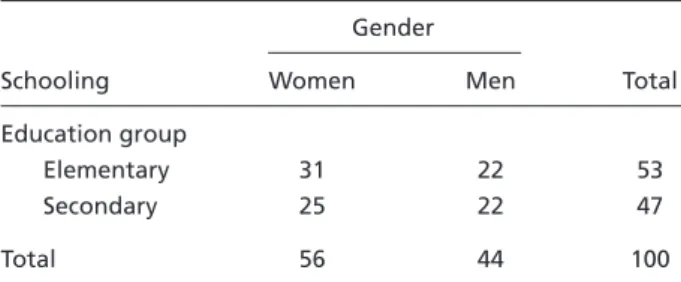
Demographic data- The study included 56
wo-men and 44 wo-men with elewo-mentary and secondary education. Ninety-two subjects were employees at the Hospital’s various departments, and 8 volun-teers from the Hospital’s Volunteer Service were included, as well. Table 1 shows the sample’s distri-bution by gender and education level. Considering the responses could be different depending on the subject’s education level, we chose to analyze the WT results by grouping men and women who
had either completed elementary education or not in the Elementary Education Group. In the Se-condary Education Group we included all men and women regardless if they had completed second-ary education or not.
Rate of right answers for Models A and B -
Re-sults obtained in the language tests showed min-imal incidence of errors, as we had expected, since the tasks were very simple. Only one subject, who had finished the 3rd grade, failed to give a correct answer to the following tasks: say the days of the week in indirect order, and point a geometrical (tri-angle) form in the comprehension exercises.
Results obtained in the memory exercises sho-wed that, although very simple, not all stimuli can be recalled after a distraction. Thus, for a normal sample of subjects with elementary and secondary education, it is more difficult to recall than to rec-ognize stimuli. As for recognition, the results were analyzed separately by stimuli type, and later grou-ped by material-specific both verbal and visual. Ta-ble 2 shows, for each memory exercise, the estima-tes that correspond to the rate of correct answers in the two models, separated by education degree. The results describe above have shown that sti-muli recall covers around 60% of the material pre-sented, but stimuli recognition however, both of verbal and visual material, is above 80%. Therefore, assessing memory through recognition is the most reliable parameter to analyze WT results.
Asymmetry between models -Comparing results
from models A and B, there are no statistically sig-nificant differences. The results obtained have shown that both models are the same and may be used for asymmetry analysis in the WT. Different performance of normal subjects in memory tests have shown that between the two models there may be a variation of up to 7 points.
Material-specific memory - The different types
Table 1. Sample’s distribution by gender and education.
Gender
Schooling Women Men Total
Education group
Elementary 31 22 53
Secondary 25 22 47
of stimuli were compared two by two. Recalling objects is significantly easier than recalling words in both models; recalling objects is also easier than verbally recalling the pictures; verbally recalling the pictures is significantly easier than recalling words. Recognizing objects or pictures is significantly easier than recognizing words and designs. Table 3 describes the results obtained for each comparison.
DISCUSSION
The accuracy of memory assessment in the WT depends on the similarity between the two mod-els, because the results are interpreted by the rate of correct answers and the asymmetry between the performance of both the brain hemispheres. Com-paring performance in the two stages of the test (anesthetizing each hemisphere separately) enables
Table 2. Rate of correct answers in the two models, separated by education degree.
Elementary education group Secondary education group
Model A Model B Model A Model B
Recall of objects 0.85 0.83 0.85 0.78
Recall of words 0.23 0.17 0.28 0.23
Recall of pictures 0.60 0.64 0.64 0.60
Total recall 0.56 0.55 0.59 0.52A
Recognition of objects 1.0 1.0 1.0 1.0
Recognition of words 0.86 0.88 0.88 0.86
Recognition of abstracts designs 0.85 0.79 0.88 0.89
Verbal recognition of pictures 0.98 0.99 0.99 1.0
Visual recognition of pictures 0.99 0.98 1.0 0.98
Recognition of verbal material 0.95 0.96 0.96 0.96
Recognition of visual material 0.91 0.88 0.93 0.92
Table 3. Comparing the correct answer , for the two models, on recognition of stimuli type.
Elementary Secondary
education group education group
Stimulus type Model A Model B Model A Model B
Recognition of objects > Recognition of words 0 0 p<0.0001 0 Recognition of objects > Recognition of abstracts designs p<0.0001 p<0.0001 p<0.0001 p<0.0001
Recognition of objects = Verbal recognition of pictures p=0.0385 p=0.3219 p=0.3179 p=1 Recognition of objects = Visual recognition of pictures p=0.3219 p=0.0385 p=1 p=0.074
Recognition of words = Recognition of abstracts designs p=0.7984 p=0.0367 p=1 p=0.2676 Recognition of words < Verbal recognition of pictures p<0.0001 p<0.0001 p<0.0001 p<0.0001
Recognition of words < Visual recognition of pictures p<0.0001 p<0.0001 p<0.0001 p<0.0001 Recognition of abstracts < Verbal recognition of pictures p<0.0001 p<0.0001 p<0.0001 p<0.0001 designs
Recognition of abstracts < Visual recognition of pictures p<0.0001 p<0.0001 p<0.0001 p=0.00064 designs
to analyze the asymmetry between the function-al memory capacity in each hemisphere. From such comparison one draws conclusions about the func-tional memory reserve in the contralateral hemi-sphere (the one not proposed for surgery) and the likelihood of memory loss if the functional memo-ry capacity of the hemisphere that will undergo sur-gery is still very preserved15,16. Therefore, the
ana-lysis of the more adequate types of stimuli fine tu-nes the exam and enhances the discussion on the models. In order to have a more reliable effect of anesthesia in one of the brain hemispheres, it is necessary that as many stimuli as possible can be recognized.
The main objective of this study was to help pro-vide a more reliable WT protocol, better suited for the Brazilian population. Our results have shown that models A and B are equivalent, since the rate of correct answers was similar both in the elemen-tary and secondary education groups. Subject per-formance in either of the two models was not sig-nificantly different. The chosen stimuli were sim-ple enough for both the elementary and second-ary education levels, and those data can be extrap-olated for the higher education population.
Correct answer rates were analyzed for langua-ge and memory tasks. Langualangua-ge tasks presented no difficulty, since they were simple and easy to understand, as required by the test. Memory task results, on the contrary, were relevant.
A subject, in favorable testing conditions, is ca-pable of recalling between 50% and 64% of the information that can be verbally decoded after a brief interference of attention tests. Such data have shown that results based exclusively on recall are not enough to determine if functional mem-ory remains present. Therefore, recognition would be the most suitable parameter.
The criteria to consider a positive result when as-sessing memory in our study (which follows the Montreal procedures) vary between 60% and 68% of correct recognition answers. Normal subjects’ re-sults in our study are above 80% of correct recog-nition answers for all kinds of stimuli except abstract designs. Thus, we concluded that the analyzed mo-dels can provide data on functional reserve and functional adaptation of memory, since they are sim-ple enough for a normal subject, under no medica-tion, to recognize at least 80% of the stimuli.
Double encoding stimuli (objects and pictures) are significantly superior for memory assessment in
the WT. Our results suggest that double encoding stimuli, because they are overall easier, ensure bet-ter test results and therefore it is more reliable to use this kind of material to make a post-surgery me-mory prognosis. On the other hand, material clas-sified as unilateral in terms of encoding may be use-ful to assess memory-specific material, but it should be analyzed separately, taking the total correct answer rate into account, rather than asymmetry.
Christianson et al.17noticed that words and
pic-tures of common objects provided more conclusive results when compared to designs and faces, and stim-uli diversity has the advantage of enabling a more detailed assessment of material-specific memory18.
The WT aims at studying how memory and lan-guage function in candidates for refractory epilep-sy surgery. However, since it is a very short test, it is not able to encompass all complex aspects of tho-se functions. Language cannot be fully astho-sestho-sed by having the patient repeat the days of the week or read isolated words only, nor can memory be as-sessed just by asking the patient to recognize four objects after a few-minutes interval. Therefore, the WT’s structure enables no more than the assess-ment of episodic declarative memory within a very specific situation.
The study has shown that stimuli quality affects the results. Double encoding stimuli (pictures and objects that are easy to name), that is, theoretical-ly encodable by both hemispheres, have shown higher correct answer rates. Stimuli classified as visu-al or verbvisu-al (unilatervisu-al in terms of encoding) are not memorized at the same rate. Therefore, the practical application of the observed parameters may also contribute to the study of declarative memory and material-specific memory functions.
Lastly, this study provides grounds for further discussion about the actual ability to anticipate me-mory deficits in patients taking the Test and submit-ted to temporal lobectomy.
REFERENCES
1. Cockerel O, Sander, JWA. O Custo econômico da epilepsia. In Costa JC, Palmini A, Yacubian EMT, Cavalheiro E (eds). Fundamentos neurobi-ológicos das epilepsias: aspectos clínicos e cirúrgicos. São Paulo: Lemos, 1998;1;21-30.
2. Jones-Gotman M. Localization of lesion by neuropsychological testing. Epilepsia 1991;32:Supp.5:41-52.
3. Hermann BP, Seidenberg M, Schoenfeld J, Davies K. Neuropsychological characteristics of the syndrome of medial temporal lobe epilepsy. Arch Neurol 1997;54:369-376.
5. Milner B, Branch C, Rasmussen T. Study of short term memory after intracarotid injection of sodium amytal. Transactions of the American Neurological Association 1962;224-226.
6. Loring D, Meador K, Lee G, King D. Amobarbital effects and lateralized brain function - the Wada test, New York; Springer-Verlag 1992;1-23. 7. De Paola L. Epilepsia clinicamente refratária do lobo temporal
associ-ada a esclerose medial temporal. Dissertação (Mestrado), da Universidade Federal do Paraná Curitiba, 1999.
8. Dodrill CB. Preoperative criteria for identifying eloquent brain intrac-arotid amytal for language testing. Neurosurg Clin N Am,1993;4:2-4. 9. Rausch R, Silfvenius H, Wieser H, Dodrill C D, Meador K J, Jones-Gotman
M. Intraarterial amobarbital procedures. In Engel J. (ed). Surgical treat-ment of the epilepsies. New York: Raven Press, 1993:341-357. 10. Mader M J, Romano B W. The Wada test: diferences in Brazilian
pro-tocols. J Ep Clin Neurophysiol 2001:7;70-75
11. Risse G L, Gates J R, Fangman MC. A reconsideration of bilateral lan-guage representation based on the intracarotid amobarbital procedure. Brain Cog 1997;33:118-132.
12. Bertolucci P, Brucki S, Camapaci S, Juliano Y. O mini-exame do estado mental em população geral. Arq Neuropsiquiatr 1994;52:1-7. 13. Lezak M D. Neuropsychological assessment. 3.Ed. New York: Oxford
Univ Press, 1995:373-669.
14. Spreen O, Strauss E. A compendium of neuropsychological tests: admin-istration, norms and commentary New York: Oxford Univ Press, 1998:206-547.
15. Chelune G. Hipocampal adequacy versus functional reserve: predict-ing memory functions followpredict-ing temporal lobectomy. Arch Clin Neuropsychol 1995:10;413-432.
16. Trenerry MR, Loring, DW, Peerson RC, Scharbrough S. The Wada test. In Wyllie E. (ed). The treatment of epilepsy: principles and practice, 2.Ed. Baltimore: Williams & Wilkins, 1996:1000-1005.
17. Christianson SA, Säisa J, Silfvenius H, Hemisphere memory differ-ences in sodium amytal testing of epileptic patients. J Clin Exp Neuro-psychol 1990;12:681-694.