cassiano Kuchenbecker Rösing(a)
walter loesche(b)
(a) Department of Periodontology, Dental School, Universidade Federal do Rio Grande do Sul, Porto Alegre, RS, Brazil.
(b) Department of Microbiology and
Immunology, School of Dentistry, University of Michigan, Ann Arbor, MI, USA.
corresponding author:
Cassiano Kuchenbecker Rösing E-mail: [email protected]
Received for publication on Jul 10, 2011 Accepted for publication on Sep 01, 2011
Halitosis: an overview of epidemiology,
etiology and clinical management
Abstract: Halitosis is an unpleasant condition that causes social re-straint. Studies worldwide indicate a high prevalence of moderate halito-sis, whereas severe cases are restricted to around 5% of the populations. The etiological chain of halitosis relates to the presence of odoriferous substances in exhaled air, especially the volatile sulphur compounds (VSC) produced by bacteria. The organoleptic diagnosis is the gold stan-dard and clinical management includes oral approaches, especially peri-odontal treatment and oral hygiene instructions, including the tongue. When oral strategies are not successful, referral to physicians is warrant-ed.
Descriptors: Halitosis; Epidemiology; Microbiology; Review.
introduction
Halitosis is deined as breath that is offensive to others, caused by a variety of reasons including but not limited to periodontal disease, bacte-rial coating of tongue, systemic disorders and different types of food.1 It is one of the most frequent claims from patients to the dentist.2
After the decline in the prevalence of oral diseases of major preva-lence, Dentistry has given it a closer attention, which should not be con-sidered a cosmetic problem. However, science behind the understand-ing of halitosis is weak. Several clinical approaches are based strictly on opinions. The present review will focus on different aspects of halitosis, trying to demonstrate the most appropriate evidence to support the ap-proach for its management.
epidemiology
Descriptive studies
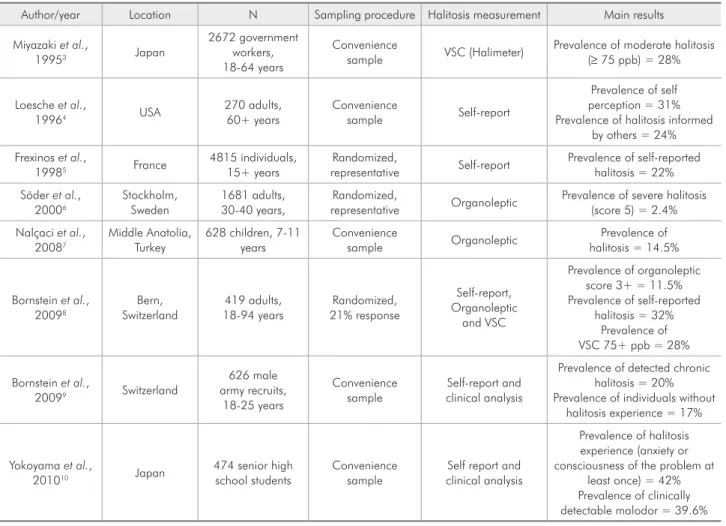
The prevalence of halitosis has been studied in groups of individu-als found in different parts of the world in convenience samples. Dif-ferent assessments and cut-off points are presented. Therefore, precise estimates of the prevalence of halitosis are not possible to obtain. Table 1 describes descriptive epidemiological studies that document the preva-lence of halitosis. They indicate that moderate chronic halitosis affects approximately one third of the groups, whereas severe halitosis may in-volve less than 5% of the population. It is clear that halitosis is a preva-lent problem, and that the dental profession needs to take its responsibil-ity in managing it.
Associated factors
A study in Sweden6 observed that calculus, plaque and scarce dental visits were signiicantly correlated to severe halitosis. A Japanese study3 cor-related periodontitis and tongue coating to VSC scores. Also, severe periodontitis patients presented higher halitosis scores than non-periodontal pa-tients. In the two Swiss studies8,9 tongue coating was considered an inluencing factor for halitosis. Smok-ing and periodontal disease were associated with higher halitosis rankings.8 Plaque and tongue coat-ing were associated with halitosis.10 In children, car-ies experience and age were associated to malodor.7 Whether these associations are causal is not clear.
etiology
The etiology of halitosis has been subject to a historical controversy.2 Dentistry claimed oral
etio-logical factors; however, in order not to undertake the responsibility for treatment, it would sometimes emphasize non-oral causes of halitosis. Thus, the stomach was, for years, blamed for the presence of halitosis. Several studies have demonstrated that the mouth is the origin for the majority of halitosis.2,11 Eighty-seven percent of the incoming patients with severe malodor who attended a specialized clinic for halitosis in Belgium11 had their problem related to oral factors. Gingivitis and periodontitis accounted for approximately 60% of the oral factors and the tongue accounted for the other 40%. A subsequent report by the same group12 found oral factors as responsible for halitosis in 76% of 2000 patients. Therefore, Dentistry is responsible for diagnosing and treating halitosis.
table 1 - Summary of descriptive epidemiological studies concerning halitosis.
Author/year Location N Sampling procedure Halitosis measurement Main results
Miyazaki et al.,
19953 Japan
2672 government workers, 18-64 years
Convenience
sample VSC (Halimeter)
Prevalence of moderate halitosis (≥ 75 ppb) = 28%
Loesche et al.,
19964 USA
270 adults, 60+ years
Convenience
sample Self-report
Prevalence of self perception = 31% Prevalence of halitosis informed
by others = 24%
Frexinos et al.,
19985 France
4815 individuals, 15+ years
Randomized,
representative Self-report
Prevalence of self-reported halitosis = 22%
Söder et al., 20006
Stockholm, Sweden
1681 adults, 30-40 years,
Randomized,
representative Organoleptic
Prevalence of severe halitosis (score 5) = 2.4%
Nalçaci et al., 20087
Middle Anatolia, Turkey
628 children, 7-11 years
Convenience
sample Organoleptic
Prevalence of halitosis = 14.5%
Bornstein et al., 20098
Bern, Switzerland
419 adults, 18-94 years
Randomized, 21% response
Self-report, Organoleptic
and VSC
Prevalence of organoleptic score 3+ = 11.5% Prevalence of self-reported
halitosis = 32% Prevalence of VSC 75+ ppb = 28%
Bornstein et al.,
20099 Switzerland
626 male army recruits,
18-25 years
Convenience sample
Self-report and clinical analysis
Prevalence of detected chronic halitosis = 20% Prevalence of individuals without
halitosis experience = 17%
Yokoyama et al.,
201010 Japan
474 senior high school students
Convenience sample
Self report and clinical analysis
Prevalence of halitosis experience (anxiety or consciousness of the problem at
Periodontal inflammation
The presence of microorganisms and the inlam-matory products present in gingivitis/periodontitis are capable of producing odoriferous substances. Cross-sectional studies associated halitosis to the presence of either gingivitis or periodontitis.3,8,9,11,12
In vitro and in vivo studies demonstrated the ability
of putative periodontal pathogens and products of inlammation to produce volatile odoriferous com-pounds.13,14,15,16 Therefore, the presence of periodon-tal inlammation needs to be considered in the man-agement of halitosis.
tongue coating
Tongue coating, including bacteria, desquamated cells, and saliva, among others, is one of the impor-tant etiological factors of halitosis. A study12 demon-strated that tongue coating was associated with hali-tosis in more than 60% of 2000 patients of a breath clinic, whether present alone, or with periodontal inlammation. Most studies implicate the coating on the posterior area of the tongue which is consistent with the presence of billions of bacteria, including anaerobes that live there and are capable of produc-ing odoriferous substances.17
Microbiology of halitosis
Bacteria from the saliva,18 from plaque removed from gingivitis/periodontitis16 as well as from the tongue17 produce odoriferous substances in vitro. In-tervention studies which achieve a clinically signii-cant effect in reducing halitosis exhibit a reduction in these bacteria.19,20 Therefore, the clinical manage-ment should also include microbiological targets, with antimicrobial approaches – mechanical and chemical – being part of the strategy.
Non-oral causes of halitosis
Ear-nose-throat problems such as tonsillitis, si-nusitis, the presence of out-of-body material and rhi-nitis were frequently associated with non-oral halito-sis in breath clinics.11,12 These studies were unable to ind clinically relevant associations of halitosis with gastroenterological problems. However, two stud-ies21,22 demonstrated a possible association between gastrointestinal problems and halitosis and that their
treatment improves halitosis measurements. Stressful situations also might contribute to increase halito-sis.23 In some individuals, the complaint of halitosis cannot be associated with either the ability of the clinician to detect odors or with the demonstration of VSC in the exhaled air. This paradoxical situation has been classiied as halitophobia, an important psychological problem that needs to be addressed with non-oral clinical strategies.6,12
clinical management
Diagnosis
Self-assessment
The patient cannot smell his own breath and re-lies upon others for this information. It should be emphasized that it is a dificult task to tell someone that he has bad breath. Thus, results from this kind of diagnosis should be interpreted with care. In a breath clinic,11 more than 70% of the patients were advised by others to seek treatment, whereas in an-other study,4 only 24% of the elders were informed that they harbored bad breath. Of course, differences from study populations might explain the dispar-ity in results (the former being from a breath clinic and the latter from a convenience sample of older individuals). In the study by Bornstein et al.,8 a weak correlation was observed between self-reported hali-tosis and clinical measurements.
Organoleptic measurements
vSc monitoring
Objective measurements have always been de-sired for breath assessments. The most common mal-odorants detected in halitosis are VSC which include hydrogen sulide and methyl mercaptans, among others. VSC monitors have been developed, such as the Halimeter (Interscan, Chatsworth, USA) which is used chairside and provides both the patient and the professional an idea of the breath situation. A halim-eter score of ≥ 75 ppb is recognized as clearly detect-ed halitosis. It is important to understand that VSC assessment, as well as other breath diagnostic tools are subjected to great variation, especially between different hours of the day, and are strongly affected by confounders.16
Microbiologic tests
The VSC monitors detect from 18% to 67% of the odors represented by the organoleptic score. This is because the nose is detecting odors due to many other compounds that are in the intra-oral air as a result of microbial metabolism. Most of these com-pounds cannot be easily measured, and some such as volatile fatty acids (butyrate, propionate, etc.), diamines (cadaverine, putrescine) and other foul-smelling products can only be measured by labora-tory based assays.
An alternative strategy would be to detect in plaque, or in the tongue coating, taken from individ-uals with halitosis, those bacteria or their enzyme(s) that can produce these compounds. Three species associated with periodontal disease, Treponema
denticola, Porphyromonas gingivalis and
Tanner-ella forsythia, produce both VSC and volatile fatty
acids. The detection of these bacteria might provide additional information concerning factors contrib-uting to the individual’s malodor. These organisms can be detected by the presence of an enzyme(s) that degrades benzoyl-DL-arginine-naphthylamide (BANA), a synthetic trypsin substrate, forming a col-ored compound. We have adapted this enzyme assay to a 5- to 10-minute chairside test – the BANA Test (BANAMet LLC, Ann Arbor, USA) – that detects the presence of this enzyme(s) in plaque and tongue samples.
The BANA test provides additional information
on compounds other than the VSC that contribute to halitosis. Kozlovsky et al.26 found that the BANA Test correlated signiicantly with the organoleptic scores obtained from the whole mouth, the tongue and saliva, but not with the VSC. When multiple-regression analyses were performed with the organ-oleptic scores as the dependent variable, both peak VSC and the BANA scores factored into the regres-sion, yielding signiicant associations. They conclude that the “BANA test may be a simple, adjunct assay together with volatile sulphide determination in or-der to provide additional quantitative data which contribute to the overall association with odor-judge estimation.”
A connection between BANA-positive bacteria and malodor was observed in English subjects27 us-ing BAPNA as the trypsin-like substrate. Seventy eight percent of the isolates from 23 subjects with organoleptic scores ≥ 3 were BAPNA positive, com-pared with 35% to 40% BAPNA positive isolates in the subjects with organoleptic scores of 2. Sub-sequently, Stomatococcus mucilaginus, a gram-pos-itive, facultative, cocco-bacillus, was identiied as a BAPNA-positive species that is indigenous to the tongue. This indicates that a BANA-positive reaction in the tongue, while indicative of halitosis, is due to the presence of a bacterial lora that may be unique to it.
treatment
Periodontal therapy
Periodontal treatment decreases halitosis. How-ever, studies concerning response to periodontal therapy as the only therapeutic approach for halito-sis are scarce and sometimes the effects are limited, especially because other sources of halitosis are not considered. A study by Silveira et al.28 demonstrated that a strict supragingival plaque control is able to reduce VSC and organoleptic scores in periodonti-tis patients. The studies performed in breath clinics have also demonstrated the ability of periodontal treatment measurements to reduce halitosis.11,12
dimin-ish halitosis. A study concluded that tongue clean-ing was one of the most important approaches for halitosis.29 A systematic review30 demonstrated the potential of tongue cleaning, however the evidence was not convincing. Also, a Cochrane systematic re-view31 demonstrated that there is a little superiority of tongue scrapers as compared to brushing in re-ducing halitosis. Therefore, tongue cleansing is one of the components and should never be a sole treat-ment for halitosis.
Antimicrobials
Since the presence of microorganisms from oral bioilms is responsible for producing malodor, any type of treatment approach that has impact in the oral microbiota has the potential of reducing halito-sis. Mouthrinses, especially chlorhexidine and cetil-pyridinium chloride have been effective in reducing halitosis.20,32 In addition, the use of dentifrices has also been studied. Triclosan containing dentifrices, for example, have demonstrated an interesting po-tential in reducing VSC.33
Medical approaches
If oral approaches are not successful in reducing/ eliminating halitosis, patients should be referred to a physician. If the medical causes cannot be suspected, the irst professional to be referred is the otorhino-laryngologist, followed by the gastroenterologist. If halitophobia is considered, a psychologist or
phsy-chiatrist should be included.11,12,21,22,34
Masking agents
When it is not possible to direct the treatment ap-proach to the cause, masking agents have been devel-oped to decrease the odor. The use of chewing gum may decrease halitosis, especially through increasing salivary secretion.35 Mouthrinses containing chlorine dioxide and zinc salts have a substantial effect in masking halitosis, not allowing the volatilization of the unpleasant odor.20,35 These approaches should be only used temporarily in order to improve satisfac-tion of the patient.
Summary and conclusions
The present review demonstrated that halitosis is a common problem impacting individuals at all ages. The main etiological factors include bacteria in the oral cavity related especially to periodontal diseases and the dorsum of the tongue. Medical aspects in-clude ear-nose-throat and gastroenterological prob-lems. Since the majority of halitosis is related to the mouth, the dental team should lead the treatment, performing dental/periodontal treatment and per-sonalized oral hygiene instructions. Antimicrobials have the potential of reducing halitosis and masking agents should be used temporarily. The literature, es-pecially with randomized clinical trials, is scarce and additional studies are needed.
References
1. American Academy of Periodontology. Glossary of Periodontal Terms. 4th ed. Chicago: American Academy of Periodontol-ogy; 2001. 56 p.
2. Loesche WJ, Kazor C. Microbiology and treatment of halito-sis. Periodontol 2000. 2002 Apr;28:256-79.
3. Miyazaki H, Sakao S, Katoh Y, Takehara T. Correlation be-tween volatile sulphur compounds and certain oral health measurements in the general population. J Periodontol. 1995 Aug;66(8):679-84.
4. Loesche WJ, Grossman N, Dominguez L, Schork MA. Oral malodour in the elderly. In: van Steenberghe D, Rosenberg M, editors. Bad breath: a multidisciplinary approach. Leuven: Leuven University Press; 1996: 181-94.
5. Frexinos J, Denis P, Allemand H, Allouche S, Los F, Bonnelye G. [Descriptive study of digestive functional symptoms in the
French general population]. Gastroenterol Clin Biol. 1998 Oct;22(10):785-91. French.
6. Söder B, Johansson B, Söder PO. The relation between foetor ex ore, oral hygiene and periodontal disease. Swed Dent J. 2000 Mar;24(3):73-82.
7. Nalçaci R, Dülgergil T, Oba AA, Gelgör IE. Prevalence of breath malodour in 7-11-year-old children living in Middle Anatolia, Turkey. Community Dent Health. 2008 Sep;25(3):173-7.
8. Bornstein MM, Kislig K, Hoti BB, Seemann R, Lussi A. Prevalence of halitosis in the population of the city of Bern, Switzerland: a study comparing self-reported and clinical data. Eur J Oral Sci. 2009 Jun;117(3):261-7.
army recruits comparing self-reported and clinical data. J Periodontol. 2009 Jan;80(1):24-31.
10. Yokoyama S, Ohnuki M, Shinada K, Ueno M, Wright FA, Kawaguchi Y. Oral malodor and related factors in Japanese senior high school students. J Sch Health. 2010 Jul;80(7):346-52.
11. Delanghe G, Ghyselen J, Feenstra L, van Steenberghe D. Ex-periences of a Belgian multidisciplinary breath odour clinic. Acta Otorhinolaryngol Belg. 1997; Jan;51(1):43-8.
12. Quirynen M, Dadamio J, Van den Velde S, De Smit M, De-keyser C, Van Tornout M, et al. Characteristics of 2000 pa-tients who visited a halitosis clinic. J Clin Periodontol. 2009 Nov;36(11):970-5.
13. Yoneda M, Masuo Y, Suzuki N, Iwamoto T, Hirofuji T. Re-lationship between the β-galactosidase activity in saliva and parameters associated with oral malodor. J Breath Res. 2010 Mar;4(1):17-8.
14. Kleinberg I, Codipilly M. Modeling of the oral malodor system and methods of analysis. Quintessence Int. 1999 May;30(5):357-69.
15. Salako NO, Philip L. Comparison of the use of the Halimeter and the Oral Chroma in the assessment of the ability of
com-mon cultivable oral anaerobic bacteria to produce malodorous volatile sulfur compounds from cysteine and methionine. Med Princ Pract. 2011 Jan;20(1):75-9.
16. De Boever EH, De Uzeda M, Loesche WJ. Relationship be-tween volatile sulfur compounds, BANA-hydrolyzing bacteria and gingival health in patients with and without complaints of oral malodor. J Clin Dent. 1994;4(4):114-9.
17. Kazor CE, Mitchell PM, Lee AM, Stokes LN, Loesche WJ, Dewhirst FE, et al. Diversity of bacterial populations on the tongue dorsa of patients with halitosis and healthy patients.J Clin Microbiol. 2003 Feb;41(2):558-63.
18. Takeshita T, Suzuki N, Nakano Y, Shimazaki Y, Yoneda M, Hirofuji T, et al. Relationship between oral malodor and the global composition of indigenous bacterial populations in saliva. Appl Environ Microbiol. 2010 May;76(9):2806-14. 19. Shinada K, Ueno M, Konishi C, Takehara S, Yokoyama S,
Zaitsu T,et al. Effects of a mouthwash with chlorine dioxide on oral malodor and salivary bacteria: a randomized placebo-controlled 7-day trial. Trials. 2010 Feb 12;11:14.
20. Fedorowicz Z, Aljufairi H, Nasser M, Outhouse TL, Pedrazzi V. Mouthrinses for the treatment of halitosis. Cochrane Da-tabase Syst Rev. 2008;8(4):CD006701. [citado 27 jun 2011]. Disponível em: http://cochrane.bvsalud.org/cochrane/main. php?lib=COC&searchExp =Mouthrinses%20and%20 for%20and%20the%20and%20treatment%20and%20 of%20and%20halitosis&lang=pt.
21. Moshkowitz M, Horowitz N, Leshno M, Halpern Z. Halitosis and gastroesophageal reflux disease: a possible association. Oral Dis. 2007 Nov;13(6):581-5.
22. Kinberg S, Stein M, Zion N, Shaoul R. The gastrointestinal aspects of halitosis. Can J Gastroenterol. 2010 Sep;24(9):552-6.
23. Queiroz CS, Hayacibara MF, Tabchoury CP, Marcondes FK, Cury JA. Relationship between stressful situations, salivary flow rate and oral volatile sulfur-containing compounds. Eur J Oral Sci. 2002 Oct;110(5):337-40.
24. Rosenberg M, McCulloch CA. Measurement of oral malodor: current methods and future prospects. J Periodontol. 1992 Sep;63(9):776-82.
25. Haas AN, Silveira EM, Rösing CK. Effect of tongue cleansing on morning oral malodour in periodontally healthy individu-als. Oral Health Prev Dent. 2007;5(2):89-94.
26. Kozlovsky A, Gordon D, Gelernter I, Loesche WJ, Rosenberg M. Correlation between the BANA test and oral malodor parameters. J Dent Res. 1994 May;73(5):1036-42.
27. van Steenberghe D, Rosenberg M. Bad Breath: a Multidisci-plinary Approach. 1st. Leuven: Leuven University Press; 1996. Assessment of impressed toothbrush as a method of sampling tongue microbiota; p. 123-34.
28. Silveira EMV, Piccinin FB, Gomes SC, Oppermann RV, Rösing CK. The effect of gingivitis treatment on the breath of chronic periodontitis patients. Oral Health Prev Dent. Forthcoming 2011.
29. Faveri M, Hayacibara MF, Pupio GC, Cury JA, Tsuzuki CO, Hayacibara RM. A cross-over study on the effect of various therapeutic approaches to morning breath odour. J Clin Peri-odontol. 2006 Aug;33(8):555-60.
30. Van der Sleen MI, Slot DE, Van Trijffel E, Winkel EG, Van der Weijden GA. Effectiveness of mechanical tongue cleaning on breath odour and tongue coating: a systematic review. Int J Dent Hyg. 2010 Nov;8(4):258-68.
31. Outhouse TL, Al-Alawi R, Fedorowicz Z, Keenan JV. Tongue scraping for treating halitosis. Cochrane Database Syst Rev. 2006 19;(2):CD005519. [citado 27 jun 2011]. Disponível em: http://cochrane.bvsalud.org/cochrane/main.
php?lib=COC&searchExp =Tongue%20and%20scrap-ing%20and%20for%20and%20treating%20and%20 halitosis&lang=pt.
32. Carvalho MD, Tabchoury CM, Cury JA, Toledo S, Nogueira-Filho GR. Impact of mouthrinses on morning bad breath in healthy subjects. J Clin Periodontol. 2004 Feb;31(2):85-90. 33. Nogueira-Filho GR, Duarte PM, Toledo S, Tabchoury CP,
Cury JA. Effect of triclosan dentifrices on mouth volatile sul-phur compounds and dental plaque trypsin-like activity during experimental gingivitis development. J Clin Periodontol. 2002 Dec;29(12):1059-64.
34. Iwu CO, Akpata O. Delusional halitosis. Review of the literature and analysis of 32 cases. Br Dent J. 1990 Apr 7;168(7):294-6.