Article
0103 - 5053 $6.00+0.00
*e-mail: [email protected]
Chemoselective Synthesis of Novel Thiatriazolophanes
Madhukar S. Chande,* Kiran A. Puthamane, Pravin A. Barve, Rahul R. Khanwelkar and
Deepak S. Venkataraman
Department of Chemistry, The Institute of Science, 15, Madam Cama Road, Mumbai 400 032, India
Bis-[4-alquil/aril-5-tia-1,2,4-triazóis] foram preparados pela fusão de diácidos e tiosemicar-bazidas, pela condensação de hidrazidas ácidas aromáticas com isotiocianato. A alquilação qui-miosseletiva destes bis-[4-alquil/aril-5-tia-1,2,4-triazóis] com 1,W-dihaloalcanos na presença de hidróxido de potássio em metanol aquoso, proporcionou N-alquil/aril tiatriazolofanos inéditos.
Bis-[4-alkyl/aryl-5-thia-1,2,4-triazoles] were prepared by fusion of diacids and thiosemicarba-zides by condensation of aromatic acid hydrathiosemicarba-zides with isothiocyanate. Chemoselective alkylation of these bis-[4-alkyl/aryl-5-thia-1,2,4-triazoles] with 1,W-dihaloalkanes in presence of potassium hydroxide in aqueous methanol afforded novel N-alkyl/aryl thiatriazolophanes.
Keywords: 4-alkyl/aryl-5-thia-1,2,4-triazoles, 1,W-dihaloalkanes, N-alkyl/aryl thiatriazolophanes, chemoselectivity
Introduction
Crown compounds have generated considerable interest during the last three decades because of their ability to form stable complexes with a variety of metal and organic cations and anions.1 They also have wide applications in phase transfer catalysis.2 In recent years various structural changes have been made to the basic “crown ether” structure in order to enhance the selective activity of the ligands.3 These changes involve the insertion of aromatic and/or heterocyclic ring systems into the macrocycles. Incorporation of heterocyclic subunit provides rigidity to the macrocycle and contributes in increasing the stability of complexes formed with both metals and organic cations.3 The development of crown compounds especially macrocyclic compounds containing heterocyclic subunit has gained importance due to their wide range of applications. Several reviews and monographs have been published which highlight their synthesis and application in synthetic organic chemistry as phase transfer catalysts and in analytical chemistry as ligand for complexation.2,4
In recent years, attention has been increasingly paid to the synthesis of bisheterocyclic compounds, which exhibit various biological activities.5 including antibacterial, antifungicidal, tuberculostatic and plant growth regulative properties. Bisheterocyclic compounds displayed much better antibacterial activity than heterocyclic compounds.6 Various 1,2,4-triazoles are found to be associated with diverse pharmacological activities such as antiasthmatic,7 antiviral (ribavirin),8 antifungal (fluconazole),9 antimicrobial,10 antibacterial,11 insecticidal,11,12 amoebicidal,13 hypnotic,14 cytotoxic,15 and hypotensive16 activities. This moiety was also found in potent agonist and antagonist receptor ligands,17 in HIV-1 protease inhibitors18 and in thrombin inhibitors.19 Along with these significant pharmaceutical uses, 1,2,4-triazole derivatives are effectively used in polymers, dyestuff, photographic chemicals and agricultural chemicals.20
Results and Discussion
The present work describes a versatile synthetic strategy for the chemoselective synthesis of novel N-alkyl/aryl thiatriazolophanes. Obtained heterophanes would be similar to lariat ether23 with N-alkyl/aryl groups as side arm. The study of the stereochemistry of these compounds is of interest as the two N- alkyl/aryl groups would be either cis or trans to each other depending on the alkyl chain joining the two heterocyclic units and the thermodynamic stability of the molecule.
There are many methods described in the literature for the synthesis of N-substituted-1,2,4-triazoles,20 but none of them concerns the synthesis of heterophanes. Bis N-alkyl/ aryl thiatriazoles 3a-c were prepared in good yield by direct fusion of adipic acid 1 with thiosemicarbazides 2a-c, according to Xu method24(Scheme 1). This compound 3 containing thioamido groups has an amphoteric nature and can exist in tautomeric forms 3A and 3B. On alkylation of 3 with 1,W-dihaloalkane, multiple products could form depending on the reactions conditions.
Reaction of compounds 3a-c with diiodoalkanes 4a-f in aq. methanol (80%) in the presence of potassium hydroxide as a base gave only products 5a-nchemoselectively in good yield (Scheme 1, Table 1). The reaction was carried out in large excess of solvent to ensure intramolecular cyclisation (high dilution condition).
The elucidation of structures 5a-n was accomplished on the basis of their spectral data and elemental analysis (Table 1). For example, reaction of 3a with 1,2 diio-doethane 4b resulted in the formation of the desired
N-ethylthiatriazolophane 5b, confirmed on the basis of NMR spectra. 1H NMR spectrum of the compound showed triplet at D 4.10 for S-CH2 group of ethane chain. Absence of peak for C=S in 13C NMR spectrum con-firmed the chemoselectivity of S-alkylation. It showed signal for S-CH2 carbon at 32.1 ppm. From the above data compound 5c was identified as 14,64 -diethyl-7,11-dithia-1,6(3,5)-di-(1,2,4-triazola)cycloundecaphane.25 The other thiatriazolophanes 5a-n were similarly syn-thesized and characterized.
In order to improve the solubility of the thiatriazolophanes, it was thought to incorporate a phenyl nucleus into the structure, which would also help in complexation by PTC. Hence, the scope of the previous reaction was extended to the synthesis of benzotriazolophanes 9 (Scheme 2). Bistriazoles
8 was synthesized in high yield, by reacting isophthalic acid dihydrazide 6 with phenyl/o-tolyl isothiocyanates 7.
The reaction of 8a-b with 4a-g in aqueous methanol (80%) in the presence of potassium hydroxide as a base gave desired benzotriazolophanes9a-l chemoselectively in moderate yield (Scheme 2, Table 1). Structures of the products were confirmed on the basis of spectral data and elemental analysis (Table 1). For example, reaction of 8a with 1,2-diiodoethane 4b
resulted in the formation of desired benzotriazolophane 9a, confirmed on the basis of NMR spectra. 1H NMR spectrum of the compound showed triplet at D 3.46 for S-CH2 group of ethane chain. Absence of peak for C=S in 13C NMR spectrum confirmed the chemoselectivity of S-alkylation. It showed signals for S-CH2 carbons at 31.8 ppm.
Reagents and conditions: (a) 140 oC, fusion; (b) KOH, aq. MeOH (80%), 80 oC.
Reagents and conditions: (a) i) methanol, 75 oC, ii) KOH, 140 oC, heating; (b) KOH, aq. MeOH (80%), 80 oC.
Scheme 2. Synthesis of benzotriazolophanes 9.
Reagents and conditions: (a) 140 oC, fusion; (b) KOH, aq. MeOH (80%), 80 oC.
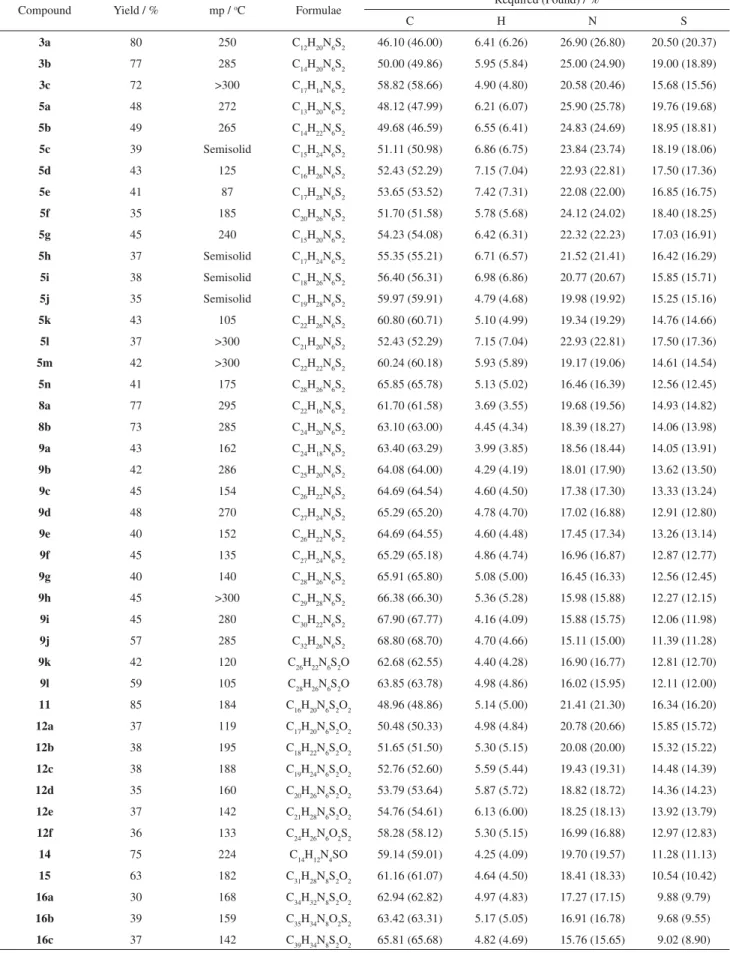
Table 1. Preparation and analytical data of compounds
Compound Yield / % mp / oC Formulae Required (Found) / %
C H N S
3a 80 250 C12H20N6S2 46.10 (46.00) 6.41 (6.26) 26.90 (26.80) 20.50 (20.37)
3b 77 285 C14H20N6S2 50.00 (49.86) 5.95 (5.84) 25.00 (24.90) 19.00 (18.89)
3c 72 >300 C17H14N6S2 58.82 (58.66) 4.90 (4.80) 20.58 (20.46) 15.68 (15.56)
5a 48 272 C13H20N6S2 48.12 (47.99) 6.21 (6.07) 25.90 (25.78) 19.76 (19.68)
5b 49 265 C14H22N6S2 49.68 (46.59) 6.55 (6.41) 24.83 (24.69) 18.95 (18.81)
5c 39 Semisolid C15H24N6S2 51.11 (50.98) 6.86 (6.75) 23.84 (23.74) 18.19 (18.06)
5d 43 125 C16H26N6S2 52.43 (52.29) 7.15 (7.04) 22.93 (22.81) 17.50 (17.36)
5e 41 87 C17H28N6S2 53.65 (53.52) 7.42 (7.31) 22.08 (22.00) 16.85 (16.75)
5f 35 185 C20H26N6S2 51.70 (51.58) 5.78 (5.68) 24.12 (24.02) 18.40 (18.25)
5g 45 240 C15H20N6S2 54.23 (54.08) 6.42 (6.31) 22.32 (22.23) 17.03 (16.91)
5h 37 Semisolid C17H24N6S2 55.35 (55.21) 6.71 (6.57) 21.52 (21.41) 16.42 (16.29)
5i 38 Semisolid C18H26N6S2 56.40 (56.31) 6.98 (6.86) 20.77 (20.67) 15.85 (15.71)
5j 35 Semisolid C19H28N6S2 59.97 (59.91) 4.79 (4.68) 19.98 (19.92) 15.25 (15.16)
5k 43 105 C22H26N6S2 60.80 (60.71) 5.10 (4.99) 19.34 (19.29) 14.76 (14.66)
5l 37 >300 C21H20N6S2 52.43 (52.29) 7.15 (7.04) 22.93 (22.81) 17.50 (17.36)
5m 42 >300 C22H22N6S2 60.24 (60.18) 5.93 (5.89) 19.17 (19.06) 14.61 (14.54)
5n 41 175 C28H26N6S2 65.85 (65.78) 5.13 (5.02) 16.46 (16.39) 12.56 (12.45)
8a 77 295 C22H16N6S2 61.70 (61.58) 3.69 (3.55) 19.68 (19.56) 14.93 (14.82)
8b 73 285 C24H20N6S2 63.10 (63.00) 4.45 (4.34) 18.39 (18.27) 14.06 (13.98)
9a 43 162 C24H18N6S2 63.40 (63.29) 3.99 (3.85) 18.56 (18.44) 14.05 (13.91)
9b 42 286 C25H20N6S2 64.08 (64.00) 4.29 (4.19) 18.01 (17.90) 13.62 (13.50)
9c 45 154 C26H22N6S2 64.69 (64.54) 4.60 (4.50) 17.38 (17.30) 13.33 (13.24)
9d 48 270 C27H24N6S2 65.29 (65.20) 4.78 (4.70) 17.02 (16.88) 12.91 (12.80)
9e 40 152 C26H22N6S2 64.69 (64.55) 4.60 (4.48) 17.45 (17.34) 13.26 (13.14)
9f 45 135 C27H24N6S2 65.29 (65.18) 4.86 (4.74) 16.96 (16.87) 12.87 (12.77)
9g 40 140 C28H26N6S2 65.91 (65.80) 5.08 (5.00) 16.45 (16.33) 12.56 (12.45)
9h 45 >300 C29H28N6S2 66.38 (66.30) 5.36 (5.28) 15.98 (15.88) 12.27 (12.15)
9i 45 280 C30H22N6S2 67.90 (67.77) 4.16 (4.09) 15.88 (15.75) 12.06 (11.98)
9j 57 285 C32H26N6S2 68.80 (68.70) 4.70 (4.66) 15.11 (15.00) 11.39 (11.28)
9k 42 120 C26H22N6S2O 62.68 (62.55) 4.40 (4.28) 16.90 (16.77) 12.81 (12.70)
9l 59 105 C28H26N6S2O 63.85 (63.78) 4.98 (4.86) 16.02 (15.95) 12.11 (12.00)
11 85 184 C16H20N6S2O2 48.96 (48.86) 5.14 (5.00) 21.41 (21.30) 16.34 (16.20)
12a 37 119 C17H20N6S2O2 50.48 (50.33) 4.98 (4.84) 20.78 (20.66) 15.85 (15.72)
12b 38 195 C18H22N6S2O2 51.65 (51.50) 5.30 (5.15) 20.08 (20.00) 15.32 (15.22)
12c 38 188 C19H24N6S2O2 52.76 (52.60) 5.59 (5.44) 19.43 (19.31) 14.48 (14.39)
12d 35 160 C20H26N6S2O2 53.79 (53.64) 5.87 (5.72) 18.82 (18.72) 14.36 (14.23)
12e 37 142 C21H28N6S2O2 54.76 (54.61) 6.13 (6.00) 18.25 (18.13) 13.92 (13.79)
12f 36 133 C24H26N6O2S2 58.28 (58.12) 5.30 (5.15) 16.99 (16.88) 12.97 (12.83)
14 75 224 C14H12N4SO 59.14 (59.01) 4.25 (4.09) 19.70 (19.57) 11.28 (11.13)
15 63 182 C31H28N8S2O2 61.16 (61.07) 4.64 (4.50) 18.41 (18.33) 10.54 (10.42)
16a 30 168 C34H32N8S2O2 62.94 (62.82) 4.97 (4.83) 17.27 (17.15) 9.88 (9.79)
16b 39 159 C35H34N8O2S2 63.42 (63.31) 5.17 (5.05) 16.91 (16.78) 9.68 (9.55)
To further explore the chelating properties of benzo-triazolophanes, it was decided to incorporate “-O-“ link-age in the heterophane skeleton. Hence, in continuation to this work on benzotriazolophanes, 3-carboxymethoxy phenoxyacetic acid 10 was fused with 4-ethyl thiosemi-carbazide2a to give compound 11 in high yield (Scheme 3). When 11 was reacted with 1,3-diiodopropane 4c in methanolic potassium hydroxide, compound 12c was afforded chemoselectively in moderate yield (Scheme 3, Table 1). Structure of the product was confirmed on the basis of spectral data and elemental analysis (Table 1). 1H NMR spectrum of the compound showed triplet at D 3.62 for S-CH2 group of propane chain and quintet at D 3.02 for the central propyl -CH2. The other thiatriazolophanes 12a-f
were similarly synthesized and characterized.
We have discussed in detail the chemoselective N-alkylation22 and S-alkylation21,22 for the synthesis of triazolophanes. In continuation to our work on O-alkylation for the synthesis of heterophanes with amino side arms,22 we now report the synthesis of novel N-substituted benzotriazolophanes. Salicylic acid hydrazide 13 was reacted with phenyl hydrazine, carbon disulphide and potassium hydroxide in methanol to give compound 14 in high yield (Scheme 4). When 14 was reacted with 1,3-diiodopropane in methanolic potassium hydroxide, compound 15 was afforded chemoselectively
in good yield (Scheme 4, Table 1). Benzotriazolophanes
16a-c were subsequently synthesized in moderate yield by reacting 15 with diiodoalkanes in aqueous methanol (80%) containing potassium hydroxide (Scheme 4, Table 1). Structures of the products were confirmed on the basis of spectral data and elemental analysis (Table 1). For example, reaction of 15 with 1,3-diiodopropane resulted in the formation of the desired compound 16a, which was confirmed on the basis of NMR spectra. 1H NMR spectrum of the compound showed triplet at D 3.62 for -SCH2 group of propane chain and triplet at D 4.18 for the propyl -OCH2 groups. M+ peak at m/z 648 in mass spectrum confirmed the formation of 16a.
Conclusion
In this paper, we have reported a versatile and convenient route for the synthesis of novel N-alkyl/aryl thiatriazolophanes from aliphatic and aromatic acids.
Experimental
The NMR spectra were recorded on Bruker AMX 500 spectrometer at 25 oC. Melting points were taken in open capillaries and are uncorrected. Mass spectra were recorded on Shimadzu GC-MS instrument.
Reagents and conditions: (a) (i) CS2, KOH, MeOH, 0-5
oC, (ii) PhNHNH 2, fusion, 140
oC; (b) KOH, aq. MeOH (80%), 80 oC.
General procedure for the synthesis of bis-(4-alkyl/aryl-5-mercapto-1,2,4-triazol-3-yl)butane (3a-c)
0.01 mol of adipic acid and 0.02 mol of alkyl/aryl thiosemicarbazide were mixed together using mortar and pestle. This mixture was fused on oil-bath at 140 oC for 4h, and then cooled to room temperature and the obtained solid mass was dumped into ice-cold water. Brown colored mass was separated by filteration and washed thoroughly with water. Then it dissolved in aqueous 10% sodium hydroxide solution and the insoluble impurities were removed by filtration. The filtrate was then acidified using aqueous 1 mol L-1 HCl till the pH of the solution became 2. Separated white colored product was filtered, washed with water and dried under vacuum.
Bis-(4-ethyl-5-mercapto-1,2,4-triazol-3-yl)butane (3a)
1H NMR, (DMSO d
6): D 13.51 (s, 2H, 2NH, D2O exchangeable), 3.92 (q, 4H, 2NCH2), 2.70 (t, 4H, 2CH2), 1.91 (p, 4H, 2CH2), 1.16 (t, 6H, 2CH3).13C NMR (DMSO d6): D 165.0 (2C=S), 155.4 (2C=N), 39.2 (2NCH2), 25.9 (2CH2), 24.0 (2CH2), 15.7 (2CH3).
Bis-(4-allyl-5-mercapto-1,2,4-triazol-3-yl)butane (3b)
1H NMR (DMSO d
6): D 13.60 (s, 2H, 2NH, D2O exchangeable), 5.87 (m, 2H, 2 =CH), 5.17, 4.98 (dd, 4H, 2=CH2), 4.61(d, 4H, 2NCH2), 2.51 (t, 4H, 2CH2), 1.72 (p, 4H, 2CH2).
Bis-(4-phenyl-5-mercapto-1,2,4-triazol-3-yl)butane (3c)
1H NMR (DMSO d
6): D 13.60 (s, 2H, NH, D2O exchangeable), 7.55-7.33 (m, 10H, Aromatic H), 2.32 (t, 2H, 2CH2), 1.38 (p, 4H, 2CH2).13C NMR (DMSO d
6):D 167.6 (2C=S), 151.7 (2C=N), 133.6-128.2 (12 Aromatic C), 24.6 (2CH2), 24.1(2CH2).
General procedure for the synthesis of 5a-n,8a-l,12a-f,
15 and 16a-c
Compounds3a-c,7a-b,11, 14 and 15 (respectively for the synthesis of 5a-n, 8a-l, 12a-f, 15 and 16a-c) (0.01 mol) were dissolved in aqueous methanol (80:20, methanol:water; 200 mL) containing potassium hydroxide (0.02 mol). A solution of 1,W-dihaloalkane (0.01 mol) in methanol was added dropwise for an hour. This reaction mixture was then refluxed with stirring on a magnetic stirrer for eight hours. On cooling it to 10-15 oC, a solid separated out. This solid was then separated by filtration, washed with cold water and recrystallised from aqueous dimethyl formamide (DMF).
14,64-Diethyl-7,9-dithia-1,6(3,5)-di-(1,2,4-triazola)
cyclononaphane (5a)
1H NMR (CDCl
3):D 4.70 (s, 2H, -CH2), 3.91 (q, 4H, 2NCH2), 2.61 (t, 4H, 2CH2), 2.10 (p, 4H, 2CH2), 1.16 (t, 6H, 2CH3).13C NMR (DMSO d
6):D 155.6 (2S-C=N), 146.6 (2CH2-C=N), 40.7 (CH2), 39.2 (2NCH2), 25.9 (2CH2), 25.0 (2CH2), 15.7 (2CH3).
14,64-Diethyl-7,10-dithia-1,6(3,5)-di-(1,2,4-triazola)
cyclodecaphane (5b)
1H NMR (CDCl
3):D 4.10 (t, 4H, 2SCH2), 3.76 (q, 4H, 2NCH2), 3.03 (t, 4H, 2CH2), 2.49 (p, 4H, 2CH2), 1.30 (t, 6H, 2CH3).13C NMR (DMSO d
6):D 156.3 (2S-C=N), 147.0 (2CH2-C=N), 39.1 (2NCH2), 32.1 (1SCH2), 24.7 (2CH2), 23.1 (2CH2), 15.3 (2CH3). MS (DI) (m/z): 338 (M+).
14,64-Diethyl-7,11-dithia-1,6(3,5)-di-(1,2,4-triazola)
cycloundecaphane (5c)
1H NMR (CDCl
3):D 3.87 (q, 4H, 2NCH2), 3.31 (t, 4H, 2SCH2), 2.76 (t, 4H, 2CH2), 2.10 (p, 2H, 1CH2), 1.95 (p, 4H, 2CH2), 1.30 (t, 6H, 2CH3).13C NMR (DMSO d
6):D 153.5 (2S-C=N), 149.6 (2CH2-C=N), 39.8 (2NCH2), 36.2 (2SCH2), 28.2 (CH2), 25.9 (2CH2), 24.3 (2CH2), 15.4 (2CH3).
14,64-Diethyl-7,12-dithia-1,6(3,5)-di-(1,2,4-triazola)
cyclododecaphane (5d)
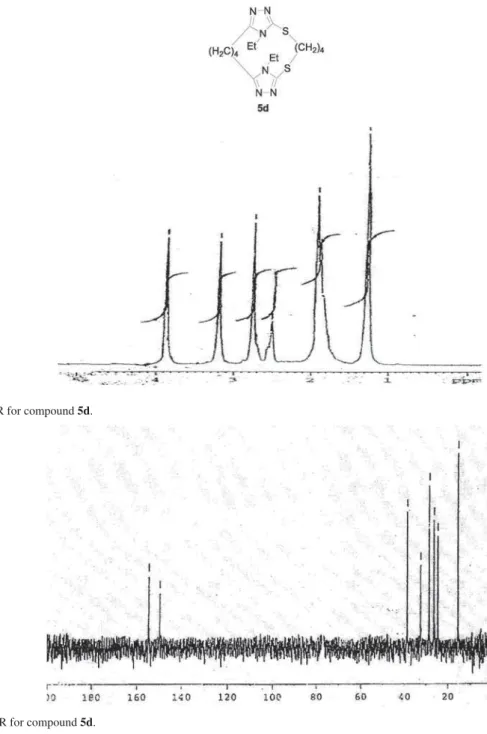
1H NMR (CDCl
3): D 3.86 (q, 4H, 2NCH2), 3.20 (t, 4H, 2SCH2), 2.72 (t, 4H, 2CH2), 2.03 (p, 4H, 2CH2), 1.84 (p, 4H, 2CH2),1.28 (t, 6H, 2CH3).13C NMR (DMSO d
6): D 154.8 (2S-C=N), 149.7 (2CH2-C=N), 38.6 (2NCH2), 32.5 (2SCH2), 28.4 (2CH2), 26.3 (2CH2), 24.6 (2CH2), 15.3 (2CH3).
14,64-Diethyl-7,13-dithia-1,6(3,5)-di-(1,2,4-triazola)
cyclotridecaphane (5e)
1H NMR (CDCl
3):D 3.87 (q, 4H, 2NCH2), 3.19 (t, 4H, 2SCH2), 2.76 (t, 4H, 2CH2), 1.94 (p, 4H, 2CH2), 1.75 (p, 4H, 2CH2), 1.52 (p, 2H, 1CH2), 1.25 (t, 6H, 2CH3).13C NMR (DMSO d6):D 154.8 (2S-C=N), 149.9 (2CH2-C=N), 38.6 (2NCH2), 32.9 (2SCH2), 28.2 (2CH2), 26.3 (2CH2), 24.6 (1CH2), 24.1 (2CH2), 15.3 (2CH3).
14,64-Diallyl-7,9-dithia-1,6(3,5)-di-(1,2,4-triazola)
cyclononaphane (5f)
1H NMR (DMSO d
14,64-Diallyl-7,11-dithia-1,6(3,5)-di-(1,2,4-triazola)
cycloundecaphane (5g)
1H NMR (DMSO d
6):D 5.81 (m, 2H, 2=CH), 5.19 (dd, 4H, 2 =CH2), 4.55 (d, 4H, 2NCH2), 3.24 (t, 4H, 2CH2), 2.73 (t, 4H, 2CH2), 1.98 (p, 2H, 1CH2), 1.89 (p, 4H, 2CH2). 13C NMR (DMSO d
6):D 155.4 (2S-C=N), 149.4 (2-C-C=N), 131.3 (2C=CH), 117.8 (2C=CH2), 45.8 (2CH2), 32.1 (2NCH2), 29.3 (2CH2), 26.1 (CH2), 24.2 (2CH2).
14,64-Diallyl-7,12-dithia-1,6(3,5)-di-(1,2,4-triazola)
cyclododecaphane (5h)
1H NMR (DMSO d
6):D 5.82 (m, 2H, 2=CH), 5.10 (dd, 4H, 2 =CH2), 4.58(d, 4H, 2NCH2), 3.13 (t, 4H, 2CH2), 2.50 (t, 4H, 2CH2), 2.01 (p, 4H, 1CH2), 1.72 (p, 4H, 2CH2). 13C NMR (DMSO d
6):D 155.5 (2S-C=N), 149.1 (2C-C=N), 131.1 (2C=CH), 117.9 (2C=CH2), 45.7 (2SCH2), 32.6 (2NCH2), 28.4 (2CH2), 23.8 (2CH2), 23.5 (2CH2).
14,64-Diallyl-7,13-dithia-1,6(3,5)-di-(1,2,4-triazola)
cyclotridecaphane (5i)
1H NMR (DMSO d
6):D 5.82 (m, 2H, 2=CH), 5.07 (dd, 4H, 2=CH2), 4.24 (d, 4H, 2NCH2), 3.35 (t, 4H, 2CH2), 2.66 (t, 4H, 2CH2), 1.90 (p, 4H, 1CH2), 1.72 (p, 4H, 2CH2), 1.58 (p, 2H, 1CH2).13C NMR (DMSO d
6):D 155.2 (2S-C=N), 150.4 (2C-C=N), 131.8 (2 C=CH), 117.8 (2 C=CH2), 45.5 (2CH2), 33.1 (2NCH2), 28.9 (2CH2), 28.1 (2CH2), 25.3 (CH2), 24.5 (2CH2).
14,64
-Diphenyl-7,9-dithia-1,6(3,5)-di-(1,2,4-triazola)cy-clononaphane (5j)
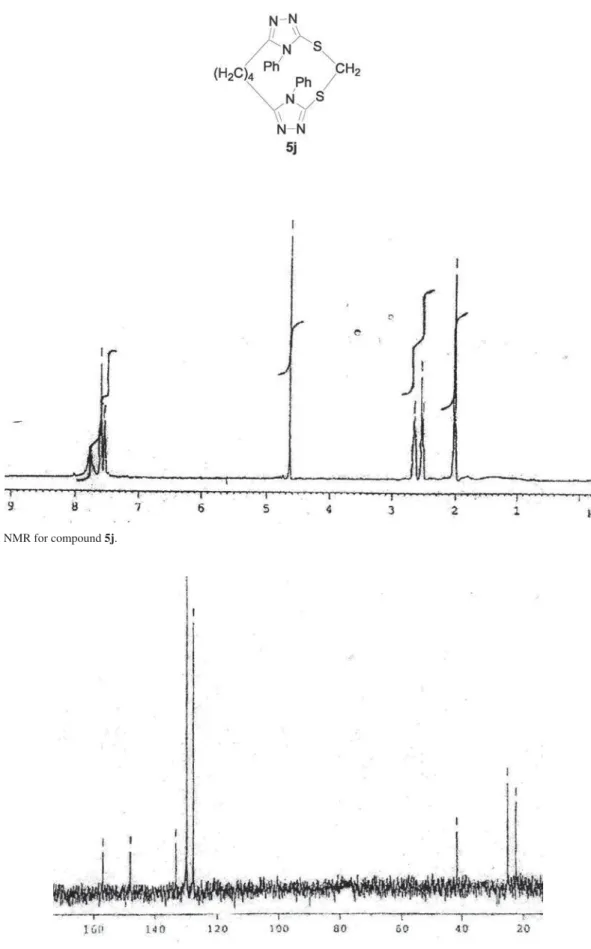
1H NMR (DMSO d
6):D 7.52 -7.77 (m, 10H, Aromatic H), 4.64 (s, 2H, CH2), 2.52 (t, 4H, 2CH2), 2.00 (p, 4H, 2CH2).13C NMR (DMSO d
6): D 157.0 (2S-C=N), 148.8 (2C-C=N), 133.3-127.6 (12 Aromatic C), 41.5 (CH2), 25.0 (2CH2), 22.3 (2CH2).
14,64-Diphenyl-7,10-dithia-1,6(3,5)-di-(1,2,4-triazola)
cyclodecaphane (5k)
1H NMR (DMSO d
6):D 7.63-7.55 (m, 10H, Aromatic H), 2.86 (t, 4H, 2CH2), 2.64 (t, 4H, 2CH2), 1.96 (p, 4H, 2CH2).13C NMR (DMSO d
6): D 158.0 (2S-C=N), 148.8 (2C-C=N), 133.3-127.9 (12 Aromatic C), 32.1 (2CH2), 25.1 (2CH2), 23.1 (2CH2).
14,64
–Diethyl-9(1,2)-benzena–7,11-dithia–1,3(3,5)(5,3)-di-(1,2,4–triazola)cycloundecaphane (5l)
1H NMR (CDCl
3):D 7.73-6.95 (m, 4H, Aromatic H), 4.72 (s, 4H, 2SCH2), 3.80 (q, 4H, 2NCH2), 2.76 (t, 4H, 2CH2), 2.00 (p, 4H, 2CH2), 1.17 (t, 6H, 2CH3).13C NMR (DMSO d6):D 155.5 (2S-C=N), 149.6 (2C-C=N), 133.0-125.0 (6 Aromatic C), 45.7 (2SCH2), 36.0 (2NCH2), 25.9
(2CH2), 24.6 (2CH2), 15.4 (2CH3).
14,64
–Diallyl-9(1,2)-benzena–7,11-dithia–1,3(3,5)(5,3)-di-(1,2,4–triazola)cycloundecaphane (5m)
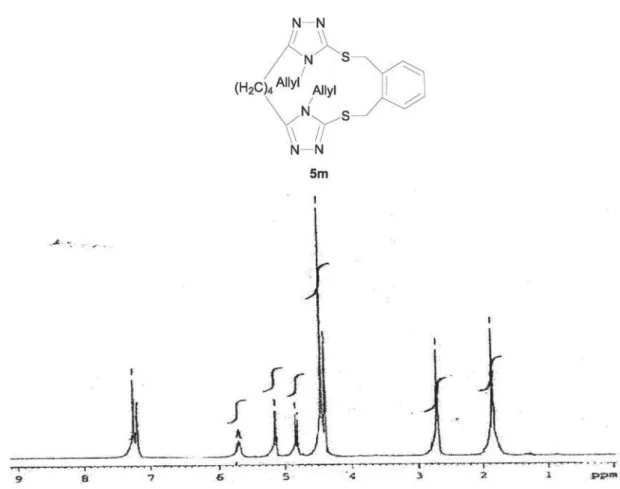
1H NMR (DMSO d
6):D 7.63-7.04 (m, 4H, Aromatic H), 5.74 (m, 2H, 2C=CH), 5.16 (dd, 4H, 2C=CH2), 4.73 (s, 4H, 2SCH2), 4.38 (d, 4H, 2NCH2), 2.71 (t, 4H, 2CH2), 1.72 (p, 4H, 2CH2).13C NMR (DMSO d
6):D 155.5 (2S-C=N), 149.6 (2C-(2S-C=N), 133.0-125.0 (6 Aromatic C), 131.2 (2C=CH), 117.8 (2C=CH2), 45.7 (2SCH2), 36.0 (2NCH2), 25.9 (2CH2), 24.6 (2CH2).
14,64
–Diphenyl-9(1,2)-benzena–7,11-dithia–1,3(3,5)(5,3)-di-(1,2,4–triazola)cycloundecaphane (5n)
1H NMR (DMSO d
6):D 7.65-7.15 (m, 14H, Aromatic H), 4.82 (s, 4H, 2SCH2), 2.69 (t, 4H, 2CH2), 2.03 (p, 4H, 2CH2).13C NMR (DMSO d
6): D 158.0 (2S-C=N), 148.8 (2C-C=N), 133.3-127.9 (18 Aromatic C), 38.0 (2SCH2), 25.1 (2CH2), 23.2 (2CH2).
14,34
-Diphenyl–2(1,3)-benzena–4,7–dithia–1,3(3,5)(5,3)-di–(1,2,4–triazola)cycloheptaphane (9a)
1H NMR (DMSO d
6):D 7.58-7.22 (m, 14H, Aromatic H), 3.46 (t, 4H, 2SCH2).13C NMR (DMSO d
6):D 153.6, 151.3 (4C=N), 133.4-127.0 (18x Aromatic C), 31.8 (2SCH2). MS (DI) (m/z): 454 (M+).
14,34-Diphenyl–2(1,3)-benzena–4,8–dithia–1,3(3,5)(5,3)-di–(1,2,4–triazola)cycloctaphane (9b)
1H NMR (DMSO d
6):D 7.68-7.28 (m, 14H, Aromatic H), 3.23 (t, 4H, 2SCH2), 1.96 (p, 2H, CH2). MS (DI) (m/z): 468 (M+).
14,34
-Diphenyl–2(1,3)-benzena–4,9–dithia–1,3,(3,5)(5,3)-di–(1,2,4–triazola)cyclononaphane (9c)
1H NMR (DMSO d
6):D 7.55-7.19 (m, 14H, Aromatic H), 3.13 (t, 4H, 2 SCH2), 1.73 (p, 4H, 2 CH2).13C NMR (DMSO d6): D 153.4, 152.0 (4C=N), 133.5-124.8 (18 Aromatic C), 35.7 (2SCH2), 31.4 (2CH2). MS (DI) (m/z): 482 (M+).
14,34
-Diphenyl–2(1,3)-benzena–4,10–dithia–1,3(3,5)(5,3)-di–(1,2,4–triazola)cyclodecaphane (9d)
1H NMR (DMSO d
6):D 7.51-7.21 (m, 14H, Aromatic H), 3.05 (t, 4H, 2SCH2), 1.64 (p, 4H, 2CH2), 1.33 (p, 2H, CH2). MS (DI) (m/z): 496 (M+).
14,34–Di-[(2’
-methyl)phenyl]–2(1,3)6(1,2)–dibenzena-4,7-dithia–1(3,5)3(5,3)–di–(1,2,4-triazola)cycloheptaphane (9e)
1H NMR (DMSO d
H), 5.52 (t, 4H, 2SCH2), 1.90 (s, 3H, CH3), 1.85 (s, 3H, CH3).13C NMR (DMSO d
6): 151.0, 149.0 (4C=N), 135.6-118.7 (18 Aromatic C), 41.9, 31.4 (2SCH2), 17.4, 17.3 (2CH3). MS (DI) (m/z): 482 (M+).
14,34–Di-[(2’-methyl)phenyl]–2(1,3)6(1,2)–dibenzena-4,
8-dithia–1(3,5)3(5,3)–di–(1,2,4-triazola)cycloctaphane (9f)
1H NMR (DMSO d
6):D 7.32-7.13 (m, 12H, Aromatic H), 3.76 (t, 4H, 2SCH2), 2.06 (p, 2H, CH2), 1.92 (s, 3H, CH3), 1.87 (s, 3H, CH3).13C NMR (DMSO d
6):D 153.8, 152.6 (4C=N), 135.6-126.5 (18 Aromatic C), 30.8, 30.6 (2SCH2), 28.7 (CH2), 17.7, 17.4 (2CH3). MS (DI) (m/z): 496 (M+).
14,34–Di-[(2’-methyl)phenyl]–2(1,3)6(1,2)–dibenzena-4,
9-dithia–1(3,5)3(5,3)–di–(1,2,4-triazola)cyclononaphane (9g)
1H NMR (DMSO d
6):D 7.80-7.09 (m, 12H, Aromatic H), 3.31 (t, 4H, 2SCH2), 1.93 (s, 3H, CH3), 1.85 (p, 4H, 2CH2), 1.80 (s, 3H, CH3).13C NMR (DMSO d
6):D 153.8, 153.1 (4C=N), 135.6-127.4 (18x Aromatic C), 31.4, 31.3 (2SCH2), 28.3 (CH2), 17.5, 17.4 (2CH3). MS (DI) (m/z): 510 (M+).
14,34–Di-[(2’-methyl)phenyl]–2(1,3)6(1,2)–dibenzena-4,
10-dithia–1(3,5)3(5,3)–di–(1,2,4-triazola)cyclodecaphane (9h)
1H NMR (DMSO d
6):D 7.60-7.12 (m, 12H, Aromatic H), 3.21 (t, 4H, 2SCH2), 1.91 (s, 3H, CH3), 1.89 (s, 3H, CH3), 1.68 (q, 4H, 2CH2), 1.55 (p, 2H, CH2).13C NMR (DMSO d6): D 153.8, 153.2 (4C=N), 135.5-127.4 (18 Aromatic C), 32.2, 31.8 (2SCH2), 28.7, 27.2 (3CH2), 17.3 (CH3). MS (DI) (m/z): 524 (M+).
14,34–Diphenyl-2(1,3)6(1,2)-dibenzena–4,8-dithia–1,3(3,5)
(5,3)-di-(1,2,4–triazola)cycloctaphane (9i)
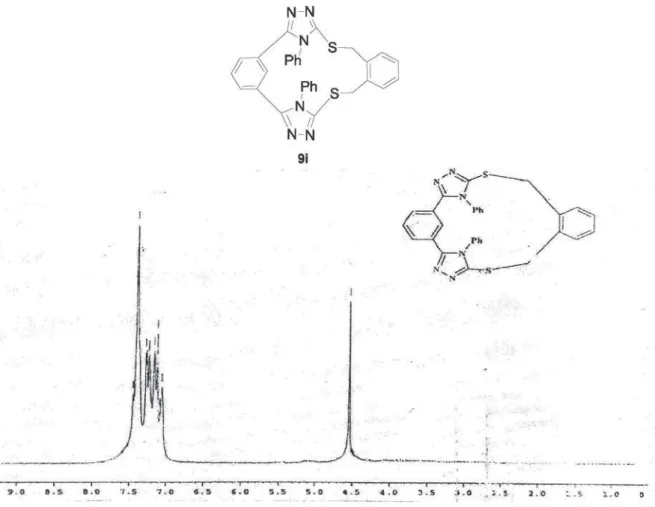
1H NMR (DMSO d
6)D 7.57-7.05 (m, 14H, Aromatic H), 4.53 (s, 4H, 2SCH2).13C NMR (DMSO d
6):D154.4, 152.4 (4C=N), 135.9-127.8 (24 Aromatic C), 34.7 (2SCH2). MS (DI) (m/z): 530 (M+).
14,34–Di-[(2’-methyl)phenyl)]–2(1,3)6(1,2)–dibenzena-4,
8-dithia–1(3,5)3(5,3)–di–(1,2,4-triazola)cycloctaphane (9j)
1H NMR (CDCl
3) D 7.23-6.95 (m, 12H, Aromatic H), 4.76 (s, 2H, SCH2), 4.40 (s, 2H, SCH2), 1.96 (s, 3H, CH3), 1.89 (s, 3H, CH3).13C NMR (CDCl
3):D152.9, 151.3 (4C=N), 134.4-126.3 (18 Aromatic C), 33.4, 33.1, (2SCH2), 16.5, 16.2 (2CH3). MS (DI) (m/z): 558 (M+).
14,34-Diphenyl–2(1,3)-benzena–7-oxa–4,10–dithia–1,
3(3,5)(5,3)-di–(1,2,4–triazola)cyclodecaphane (9k)
1H NMR (DMSO d
6):D 7.51-7.22 (m, 14H, Aromatic H), 3.70 (t,4H, 2OCH2), 3.64 (t,4H, 2SCH2).13C NMR (DMSO d6):D 153.5, 152.0 (4C=N), 133.5-127.0 (18 Aro-matic C), 70.2 (2 OCH2), 43.4 (2SCH2). MS (DI) (m/z): 498 (M+).
14,34–Di-[(2’
-methyl)phenyl]–2(1,3)6(1,2)–dibenzena-7- oxa-4,10-dithia–1(3,5)3(5,3)–di–(1,2,4-triazola)cyclode-caphane (9l)
1H NMR (DMSO d
6):D 7.59-7.10 (m, 16H, Aromatic H), 3.90-3.44 (m, 8H, 2OCH2& 2SCH2), 1.87 (s, 3H, -CH3), 1.85 (s, 3H, -CH3).13C NMR (DMSO d
6):D 153.8, 152.9 (4C=N), 135.5-126.4 (24 Aromatic C), 70.1, 69.1 (2OCH2), 42.6, 31.4 (2SCH2), 17.4, 17.3 (2CH3). MS (DI) (m/z): 526 (M+).
1454-Diethyl-3(1,3)-benzena-2,4-dioxa-6,8-dithia-1,5(3,5)
(5,3)-di-(1,2,4-triazola)cycloctaphane (12a)
1H NMR (CDCl
3):D 7.25-6.64 (m, 4H, Aromatic H), 5.10 (s, 4H, 2OCH2), 4.70(s, 2H, 1CH2), 4.02 (q, 4H, 2NCH2), 1.26 (t, 6H, 2CH3).13C NMR (CDCl
3):D 152.5, 147.8 (4C=N), 158.6, 112.4, 107.9, 102.1 (6 Aromatic C), 62.4 (CH2), 60.3 (2OCH2), 39.7 (2NCH2), 15.2 (2CH3).
1454-Diethyl-3(1,3)-benzena-2,4-dioxa-6,9-dithia-1,5(3,5)
(5,3)-di-(1,2,4-triazola)cyclononaphane (12b)
1H NMR (CDCl
3):D 7.25-6.64 (m, 4H, Aromatic H), 5.15 (s, 4H, 2OCH2), 4.02 (q, 4H, 2NCH2), 3.10 (t, 4H, 2SCH2), 1.26 (t, 6H, 2CH3).13C NMR (CDCl
3):D 152.5, 147.8 (2C=N), 158.6, 112.4, 107.9, 102.1 (6 Aromatic C), 60.3 (2OCH2), 39.7 (2NCH2), 37.2 (2SCH2), 15.2 (2CH3).
1454-Diethyl-3(1,3)-benzena-2,4-dioxa-6,10-dithia-1,5(3,5)
(5,3)-di-(1,2,4-triazola)cyclodecaphane (12c)
1H NMR (CDCl
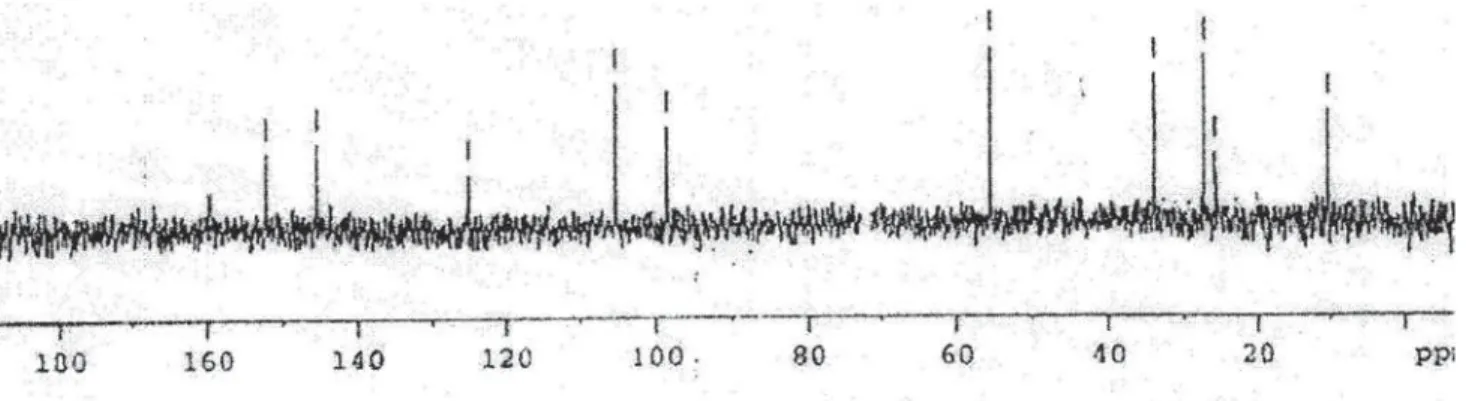
3):D 7.25-6.64 (m, 4H, Aromatic H), 5.21 (s, 4H, 2OCH2), 4.10 (q, 4H, 2NCH2), 3.62 (t, 4H, 2SCH2), 3.02 (p, 2H, 1CH2), 1.26 (t, 6H, 2CH3).13C NMR (CDCl3): D 152.1, 145.5 (4C=N), 157.3, 124.9, 105.4, 102.5 (6 Aromatic C), 55.4 (2OCH2), 33.9 (2NCH2), 27.2 (2SCH2), 25.7 (1CH2), 10.2 (2CH3).
1454-Diethyl-3(1,3)-benzena-2,4-dioxa-6,11-dithia-1,5(3,5)
(5,3)-di-(1,2,4-triazola)cycloundecaphane (12d)
1H NMR (CDCl
1454-Diethyl-3(1,3)-benzena-2,4-dioxa-6,12-dithia-1,5(3,5)
(5,3)-di-(1,2,4-triazola)cyclododecaphane (12e)
1H NMR (CDCl
3):D 7.25-6.64 (m, 4H, Aromatic H), 5.20 (s, 4H, 2OCH2), 4.10 (q, 4H, 2NCH2), 3.01(t, 4H, 2SCH2), 1.40-1.32 (m, 6H, 3CH2), 1.26(t, 6H, 2CH3).13C NMR (CDCl3):D 151.1, 150.7 (4C=N), 157.3, 130.2, 108.8, 103.5 (6 Aromatic C), 59.8 (2OCH2), 39.3 (2NCH2), 34.0, 29.0 (4SCH2), 26.3 (CH2), 15.4 (2CH3).
14,54
–Diphenyl-3(1,3)8(1,2)dibenzena–2,4-dioxa-6,10-dithia–1,3(3,5)(5,3)-di-(1,2,4–triazola)cycldecaphane (12f)
1H NMR (CDCl
3):D 7.36-6.61 (m, 8H, Aromatic H), 5.10 (s, 4H, 2OCH2), 4.64 (s, 4H, 2SCH2), 3.98 (q, 4H, 2NCH2), 1.26 (t, 6H, 2CH3).13C NMR (CDCl
3):D 151.1, 147.8 (4C=N), 158.6, 134.7-125.7, 107.9, 101.9 (12 Aromatic C), 60.4 (2OCH2), 39.5 (2NCH2), 37.2 (2SCH2), 15.1 (2CH3).
1,3-Di-[4-anilino-5(2’-hydroxyphenyl)-1,2,4-triazol-3-yl] mercapto propane (15)
1H NMR (CDCl
3):D 11.12 (s, 2H, 2OH, D2O exchan-geable), 7.84-6.94 (m, 18H, Aromatic H), 5.72 (s, 2H, 2NH, D2O exchangeable), 3.42 (t, 4H, 2SCH2), 2.32 (p, 2H, CH2).13C NMR (CDCl
3):D 156.3 (2S-C=N), 153.4 (2C=N), 156.2-113.2 (24 Aromatic C), 30.4 (2SCH2), 28.5 (-CH2).
14,94
–Dianilino-2,8(1,2)-dibenza-3,7-dioxa-10,14-dithia-1(3,5)9(5,3)-di-(1,2,4-triazola)cyclotetradecaphane (16a)
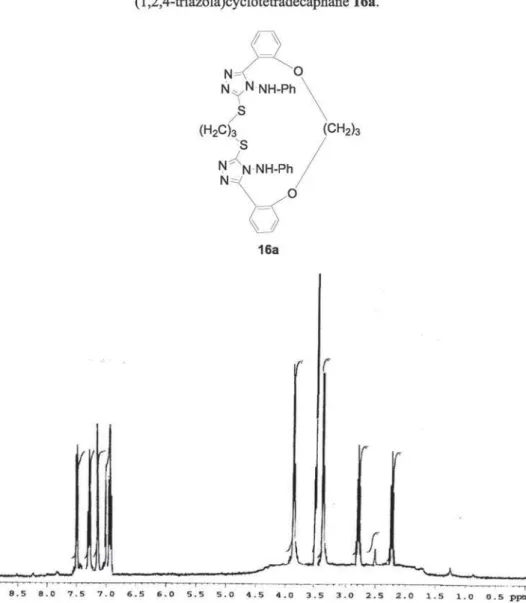
1H NMR (CDCl
3): D 7.68-6.74 (m, 18H, Aromatic H), 5.87 (s, 2H, 2NH), 4.18 (t, 4H, 2OCH2), 3.62 (t, 4H, 2SCH2), 2.41 (p, 2H, CH2), 2.23 (p, 2H, CH2). MS (DI) (m/z): 648 (M+).
14,104
–Dianilino-2,9(1,2)-dibenza-3,8-dioxa-11,15-dithia-1(3,5)10(5,3)-di-(1,2,4-triazola)cyclopentadecaphane (16b)
1H NMR (CDCl
3):D 7.86-7.10 (m, 18H, Aromatic H), 5.72 (s, 2H, 2NH), 3.82 (s, 4H, 2OCH2), 3.42 (t, 4H, SCH2), 2.34 (p, 2H, CH2), 2.06 (m, 4H, 2CH2).
14,94
–Dianilino-3,7-dioxa-10,14-dithia-1(3,5)9(5,3)-di-(1,2,4-triazola)-2,5,8(1,2)-tribenza cyclotetradecaphane (16c)
1H NMR (CDCl
3): D 7.83-6.81 (m, 22H, Aromatic H), 5.72 (s, 2H, 2NH), 4.62 (s, 4H, 2OCH2), 3.42 (t, 4H, 2SCH2), 2.32 (p, 2H, CH2).
General procedure for the synthesis of 8a-b
Isophthalic acid dihydrazide (0.01 mol) and phenyl or
o-tolyl isothiocyanate (0.02 mol) were refluxed in methanol
(50 mL) for 4h. The compound formed was filtered, washed with water, was added to 10% aqueous alkali (100 mL) and heated on water bath for 4h. The reaction mixture was poured over crushed ice. This cold solution was then filtered to remove some trace particles. Obtained filtrate was neutralized with dilute aqueous hydrochloric acid to obtain a solid compound, which was filtered, washed with cold water and recrystallised from aqueous DMF.
1,3-Bis-(5-mercapto–4-phenyl–1,2,4-triazol–3-yl)benzene (8a)
1H NMR (DMSO d
6):D 14.31 (s, 2H, 2NH), 7.66-7.41 (m, 14H, Aromatic H). 13C NMR (DMSO d
6): D 169.1 (2C=S), 150.0 (2C=N), 134.5-126.6 (18 Aromatic C). MS (DI) (m/z): 428 (M+).
1,3-Bis-[5-mercapto–4-(2’-methyl)phenyl-1,2,4-triazol– 3-yl]benzene (8b)
1H NMR (DMSO d
6):D 14.18 (s, 2H, 2NH), 7.39-7.18 (m, 12H, Aromatic H), 1.91 (s, 6H, 2CH3). 13C NMR (DMSO d6):D 168.2 (2C=S), 149.3 (2C=N), 17.2 (2CH3), 135.7-126.2 (18 Aromatic C). MS (DI) (m/z): 456 (M+).
Synthesis of 1,3-bis-[(4-ethyl-3-mercapto-1,2,4-triazol-3-yl)methyleneoxy]benzene (11)
Benzene-1,3-dioxyacetic acid 10 (2.26 g, 0.01 mol) and 4-ethyl-3-thiosemicarbazide 2a (2.38 g, 0.02 mol) were thoroughly mixed using mortar and pestle. This mixture was then fused in oil-bath maintaining temperature 140 oC for 4h. The reaction mixture was then cooled and dumped into ice. The resulting brown colored solid filtered off, washed with 5% sodium bicarbonate solution followed by water till pH becomes neutral and recrystallized from aqueous DMF, 3.13 g (85%), mp 184oC; 1H NMR (DMSO d
6):D 13.80 (s, 2H, 2x-NH), 7.28-6.72 (m, 4H, Aromatic H), 5.23 (s, 4H, 2OCH2), 4.01 (q, 4H, 2NCH2), 1.26 (t, 6H, 2CH3).
General procedure for the synthesis of 4-anilino-5-(2’-hydroxyphenyl)-3-mercapto-1,2,4-triazole (14)
aqueous hydrochloric acid till pH of the solution became neutral. The resulting pale yellow solid was filtered off, washed with cold water and recrystallized from aqueous DMF. 1H NMR (DMSO d
6):D 13.84 (s, 1H, S=C-NH, D2O exchangeable), 10.28 (s, 1H, OH, D2O exchangeable), 7.43-6.84 (m, 9H, Aromatic H), 5.82 (s, 1H, NH, D2O exchangeable). 13C NMR (DMSO d
6): D 164.2 (2C=S), 148.2 (2 C=N), 154.3-113.1 (12 Aromatic C).
Acknowledgments
The help rendered by the Regional Sophisticated Instrumentation Centres (RSIC), the Indian Institute of Technology (IIT) and the Tata Institute of Fundamental Research (TIFR); Department of Chemistry, University of Pune, and Department of Chemistry, Institute of Science, Mumbai, is gratefully acknowledged.
Supplementary Information
1H NMR, 13C NMR data is available free of charge at http://jbcs.sbq.org.br, as PDF file.
References
1. Graf, E.; Lehn, J. M.; Helv. Chim. Acta 1981,64, 1040; Dietrich, B.; Hosseini, M. W.; Lehn, J. M.; Session, R. B.; Helv. Chim. Acta1983,66, 1262; Hosseini, M. W.; Lehn, J. M.; Mertes, M.
P.; Helv. Chim. Acta 1983,66, 2444; Kumar, A.; Mageswaran,
S.; Sutherland, I. O.; Tetrahedron1986,42, 3291; Bradshaw, J. S.; Izatt, R. M.; Acc. Chem. Res. 1997,30, 338.
2. Newkome, G. R.; Traynham, J. G.; Baker, G. R. In
Comprehensive Heterocyclic Chemistry; Katritzky, A. R.,
ed.; Pergamon Press: London, 1984, vol. 5, p. 763; Stark, C. M.; Liotta, C.; Halpern, M.; Phase Transfer Catalysis,
Fundamentals: Applications and Industrial Perspective,
Chapman and Hall: New York, 1994.
3. Bradshaw, J. S.; Izzat, R. M.; Bordunov, A. V.; Zhu, C. Y.; Hathaway, J. K. In Comprehensive Supramolecular Chemistry; Gokel, G. W., ed.; Pergamon: New York, 1996, vol.1, p. 35. 4. Pedersen, C. J.; J. Am. Chem. Soc.1970,89, 2495.
5. Singh, H.; Yadav, L. D. S.; Bhattacharya, B. K.; J. Indian Chem. Soc.1979,56, 1013; Desai, N. C.; Indian J. Chem.1993,32B, 343; Feng, X. M.; Chen, R.; Liu, X. C.; Zhang, Z. Y.; Chin.
J. Appl. Chem.1991,8, 28; Upadhyay, P. S.; Vansdadia, R.
N.; Baxi, A. J.; Indian J. Chem.1990,29B, 793; Mohan, J.; Anjaneyula, G. S. R.; Sudhir, S.; Arora, D. R.; J. Indian Chem. Soc.1989,66, 330; Ghorab, M. M.; El-Sharief, A. M. Sh.; Ammar, Y. A.; Mohamed, Sh. I.; Farmaco2000,55, 354. 6. Zhang, Z. Y.; Chen, X. L.; Wei, L.; Ma, Z. L.; Chem. Res. Chin.
Univ.1991,7, 129.
7. Naito, Y.; Akahoshi, F.; Takeda, S.; Okada, T.; Kajii, M.; Nishimura, H.; Sugiura, M.; Fukaya, C.; Kagitani, Y.; J. Med.
Chem.1996,39, 3019.
8. Narang, A. S.; Vince, R.; J. Med. Chem.1977,20, 1684; De Clercq, E.; J. Clin. Virol.2004,30, 115.
9. Collin, X.; Sauleau, A.; Coulon, J.; Bioorg. Med. Chem. Lett. 2003,13, 2601; Holla, B. S.; Kalluraya, B.; Indian J. Chem.
1988,27B, 683; Giri, S.; Singh, H.; Yadav, L. D. S.; Khare, R.
K.;J. Indian Chem. Soc.1978,55, 168.
10. Kidwai, M.; Sapra, P.; Misra, P.; Saxena, R. K.; Singh, M.;
Bioorg. Med. Chem.2001,9, 217.
11. George, T.; Mehta, D. V.; Tahilramani, R.; David, J.; Talwalker, P. K.; J. Med. Chem.1971, 14, 335; Papakonstantinou-Garoufalias, S.; Pouli, N.; Marakos, P.; Chytyroglou-Ladas,
A.;Farmaco 2002,57, 973; Sengupta, A. K.; Misra, H. K.; J.
Indian Chem. Soc. 1981,58, 508.
12. Ghorab, M. M.; Abdel- Hamide, S. G.; El-Gaby, M. S. A.; El- Sayed, S. M.; Acta Pharm.1999,49, 1.
13. Andotra, C. S.; Sharma, S. K.; Proc. Natl. Acad. Sci. India 1988,
58A, 215.
14. Hester, J. B.; Rudzik, A. D.; Kamdar, B. V.; J. Med. Chem.1971,
14, 1078.
15. Milton, N. G. N.; Neurotoxicology2001,22, 767.
16. Burell, G.; Evans, J. M.; Hadley, M. S.; Hicks, F.; Stemp,
G.;Bioorg. Med. Chem. Lett.1994,4, 1285; Ghorab, M. M.;
Abdel- Hamide, S. G.; Ali, G. M.; El-Sayed, H. S.; Shaurub,
H.;Pestic. Sci. 1996,48, 31; Mody, M. K.; Prasad, A. R.;
Ramalingham, T.; Suttur, P. B.; J. Indian Chem. Soc.1982,
59, 769.
17. Wadsworth, J. H.; Jenkins, S. M.; Orlek, B. S.; Cassidy, F.; Clark, M. S. G.; Brown, F.; Riley, G. J.; Graves, D.; Hawkins, J.; Naylor, C. B.; J. Med. Chem.1992,35, 1280; Jenkins, S. M.; Wadsworth, H.; Bromidge, S.; Orlek, B. S.; Wyman, P. A.; Riley, G. J.; Hawkins, J.; J. Med. Chem.1992,35, 2392; Chen, C.; Dagnino, R.; Huang, C. Q.; McCarthy, J. R.; Grigoriadis, D.
E.;Bioorg. Med. Chem. Lett.2001,11, 3165; Neumann-Schultz,
B.; Unger, L.; Blumbach, K.; Starck, D.; Schoebel, D.; Treiber,
H.;WO 00420382000.
18. Thompson, S. K.; Eppley, A. M.; Frazee, J. S.; Darcy, M. G.; Lum, R. T.; Tomaszeck, T. A.; Ivanoff, L. A.; Morris, J. F.; Sternberg, E. J.; Lambert, D. M.; Fernandez, A. V.; Patteway, S. R.; Meek, T. D.; Metcalf, B. W.; Gleason, J. G.; Bioorg. Med.
Chem. Lett.1994,4, 2441.
19. Duncia, J. V.; Santella, J. B.; Higley, C. A.; VanAtten, M. K.; Weber, P. C.; Alexander, R. S.; Kettner, C. A.; Pruitt, J. R.; Liauw, A. Y.; Quan, M. L.; Knabb, R. M.; Wexler, R. R.; Bioorg.
Med. Chem. Lett.1998,8, 775.
20. Potts, K. T.; Chem. Rev.1961,61, 87.
21. Chande, M. S.; Godbole, A. A.; Sajithkumar, C.; Heteroat.
Chem.2003,14, 273; Chande, M. S.; Godbole, A. A.; Coutinho,
22. Chande, M. S.; Athalye, S. S.; Synth. Commun.1999,29, 1711; Chande, M. S.; Athalye, S. S.; Synth. Commun.2000,30, 1667; Chande, M. S.; Athalye, S. S.; Godbole, A. A.; Indian J. Chem.
2004, 43B, 670; Chande, M. S.; Uchil, M. H.; Barve, P.A.;
Heteroatom Chem.2006,14, 329; Chande, M. S.; Barve, P.
A.; Khanwelkar, R. R.; Athalye, S. S.; Venkatraman, D.; Can.
J. Chem.2007,85, 21.
23. Gokel, G. W.; Dishang, D. M.; Dimond, C. J.; J. Chem. Soc.,
Chem. Commun.1980, 1053.
24. Xu, P.-F.; Sun, X.-W.; Zhang, L.-M.; Zhang, Z.-Y.; J. Chem.
Res. (s)1999,2, 170.
25. Nomenclature as per the following: Powell, W. H.; Pure Appl.
Chem.1998,70, 1513; Favre, H. A.; Hellwinkel, D.; Powel, W.
H.; Smith, H. A.; Pure Appl. Chem.2002,74, 809.
Supplementary Information
Printed in Brazil - ©2008 Sociedade Brasileira de Química 0103 - 5053 $6.00+0.00
*e-mail: [email protected]
Chemoselective Synthesis of Novel Thiatriazolophanes
Madhukar S. Chande,* Kiran A. Puthamane, Pravin A. Barve, Rahul R. Khanwelkar and
Deepak S. Venkataraman
Department of Chemistry, The Institute of Science, 15, Madam Cama Road, Mumbai 400 032, India
Figure S1.1H NMR for compound 5d.
Figure S3.1H NMR for compound 5j.
Figure S5.1H NMR for compound 5m.
Figure S7. 1H NMR for compound 9i.
Figure S9.1H NMR for compound 12c.
Figure S11.1H NMR for compound 16a.