Abstract
—
Elastic optical networks (EONs) have been pointed out
as a promising candidate for transporting data with high
transmission rates in adaptive optical networks. Consequently,
the occurrence of a failure in a simple element may cause
the interruption of various services. Survival mechanisms have
been crucial to try to overcome the problems created by possible
failures. In this paper, we propose a new dedicated path
protection mechanism for link-failure survivability in EONs,
referred to as Spectrum Continuity and Contiguity based
Dedicated Protection (SCCDP).
SCCDPtries to avoid the trap
topology problem in search for a link-disjoint route pair. In
addition, the calculation of the link-disjoint routes is based on
modified version of the Dijkstra’s algorithm, referred to as
Spectrum Continuity and Contiguity based Shortest Path (SCCSP),
which chooses the pair of routes according to the end-to-end
spectrum continuity and contiguity. The performance of the
proposed algorithm is compared to other well-known algorithms in
the Literature. Two different network topologies are used in our
simulations for comparison purposes. Our proposal achieved better
results concerning blocking probability.
Index Terms—Dedicated protection, Path protection, Elastic optical networks, Single failure, Survivability.
I.
INTRODUCTIONThe Internet traffic has grown in recent years due to the increased number of users and new data-demanding applications, such as video on demand and streaming services in real time. Wavelength division multiplexing (WDM) optical networks have been applied in transport networks to supply these requirements of traffic. These systems are capable of handling the channels through wavelength division multiplexing (WDM), where each WDM channel have been traditionally filled up with transmission rates of 10, 40 or 100 Gb/s [1], [2].
The use of a fixed spectral band for every WDM channel independently of the traffic intensity and modulation format used generates an inefficient use of the spectrum for scenarios with heterogeneous services. Since the end of last decade, there has been increasing interest in the investigation of new optical networking architectures without the fixed grid employed in WDM optical networks. In such new architectures, the management layer and network elements support flexible bandwidth for the channels, which are adjusted according to the characteristics of the network requests. Elastic optical networks (EONs) have been proposed as
Spectrum Continuity and Contiguity based
Dedicated Protection for Flexible Optical
Networks
André V. S. Xavier, Raul C. Almeida Jr., Joaquim F. Martins-Filho,
Federal University of Pernambuco, e-mail: [email protected]
Daniel A. R. Chaves and Carmelo J. A. Bastos-Filho
developed technologies have been proposed to provide the desirable flexibility in the optical domain for this new type of network architecture, such as transponders with variable bandwidth, wavelength-selective switches (WSSs) with variable bandwidth, efficient fiber-optic transmission technologies (like coherent optical orthogonal frequency division multiplexing, CO-OFDM) [4], Nyquist-WDM and dynamic optical arbitrary waveform generation (OAWG) [5], [6]. This adaptability maximizes the efficiency in the use of spectrum resources by using a finer spectral unit, called frequency slot. Besides, new switching technologies enable that lightpaths be provisioned with multiple frequency slots.
Two constraints in spectrum management in EONs are the spectrum contiguity and spectrum continuity. In the spectrum contiguity, if a call request needs two or more frequency slots, these frequency slots must be adjacent in the optical spectrum. On the other hand, spectrum continuity means that the same frequency slots assigned to a call request must be used in all links of the route found to implement this call request [7]. Analogous to the routing and wavelength assignment (RWA) process in WDM optical networks, the development of efficient routing and spectrum assignment (RSA) algorithms is an important challenge for EONs. These algorithms have a direct influence on how the occupancy of the frequency slots turn up among the network links and, as a consequence, it has a significant impact on the network performance. RSA consists of finding a route between the source and destination nodes with a required number of contiguous and continuous frequency slots on the links along this route [8]. If it is assumed that one may choose, for each call request, an appropriate modulation format among some available ones, the RSA process is referred to as routing, modulation level and spectrum assignment (RMLSA) [9].
Another important factor in EONs is to provide survivability mechanisms against failures. The occurrence of a single failure in one or more network elements can lead to a massive loss of information. The survivability mechanisms are commonly divided into protection and restoration techniques. Protection techniques are based on providing resource reservation to guarantee the connection protection after a failure. Protection techniques can be divided into the categories of dedicated path protection (DPP) and shared path protection (SPP). In DPP, a dedicated link-disjoint backup lightpath is configured to protect each working lightpath on the network. In the SPP, the backup lightpath can be shared among other backup routes [10].
On the other hand, restoration techniques are based on the best effort recovery mechanism and are triggered by the occurrence of the failure. When a connection is affected by a failure, the restoration algorithm tries to find a new lightpath to restore the interrupted connection. Restoration techniques are more efficient regarding network resource utilization, but it does not guarantee an available lightpath to restore the affected connection. The three most important methods to perform restoration in a network are path restoration, subpath restoration, and link restoration. In the path restoration, one tries to find a new lightpath between the source and destination nodes. In the link restoration, one attempts to find a new lightpath from the adjacent nodes to the failure. Finally, in the subpath restoration, one tries to find a lightpath from the previous node to the failure until the destination node, reusing a portion of the existing lightpath [10].
Dedicated Protection (SCCDP). SCCDP finds a link-disjoint route pair based on the end-to-end spectrum continuity and contiguity. The remainder of the paper is organized as follows. In Section II, we present some related works and some solutions in the literature, whereas, in Section III, we present a description of the proposed SCCDP algorithm. Section IV details the simulation setup and the parameters used in the simulations. In Section V, we present and discuss the simulation results, and in Section VI, we present our conclusions.
II.
R
ELATED WORKSIn this section, we review some solutions in the literature for solving the DPP problem in EONs. The simplest approach for tackling the DPP problem in WDM optical networks attempted to use Dijkstra’s or Bellman-Ford’s algorithm [13] in two steps. The first step is to calculate the working route in the network topology, and the links of this route are temporarily removed from the network. In the second phase, the protection route is determined. This approach is easily implemented. However, after the temporary removal of the links used in the working path, the network may be broken into two disconnected portions which would make impossible to discover a backup route. Such scenario may occur even when two link-disjoint paths exist in the network. These network topologies are commonly referred to as trap topologies. Suurballe et al. [14] proposed an algorithm to solve the problem of finding link-disjoint pairs on trap topologies. The Suurballe’s algorithm tries to avoid the critical links in the trap topology, allowing the algorithm to find a link-disjoint route pair if it exists.
Takagi et al. [15] proposed some algorithms to solve the RSA problem considering dedicated and shared path protection in EONs. The developed algorithms are based on an integer linear programming (ILP) model. This model considers the distance-adaptive constraint. These proposed algorithms are compared to WDM scenario regarding spectrum efficiency. The achieved results show a reduction around 30% in required resources.
Klinkowski et al. [16] proposed a genetic algorithm (GA) to solve the problem of RSA with dedicated path protection in an EON with static traffic demand and subject to single-link failures. Other graph-based algorithms were used for the sake of comparison with the proposed algorithm regarding spectrum efficiency.
Vizcaíno et al. [17] proposed heuristics to investigate power consumption and cost model problems in both WDM and EON architectures. Due to the importance of survivability in optical networks, the paper considers and evaluates both dedicated path protection and shared path protection. The results present the potential energy efficiency improvements that can be obtained by using EONs.
Walkowiak et al. [18] proposed an ILP model to solve the offline problem of routing and spectrum assignment (RSA) with dedicated path protection (DPP). The formulation uses a modified version of the Tabu Search method to provide near optimal solutions.
Shen et al. [19] developed ILP models to minimize the number of link frequency slots used and the required spare capacity. Shared path protection (SPP) and dedicated path protection (DPP) techniques were considered. Both techniques were analyzed under the scenarios with and without tunable transponders. All models were compared to each other in three network topologies. The results show that the SPP techniques require lower spare capacity when compared to the DPP techniques.
j i
j i j i
d
W
, , ,
,
(1)
where
W
i,jis the cost associated to the link between nodesi
andj
, which is given by the ratio of the link length (d
i,jj) and the fraction of spectrum that is available on the link (
i,j). After evaluating the link's cost, Dijkstra Algorithm is used to find the route to attend the connection request. This heuristics may be easily adapted to solve the DPP problem in elastic optical networks.III.
SCCDP
ALGORITHMIn this paper, we propose a new dedicated path protection algorithm to deal with single-link failure in EONs. This new proposal is named spectrum continuity and contiguity based dedicated protection (SCCDP). The SCCDP algorithm finds a link-disjoint route pair in the network considering the spectrum continuity and contiguity information during the process. The SCCDP pseudocode is presented in Algorithm 1. It applies some steps proposed by Suurballe et al. [14] to find a link-disjoint route pair and to deal with the trap topology problem (lines 5-9). SCCDP algorithm determines a route P1 with spectrum continuity and contiguity using the SCSP routing algorithm in T (line 2). In line 5, the SCCDP algorithm removes temporarily the uplinks of P1 (or reverses the links of P1) from T and finds a new route, P2. If P2 is not found, the SCCDP algorithm rejects the connection request, as described in line 18. Otherwise, the algorithm compares and removes the shared links between P1 and P2. These shared links must be avoided during the calculation of both link-disjoint working and protection routes (lines 7–9), since the use of these shared links may split the network into disconnected parts [13], as previously discussed. In lines 2, 3, 7 and 9, the SCSP algorithm is responsible for finding a route with the lowest cost considering end-to-end spectrum continuity and contiguity.
ALGORITHM 1.SCCDP ALGORITHM PSEUDOCODE.
1. Input: Connection request, network topology matrix (T), source node, destination node, k
(number of frequency slots required by request);
2. Find a route (P1) with spectrum continuity and contiguity using the SCSP algorithm in T; 3. Remove temporarily the uplinks of P1 from T and find a new route (P2) with spectrum continuity
and contiguity using the SCSP algorithm; 4. if there are the P1 and P2 routes then
5. if P1 shares links with P2 then
6. Remove the shared links between P1 and P2 from T;
7. Find the working route with spectrum continuity using the SCSP algorithm from T; 8. Remove the links of working route from T;
9. Find the protection route with spectrum continuity using the SCSP algorithm from T; 10. if there are the working and protection routes then
11. return working and protection routes.
12. end if 13. else
14. working route ← P1; protection route ← P2; 15. return working and protection routes. 16. end if
17. else
ALGORITHM 2.SCSP ALGORITHM PSEUDOCODE. max , ,
d
d
x
uv
uv ,(2)
in which
d
u,v is the link length between nodesu
andv
andd
maxis the maximum link length in the network. The parameterx
u,v contributes to reduce the path request blocking occurrences due to physical layer constraints. The second parameter,y
R,k, considers the information regarding frequency slots contiguity, as well as the spectrum continuity from source node until the currently analyzed node, this information of the spectrum continuity is stored in the algorithm during the analysis of the network link, the parametery
R,k is shown in Eq. (3). The variabley
R,k is responsible for reducing the path request blocking occurrences due to lack of resources.1
1
, ,
k R k Rs
y
,(3)
in which
s
R,k accounts for is the frequency slots contiguity.s
R,k is obtained by the number of possible manners of assigning the current k-slot request in the available spectrum of the vector R, as proposed in [21].1. Input: network topology, source node, destination node, k (number of frequency slots required by
request);
2. Initialize the vectors: cost, father, continuity; 3. Initialize the List Q ← empty;
4. for all node v from the network do
5. cost[v] = ∞; father[v] = − 1; Q ← v; 6. end for
7. cost[source] = 0;
8. continuity[source] = {1, 1, 1, ..., 1, 1, 1}; 9. u = source and remove source of Q; 10. while Q is not empty do
11. for all neighbor node v of u do
12. if there is link between the nodes u and v then
13. Define D as the frequency slots availability vector between the nodes u and v;
14. Define the vector R;
15. Define S as the total number of frequency slots;
16. Define d(u, v) as the physical length between the nodes u and v; 17. for each frequency slot s from S do
18. if continuity[u][s] = 1 & D[s] = 1 then R[s]=1;
19. else R[s]=0;
20. end if 21. end for
22. costBetweenNodes = f(d(u, v), R, k);
23. minimumCost = cost[u] + costBetweenNodes; 24. if cost[v] > minimumCost then
25. cost[v] = minimumCost; father[v] = u; continuity[v] = R; 26. end if
27. end if
28. end for
29. u = element of Q with lower cost and remove u of Q; 30. end while
The cost function (
f
) of SCSP algorithm using the two variables is shown in Eq. (4).1
1
)
,
(
, max , , ,
k R v u k R v us
d
d
y
x
f
.(4)
Another cost function for the SCSP algorithm using only the spectrum availability information is
presented in Eq. (5). Both cost functions are used in the simulations of proposed algorithm.
1
1
)
(
, ,
k R k Rs
y
f
.(5)
IV.
S
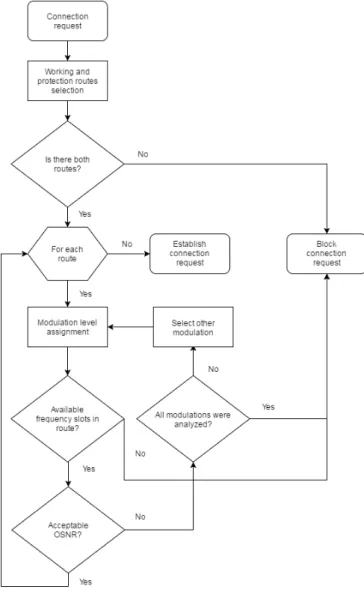
IMULATION SETUPThe SIMTON simulation tool [22] was adapted to evaluate the blocking probability of dedicated path protection algorithms in survivable EON scenarios. For each network simulation, a set of 100,000 calls is generated with source-destination node pairs selected by using a uniform distribution. The call request arrival process is characterized as a Poisson process and the time duration for each established lightpath follows an Exponential distribution. Moreover, each call request has its bit rate demand defined randomly with uniform distribution. The allowed bit rates are 40, 100, 200 and 400 Gbps. Fig. 1 shows the flowchart of the dedicated path protection, modulation level and spectrum assignment algorithms employed in the network simulations. For each call request, the DPP algorithm tries to find a link-disjoint route pair. If there is not a link-disjoint route pair for this call request, the request is blocked. Otherwise, the process tries to choose an appropriate modulation format for each route, starting from the most efficient modulation format. One can observe that the modulation format determines the number of necessary contiguous frequency slots for each call. If either working or backup route has no contiguous and continuous frequency slots to attend the call request, the call is blocked. In case there are free slots, the quality of transmission (QoT) is evaluated. If either working or backup routes has QoT below the acceptance threshold, the second most efficient modulation format is tested, and this process continues until the most robust modulation format is checked. In all simulations, the working and protection lightpaths may be assigned with different modulation formats.
The performance indicator used to evaluate the DPP algorithm in this paper is the network blocking probability. The network blocking probability is obtained as the ratio of the number of blocked call requests to the total number of call requests. For the call request to be accepted in the network, the dedicated protection algorithm has to find a pair of link-disjoint routes, both with available resources (contiguous and continuous frequency slots) and enough QoT. The physical layer impairments considered in this paper are ASE (Amplified Spontaneous Emission) noise and ASE saturation in the amplifiers [23].
Fig. 1. Flowchart of the dedicated path protection, modulation level and spectrum assignment algorithms employed in the network simulations.
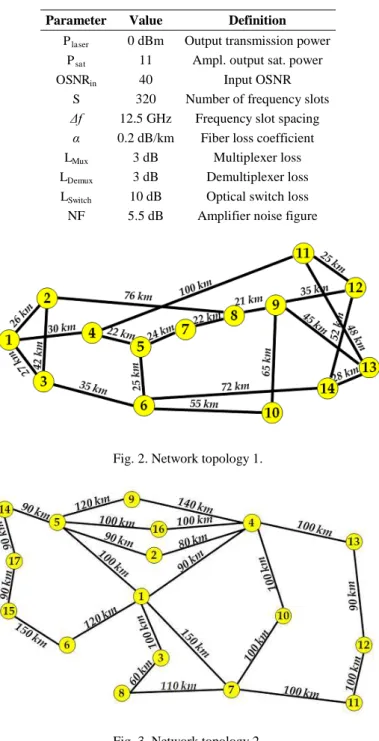
The modulation formats allowed in our simulations are QPSK, 8-QAM, 16-QAM and 32-QAM. The optical parameters used in the simulations are shown in Table I.
TABLE I.DEFAULT SIMULATION PARAMETERS.
Parameter Value Definition
Plaser 0 dBm Output transmission power
Psat 11 Ampl. output sat. power
OSNRin 40 Input OSNR
S 320 Number of frequency slots Δf 12.5 GHz Frequency slot spacing
α 0.2 dB/km Fiber loss coefficient LMux 3 dB Multiplexer loss
LDemux 3 dB Demultiplexer loss
LSwitch 10 dB Optical switch loss
NF 5.5 dB Amplifier noise figure
Fig. 2. Network topology 1.
TABLE II.NUMBER OF FREQUENCY SLOTS FOR EACH COMBINATION OF MODULATION LEVEL AND TRANSMISSION BIT RATE.
Modulation/Bit rate 40 Gbit/s 100 Gbit/s 200 Gbit/s 400 Gbit/s
QPSK 2 4 8 16
8-QAM 2 3 6 11
16-QAM 1 2 4 8
32-QAM 1 2 4 7
TABLE III.OSNRTH FOR EACH COMBINATION OF MODULATION LEVEL AND TRANSMISSION BIT RATE.
Modulation/Bit rate 40 Gbit/s 100 Gbit/s 200 Gbit/s 400 Gbit/s
QPSK 8.83 12.81 15.82 18.83
8-QAM 12.04 16.02 19.03 22.04
16-QAM 12.56 16.54 19.55 22.56
32-QAM 14.61 18.59 21.60 24.61
As the SCCDP algorithm needs information about the required number of frequency slots to calculate the routes before determining the modulation format, we assume that the algorithm considers the number of frequency slots used by the most robust of the modulation formats (QPSK), which is the worst case. However, after the routing process, the SCCDP algorithm may select another more efficient modulation format to attend the connection request.
Variables
x
u,v andy
R,k defined in Section III, are used in the SCCDP algorithm, which yields two distinct versions: SCCDP(y), which searches for the link-disjoint route pair based on the information of the spectrum continuity and contiguity, so that the physical distance does not influence the routing decision process, and the second version, SCCDP(x,y), which uses information about both the link physical distance and the spectrum continuity and contiguity during the search for the link-disjoint route pair.We used two versions of the Suurballe’s algorithm for the sake of comparison. The first release is the classical algorithm, which uses the link length (
x
u,v) as the link cost function. The other version is an adaptation of Suurballe algorithm to use information about the frequency slots contiguity (y
R,k) as a parameter to evaluate the network links’ costs. Such versions are referred to as Suurballe(x) and Suurballe(y), respectively. Another algorithm adapted to solve the DPP problem was based on the routing algorithm proposed by Savory [20]. This algorithm is referred to as congestion-aware dedicated protection (CADP). The CADP algorithm evaluates the links of the network by using Eq. (1). Then, the Dijkstra's algorithm is run twice to find working and protection routes. After finding the pair of routes for the DPP process, the spectrum assignment is done using the First-Fit (FF) algorithm [25][26]. In this algorithm, all frequency slots are labeled with numbers in a sequential order, and the FF algorithm searches for the first available spectrum range with the necessary consecutive number of slots considering the ascending order of the frequency slot index.V.
S
IMULATION RESULTSIn this section, we present results regarding the network blocking probability of Suurballe(x), Suurballe(y), CADP, SCCDP(y) and SCCDP(x,y) algorithms, all of them using the FF spectrum assignment.
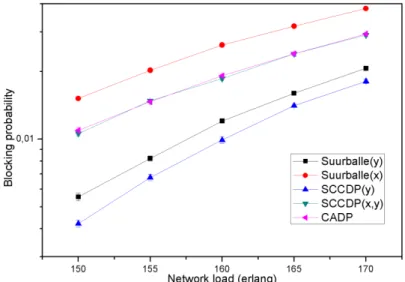
each algorithm, and the error bars represent a confidence interval of 95%. In some cases, the error bars are smaller than the symbols size, and therefore cannot be perceived in the graphs. In Fig. 4, it can be observed that SCCDP(y) outperformed any other algorithms, which can be explained by the fact that SCCDP(y) algorithm used the spectrum continuity and contiguity information of the frequency slots to better select the pair of routes to meet the requests in the network more efficiently than Suurballe(y), CADP and SCCDP(x,y) algorithms. Although the SCCDP(x,y) algorithm considers the spectrum continuity during the routing process, the introduction of the variable xu,v in the algorithm makes the pair of shortest routes be chosen more frequently, which may reduce the chance of selecting alternative routes with higher spectrum availability which would usually present additional chance of having end-to-end free spectrum resource. Notice that the majority of nodes in network topology 1 has a connectivity equal to 3, i.e., there are at most three pairs of link-disjoint routes for each node pair. If some algorithm always uses the same two of the three existing routes to attend the call requests for a given source and destination pair, eventually, the network will not be able to provide resources to attend new demands.
Fig. 4. Comparison of the blocking probability as a function of the network load after 30 different runs and its margin of error at 95% confidence interval for all investigated DPP algorithms applied to Network Topology 1.
In Fig. 4, the Suurballe(y) algorithm obtained the second best performance. This occurs because the algorithm may analyze and evaluate the state of the links regarding frequency slots contiguity, which results in an adaptive dynamic routing process, although it cannot infer the information about the end-to-end frequency slot continuity. Regarding the CADP algorithm, it weights the links in the network as a function of both the physical length and the proportion of the total spectrum that is still available. Since the CADP algorithm does not consider information about the continuity and contiguity of frequency slots, it is expected that the algorithm in some cases does not choose efficient routes with enough available spectrum resources to attend the connection requests.
frequency slots and the possible modulation formats.
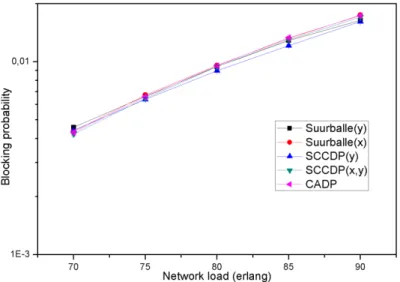
In Fig. 5, all algorithms obtained similar performance in network topology 2. This occurs because, in such topology, the blocking due to the lack of quality of transmission is predominant. The SCCDP(y) algorithm chooses its routes based only on frequency slots availability, which returns solutions, in some case, that do not present the necessary quality of transmission. Another factor that contributes for the algorithms to obtain similar performance is related to the constraints in Network Topology 2. The fact that its majority of nodes has connectivity equal to 2 results that the algorithms find, for most of the source-destination nodes in the network, just one pair of link-disjoint routes.
It is important to notice that our target blocking probability for operation in dynamic networks is 1%. Also, dedicated protection implies in the assignment of two lightpaths for each call. Besides, one can observe from the topologies that some of the links concentrate traffic and, as a consequence, they represent bottlenecks for the lightpath assignment process. A call request is denied if one of the two lightpaths can not be implemented due to unavailable resources or inappropriate Quality of Transmission. This is a hard constraint and causes an increase in the blocking probability, leading to high blocking probability for lower network loads.
Fig. 5. Comparison of the blocking probability as a function of the network load after 30 different runs and its margin of error at 95% confidence interval of all investigated DPP algorithms on the Network Topology 2.
VI.
C
ONCLUSIONSIn this paper, we propose a new dedicated path protection algorithm for EONs, named spectrum continuity and contiguity based dedicated protection (SCCDP). We used two different network topologies in our simulations. We used a simple model based on OSNR that considers ASE noise generation and ASE saturation for physical impairment evaluation. The SCCDP algorithm finds link-disjoint route pairs avoiding the trap topology problem. Each obtained route takes into account the end to end spectrum continuity and contiguity.
ACKNOWLEDGMENT
T
HE AUTHORS ACKNOWLEDGE THE INSTITUTIONAL SUPPORT FROMUPE
ANDUFPE,
AS WELL ASCNP
Q,
CAPES
ANDFACEPE
FOR SCHOLARSHIPS AND GRANT.
REFERENCES
[1] A. A. M. Saleh and J. M. Simmons, Technology and architecture to enable the explosive growth of the internet, IEEE Commun. Mag. 49(1), 126–132, 2011.
[2] R. Ramaswami and K. N. Sivarajan, Optical Networks: A PracticalPerspective, 3rd ed. San Diego: Morgan Kaufmann, 2009.
[3] G. Zhang, M. De Leenheer, A. Morea and B. Mukherjee, A survey on OFDM-based elastic core optical networking, IEEE Commun. Surv. Tutor. 15(1), 65–87, 2013.
[4] W. Shieh, H. Bao and Y. Tang, Coherent optical OFDM: theory and design, Opt. Express, 16(2), 841-859, 2008. [5] D. J. Geisler, N. K. Fontaine, R. P. Scott, T. He, L. Paraschis, O. Gerstel, J. P. Heritage and S. J. B. Yoo, Bandwidth
scalable, coherent transmitter based on the parallel synthesis of multiple spectral slices using opticalarbitrary waveform generation, Opt. Express, 19(9), 8242-8253, 2011.
[6] S. Ben Yoo, L. Liu, R. Proietti and R. Scott, Software defined elastic optical networking in temporal, spectral, and spatial domains, Photonic Network Communications, 28(1), 19-33, 2014.
[7] S. Bregni, M. Recalcati, F. Musumeci, M. Tornatore and A. Pattavina. Benefits of Elastic Spectrum Allocation in Optical Networks with Dynamic Traffic, IEEE Latin America Transactions, 11, 3642-3648, 2015.
[8] S. Talebi, F. Alam, I. Katib, M. Khamis, R. Salama and G. N. Rouskas, Spectrum management techniques for elastic optical networks: A survey, Optical Switching and Networking, 13, 34-48, 2014.
[9] W. Lu and Z. Zhu, Dynamic service provisioning of advance reservation requests in elastic optical networks, Lightwave Technology, Journal of, 31(10), 1621-1627, 2013.
[10]G. Shen and Hong Guo and Sanjay K. Bose, Survivable elastic optical networks: survey and perspective, Photonic Network Communications, 1(31), 71-87, 2016.
[11]Vivek Alwayn, Optical Network Design and Implementation, 1st ed. Cisco Press, 2004.
[12]Thomas E. Stern, Georgios Ellinas and Krishna Bala, Multiwavelength Optical Networks: Architectures, Design, and Control, 2nd ed. Cambridge University Press, 2009.
[13]E. Horowitz, S. Sahni and S. Rajasekaran, Computer Algorithms, Computer Science Press, Rockville, 1998. [14]J. W. Suurballe, Disjoint paths in a Network, Networks, 4, 125-145, 1974.
[15]T. Takagi, H. Hasegawa, K. Sato, T. Tanaka, B. Kozicki, Y. Sone and M. Jinno, Algorithms for maximizing spectrum efficiency in elastic optical path networks that adopt distance adaptive modulation, 36th European Conference and Exhibition on Optical Communication, 1-3, 2010.
[16]M. Klinkowski, An Evolutionary algorithm approach for dedicated path protection problem in Elastic Optical Networks, Cybern. Syst., 44 (6), 589-605, 2013.
[17]Jorge Lopez Vizcaíno, Yabin Ye, Víctor Lopez, Felipe Jiménez, Francesco Musumeci, Massimo Tornatore, Achille Pattavina and Peter M. Krummrich, Protection in Optical Transport Networks with Fixed and Flexible Grid: Cost and Energy Efficiency Evaluation, Opt. Switch. Netw., 11, 55-71, 2014.
[18]Krzysztof Walkowiak and Miroslaw Klinkowski and Bartosz Rabiega and Roza Goscien, Routing and spectrum allocation algorithms for elastic optical networks with dedicated path protection, Optical Switching and Networking, 13, 63-75, 2014.
[19]Gangxiang Shen and Yue Wei and Sanjay K. Bose, Optimal Design for Shared Backup Path Protected Elastic Optical Networks Under SingleLink Failure, J. Opt. Commun. Netw. 6, 649-659, 2014.
[20]Seb J. Savory, Congestion Aware Routing in Nonlinear Elastic Optical Networks, IEEE Photonics Tecnology Letters, v. 26, n. 10, 2014.
[21]A. V. S. Xavier, R. C. Almeida, D. A. R. Chaves, C. J. A. Bastos-Filho and J. F. Martins-Filho, Spectrum continuity based routing algorithm for flexible grid optical networks, Microwave and Optoelectronics Conference
(IMOC), 2015 SBMO/IEEE MTT-S International, 1-5, 2015.
[22]D. A. R. Chaves, H. A. Pereira, C. J. A. Bastos-Filho and J. F. Martins-Filho, SIMTON: a simulator for transparent optical networks, J. Commun. Inf. Syst. 25(1), 1-10, 2010.
[23]H. A. Pereira, D. A. R. Chaves, C. J. A. Bastos-Filho, and J. F. MartinsFilho, OSNR model to consider physical layer impairments in transparent optical networks, Photonic Netw. Commun., 18, 137-149, 2009.
[24]R. Essiambre, G. Kramer, P.J. Winzer, G.J. Foschini and B. Goebel, Capacity Limits of Optical Fiber Networks, Journal of Lightwave Technology, 28(4), 2010.
[25]Xin Wan, Lei Wang, Nan Hua, Hanyi Zhang and Xiaoping Zheng, Dynamic routing and spectrum assignment in flexible optical path networks, Optical Fiber Communication Conference and Exposition (OFC/NFOEC), 2011 and the National Fiber Optic Engineers Conference, 6-10, 2011.