The Development of Structure Model in Metallic Glasses
Xingxing Yuea, Akihisa Inoueb,c, Chain-Tsuan Liud, Cang Fana*
Received: April 22, 2016; Revised: November 22, 2016; Accepted: December 13, 2016
Metallic glasses (amorphous alloys) have grown from a singular observation to an expansive
class of alloys with a broad range of scientiic interests. Their unique properties require a robust
understanding on the structures at the atomic level while alloys in this class have a similar outlook on
the microstructure. In this review, we went through the history of the majority studies on the structure
models of metallic glasses, and summarized their historical contributions to the understanding of the
structure metallic glasses and the relationship between their structures and properties.
Keywords: Metallic glasses, Amorphous alloys, Structure model, Properties
* e-mail: [email protected]
1. Introduction
Amorphous alloys were irst synthesized in 1960 by Duwez and coworkers at the California Institute of Technology1.
Metallic glasses, which show no long-range structural
order, are usually referred to as amorphous alloys. After the irst discovery of amorphous alloys, the scientists pay much
attention to the new alloys because of their complex atomic structures and novel physical, mechanical and chemical properties2-4, such as high electrical resistivity5, soft-type
superconductivity6, good magnetic softness7, high strength
and large elastic strain8,9. These unusual properties make the
amorphous alloys potentially useful for various applications. Metallic glasses can be formed by quenching molten metals or alloys. Since the liquids tend to crystallize when
the temperature (T) is below the melting temperature (Tm) or
liquidus temperature (Tl), in order to retain the glassy structure,
the cooling rate must be suiciently fast to freeze the liquids before the crystals have the time to nucleate and grow. In this process, the liquids will undergo the glass transition at
a temperature, called the glass transition temperature (Tg).
The glass transition is a vital phenomenon. When a glassy
solid is heated, the glass can be transferred to a supercooled
liquid state at Tg. Here, the supercooled liquid refers to liquid
at temperatures far below the melting points. In this process,
it needs only very limited energy to get into the supercooled
liquid compared with its crystallization process, but its
physical and mechanical properties change dramatically10,11.
Glass transition is so interesting that it almost always a hot topic in the papers10,11 of studying the atomic structure of metallic glasses.
In the early 60s, the irst metallic glass was obtained
at very high cooling rates (105-106 K/s), resulting in a very limited thickness with only several tens micrometer. For the subsequent several decades, great efects have been devoted to decrease the critical cooling rate for glass formation. Even up to the late 1980s no signiicant achievements on reducing the critical cooling rate. However, in the late 80s and early 90s, metallic glasses were able to be produced
at a much slower cooling rates12-14. Some metallic glasses
have been produced at low cooling rates of around 1 K/s with sizes up to the range of 15 to 80 mm in diameter15-22. Such metallic glasses are so called as bulk metallic glasses (BMGs). The achievements of preparing BMGs in various
alloy systems have dramatically accelerated the study on
the glass-forming-ability and their fundamental properties. Following it, a three components rule which needs to be satisied for forming BMGs was summarized in 1990s23: 1.
the multicomponent system consisting of more than three
elements, 2. signiicantly diferent atomic size ratios above about 12 % among the main three elements, 3. optimally large negative heats of mixing among the main three elements.
Meanwhile, over the past several decades, scientists have
also made considerable eforts to explore atomic conigurations in metallic glasses. It is well known that the atomic structure in crystalline solids shows a long-range translational periodicity. However, in metallic glasses, the long-rang order is absent aSchool of Material Science and Engineering, Engineering Research Center of Materials Behavior and
Design Ministry of Education, Nanjing University of Science & Technology, 210094, Nanjing, Jiangsu Province, China
bInternational Institute of Green Materials, Josai International University, 283-8555, Togane, Chiba
Province, Japan
cDepartment of Physics, King Abdulaziz University, 22254, Jeddah, Saudi Arabia
dCenter for Advanced Structural Materials, Department of Mechanical and Biomedical Engineering –
and no periodicity. For understanding the structure of
metallic glasses, scientists have used extensive database to investigate their nature, proposing models at atomic level to
characterize metallic glasses. With these studies, scientists
found that metallic glasses can be characterized not only by
randomness, but also short-range order (SRO), medium-range order (MRO) and eicient atomic packing around both solute and solvent atoms. SRO refers to the nearest-neighbor atomic environment. It contains the geometric short-range order
and chemical short-range order24-27. At present, the study of SRO mostly focuses on the geometrical ordering. MRO refers to the second or third nearest -neighbor arrangement. The structure of MRO has a great inluence on the formation and properties of metallic glasses.
Detailed structure information of metallic glasses can be generally inferred by the following two approaches: (1)
Experiments such as X-ray difraction (XRD)28,29, extended
X-ray absorption of ine structure (EXAFS)30-32, small-angle X-ray scattering (SAXS)33; atom probe tomography34, high-resolution transmission electron microscope (HREM)35-37, synchrotron difraction38,39 and neutron scattering40, (2)
Computer simulation such as Monte Carlo simulation41,
Reverse Monte Carlo (RMC) simulation42,43, Ab initio Molecular Dynamics (AIMD) simulation44,45 and molecular
dynamics (MD) simulation46. Based on the experiments
and computer simulations, several structural models for the amorphous alloys have been proposed and successfully used
to describe characteristics of metallic glasses from diferent perspectives. Models could not only give an intuitive image
of structure, but also provide a foundation for developing
high performance of new glassy materials. This paper mainly
introduces the models, which were proposed in the last several decades, historically contributed to understanding the structure at atomic level and the relations between the structure and
physical/mechanical properties of metallic glasses.
2. Structure models of metallic glasses
The atomic structure determines the intrinsic properties of metallic glasses. The disordered structure makes the metallic glasses possess unique physical/mechanical properties. We
summarized the atomic structural models up to date and
show them as follows.
2.1. Hard sphere random dense packing model
Compared with the structures of gas and crystalline solid,
the structure model of liquid was mysterious for a long time. In1959, Bernal47 irst put forward a model to describe the structure of liquid called random dense packing model. This model mainly contains ive Bernal polyhedrons48 with edges of equal length, as shown in Figure 1, and their percentages are listed in Table 1. The tetrahedron accounts for about
73% of all Bernal polyhedrons and has the highest packing
eiciency among the ive polyhedrons, so the tetrahedron was
considered as the most basic structure unit in the model. In 1960, he49 further pointed out that a random dense packing of
hard spheres resembles a monatomic liquid quite closely. In this model, the main assumptions are as follows: (1) the liquid
is homogenous, coherent and irregular; (2) all the atoms are regarded as rigid balls and stacking without rules, and there is no extra hole whose size is an atom volume; (3) the atoms
are incompressible. In 1964, Cohen and Turnbull50 found that
Bernal dense random model can describe the hypothetical
metastable glassy state of simple liquids. Finney used Voronoi
tessellation51,52 to study the random dense packing model. He analyzed the 5500 Voronoi polyhedrons and found that the average face number of Voronoi polyhedra is 14.251 ± 0.015 and the average number of edges per face is 5.158 ± 0.003. This shows that there are a large number of pentagons in voronoi polyhedra. Five-rotating symmetry could not form the long-range order and hence the structures of Figures 1 (c), (d) and (e) are possible to form the amorphous alloy. In 1970,
Cargill53 compared the experimental pair distribution function (PDF) for noncrystalline Ni-P alloys with the distribution
function for random dense packing of hard spheres and found
that the feature was greatly similar. Besides, he pointed out
that the random dense packing models may be useful in
interpreting properties of amorphous alloys.
Figure 1. Five Bernal polyhedra: (a) Tetrahedron, (b) Octahedron; (c)Trigonal prism capped with three half octahedra; (d) Archimedean antiprism capped with two half octahedra; (e) Tetragonal dodecahedron.48
The PDF54 is often used to describe and distinguish
amorphous structure which is related to the probability of
Table 1. The percentage of ive Bernal polyhedrons.
Type The number of percentage Volume percentage
Tetrahedron 73% 48.4%
Octahedron 20.3% 26.9%
Trigonal prism capped with three half octahedra 3.2% 7.8%
Archimedean antiprism capped with two half octahedra 0.4% 2.1%
Tetragonal dodecahedron 3.1% 14.8%
of the PDF gradually converges to unity at a larger distance, showing the long-range disorder. The partial PDF is given by:
where ρ is the number density, Nα and Nβ denote the number of α atoms and β atoms, respectively, is the
interatomic distance between two atoms. The total PDF is deined as:
Figure 2 is the schematic illustration of PDF. The irst peak (r: 3-5 Å) in the PDF is fairly sharp which derived from the atomic packing and coniguration of the nearest-neighbor shell. The second, third, fourth, and ifth peaks are blunt but more pronounced than those found in liquids55. It
is worthwhile to note that the split second peak (r: 5-10 Å)
is usually found in metallic glasses. In addition, the radial
distribution functions56 (RDF) that describes how many α
atoms within a distance of r and r + dr away from the β atom,
can be calculated by means of PDF, namely:
where ρβ is the number density of atom of type β.
Based on the random packing of hard spheres model,
Polk’s simulation results agreed well with the RDF obtained
by experiments on metal-metalloid metallic glasses57. This
model could explain why the metallic glasses cannot exhibit the long-range order structure in a certain extent and the
RDF agrees well with the experimental results especially on metal-metalloid metallic glasses. The RDF58,59 of the model was simulated and compared with the experimental results
of Ni-P glassy alloys by Bennett et al. They found that the irst peak suits well with the experimental result, but the second peak has certain diferences. Sadoc et al.60 adopted
the two sizes of spheres heaps calculations, and assumed
that the two small spheres did not touch. Their calculated
values of some metallic glassy systems meet well with the experimental data, but the density is lower than the dense
packing. In order to solve the contradiction between local
structure of second peak and density, Connell61, Baker et al.62, Heimendhal63 and Yamamoto64 took the realistic interatomic
potential into account based on the Bernal sphere-packing
model. The modiied model showed more agreement with the actual materials compared with the Bernal model. The
( )
(
|
|)
( )
g
r
r
N N
r
r
4
1
,1
N N
i j j i
ij 2
1 1
r t
R
R
d
=
-
"a b ab
= = + a b
| |rij
( ) ( | |) ( )
g r
r N r r
4 1 i , 2
N
j j i N
ij 2
1 1 r t R R d
= - "
= = +
( ) ( ) ( )
RDF r 4 r2 g r 3
r t
= b ab
Figure 2. The illustration of pair distribution function.56
spheres are softened when considering the potential energy.
According to the modern physics, we know that the atomic
radius will change in the process of atomic interaction. So
it is an important progress from hard spheres to soft spheres
concept.
Simplifying the system and problems, mainly focusing
on the geometry of the atomic arrangement, provides a very fundamental knowledge and is a very good start for
studying atomic structures. The random dense packing model
has reached certain achievements on the analysis of some metallic glassy systems, such as alloys with constituent
species having comparable atomic sizes and insigniicant
chemical short-range order, contributing to understanding amorphous alloys at the atomic level, even people have been struggling to describe many binary metallic glasses,
especially metal-metalloid alloys.
2.2. Micro-crystallite model
In 1947, Bragg65 provided a dynamical model to describe the structure of crystal. He thought that the basic
structure of metal consisted of small grains and grain
liquid-like structure. Afterwards, Bagley et al.66 used the micro-crystallite model to describe the coniguration of amorphous alloys. A schematic illustration67 of the model is given in Figure 3, which can explain some XRD data of certain metallic glasses. Inside of small grain, it exhibits the short-range order, which is similar to the crystal. These
small grains are mixed randomly and their orientations are
in disorder. It is therefore diicult to form the long-range ordered structure. The model can qualitatively explain some properties of amorphous alloys. However, the RDF is not agreement well with the experimental data. The details of
the structures of microcrystalline area and boundary area are unknown, and furthermore the scientists also did not observe directly these areas in their experiments68,69. When the size of micro-crystallite is smaller, the volume of boundary will
occupy too much and it is diicult to determine the atomic arrangements in associated areas. It is therefore regarded that this model does not it the structures of metallic glasses.
The term of the free volume is a very important concept and plays a signiicant role in amorphous alloys, and has been
widely used to explain physical and mechanical properties
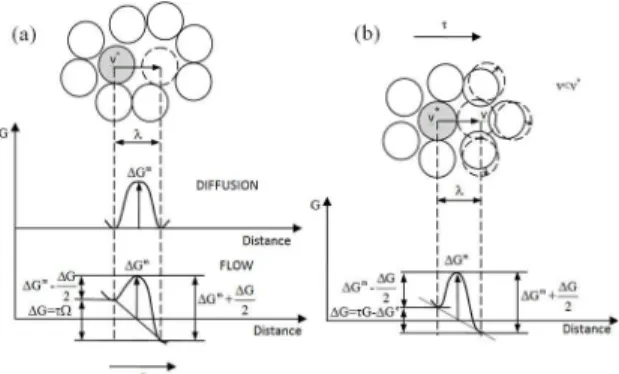
of amorphous alloys. Figure 4 shows the process of atomic
movement during deformation of metallic glasses and the creation of free volume, in which V* is the efective
hard-sphere size of the atom, ΔGm is the activation energy of the motion, λ is the jump of length, τ is the shear stress, ΔG = τΩ
is the decreased free energy of the atom after jumping and Ω is the atomic volume.
Figure 3. Micro-crystallite model.
2.3. Free volume model
Free volume model was put forward by Cohen and Turnbull70-72 to explain the phenomenon of self-difusion in Van der Waals liquids and liquid metals. Then Spaepen73
developed this model by analysis of the mechanism for
deformation and dynamics of metal in 1977, which can be
used to describe the deformation and fracture of metallic
glasses. He thought that there existed some free volumes
in amorphous phase and the microscopic plasticity resulted from many single atom‒jumps. When the liquid is cooled slowly, the atoms will rearrange and form the crystalline
solid. In this process, the volume of material will shrink. On the other hand, when the liquid is quenched fast, the “gap” will be kept in amorphous solid. Its volume is larger than
the corresponding crystalline solid and hence the increased
part is called the free volume. In a word, the free volume
Vf is deined as that part of the thermal expansion, or excess
volume Δ which can be redistributed without energy changeV 72.
Gm 2G
D -D
Gm 2G
D +D
Figure 4. (a) Illustration of an atomic jump; (b) The creation of free volume.73
For an atom jump, it must have a nearest neighbor environment as shown in Figure 4 (a), and the nearby area
also must have enough space to accommodate its atomic volume V*. In this jumping process, the local free energy
is minimal and some ΔGm must be supplied. The number of jumps across the activation barrier is the same in both directions, when ΔGm is obtained from thermal luctuations. However, at an applied stress, the number of forward jumps
across the activation barrier ( ) is larger than
that of backward jumps (
), and this results in
a net forward lux of atoms and forms the basic mechanism for low. Figure 4 (b) shows the creation of the free volume.
Under the applied stress, the certain amount of free volume
is created when an atom squeezes into a smaller space whose
volume is V.
This model can analyze the low behavior of metal glasses at high temperature. At low temperature, however, it cannot be well used to qualitatively analyze the deformation behavior of metallic glasses. The free volume model provides a simple
and practical model to describe the plasticity of amorphous
alloys. The applicability of the model has been well veriied and it can qualitatively explain many mechanics properties
of amorphous alloys74-76. In 1979, Argon77 used “shear transformation” to explain the plastic deformation of metallic
glasses and the theory meets well with the experimental
observations. He thought that the “low event” was not a single isolated event, but a rearrangement of a group of atoms. Falk78,79 developed the theory of “shear transformation zone
conjunction with the complete mathematical model. An STZ only appears in response to external stimuli, being undeinable
a priori in the static glass structure before deformation80. The shear transformation zone theory is an extension and expansion for free volume model at the molecular level. It
can solve the defects of the free volume model, particularly
in the description of low temperature state. But this process involves too many parameters. Based on the researches of Stillinger et al.10,81, Malandro et al.82 and Wales et al.83,84, Johnson and Samwer85 put forward the cooperative shear model (CSM). They well explained the plasticity behavior in low temperature.
2.4. Continuous random network model
Bernal’s model has been widely accepted for metallic glasses, but it fails to describe the metal-metalloid-based alloys with pronounced chemical short-range order86. In
light of this, Gaskell87-89 put forward a model shown in
Figure 5. He87 thought that there was a basic structure unit
that is similar to the corresponding component crystal microstructure in metallic glasses, this structure unit was
regarded as tri-capped trigonal prism (TTP) that can form the net by coplanar points and coplanar faces. Figure 5(a)
displays the regular trigonal prismatic coordination, in which N is the non-metallic element, MI are metal atoms, MII are
further atoms capping the square faces at somewhat larger and even more variable M-N distances. For example, the TTP of Ni-P is P-centered and trigonal prism forms by six Ni atoms, another three Ni atoms capped the square faces of the prisms. Figure 5(b) shows a chain-like connection of trigonal prism by sharing edges. Dubois90 proposed
the packing rule of TTP based on the theory of chemical twinning. Gaskell87 used this model to calculate the RDF of Pd-Si and found that it agreed well with the experimental data. However, there exist some limitations for describing
the structure of metallic glasses91-93. For example, Waseda and Chen91 found that the microstructure of Fe-B is diferent
from that in Fe-P. Boudreaux and Frost92 found two diferent
structures (octahedron and trigonal prism) in Pd-Si, Fe-P and Fe-B with the help of computer simulation. So the TTP unit is not the only structure in metallic glasses. In addition, the
model assumed that the neighbor bond length and angle are unchanged which make the system a smaller density than
the corresponding component crystal. Thus it does not meet
the principle of dense packing of metallic glasses, and the
diference of densities obtained by theoretical calculation
and experiment is obvious94,95.
The model not only shows the homogeneity of metallic
glasses macroscopicly, but also explains why the structure
of the metallic glasses has long-range disorder. It reveals
many properties such as isotropy, but cannot explain micro-inhomogeneity and phase splitting phenomenon of metallic
glasses.
Figure 5. Gaskell's stereochemical model: (a) Regular trigonal prismatic coordination; (b) Edge-sharing of polyhedra.87
2.5. Dense packing of atomic cluster model
In the 1970s, Wang96 suggested that amorphous alloys may have a crystal-like, short-range structure which retained by stacking various types of polyhedra and atomic disorders
at random. These polyhedrons are called clusters those are considered as the basic unit in the structure of metallic glasses. They have more abundant atomic connection compared with the ive basic Bernal polyhedrons97,98. In addition, the
ive-fold symmetry of the clusters can prevent the way of crystal growth to a certain extent. This is consistent with
the principles of short-range order and long-range disorder
in metallic glasses.
SRO is insuicient to describe the structure of metallic glasses and hence MRO is used to describe the connection and coniguration of SRO. In order to describe the MRO of
metallic glasses, Miracle99,100 put forward the FCC/HCP dense
packing cluster model in 2004. He put many hard spheres in
a three-dimensional box and then made the spheres dense
packing by shaking. He found that there exist many stable icosahedron clusters stacking in fcc. In this model, the center
atom of cluster is regarded as solute atoms, and these atoms which occupied the gap of cluster are regarded as solvent
atom. The model considers only three topologically distinct solutes and these solutes have speciic and predictable sizes
relative to the solvent atoms101,102. Figure 6 (a) shows an
(110) plane of clusters in dense cluster-packing structure, which illustrates the feature of interpenetrating clusters and
eicient atomic packing around each solute. And Ω is the
solvent atom which is packed randomly, α is the primary cluster-forming solute species which usually form an fcc array extending to no more than a few cluster diameters,
β is the secondary solute occupied the tetrahedral site and
BSAP type is further transformed into the TTP type. The
packing of solute-centered icosahedron cluster obtained by using the common-neighbor analysis109 is displayed in
Figure 8. It can be seen from this igure that the majorities
of clusters are icosahedron (555) and icosahedron-like (544 and 433) clusters in Ni81P19, Ni80P20 and Zr84Pt16. Figure 8 (b)
(c) (d) show the three typical cluster connections. In these igures,VS, ES and FS denote vertex-sharing, edge-sharing and face-sharing, respectively. In the same system, the type
of cluster is similar, especially the type of topology and the
coordination number.
Figure 6. (a) 2D Miracle dense cluster model; (b) 3D cluster model.99
In Miracle’s model, the order of the cluster-forming
solutes cannot extend beyond a few cluster diameters, and hence the characteristic of disorder can be retained beyond
the nanoscale. However, the model includes defects that provide rich structural description of metallic glasses. It could not only predict the number of solute atoms in the irst
coordination shell of a typical solvent atom, but also provide a remarkable ability to predict metallic-glass composition
accurately for a wide range of simple and complex alloys. In general, this model is more successful in recent studies on glassy alloys.
According to the model of Miracle, Sheng et al.103-105
used a combination of state-of-the-art experimental and
computational techniques to analyze a range of binary systems and ternary systems that involve diferent atomic size
ratios106,107 and elucidate the diferent type of SRO as well as the nature of the MRO. They conirmed the dominance of solute-centered clusters and put forward a dense equivalent cluster packing model. They thought that the basic unit of metallic glasses is cluster made up of a variety of Voronoi polyhedra. Meanwhile they used Voronoi index method to measure the diferent clusters, then process statistical analysis. Voronoi index usually expresses as <n3,n4,n5,n6, ... >, ni refers to the number i-edges faces of Voronoi polyhedra which can
be considered as a characteristic signature of a particle’s
coordination structure. Since the face count is equal to the
number of nearest neighbors of the particle, so
is called
the coordination number (CN). For example, the icosahedral coordination structure corresponding to the Voronoi index <0,0,12,0, ... > describes a polyhedron with exactly 12 faces with 5 edges each. Figure 7 (a) shows the CN distribution
in Ni81B19, Ni80P20, Zr84Pt16 and Ni63Nb37, respectively. The polyhedron structure in several representative metallic glasses
is listed in Figure 7 (b). It can be seen that the average CN changes with the efective atomic size ratio radius (R*) between solutes and solvent atoms. The preference for a particular type of cluster is diferent with the variation of R* in various systems. When R* > 1.2, the main polyhedra belongs to the Frank-Kasper108 type; when R* ≈ 0.902, the Frank-Kasper is transformed into the icosahedral type; when R* ≈ 0.835, the icosahedral type is transformed into the BSAP (bi-capped square Archimedean antiprism) type; when R* ≈ 0.732, the
ni i
/
Figure 7. (a) The coordination number distribution of solute atoms in several metallic glasses; (b) The corresponding polyhedron structure.103
Figure 8. (a) The icosahedral type ordering of cluster in metallic glasses; (b) (c) and (d) The ive-fold symmetry of cluster connections for Ni81B19, Ni80P20 and Zr84Pt16, respectively.103
topologies for various CNs. It greatly reduces the human subjective factor and the system error and enhances people’s understanding of structure of metallic glasses.
Recently, based on the study of the Cu-Zr metallic glasses, Almyras et al.110 found that the combinations of icosahedral-like clusters can be formed according to a simple rule. They
demonstrated that the combinations of icosahedral-like clusters
can follow a sequence of magic number by considering the system’s stoichiometry. In experiments, the combinations of icosahedral-like clusters were referred to as “superclusters”
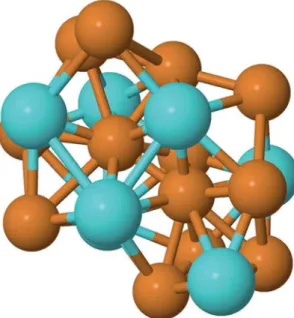
and they regarded superclusters as basic building units111. Figure 9 shows a case of 20-atom supercluster composed of
two 13-atom icosahedrons-like clusters, in which the brown spheres represent copper and the blue represent zirconium
atoms. Their experimental results well agreed with the
simulation and could reproduce the structural characteristics
of the system. They suggested that the interconnections of clusters and consequently the formation of the superclusters
were topological112. This method may be used to interpret
the design of new metallic glasses and to understand their experimental data113.
Figure 9. A case of 20-atom supercluster.112
2.6. Direct observation of the local structure in
metallic glasses
Scientists did not directly observe the disordered structure of metallic glasses in experiments all the time. All the methods of studying the local structure of metallic glasses just provide the average and one-dimensional structural information. In 2010, Hirata et al.114 investigated the coniguration of metallic glass by nanobeam electron difraction (NBED) combined with AIMD. They irst directly observed the local atomic structure in metallic glasses. Figure 10 shows the experimental principle and structure image of metallic glasses.
Figure 10. (a) The experimental principle; (b) The three-dimensional proile of a calculated electron nanoprobe with a FWHM beam size of ~0.36nm; (c) The image of local atomic order in metallic glasses.114
The direct observation provides an important method to
explore the microstructure of metallic glasses by employing
a state-of-the-art electron nanoprobe combined with AIMD simulation. Compared with the x-ray115, extended x-ray absorption ine structure (EXAFS)116 etc., this method
can directly observe the distinct patterns from individual
atomic cluster and its assemblies. This provides a new
way to understand the properties and mechanisms of the metallic-glasses formation and gives a compelling evidence
of short-range order in metallic glasses.
2.7. Flow unit model
In metallic glasses, there exist some diferent liquid-like
regions and solid-like regions, as envisaged by Cohen and Grest117,118. In the system, the coordination of “liquid-like”
atoms is unstable and changes within the Debye time, while
the coordination of “solid-like” atoms has a long life-time119.
Egami et al.120 found that there exist about 24.3% liquid-like atoms in Zr52.5Cu17.9Ni14.6Al10Ti5. Based on the researches
of glassy structure and dynamic non-uniformity, Wang’s team combines experiment with computer simulation. They have found that the liquid-like regions played a role of “detect”, which can detect the atomic rearrangement
and have characteristics of relatively high free energy, low
density and viscoelasticity. The regions were deined as low unit121 in metallic glasses. Flow unit model is shown in Figure 11. In this model, they thought that the low units as liquid-like quasi phases were embedded in solid-like
glassy substrate122,123.
The size of clusters in pink-color area is several nanometer level. Compared with other atoms in the metallic glass, they have low elastic modulus and strength, high liquidity and atomic energy, and atomic arrangement is looser. These areas are also known as “soft region” or “liquid-like regions”, in
which elastic energy cannot be stored, and they are embedded
free-volume regions formed between the atomic clusters, in
which atoms are loosely bonded; and (III) interconnecting
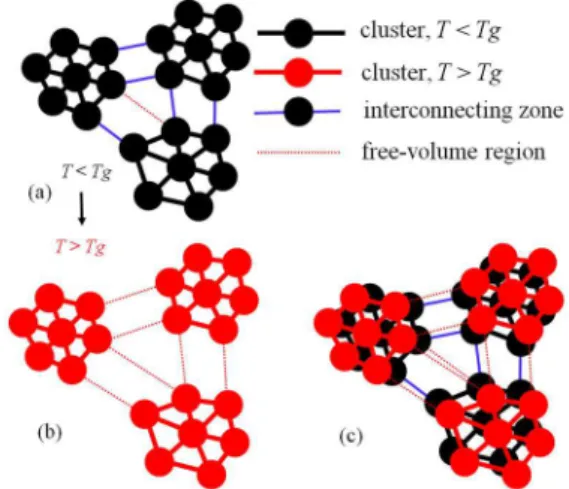
zones with less directional bonding or transition bonding, which interconnect the clusters127. When T< T
g (Figure 12a),
the tightly bonded clusters randomly connected each other through the interconnecting zones and separated by the
free volumes. When T> Tg, the tightly bonded clusters are
completely separated by free volume (Figure 12b) as the
interconnecting zones gaining energies become the free
volumes (Figure 12c). At this stage, the cluster, i-zone and free volume concept were still based on qualitative deinition.
Figure 11. Flow unit model.123
are subject to stress or thermal activation, these areas will be rearranged and dissipate energy.
Diferent mechanical properties in metallic glasses result from the diferent characteristics of the low units. For instance, the ductility in tension at 0.75 Tg achieved in the
La-based MG is due to the activation of high density of low
units124. The fundamental low units govern the mechanical
behavior and ductility, and the activation energy and density
of the low units play a crucial role in the viscoelasticity and plasticity of metallic glasses. In addition, the features of the activated low units are similar to those of the supercooled liquid, and the activation of low units is the precursor of the glass transition.
This model can explain many phenomena in metallic
glasses and also can help the understanding of some processes125 such as the evolution of low unit. Whether the low units exist remains unclear, and needs a direct evidence from experiments.
2.8. Tight- bond cluster model
The high intense neutron scattering source for powder scattering, for example, the Neutron Powder Difractometer (NPDF), provides a high resolution and a large Q-range (0.8 to 50 Å-1), and together with low and stable background
scattering, enables scientists to obtain excellent data for
PDF studies of disordered and nanocrystalline materials. Taking this advantage, Fan et al. collected total-scattering for PDF on the as-cast and its crystallized counterpart of a Zr-Cu-Al ternary BMG at room temperature and cryogenic
15 K. They constructed an atomic model based on the peak spallation, atomic compression and tension appeared on
the PDF data for the nearest atom pairs, in which strongly bonded clusters act as units or “hard spheres” instead of the
individual atoms acting as hard spheres, and these clusters are randomly distributed, strongly connected, and result in free volume between the clusters126. They further developed the atomic model in 2009, and described it as the tight-bond cluster model. This model is illustrated in Figure 12 and contains essentially three major parts: (I) clusters of atoms with strong directional bonding (tight-bond clusters); (II)
Figure 12. Tight-bond cluster model: A change in the connections between clusters below and above Tg (black: below Tg and red: above Tg).128
The properties of material always have an intimate relationship with their structure. In order to have a good
understanding of the structure and the relationship between
properties and structure in metallic glass, Fan et al.127 built a
sketch to illustrate the structural changes and try to explain
the physical and mechanical properties of metallic glasses. As shown in Figure 13, A, B and C are represented as atomic clusters with diferent types or orientations. When
the temperature rises close to the Tg, tight bonds in the interconnecting zones become loose as they gain energies,
resulting in free volume. When the clusters are mostly
separated by free volume, the solid amorphous structure is
then transformed into the supercooled liquid state. So we can
see that the high strength of metallic glasses results from the
tight bond in the clusters. The interconnecting zone results
in the free-volume matrix, resulting in a homogeneous
deformation under low applied stresses. are equal to or shorter than those within the crystal grains in the crystallized counterpart. (2) i-zone: areas consist of
weak bonded atoms that have the bond lengths of the nearest atoms compared to those in the crystal boundaries in its
crystallized counterpart. The bonding property in this area is similar to the crystal (grain) boundary in crystals. There are no crystals/grains, but clusters in metallic glasses. It is
the reason why they use the concept of i-zone to describe the
boundary-like area. The bond lengths in i-zone grow larger to form free volume network at glass transition temperature.
(3) free volume: areas consists of the weakest bonded atoms that have the bond distances of the nearest atoms longer
than those existed in its crystallized counterpart, i.e., the
bond lengths of the nearest atoms are greater than that in
the i-zone. Free-volumes do not exist in its crystallized counterpart and can be considered as supercooled liquid-like area. The authors also provided quantitative deinition for
the i-zone, and free-volume by distances between the nearest
atoms in the as-cast Zr55Cu35Al10 BMG. The initiating atom pair distances for i-zone and free volumes can be deined as that they are at least 2.8% greater, or at least 9.6% greater
than that calculated from their characteristic atomic radius,
respectively; and thus, the cluster is deined128. The authors
claimed that the atoms which weakly connected i-zone should be one of the most dominated factors on mechanical properties in metallic glasses40.
Based on the tight-bond model, these authors started to investigate the structural evolution and energy distribution
of the Zr-, Cu- and Al-centered irst shell clusters for Zr55Cu35Al10 liquid and glass during the cooling process, and
propose a new parameter to describe the structural evolution of the clusters131. In addition, they conducted series AIMD
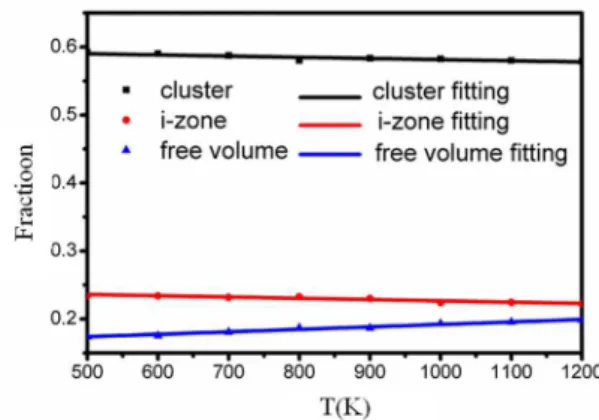
simulations to further analyze and improve their model132. Figure 15 shows the relative fractions of cluster, i-zone and
free volume atom pairs compared to their summation as a
function of temperature and Figure 16 shows the efect of diferent elements. They found that the relative fraction
of the cluster atom pairs increases linearly and that of the free volume atom pairs decreases linearly with decreasing
temperature. Although the radius of Al is not the smallest, it exerts a great inluence on the structure of Zr55Cu35Al10.
Although this model can well qualitatively explain many
physical phenomena of amorphous alloys, it needs more
research work on quantitatively determining the relationship between the mechanical properties and the atomic structures.
3. Conclusions
Scientists have made great eforts in studying the structure of amorphous alloys at the atomic level. Nowadays, we can
say that the structures at the atomic-level of metallic glasses
can be well understood with some mystery remaining. The
lack of unit cells makes the amorphous structures much more complex at the atomic level and thus one of the important
Figure 13. (a) When T< Tg, the clusters are connected to each other by interconnecting zone; (b) When T> Tg, the clusters are separated by free volume.127
In addition, Figure 14 shows a schematic illustration to
further understand vividly the mutual relation among the
three parts of the model proposed by Fan. The black-color
parts represent the clusters, and the interconnecting zone between the clusters and the free volume region are shown in
Figure 14 (b), and Figure 14 (c), respectively. The blue area in Figure 14 (b) represents the interconnecting zone between clusters, which may contain several layers of atoms. The atomic coniguration in this interconnecting region is looser as compared with the cluster zones. The atoms marked with half blue and half red in Figure 14 (d) show the connecting state between atoms just near the clusters. The blue parts
correspond to interconnection zones, while the red parts
connect with the region belonging to free volume.
Figure 14. (a) Tight-bond cluster model; (b) The interconnecting zone between clusters; (c) Free volume zone; (d) The connecting condition between atoms in the boundary of clusters.
Based on a systematic study on PDF and RDF at diferent temperatures and phase states for ternary bulk
metallic glasses37,126,127-130, in 2015, they inally deined
the free-volume, i-zone and cluster in metallic glasses for
3. Qiao JC, Pelletier JM. Dynamic Mechanical Relaxation in Bulk Metallic Glasses: A Review. Journal of Materials Science & Technology. 2014;30(6):523-545.
4. Hufnagel TC, Schuh CA, Falk ML. Deformation of metallic glasses: Recent developments in theory, simulations, and experiments. Acta Materialia. 2016;109:375-393.
5. Inoue A, Zhang T, Kita K, Masumoto T. Mechanical Strengths, Thermal Stability and Electrical Resistivity of Aluminum-Rare Earth Metal Binary Amorphous Alloys. Materials Transactions, JIM. 1989;30(11):870-877.
6. Li Y, Bai HY, Wen P, Liu ZX, Zhao ZF. Superconductivity of bulk Zr46.75Ti8.25Cu7.5Ni10Be27.5 metallic glass. Journal of Physics:
Condensed Matter. 2003;15(27):4809-8415.
7. Inoue A, Takeuchi A. Recent progress in bulk glassy, nanoquasicrystalline and nanocrystalline alloys. Materials Science and Engineering: A. 2004;375-377:16-30.
8. Chen HS. Glassy metals. Reports on Progress in Physics.
1980;43(4):353-432.
9. Suryanarayana C, Inoue A. Bulk metallic glasses. Boca Raton:
CRC Press; 2010. 565 p.
10. Debenedetti PG, Stillinger FH. Supercooled liquids and the glass transition. Nature. 2001;410(6825):259-267.
11. Lee KS, Ha TK, Ahn S, Chang YW. High temperature deformation behavior of the Zr41.2Ti13.8Cu12.5Ni10Be22.5 bulk metallic glass.
Journal of Non-Crystalline Solids. 2003;317(1-2):193-199.
12. Inoue A, Zhang T, Masumoto T. Al–La–Ni Amorphous Alloys with a Wide Supercooled Liquid Region. Materials Transactions, JIM. 1989;30(12):965-972.
13. Inoue A, Nakamura T, Nishiyama N, Masumoto T. Mg–Cu–Y Bulk Amorphous Alloys with High Tensile Strength Produced by a High-Pressure Die Casting Method. Materials Transactions,
JIM. 1992;33(10):937-945.
14. Peker A, Johnson WL. A highly processable metallic glass: Zr41.2Ti13.8Cu12.5 Ni10.0 Be22.5. Applied Physics Letters.
1993;63(17):2342-2344.
15. Inoue A, Nishiyama N, Matsuda T. Preparation of Bulk Glassy Pd40Ni10Cu30P20 Alloy of 40 mm in Diameter by Water Quenching.
Materials Transactions, JIM.1996;37(2):181-184.
16. Inoue A, Zhang T. Fabrication of bulk glassy Zr55Al10Ni5Cu30 alloy
of 30 mm in diameter by a suction casting method. Materials Transactions, JIM. 1996;37(2):185-187.
17. Inoue A, Nishiyama N, Kimura H. Preparation and Thermal Stability of Bulk Amorphous Pd40Cu30Ni10P20 Alloy Cylinder of 72 mm in Diameter. Materials Transactions, JIM. 1997;38(2):179-183.
18. Johnson WL. Bulk Glass-Forming Metallic Alloys: Science and Technology. MRS Bulletin.1999;24(10):42-56.
19. Zhang Q, Zhang W, Inoue A. Fabrication of New Cu34Pd2Zr48Ag8Al8
Bulk Glassy Alloy with a Diameter of 30 mm. Materials Transactions, JIM. 2007;48(11):3031-3033.
20. Yuqiao Z, Nishiyama N, Inoue A. Development of Ni-Pd-PB Bulk Metallic Glasses with High Glass-Forming Ability. Materials Transactions, JIM. 2009;50(6):1243-1246.
21. Lou HB, Wang XD, Xu F, Ding SQ, Cao QP, Hono K, et al. 73 mm-diameter bulk metallic glass rod by copper mould casting.
Applied Physics Letters. 2011;99(5):051910.
Figure 15. Changes of the relative fractions of cluster, i-zone and free volume atom pairs with temperature in AIMD simulations.132
Figure 16. Changes of the relative fractions of Al, Cu and Zr cluster, i-zone and free volume atom pairs with temperature in AIMD simulations.132
interests to conduct further studies on their local atomic
structures, which might be able to help scientists inally wipe the remaining mystery away. Furthermore, quantitatively characterizing and understanding the structure–property
correlations at the atomic level on amorphous alloys are one of the most interesting topics, and also might be one of the
hardest ields to inish, which is still attracting scientists greatly.
4. Acknowledgments
This work was supported by the NSFC (Grant No. 50971057 and 51371099). CTL is thankful for the inancial
support provided by the Research Grant Council (RGC),
the Hong Kong Government through the General Research Fund (GRF) with the account number of City U 102013.
5. References
1. Klement Jun W, Willens RH, Duwez P. Non-crystalline Structure in Solidiied Gold-Silicon Alloys. Nature. 1960;187(4740):869-870.
22. Nishiyama N, Takenaka K, Miura H, Saidoh N, Zeng Y, Inoue A. The world’s biggest glassy alloy ever made. Intermetallics.
2012;30:19-24.
23. Inoue A. Recent Progress of Zr-Based Bulk Amorphous Alloys.
Science Reports of the Research Institutes, Tohoku University. Ser. A, Physics, Chemistry and Metallurgy. 1996;42(1):1-11.
24. Cargill GS, Spaepen F. Description of chemical ordering in amorphous alloys. Journal of Non-Crystalline Solids.
1981;43(1):91-97.
25. Mattern N, Kühn U, Hermann H, Ehrenberg H, Neuefeind J, Eckert J. Short-range order of Zr62−xTixAl10Cu20Ni8 bulk metallic
glasses. Acta Materialia. 2002;50(2):305-314.
26. Huang L, Wang CZ, Hao SG, Kramer MJ, Ho KM. Short- and medium-range order in amorphous Zr2Ni metallic alloy. Physical
Review B. 2010;81(9):094118.
27. Ivison PK, Soletta I, Cowlam N, Cocco G, Enzo S, Battezzati L. Evidence of chemical short-range order in amorphous CuTi alloys produced by mechanical alloying. Journal of Physics: Condensed Matter. 1992;4(7):1635.
28. Nassif E, Lamparter P, Steeb S. X-ray Difraction Study on the Structure of the Metallic Glasses Mg84Ni16 and Mg30Ca70.
Zeitschrift für Naturforschung A. 1983;38(11):1206-1209.
29. Steeb S, Lamparter P. Difraction studies of liquid and amorphous alloys. Journal of Non-Crystalline Solids. 1984;61-62(Pt
1):237-248.
30. Kaban I, Jóvári P, Escher B, Tran DT, Svensson G, Webb MA, et al. Atomic structure and formation of CuZrAl bulk metallic glasses and composites. Acta Materialia. 2015;100:369-376.
31. Sato S, Sanada T, Saida J, Imafuku M, Matsubara E, Inoue A. Efect of Al on Local Structures of Zr-Ni and Zr-Cu Metallic Glasses. Materials Transactions. 2005;46(12):2893-2897.
32. Enzo S, Schiini L, Battezzati L, Cocco G. RDF and EXAFS structural study of mechanically alloyed Ni50Ti50. Journal of the Less Common Metals. 1988;140:129-137.
33. Cocco G, Enzo S, Antonione C, Riontino G, Venturello G. SAXS study of the structure of amorphous Fe75TM5B20 (TM,
Ti, V, Cr, Mn, Fe, Co, Ni). Solid State Communications.
1984;51(10):777-780.
34. Miller MK, Shen TD, Schwarz RB. Atom probe studies of metallic glasses. Journal of Non-Crystalline Solids. 2003;317(1-2):10-16.
35. He J, Kaban I, Mattern N, Song K, Sun B, Zhao J, et al. Local microstructure evolution at shear bands in metallic glasses with nanoscale phase separation. Scientiic Reports. 2016;6:25832. 36. Ichitsubo T, Matsubara E, Yamamoto T, Chen HS, Nishiyama
N, Saida J, et al. Microstructure of fragile metallic glasses inferred from ultrasound-accelerated crystallization in Pd-based metallic glasses. Physical Review Letters. 2005;95(24):245501.
37. Fan C, Liu CT, Chen G, Chen G, Liaw PK, Yan HG. Efect of molten quenching temperature on glass-forming ability of nanoquasi-crystal-forming Zr-based metallic glasses. Scripta Materialia. 2013;68(7):534-537.
38. Mattern N, Bednarčik J, Pauly S, Wang G, Das J, Eckert J. Structural evolution of Cu–Zr metallic glasses under tension.
Acta Materialia. 2009;57(14):4133-4139.
39. Michalik S, Michalikova J, Pavlovic M, Sovak P, Liermann HP, Miglierini M. Structural modiications of swift-ion-bombarded metallic glasses studied by high-energy X-ray synchrotron radiation. Acta Materialia. 2014;80:309-316.
40. Fan C, Liu CT, Chen G, Liaw PK. Quantitatively deining free-volume, interconnecting- zone and cluster in metallic glasses.
Intermetallics. 2015;57:98-100.
41. Luo SY, Li JH, Cui YY, Liu BX. Glass-formation and atomic structures of Cux(Zr0.22Hf0.78)1−x and (Cu0.61Hf0.39)1−x Zrx alloys investigated by Monte Carlo simulation. Materials Letters. 2013;100:130-132.
42. McGreevy RL, Pusztai L. Reverse Monte Carlo Simulation: A New Technique for the Determination of Disordered Structures.
Molecular Simulation. 1988;1(6):359-367.
43. Keen DA, McGreevy RL. Structural modelling of glasses using reverse Monte Carlo simulation. Nature. 1990;344(6265):423-425.
44. Kresse G, Hafner J. Ab initio molecular dynamics for liquid
metals. Physical Review B. 1993;47(1):558.
45. Kresse G. Ab initio molecular dynamics for liquid metals.
Journal of Non-Crystalline Solids. 1995;192-193:222-229.
46. Trady S, Mazroui M, Hasnaoui A, Sassouni K. Molecular dynamics study of atomic-level structure in monatomic metallic glass. Journal of Non-Crystalline Solids. 2016;443:136-142.
47. Bernal JD. A Geometrical Approach to the Structure of Liquids.
Nature.1959;183(4655):141-147.
48. Bernal JD. Geometry of the Structure of Monatomic Liquids.
Nature.1960;185(4706):68-70.
49. Bernal JD, Mason J. Packing of Spheres: Co-ordination of Randomly Packed Spheres. Nature.1960;188(4754):910-911.
50. Cohen MH, Turnbull D. Metastability of Amorphous Structures.
Nature. 1964;203(4948):964.
51. Finney JL. Random packings and the structure of simple liquids. I. The geometry of random close packing. Proceedings of the Royal Society of London A: Mathematical, Physical and Engineering Sciences. 1970;319(1539):479-493.
52. Finney JL. Modelling the structures of amorphous metals and alloys. Nature. 1977;266(5600):309-314.
53. Cargill GS. Dense Random Packing of Hard Spheres as a Structural Model for Noncrystalline Metallic Solids. Journal of Applied Physics. 1970;41(5):2248-2250.
54. Faber TE, Ziman JM. A theory of the electrical properties of liquid metals. Philosophical Magazine. 1965;11(109):153-173.
55. Bennett CH. Serially Deposited Amorphous Aggregates of Hard Spheres. Journal of Applied Physics. 1972;43(6):2727-2734.
56. Wang WH. The nature and properties of amorphous matter.
Progress in Physics. 2013;33(5):177-351.
57. Polk DE. The structure of glassy metallic alloys. Acta Metallurgica.
1972;20(4):485-491.
58. Adams DJ, Matheson AJ. Computation of Dense Random Packings of Hard Spheres. The Journal of Chemical Physics.
1972;56(5):1989-1994.
59. Matheson AJ. Computation of a random packing of hard spheres.
60. Sadoc JF, Dixmier J, Guinier A. Theoretical calculation of dense random packings of equal and non-equal sized hard spheres applications to amorphous metallic alloys. Journal of Non-Crystalline Solids.1973;12(1):46-60.
61. Connell GAN. Dense random packings of hard and compressible spheres. Solid State Communications. 1975;16(1):109-112.
62. Barker JA, Hoare MR, Finney JL. Relaxation of the Bernal model. Nature. 1975;257(5522):120-122.
63. Heimendhal LV. Metallic glasses as relaxed Bernal structures.
Journal of Physics F: Metal Physics. 1975;5(9):L141.
64. Yamamoto R, Matsuoka H, Doyama M. Structural relaxation of the dense random packing model for amorphous iron. Physica Status Solidi (a). 1978;45(1):305-314.
65. Bragg L, Nye JF. A dynamical model of a crystal structure.
Proceedings of the Royal Society of London A: Mathematical,
Physical and Engineering Sciences. 1947;190(1023):474-481.
66. Bagley BG, Turnbull D. Structure Study of an Amorphous Electrodeposited Nickel-Phosphorus Alloy. Journal of Applied Physics. 1968;39(12):5681-5685.
67. Waseda Y. The Structure of Non-Crystalline Materials: Liquids and Amorphous Solids. New York: McGraw-Hill; 1980. 326 p.
68. Wagner CNJ. Structure of Amorphous Alloy Films. Journal of Vacuum Science and Technology. 1969;6(4):650-657.
69. Cargill GS III. Structure Investigation of Noncrystalline Nickel-Phosphorus Alloys. Journal of Applied Physics. 1970;41(1):12-29.
70. Cohen MH, Turnbull D. Molecular transport in liquids and glasses. The Journal of Chemical Physics. 1959;31(5):1164.
71. Turnbull D, Cohen MH. On Free-Volume Model of Liquid-Glass Transition. The Journal of Chemical Physics. 1970;52(6):3038.
72. Turnbull D, Cohen MH. Free-Volume Model of the Amorphous Phase: Glass Transition. The Journal of Chemical Physics.
1961;34(1):120.
73. Spaepen F. A microscopic mechanism for steady state inhomogeneous low in metallic glasses. Acta Metallurgica.
1977;25(4):407-415.
74. de Hey P, Sietsma J, van Den Beukel A. Structural disordering in amorphous Pd40Ni40P20 induced by high temperature deformation.
Acta Materialia. 1998;46(16):5873-5882.
75. Flores KM, Sherer E, Bharathula A, Chen H, Jean YC. Sub-nanometer open volume regions in a bulk metallic glass investigated by positron annihilation. Acta Materialia. 2007;55(10):3403-3411.
76. Hajlaoui K, Benameur T, Vaughan G, Yavari AR. Thermal expansion and indentation-induced free volume in Zr-based metallic glasses measured by real-time difraction using synchrotron radiation. Scripta Materialia. 2004;51(9):843-848.
77. Argon AS. Plastic deformation in metallic glasses. Acta Metallurgica.1979;27(1):47-58.
78. Falk ML, Langer JS. Dynamics of viscoplastic deformation in amorphous solids. Physical Review E.1998;57(6):7192-7205.
79. Langer JS. Shear-transformation-zone theory of deformation in metallic glasses. Scripta Materialia. 2006;54(3):375-379.
80. Greer AL, Cheng YQ, Ma E. Shear bands in metallic glasses.
Materials Science and Engineering: R: Reports.2013;74(4):71-132.
81. Stillinger FH. Supercooled liquids, glass transitions, and the Kauzmann paradox. The Journal of Chemical Physics.
1988;88(2):7818-7825.
82. Malandro DL, Lacks DJ. Relationships of shear-induced changes in the potential energy landscape to the mechanical properties of ductile glasses. The Journal of Chemical Physics.
1999;110(9):4593-4601.
83. Wales DJ. A Microscopic Basis for the Global Appearance of Energy Landscapes. Science.2001;293(5537):2067-2070.
84. Doye JPK, Wales DJ. Saddle points and dynamics of Lennard-Jones clusters, solids, and supercooled liquids. The Journal of Chemical Physics. 2002;116(9):3777-3788.
85. Johnson WL, Samwer K. A Universal Criterion for Plastic Yielding of Metallic Glasses with a (T/Tg)2/3 Temperature Dependence.
Physical Review Letters. 2005;95(19):195501.
86. Chen M. A brief overview of bulk metallic glasses. NPG Asia Materials. 2011;3:82-90.
87. Gaskell PH. A new structural model for transition metal–metalloid glasses. Nature. 1978;276(5687):484-485.
88. Gaskell PH. A new structural model for amorphous transition metal silicides, borides, phosphides and carbides. Journal of Non-Crystalline Solids. 1979;32(1-3):207-224.
89. Gaskell PH. Medium-range structure in glasses and low-Q structure in neutron and X-ray scattering data. Journal of Non-Crystalline Solids. 2005;351(12-13):1003-1013.
90. Dubois JM, Gaskell PH, Le Caer G. A Model for the Structure of Metallic Glasses Based on Chemical Twinning. Proceedings of the Royal Society of London A: Mathematical, Physical and Engineering Sciences. 1985;402(1823):323-357.
91. Waseda Y, Chen HS. Structural study of metallic glasses containing boron (Fe-B, Co-B, and Ni-B). Physica Status Solidi (a). 1978;49(1):387-392.
92. Boudreaux DS, Frost HJ. Short-range order in theoretical-models of binary metallic-glass alloys. Physical Review B.
1981;23(4):1506.
93. Lamparter P. Reverse Monte-Carlo simulation of amorphous Ni80P20 and Ni81B19. Physica Scripta. 1995;T57:72.
94. Inoue A, Negishi T, Kimura HM, Zhang T, Yavari AR. High Packing Density of Zr-and Pd-Based Bulk Amorphous Alloys.
Materials Transactions, JIM. 1998;39(2):318-321.
95. Wang WH, Wang RJ, Zhao DQ, Pan MX, Yao YS. Microstructural transformation in a Zr41Ti14Cu12.5Ni10Be22.5 bulk metallic glass under
high pressure. Physical Review B.2000;62(17):11292-11295.
96. Wang R. Short-range structure for amorphous intertransition metal alloys. Nature. 1979;278(5706):700-704.
97. Saida J, Matsushita M, Inoue A. Direct observation of icosahedral cluster in Zr70Pd30 binary glassy alloy. Applied Physics Letters.
2001;79(3):412-414.
98. Kelton KF. Crystal Nucleation in Supercooled Liquid Metals.
International Journal of Microgravity Science and Application.
2013;30(1):11-18.
100. Miracle DB. Eicient local packing in metallic glasses. Journal of Non-Crystalline Solids. 2004;342(1-3):89-96.
101. Miracle DB, Sanders WS, Senkov ON. The inluence of eicient atomic packing on the constitution of metallic glasses.
Philosophical Magazine.2003;83(20):2409-2428.
102. Miracle DB. The eicient cluster packing model – An atomic structural model for metallic glasses. Acta Materialia. 2006;
54(16):4317-4336.
103. Sheng HW, Luo WK, Alamgir FM, Bai JM, Ma E. Atomic packing and short-to -medium-range order in metallic glasses.
Nature. 2006;439(7075):419-425.
104. Cheng YQ, Ma E, Sheng HW. Atomic level structure in multicomponent bulk metallic glass. Physical Review Letters.
2009;102(24):245501.
105. Cheng YQ, Ma E. Atomic-level structure and structure-property relationship in metallic glasses. Progress in Materials Science.
2011;56(4):379-473.
106. Egami T, Waseda Y. Atomic size efect on the formability of metallic glasses. Journal of Non-Crystalline Solids.
1984;64(1-2):113-134.
107. Senkov ON, Miracle DB. Efect of the atomic size distribution on glass forming ability of amorphous metallic alloys.Materials Research Bulletin. 2001;36(12):2183-2198.
108. Frank FC, Kasper JS. Complex alloy structures regarded as sphere packing. I. Deinitions and basic principles. Acta Crystallographica. 1958;11(3):184-190.
109. Clarke AS, Jónsson H. Structural changes accompanying densiication of random hard-sphere packings. Physical Review E. 1993;47(6):3975-3984.
110. Almyras GA, Lekka CE, Mattern N, Evangelakis GA. On the microstructure of the Cu65Zr35 and Cu35Zr65 metallic glasses.
Scripta Materialia. 2010;62(1):33-36.
111. Almyras GA, Papageorgiou DG, Lekka CE, Mattern N, Eckert J, Evangelakis GA. Atomic cluster arrangements in Reverse Monte Carlo and Molecular Dynamics structural models of binary Cu–Zr metallic glasses. Intermetallics. 2011;19(5):657-661.
112. Antonowicz J, Pietnoczka A, Drobiazg T, Almyras GA, Papageorgiou DG, Evangelakis GA. Icosahedral order in Cu-Zr amorphous alloys studied by means of X-ray absorption ine structure and molecular dynamics simulations. Philosophical Magazine. 2012;92(15):1865-1875.
113. Lekka CE, Bokas GB, Almyras GA, Papageorgiou DG, Evangelakis GA. Clustering, microalloying and mechanical properties in Cu/Zr-based glassy models by molecular dynamics simulations and ab-initio computations. Journal of Alloys and Compounds. 2012;536(Suppl 1):S65-S69
114. Hirata A, Guan P, Fujita T, Hirotsu Y, Inoue A, Yavari AR, et al. Direct observation of local atomic order in a metallic glass.
Nature Materials. 2011;10(1):28-33.
115. Xi XK, Li LL, Zhang B, Wang WH, Wu Y. Correlation of atomic cluster symmetry and glass-forming ability of metallic glass. Physical Review Letters. 2007;99(9):095501.
116. Fujita T, Konno K, Zhang W, Kumar V, Matsuura M, Inoue A, et al. Atomic-scale heterogeneity of a multicomponent bulk metallic glass with excellent glass forming ability. Physical Review Letters. 2009;103(7):075502.
117. Cohen MH, Grest GS. Liquid-glass transition, a free-volume approach. Physical Review B. 1979;20(3):1077.
118. Grest GS, Cohen MH. Liquid-glass transition: Dependence of the glass transition on heating and cooling rates. Physical Review B. 1980;21(9):4113.
119. Egami T. Nano-glass Mechanism of Bulk Metallic Glass Formation. Materials Transactions.2002;43(3):510-517.
120. Dmowski W, Iwashita T, Chuang CP, Almer J, Egami T. Elastic heterogeneity in metallic glasses. Physical Review Letters.
2010; 105(20):205502.
121. Wang Z, Wen P, Huo LS, Bai HY, Wang WH. Signature of viscous low units in apparent elastic regime of metallic glasses.
Applied Physics Letters. 2012;101(12):121906.
122. Wang DP, Zhu ZG, Xue RJ, Ding DW, Bai HY, Wang WH. Structural perspectives on the elastic and mechanical properties of metallic glasses. Journal of Applied Physics.
2013;114(17):173505.
123. Liu ST, Wang Z, Peng HL, Yu HB, Wang WH. The activation energy and volume of low units of metallic glasses. Scripta Materialia.2012;67(1):9-12.
124. Yu HB, Shen X, Wang Z, Gu L, Wang WH, Bai HY. Tensile plasticity in metallic glasses with pronounced β relaxations. Physical Review Letters.2012;108(1):015504.
125. Liu ST, Jiao W, Sun BA, Wang WH. A quasi-phase perspective on low units of glass transition and plastic low in metallic glasses. Journal of Non-Crystalline Solids. 2013;376:76-80.
126. Fan C, Liaw PK, Wilson TW, Dmowski W, Choo H, Liu CT, et al. Structural model for bulk amorphous alloys. Applied Physics Letters. 2006;89(11):111905.
127. Fan C, Liaw PK, Liu CT. Atomistic model of amorphous materials. Intermetallics.2009;17(1-2):86-87.
128. Fan C, Ren Y, Liu CT, Liaw PK, Yan HG, Egami T. Atomic migration and bonding characteristics during a glass transition investigated using as-cast Zr-Cu-Al. Physical Review B.
2011;83(19):195207.
129. Fan C, Liaw PK, Haas V, Wall JJ, Choo H, Inoue A, Liu CT. Structures and mechanical behaviors of Zr55 Cu35 Al10 bulk
amorphous alloys at ambient and cryogenic temperatures. Physical Review B. 2006;74(1):014205.
130. Fan C, Yan HG, Liu CT, Li HQ, Liaw PK, Ren Y, et al. Changes in the atomic structure through glass transition observed by X-ray scattering. Intermetallics. 2012;23:111-115.
131. Zhao J, Inoue A, Liu CT, Liaw PK, Shen X, Pan S, et al. Structure evolution and energy landscape of the clusters in Zr55Cu35Al10
metallic liquid and glass. Scripta Materialia. 2016;117:64-67.
132. Zhao JF, Tang Z, Kelton KF, Liu CT, Liaw PK, Inoue A, et al. Evolution of the atomic structure of a supercooled Zr55Cu35Al10