DOI: 10.1590/1808-057x201803640
*Paper presented at the X ANPCONT Congress, Ribeirão Preto, SP, Brazil, June 2016.
Original Article
Th
e diversity of the Brazilian regional Audit Courts on
government auditing*
André Feliciano Lino
Universidade de São Paulo, Faculdade de Economia, Administração e Contabilidade de Ribeirão Preto, Departamento de Contabilidade, Ribeirão Preto, SP, Brazil
Email: afl [email protected]
André Carlos Busanelli de Aquino
Universidade de São Paulo, Faculdade de Economia, Administração e Contabilidade de Ribeirão Preto, Departamento de Contabilidade, Ribeirão Preto, SP, Brazil
Email: [email protected]
Received on 04.25.2016 - Desk acceptance on 05.02.2016 - 3rd version approved on 06.18.2017 – Ahead of print on 11.06.2017
ABSTRACT
Currently, the 33 regional audit courts are responsible to monitor the public fi nancial management cycle for states and municipalities and to judge the compliance of governors’ acts to the laws regarding procurement and civil servants’ employment from more than 20,000 governmental entities under their jurisdiction. Th is article aims to analyze the diversity of internal confi guration of these regional audit courts and to discuss the potential associations with the fi nancial auditing quality their teams usually run. We conducted interviews with external auditors and IT directors from 18 courts, followed by triangulation to offi cial documents from the audit courts, such as audit manuals and activities reports. Th e audit quality drivers were identifi ed within the governmental auditing literature, supporting the evidences collected by the interviews content analysis. Despite all regional auditing bodies in Brazil were based on the Napoleonic model, the analysis indicates the identifi ed confi gurations vary according to the team’s organization and size, auditor rotation and use of data reporting systems. Th e discussion shows that dissimilarities on the courts’ confi gurations, as they are responsible to audit a specifi c country area, will contribute to a diff erent coercion level on fi scal and accounting issues to state and municipalities, due a combination of characteristics which could mitigate or improve the audit quality. Th is paper additionally suggests some precautions, based on the organization alignment literature, for the use of proxies to control audit quality eff ects in the public fi nance studies in Brazil.
Keywords: governmental audit, Courts of Accounts, external control, audit quality, public sector accounting.
Correspondence address:
André Feliciano Lino
Universidade de São Paulo, Faculdade de Economia, Administração e Contabilidade de Ribeirão Preto, Departamento de Contabilidade
1. INTRODUCTION
“... the National Council of Courts of Accounts is the cornerstone for the defi nition of a national system that integrates the 34 Courts of Accounts, with the capacity to make the Courts of Accounts speak the ‘same language’ and to serve the interest of the society, because Brazil ‘cannot aff ord to have islanded bodies’.” Bruno Dantas, Minister of the Brazilian Supreme Audit Institution (Tribunal de Contas da União - TCU), 2015, at an event of the Association of Members of the Brazilian Courts of Accounts in São Paulo.
The proposal to create a National Council of Courts of Accounts (CNTC in Brazilian Portuguese) is not new: the issue has been debated in the Federal Senate and in the press since proposals for constitutional amendments in 2007. Similar to the successful creation of the National Justice Council and the National Council of the Public Prosecution, the new national council would bring uniformity to procedural norms, guiding audit professionals practices, and acting as a centralized administrative oversight of the Courts of Accounts in the country. In addition to the various understandings that arise regarding the application of fi scal regulation, for example in the interpretation of limits to the use of unpaid commitments or the inclusion of some charges in the limits of personnel expenditures imposed by the Fiscal Responsibility Law (LRF), the rigidity observed in the scrutiny and imposition of penalties also varies with the Court of Accounts. Finally, as freely presented by Senator Humberto Costa to those appointed as Ministers to the Brazilian Supreme Audit Institution (TCU) in the Committee on Economic Matters of the Federal Senate in 2014, cooptation cases of Counselors of State Courts of Account that act in defense of governors given the political indication are well known. The diversity in the composition and practices of the Courts of Accounts lead to diff erent applications of fi scal, fi nancial and accounting regulation in the country.
In the Brazilian context, the 33 State Courts of Accounts, Municipalities and Federal District (CAs) compose the control network on the public administration, which is also formed by the Legislative Branch, Public Prosecutor’s Offi ce, Superior Electoral Court and the SAI (Speck, 2011). The mandate of government audit organizations in Brazil is identifi ed in Articles 70 to 75 of the Federal Constitution of 1988, which place the TCU and CAs as technical organizations auxiliary of the Legislative Branch. However, not only accountability arise from the joint enforcement capacity of the control network, but the diff usion of Public Financial Management (PFM) cycle reforms is also induced by the understanding of
the audit bodies, since they will exercise enforcement of the regulation in force, including fi scal matters.
The dynamism of PFM regulation in Brazil has intensifi ed since 1988, demanding the CAs to review their understandings and procedures demanding the adoption of the innovations by audited entities. Both the new planning instruments, such as the Multi-year Plan (PPA), the Annual Budget Guidelines Law (LDO), and the Appropriation Bill or Annual Budget Law (LOA), the use of physical and fi scal targets, the increasing of the transparency level in the budget process became focus of auditing by CAs. The same with annual account reports by CAs which now requires the preparation of reports on budget execution and on the existence and conditions of the municipality’s internal control. Finally, the CAs began issuing their guidelines on convergence to International Public Sector Accounting Standards (IPSAS), which imposed a standardized chart of accounts and the adoption of specifi c accounting policies by the municipalities.
All of these reforms originated from the central government, designed at Esplanada dos Ministérios’ in Brasilia or at the National Congress, go through a long process until they are institutionalized, that is, embedded at the most operational levels of governments (Andrews, 2013). In this process, audit organizations (SAIs or regional audit bodies) are responsible for encouraging reforms. These independent technical bodies are responsible for external control in the PFM cycle (Stapenhurst & Titsworth, 2001) and run three relevant functions: (i) translation and reduction of the ambiguity of new values, concepts, formulas and limits present in the new practice; (ii) dissemination of new understandings of regulation, using its capillarity and access to the various organs of the federation entities; and (iii) enforcement over the new practice, imputing punishment for misconduct. It is not expected that PFM reforms generate positive impacts on public fi nance without the inductive role of CAs. Therefore, the PFM reforms that challenge CAs to review their understandings and procedures depend on them to be institutionalized by governments.
Despite the common basic structure, there is still room for discretion to organize internal activities, given the autonomy of CAs (for example, the policy of allocating audit activities to teams, the use of data reporting systems for collecting data from the audited entities, policies for personnel qualifi cation). Such diff erences can infl uence the quantity and quality of audits, interfering with the eff ectiveness of each CA, which justifi es the debate about the need to create the National Council of Courts of Accounts, as already mentioned.
Organizations such as the Association of Members of the Brazilian Courts of Accounts (Atricon) and Instituto Rui Barbosa (IRB) carry out actions to reduce the heterogeneity of CAs in the absence of the National Council Courts of Accounts . In 2002, Atricon mapped the CAs characteristics and identifi ed defi ciencies as gap on IT capabilities, culminating to the launch of PROMOEX (Program for Modernization of the External Control System of the States, Federal District and Brazilian Municipalities). Promoex aimed to develop 28 participating CAs and was held from 2006 to 2012, with the support from the Inter-American Development Bank. Recently, Atricon has leading similar actions include the development of the Government Auditing Standards (NAGs), the current Brazilian Public Sector Auditing Standards (NBASP), a portal of good practices to be used as a benchmark to all CAs, and a CA’s performance measurement framework. Finally, Atricon is encouraging the adoption of the Municipal Management Eff ectiveness Index (IEGM) by all CAs in Brazil.
Unlike public sector practitioners, who has already recognized the impact of CAs diversity, the role of auditing in government performance literature is rarely addressed (Rosa, Morote & Prole, 2014). Studies on regional government audit organizations are rare (Melo & Pereira, 2013). Also, there is lack of discussion on the diff erences of these organizations– one exception is Wehner (2003). The previous studies seek to identify how external factors over which audit organizations do not have infl uence ( such as political factors or size
of the budget) would aff ect the performance of their activities in regional and local governments (Melo & Pereira, 2013). However, they ignore internal factors to these organizations under which there is discretion and autonomy, such as the execution of audit processes or the use of data reporting systems to collect data from audited entities. One of the exceptions is the study by Melo, Pereira, and Souza (2014), which pointed out the positive eff ect of CA productivity (number of audits performed by each court in a given year by the number of organs) in reducing propensity to use unpaid commitments by State government. Furthermore, previous studies on public fi nance in Brazil do not consider the role of CAs, especially those involving the impact of the Fiscal Responsibility Law on municipalities (Gerigk, Clemente & Taff arel, 2010; Santos & Alves, 2011; Santolin, Jayme Jr & Reis, 2009). Given the role of CAs in the fi scal dynamics of regional and local governments, the results of these studies would gain greater internal validity by controlling the coercive eff ect that CAs eventually exert on audited entities.
This research aims to analyze the diversity of internal confi guration of regional audit courts in Brazil and to discuss the potential associations with the fi nancial auditing quality their teams usually run. Also, implications of the fi ndings for public fi nance research in Brazil are suggested. In addition to the institutional diff erences of the counselors dynamics in CAs (political layer), usually politically oriented as described by Loureiro, Teixeira and Moraes (2009), we specifi cally discuss the diff erences in the technical layer. External control agents from 18 Courts of Accounts were interviewed all over the country. The interviews were triangulated with documents provided by the CAs.
2. AUDIT MODELS IN THE PUBLIC SECTOR
Audit procedures are relevant part of public fi nancial management (PFM) cycle ) to guarantee the legality and
effi ciency of government actions. Th e PFM cycle is a
series of institutional routines that guide the behavior of bureaucracy in the use of the allocated resources to deliver public policies (Campos & Pradhan, 1996). Routines can be separated into steps (for didactic purposes), from budget preparation and resource management to public accountability, comprising internal or external control (Andrews, 2007). At each stage of the PFM cycle, various governmental and civil society actors produce and use information (Moynihan & Andrews, 2010). At the stage of the PFM cycle that occurs within the organization, internal auditors and part of Internal Control work; auditors from auditing organizations work externally in central, regional and local governments, responsible for External Control.
External audit organizations can be classifi ed into three major general models: (i) Westminster model, (ii) Collegiate model and (iii) Napoleonic model (Stapenhurst & Titsworth, 2001). In the Westminster Anglo-Saxon model, adopted in the United Kingdom, in the 53 former British colonies, and in countries such as Chile and Peru, the General Auditor centralizes decision-making powers over all matters of the body. Professionals with backgrounds in economics and fi nance are predominant, and audit work has a fi nancial bias with less emphasis on legality (Stapenhurst & Titsworth, 2001). Local governments in the United Kingdom, previously audited by public auditors and by private audit fi rms, have been audited since 2010 by private fi rms only (Jones & Caruana, 2015).
Th e Collegiate Model operating in Germany, the
Netherlands, and Japan delegates maximum authority to a board with consensus decisions (Stapenhurst & Titsworth, 2001). In Germany, the governmental audit is runned in
the States, Cities, Municipalities and Counties. At the state level, the audit is done by an independent government body with full autonomy to defi ne the scope of the work (i.e., the Legislative does not indicate what should be audited). Local governments (Cities, Municipalities and Counties) have their accounts audited annually by private fi rms, except the cities where the state audit organization is located, which are audited by it (Berger & Heiling, 2015).
In the Napoleonic model, adopted by Brazil, France, Italy and Spain, the audit organization is not only autonomous but also distant from the Legislative (despite
its auxiliary role). Th e main focus of the auditing is to
verify the legality of the operations executed by the
government; little attention is paid to the effi ciency of
actions. Th eir auditors tend to have legal background. Th e
audit in this model subsidizes the legislature with technical
opinions of government accounts. Th e audit organization
has two layers, a technical one and a judging one. Th e
judging layer, which is the organization’s last decision on all subjects, should vote on technical recommendations and could penalize civil servants, public sector managers and fi rms that contract with governments (Stapenhurst & Titsworth, 2001).
In Brazil, regional audit organizations follow closely TCU formation. Each State in its Constitution provides for the establishment of its regional Court of Accounts. Unlike the Italian model, all external audit tasks of governments are performed by public servants hired with career stability
in CAs. Th erefore, it can be said that government audit
organizations in Brazil hold the monopoly of auditing legality and performance in governments for purposes of external control. States or municipalities do not pay to be audited and the governors and mayors should not have interference over the agenda and scope of the audit.
3. LITERATURE OF AUDIT QUALITY IN GOVERNMENTS
Th e existing literature identifi es three types of audit
procedures performed by government audit organizations; they are (i) fi nancial: related to the reliability of the fi nancial statements; (ii) legality: related to compliance with laws; and (iii) performance or operational: related to
the effi ciency of the public resources usage (Santiso, 2007).
Financial audit reports are fundamental for the enforcement by the external control network on public
administration, especially considering recent advances of
public sector accrual accounting. Th e quality of fi nancial
However, the quality of the audit is related to external factors, which audit organizations have no infl uence – such as political competition, alternation of power, and existence of well-defi ned legal mandate (Dye & Stapenhurst,1998; Melo & Pereira, 2013) – as well as internal factors, which they have potential control or interference. Among the internal factors are the independence of auditors, the best application of the available budget to their activities and the qualifi ed staff (Dye & Stapenhurst, 1998; Portal, 2011). Flaws in these factors lead to a decrease in audit quality and, consequently, to the minor eff ectiveness of the audit organization and the entire control network.
Th e independence of the audit body is made up of
its organizational independence and the operational
independence of its auditors. Th e fi rst concerns the
non-interference of other spheres of government in the body’s mandate and the exempt action of the Councilors (in the case of the Napoleonic model) in relation to
mayors, governors, federal judges. Th e second type of
independence concerns the audit process itself to choose the audit objective and what will be reported (Dye & Stapenhurst, 1998; Power, 1997), without interference from the auditee, whether exercised directly in the auditors or by means of requesting the highest hierarchical positions of the audit organization itself to interfere in favor of the auditee.
One of the remedies to the loss of independence of auditors is the periodic rotation, which is considered essential by the INTOSAI code of ethics (ISSAI 30) and by the Government Auditing Standards applicable to external control in Brazil, published by Rui Barbosa Institute in
2010. Th e non-repetition of the auditing team (rotation)
that recently acted in the same entity would increase the objectivity and accuracy of the reports issued.
However, the discussion on rotation is broad and
has pros and cons to such practice. Th e argument in
favor of rotation is the consequent reduction of the
auditor’s catch potential by the auditee. Th e recursion
of audit-auditee interaction develops relational trust in the pair (Rousseau, Sitkin, Burt & Camerer, 1998), which reduces the independence of reporting nonconformities through the bonds of friendship developed. On the other hand, since audit quality is lower at the beginning of the relationship because the auditor is not aware of the auditee’s activities (Francis, 2004), low recursiveness inhibits learning development and hinder audit quality and depth.
In turn, the recursiveness could come from the greater geographical proximity between auditor and auditee, with positive eff ects to audit quality. Informal conversations with auditees would bring crucial information and greater
use of on-site visits at lower cost, as well as obtaining local media information (newspapers, radios, and local TVs) would broaden the possibility of developing specifi c knowledge (Choi, Kim, Qiu & Zang, 2012). In an era prior to the internet boom, Carcello, Hermanson, and McGrath (1992) pointed out that greater involvement between auditor and auditee and a greater number of on-site audits were among the ten most relevant factors for audit quality.
Unlike the private sector, where the size of the audit organization is signifi cant because of the auditors’ harmful dependence on the revenue of a particular customer or group of clients (DeAngelo, 1981), governmental audit organizations don’t have necessarily their revenues generated by the provision of services in the public sector. When they do, they can still benefi t from the service monopoly. In the case of Brazil, CA revenues come from the State itself and are not associated with the volume
or quality of the services provided. Th us, the auditor
does not suff er pressure from their directors to preserve contracts with clients. However, there is still some degree of dependence between CAs and the State Government, which has the discretion to defi ne their budget.
Another relevant aspect for the autonomy of auditors is the possible promotion to higher positions of the audit organization, such as management positions, by
the infl uence of high offi cials of the central government
or local government with the Councilors. Th is would
reduce the independence of the audit director even though he/she had a permanent position (tenured). Finally, a greater politicization of the judging layer (in Napoleonic models) could lead to less autonomy of the technical layer if there were interference in the operational procedures or discretionary allocation of resources for certain projects supported by the technical layer (such as innovation of audit procedures and procedures, manuals, new information systems etc.), but which may not have support from the judicial branch.
Even with organizational independence assured for CA, constraints on audit capacity or teams with lower capabilities reduce audit quality (Dorotinsky & Floyd,
2004). Th e technical capacity to perform audits depends
Th e size of the teams determines the total of hours allocated to auditing jobs and consequently the audit quality. As the greater the audit eff ort (hours of work), the greater is the probability that the auditor will fi nd nonconformities in accounting statements (Caramanis & Lennox, 2008), the total number of staff hours available for the audit will aff ect the overall quality of the process (Deis & Giroux, 1992; Portal, 2011).
Regarding the technology used, the use of Computer Assisted Audit Tools (CAAT), or Data Reporting Systems, in the collection, storage and pre-processing of accounting data increases the eff ectiveness of the auditing process (Braun & Davis, 2003) by analyzing large quantities of
data in a shorter period of time. Th us, the degree of
automation of CAs would aff ect the hours-audit ratio used in audit work.
However, it is not only the presence of such factors that would lead to a better audit, but their combined presence, coupled with the context in which they operate.
Th is notion of fi tness between context and structure
(organizational fi t) was applied by Gupta, Dirsmith and Fogarty (1994) to the teams of the General Accountability
Offi ce in the United States. Th e Offi ce adjusted of its teams’
control and coordination to the external environment and the technical nature of the audit task. Such organizational alignment approaches through contingency theory or institutional theory have been applied to explain the responses of organizations in the search for better performance, either with the adequacy to environmental demands (contingency fi t) or the search for legitimacy in relation to the stakeholders (institutional fi t) (Van de
Ven & Drazin, 1985). Th us, fi t or alignment is seen as
the congruence of organizational responses (technology, structure, processes) to the environment and institutional context.
Several combinations of alignment may have similar and superior performances depending on the context, which has been called by Van de Ven and Drazin (1985) of isoperformance. As adaptation is a dynamic process, given the constant environmental change (Zajac, Kraatz & Bresser, 2000), the organization operates under a semi-adequacy level (Donaldson, 2001) is repeatedly challenged in its structure and organization.
4. METHODOLOGY
Th is study is based on (i) thematic analysis of the
literature and content analysis of public documents of CAs and (ii) interviews. First, the thematic analysis suggested by Tranfi eld, Denyer and Smart (2003) was carried out, categorizing the audit quality determinants identifi ed in the external audit literature of governments, based on a systematic review of empirical studies on Accounting,
Administration and Public Finance journals. Th e thematic
analysis of empirical studies identifi ed internal factors (independence and technical capacity), which were divided into the following formative characteristics of the audit organizations:
1. Operational independence. It refers to the autonomy of the auditors in selecting the best criteria for performing the audit work and being less subject to actions that would lead them to not report identifi ed misstatements. Such independence is the existence of institutionalized periodic rotation on audit team.
2. Human Resources and Organization. It is the part of the internal capacity related to the acquisition and development of technical skills necessary for the audit work and the organization of these capacities (human capital) in specialized teams. For the same budget, the CA could choose how to apply available resources to expand the number of specialized auditors and how
to geographically allocate them to regional offi ces or
concentrate them in a single headquarter.
3. Audit Processes. It is the technical capacity expressed in the processes used to carry out the audit. Examples are on-site auditing in all audited entities and the automation of audit work routines.
4. Process of Data Collection. Since audit organizations need to break the asymmetry of information regarding the transactions carried out by their auditees, this internal capacity deals with the IT strategies employed by the CA to access the accounting and budgetary data of the audited entities. As example, the recent continuous investments made in the Data Reporting Systems by all CAs in Brazil .
Although the research aims to analyze the Courts of Accounts the diversity in relation to their internal factors as explained above, such organizations are circumscribed to a context, which denotes external factors to be taken into account:
5. Jurisdiction, foundation and annual budget. While the jurisdiction was given by the Constitution of the State of the Federation in which the CA operates, its budget is defi ned yearly by the Legislative Assembly. Notwithstanding this factors which can vary in the present time, a historical aspect is impressed by the year of
usually adopted and the regulation in force that year will impress how the court was organized and should operate. It can change through time, but always some
path dependence remains. Th is starting point was not
chosed by the current counselors and directors in chief. Next, we conducted interviews to observe the determinants of the CAs’ formative characteristics We contacted the correspondent ombudsman of each 33 CAs, which led to a positive participation response of 18 CAs (54% of CAs), from all regions of Brazil, with diff erent sizes regarding the number of audited entities.
Th is represents the plurality of context studied. Th e region
less represented in the survey is the Midwest, and the most represented are South and Southeast, with 40% and
67% of CAs interviewed respectively. Th e interviews were
made by telephone between April and December 2015, with auditors (called ‘Analistas de Controle Externo’ in Portuguese) and directors of Information Technology (IT). As the analysis is focused on the internal factors, observed with greater precision by the technical layer, it was decided not to interview Counselors (political layer).
A semi-structured interview protocol was adopted, divided in the formative characteristics mentioned. Aft er scheduling the interview, the questions was sent to the respondent for their prior preparation. Some interviewee preferred as a fi rst step to send the answers by email and
then be contacted by phone to confi rm answers or make any supplements. On average, the interviews lasted 45 minutes. Interviewees in general have been working for more than 10 years in the CA (maximum of 28 years, minimum of 4 years), and 75% of them had a coordination position (auditor in chief). We counted on the recordings of the interviews to perform the content analysis and to inductively identify the determinants in each training characteristic.
It can be said that each characteristic was unfolded in determinants, because its presence led to it. As the determinants were identifi ed inductively, and no prior knowledge of the determinants was found, respondents were contacted more than once to confi rm answers or
to add information. Th e determinants are represented
in the columns of Table 1, for each of the formative characteristics. It should be noted that those mentioned in the table do not form an exhaustive list. As an example, the automation of audit work routines did not emerge as a relevant aspect, since CAs are generally at an early stage in the issue. Finally, when available, documents such as annual activity reports for the year of 2014, audit manuals and the Data Reporting Systems manuals available on CAs websites served as a complement and triangulation in relation to the data (Denzin & Lincoln, 2005) obtained through interviews.
5. THE DIFFERENT SETTINGS OF THE COURTS OF ACCOUNTS
Th e institutional development of CAs is associated
with the institutional changes of the country and the states (Loureiro et al, 2009) over the 100-year time window of their creation (1891 - 1991). A priori, temporal concentration in its implementation is not identifi ed, since there are CAs settled under the aegis of all Federal
Constitutions (except 1937). Th ese Federal Constitutions,
and most recently constitutional amendments and complementary laws (such as the LRF), change the legal mandate of CAs (space and scope to act), impacting their independence (in the event that audit mandates are not well defi ned, especially when laws are new). In addition, such changes impact the ability of CAs to change the scope
of their audits in order to fulfi ll new legal mandates. Th e
budget allocated to each CA may be protected by some rule, such as the link to state revenue applied by Mato Grosso and Santa Catarina states. In non-ruled cases, the CA budget could be subject to political bargaining, as the state government may reduce the CA budget in approving
the bill for the year’s budget. Th e more pressured and
uncertain the budget available to the CA is, the more it
can reduce its organizational independence to bargain resources, restricting auditing eff orts and investments in training and technology, directly impacting the audit quality.
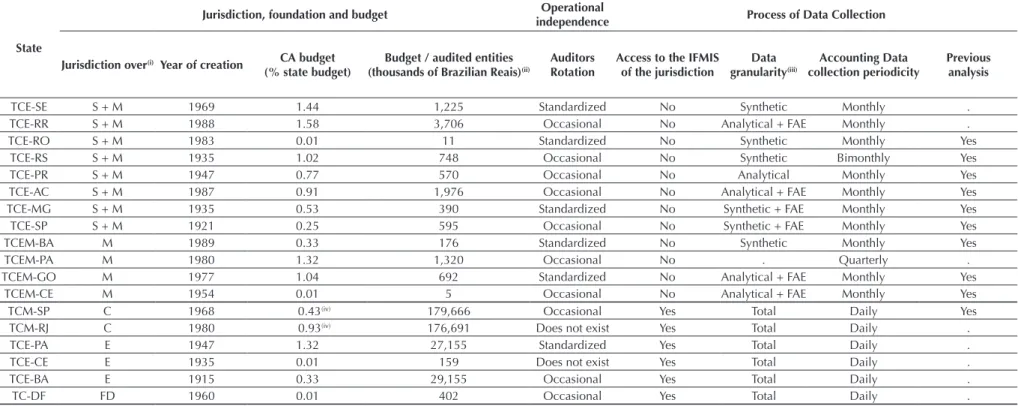
A fi rst characteristic that is of clear impact in the diff erentiation of the structure of the Courts of Accounts of States and Municipalities in Brazil is the jurisdiction
coverage. Th e coverage highlights two major groups:
(i) those courts which audit the accounts of a single municipality; and (ii) those which audit the accounts of several municipalities belonging to the geographical location of a specifi c State. Examples of this characteristic are the index of total budget per audited entity and the
eventual logistical complexities to run the job Th e 5,569
The first group of CAs which audits a single
municipality is listed at the bottom of Table 1. Th ese
CAs only audit the capital or the state government, in
addition to the specifi c case of the Federal District. Th eir
teams are geographically centralized and have a higher ratio of auditors by audited entities (ie, all bodies from executive and legislative branches). Still, such CAs deals with a single mayor and a single local legislative council, having greater recurrence and frequency of interactions with them. In terms of audit quality, auditors can achieve greater specialization given the proximity of teams based, generally, geographically close to their auditees in the capital city. In these cases, the number of agencies to be audited is larger and also involves larger budgets. As their jurisdictions are Capitals or state governments, auditors deal with issues that do not appear or are less frequent in other municipalities, such as joint initiatives, PPPs and complex contracts, so that greater specialization is desirable. However, the frequency of interactions can reduce the autonomy of technical auditors and their operational independence.
CAs of single jurisdiction do not gain scale when developing their own data reporting systems (DRS). In order to have access to the data of the auditee, they entered into an agreement of full access to the Integrated Financial Management Information System (IFMIS) of the local jurisdiction, obtaining a more timely and detailed data
collection. Th us, in the absence of their own DRS, they
should seek other means of issuing automatic alerts and make prior analyzes on tax aspects, for example. Finally, these CAs have a diff erential resource pressure in relation
to the others, given the less diffi culty of logistic access to
the various organs.
The secondgroup of CAs, listed at the top of Table 1, brings together those who have multiple municipalities in its jurisdiction. Each of these CAs relates to several mayors, local legislative councils, and independent governmental agencies bodies. Geographical dispersion is an important element and impacts the costs of on-site
auditing. Th e two combined eff ects, multi-jurisdictions
(audited municipalities) and geographic dispersion, bring incentives and productivity gains to data collection
automation (Data Reporting Systems – DRS). Th e DRS
acts to reduce the asymmetry of information between the auditee and the CA, increasing the frequency of access to the accounting registering (as can be seen in Table 1) since these CAs do not directly access the IFMIS of the
audited entity. Th e greater the reduction in information
asymmetry, the greater the potential of audit quality. Th ree
factors that result from the development of DRSs end up
boosting the productivity of audit work in the CA. Th e
greater periodicity, the greater level of detail of the data collected (analytical data, rather than just synthetic – as budget balance). Sending previous analyzes to the auditors
generate effi ciency gains (audit hours) and audit quality.
Th e periodic rotation of audit team institutionalized
by internal norms exists in few CAs, contrary to the best practices promoted by INTOSAI. In the others, the rotation is occasional, resulting from the replacement of an auditor promoted to the coordination positions, or at the auditor’s own request. Rotating associated with on-site auditing leads to less possibility of avoiding misstatements – auditors and auditees may not feel secure in performing activities that exceed the ethical limits of
their professions. Th e rotation encourages municipalities
to develop its accounting information systems and to improve accounting policies and innovate in budgetary
and risk management, since they do not know ex ante
the auditor who will audit on-site. On the other hand, the international literature points out that the recursiveness of the relationship between auditor and auditee would lead to the sharing of knowledge and the infl uence of the
auditor on best practices in the audited bodies. Th is would
allow the development of learning about the auditee. Learning is an important intangible capital for the auditor in medium and large municipalities, given the greater presence of independent governmental agencies and greater need for specialization/learning in these bodies. Such an eff ect would be smaller in less complex, small municipalities (e.g., fewer audit hours to identify
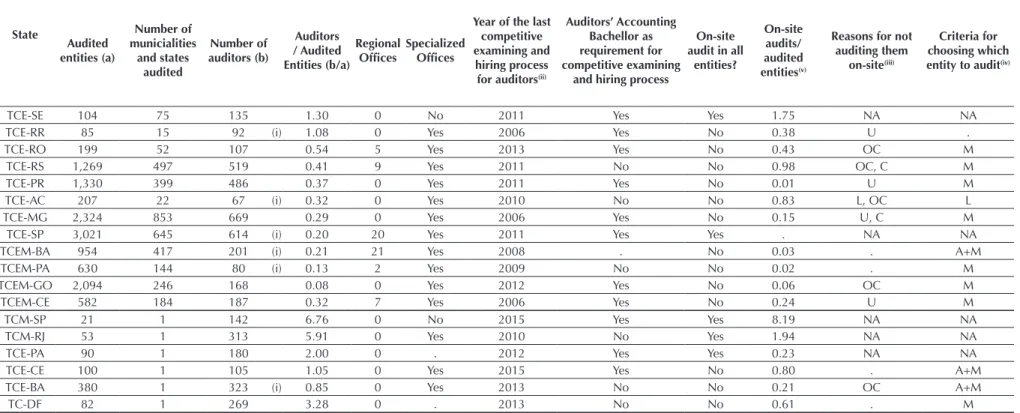
problems that are more serious). Th e number of auditors
per organ varies from less than 1 auditor to 10 organs (Goiás State) up to 1.3 auditors to 1 organ (Sergipe State).
Th e greater relationship between a body and an auditor
can lead to both on-site audit restriction, which combined with a DRS restricted to synthetic data, reduces the scope of the audit, how much can lead to a less reclusive audit-auditee contact; this would be mitigated by rotating auditors.
Some CAs distribute audit teams to regional offi ces,
regardless of the number of jurisdictions. Before the automation of the DRS, the resource was used to increase speed of procedure since the jurisdictional ones did not have to send their documents until the state capital, where headquarters of the CA are usually located. In the case of the Sao Paulo State CA, the historical motivation for such organization was to generate a greater physical proximity
with the audited entities. Currently, regional offi ces are
teams, they develop their own institutional variation. It reduces the uniformity of audit processes, even with defi ned and shared audit work protocols.
Another form of team organization is the use of
specialized offi ces (‘inspetorias’ in Portuguese). Th ese
are specialized audit departments specifi c to (i) a type of public service delivery, like specifi cs entities as health, education, state companies for water supplying or public transport, or (ii) by geographic area. Additionally, some
CAs have specialized offi ces to audit just the state capital
city or the state government. Th e segregation in regional
offices or specialized offices imposes a reduction of rotation because it increases the chance of recursiveness in the relation between auditee and auditor.
Th e requirement of training in Accounting for auditors
is not a consensus. Th ere was no such requirement in the
last hirings held in states of Pará, Rio Grande do Sul and Acre. All of them occurred aft er the announcement of the convergence of national accounting rules to international
standards. Th e low qualifi cation or non-specialization of
the auditors in accounting background can be alleviated by the use of automated data reporting systems and consequent prior analyzes issued by the CA to auditors and jurisdictions in a standardized manner. However, the automated DRS would not resolve the audit of the accounting process itself. Without accounting background, the auditor is not able to judge the adequacy of the accounting policies implemented in the municipalities, even in Courts that access municipalities’ detailed data. In order to do this type of audit, the auditor must eff ectively analyze the accounting policy (regarding the registration, recognition, and measurement) used.
A formal training in accounting (as a bachelor degree for instance) is relevant to the execution of the auditing jobs for both cases of CAs, with only one audited entity
or several. Th e fact that the auditor does not have prior
accounting knowledge inhibits specifi c misstatements in
accounting topics to be detected. Th erefore, the auditor
oft en is restricted to a compliance auditing. Th e maximum
number of auditors graduated in accounting was 26% and the minimum was 13% (data not shown in the table).
Th e audit process also varies. For the most part of them,
it is conducted as a “legality audit”, in which CAs verify entities’ compliance with budget legislation and fi scal parameters from FRL. In general, auditing techniques go through physical verifi cation, inspection of documents
and records, such as accounting journal entries. Th ere is
still observation of the activity performed in the entity, interviews and calculation conferences. In fi nancial auditing, examples are the correctness on accounting policies used to record transactions such as expenditures and revenues.
Only two cases among CAs of several jurisdictions carry out on-site audits in all entities. CAs in general prefer to audit on-site part of entities they are responsible each year, consequently part of them are no audited that
year. Th ere is no clear relationship between the available
resources ( CA’s budget per total auditees) and volume of auditing jobs (number of audits per total auditees), what brings the question whether the potential dependence on resources would be a justifi cation to reduce on-site audits. In the case of Courts of Accounts that do not perform yearly on-site auditing to all audited entities, the prior selection of which entities will be audited on-site occurs (i) via random sampling or (ii) by criteria pre-established in
a risk matrix or (iii) a combination of the above. Th e risk
matrix directs auditing eff orts to cases that show chances
of higher impact irregularities. Th e eff ectiveness of the
matrix is in the parameters they use; these will “pull” the cases with irregularities to be considered in the sample. When the interviewee wanted to describe the applied risk matrix, the following indicators were presented: (i) previous address on misconduct in public management and rejection of accounts; (ii) how long time ago the last auditing was run; and (iii) materiality (e.g., budget size). With the computerization and use of DRS, any errors identifi ed in the computerized rendering of accounts allow constant updating of the risk matrix. In addition, they are the justifi cation of the CA for public managers.
While the exclusive use of random sampling of selected entities to be audited may leave material and relevant potential auditees outside the analysis, the exclusive use of risk matrix may condition that, in the long run, smaller municipalities with lower budgets and no history of rejection have a low probability of being audited on-site. With the low risk of being audited, the entity may carry out activities that are not in accordance with good public
management practices. Th e ideal would be combine a
random sampling to risk matrix selection to states where
there is no annual on-site auditing to all entities. Th is
Table 1 – Formation characteristics of the Courts of Accounts
State
Jurisdiction, foundation and budget Operational
independence Process of Data Collection
Jurisdiction over(i) Year of creation CA budget
(% state budget)
Budget / audited entities (thousands of Brazilian Reais)(ii)
Auditors Rotation
Access to the IFMIS of the jurisdiction
Data granularity(iii)
Accounting Data collection periodicity
Previous analysis
TCE-SE S + M 1969 1.44 1,225 Standardized No Synthetic Monthly .
TCE-RR S + M 1988 1.58 3,706 Occasional No Analytical + FAE Monthly .
TCE-RO S + M 1983 0.01 11 Standardized No Synthetic Monthly Yes
TCE-RS S + M 1935 1.02 748 Occasional No Synthetic Bimonthly Yes
TCE-PR S + M 1947 0.77 570 Occasional No Analytical Monthly Yes
TCE-AC S + M 1987 0.91 1,976 Occasional No Analytical + FAE Monthly Yes
TCE-MG S + M 1935 0.53 390 Standardized No Synthetic + FAE Monthly Yes
TCE-SP S + M 1921 0.25 595 Occasional No Synthetic + FAE Monthly Yes
TCEM-BA M 1989 0.33 176 Standardized No Synthetic Monthly Yes
TCEM-PA M 1980 1.32 1,320 Occasional No . Quarterly .
TCEM-GO M 1977 1.04 692 Standardized No Analytical + FAE Monthly Yes
TCEM-CE M 1954 0.01 5 Occasional No Analytical + FAE Monthly Yes
TCM-SP C 1968 0.43(iv) 179,666 Occasional Yes Total Daily Yes
TCM-RJ C 1980 0.93(iv) 176,691 Does not exist Yes Total Daily .
TCE-PA E 1947 1.32 27,155 Standardized Yes Total Daily .
TCE-CE E 1935 0.01 159 Does not exist Yes Total Daily .
TCE-BA E 1915 0.33 29,155 Occasional Yes Total Daily .
TC-DF FD 1960 0.01 402 Occasional Yes Total Daily .
Table 1 – Formation characteristics of the Courts of Accounts (continuation)
State
Human Resources and Organization Audit Work Processes
Audited entities (a)
Number of municialities
and states audited
Number of auditors (b)
Auditors / Audited Entities (b/a)
Regional Offi ces
Specialized Offi ces
Year of the last competitive examining and hiring process
for auditors(ii)
Auditors’ Accounting Bachellor as requirement for competitive examining
and hiring process
On-site audit in all
entities?
On-site audits/ audited entities(v)
Reasons for not auditing them
on-site(iii)
Criteria for choosing which entity to audit(iv)
TCE-SE 104 75 135 1.30 0 No 2011 Yes Yes 1.75 NA NA
TCE-RR 85 15 92 (i) 1.08 0 Yes 2006 Yes No 0.38 U .
TCE-RO 199 52 107 0.54 5 Yes 2013 Yes No 0.43 OC M
TCE-RS 1,269 497 519 0.41 9 Yes 2011 No No 0.98 OC, C M
TCE-PR 1,330 399 486 0.37 0 Yes 2011 Yes No 0.01 U M
TCE-AC 207 22 67 (i) 0.32 0 Yes 2010 No No 0.83 L, OC L
TCE-MG 2,324 853 669 0.29 0 Yes 2006 Yes No 0.15 U, C M
TCE-SP 3,021 645 614 (i) 0.20 20 Yes 2011 Yes Yes . NA NA
TCEM-BA 954 417 201 (i) 0.21 21 Yes 2008 . No 0.03 . A+M
TCEM-PA 630 144 80 (i) 0.13 2 Yes 2009 No No 0.02 . M
TCEM-GO 2,094 246 168 0.08 0 Yes 2012 Yes No 0.06 OC M
TCEM-CE 582 184 187 0.32 7 Yes 2006 Yes No 0.24 U M
TCM-SP 21 1 142 6.76 0 No 2015 Yes Yes 8.19 NA NA
TCM-RJ 53 1 313 5.91 0 Yes 2010 No Yes 1.94 NA NA
TCE-PA 90 1 180 2.00 0 . 2012 Yes Yes 0.23 NA NA
TCE-CE 100 1 105 1.05 0 Yes 2015 Yes No 0.80 . A+M
TCE-BA 380 1 323 (i) 0.85 0 Yes 2013 No No 0.21 OC A+M
TC-DF 82 1 269 3.28 0 . 2013 No No 0.61 . M
Notes: (i) Value based on the average number of auditors per total number of servers in the CAs where data was available. (ii) Auditors are ‘Analistas de Controle Externo’ in Portuguese . (iii) U: No utility is observed; C: Cost; CO: Low Operational Capacity; L: Logistics; NA: Does not apply. (iv) A: Random sampling; M: Risk matrix; L: Logistics; A + M: Risk Matrix and Random Sampling; NA: Does not apply. (V) The number of on-site audits was obtained in the last activity report made available by the CAs website and includes several themes in the same visit, such as the fi nancial one. (vi) Values not reported by the CA are marked with “.”.
6. DISCUSSION AND IMPLICATIONS FOR LITERATURE IN PUBLIC FINANCE
As observed, the structure of the CAs and the range of the auditing process vary signifi cantly in the cases we analyzed. The question is how much this affects
audit quality. Th e previous literature indicates that if an
organization chooses structure, internal organization and technology in such way misaligned to the context (contingencies) or to the current institutional set (regulation, expectations of stakeholders), its performance
happens to be lower. Th us, the diff erent responses of CAs
to their context will impact the performance of their audit.
Th e fi rst identifi ed group (CAs of a single jurisdiction) has
a context in which the fi nancial audit is threatened by the independence of the courts due to the proximity to the auditee. Even with rotation, the smaller number of audited entities and geographical proximity increase the likelihood of an auditor maintaining a recursive relationship with the same team of the audited government’s civil servants.
Th e benefi ts of expertise can overcome the threat of
low independence to report nonconformities. On the other hand, the high number of auditors and full access to fi nancial data through the use of the IFMIS of the municipality positively impact the technical capacity of auditing in this group.
In the context of the identifi ed (second group multi-municipalities CAs), there is a greater potential for enhancing the independence of the auditor due to the use of auditor rotation (even if informal) combined with the greater number of audited entities. However, there is less specialization of the auditor in relation to the particularities of a particular auditee when the rotation
is heavily used. Th e loss of specialization in this case could
be reduced with the use of subject-based specialized offi ces
as an alternative source of expertise, ensuring higher audit
quality. Th e lower number of auditors by the jurisdictional
entity higher the potential to justify the automation of the data collection process. Despite the diff erences in the collection process observed in CAs (for example, synthetic or analytical accounting data), greater automation would release more working hours for on-site audits.
Currently there are CAs that access through DRS information monthly of the entities with greater detail, emit previous alerts and audit only part of them on-site, based on objective criteria of a risk matrix (like Goiás and Paraná states), while São Paulo continues to audit all entities annually, with occasional rotation. On the other hand, some CAs receive data with low detail and audit on-site part of them annually with rotation, with selection by Risk Matrix (for example, RS and RR).
Th e discussion of the results points out that to capture
the eff ect of CAs on the performance of governments, metrics that control the adequacy of the confi guration of CAs to their context are necessary, capturing with the vector “coercion by the quality of the audit” with less trouble.
Th e diff erences identifi ed in the CAs can be used
by the literature in two perspectives: to (i) explain the diff erent confi gurations of CAs; and (ii) what are the impacts of setting up a CA regarding quality of auditing produced by its auditors. One confi guration would be the combination of organizational characteristics gathered as responses of CAs considering the demands, resources available and the contingent and institutional factors in
which they operate. Th e confi guration is developed over
time, with a certain eff ect of path dependence on previous choices and in response to new demands that signifi cantly increased the scope of action in fi scal supervision of CAs (for example, LRF). In the fi rst perspective, the alignment to the context would explain organizational choices that were preferred in the creation and restructuring of CAs. In the second, the alignment of the CA confi guration would explain the higher audit quality.
If the organization’s performance is superior when it is aligned with the context in which it operates, similar confi gurations will have similar eff ects if they operate in similar contexts. Similar contexts are the variables that aff ect the process of external control and that fall short of the CAs discretion, such as: level of attention of the legislative to the budget issue, cooperation between executive and legislative, civil society performance, degree of structuring of systems of information and internal audit in entities, among others. Isolated features that may be detrimental to audit quality if combined with others lead to an opposite eff ect (joining nonrotation with automated alert issuance).
Th e eff ect of report quality on the Napoleonic model
occurs fi rst in the court’s judging stage. Counselors may fail to fully or partially follow the recommendation of the technical audit report, for example for a decision on the municipality’s accounts. A low technical capacity configuration reduces the chances of irregularities being pointed out by the auditors in their entirety, or increases the chances that the technical reports present poor technicalities. In both cases, the judicial stage may question the technical report.
Th e decision on the accounts of municipalities depends
enforcement, such as the propensity of the Chamber to release the mayor’s term of office and favorable judgments to the decisions of the CAs in the Judiciary. However, acts of public managers will be changed to
legality and effi ciency as governments and their managers
are punished when they fail to comply with regulation. Such punishment would result in the payment of fi nes, imprisonment or loss of political capital, such as becoming ineligible for a period or having a weak reputation. For attribution of related penalties, the audit report is the basis for constructing justifi cations for punishing the public manager in all cases, but does not guarantee the
process. Th us, the use of isolated set of characteristics as
a proxy for audit quality or CA enforcement should be
done with caution, since neither the quality stems from
the isolated characteristics nor are they suffi cient to coerce
governments.
Auditing can lead organizations to improvements
and innovations (Power, 1997). Th us, although the CA
does not have coercion to generate further incentives, its performance may lead to organizational improvements in the audited entities, which, if perpetuated, can strengthen mechanisms of fi scal governance indirectly. Similarly, demands for greater frequency and detail in the sending of data via DRS and requirement of justifi cation impel the improvement of administrative, budgetary, accounting and internal control processes.
7. FINAL CONSIDERATIONS
Th is research analyzed diff erent confi gurations of
Courts of Accounts that act at a regional level in Brazil, supervising and supporting the development of the fi nancial management cycle in states and municipalities. Diff erences such as size and specialization of teams, automation of accounting data collection, diff erent criteria for selection of on-site audit cases and recursiveness in the audited-auditee relationship, combined in a working context, would be associated with the court’s quality audit.
Th ese diff erences remain the same even aft er the Atricon
and IRB actions, seeking the harmonization of some practices in CAs (such as NAGs and PROMOEX).
Many diff erences are environmental responses by the audit organization to conditions to which it is exposed, such as budgetary constraints, geographic dispersion
and number of auditees. Th e fi nancial audit procedures
performed by CAs become increasingly relevant with the process of convergence to international accounting – accrual accounting. The non-uniformity of these procedures would undermine the translation of this
reform to entities all over the country, mitigating the
standardized dissemination of practices. Th is would
impact the consolidated statements in the Whole of Government Accounts (BSPN, in Portuguese). The discussion on the creation of a National Council of Courts of Accounts points to this need for uniformity.
REFERENCES
Andrews, M. (2007). What would an ideal PFM system look like?. In Shah, A. (Coord.). Budgeting and Budgetary Institutions. (pp. 359-383). Washington, D.C.: World Bank.
Andrews, M. (2013). Th e Limits of Institutional Reform in Development: Changing Rules For Realistic Solutions. (1. Ed.) New York, NY: Cambridge University Press.
Arantes, R. B., Abrucio, F. L., & Teixeira, M. A. C. (2005) A imagem dos Tribunais de Contas subnacionais. Revista do Serviço Público, Brasília, Brazil: Enap, 56(1), p. 57-85. Berger, T. M., & Heiling, J. (2015). Public Sector Accounting and
Auditing in Germany. In Brusca, I; Caperchione, E.; Cohen, S.; & Manes Rossi, F. (Coord.). Public Sector Accounting and Auditing in Europe: Th e challenge of harmonization. (pp. 93-107). London, UK: Palgrave Macmillan.
Braun, R. L., & Davis H. E. (2003). Computer-assisted audit tools and techniques: analysis and perspectives. Managerial Auditing Journal, 18(9), p. 725 – 731.
Campos, E., & Pradhan, S. (1996). Budgetary Institutions and Expenditure Outcomes: Binding Governments to Fiscal Performance, Policy Research Working Paper 1646, Th e World Bank, Washington.
Caramanis, C., & Lennox, C. (2008). Audit eff ort and earnings management. Journal of Accounting and Economics, 45(1), p. 116-138
Carcello, J.V., Hermanson, R.H., & McGrath, N.T. (1992). Audit Quality Attributes: Th e Perceptions of Audit Partners, Preparers, and Financial Statement Users. Auditing: A Journal of Practice and Th eory, 11(1), p. 1–15.
Choi, J., Kim, J., Qiu, A. A., & Zang, Y. (2012) Geographic Proximity between Auditor and Client: How Does It Impact Audit Quality?. Auditing: A Journal of Practice & Th eory. 31(2), p. 43-72.
Deangelo, L. E. (1981). Auditor Size and Audit Quality. Journal of Accounting and Economics. 3(3): 183-199.
Deis, D. R., & Giroux, G. A. (1992). Determinants of Audit Quality in the Public Sector. Th e Accounting Review, 67(3), 462–479.
Denzin, N. K., & Lincoln, Y. S. (2005). Th e SAGE handbook of qualitative research. Th ousand Oaks: Sage Publications. Donaldson, L. (2001) Th e Contingency Th eory of Organizations.
Sage, Th ousand Oaks, CA.
Dorotinsky, W., & Floyd, R. (2004). Public Expenditure Accountability in Africa: Progress, Lessons and Challenges. In B. Levy and S. Kpundeh (coord.). Building State Capacity in Africa: New Approaches, Emerging Lessons. (pp. 179-210). Washington D.C: World Bank.
Dye, K. M., & Stapenhurst, R. (1998). Pillars of integrity: the importance of supreme audit institutions in curbing corruption.
Economic Development Institute World Bank. Figueiredo, M., Melo, M., & Pereira, C. (2005). Political
and electoral accountability enhances accountability: a comparative analysis of courts of accounts in Brazil. In:
International Congress of Lasa. Proceedings… San Juan, 2005. Francis, J. R. (2004). What do we know about audit quality?. The
British Accounting Review, 36(4), p. 345-368.
Gerigk, W., Clemente, A., & Taff arel, M. (2010). O Impacto da Lei de Responsabilidade Fiscal sobre a gestão fi nanceira municipal: o caso do Paraná. Revista de Educação e Pesquisa em Contabilidade, 4(3), p. 44-69.
Gupta, P. P., Dirsmith, M. W., & Fogarty, T. J. (1994). Coordination and Control in a Government Agency: Contingency
and Institutional Th eory Perspectives on GAO Audits.
Administrative Science Quarterly, 39(2), 264–284. Isaksson, A., & Bigsten, A. (2012). Institution Building with
Limited Resources: Establishing a Supreme Audit Institution in Rwanda. World Development, 40(9), p. 1870-1881. Jones, R., & Caruana, J. (2015). Public Sector Accounting and
Auditing in the United Kingdom. In Brusca, I; Caperchione, E.; Cohen, S.; & Manes Rossi, F. (Coord.). Public Sector Accounting and Auditing in Europe: Th e challenge of harmonization. (pp. 219-234). London: Palgrave. UK. Loureiro, M. R., Teixeira, M. A. C., & Moraes, T. C. (2009).
Democratização e reforma do Estado: o desenvolvimento institucional dos Tribunais de Contas no Brasil recente.
Revista de Administração Pública, Rio de Janeiro, 43(4), p.739-772.
Melo, M. A., & Pereira, C. (2013) Making Brazil Work. (1 ed.) New York: Palgrave.
Melo, M. A., Pereira, C., & Souza, S. (2014) Why do some governments resort to “creative accounting” but not others? Fiscal governance in the Brazilian federation. International Political Science Review, v. 35, n. 5, p. 595–612.
Moynihan, D. P., & Andrews, M. (2010). Budgets and Financial Management. In Walker, R; Boyne, G.A.; & Brewer, G.A. (coord.). Public Management and Performance: Research Directions (60-88). Cambridge, England: Cambridge University Press.
Portal, M. (2011). Th e determining factors for audit quality, the case of governmental fi nancial statements audit. Comptabilité contrôle audit 17(1), p. 37-65.
Power, M. (1997). Th e Audit Society: Rituals of Verifi cation. Oxford: Oxford Un. Press.
Rosa, C.P., Morote, R.P., & Prowle, M. (2014) Developing performance audit in Spanish local government: an empirical study of a way forward, Public Money & Management, 34:3, 189-196.
Rousseau, D., Sitkin, S.B., Burt, R.S., & Camerer, C. (1998)Not so diff erent aft er all: A cross-discipline view of trust. Academy of Management Review, 23(3), p.393–404.
Santiso, C. (2007). Eyes wide shut? Th e politics of autonomous audit agencies in emerging economies. CIPPEC Working paper. Buenos Aires, Argentina.
Santolin, R., Jayme Jr., F. G., & Reis, J. C. (2009). Lei de
Responsabilidade Fiscal e implicações na despesa de pessoal e de investimento nos municípios mineiros: um estudo com dados em painel dinâmico. Estud. Econ., São Paulo, 39(4), p. 895-923.
Speck, B. W. (2011). Auditing Institutions. In Power, T.; & Taylor, M. (coord.). Corruption and Democracy in Brazil: Th e Struggle for Accountability. (pp 127-161). University of Notre Dame Press.
Stapenhurst, R., & Titsworth, J. (2001). Features and Functions of Supreme Audit Institutions Washington, DC: World Bank PREM.
Tranfi eld, D., Denyer, D., & Smart, P. (2003) Towards a
methodology for developing evidence-informed management knowledge by means of systematic review. British Journal of Management, 14, p. 207–222.
Van de Ven, A. H., & Drazin, R. (1985) Th e concept of fi t in contingency theory. In Staw, B. M., & Cummings, L. L. (coord). Research in Organizational Behavior. JAI Press, Greenwich, CT, 333–365.
Wehner, J. (2003) Principles and patterns of fi nancial scrutiny: Public Accounts Committees in the Commonwealth,
Commonwealth & Comparative Politics, 41(3), 21-36.