DOI: 10.1590/1808-057x201704460
Predicting inancial distress in publicly-traded companies
Felipe Fontaine Rezende
Ibmec Rio de Janeiro, Departamento de Administração, Rio de Janeiro, RJ, Brazil
Roberto Marcos da Silva Montezano
Ibmec Rio de Janeiro, Departamento de Administração, Rio de Janeiro, RJ, Brazil
Fernando Nascimento de Oliveira
Ibmec Rio de Janeiro, Departamento de Economia, Rio de Janeiro, RJ, Brazil
Valdir de Jesus Lameira
Ibmec Rio de Janeiro, Departamento de Administração, Rio de Janeiro, RJ, Brazil
Received on 10.05.2016 – Desk acceptance on 11.01.2016 – 3rd version approved on 05.15.2017 – Ahead of print on 07.20.2017
ABSTRACT
Several models for forecasting bankruptcy have been developed over the years, one of the reasons for which is the important part it plays in decision-making. However, forecasting a company’s bankruptcy leaves a very short time for stakeholders to change the situation. It is in this context that this paper arises in order to develop a model for predicting inancial distress, which is identiied as a step prior to bankruptcy. he predictive model uses the logistic regression technique with panel data and a sample of Brazilian publicly-traded companies with shares listed on the São Paulo Stock, Commodities, and Futures Exchange between 2001 and 2014. As well as inancial variables, the inal model includes market expectations (macroeconomic) and sector variables. hese variables are statistically tested and the hypothesis is conirmed that they improve the accuracy of the model. he research identiied the existence of inancial distress in 96% of the companies that went bankrupt. In addition, the relationship between the phenomena of bankruptcy and inancial distress is veriied, using inancial and macroeconomic explanatory variables. he results demonstrate that most (83%) of the explanatory variables in the model for predicting bankruptcy are also present in the model for predicting the phenomenon of inancial distress. he expected gross domestic product variables and the quick ratio, asset turnover, and net equity over total liabilities inancial variables are statistically signiicant in predicting both phenomena. With this evidence, the study suggests the use of the concept of inancial distress as a stage prior to bankruptcy and provides a model for predicting inancial distress with 89% accuracy when applied to publicly-traded companies in Brazil in the period examined.
1. INTRODUCTION
Models seeking to predict company bankruptcy have been studied with enthusiasm in recent decades in the academic ields (Allen & Saunders, 2004). Horta, Borges, Carvalho, and Alves (2011) and Horta, Alves, and Carvalho (2013) report that bankruptcy forecasting models ofer an advanced tool for analysts and credit managers that is free from subjective inluences and that makes it possible to obtain a reliable classiication regarding a company’s future ability to continue honoring its inancial commitments.
In their review concerning bankruptcy forecasting models since 1930, Bellovary, Giacomino, and Akers (2007) reach the conclusion that, despite the diferences that exist between the forecasting models, the empirical tests for most show a high predictive ability, suggesting that they are useful for many groups, including auditors, managers, creditors, and analysts.
However, Pinheiro, Santos, Colauto, and Pinheiro (2009) stress the importance of updating these models, due to the loss in validity of the coeicients associated with the variables over time. Balcaen and Ooghe (2004) highlight that these losses mainly occur in models that only contemplate financial variables as they do not consider macroeconomic conditions. In not doing so, these models implicitly assume that the relationship between the variables is stable over time.
With regards to the methods used, Platt and Platt (2006) explain that the models that use the classiication of bankruptcy ultimately predict a situation that is practically irreversible for the company and do not leave enough time for stakeholders to be able to make changes. Tinoco and Wilson (2013) note that the legal deinition of bankruptcy is not without criticism and bankruptcy can be a slow process, in which the “legal” date of bankruptcy formalization may not represent the “economic” date; that is, the real event of company failure.
Balcaen and Ooghe (2004) complement this by raising other criticisms regarding the use of bankruptcy. hey comment that the classification of bankruptcy will depend on the current legislation in each country, and consequently, models developed in diferent countries will present diferent deinitions of bankruptcy. Moreover, the use of one legal deinition of bankruptcy can result in contaminated samples that will interfere in the accuracy of the forecasting model. Companies in inancial distress that are about to go bankrupt can undergo incorporation or acquisition processes and are not classiied as bankrupt.
At the same time, stable and inancially healthy companies can enter into the bankruptcy process for strategic reasons, without there being any relationship with inancial distress. his study opts to work with the theoretical concept of inancial distress. he main objective is to develop a predictive model that identiies a stage before company bankruptcy; that is, inancial distress. his model has the diferential of being able to identify a situation in which the interested parties would have enough time to act before the company goes into a state of bankruptcy.
Moreover, the aim of this study is to develop a forecasting model that includes not only microeconomic (inancial) variables, but also macroeconomic and sector variables that portray the environment experienced by companies, thus providing a wider understanding of the phenomenon studied. Sun, Huang, and He (2014) claim that it is necessary to break this traditional view of quantitative models based exclusively on inancial indicators and use non-inancial information in order to widen the studies on forecasting bankruptcy.
Before developing the model, the study verifies whether the event of inancial distress really precedes the bankruptcy stage. For this, two hypotheses are raised and tested:
H1: bankrupt companies should be classiied as being in inancial distress at some point in their lifecycle;
H2: the variables explaining the phenomenon of inancial distress should be similar, or at least one of them should, to the variables explaining the phenomenon of bankruptcy.
he results obtained identify that 96% of the bankrupt companies in the sample were classiied as being in inancial distress. he models for forecasting inancial distress and bankruptcy that were generated presented some similar explanatory variables. hus, both hypotheses are conirmed, indicating the use of the theoretical concept of inancial distress as an event prior to bankruptcy.
he article develops a model for forecasting inancial distress based on a quarterly sample of publicly-traded companies with shares on the São Paulo Stock, Commodities, and Futures Exchange (BM&FBOVESPA) between 2001 and 2014, totaling 11,147 cases.
cases and performs satisfactorily compared with the main Brazilian prediction studies (Altman, Baidya & Dias, 1979; Brito & Assaf Neto, 2008; Elizabetsky, 1976; Kanitz, 1976; Matias 1978; Sanvicente & Minardi, 1998; Silva, 1982).
Korol and Korodi (2010) report that no single factor is responsible for a company’s bankruptcy. here is a consensus on the existence of two groups of factors. he irst involves endogenous causes, which occur within a company and are related to ineicient asset allocation, to an ineicient funding structure, and/or inadequate company management. The second group refers to exogenous causes, which consist of phenomena related with a country’s general economic situation and with the iscal, monetary, and exchange rate policies of the government authority. Companies cannot inluence these factors. However, such factors afect companies’ inancial situation.
he inal model covers these two groups of factors by means of the inancial and macroeconomic variables. he inancial variables constitute company information using coeicients and percentage indices extracted from the companies’ accounting statements, which makes it possible to interpret the economic-inancial situation and make inferences regarding the future tendency for a company (Hein, Pinto & Beuren, 2012). The macroeconomic variables add the business environment in which the company is operating to the forecast (Korol & Korodi,
2010; Tinoco & Wilson, 2013; Tomas & Dimitri, 2011). he model also includes a dummy variable for sector, in accordance with the methodology proposed by Chava and Jarrow (2004), with the aim of measuring the sector efect as a component in predicting inancial distress.
he paper contributes to the academic literature by presenting evidence for the use of the theoretical concept of inancial distress, making it possible to develop forecasting models that identify a stage prior to company bankruptcy.
In relation to the choice of variables, the results found in the tests support the claim that a model that contemplates microeconomic and macroeconomic variables presents greater predictive power than a model that only contemplates inancial variables. he study also introduces the use of market expectations variables, which were statistically signiicant. A model for forecasting inancial distress is presented, which is useful for academics, investors, and capital market analysts.
After this introduction, the article is structured in the following way: section 2 deines the concept of inancial distress and identiies the main models for forecasting bankruptcy, section 3 details the samples and the bankruptcy forecasting model, section 4 presents the results, and section 5 contemplates the conclusions, limitations, and suggestions for future studies.
2. THEORETICAL FRAMEWORK
2.1 Theoretical Concept of Financial Distress
Platt and Platt (2006) report that the concept of inancial distress is not deined in a precise way if compared to the legislations that deine the processes, such as bankruptcy and liquidation. his indeinition still occurs today, as noted by Soares and Rebouças (2015). However, there are a great number of possible events that can characterize, whether in isolation or together, the state of company inancial distress. Platt and Platt (2006) airm that the state of inancial distress precedes practically all bankruptcies, except those due to sudden and unexpected events, such as natural disasters, judicial decisions, or changes in regulation by the government.
he studies that seek to classify companies in inancial distress show similarities due to the presence of indices
to cover its current obligations. Asquith, Gertner, and Scharfstein (1991) report that whether a company is in inancial distress depends on its interest coverage ratio, which is calculated using earnings before interest and taxes, depreciation, and amortization (EBITDA) and inancial expenses. Andrade and Kaplan (1998) also make use of the EBITDA and of values of inancial expenses to classify a company in inancial distress. As well as using these indices, Whitaker (1999) considers market value to be a selection criterion, since all companies included in the sample presented a decline in their market value or in the market value corrected for their sector in the year they entered into inancial distress.
(EBIDTA) are lower than its inancial expenses for two consecutive years, leading the company to a situation where it can not generate sufficient resources in its operating activities to fulill its inancial obligations; (ii) a fall in its market value between two consecutive periods. hus, the year ater the occurrence of both events is deined as one of entering into inancial distress.
Tinoco and Wilson (2013) use this methodology in their predictive study for companies listed on the London Stock Exchange. In their explanation for choosing this approach, for the irst condition, when the EBITDA is lower than spending on interest on company debt, they conclude that the company’s operating proitability is insuicient to cover its inancial obligations. In relation to the second condition, they highlight the same airmation from Pindado et al. (2008), in which the market, as well as the interested parties, are susceptible to negatively judging a company that sufers from an operating deicit (irst condition situation) until an improvement in the company’s inancial situation is perceived again. hus, a fall in market value for two consecutive years is interpreted as an indication that a company is experiencing inancial distress.
2.2 Main Models for Forecasting Bankruptcy
he studies on predicting bankruptcy date back to the 1930s with the analysis of indicators for forecasting bankruptcy starting with the study from Fitzpatrick (1932, apud Bellovary et al., 2007).
Some decades later, Beaver (1966) presented the irst study that discussed the use of statistical techniques for predicting bankruptcy; in this case, univariate discriminant analysis. hirty indices were constructed based on inancial statements and from proile analysis it was concluded that bankrupt companies’ indices deteriorated much more quickly than those of companies that remained healthy. In his conclusion, he suggested that subsequent studies should use various indicators simultaneously in constructing the models, which would ultimately determine the tendency of subsequent papers with regards to forecasting bankruptcy.
In line with the suggestion from Beaver (1966), Altman (1968) published a study in which a set of inancial indices combined with a multivariate discriminant analysis approach would assume greater statistical signiicance than the technique used up until then, involving comparing the sequential relationship. he model developed, known as Z-score, presented a high ability to predict bankruptcy for one year before entry into bankruptcy (95% accuracy).
Based on the model from Altman, company bankruptcy
became a much more widely studied and publicized subject in the academic literature (Horta et al., 2011). he number and complexity of models for forecasting bankruptcy increased drastically (Bellovary et al., 2007).
With the advance in technology, new techniques emerged and new models were developed for predicting bankruptcy. Martins (1977) presented a model for forecasting bankruptcy for banks based on logistic regression. hen, Ohlson (1980) used the logit model (logistic regression) with inancial indicators for predicting company bankruptcy and determined that the factors related to probable bankruptcy within the space of a year were company size and measures of inancial structure, performance, and liquidity.
Minussi, Damacena, and Ness (2002) report that the advantage of logistic regression compared with multivariate discrimant analysis lies in its coverage of possibilities, given that it is not necessary to guarantee the normality of residues nor the existence of homogeneity of the variance. Moreover, the logistic regression models enable the likelihood of a company going into bankruptcy to be estimated (Balcaen & Ooghe, 2004).
Also in the 1980s, models emerged that applied artificial intelligence methods, in contrast with the methods developed up until then (statistical methods). Among the artiicial intelligence methods, decision trees, neural network techniques, support vector machines, evolved (genetic) algorithms, reasoning based on cases, and rough set, all stand out (Sun et al., 2014).
Sun et al. (2014) comment that both the statistical and artiicial intelligence methods present pros and cons. While the statistical methods are constrained by the statistical assumptions, the artiicial intelligence methods do not present this constraint, but are much more complex. By using this same approach, Olson, Delen, and Meng (2012) report that due to the complex nature of artiicial intelligence models, two relevant modeling characteristics are lost: transparency and transportability. Transparency in the sense of the human ability to understand what the model consists of, and transportability in the sense of the ability to apply the model to new observations. hese characteristics, in contrast, are present in the statistical methods, which present a way that can be easily understood and transported.
that result in the event of a company’s bankruptcy. he irst concerns endogenous causes, which occur within a company and are the main factors extensively studied and used in the specialized literature on forecasting bankruptcy. he classical models, which began with the work of Altman (1968), used these variables based on speciic company information; that is, information obtained from economic-inancial reports.
he second group refers to exogenous causes, which consist of phenomena related with a country’s general economic situation and with the macroeconomic policies of the governmental authorities. Companies cannot inluence these factors; however, such factors afect a company’s inancial situation, such as its liquidity and its ability to pay.
One of the irst studies that defended the use of this second group of variables for forecasting bankruptcy was presented by Johnson (1970). He comments that a company’s inancial indicators do not contain suicient information regarding the economic conditions faced by the company’s management and by the investors and suggests the use of macroeconomic indicators.
Liou (2007) highlights the study from Rose et al. (1982, apud Liou, 2007) as one of the most signiicant in the use of macroeconomic variables. he study investigated the relationship between North American company bankruptcy rates and economic indicators between 1970 and 1980 and identiied nine economic variables that were statistically related with bankruptcy rates. In their model, they obtained an R2 of 0.91, conirming the relationship
between economic variables and the company bankruptcy process.
Based on these pioneering papers, researchers have come to include and identify macroeconomic variables in studies forecasting bankruptcy or even inancial distress (Cuthbertson & Hudson, 1996; Goudie & Meeks, 1991; Hudson, 1987; Levy & Bar-niv, 1987; Liu, 2004, 2009; Platt & Platt, 1994; Wadhwani, 1986; Zhang, Bessler, and Leatham, 2013).
In their review concerning this topic, Korol and Korodi (2010) report that the main macroeconomic factors that afect company bankruptcy prediction are a country’s economic situation, iscal policy, monetary conditions,
inlation, and market characteristics and expectations. Zhang et al.(2013) identify the same macroeconomic factors as some previous studies (Altman, 1983; Liu, 2004, 2009; Platt & Platt, 1994) and suggest the use of speciic variables to represent the economic factors. With regards to a country’s economic situation, they suggest using a general economic index, such as gross domestic product (GDP) or aggregated company earnings. With regards to iscal policy and monetary conditions, they indicate using the interest rate. In relation to the market, Zhang et al. (2013) report that the share price index or another index are usually used, such as the S&P 500, which conveys investor expectations for the market as a whole. Inlation is also considered, as it is seen as an important indicator for the economy since it makes companies’ earnings more volatile and hampers their ability to pay debts.
Korol and Korodi (2010) and Tomas and Dimitric (2011) conclude that the classical approach to addressing only endogenous factors is obsolete and that there is a logical step in the future of forecasting bankruptcy: the development of predictive models that involves both micro variables and variables linked to the macroeconomic environment in which companies operate.
Altman and Sabato (2007) recognize the qualitative criteria (non-inancial variables) as being relevant in the analysis models for forecasting bankruptcy. However, carrying out a literature review regarding the non-inancial variables, they perceive their use in the great majority of predictive studies involving small and medium companies. his occurs because such companies, when obliged, present limited inancial information (Blanco-Oliver, Irimia-Dieguez, Oliver-Alfonso & Wilson 2015).
3. METHODOLOGY
3.1 Sample
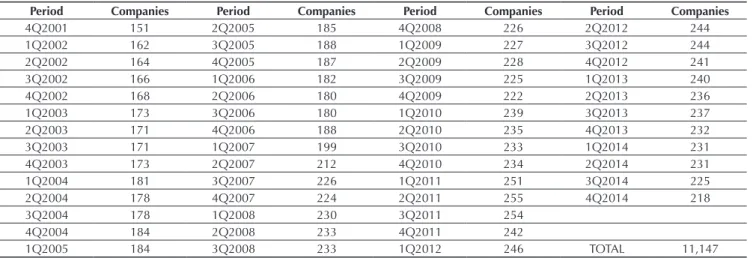
In order to examine the hypotheses and develop the model for forecasting inancial distress, this study uses a sample of non-inancial and non-state publicly-traded companies with shares listed on the BM&FBOVESPA. he analysis period runs from the fourth quarter of 2011 (4Q2001) to the fourth quarter of 2014 (4Q2014). 4Q2001 was chosen because it is the irst period in the database for the Brazilian Central Bank’s market expectations published by the Executive Management of Investor
Relations of the Brazilian Central Bank (Gerência-Executiva de Relacionamento com Investidores do Banco Central do Brasil – GERIN).
By using quarterly periods, as presented in Table 1, this study follows the suggestion of Baldwin and Glezen (1992). hese authors comment that annual forecasts may not be adequate in rapidly changing economies or when a particular company or industry is experiencing rapid deterioration. hus, quarterly data have more suitable potential for forecasting.
Table 1 Total observations
Period Companies Period Companies Period Companies Period Companies
4Q2001 151 2Q2005 185 4Q2008 226 2Q2012 244
1Q2002 162 3Q2005 188 1Q2009 227 3Q2012 244
2Q2002 164 4Q2005 187 2Q2009 228 4Q2012 241
3Q2002 166 1Q2006 182 3Q2009 225 1Q2013 240
4Q2002 168 2Q2006 180 4Q2009 222 2Q2013 236
1Q2003 173 3Q2006 180 1Q2010 239 3Q2013 237
2Q2003 171 4Q2006 188 2Q2010 235 4Q2013 232
3Q2003 171 1Q2007 199 3Q2010 233 1Q2014 231
4Q2003 173 2Q2007 212 4Q2010 234 2Q2014 231
1Q2004 181 3Q2007 226 1Q2011 251 3Q2014 225
2Q2004 178 4Q2007 224 2Q2011 255 4Q2014 218
3Q2004 178 1Q2008 230 3Q2011 254
4Q2004 184 2Q2008 233 4Q2011 242
1Q2005 184 3Q2008 233 1Q2012 246 TOTAL 11,147
Note: as an example, 4Q2001 refers to the fourth quarter of 2001. Source: Elaborated by the authors.
he information needed to construct the company inancial indicators were extracted from the Economática® database. Regarding the sample classiication for situations of bankruptcy and inancial distress, two treatments were used. Companies were classiied as being in inancial distress when (i) their earnings before interest and taxes, depreciation, and amortization (EBITDA) were lower than their inancial expenses for two consecutive periods; (ii) there was a fall in their market value between two consecutive periods. hus, the period ater the occurrence of both events was deined as one of entry into inancial distress (Pindado et al., 2008; Tinoco & Wilson, 2013).
To verify both conditions, the real values for the indicators (EBITDA and inancial expenses) and the companies’ market value were used. The data were
obtained using the Economática® system, and to adjust the data in relation to inlation, the consumer price index (índice de preços ao consumidor – IPCA) was applied.
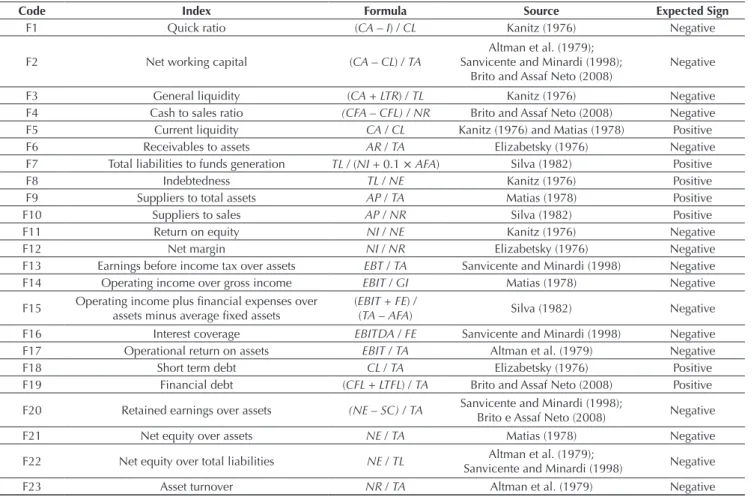
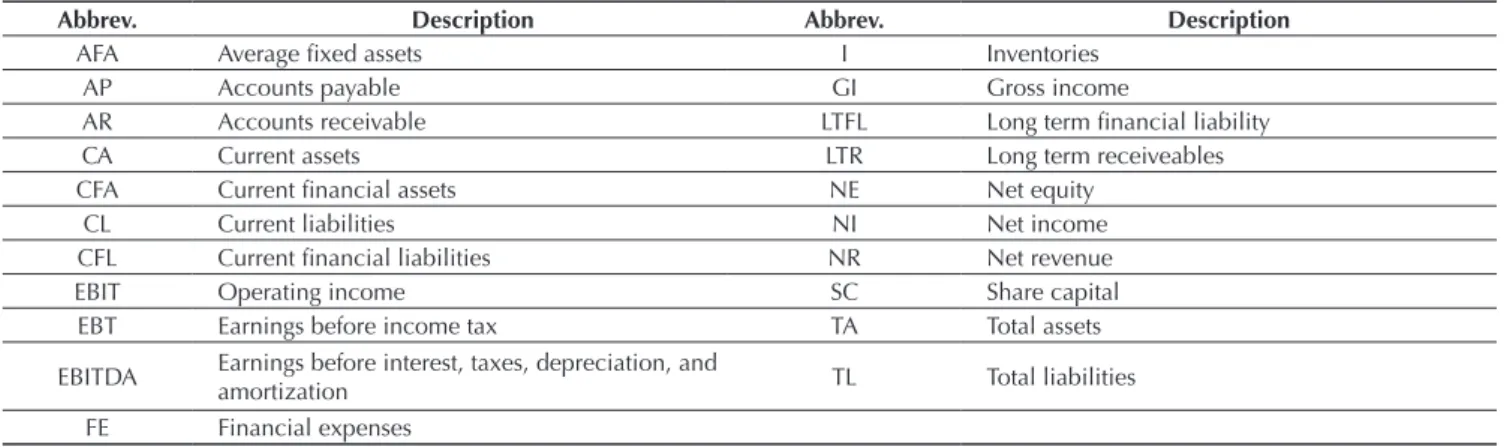
Table 2 Inicial inancial variables
Code Index Formula Source Expected Sign
F1 Quick ratio (CA – I) / CL Kanitz (1976) Negative
F2 Net working capital (CA – CL) / TA
Altman et al. (1979); Sanvicente and Minardi (1998);
Brito and Assaf Neto (2008)
Negative
F3 General liquidity (CA + LTR) / TL Kanitz (1976) Negative
F4 Cash to sales ratio (CFA – CFL) / NR Brito and Assaf Neto (2008) Negative F5 Current liquidity CA / CL Kanitz (1976) and Matias (1978) Positive
F6 Receivables to assets AR / TA Elizabetsky (1976) Negative
F7 Total liabilities to funds generation TL / (NI + 0.1 × AFA) Silva (1982) Positive
F8 Indebtedness TL / NE Kanitz (1976) Positive
F9 Suppliers to total assets AP / TA Matias (1978) Positive
F10 Suppliers to sales AP / NR Silva (1982) Positive
F11 Return on equity NI / NE Kanitz (1976) Negative
F12 Net margin NI / NR Elizabetsky (1976) Negative
F13 Earnings before income tax over assets EBT / TA Sanvicente and Minardi (1998) Negative F14 Operating income over gross income EBIT / GI Matias (1978) Negative F15 Operating income plus inancial expenses over
assets minus average ixed assets
(EBIT + FE) /
(TA – AFA) Silva (1982) Negative
F16 Interest coverage EBITDA / FE Sanvicente and Minardi (1998) Negative F17 Operational return on assets EBIT / TA Altman et al. (1979) Negative
F18 Short term debt CL / TA Elizabetsky (1976) Positive
F19 Financial debt (CFL + LTFL) / TA Brito and Assaf Neto (2008) Positive F20 Retained earnings over assets (NE – SC) / TA Sanvicente and Minardi (1998);
Brito e Assaf Neto (2008) Negative
F21 Net equity over assets NE / TA Matias (1978) Negative
F22 Net equity over total liabilities NE / TL Altman et al. (1979);
Sanvicente and Minardi (1998) Negative
F23 Asset turnover NR / TA Altman et al. (1979) Negative
Source: Elaborated by the authors.
considered as being bankrupt. he year in which the bankruptcy event occurred was deined as that in which the company’s shares were traded as being in composition with creditors and in which it appeared in the CVM register as being bankrupt.
3.2 Forecasting Model
When constructing the models, as well as classifying the event (bankruptcy and inancial distress), the explanatory variables and the model’s approach technique need to be deined.
Due to the inexistence of a general theory regarding the choice of explanatory variables for forecasting bankruptcy or inancial distress, the criteria used for selection are varied (Tascón & Castano, 2012). In accordance with the conclusions of Korol and Korodi (2010) and Tomas and Dimitric (2011), inancial and macroeconomic variables were chosen.
For the inancial variables, the same indicators from Brazilian studies on forecasting bankruptcy were used (Altman et al., 1979; Brito & Assaf Neto, 2008; Elizabetsky, 1976; Kanitz, 1976; Matias, 1978; Sanvicente & Minardi, 1998; Silva, 1982). hese studies were chosen due to their representativeness in the literature, their good predictive ability, and because they use Brazilian companies, the same scope of this article. Cinca, Molinero, and Larraz (2005) explain that the country where a company operates afects the structure of inancial indices. Consequently, we sought to use the indicators already tested for companies operating in Brazil.
here were also other indicators in the original papers. However, they were not considered, given that a large portion of the sample (companies) did not present the information needed for the calculation.
In relation to the macroeconomic variables, two categories were used. he irst refers to the economic indicators observed in each period. For this category, the indicators suggested by Zhang et al.(2013) were considered. To represent a country’s macroeconomic situation, the GDP growth rate, the real basic interest rate (SELIC), and the real Bovespa index (Ibovespa) were chosen, as well as inlation measured by the IPCA.
In the second category, the market expectations indicators from the GERIN database were considered. he market expectations survey, as published on the institution’s website, aims to monitor the evolution of market expectations for the main macroeconomic variables, providing support for the monetary policy decision-making process. hus, if these variables provide support that can influence in the monetary policy decision-making process, they ultimately influence the macroeconomic environment and can be useful in predicting this environment.
Tabela 4 Descriptive statistics for the inancial variables (n = 11,147)
Variable Mean Standard Deviation Minimum Maximum
F1 1.53 2.06 0.00 46.83
F2 0.08 0.56 -16.31 0.92
F3 1.25 1.44 0.00 23.35
F4 -8.09 219.39 -12,352.18 39,835.83
F5 1.92 2.20 0.00 46.83
F6 0.15 0.12 0.00 0.98
F7 15.86 364.13 -11,355.88 16,125.79
F8 2.79 25.64 -412 1,203.89
F9 0.07 0.09 0.00 1.62
F10 0.90 8.20 0.00 467.51
F11 0.00 0.91 -44.60 10.89
F12 0.10 17.97 -638.42 731.00
F13 0.01 0.10 -3.25 1.91
F14 -0.03 26.73 -866.19 1,153.22
F15 0.04 0.20 -6.36 7.98
F16 3.46 122.76 -7,670.62 3,891.72
F17 0.02 0.07 -2.95 1.74
F18 0.35 0.53 0.00 16.40
F19 0.34 0.76 0.00 65.98
F20 -0.12 1.95 -73.19 0.82
F21 0.22 1.83 -69.37 0.99
F22 1.25 3.83 -0.99 109.44
F23 0.21 0.17 0.00 1.94
Source: Elaborated by the authors. Tabela 3 Abbreviations for the indicators
Abbrev. Description Abbrev. Description
AFA Average ixed assets I Inventories
AP Accounts payable GI Gross income
AR Accounts receivable LTFL Long term inancial liability
CA Current assets LTR Long term receiveables
CFA Current inancial assets NE Net equity
CL Current liabilities NI Net income
CFL Current inancial liabilities NR Net revenue
EBIT Operating income SC Share capital
EBT Earnings before income tax TA Total assets
EBITDA Earnings before interest, taxes, depreciation, and
amortization TL Total liabilities
Table 5 Initial macroeconomic variables
Code Category Index Source Expected Sign
M24 Contemporary GDP growth rate (%) Economática® Negative
M25 Contemporary Nominal interest rate (%) Economática® Positive
M26 Contemporary Inlation (%) Economática® Positive
M27 Contemporary Real Bovespa Index (points) Economática® Negative
E28 Expectation GDP growth rate (%) GERIN Negative
E29 Expectation Nominal interst rate (%) GERIN Positive
E30 Expectation Inlation (%) GERIN Positive
GERIN = Executive Management of Investor Relations of the Brazilian Central Bank; GDP = gross domestic product. Source: Elaborated by the authors.
Table 6 Descriptive statistics for the macroeconomic variables (n = 11,147)
Variable Mean Standard Deviation Minimum Maximum
M24 0.829 2.803 -5.356 5.195
M25 13.048 4.508 7.160 26.320
M26 1.544 0.932 0.100 6.516
M27 66,215.16 22,310.34 19,685.20 102,210.96
E28 3.448 0.919 0.690 4.701
E29 12.288 2.796 7.480 20.060
E30 5.404 1.413 3.470 13.240
Source: Elaborated by the authors.
Therefore, the study adopted three expectations indicators related to the (contemporary) macroeconomic indicators observed, as shown in Table 5. he period for
obtaining the expectations used involved the forecast for 12 months ahead. Table 6 shows the descriptive statistics for the macroeconomic variables considered.
To construct the dummy variable that identiies the sector efect, this study separated the sample between companies from industry (1) and services (0), using the existing classiication in Economática®. he dummy
variable is represented by code I31.
With the variables deined, the study then opts to use the logistic regression technique with panel data, based on an unbalanced panel and choosing between the expectation for ixed efects (FE) or random efects (RE), according with the Hausman test results.
he choice of the logistic regression technique is
orientated by the positioning of Minussi et al. (2002), Olson et al. (2012), and Sun et al. (2014), as shown in the literature review. he use of panel data enables the simultaneous use of cross-sectional data and time series data (Greene, 2003). he panel not being balanced is the result of the sample used. Since there are companies that entered, or rather, began to trade their shares on the BM&FBOVESPA and that ceased to trade their shares during the analysis period, the panel is classiied as unbalanced. his classiication is shown in the statistical sotware that generates the results (Stata v. 12.0).
4. RESULTS
Before developing of the model for predicting inancial distress, the hypotheses raised need to be veriied to identify if the event of inancial distress precedes the event of bankruptcy.
Table 7 Sample behavior in relation to inancial distress
Number of times classiied as being in inancial distress
0 1 2–3 4–10 11–20
Solvent (%) 100 92 84 78 57
Bankrupt (%) 0 8 16 22 43
Total companies (n) 214 36 43 49 7
Source: Elaborated by the authors.
Table 8 Sample behavior in relation to bankruptcy
Bankrupt companies (n) % Classiied as being in inancial distress
1 4 0
3 12 1
7 28 2–3
11 44 4–10
3 12 11–20
Source: Elaborated by the authors.
Using these tables, the presence of solvent or bankrupt companies can be veriied in accordance with the number of times that the situation of financial distress was identiied.
From the data presented in Table 8, it can be perceived that of all the bankrupt companies identiied, only one did not present the situation of inancial distress. It bears mentioning that it entered into bankruptcy in 2003. So, as the sample begins at the end of 2001 (fourth quarter), there is no comprehensive time period for this company and the situation of inancial distress may have occurred before this period.
By excluding this company, all of the other bankrupt companies were also classiied as being in a situation of inancial distress; that is, the situation of inancial distress may be a stage before the stage of bankruptcy.
Moreover, Table 7 shows that the greater the number of quarters in which a company inds itself in inancial distress, the greater the possibility of it being a bankrupt company. he bankruptcy percentages grow from 0% (when the theoretical situation of inancial distress is not identiied) to 43% (when the company presents 11 or more quarters in which inancial distress was identiied). In this range (11 to 20), one of the companies classiied as solvent entered into receivership in 1998, before the analysis period. So, by adjusting its classiication to bankrupt, the percentage of bankrupt companies in the latter range would reach 57% (4 out of 7 companies).
As the situation of inancial distress is concerned, it is understood that this is a reversible situation; that is, the company will not necessarily enter into bankruptcy. hus, the existence of solvent companies that have presented periods of inancial distress over the period analyzed is seen as normal/predictable.
In relation to the second hypothesis, in which at least some of the explanatory variables for the phenomenon of inancial distress should be similar to the explanatory variables for the phenomenon of bankruptcy, the predictive models needed to be developed.
In order to develop the model for predicting inancial distress, the following procedure was used:
y At irst, only the inancial variables were used, as listed in Table 2.
y Due to the great number of variables (23), the presence of multicollinearity was veriied using the correlation matrix. For coeicients above 0.8, one of the variables was excluded (Kennedy, 2009). In this study, the variables current liquidity (F5), short term debt (F18), and net equity over assets (F21) were ignored.
y hen, the stepwise backward procedure was used to identify the statistically signiicant variables for a 95% level of conidence. As a sample in the format of panel data is concerned, it is necessary to identify which is the best estimation model (FE or RE). hus, only the variables that presented a p – value lower than 0.05 in both models were excluded.
y In order to choose between the FE and RE method, the Hausman test was carried out. he result from the Hausman test (186.34) presented Prob > chi2 = 0.0000; that is, for a 95% conidence interval (p = 0.05), the null hypothesis can be rejected and it can be airmed that the FE model is preferable (the quality is more robust) to the RE model.
Table 9 Model for predicting inancial distress
Variable Coeficient Standard Error Z P > |Z|
I31 0.84 0.29 2.98 0.003
E28 - 0.32 0.06 -5.68 0.000
E29 - 0.21 0.02 -8.66 0.000
E30 0.32 0.04 7.76 0.000
F1 - 1.34 0.15 - 9.03 0.000
F2 - 0.33 0.09 -3.67 0.000
F9 2.84 0.68 4.19 0.000
F22 0.06 0.02 3.82 0.000
F23 - 2.74 0.57 -4.86 0.000
Const. -1.30 0.47 -2.76 0.006
Note: the dummy variable for the industry (I31) is omitted from the ixed effects model as it concerns a variable that is invariant in time, since in the period analyzed no company altered its commercial characteristic (industry vs. service). The random effects model was thus deined.
Source: Elaborated by the authors.
Table 10 Model for predicting bankruptcy
Variable Coeficient Standard Error Z P > |Z|P > |Z|
E28 - 0.93 0.41 -2.25 0.024
F1 - 10.85 3.16 -3.44 0.001
F4 - 0.16 0.04 -3.57 0.000
F9 - 55.12 16.25 -3.39 0.001
F22 - 14.66 3.81 -3.84 0.000
F23 - 28.97 8.71 -3.33 0.001
Note: maximun vraisemblance = -25.492083; LR chi2(7) = 111.09; Prob > chi2 = 0.000.
was chosen with the aim of verifying whether the inclusion of these variables improves the model’s predictive ability. his hypothesis was conirmed.
y he same procedures for the stage were carried out,
contemplating the inancial variables.
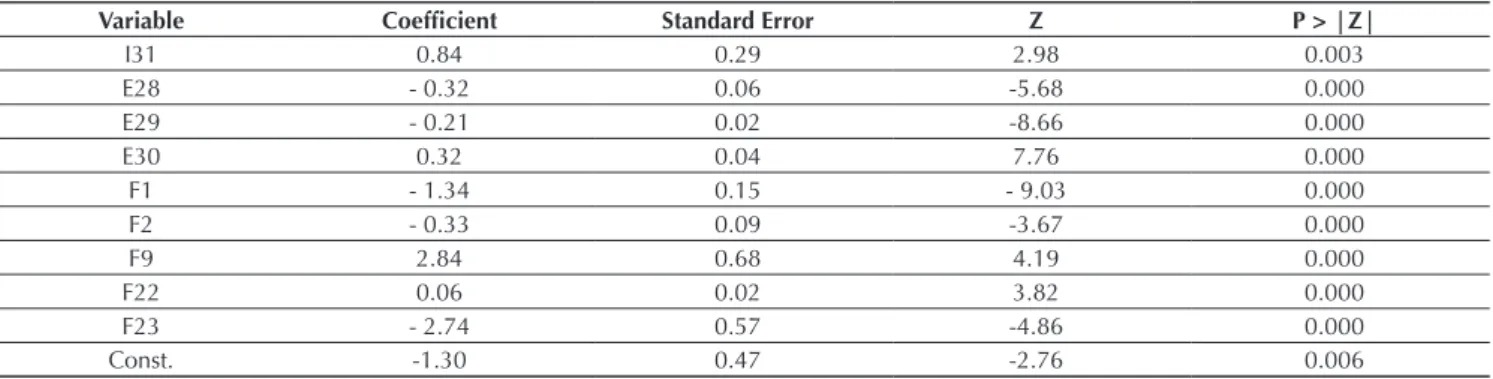
he inal model is presented in Table 9.
he inal model identiied nine statistically signiicant variables composed of ive inancial variables [quick ratio (F1), net working capital (F2), suppliers divided by total assets (F9), net equity over total liabilities (F22), and asset turnover (F23)], three macroeconomic variables [GDP
expectation (E28), interest rate expectation (E29), and inlation expectation (E30)], and the dummy variable (I31). he probability (P) of a company inding itself in a state of inancial distress is given by the following equation:
in which Z =–1.30 – 0.84 I31 – 0.32E28 – 0.21E29 + 0.32E30 –1.34F1– 0.33F2 + 2.84F9 + 0.06F22 – 2.74F23
For the model for predicting insolvency, the companies in the sample were previously selected. Once the bankrupt companies (25 cases) were identiied in the sample, the group of solvent companies (25 cases) were selected; that is, for each bankrupt company one solvent company was
selected, a procedure also known as the pairing method (Brito & Assaf Neto, 2008; Kanitz, 1976; Matias, 1978; Sanvicente & Minardi, 1998).
Having deined the sample, the statistical procedures for the model for predicting financial distress were followed, which led to the construction of the model for predicting bankruptcy, shown in Table 10.
P = eZ
Having developed the predictive models, it is observed that of the six variables existing in the model for predicting bankruptcy, ive are present in the model for predicting inancial distress. Variables E28, F1, and E23 presented the same behavior, while variables F22 and F9 presented diverging signs. Observing the model for inancial distress, the F9 variable is in agreement with the sign suggested by the literature, while the sign presented by the F22 variable is diferent.
By analyzing variable F22 in isolation, it is understood, based on the literature, that an increase in the proportion of net equity in relation to total liabilities would decrease the chances of a company going into bankruptcy. his occurs because the greater this indicator was, the fewer third-party resources the company would be using, and thus, the lower its obligations would be. herefore, the expectation was that the variable would present a negative sign, as in the model for predicting bankruptcy. However, by considering this indicator in a more comprehensive way, other behaviors can be raised, especially by analyzing the denominator of indicator F22, total liabilities.
If on one hand an increase in these would lead to a rise in the company’s obligations, increasing its probability of going into bankruptcy, on the other their growth could be related to other factors, these being beneicial for the health of the company. A growth in liabilities can be due to some investment that will bring large returns for the company. Moreover, an increase in liabilities may be due to a change in debt proile. In this case, the company uses the rolling debt tool, in which it opts to renegotiate and put of payment of its debts. his renegotiation oten occurs as a result of the emergence of new obligations replacing the old ones (which are expiring). hus, the company presents an increase in liabilities, but by decreasing its short term obligations and reducing its probability of entering into inancial distress or into bankruptcy.
It is observed that both hypotheses raised for an increase in liabilities (investment and rolling debt) are more likely to occur in healthy companies. So, companies at risk of bankruptcy (classiied as such) have already undergone the inancial distress stage. Not being healthy companies, they are unlikely to be able to renegotiate their debts or have suicient resources to carry out investments. In contrast, companies at risk of inancial distress are still classiied by the market as healthy, and can use these strategies as a resource in order not to get into inancial distress; however, as the data presents, without success.
With regards to the dummy variable for industry (I31),
it is perceived that it was not statistically signiicant. his result was in a way expected, since through using the pairing methodology, for each bankrupt company one solvent company was sought from the same sector. hus, by using this methodology, the sector variable became a controlled variable.
Having concluded the tests that conirmed the existence of indications that suggest the inancial distress stage as a predecessor to bankruptcy, the model for predicting inancial distress was deined, as presented in Table 9.
In the model for predicting inancial distress that is presented, it is perceived that, as well as variable F22, variable E29 presented a sign that contradicts the literature.
his occurs because a rise in expectations for the interest rate would lead to diiculties for a company to obtain credit, raising the probability of bankruptcy occurring. However, the presence of a negative sign leads to another interpretation of this variable, as presented by Aita, Zani and Silva (2010). heir paper, which aims to identify the micro and macroeconomic variables that determine Brazilian bank failure, also obtained the same (negative) sign for the nominal interest rate (SELIC) variable. In their conclusion, this behavior occurs because the SELIC is lower at times prior to bankruptcy, and it is only ater the onset of crisis, efectively when the banks have already declared themselves bankrupt, that the regulatory bodies act (ex post) to contain the situation by raising the rate. hat is, in the period in which bankruptcy is predicted, one year before the bank’s declaration of bankruptcy, rates are low.
his same interpretation can be used for the market expectations variable. Once a crisis is underway, in other words, ater the bankruptcies, the market then projects that the regulatory bodies will react and thus engineer an increase in the interest rate. So, as seen in the paper from Aita et al. (2010), in the period in which inancial distress is predicted, the expectations are for a low real interest rate.
In this study, it is observed that both the expectation for interest rates (E29) and the interest rate variable (M25) present a negative sign, with the latter not being statistically signiicant for a 95% conidence interval (p
= 0.12).
Table 11 Odds ratio industry dummy variable
Variable Odds ratio Standard Error Z P > |Z|P > |Z|
I31 2.33 0.66 2.98 0.0003
Source: Elaborated by the authors.
Table 12 Classiication table
Classiication
Sensitivity Speciicity Model Accuracy
50.0 % 91.3 % 89.3 %
Source: Elaborated by the authors.
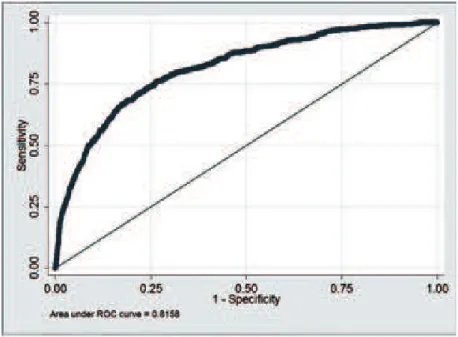
Having veriied the variables, the study concludes the results stage with an analysis of the predictive power of the model by developing a classiications table, using the
proportional cut-of value for the sample and constructing the ROC (receiver operating characteristic) curve (Fávero, Beliore, Silva & Cham 2009).
Figure 1 ROC (receiver operating characteristic) Curve. Source: Elaborated by the authors.
It can be airmed, referring to the interpretation from Fávero et al. (2009), that the model presents an acceptable
discrimination (area greater than 0.7), given that the result from the area under the ROC curve was 0.82.
In addition, the summary shown in Table 12 indicates that the model for predicting bankruptcy reached 89% accuracy. Compared with the main Brazilian studies that
Despite the predictive power presented by the model (89%), it is noted that this result was obtained for the sample that constructed the model itself. hus, the degree of accuracy is higher than those that should be expected when this model is applied to future samples (Grice & Ingram, 2001).
In contrast, if the study opted to separate the sample, constructing the model in a test sample (2/3) and calculating its predictive power in a validation sample (1/3), it would present limitations in relation to the size of the sample (2/3). he event of inancial distress and bankruptcy occurs in a much smaller percentage of the population; thus, a greater amount of data is needed to estimate these models. When including macroeconomic variables it is important for the test sample to contain
a reasonable time period, making it possible to cover diferent economic periods. he constraint that exists in this study, derived from the start of the sampling time (4Q2001) and the number of companies-quarters with shares traded on the BM&FBOVESPA, limit the sample size, making it diicult to make inferences if the sample is divided/reduced.
Pinheiro et al. (2009) carry out a validation of the main Brazilian models for predicting bankruptcy, using a historic record covering the period from 1995 to 2006, and the variations obtained between the predictive powers calculated in the original models and in the study sample can be veriied in Table 14. It is observed that all of the models presented a loss in their predictive power.
Table 14 Updated predictive power of the main Brazilian models
Model Variation in overall predictive power (%)
Kanitz (1976) -16
Elizabetsky (1976) -23
Altman et al. (1979) -38
Silva (1982) -13
Sanvicente and Minardi (1998) -3
Source: Elaborated by the authors based on Pinheiro et al. (2009). Table 13 Main Brazilian models
Model Sensitivity (%) Speciicity (%)
Kanitz (1976) 80 68
Elizabetsky (1976) 74 63
Matias (1978) 70 77
Altman et al. (1979) 83 77
Silva (1982) 90 86
Brito and Assaf Neto (2008) 93 90
Sanvicente and Minardi (1998) 82 82
Source: Elaborated by the authors based on Matarazzo (2010).
In relation to this study, this variation is expected to be lower, since the classical models only consider inancial variables, while this model assumes the possibility of
diferent macroeconomic conditions (macroeconomic variables) (Balcaen & Ooghe, 2004).
5. CONCLUSION
With the situation of inancial crisis in which Brazil inds itself, together with the recent economic crises that the world has experienced, the possibility of increased company bankruptcies is real. hus, the ability to identify bankruptcy a stage before its occurrence, enabling more time for the planning and implementation of preventative actions and increasing the chances of companies reversing this situation, is a topic that is of considerable relevance.
he concept of inancial distress used in the study considers a company to be in inancial distress when its EBITDA is lower than its inancial expenses for two consecutive periods and when it presents a fall in its market value, also for two consecutive periods.
used as a stage prior to bankruptcy. he tests identify that 96% of the bankrupt companies presented a state of inancial distress. Within the six variables that explain the phenomenon of bankruptcy, four are present in the inancial distress model.
his study therefore ofers a model for predicting inancial distress, using variables that not only contemplate the microeconomic situation (inancial variables), but also portray the environment experienced by these companies (macroeconomic variables) and the sector to which they belong (industry or services). As a premise, all of the variables have been discussed in previous studies and can be found in sources within the public domain or in the publishings of publicly-traded companies.
he only exceptions were the market expectations variables, which are publicly available, but were not used in previous studies on this topic. However, this exception was shown to be a contribution from the study, given that such variables were statistically signiicant in predicting inancial distress.
he inal model identiied nine statistically signiicant variables composed of ive inancial variables (quick ratio – F1, net working capital – F2, suppliers over total assets – F9, net equity over total liabilities – F22, and asset turnover – F23), three macroeconomic variables (GDP
expectation – E28, interest rate expectation – E29, and inlation expectation – E30), and one dummy variable for sector (I31).
In relation to the model’s limitations, because it is applied to publicly-traded companies operating in Brazil, it is probable that there would be a loss in the model’s accuracy from using the resulting equations in other countries or in privately held companies. he indication, in the case of applying it in other countries, is to follow the methodology of this study, but to generate the model equations by collecting a sample of companies from the country that is the focus of study.
Moreover, the model’s predictive power (89%) was calculated based on the sample used to construct it. he rate of accuracy is expected to be lower when this model is applied to future samples. However, the hope is that this loss will be small, since the model includes variables for macroeconomic efects over time.
For future studies, a broader investigation is suggested that involves market expectations variables, as they were signiicant in the predictive model.
Moreover, there is the possibility of developing new models for predicting inancial distress, by maintaining the theoretical concept applied but employing other statistical techniques and/or artiicial intelligence.
REFERENCES
Aita, J., Zani, J., & Silva, C. E. S. (2010). Determinantes de insolvência bancária no Brasil: identiicação de evidências macro e microeconômicas (Master’s dissertation). Universidade do Vale dos Sinos, São Leopoldo.
Allen, L., DeLong, G., & Saunders, A. (2004). Issues in the credit risk modeling of retail markets. Journal of Banking & Finance, 28(4), 727-752.
Altman, E. I. (1968). Financial ratios, discriminant analysis and the prediction of corporate bankruptcy. Journal of inance, 23(4), 589-609.
Altman, E. I. (1983). Why businesses fail. Journal of Business Strategy, 3(4), 15-21.
Altman, E. I., & Sabato, G. (2007). Modelling credit risk for SMEs: evidence from the US market. Abacus, 43(3), 332-357. Altman, E. I., Baidya, T. K., & Dias, L. M. R. (1979). Previsão de
problemas inanceiros em empresas. Revista de Administração de Empresas, 19(1), 17-28.
Andrade, G., & Kaplan, S. N. (1998). How costly is inancial (not economic) distress? Evidence from highly leveraged transactions that became distressed. Journal of Finance, 53(5), 1443-1493.
Asquith, P., Gertner, R., & Scharfstein, D. (1991). Anatomy of inancial distress: an examination of junk-bond issuers.
de risco de crédito de empresas. Revista Contabilidade & Finanças, 19(46), 18-29.
Balcaen, S., & Ooghe, H. (2006). 35 years of studies on business failure: an overview of the classic statistical methodologies and their related problems. he British Accounting Review, 38(1), 63-93.
Baldwin, J., & Glezen, G. W. (1992). Bankruptcy prediction using quarterly inancial statement data. Journal of Accounting, Auditing & Finance, 7(3), 269-285.
Beaver, W. H. (1966). Financial ratios as predictors of failure. Journal of Accounting Research, 4, 71-111.
Bellovary, J. L., Giacomino, D. E., & Akers, M. D. (2007). A review of bankruptcy prediction studies: 1930 to present. Journal of Financial Education, 33, 1-42.
Blanco-Oliver, A., Irimia-Dieguez, A., Oliver-Alfonso, M., & Wilson, N. (2015). Improving bankruptcy prediction in micro-entities by using nonlinear efects and non-inancial variables. Finance a Uver, 65(2), 144.
Chava, S., & Jarrow, R. A. (2004). Bankruptcy prediction with industry efects. Review of Finance, 8(4), 537-569.
Cinca, C. S., Molinero, C. M., & Larraz, J. G. (2005). Country and size efects in inancial ratios: a European perspective. Global Finance Journal, 16(1), 26-47.
Elizabetsky, R. (1976). Um modelo matemático para a decisão no banco comercial (Bachelor’s hesis). Departamento de Engenharia de Produção, Escola Politécnica da Universidade de São Paulo, São Paulo.
Fávero, L., Beliore, P., Silva, F., & Cham, B. (2009). Análise de dados: modelagem multivariada para tomada de decisão. São Paulo, SP: Campus.
Goudie, A. W., & Meeks, G. (1991). he exchange rate and company failure in a macro-micro model of the UK company sector. he Economic Journal, 101(406), 444-457.
Greene, W. H. (2003). Econometric analysis. Delhi: Pearson Education India.
Grice, J. S., & Ingram, R. W. (2001). Tests of the generalizability of Altman’s bankruptcy prediction model. Journal of Business Research, 54(1), 53-61.
Hein, N., Pinto, J., & Beuren, I. M. (2012). Uso da teoria rough sets na análise da solvência de empresas. BASE – Revista de Administração e Contabilidade da Unisinos, 9(1), 68-81. Hill, N., Perry, S., & Andes, S. (2011). Evaluating irms in inancial
distress: an event history analysis. Journal of Applied Business, 12(3), 60-71.
Horta, R. A. M., Borges, C. C. H., Carvalho, F. A. A., & Alves, F. J. S. (2011). Previsão de insolvência: uma estratégia para balanceamento da base de dados utilizando variáveis contábeis de empresas brasileiras. Sociedade, Contabilidade e Gestão, 6(2), 21-36.
Horta, R. A. M., Alves, F. J. S., & Carvalho, F. A. A. (2013). Seleção de atributos na previsão de insolvência: aplicação e avaliação usando dados brasileiros recentes. Revista de Administração Mackenzie, 15(1), 125-151.
Hudson, J. (1987). he age, regional, and industrial structure of company liquidations. Journal of Business Finance & Accounting, 14(2), 199-213.
Johnson, C. G. (1970). Ratio analysis and the prediction of irm failure. Journal of Finance, 25(5), 1166-1168.
Kanitz, S. C. (1976). Indicadores contábeis inanceiros previsão de insolvência: a experiência da pequena e média empresa brasileira (Ph.D. hesis). Faculdade de Economia
Administração e Contabilidade, Universidade de São Paulo, São Paulo.
Karkinen, E. L. & Laitinen, E. K. (2015). Financial and non-inancial information in reorganisation failure prediction. International Journal Management and Enterprise Development, 14(2), 144-171.
Kennedy, P. (2009). Manual de econometria (6a. ed.). Rio de Janeiro, RJ: Elsevier.
Korol, T., & Korodi, A. (2010). Predicting bankruptcy with the use of macroeconomic variables. Economic Computation and Economic Cybernetics Studies and Research, 44(1), 201-221. Levy, A., & Bar-niv, R. (1987). Macroeconomic aspects of irm bankruptcy analysis. Journal of Macroeconomics, 9(3), 407-415.
Liou, D. K. (2007). Macroeconomic variables and inancial distress. Journal of Accounting, Business & Management, 14, 17-31.
Liu, J. (2004). Macroeconomic determinants of corporate failures: evidence from the UK. Applied Economics, 36(9), 939-945.
Liu, J. (2009). Business failures and macroeconomic factors in the UK. Bulletin of Economic Research, 61(1), 47-72.
Mansi, S. A., Maxwell, W. F. & Zhang, A. (2012). Bankruptcy prediction models and the cost of debt. he Journal of Fixed Income, 21(4), 25-42.
Martin, D. (1977). Early warning of bank failure: a logit regression approach. Journal of Banking & Finance, 1(3), 249-276. Matarazzo, D. C. (2010). Análise inanceira de balanços: abordagem
gerencial (7a. ed.). São Paulo, SP: Atlas.
Matias, A. B. (1978). Contribuição às técnicas de análise inanceira: um modelo de concessão de crédito (Doctoral hesis).
Departamento de Administração da Faculdade de Economia, Administração e Contabilidade, Universidade de São Paulo, São Paulo.
Minussi, J. A., Damacena, C., & Ness, W. L., Jr. (2002). Um modelo de previsão de solvência utilizando regressão logística. Revista de Administração Contemporânea, 6(3), 109-128.
Ohlson, J. A. (1980). Financial ratios and the probabilistic prediction of bankruptcy. Journal of Accounting Research, 18, 109-131.
Olson, D. L., Delen, D., & Meng, Y. (2012). Comparative analysis of data mining methods for bankruptcy prediction. Decision Support Systems, 52(2), 464-473.
Pindado, J., Rodrigues, L., & de la Torre, C. (2008). Estimating inancial distress likelihood. Journal of Business Research, 61(9), 995-1003.
Pinheiro, L. E. T., Santos, C. P., Colauto, R. D., & Pinheiro, J. L. (2009). Validação de modelos brasileiros de previsão de insolvência. Contabilidade Vista & Revista, 18(4), 83-103. Platt, H. D., & Platt, M. (2006). Comparing inancial distress and
bankruptcy [Working Paper]. Review of Applied Economics. Retrieved from https://ssrn.com/abstract=876470
Platt, H. D., & Platt, M. B. (1994). Business cycle efects on state corporate failure rates. Journal of Economics and Business, 46(2), 113-127.
Sanvicente, A. Z., & Minardi, A. M. A. F. (1998). Identiicação de indicadores contábeis signiicativos para a previsão de concordata de empresas [Working Paper]. Instituto Brasileiro de Mercado de Capitais. Retrieved from http://www.cyta.com. ar/elearn/tc/marterial/altaman5.pdf
Silva, J. P. D. (1982). Modelos para classiicação de empresas com vistas à concessão de crédito (Master’s dissertation). Escola de Administração de Empresas de São Paulo, Fundação Getúlio Vargas, São Paulo.
Soares, R. A., & Rebouças, S. M. D. P. (2015). Avaliação do desempenho de técnicas de classiicação aplicadas à previsão de insolvência de empresas de capital aberto brasileiras. Revista do Programa de Mestrado em Administração e Desenvolvimento Empresarial da Universidade Estácio de Sá, 18(3), 40-61.
Sun, J., Li, H., Huang, Q. H., & He, K. Y. (2014). Predicting inancial distress and corporate failure: a review from the state-of-the-art deinitions, modeling, sampling, and featuring approaches. Knowledge-Based Systems, 57, 41-56.
Tinoco, M. H., & Wilson, N. (2013). Financial distress and bankruptcy prediction among listed companies using accounting, market and macroeconomic variables. International Review of Financial Analysis, 30, 394-419. Tomas, I., & Dimitrić, M. (2011, Maio). Micro and
macroeconomic variables in predicting inancial distress of companies. Anais of International Conference Challenges of Europe: Growth and competitiveness – reversing the trends. Split, Croácia, 9. Retrieved from http://conference.efst.hr/ proceedings/NinthInternationalConferenceChallengesOfEuro pe-ConferenceProceedings-bookmarked.pdf
Wadhwani, S. B. (1986). Inlation, bankruptcy, default premia and the stock market. he Economic Journal, 96(381), 120-138. Whitaker, R. B. (1999). he early stages of inancial distress.
Journal of Economics and Finance, 23(2), 123-132. Wruck, K. H. (1990). Financial distress, reorganization, and
organizational eiciency. Journal of Financial Economics, 27(2), 419-444.
Zhang, J., Bessler, D. A., & Leatham, D. J. (2013). Aggregate business failures and macroeconomic conditions: a VAR look at the US between 1980 and 2004. Journal of Applied Economics, 16(1), 179-202.
Correspondence address:
Felipe Fontaine Rezende