Complexity and corporate governance: an analysis of companies
listed on the BM&FBOVESPA*
Renata Rouquayrol Assunção
Universidade Federal do Ceará, Faculdade de Economia, Administração, Atuária e Contabilidade, Fortaleza, CE, Brazil
Márcia Martins Mendes De Luca
Universidade Federal do Ceará, Faculdade de Economia, Administração, Atuária e Contabilidade, Departamento de Contabilidade, Fortaleza, CE, Brazil
Alessandra Carvalho de Vasconcelos
Universidade Federal do Ceará, Faculdade de Economia, Administração, Atuária e Contabilidade, Departamento de Contabilidade, Fortaleza, CE, Brazil
Received on 10.13.2015 – Desk acceptance on 11.12.2015 – 4th version approved on 12.23.2016
ABSTRACT
In light of the need to develop mechanisms of control, protection, and transparency regarding the relationships between principal and agent, and with the aim of eliminating or reducing the agency problem, corporate governance has emerged. Based on Agency heory, separation of ownership and control of activities derives from the complexity of organizations. In this context, this study aims to analyze the relationship between dimensions of complexity and corporate governance in companies listed on the São Paulo Stock, Commodities, and Futures Exchange (BM&FBOVESPA), in which contingency factors might inluence organizational characteristics. he investigation gathers data from a sample of 162 companies listed on the BM&FBOVESPA. he following statistical tests were used in the data analysis: Factor Analysis, Multiple Linear Regression, Correspondence Analysis, and Correlation Analysis. For measuring complexity, contingency variables such as age, size, diversiication, and internationalization were adopted; and, to assess corporate governance, a representative index of the adoption of good governance practices was used. he results show that organizational complexity is explained by the size and diversiication variables, whereas operational complexity is explained by the size, diversiication, and internationalization variables. It was observed that in the two dimensions of complexity – organizational and operational – corporate governance was inluenced by the diversiication, internationalization, and age variables, with the latter involving an inverse relationship. It is concluded that companies displaying more complexity, in its two dimensions, record a higher level of corporate governance, which conirms the research hypothesis.
1 INTRODUCTION
h e initial discussion regarding the agency problem, promoted by Berle and Means (1932), and subsequently, the conception of Agency h eory, defended by Jensen and Meckling (1976), are essential for understanding the origin of corporate governance, given that, based on the conl ict of interest between principal and agent, the need is verii ed for adopting mechanisms that promote an alignment of interests between these parties (Hitt, Ireland, & Hoskisson, 2003).
Conl icts of interest can occur in organizations with highly dispersed or highly concentrated shareholdings. h ey can be revealed, for example, through one shareholder or controlling group maximizing earnings to the expense of the other shareholders, or also in manager opportunism, where executives aim to maximize earnings during their careers instead of increasing company value (Silveira, 2010). Berle and Means (1932) argued that these agency problems originate from the complexity of organizations. With this understanding, separation between shareholder and manager is thus owed to operational complexity (Arruda, Madruga, & Freitas, 2008).
h e literature indicates that bigger, older companies with greater business volumes and that are more dependent on external capital and more involved with the external market, can be considered as being more complex (Andreatta, Silveira, & Olinquevitch, 2009; Fama & Jensen, 1983; Greiner, 1998; Miller & Friesen, 1984; h ompson, 1967), and, consequently, they require more improved control mechanisms, the result of which is generally rel ected in the adoption of best corporate governance practices (Silveira, 2002).
According to Agency h eory, the separation between control activities and ownership occurred as a result of the increased complexity of organizations, and in order to minimize agency problems it was necessary to improve their control mechanisms. From this perspective, an analysis of the relationship between aspects linked to organizational complexity and those related to corporate governance, with a focus on good governance practices, is considered relevant. In light of this scenario, the following question is set: What is the relationship between dimensions of complexity and corporate governance in companies listed on the São Paulo Stock, Commodities, and Futures Exchange (BM&FBOVESPA)?
Based on an analysis of studies that have addressed
to corporate governance (Anderson, Reeb, Upadhyay, & Zhao, 2011; Assunção, De Luca, Vasconcelos, & Rebouças, 2014; Berry, Bizjak, Lemmon, & Naveen, 2006; Boone, Field, Karpoff , & Raheja, 2007; Bushman, Chen, Engel, & Smith, 2004; Coles, Daniel, & Naveen, 2008; Ferreira, Ferreira, & Raposo, 2011; Lin & Lee, 2008; Linck, Netter, & Yang, 2008; Naveen, 2006), the use of the term “complexity” is verii ed in relation to two dimensions: organizational complexity and operational complexity. However, the choice of adopting one of these dimensions is rarely explained by the authors. In this study, though, organizational complexity is considered as referring to the complexity of the aspects that are necessary for a company’s insertion into the market, and operational complexity is regarded as relating to the whole complexity of resources and valid processes for developing a company’s activities.
h e study, therefore, aims to analyze the relationship between dimensions of complexity and corporate governance in companies listed on the BM&FBOVESPA.
Considering that contingency factors can inl uence modii cations in the characteristics related to company structure and strategy (Donaldson, 2007) and that complexity creates a demand for more control mechanisms, which in turn can be established via good corporate governance practices (Silveira, 2002), this descriptive study presents the following hypothesis: More complex companies listed on the BM&FBOVESPA present higher corporate governance indices.
h is study i ts into the context of research that addresses organizational complexity and that aims to understand its relationship with governance, thus expanding the contributions from the current literature regarding the two issues (Boone et al., 2007; Cardoso & Cabral, 2010; Coles et al., 2008; Ferreira et al., 2011; Linck et al., 2008; Ponchirolli, 2007). It bears mentioning that this prior research was carried out in diff erent contexts and that no studies were found that had developed analyses of this nature by specii cally considering companies listed on the BM&FBOVESPA.
2 LITERATURE REVIEW
2.1 Organizational Complexity
In light of the idea that setting inl uences the structure of an organization, the existence of contingency factors is observed; that is, variables that model the organizational characteristics to which companies must adapt (Espejo & Frezatti, 2008). The search to understand how these variables influence organizations gave rise to Contingency h eory, which is based on the assumption that environmental conditions cause transformations in organizational structure. h is theory argues that there is no unique structure (the best way) to be applied in all companies, since for each one there are diff erent contingency factors that inl uence the organizational characteristics and conduct (Donaldson, 2007).
Some researchers understand that, as they grow and evolve, organizations can become complex and alter their structures, which will result in a demand for new and better systems of control (Andreatta et al., 2009; Fama & Jensen, 1983). Or, also, because of a dynamic environment with rapid changes, companies need to adapt (Kledt, Evers, & Benson, 2016). h us, independent of the context that they are part of, it is considered fundamental that companies prepare to face changes, and consequently, that they develop new control mechanisms, as well as knowing how to use them simultaneously in diff erent situations (Ponchirolli, 2007).
h e organizational complexity construct can cover a wide range of organizational characteristics (Bushman et al., 2004). According to h ompson (1967), organizational complexity describes a signii cant level of diff erentiation and specialization within an organization in relation to the profession, task, access to information, and technology. It bears mentioning, therefore, that size in itself does not necessarily result in complexity, since companies that employ simple technology and undertake simple tasks can be big, and nonetheless have a relatively lean structure.
h us, it is observed that organizational complexity can derive from an organization itself or from the way its subsystems interact. However, it may also be a rel ection of turbulence in the market environment it forms part of and of its underlying mechanisms (Ponchirolli, 2007). Coles et al. (2008) understand that organizations can be complex in diff erent dimensions (operational, size, and leverage). h us, the authors state that companies with greater numbers of segments, with higher revenue, and with greater dependency of third-party capital, can be
characterized as complex. Lin and Lee (2008), in turn, understand that while an organization grows, operational activities, technological development, and organizational hierarchy become more complex. h us, when a company is more diversii ed, this means that it encounters various product and industry markets that diff er from it in many operational aspects.
It is therefore observed that from a Contingency h eory standpoint, the characteristics and specii cities of each organization that take into account environment, competitive strategies, technology, structure, processes, and size, among others (Chenhall, 2007; Fisher, 1995), determine its own dynamics and complexity. h us, it is understood that complexity of organizational life also exists as a result of organizations’ internal dynamics themselves, and not only due to external market dynamics or other factors such as technology, which are constantly changing (Crispim & Barbosa, 2006).
h e literature presents empirical studies that use organizational complexity to compare or determine certain company characteristics in diff erent contexts (Anderson et al., 2011; Berry et al., 2006; Boone et al., 2007; Bushman et al., 2004; Coles et al., 2008; Ferreira et al., 2011; Lin & Lee, 2008; Linck et al. 2008; Naveen, 2006). Based on the terminology adopted in these studies, we i nd complexity used in relation to two dimensions: organizational and operational. Moreover, we verify the use of diff erent variables to evaluate complexity, such as business diversii cation (Berry et al., 2006; Bushman et al., 2004; Coles et al., 2008; Linck et al., 2008), debt (Linck et al., 2008), leverage (Coles et al., 2008; Lin & Lee, 2008), age (Anderson et al., 2011; Boone et al., 2007; Linck et al., 2008), internationalization (Lin & Lee, 2008), strategy (Chenhall, 2007), and size (Coles et al., 2008; Ferreira et al., 2011; Linck et al., 2008). In the studies identii ed there is thus no predominance with regards to the adoption of variables in one or the other dimension of complexity (organizational or operational). It bears mentioning that in order to carry out the aim of this study, organizational complexity is considered as referring to the aspects that are necessary for a company’s insertion into the market, while operational complexity is related to the resources and processes that are essential and valid for the development of its activities.
phenomena that occur in organizations (Cardoso & Cabral, 2010; Daryani & Amini, 2016). From an Agency h eory perspective, separation between shareholders and managers is attributed to operational complexity (Arruda et al., 2008).
h us, according to Bhagat, Carey, and Elson (1999), a story told in 1954 at Columbia University Graduate School of Business illustrates that an increase in the size and complexity of organizations gave rise to the need to improve both the means and methods of supervision of management and those of control. h erefore, it is understood that the contingency elements that take into account the external environment, technology, structure, and competitive strategies, among others, inl uence organizational characteristics – and thus their complexity – requiring from companies a capacity for adaption and adequation to such elements (Chenhall, 2007; Lawrence & Lorsch, 1967).
In the context of this study, it should also be mentioned that complex structures make it possible for managers to pursue their own objectives at the expense of the interests of shareholders (Gomes, 2016). It is thus supposed that complexity creates a demand for more mechanisms of control, which in turn can be established via the adoption of good corporate governance practices.
2.2 Corporate Governance and Control Mechanisms
Corporate governance can be represented by a set of rules and practices that aim to reduce conl icts or problems of agency, by using incentive and control mechanisms (Silveira, 2004). Depending on the setting, there can be two types of control mechanism: internal and external. Internal controls operate via boards of directors and ownership structure (Gill, Vijay, & Jha, 2009). h e following are frequently mentioned: the board of directors (Securities and Exchange Commission/Comissão de Valores Mobiliários [CVM], 2002; Hitt et al., 2003; Brazilian Institute for Corporate Governance/Instituto Brasileiro de Governança Corporativa [IBGC], 2009; Jensen, 1993; Silveira, 2002), executive pay (Almeida, Santos, Ferreira & Torres, 2010; Hitt et al., 2003; IBGC, 2009; Silveira, 2002), and concentration of ownership
(Hitt et al., 2003; IBGC, 2009; Silveira, 2002).
With regards to external controls, a greater variety of mechanisms is verii ed (mandatory disclosure of periodic information regarding the company, the presence of a hostile takeover market, the demand for competitive work, the legal and regulatory environment, the accounting standards required from companies, capital market control, competitive markets, private equity fund operations, and institutional investor and shareholder activism), among which the control mechanism carried out by the capital market stands out (Hitt et al., 2003; Jensen, 1993; Rossetti & Andrade, 2011; Silveira, 2002).
It is understood that the implementation of control mechanisms provides improvements in company management, although their success depends on the degree of alignment between management and governance practices (Araújo, Cabral, Santos, Pessoa, & Roldan, 2013). Considering the large variety of documents (studies, reports, guides) with recommendations issued by diff erent bodies, it is important for managers to evaluate those that could be executed by taking into consideration the structure of their organizations.
Rossetti and Andrade (2011) understand that adhesion to good corporate governance practices is not a shield against the risks of investments in the capital market, but rather an indication of the position of companies in relation to values, such as transparency, integrity of information, regulatory compliance, and the adoption of reliable management models. h us, it is understood that corporate governance practices, aligned with the principles of governance, are considered to be internal control mechanisms.
3 METHODOLOGY
Based on the aim established in this study, a descriptive and correlational study was conducted, given that this type of approach makes it possible to evaluate the relationship between two or more concepts, categories, or variables, in a particular context – in this case, complexity and corporate governance (Sampieri, Collado, & Lúcio, 2006). With regards to the research approach, its predominantly quantitative nature stands out, with the use of the following statistical techniques: Correlation Analysis, Correspondence Analysis, Factor Analysis, and Multiple Linear Regression.
h e population of this study was initially comprised of 365 non-i nancial companies listed on the BM&FBOVESPA on 12/11/2013. Considering the BM&FBOVESPA classii cation, companies from the Financial and Others sector did not form part of this study, as they present particularities that diff erentiate them substantially from the other companies. Holding companies were also excluded, as were those with no 2013 Reference Form (RF) available during the data collection period, those under a process of judicial receivership or extrajudicial liquidation or with their operations suspended, and those without all of the variables established for measuring complexity. h us, at er these exclusions, the i nal study sample totaled 162 companies.
In order to carry out the aim, for measuring organizational complexity and operational complexity, the following variables were adopted: company age, company size, diversii cation, and internationalization, which have already been used in previous studies, individually or in combination. h ese variables stand out in the studies that in some way address aspects of complexity in organizations (Anderson et al., 2011; Assunção et al., 2014a; Berry et al., 2006; Boone et al., 2007; Bushman et al., 2004; Coles et al., 2008; Farias, 2012; Ferreira et al., 2011; Lin & Lee, 2008; Linck et al., 2008; Naveen, 2006).
The data related to complexity were collected from the companies’ 2013 Reference Forms and from the Explanatory Notes for the accounting statements closed on 12/31/2012, both of which were available on the BM&FBOVESPA website, in the period between 12/13/2013 and 02/10/2014, and from the Economática® database, on 11/23/2013. It bears mentioning that the data collected corresponds to a single period, considering that, for the researchers of contingency theory (Donaldson, 2007; Chenhall, 2007; Fisher, 1995), each context tends to dei ne its own organizational position.
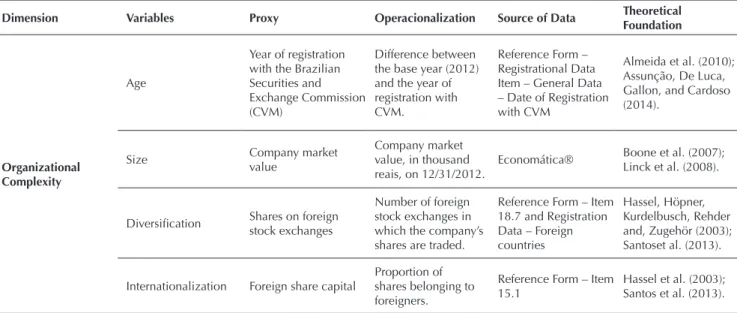
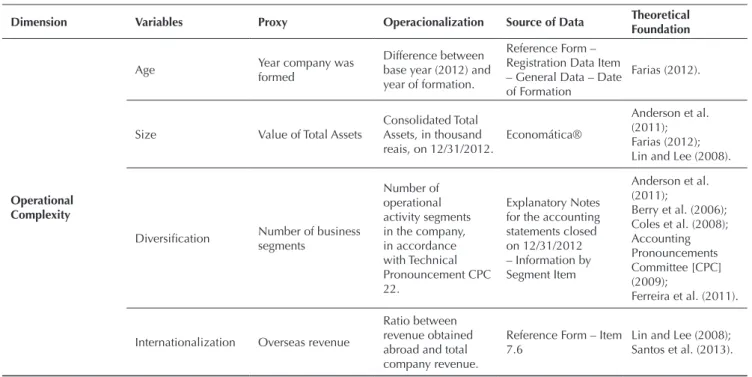
Table 1 presents the proxies, the respective sources of data, and the operationalization of the variables used in the study, considering the two dimensions of complexity (organizational and operational).
Table 1 Variables, proxies, operationalization, and source of data for the dimensions of complexity
Dimension Variables Proxy Operacionalization Source of Data Theoretical
Foundation
Organizational Complexity
Age
Year of registration with the Brazilian Securities and Exchange Commission (CVM)
Difference between the base year (2012) and the year of registration with CVM.
Reference Form – Registrational Data Item – General Data – Date of Registration with CVM
Almeida et al. (2010); Assunção, De Luca, Gallon, and Cardoso (2014).
Size Company market
value
Company market value, in thousand reais, on 12/31/2012.
Economática® Boone et al. (2007); Linck et al. (2008).
Diversii cation Shares on foreign stock exchanges
Number of foreign stock exchanges in which the company’s shares are traded.
Reference Form – Item 18.7 and Registration Data – Foreign countries
Hassel, Höpner, Kurdelbusch, Rehder and, Zugehör (2003); Santoset al. (2013).
Internationalization Foreign share capital
Proportion of shares belonging to foreigners.
Reference Form – Item 15.1
Hassel et al. (2003); Santos et al. (2013).
It is observed in Table 1 that the operationalization of organizational complexity takes the following variables into account: 1) age: measured by the number of years the company has been registered with the CVM; 2) size: measured by the company’s market value; 3) diversii cation: calculated using the number of foreign stock exchanges on which the company’s shares are traded; and 4) internationalization: calculated using foreign participation in the company’s share capital. Meanwhile, for operational complexity, the following variables were adopted: 1) age: measured by the time since the company was formed; 2) size: measured by the value of the company’s Total Assets; 3) diversii cation: calculated using the number of business segments in which the company operates; and 4) internationalization: calculated using the percentage of revenue obtained overseas. It bears mentioning that these variables contemplate some of the specii c characteristics of internal company dynamics for the development of activities (operational complexity), as well as particular aspects that are inherent to a company’s involvement with the environment for its insertion into the market (organizational complexity).
In order to measure organizational and operational
complexity for the companies in the sample, Factor Analysis was applied, aiming to identify “the common dimensions of variability existing in a set of phenomena”, in order to “try and describe a set of variables through creating a lower number of dimensions” (Bezerra, 2009, 74). At er carrying out the analysis, it was thus possible to distribute the companies into four complexity groups (low, medium low, medium high, and high), using the score quartiles obtained from the Factor Analysis as cut-off points.
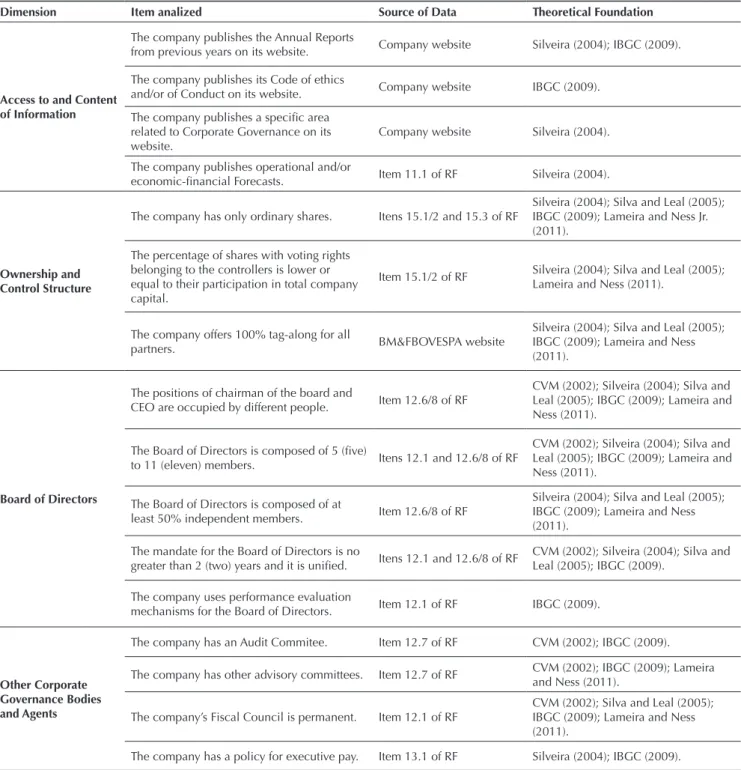
The corporate governance index (CGI) was coni gured based on the studies from Lameira and Ness (2011), Silva and Leal (2005), and Silveira (2004), as well as the recommendations proposed by the CVM Recommendations Leal et for Corporate Governance (CVM, 2002) and by the IBGC Code of Best Corporate Governance Practices (IBGC, 2009). h us, based on these studies and documents, a checklist was constructed (Table 2), divided into four dimensions and 16 items, for verifying the existence of control mechanisms in the companies, which can be established through the companies reporting the adoption of good corporate governance practices aligned with the principles of governance.
Dimension Variables Proxy Operacionalization Source of Data Theoretical
Foundation
Operational Complexity
Age Year company was
formed
Difference between base year (2012) and year of formation.
Reference Form – Registration Data Item – General Data – Date of Formation
Farias (2012).
Size Value of Total Assets
Consolidated Total Assets, in thousand reais, on 12/31/2012.
Economática®
Anderson et al. (2011); Farias (2012); Lin and Lee (2008).
Diversii cation Number of business segments
Number of operational activity segments in the company, in accordance with Technical Pronouncement CPC 22.
Explanatory Notes for the accounting statements closed on 12/31/2012 – Information by Segment Item
Anderson et al. (2011);
Berry et al. (2006); Coles et al. (2008); Accounting Pronouncements Committee [CPC] (2009);
Ferreira et al. (2011).
Internationalization Overseas revenue
Ratio between revenue obtained abroad and total company revenue.
Reference Form – Item 7.6
Lin and Lee (2008); Santos et al. (2013).
Source: Prepared by the authors.
Table 2 Dimensions and items of the Corporate Governance Index, source of data, and theoretical foundation
Dimension Item analized Source of Data Theoretical Foundation
Access to and Content of Information
The company publishes the Annual Reports
from previous years on its website. Company website Silveira (2004); IBGC (2009).
The company publishes its Code of ethics
and/or of Conduct on its website. Company website IBGC (2009).
The company publishes a specii c area related to Corporate Governance on its website.
Company website Silveira (2004).
The company publishes operational and/or
economic-i nancial Forecasts. Item 11.1 of RF Silveira (2004).
Ownership and Control Structure
The company has only ordinary shares. Itens 15.1/2 and 15.3 of RF
Silveira (2004); Silva and Leal (2005); IBGC (2009); Lameira and Ness Jr. (2011).
The percentage of shares with voting rights belonging to the controllers is lower or equal to their participation in total company capital.
Item 15.1/2 of RF Silveira (2004); Silva and Leal (2005); Lameira and Ness (2011).
The company offers 100% tag-along for all
partners. BM&FBOVESPA website
Silveira (2004); Silva and Leal (2005); IBGC (2009); Lameira and Ness (2011).
Board of Directors
The positions of chairman of the board and
CEO are occupied by different people. Item 12.6/8 of RF
CVM (2002); Silveira (2004); Silva and Leal (2005); IBGC (2009); Lameira and Ness (2011).
The Board of Directors is composed of 5 (i ve)
to 11 (eleven) members. Itens 12.1 and 12.6/8 of RF
CVM (2002); Silveira (2004); Silva and Leal (2005); IBGC (2009); Lameira and Ness (2011).
The Board of Directors is composed of at
least 50% independent members. Item 12.6/8 of RF
Silveira (2004); Silva and Leal (2005); IBGC (2009); Lameira and Ness (2011).
The mandate for the Board of Directors is no
greater than 2 (two) years and it is unii ed. Itens 12.1 and 12.6/8 of RF
CVM (2002); Silveira (2004); Silva and Leal (2005); IBGC (2009).
The company uses performance evaluation
mechanisms for the Board of Directors. Item 12.1 of RF IBGC (2009).
Other Corporate Governance Bodies and Agents
The company has an Audit Commitee. Item 12.7 of RF CVM (2002); IBGC (2009).
The company has other advisory committees. Item 12.7 of RF CVM (2002); IBGC (2009); Lameira and Ness (2011).
The company’s Fiscal Council is permanent. Item 12.1 of RF
CVM (2002); Silva and Leal (2005); IBGC (2009); Lameira and Ness (2011).
The company has a policy for executive pay. Item 13.1 of RF Silveira (2004); IBGC (2009).
From Table 2 it is verii ed that the data related to the CGI were gathered from the last 2013 Reference Form (RF) – available from the BM&FBOVESPA website – and from the company and BM&FBOVESPA websites, during the collection period (February to May 2014).
As already said, it bears mentioning that the choice of analysis period of one year considers that each specii c environmental and time set tends to dei ne its own organizational coni guration (Donaldson, 2007; Chenhall, 2007; Fisher, 1995). It is worth highlighting that the data collection for constructing the CGI, especially for analyzing the “Access to and Content of Information” dimension, derives from the information available on the company websites at the time of collection, thus reinforcing the choice of a one year analysis period adopted in this study.
In order to determine the CGI for each company in the sample, a value of “1” was attributed to each adopted good practice recommendation, with a value of “0” otherwise, considering good practices adopted as being those reported by the companies in the data sources used. h erefore, a value of “1” was attributed to reported governance practices, and not reported practices were given a value of “0”. Based on this criterion, no situation exists in which any of the items investigated are not applied in constructing the CGI. h e CGI for each company was obtained by calculating the ratio between the score obtained by the company and the maximum
value possible; that is, 16 points. At er calculating the CGI, the sample was divided into quartiles, considering that the companies classii ed in the i rst quartile have a low CGI, while those in the second one record an average CGI, those in the third one present a good CGI, and those in the fourth quartile have a high CGI.
Based on the CGI obtained, and in order to investigate complexity in relation to the two dimensions (organizational and operational), in accordance with the variables presented in Table 1, this study presents a two-dimensional analysis of complexity, and therefore formulates two hypotheses to be tested:
Hypothesis 1: The companies listed on the BM&FBOVESPA with more organizational complexity present higher corporate governance indices.
Hypothesis 2: The companies listed on the BM&FBOVESPA with more operational complexity present higher corporate governance indices.
Ordinary Least Squares Multiple Linear Regression was also used in order to verify the organizational complexity and operational complexity variables that inl uence the CGI (equation 1 and equation 2, respectively). It should be mentioned that for the regression analysis the following assumptions were addressed and analyzed: residual normality, residual homoskedasticity, linearity of coefficients, and multicollinearity between the independent variables (Cunha & Coelho, 2009).
CGI
i= α + β
1AGE
i+ β2
MV
i+ β
3FOR
i+ β
4CAP
i+ ε
iCGI
i= α + β
1TIME
i+ β
2SIZE
i+ β
3SEGM
i+ β
4REC
i+ ε
iin which: CGIi: Corporate Governance Index; AGEi: Time registered with CVM; MVi: Company size; FORi: Diversii cation of company; CAPi: Internationalization
of company; α: Constant; β: Model coeffi cient; εi: Model error.
in which: CGIi: Corporate Governance Index; TIMEi: Company age; SIZEi: Company size; SEGMi: Diversii cation of business; RECi: Internationalization of company activities; α: Constant; β: Model coeffi cient; εi: Model error.
In order to verify the relationship between dimensions of complexity and corporate governance, Correspondence Analysis (Anacor) was applied, the intention of which is to connect and analyze geometrical proximity relationships
between non-metric variables in a perceptual map (Fávero, Beli ore, Silva, & Chan, 2009). h e Anacor result is of an essentially descriptive nature and does not contain any inferences regarding cause and eff ect. h us, Correlation Analysis was also carried out in order to determine the strength of the relationship between dimensions of complexity and corporate governance.
1
4 PRESENTATION AND ANALYSIS OF THE RESULTS
4.1 Organizational Complexity and Operational Complexity
The initial Factor Analysis tests for measuring organizational complexity indicated that the age and internationalization variables are not associated with the size and diversii cation variables. It was possible to verify that the size and diversii cation variables reach a higher explanatory power when all of the factors obtained are considered. h e degree of explanation from the two variables for a factor is 80.3%, which justii es more than half of the variance in the two variables. h is result is the best one among the three tested. h is is because on the i rst occasion in which all of the variables (age, size, diversii cation, and internationalization) were used, two factors were retrieved with which around 70% of the total variability in the data was explained; and on the second, where three variables (age, size, and diversii cation) were adopted, a factor was created that would explain 54.2% of the variation in the variables. It is therefore revealed that there was a drop in the explanatory power of the model between the i rst to the second attempts and an increase in the third in relation to the previous two. As a result of this, only the size and diversii cation variables form part of the analysis model.
It is concluded that, together, market value (size) and the number of foreign stock exchanges on which a company’s shares are traded (diversii cation) explain organizational complexity, whereas because they are not related with the other variables, time registered with the CVM (age) and the proportion of shares belonging to foreigners (internationalization) do not together describe organizational complexity.
Despite the result revealing that age, together with the other variables, does not explain organizational complexity, Miller and Friesen (1984) believe that age in itself does not make a company complex, with it needing to grow and diversify in order to evolve; that is, age, together with the other variables, should explain organizational complexity. Meanwhile, Coles et al., (2008) understand that big diversii ed companies may be considered complex. h us, it is observed that, in this case, the age of a company is not seen by the authors as something that is able to inl uence its complexity.
h e initial Factor Analysis tests for the operational complexity dimension indicated that the age variable is not associated with the others. h us, in the search
for a better connection between the variables, the tests were carried out with the other variables. It is verii ed that the size and internationalization variables have a reasonable explanatory power, despite them being below 0.7. With regards to the diversii cation variable, although the value 0.301 may be considered low, Hair, Black, Bandin, Anderson & Tatham (2009) think that, even if the communality is low, it is possible not to reject it, depending on the research purpose. h us, considering the aim of this study and the results from the other tests, the diversii cation variable was kept.
h e level of explanation from the three variables for a factor is 49.7%, thus explaining almost half of the variance in the three variables; that is, taking the three variables into account, it is observed that, with regards to the explanatory power of the factor extracted by the Factor Analysis, there is an increase in relation to the i rst attempt. h erefore, the operational complexity dimension considers that the size, diversii cation, and internationalization variables form part of the analysis model.
It is therefore worth highlighting that based on the Factor Analysis, the time the company has been operating (age) is not related with the other variables; and that the value of Total Assets (size), the number of operational activity segments (diversii cation), and the proportion of revenue obtained abroad in relation to total company revenue (internationalization) explain operational complexity for the companies in the sample. As already mentioned, age is one of the variables that model organizational characteristics (Espejo & Frezatti, 2008), and despite being considered as a variable that causes changes in organizational structure over the long run (Greiner, 1998), it did not show any relationship with the other contingency factors, in order for them to explain together the operational complexity. h us, the results from the investigation from Linck et al. (2008) should be considered, which reveal that age does not inl uence complexity in the same proportion for young and mature companies.
4.2 Corporate Governance Index
Based on the data for the 162 companies in the sample, it is found that the lowest CGI is 0.0000 and the highest is 0.8125; that is, some companies adopt up to 13 of the 16 corporate governance practices considered, while others do not adopt any of them. With regards to the average, the value of 0.4610 reveals that most of the companies adopt less than half of the corporate governance practices assessed. Of the practices observed, the one most adopted by the companies in the sample relates to presenting a policy for executive pay (93.8%).
h e studies from Almeida et al. (2010) and Catapan, Colauto, and Barros (2013), respectively, found that, on average, 67% and 64% of companies adopt the recommendation for diff erent people to occupy the roles of CEO and chairman of the board. Moreover, in these two studies, 77% and 37% of the companies analyzed have between 5 and 9 members on their boards of directors. h e proportion of companies in this study that adopt these practices (79.6% and 79%) is higher than that found previously.
Although some recommendations are frequently adopted, others do not follow this same trajectory, as is the case of tag along being off ered to all partners (6.2%), the number of independent board members (12.3%), evaluating board performance (16%), and the existence of a permanent i scal council (24.7%). In relation to this last recommendation, it bears mentioning that, despite this not being adhered to in 122 of the 162 companies in the sample, 50.8% (62 companies) do have a i scal council installed. h e proportion of companies that adopt the recommendation of having other advisory committees (42.6%) is greater than that for the implantation of an audit committee (30.9%).
It is identii ed that the number of companies that publish annual reports from previous i nancial years on their websites (25.9%) corresponds to less than half of those that adopt the good practice of publishing a code of ethics and/or of conduct (66.7%). However, it is worth highlighting that of the companies that do not follow this recommendation (120), only 9% also do not publish standardized i nancial statements from previous years. It is also noted that almost 81% (84) of the companies
that publish a code of ethics and/or of conduct do so in the section of the website titled corporate governance.
4.3 Complexity Factors that Inl uence Corporate Governance
In order to identify the organizational complexity and operational complexity variables that inl uence corporate governance, Multiple Linear Regression was used. h us, based on the CGI dependent variable and the age, size, diversii cation, and internationalization independent variables, an analysis of the assumptions was carried out, followed by the Multiple Linear Regression.
It was initially identii ed using the R2 value that 30.9% of the variation in the CGI is explained by the set of variables in the organizational complexity dimension, while 24.7% are explained in the operational complexity dimension. With regards to the absence of serial autocorrelation assumption, it was observed that the Durbin-Watson test presents a value close to two, in the two dimensions; thus, the absence of autocorrelation assumption was fuli lled by both dimensions. In relation to normality, the results from the Kolmogorov-Smirnov test reveal that the normality assumption is fuli lled, given that the sig values are 0.926 and 0.713 in the organizational and operational complexity dimensions, respectively; in other words, the data follow normal distribution.
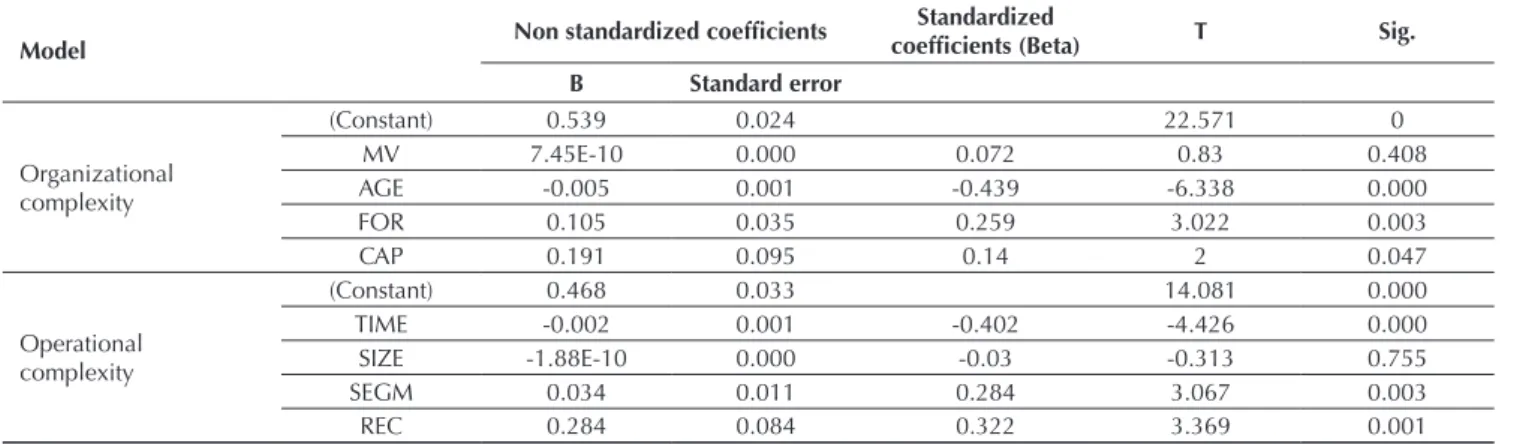
Table 3 Result from the Multiple Linear Regression model
Model Non standardized coefi cients
Standardized
coefi cients (Beta) T Sig.
B Standard error
Organizational complexity
(Constant) 0.539 0.024 22.571 0
MV 7.45E-10 0.000 0.072 0.83 0.408
AGE -0.005 0.001 -0.439 -6.338 0.000
FOR 0.105 0.035 0.259 3.022 0.003
CAP 0.191 0.095 0.14 2 0.047
Operational complexity
(Constant) 0.468 0.033 14.081 0.000
TIME -0.002 0.001 -0.402 -4.426 0.000
SIZE -1.88E-10 0.000 -0.03 -0.313 0.755
SEGM 0.034 0.011 0.284 3.067 0.003
REC 0.284 0.084 0.322 3.369 0.001
Source: Prepared by the authors.
h e data in Table 3 reveal that, in both complexity dimensions – organizational and operational – the independent variables age, diversification, and internationalization inl uence the CGI. In contrast, the same cannot be affi rmed for the size variable, since it does not present statistical signii cance.
It should be highlighted that unlike the other variables (diversii cation and internationalization), age presents a negative sign. h at is, the relationship between company age and corporate governance is inverse; in other words, age negatively inl uences the CGI, whether considering the date the company was founded or the time it has been registered with the CVM.
h is result is similar to that found by Almeida et al. (2010), who by investigating Brazilian publicly-traded companies found that company age negatively inl uences compliance with corporate governance practices; which is the opposite to the i ndings of Lameira and Ness (2011), who verii ed that more time of life is a determining factor for quality of governance.
h e study from Lin and Lee (2008), which considers the size of the board of directors to be the starting point for analyzing corporate governance, revealed that company size and diversii cation positively and signii cantly aff ect board size, while internationalization is not signii cantly related.
It is worth mentioning that the size variable, operationalized both by market value (organizational complexity) and by the value of Total Assets (operational complexity), does not inl uence the CGI, contrasting with
the results from previous empirical studies (Almeida et al. 2010; Lameira & Ness, 2011; Silveira & Barros, 2008). Klapper and Love (2002) are noted for understanding that there are reasons for companies, both big and small, to adopt good corporate governance practices.
4.4 Relationship between Dimensions of Complexity and Corporate Governance
With the aim of investigating the relationship between the organizational and operational complexity and the corporate governance of the companies listed on the BM&FBOVESPA, the Chi-Squared Test was initially carried out, which verii ed the dependency between the variables. Anacor was subsequently applied, followed by the Kolmogorov-Smirnov test, which revealed a non-normal distribution, and then the Spearman Correlation was adopted.
It bears mentioning that in order to do this, the CGI was divided into quartiles, following what was established in the methodology. h us, the companies classii ed in the i rst quartile have a low CGI; those in the second one record an average CGI; those in the third one present a good CGI; and those in the fourth one have a high CGI. h e distribution of the CGI by quartiles also took into account the whole set of companies used for measuring the two dimensions of complexity adopted in the study.
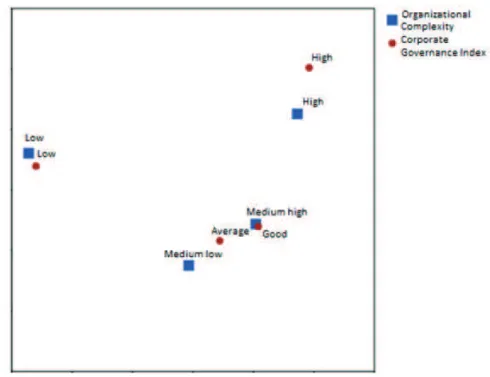
It is coni rmed that both high and low organizational complexity have a proximity relationship with high and low CGIs, respectively. It is also found that, based on the conceptual map, medium high organizational complexity
is associated with a good CGI, while medium low organizational complexity is related with an average CGI.
Figure 2 shows the perceptual map of the connection between operational complexity and the CGI.
Figure 1 Perceptual map of the relationship between organizational complexity and CGI
In a similar way to the results found in Figure 1, it can be verii ed in Figure 2 that high operational complexity presents a close relationship with a high CGI, just as low operational complexity has proximity with a low CGI. It is also observed that medium high operational complexity is associated with a good CGI and that medium low operational complexity is related with an average CGI. In order to support the results and fuli ll the study’s proposal, it is also verii ed that the correlation coeffi cient (Spearman correlation) between organizational complexity and the CGI is 0.660 (1% signii cance), which represents a strong eff ect according to Field (2009) since it was above 0.5. It can therefore be inferred that there is a positive and signii cant correlation with a strong eff ect between the variables analyzed. In turn, considering the operational
complexity dimension, the coeffi cient of correlation between operational complexity and the CGI is 0.334, which represents an average eff ect (Field, 2009), suggesting a positive and signii cant correlation with an average eff ect between operational complexity and the CGI.
It is therefore found that there is a relationship between complexity and corporate governance, considering both dimensions of complexity analyzed in this study, which coni rms research hypotheses 1 and 2 that companies with more organizational complexity and operational complexity, respectively, present a greater adhesion to good corporate governance practices. h us, it can be considered that control mechanisms are improved as a result of the demand that exists to ease the agency problems originating from company complexity.
5 CONCLUSIONS
In this study, it was considered that the contingent factors age, size, diversii cation, and internationalization can inl uence modii cations in company characteristics, or rather, in their complexity, which in turn is capable of creating a demand for more control mechanisms, represented by good corporate governance practices. h e study responds to the research question and fuli lls the proposed aim, in accordance with the comments below.
h e results demonstrate that whatever the dimension of complexity is, it is directly and positively related to the adoption of good corporate governance practices. h erefore, companies that are considered to be complex (whether in relation to structure or to the formal and strategic aspects necessary for their insertion into the market – organizational complexity -, or linked to the set of resources and valid processes for the development of their activities – operational complexity) adopt more corporate governance practices.
Considering the specii cities of this investigation, it is verii ed that its results are consistent with the literature (Boone et al., 2007; Coles et al., 2008; Ferreira et al, 2011; Lin & Lee, 2008) in affi rming that the complexity of organizations ultimately promotes the separation of control activities and ownership, and that by observing this companies perceive the need to promote an alignment between top level managers’ and shareholders’ interests and minimize agency problems.
In general terms, the results from this study are compatible with those from Coles et al. (2008), who revealed that complex companies (considering the variables diversii cation, size, and leverage) have bigger boards of directors with more external members, which
is considered to be a good corporate governance practice. It is also worth highlighting that the i ndings from this investigation are consistent with those of Bushman et al. (2004), who verii ed that organizational complexity, measured by geographic concentration and product diversii cation, limits the effi ciency of control mechanisms.
From this perspective, the results from the study
confi rm that corporate governance is related to company complexity, considering that this complexity represents the quantity and diversity of components and relationships that, together, constitute an organizational standard (Vesterby, 2008); in other words, each company has a certain level of complexity and tends to create a specifi c demand for control mechanisms, which consequently stimulates the adoption of good corporate governance practices, in order for it to meet its specifi c needs.
It should be pointed out that, despite the results from the Factor Analysis revealing that the complexity factor can be explained by a group of diff erent variables (organizational complexity – size and diversii cation – and operational complexity – size, diversii cation, and internationalization), it is concluded that in the two dimensions (organizational and operational) complexity is directly and positively related with the adoption of good corporate governance practices in non-i nancial companies listed on the BM&FBOVESPA. In light of these i ndings, research hypotheses 1 and 2 were accepted.
corporate governance practices with the aim of adapting to the environment in which they i nd themselves.
Although the results cannot be generalized, due to the limitations of this study, it can be considered that organizations improve their control mechanisms when they perceive that there is a demand for more and better control mechanisms, which results from changes in company structure and processes, which make them more complex. h e results therefore contribute to revealing the existence of complexity in organizations using contingency factors, suggesting that managers should, in this context, perceive the need to adhere to a greater quality of control mechanisms by adopting good corporate governance practices.
It is understood that, because there are other factors
that may be related with complexity and because they have not been used or explored in this investigation (leverage, tangibility of assets, geographical concentration, and industry structure, among others), and also because aspects such as company ownership contexts, characteristics related to activity sector, and capital structure, were not considered when carrying out the analysis, the study has limitations. It is therefore suggested, for future research, that the variables related to complexity and the analysis period should be expanded, that companies from other countries should be analyzed, that the inclusion of other corporate governance practices that were not considered in this investigation should be verii ed, and that, for comparison purposes, i nancial and holding companies should be considered.
REFERENCES
Almeida, M. A., Santos, J. F. D., Ferreira, L. F. V. M., & Torres, F. J. V. (2010). Determinantes da qualidade das práticas de governança corporativa das empresas brasileiras de capital aberto que possuem investimentos públicos. Revista
Brasileira de Gestão de Negócios, 12(37), 369-387.
Anderson, R. C., Reeb, D. M., Upadhyay, A., & Zhao, W. (2011). h e economics of director heterogeneity. Financial Management, 40(1), 5-38.
Andreatta, A., Silveira, A., & Olinquevitch, J. L. (2009). A controladoria nas grandes indústrias têxteis do Vale do Itajaí/ SC. Caminhos (Rio do Sul), 1, 221-240.
Araújo, C. E. B., Cabral, A. C. A., Santos, S. M., Pessoa, M. N. M., & Roldan, V. P. S. (2013). Grau de adesão de empresas familiares às boas práticas de governança corporativa: proposição e teste de um instrumento-diagnóstico. Revista Alcance – Eletrônica, 20(1), 117-138.
Arruda, G. S., Madruga, S. R., & Freitas, N. I., Júnior. (2008). A governança corporativa e a teoria da agência em consonância com a controladoria. Revista de Administração da UFSM, 1(1), 71-84.
Assunção, R. R., De Luca, M. M. M., Vasconcelos, A. C., & Rebouças, S. M. D. P. (2014a). Complexidade organizacional e governança corporativa nas maiores companhias abertas do Brasil. Enfoque: Refl exão Contábil, 33(1), 105-122.
Assunção, R. R., De Luca, M. M. M., Gallon, A. V., & Cardoso, V. I. C. (2014b). Os artefatos da contabilidade gerencial e o ciclo de vida organizacional. Revista ConTexto, 14(28), 68-82. Berle, A., & Means, G. (1932). Th e modern corporation and private
propriety. London. New York: Macmillan.
Berry, T.K., Bizjak, J. M., Lemmon, M. L., & Naveen, L. (2006). Organizational complexity and CEO labor markets: evidence from diversii ed i rms. Journal of Corporate Finance, 12, 797-817.
Bezerra, F. A. (2009). Análise fatorial. In L. J. Corrar, L. J., E. Paulo,
Bhagat, S., Carey, D. C., & Elson, C. M. (1999, May). Director ownership, corporate performance, and management turnover. Th e Business Lawyer, 54(3), 885-919.
Boone, A. L., Field, L. C., Karpoff , J. M., & Raheja, C. G. (2007). h e determinants of corporate board size and composition: an empirical analysis. Journal of Financial Economics, 85, 66-101. Burns, T., & Stalker, G. M. (1960). Th e management of innovation.
London: Tavistock.
Bushman, R., Chen, Q., Engel, E., & Smith, A. (2004). Financial accounting information, organizational complexity and corporate governance systems. Journal of Accounting and Economics, 37, 167-201.
Cardoso, A. F., & Cabral, A. S. (2010, January/June). O ambiente de pesquisa e desenvolvimento (P&D) sobre o enfoque da teoria da complexidade em instituições de pesquisa tecnológica (IPTS). Revista Innovare, 9, 125-144. Catapan, A., Colauto, R. D., & Barros, C. M. E. (2013). A
relação entre a governança corporativa e o desempenho econômico-i nanceiro de empresas de capital aberto do Brasil.
Contabilidade, Gestão e Governança, 16(2), 16-30.
Chenhall, R. H. (2007): h eorizing contingencies in management control systems research. In C. S. Chapman, A. G. Hopwood, & M. D. Shields (Eds.). Handbook of Management Accounting Research, Volume 1: Elsevier, 163-205.
Coles, J. L., Daniel, N. D., & Naveen, L. (2008). Boards: does one size i t all? Journal of Financial Economics, 87, 329-356. Comitê de Pronunciamentos Contábeis. (2009, jun.).
Pronunciamento técnico CPC 22 –informações por segmento. Retrieved on December 14th, 2012, from http://www.cpc.org. br/pdf/CPC%2022.pdf
Cunha, J. V., & Coelho, A. C. A. (2009). Regressão linear múltipla. In L. J. Corrar, E. Paulo, & J. M. Dias-Filho. (Coord.). Análise multivariada: para os cursos de administração, ciências contábeis e economia (pp. 131-231). São Paulo: Atlas.
Daryani, M., & Amini, A. (2016). Management and Organizational Complexity. Procedia-Social and Behavioral Sciences.230, 359-366.
Donaldson, L. (2007). Teoria da contingência estrutural. In S. R. Clegg, C. Hardy, & W. R. Nord (Vol. 1, pp. 104-131). Handbook de estudos organizacionais. São Paulo: Atlas.
Espejo, M. M. S. B, & Frezatti, F. (2008). A contabilidade gerencial sob a perspectiva contingencial: inl uência de fatores contingenciais no sistema orçamentário modelado por equações estruturais. Anais do Encontro da Associação Nacional de Pós-Graduação em Pesquisa e Administração, Rio de Janeiro, RJ, Brasil, 32.
Fama, E. F., & Jensen, M. C. (1983). Separation of ownership and control. Journal of Law and Economic, 26(2), 301-325. Farias, K. T. R. (2012). Mecanismos de controle do reporting
fi nanceiro das companhias abertas do Brasil. (Doctoral h esis). Faculdade de Economia, Administração e Contabilidade, Universidade de São Paulo, São Paulo, SP, Brasil.
Fávero, L. P., Beli ore, P. P., Silva, F. L., & Chan, F. B. (2009). Análise de dados: modelagem multivariada para tomada de decisões. Rio de Janeiro: Elsevier.
Ferreira, D., Ferreira, M. A., & Raposo, C. C. (2011). Board structure and price informativeness. Journal of Financial Economics, 99, 523-545.
Field, A. (2009). Descobrindo a estatística usando o SPSS. Porto Alegre: Artmed.
Fisher, J. (1995). Contingency-based research on management control systems: categorization by level of complexity. Journal of Accounting Literature, 14, 24-53.
Gill, M. S., Vijay, T. S., & JHA, S. (2009). Corporate governance mechanisms and i rm performance: a survey of literature. The Icfai University Journal of Corporate Governance, 8(1), 7-21. Greiner, L. E. (May/June, 1998). Evolution and revolution as
organizations grow. Harvard Business Review, 76(3), 55-98). Gomes, A. P. M. (2016). Características da governança corporativa
como estímulo à gestão i scal. Revista Contabilidade & Finanças - USP, 27(71), 149-168.
Hair, J. F., Black, W. C., Bandin, B. J., Anderson, R. E., & Tatham, R. L. (2009). Análise multivariada de dados (6a ed.). São Paulo: Bookman.
Hassel, A., Höpner, M., Kurdelbusch, A., Rehder, B., & Zugehör, R. (2003). Two dimensions of the internationalization of i rms.
Journal of Management Studies, 40(3), 701-720. Hitt, M., Ireland, R., & Hoskisson, R. (2003). Administração
estratégica: competitividade e globalização. São Paulo: h omson Learning.
Instituto Brasileiro de Governança Corporativa. (2009). Código das melhores práticas de governança corporativa (4a ed.). São Paulo: IBGC. Retrieved on October 14th, 2012, from http:// www.ibgc.org.br/CodigoMelhoresPraticas.aspx
Jensen, M. C. (1993). h e modern industrial revolution exit and the failure of internal control systems. Th e Journal of Finance,
48(3), 831-880.
Klapper, L. F., & Love, I. Corporate governance, investor protection, and performance in emerging markets [Working Paper]. h e World Bank. Retrieved on June 18, 2014, from http://elibrary.worldbank.org/doi/book/10.1596/1813-9450-2818
Kledt, F., Evers, P., & Benson, D. (2016). Organizational complexity. In T. Havar-Simonovich, T., & D. Simonovich. (Vol. 1 pp. 95-116). Contemporary Th eory and Practice of Organizations, Part I: Understanding the Organization. Stuttgart: Verlag.
Lameira, V. J., & Ness, W. L., Jr. (2011). Os determinantes da qualidade da governança praticada pelas companhias abertas brasileiras. Revista de Negócios, 16(3), 33-52.
Lawrence, P. R., & Lorsch, J. W. (1967). Diff erentiation and integration in complex organizations. Administrative Science Quarterly, 12(1), 1-47.
Lin, T. T., & Lee, Y. C. (2008). Organizational characteristics, board size and corporate performance. Journal of Global
Business Management, 4(2), 338-347.
Linck, J., Netter, J., & Yang, T. (2008). h e determinants of board structure. Journal of Financial Economics, 87, 308-328. Miller, D., & Friesen, P. H. (1984). A longitudinal study of the
corporate life cycle. Management Science, 30(10), 1.161-1.183. Mintzberg, H., & Quinn, J. B. (2001). O processo da estratégia.
Porto Alegre: Bookman.
Naveen, L. (2006). Organizational complexity and succession planning. Journal of Financial and Quantitative Analysis, 41(3), 661-683.
Ponchirolli, O. (2007). A teoria da complexidade e as organizações.
Diálogo Educacional, 7(22), 81-100.
Rossetti, J. P., & Andrade, A. (2011). Governança corporativa: fundamentos, desenvolvimento e tendências (5a ed.). São Paulo: Atlas.
Sampieri, R. H., Collado, C. F., & Lúcio, P. B. (2006). Metodologia de pesquisa (3a ed.). São Paulo: McGraw-Hill.
Santos, J. G. C. D., Vasconcelos, A. C., & De Luca, M. M. M. (2013, jan./mar.). Peri l da inovação e da internacionalização de empresas transnacionais. Revista de Administração e Inovação,
10(1), 189-211.
Shleifer, A., & Vishny, R. W. (1997). A survey of corporate governance. Th e Journal of Finance, 52(2), 737-783.
Silva, A. L. C., & Leal, R. P. C. (2005). Corporate governance index, i rm valuation and performance in Brazil. Revista Brasileira de Finanças, 3(1), 1-18.
Silveira, A. M. (2002). Governança corporativa, desempenho e valor da empresa no Brasil. (Master’s Degree). Faculdade de Economia, Administração e Contabilidade, Universidade de São Paulo, São Paulo, SP, Brasil.
Silveira, A. M. (2004). Governança corporativa e estrutura de propriedade: determinantes e relação com o desempenho das empresas no Brasil. (Doctoral h esis). Faculdade de Economia, Administração e Contabilidade, Universidade de São Paulo, São Paulo, SP, Brasil.
Silveira, A. M. (2010). Governança corporativa no Brasil e no mundo: teoria e prática. Rio de Janeiro: Elsevier.
h ompson, J. D. (1967). Organizations in action: social science bases of administrative theory. New York: McGraw-Hill.
Vesterby, V. (2008). Measuring complexity: things that go wrong and how to get it right. Emergence: Complexity and Organization, 10(2), 90-102.
Address for correspondence:
Renata Rouquayrol Assunção