1 ISSN 0100-2945 DOI: http://dx.doi.org /10.1590/0100-29452019081
Corresponding author: [email protected] Received: July 19, 2018 Accepted: November 27, 2018
Copyright: All the contents of this journal, except where otherwise noted, is licensed under a Creative Commons Attribution License.
Evaluation of SSR and SNP markers
in Rubus glaucus Benth progenitors selection
Ana María López
1, Carlos Felipe Barrera
2, Marta Leonor Marulanda
31PhD Fellow (Universidad de Caldas). Universidad Tecnológica de Pereira. Plant Biotechnology Laboratory. Pereira-Colombia. E – mail: [email protected]. co(ORCID 0000-0002-5138-1806)
2PhD. Universidad Nacional de Colombia - Medellín. Agricultural Sciences Faculty.Arauca-Colombia E – mail: [email protected] (ORCID 0000-0002-5015-2956) 3PhD. Universidad Tecnológica de Pereira. Research, Innovation and Extension Vice-chancellory. Pereira-Colombia. E – mail: [email protected](ORCID 0000-0002-5015-2956)
Abstract -Rubus glaucus Benth (known as “mora de castilla”) is a Colombian agricultural product, with probably, the major potential. This fruit combines features of Idaeobatus and Rubus subgenera. Despite its recognized importance in the economy of small producers, this crop has received little technological development; as a result, sowing procedures of this specie is done by using local cultivars asexually propagated by producers. Associated Rubus producers in Colombia has noticed the necessity to formalize the offer of planting material, starting with plant breeding programs tending to the obtention of more productive varieties with morphological features that facilitates cultural activities. This study presents the results of the evaluation of SSR and SNPs markers obtained in previous experimental works from a RNA-Seq transcriptome analysis. It was evaluated 15 promissory R. glaucus cultivars, which could be potential progenitors in future breeding schemes. Genetic characterization was accomplished by testing 22 SSR microsatellite and 78 single nucleotide polymorphisms (SNPs) markers. From evaluated SSR markers, 15 yielded positive PCR amplification generating 29 loci and 58 alleles. From evaluated SNPs markers, 36 yielded positive PCR amplification. Obtained sequences from amplified products with SNPs showed high homology with species belonging to Rosaceae family. Selection criteria of progenitors were based on the results of molecular characterizations and useful morphological features in the culture management. This research demonstrates the utility of molecular markers to assess genetic diversity of potential progenitors susceptible to plant breeding processes.
This process, highly known as development of parental populations, determines in a great manner the success of plant breeding processes.
Index terms: Plant breeding, andean blackberry, genetic diversity.
Avaliação dos marcadores SSR e SNP na seleção
de progenitores em
Rubus glaucus
Benth
Resumo-Amora de castilla (Rubus glaucus Benth) é um dos produtos com maior potencial de desenvolvimento agrícola Colômbiano, que combina características dos subgéneros Idaeobatus e Rubus. Apesar da sua reconhecida importância na geração de rendas para os pequenos produtores, este cultivo tem recebido pouco desenvolvimento tecnológico. Como resultado a semeadura desta espécie é feita mediante cultivares locais propagados asexualmente pelos agricultores. Os produtores associados de amora na Colômbia têm ressaltado a necessidade de formalizar a oferta de cultivares para semente, começando com processos de fito-melhoramento para obter variedades mais produtivas, com características morfológicas que ajudem nas atividades culturais. O presente artigo, mostra os resultados da avaliação com marcadores tipo SSR e SNP obtidos em trabalhos prévios desde uma análise do transcriptoma por ARN-Seq. Quinze cultivares promissórios de R. glaucus foram avaliados para ser possivelmente utilizados num futuro processo de cruzamento. Na caracterização, 22 marcadores tipo SSR e 78 marcadores polimórficos tipo SNP foram selecionados. Dos 22 marcadores SSR usados, 15 rendeu amplificação positiva gerando um total de 29 loci e 58 alelos. Similarmente, dos 78 marcadores tipo SNP avaliados, 36 mostraram amplificação positiva. As sequencias obtidas dos produtos amplificados com SNP mostraram uma alta homologia com espécies da família Rosaceae. Os critérios de seleção dos progenitores foram realizados com base em os resultados das caracterizações moleculares junto com os critérios morfológicos úteis no manejo do cultivo. Este trabalho prova a utilidade dos marcadores moleculares para estimar a diversidade genética dos possíveis progenitores para ser usados num processo de fito-melhoramento. Um aspecto conhecido como o desenvolvimento da população parental, e que determina de uma forma grande o sucesso dos processos de fito-melhoramento.
Termos para indexação: Fito-melhoramento, amora de castilla, diversidade genética.
2
Rev. Bras. Frutic., Jaboticabal, 2019, v. 41, n. 1: (e-081) A. M. López et al.
Introduction
Rosaceae family comprises nearly 90 genera and 300 species, among them fruit trees with economic importance are included such as apples (Malus pumila Mill.) and pears (Pyrus spp.); stone fruits or drupes like peaches (Prunus persica); several ornamental species including the rose (Rosa spp.), and soft fruits as strawberries, raspberries, blackberries, among others. Different taxonomic classifications of the family has been proposed based upon morphology, whilst Schulze-Menz (1964) suggested a new family classification into subfamilies: Maloideae, Amygdaloideae, Rosoideae y Spiraeoideae based on chromosome number and fruit type (LONGHI, et al. 2014).
Genetic variability of Rubus genus is known over the world and has been widely studied over the phenotypical, morphological, chromosomal and molecular aspects (DOSSETT, et al. 2012; ALICE, et al. 1999; GRAHAM AND MCNICOL, 1995; GRAHAM et al., 1997). One of the most interesting features of the genus is the variability in the number of chromosomes, polyploidy and hybridization; in contrast, only Idaeobatus, Dalibarda, and Anoplobatus subgenera are predominantly diploid, whilst Dalibardastrum, Malachobatus, and Orobatus are exclusively polyploid (THOMPSON, 1995, 1997). Hybridization in Rubus occurs mainly between closely related species (NARUHASHI, N., 1990; KRAFT, 1995) and, in some cases, between subgenera (JENNINGS, 1979; WEBER, 1996; ALICE, et al. 1997), thus, some intersubgeneric hybrids possess commercial importance (WAUGH, et al. 1990).
Rubus glaucus or Andean blackberry is distributed over the main Colombian mountain and combines Idaeobatus and Rubus features. This specie is a fertile amphidiploid or allotetraploid, probably originated by genome fusion of two species (JENNINGS, 1988). (DELGADO, et al. 2010) found 28 chromosomes in R. glaucus cultivars, assuming a basic number n=7 for Rubus genus, it confirms its tetraploidy (4x).
Despite its well-known importance in the income generation for small producers, this cultivar has received little technological development, as a result, cultivar quality and productivity shown high variability, mainly due to the lack of formal varieties and the scarcity of planting material with good genetic and phytosanitary quality. Nowadays, planting of this specie is still done by the usage of local cultivars asexually propagated by growers (LOBO et al., 2002). This specie shows low yielding rates, mainly caused by anthracnose caused by por Glomerella cingulata(Stoneman) Spauld & H. Schrenk (teleomorph state of Colletotrichum gloeosporioides). This disease is considered the most devastating affecting R. glaucus, creating losses above the 50%. In addition, chemical treatment of this agent increases production costs
(SALDARRIAGA-CARDONA, et al. 2008).
Associated Colombian blackberry producers, has highlighted the necessity to formalize the offer of planting material, starting by plant breeding schemes that allow the obtention of more productive varieties with morphological features that facilitates cultural activities and certain tolerance to fungal attack, especially those related to anthracnose. It is well known that the first step in plant breeding programs is the selection and characterization of promising cultivars.
In this regards, (BERTRAND, et al. 2008) has stated that with help of polymerase chain reaction (PCR), public institutions and commercial organizations in charge of plant breeding programs has implemented molecular markers, including SSR and progenitor genotyping to make more efficient those processes. In addition, the evolution of molecular techniques developed the polymorphisms of a single nucleotide (SNP). Bertrand et al. (2008), classified selection schemes assisted by markers onto 5 areas: 1) Development of parental population for its selection and hybridization, 2) construction of ligation maps for its evaluation over phenotypical features, 3) QTL (Quantitative trait loci) validation, confirming the position and effects of QTL, 4) Selection assisted by markers, and 5) marker validation (BERTRAND, et al. 2008).
In Colombia, some studies regarding genetic diversity of Rubus genus has been carried out: Zamorano et al. (2004) conducted a molecular and morphological characterization of species belonging this genus using Random Amplified Microsatellite (RAMS). Duarte et al. (2011) evaluated genetic relations of elite Colombian Rubus glaucus cultivars through AFLP analysis obtained by the employment of three primer combinations. (MARULANDA, et al. 2007) assessed genetic diversity of wild and cultivated species of R. robustus, R. urticifolius, R. glaucus and R. rosifolius through AFLP and SSR markers developed for R. alceifolius (heterologous markers, when applied to R. glaucus). Marulanda and López (2009), performed molecular (SSR markers) and morpho-agricultural charcaterization for cultivated and wild varieties of Rubus glaucus with and without thorn, paying special attention to fruit size. (MARULANDA, et al. 2012) developed especific SSR markers for Rubus glaucus, aiming to obtain higher discrimination power. They concluded the necessity to develop more discriminatory molecular markers associated to morphological desired features. (LÓPEZ-VÁSQUEZ, et al. 2013), found differential responses in blackberry cultivars against anthracnose attack.
3
Rev. Bras. Frutic., Jaboticabal, 2019, v. 41, n. 1: (e-081) Evaluation of SSR and SNP markers inRubus glaucusBenth progenitor selection
together with a control treatment (cultivar inoculated with sterile water). Afterwards, RNA was extracted 72 hours later and the genetic material sequencing were compared between treatments (unpublished results). This study allowed the design of new molecular markers (SSR and SNPs) which were finally used in this project.
In order to start with plant breeding processes for Rubus glaucus, evaluations with SSR and SNPs were conducted over promissory cultivars that potentially could be used in future breeding schemes. Genetic distance and other features such as thorn presence/absence and fruit size were considered at the time of selecting cultivars.
Materials and methods
Plant material and DNA extraction - Fifteen Andean blackberry cultivars with agricultural interesting features coming from participative selections made with producers in different regions of the country were selected. These cultivars were previously characterized with heterologous (transferred from other Rubus specie) and homologous SSR markers (developed for R. glaucus) (MARULANDA, et al. 2012). Selected cultivars shown differential response against C. gloeosporioides attack (LÓPEZ-VÁSQUEZ, et al. 2013). Table 1, gather all data related to the sampled material (name, place of collection, thorn presence/absence and response against C. gloeosporioides (MORALES, et al. 2010).
DNA extraction of healthy foliar tissue was accomplished using the commercial Plant DNeasy Mini Kit (QIAGEN) following manufacturer instructions.
M o l e c u l a r m a r k e r d e v e l o p m e n t - T h e development of the SSR and SNPs markers from a previous RNA-Seq analysis of the R. glaucus interaction against C. gloeosporioides, and its further use in this study is described.
SSR molecular markers - Detection of the simple sequence repeats (SSR) from the transcriptome analysis was completed using the MIcroSAtellite (MISA) software. From these sequences, 22 primers were designed. Rubus glaucus genome possess several microsatellite with different repetitions and lengths, as well as the majority of plant genomes analyzed so far. Thus, it was decided to select sequences with longer repetition than tri- nucleotides given that they has demonstrated to be more polymorphic and reproducible than microsatellite with di-nucleotide repetitions (VUKOSAVLJEV, et al. 2015; FAN, et al. 2013). Primer design was limited to sequences with a high number of repetitions of the base unit (> 5 for tri- nucleotide and > 4 for repetitions bigger than tetra- nucleotides). Another criterion were to select primers with annealing temperatures between 58°C and 61°C and expected PCR product sizes between 100 and 200 base pairs (bp) (see Table 2). In addition, Table 3 shows homology of generated primer sequences with other Rosaceae family species.
Code Latitude (N)
Longitude (W)
Height (m. a. s. l.)
Thorn Presence/
Absence
Collect Place
Response against Colletotrichum gloeosporioides* attack
UTP1 4°52’15.0’’ 75°37’32.4’’ 2000 Absence Risaralda Tolerant
UTP2 4° 39´7´´ 75° 35´26.3´´ 2014 Presence Quindío Tolerant
UTP3** 4°38’36’’ 75°28’41,5’’ 2300 Absence Quindío Moderately tolerant
UTP4** 4°48´99.2´´ 75°41´86´´ 1950 Presence Risaralda Very susceptible
UTP5 5° 2´2.7´´ 75° 27´10.5´´ 1800 Presence Caldas Very susceptible
UTP6 4° 44´45.1´´ 75° 36´39.6´´ 1850 Absence Risaralda Moderately tolerant
UTP7 4°11’36.1’’ 75°48’14.6’’ 2000 Absence Quindío Moderately tolerant
UTP11 4°79’33’’ 74°42’68’’ 2288 Absence Cundinamarca Moderately tolerant
UTP15 6°99’44’’ 72°98’80’’ 2157 Absence Santander Tolerant
UTP16 6°59’39’’.1 72°59’13’’ 2176 Presence Santander Very susceptible
UTP20** 4°13’23.8’’ 76°25’35.9’’ 2380 Presence Valle
del Cauca Very susceptible
UTP21 4°13’23.8’’ 76°25’35.9’’ 2380 Presence Valle
del Cauca Very susceptible
UTP26 6°09’15.4’’ 75°23’00.1’’ 2000 Absence Antioquia Moderately tolerant
UTP27 6°09’15.4’’ 75°23’00.1’’ 2000 Presence Antioquia Very susceptible
UTP28** 6°09’15.4’’ 75°23’00.1’’ 2000 Presence Antioquia Very susceptible
* (Morales, Y. M., Marulanda, M. L., ; Isaza, L., 2010). ** Cultivars with outstanding fruit size
4
Rev
. Bras. Frutic., Jaboticabal, 2019, v
. 41, n. 1: (e-081)
A. M. López et al.
Am pli fic ati on re ac tions for this type of marke rs
was accomplished following described conditions
by (MARULANDA, et al. 2012).
The “touchdown” amplification profile consisted of 32 denaturing cycles at
95°C by 1 minute;
annealing
for 1 minute
with decrease of 1°C every two cycles from 63°C to 58°C; 10 cycles
at 59°C and 10 cycles at 58°C; elongation at 72°C for 1
minute. Aft erwa rds, a m pl ic on vi sua liz at ion wa s c ond uc te d
over denaturing 6% polyacrylamide electrophoresis
ge ls. Obt ain ed re sul ts wa s ana lyz ed through Ge nAl ex v6.2 (PEAKALL AND SMOUSE, 2006) and PAST (
Paleontological statistics softwar
e package for education
and data analysis
) (HAMMER, et al. 2001). Hardy-W einber g Equilibrium (HWE) analysis was evaluated employing the Markov chain in GenAlex v6.2 (PEAKALL AND SMOUSE, 2006). In the SSR analysis, it was also incorporated another specie belonging to Rubus genus as external group.
Table 2.SSR primer markers for Rubus glaucus.
Identification
code SSR motif F Primer R Primer
Annealing Temperature
Expected Product
Size (Bp)
CL1004.Contig2_All_94_1 (GAA)7 CAGATTTGAATTATGGTGGGTGT TCCTTTCCTTCTCACCCTTTAAC 60,0 141
CL1101.Contig1_ll_110_1 (TCACCC)4 GACCCAACTATGCTTGTCGTTAC GATTGGAACACGAGACCTACAAC 59,9 113
CL1366.Contig2_All_134_1 (GAA)6 AAGGATGATTGTCACGTATGAGG ACTCGGCAATCCATTCTCTATTT 60,3 129
CL1491.Contig11_All_143_1 (CTT)6 CTTGGCTTTAGAAACTTGGGAGT CTTCAAAGAAGAAAGTTGTTGGC 59,5 100
CL150.Contig2_All_12_1 (TTG)6 CCATCAAGATTGAGTTTGCTTCT ATTGAAGAATGCAACGAGATGAT 60,0 124
CL1916.Contig1_All_167_1 (AAAGTG)4ACAGCCAAGAATGACCTACAAAA ACGTGAAAACTGAGTTGGAAGAG 59,8 129
CL1891.Contig3_All_166_1 (GCA)7 GAGGGAGAGATTTGGAGATGAAT GTGCCATAAGCTTACAGGTTCAG 60,2 139
CL2218.Contig3_All_177_1 (GAA)6 AAGCTTTCAAGTGCAACCTACTG TTTGGGATTTTGGAATTTTTCTT 60,0 149
CL2322.Contig2_All_181_1 (CAT)6 CTGTTTGCGAAGGATCTGTAAC TGACGCAATGATATTACGATGAG 60,0 146
CL2455.Contig1_All_192_1 (AGC)6 AGCTTGGACTGTGAACAAGGAT CAACAATCACCAACCCAAGAC 60,3 138
CL2455.Contig1_All_193_1 (AAG)7 CAGATTTCAGCCAAGAAGAGGTT CGATCTCCTTCTTCTTCCTCTTT 59,5 148
CL2364.Contig3_All_186_1 (GTGGTA)4 CCAAACATGAAATCAGTAGGGAA TCATAAGAGGGCCATAAGAATGA 59,9 159
CL274.Contig3_All_22_1 (TGT)6 CTGTTGTTATCGCTGTTGTTGAT AGAGACCTTGTGAAGGAGTGGTT 60,6 160
CL2958.Contig1_All_219_1 (TTC)7 TTATTTCTCTCCAAAATGCAACG AAAAAGGAACAAACACCTGAACC 60,6 112
CL2556.Contig1_All_201_1 (AGAGGG)4 AGAGGTGTGGTGTTGTTTGTTGT AAAATGCCACTTTTCCTATTGAA 59,1 156
CL3540.Contig2_All_254_1 (TCT)7 CAACTCCAATCTCAGCTTTCTGT CGATATTGACGACTCTACCTTCG 60,2 151
CL2787.Contig1_All_210_1 (GGAAA)4 TAGATCTTAGGCCTCGTTTGGTT CCAAACACTTGAAAGGAAAGCTA 59,8 116
CL3301.Contig1_All_237_1 (AGAA)5 TGTGTATGGATATAGGGAGGGTG TGTTCCTTCTTCCTTCCTTCTTT 59,8 85
CL3840.Contig1_All_265_1 (GAA)7 GAAGTCAAAGTCCTGGAGGAGAG CTCACTCTCCGTAAACCCATCAC 62,1 156
5
Rev. Bras. Frutic., Jaboticabal, 2019, v. 41, n. 1: (e-081) Evaluation of SSR and SNP markers inRubus glaucusBenth progenitor selection
SNP molecular markers - Bowtie2 v2.2.4 (LANGMEAD, et al. 2012) and samtools v0.1.19 (LI AND DURBIN, 2009) software were used in the SNP marker identification. Given that whole genome sequencing of Rubus glaucus had not been carried out so far, the Fragaria vesca genome was employed as reference genome, as well as the comparison between tolerant and susceptible samples. Finally, SNPs were identified in 200 genes from susceptible and tolerant R. glaucus against C. gloeosporioides, allowing the design of 78 primers. In addition, homology of generated primer sequences with Rosaceae family was evaluated. Table 4, present in detail primer sequences of the SNP markers (UNIGENE primers).
Amplification reactions for SNP markers was accomplished following described conditions by
(MARULANDA, et al. 2012). The “touchdown”
amplification profile consisted of 32 denaturing cycles at 95°C by 1 minute; annealing for 1 minute with decrease of 1°C every two cycles from 64°C to 59°C; 10 cycles at 58°C and 10 cycles at 57°C; elongation at 72°C for 1 minute.
Table 3. Accession number and homologous sequences for developed SSR markers.
Homologous sequences in other rosaceae species
Identification code Genbank Accession Number Reported accession number in
other Rosaceae species Specie
CL1004.Contig2_All_94_1 MH516338 XM_024331960.1 Rosa chinensis
CL1101.Contig1_All_110_1 MH516339 XM_008365700.2 Malus x domestica
CL1366.Contig2_All_134_1 MH516340 XM_024327521.1 Rosa chinensis
CL1491.Contig11_All_143_1 MH516341 ***
CL150.Contig2_All_12_1 MH516342 XM_004293478.2 Fragaria vesca subsp. vesca
CL1916.Contig1_All_167_1 MH516343 XM_024315090.1 Rosa chinensis
CL1891.Contig3_All_166_1 MH516344 XM_024315199.1 Rosa chinensis
CL2218.Contig3_All_177_1 MH516345 XM_021953392.1 Prunus avium
CL2322.Contig2_All_181_1 MH516346 XM_024325000.1 Rosa chinensis
CL2455.Contig1_All_192_1 MH516347 XM_020567229.1 Prunus persica
CL2455.Contig1_All_193_1 MH516348 XM_021972419.1 Prunus avium
CL2364.Contig3_All_186_1 *** XM_024325669.1 Rosa chinensis
CL274.Contig3_All_22_1 *** XM_024304460.1 Rosa chinensis
CL2958.Contig1_All_219_1 *** XM_009353829.2 Pyrus x bretschneideri
CL2556.Contig1_All_201_1 *** XR_002271838.1 Prunus persica
CL3540.Contig2_All_254_1 *** XM_024301335.1 Rosa chinensis
CL2787.Contig1_All_210_1 *** XR_907125.1 Fragaria vesca subsp. vesca
CL3301.Contig1_All_237_1 *** XM_007217879.2 Prunus persica
CL3840.Contig1_All_265_1 *** XM_021945224.1 Prunus avium
CL4175.Contig2_All_292_1 *** XM_024301524.1 Rosa chinensis
SNP´s fragment visualization was accomplished through gel electrophoresis and amplicons were sequenced
by extension using the ABI PRISM® BigDyeTM
Terminator Cycle Sequencing kit in a capillary ABI PRISM® 3730XL (96 capillary type) sequencer.
6
Rev. Bras. Frutic., Jaboticabal, 2019, v. 41, n. 1: (e-081) A. M. López et al.
Results and discussion
Microsatellite marker analysis - It was found 4799 simple sequence repeats consisting mainly of di-nucleotide repetitions, followed by tri- and tetra-nucleotide repetitions. From the 22 evaluated SSR markers, 15 yielded positive amplification generating 29 loci and 58 alleles. Thirteen of them amplified 2 loci and the allelic number was about 15. Informative alleles were approximately 3 (see Table 5). In that regards, (DOSSETT, et al. 2012) showed that when assessing genetic diversity in R. occidentalis cultivars using SSR markers, observed allelic diversity was low with 3 or least alleles in 15 of the 21 evaluated loci, similarly to the observed in this study where allelic number was set around 3.
Expected heterozygosity (He) ranged between 0,607 and 0,7575; whilst observed heterozygosity (Ho) varied among 0,5665 and 1. Consequently, (GRAHAM, et al. 2004) explains that Rubus genus comprises highly heterozygous species. In that study Rubus idaeus varieties with thorn (e.g. Latham) are compared with glabrous ones (e.g. Glen Moy) demonstrating that thorn-possessing varieties showed higher heterozygosity levels than thorn-absent varieties. These differences associated to a morphological feature could support obtained values for R. glaucus, values that would be corroborated once progenies are established.
(DOSSETT, et al. 2012) argues that R. occidentalis cultivars show a noticeable heterozygosity level. For this specie in every evaluated locus (SSR), Ho was higher than He. Parallel, for Rubus glaucus this behavior was the same for the majority of markers (higher Ho values), excepting the marker CL2322. Additionally, (DOSSETT, et al. 2012) explains that this phenomena could be attributed to selection process and clonal propagation, similar situation to R. glaucus in Colombia where local selections made by producers are asexually propagated. Respect to variability parameters, (CLARK, et al. 2013) detected for R. fruticosus, a diploid specie with polyploidy ancestors and invasive behavior in United States, very low allele numbers, ranging between zero and 2,56 alleles per locus. That reported values are lower than obtained in the present study where the average value for polymorphic alleles was 5,448. This behavior is supported considering that polyploidy species is expected to obtain higher values, such as R. glaucus.
In the HWE analysis, five markers were in equilibrium while the rest (10) showed significant or highly significant disequilibrium (Table 5). (FU, et al. 2016) reported that a loss of the HWE for the specie Ziziphus jujube is explained because there did not existed a random selection of the samples, similar to this case of study, where samples corresponded to selected and asexually propagated cultivars.
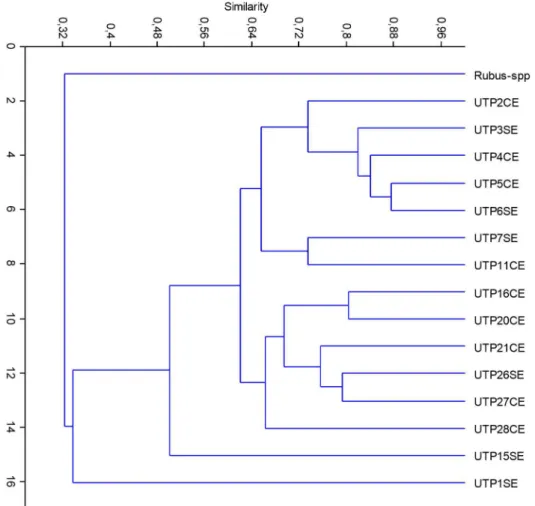
Genetic diversity estimation through Dice index allowed the construction of a dendogram, depicted in Figure 1. Detachment of cultivar UTP1 is explained considering its recognized tolerance to C. gloeosporioides attack in the RNA-Seq analysis. The presence of groups in the distance analysis evidence a geographical tendency, corroborating that the interchange of planting material in Colombia is apparent. The fact of thorn present/absent cultivar clustering contributes to the design of future breeding schemes.
(DOSSETT, et al. 2012) assessed the genetic diversity of cultivated and wild plants of R. occidentalis, a berry from temperate regions from North America and Europe, through the usage of 21 SSR markers aiming to stablish a plant breeding process over a germplasm bank that was thought to possess low diversity levels. This study raised the probability to perform the breeding process with higher levels of Ho in cultivated samples rather than wild ones, similar situation observed in the present study, where Ho in a general trend were higher than He. McCallum et al. (2016) carried out the construction of a ligation map for the auto-tetraploid specie, Vaccinium corymbosum, through SNPs and SSR markers obtained from a Genotyping by Sequencing (GBS) analysis, a technique that combines DNA fragmentation with restriction enzymes and its further sequencing with high performance tools. This work yielded 207 codominant primer pairs. Obtained SSR primers have made genetic characterizations more efficient by covering larger portions of the genome.
Previous works published by (MARULANDA, et al. 2007; 2012), have characterized R. glaucus cultivars transferring SSR markers from other Rubus species to R. glaucus, with positive polymorphic amplification for some markers and no amplification or monomorphic results for others, similarly to this study. With the use of the new SSR markers polymorphic amplification of the samples was achieved.
7
Rev
.
Bras.
Frutic.,
Jaboticabal,
2019,
v.
41,
n.
1:
(e-081)
Evaluation of
SSR
and
SNP
markers in
Rubus glaucus
Benth progenitor selection
Table 4. Primer sequences for employed SNP markers.
Primers Homologous sequences in other Rosaceae species
Sequence
identification Forward Reverse
Genbank accession
number
Reported accession number in other
Rosaceae species Specie
Unigene11151 TATGTGGGGGTGAAGAAAGC ACAGGACCCAATCATCCAAC MH479026 XM_008223370.1 Prunus mume
Unigene11157 CCAAGGAAACTTGCTCCAAC AGCCTTAAACTTGCCAGCAC MH479027 XM_024322668.1 Rosa chinensis
Unigene11255 TGATGGCGCAGATAAGAAGA AGACTCAACAGCGCCAACTT MH479028 XM_024331931.1 Rosa chinensis
Unigene12343 TGGATCCAGATGAGTCCAGA CGGACGTTTTCCCAAATCTA MH479029 XM_021960956.1 Prunus avium
Unigene12924 GGACCAATTCCTTGTGTGCT TGCCGTGACTGTATCCTTGA MH479030 XM_004287281.2 Fragaria vesca subsp. vesca
Unigene13090 GGCTCAGAACTGTGGGGTTA CACATTGTAGGCATCCCAGA MH479031 XM_024300962.1 Rosa chinensis
Unigene1465 TCGTCTGTTTTGGCTCTTGA TACTCCCCTTGCTTGAGTCG MH479032 XM_024340632.1 Rosa chinensis
Unigene14681 ATCAGGAATGGGCTGAGCTA AGCAGCCTTCAAACTCTCCA MH479033 XM_024324523.1 Rosa chinensis
Unigene14822 TACTGGATCGCTCAGCTCCT TGTGTACACCAACCCGAATG MH479034 XM_021968382.1 Prunus avium
Unigene14951 ATGGCAGTACCCAAATCAGC TGGGTAATTGATGGTGGTGA MH479035 XM_008377277.2 Malus x domestica
Unigene15095 TTCCTGCTGATGAATGCAGA GAACCTGTCCTTGGAGCTTG MH479036 XM_021964662.1 Prunus avium
Unigene15115 CCATTCATGGGGTAATTTGC AAGCTTTCCCAATTGCCTCT MH479037 XM_011465001.1 Fragaria vesca subsp. Vesca
Unigene15294 GCCAGGAGTTTGCTGAGTTC ATGGGCAAGTAGCTCTCCAA MH479038 XM_024315181.1 Rosa chinensis
Unigene15456 ACAAGCTTCTGGTGGAAGGA AAGAAGAGCCCCGTCAAACT MH479039 XM_024302866.1 Rosa chinensis
Unigene15499 TGCACCAACAGACCATAAGC ATAATTCCCACAGGCTGTCC MH479040 XM_024307824.1 Rosa chinensis
Unigene15574 CCTGCTGAGGTGGAATCAGT CGATCCAACAAACATGCCTA MH479041 XM_020565943.1 Prunus persica
Unigene16239 AGAGGGAGGATCAAGGAGGA GGGCATTGTATCATGTACGG MH479042 XM_007221893.2 Prunus persica
Unigene16323 AAAGACGGTGGAGAGGAACC TTTATGTAGGAGGCCGCAAG MH479043 XM_024317156.1 Rosa chinensis
Unigene16368 GGTTGCCAAGATCAAAGAGG CCGGTGTGCTTAGTTCCTTG MH479044 XM_024304514.1 Rosa chinensis
Unigene16415 GCGGGTGCAGATAAGAAAAG TTCTTCTTGCGCTCCATAGC MH479045 XM_024307003.1 Rosa chinensis
Unigene16433 AGCAGGAGAGGAAACTCCAA TGGCATAAAGCTCAAGATGC MH479046 XM_021957543.1 Prunus avium
Unigene16551 CTTGTTTCCCCTTCATCCAA TTGCAGCATTTCCCTCTCTT MH479047 XM_024324543.1 Rosa chinensis
Unigene2064 AGTACACGGATGCCTTGCTT GAGGCGCTACAGGGATGTTA
Unigene2247 GTGTCCGGAGATCAAGCAAC CTTTGATAGCCTGCCCAATC MH479048 XM_008234124.2 Prunus mume
Unigene2361 AGCAGTTGCTGCACTTTCAA AACGCCTGTTCACTTTTTGC MH479049 XM_021957567.1 Prunus avium
Unigene2373 TGGCCTCACCAACACTTGTA GAGTCGCCACAGCGATAGAT MH479050 XM_021946702.1 Prunus avium
Unigene242 GGAGAAGAAGCTGCTGGAGA TCGCTCTTGACCCTCTCAAT MH479051 XM_024332998.1 Rosa chinensis
Unigene31842 CTGGCCAGAAGAAGGATTGA TCTCCAAGAAGAATGTTTGAAGG MH479052 XM_004289533.2 Fragaria vesca subsp. Vesca
Unigene33255 TGATGGCTTGAAGCTTTTGA AGCGCTTGAAACAAATTTCC MH479053 XM_024315336.1 Rosa chinensis
8
Rev
. Bras. Frutic., Jaboticabal, 2019, v
. 41, n. 1: (e-081)
A. M. López et al.
Unigene34846 GTCAGGACCTCAGTGCTGCT GGTGGGTGAGTACCAAATATGTC
Unigene34996 ATCAGTGCTGGGGTGAATG CTCCCCTGATGCGATCTTAG MH479054 XM_004295163.2 Fragaria vesca subsp. Vesca
Unigene351 TTGCTGATGACACGAATGGT TTGTTGGCAAATGTCCGATA MH479055 XM_024307531.1 Rosa chinensis
Unigene36231 AAGGGAGATGTGGTGTTGGA TAAAACCAACACCCCCAAGA
Unigene3673 GGGCTGCACCTCTTTGTATC ACATGCTCCCACAAACGAAT
Unigene37334 GTCCACAAGGCTTCCTTCAG GATTCTGTTGCCCTTGCACT
Unigene42870 TAGAGGGCTCGAAGAAGGTG AGGTCCATCTTGCTGGGTAG MH479056 XM_018645776.1 Pyrus x bretschneideri
Table 5.Genetic variability of SSR markers for R. glaucus.
SSR marker Number
of Loci N Na Ne Ho He HWE
CL150.Contig2_All_12_1 2 14,5 5,5 3,6495 1 0,703 ns
CL1916.Contig1_All_167_1 2 15,5 5,5 2,6845 1 0,6275 ***
CL1891.Contig3_All_166_1 2 16 6 3,886 1 0,735 ns
CL1101.Contig1_All_110_1 2 16 4,5 2,34 1 0,6975 ***
CL1366.Contig2_All_134_1 2 15 6 4,3335 1 0,7245 ns
CL1491.Contig11_All_143_1 2 16 8 4,168 0,7815 0,7575 *
CL2455.Contig1_All_192_1 2 14 4,5 3,829 0,9645 0,7375 *
CL2556.Contig1_All_201_1 2 16 6 3,1315 0,844 0,681 *
CL1004.Contig2_All_94_1 1 15 4 2,542 0,733 0,607 *
CL2322.Contig2_All_181_1 2 16 6,5 3,527 0,5665 0,71 **
CL2455.Contig1_All_193_1 2 15,5 6,5 4,063 0,969 0,7315 *
CL3840.Contig1_All_265_1 2 16 5 2,9505 1 0,658 *
CL2364.Contig3_All_186_1 2 15 4,5 3,426 1 0,697 ns
CL274.Contig3_All_22_1 2 16 4 3,2315 0,7815 0,6525 ns
CL2958.Contig1_All_219_1 1 16 4,5 2,906 0,938 0,638 **
All SSR (Average) 15,448 5,448 3,407 0,911 0,685
Standard Deviation 0,127 0,283 0,182 0,035 0,015
1
N: Allele number; Na: Polymorphic allele number; Ne: Informative allele number; Ho: Observed heterozygosity; He: Expected heterozygosity; HWE: Hardy-Weinberg equilibrium (Detection of significant differences through Chi2 test); ns: Non-significant differences, *P<0.05; **P<0.01, ***P<0.001.
9
Rev. Bras. Frutic., Jaboticabal, 2019, v. 41, n. 1: (e-081) Evaluation of SSR and SNP markers inRubus glaucusBenth progenitor selection
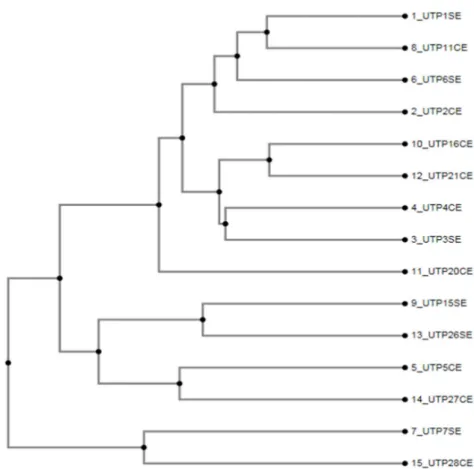
SNP marker analysis - From the 78 evaluated SNP-containing DNA fragments, 36-yielded positive amplification. Obtained amplicon sequences showed high homology with Rosaceae species: Prunus spp. (29%); Fragaria vesca (23%); Pyrus spp. (5%); Malus spp. (2%) (Table 4). Other homologies were established with species of other families (9%) and another corresponded to sequences with non-reported homologies in public data bases (32%). Using sequence alignments (Figure 2), a dendogram was constructed with the clustering method of Figure 3. This dendogram showed 4 clusters with any clustering tendency by morphologic features (thorn presence/absence) nor geographical origin. The first group comprises cultivars UTP1, UTP11, UTP6, UTP2; the second consisted of the UTP16, UTP21, UTP4, UTP3 cultivars; the third clustered UTP15, UTP26, UTP5 and UTP27; and the fourth possessed the most distant cultivars, UTP7 and UTP28. Surprisingly, cultivars with desirables features (UTP1, UTP4 y UTP7) were located
in different groups, an important annotation to guide the progenitor selection in breeding processes. Both SSR and SNP-derived dendograms allowed the progenitor selection with noticeable differences in their genomes.
Sequence homology result were consistent with other Rosaceae species. It is expected that R. glaucus shows high homology within its family to species that have complete or partially sequenced genomes. In addition, is important to state that the development of SNP markers from transcriptome analysis has been widely used in Prunus spp. (Rosaceae) to evaluate segregant populations of pears in Europe. The employment of SNP markers in the evaluation of germplasm banks of peaches and the construction of microarrays from transcriptome analysis-derived SNPs in apples, have been also reported. Based in that evidence, the development of such methodologies have improve the selection processes in breeding programs (YAMAMOTO AND TERAKAMI, 2016).
10
Rev. Bras. Frutic., Jaboticabal, 2019, v. 41, n. 1: (e-081) A. M. López et al.
Genetic diversity parameters for haplotypical data are presented in Table 6. It was found 1162 SNP-containing fragments, corresponding to 1082 effective SNPs and a polymorphism of 12,49%. In regards to the specific nature of each SNP and SSR marker, biallelic nature of SNP markers makes their discrimination power lower than SSR. In that sense, the greater variability observed
in SSR compared to SNPs allows better possibilities in the identification of cultivars and its genetic variability assessment (SÁNCHEZ-PÉREZ, et al. 2006), making them leading markers for genotyping, fine mapping or to increasing QTL resolution.
Figure 2.Segment of the sequence alignment with UNIGENE37334 with Clustal Omega software (EMBL–EBI), online version (https://www.ebi.ac.uk/Tools/msa/clustalo/).
11
Rev. Bras. Frutic., Jaboticabal, 2019, v. 41, n. 1: (e-081) Evaluation of SSR and SNP markers inRubus glaucusBenth progenitor selection
Table 6.Genetic diversity parameters for haplotypical data obtained with SNP markers in R. glaucus.
Parameter Average value Standard deviation
Number of SNP-containing regions 1162 0.005
Number of SNP-containing effective regions 1082 0.003
Percentage of polymorphic SNPs 12.49%
---Progenitor selection - Genetic diversity analysis between previously selected cultivars are used to recommend progenitors susceptible to be used in future breeding processes (Table 7). In order to make those recommendations, the morphologic features related to thorn presence/absence and C. gloeosporioides tolerance (very desirable features in new cultivars) were also considered; in that sense, tolerant or moderately tolerant
(HE, et al. 2014), states that plant breeding can be performed through two main strategies, classic and molecular approaches. The classic process employs closely related varieties that could interbreed, whilst the molecular breeding consist in the application of molecular biology and biotechnology approaches to accomplish the development of new cultivars through the Marker-assisted Selection (MAS) and the genetic transformation (MOOSE AND MUMM, 2008). This work employed SSR and SNP markers in the development of a progenitor population aiming to move towards hybridization processes that permit an increase in the genetic gain.
Conclusions
This work evidence the utility of molecular markers to assess the genetic diversity of possible progenitors susceptible to be employed in future breeding processes. This aspect, widely known as the development of a parental population, determines in great manner the
without thorn material was privileged. Respect to cluster analysis, there were selected samples from different clustering groups. Moreover, cultivars UTP5, UTP20 and UTP28 possess, according to producers, fruits with greater size, making them very popular in Colombia, despite its thorn presence and significant susceptibility to C. gloeosporioides.
Table 7. Progenitor selection for future breeding schemes.
Selected cultivar Thorn presence/ absence Response against
C. gloeosporioides attack
Cluster number with SNPs
Cluster number with SSR
UTP1 Absence (SE) Tolerant 1 4
UTP5 Presence (CE) Very susceptible 3 1
UTP7 Absence (SE) Moderately tolerant 4 2
UTP11 Absence (SE) Moderately tolerant 1 2
UTP20 Presence (CE) Very susceptible 2 3
UTP28 Presence (CE) Very susceptible 4 3
success of breeding schemes. The SSR and SNP markers employed in this study, allowed the characterization of such population studying different genome regions. Morphological and fungal tolerance selection criteria, previously evaluated, were also considered in the selection of six progenitors.
Acknowledgements
Authors express their thanks to Universidad Tecnológica de Pereira (Colombia) and the General System of Royalties (National Planning Department) for financing the research program “Development of scientific and technologies in biotechnology applied to the sectors of health and agro-industry in the department of Risaralda “ identified with BPIN code 2012000100050.
12
Rev. Bras. Frutic., Jaboticabal, 2019, v. 41, n. 1: (e-081) A. M. López et al.
References
ALICE, L.A.; ERIKSSON, T.; ERIKSEN, B.; CAMPBELL, C.S. Intersubgeneric hybridization between a diploid raspberry, Rubus idaeus, and a tetraploid blackberry, R. caesius (Rosaceae). American Journal of Botany, New York, v.84, p.171, 1997.
BERTRAND, C.; COLLARD, Y.; MACKILL, D. J. Marker-assisted selection: an approach for precision plant breeding in the twenty - firs century. Philosophical Transactions of the Royal Society of London Series B, Biological Sciences, New York, v.363, p.557-572, 2008.
CLARK, L.V.; EVANS, K.J.; JASIENIUK, M. Origins and distribution of invasive Rubus fruticosus L. agg. (Rosaceae) clones in the Western United States. Biological Invasions, Berlin, v.15, n.6, p.1331-1342, 2013.
DELGADO, L.; URIBE, M.; MARULANDA, M. L. Estandarización de la técnica citogenética “SQUASH”. Scientia Et Technica, Pereira, v.17,n.46, p.74-79,2010.
DOSSETT, M.; BASSIL, N. V.; LEWERS, K.S.; FINN, C. E. Genetic diversity in wild and cultivated black raspberry (Rubus occidentalis L.) evaluated by simple sequence repeat markers. Genetic Resources and Crop Evolution, Dordrecht, v.59, n.8, p. 1849-1865, 2012.
DUARTE-DELGADO, D.; CHACÓN M. I.; NÚÑEZ, V.; BARRERO, L. S. Preliminary assessment of AFLP fingerprinting of Rubus glaucus Benth. elite genotypes. Agronomia Colombiana, Bogotá, v.29, n.1, p.7-16, 2011.
FAN, L.; ZHANG, M.Y.; LIU, Q.Z.; LI, L.T.; SONG, Y.; WANG, L.F.; ZHANG, S.L.; WU, J. Transferability of newly developed pear SSR markers to other Rosaceae species. Plant Molecular Biology Reporter, Dordrecht, v.31, n.6, p.1271-1282, 2013.
FU, P. C.; ZHANG, Y. Z.; YA, H. Y.; GAO, Q. B. Characterization of SSR genomic abundance and identification of SSR markers for population genetics in Chinese jujube (Ziziphus jujuba Mill.). Peer J, United State, v.4, p.1735, 2016.
GRAHAM, J. AND MCNICOL R.J. An examination of the ability of RAPD markers to determine the relationships within and between Rubus species. Theoretical and Applied Genetics, Berlin, v.90, p.7/8, p.1128-1132, 1995.
GRAHAM, J.; SMITH, K.; MACKENZIE, K.; JORGENSON, L.; HACKETT, C.; POWELL, W. The construction of a genetic linkage map of red raspberry (Rubus idaeus subsp. idaeus) based on AFLPs, genomic-SSR and EST-genomic-SSR markers. Theoretical and Applied Genetics, Berlin, v.9, n.4, p.740-749, 2004.
GRAHAM, J.; SQUIRE, G. R.; MARSHALL, B.; HARRISON, R.E. Investigation of rubus breeding anomalies and taxonomy using RAPD analysis. Molecular Ecology, London, v.6, n.11, p.1001-1008, 1997.
HAMMER, Ø.; HARPER, D. A. T.; RYAN, P. D. PAST-Palaeontological statistics. 2001. Disponível em: <www. uv. es/~ pardomv/pe/2001_1/past/pastprog/past. Pdf>. Acesso em: 25 jul. 2001.
HE, J.; ZHAO, X.; LAROCHE, A.; LU, Z. X.; LIU, H.; LI, Z. Genotyping-by-sequencing (GBS), an ultimate marker-assisted selection (MAS) tool to accelerate plant breeding. Frontiers in Plant Science, Lausane, v.5, p.484, 2014.
JENNINGS, D. L. Raspberries and blackberries: their breeding, diseases and growth. London: Academic Press,1988. p.230.
JENNINGS, D. L. Resistance to Leptosphaeria coniothyrium in the red raspberry and some related species. Annals of Applied Biology, London, v.93, n.3, p.319-326, 1979.
JUKES, T. H. AND CANTOR, C. R. Evolution of protein molecules. Mammalian protein Metabolism, New York, v.3, p.21-132, 1969.
KRAFT, T.; NYBOM, H.; WERLEMARK, G. Rubus vestervicensis (Rosaceae)—its hybrid origin revealed by DNA fingerprinting. Nordic Journal of Botany, Oxford, v.15, n.3, p.237-242. 1995.
LANGMEAD, B.; SALZBERG, S. L. Fast gapped-read alignment with Bowtie 2. Nature Methods, New York, v.9. n.4, p.357-359, 2012.
LI, H.; DURBIN, R. Fast and accurate short read alignment with Burrows–Wheeler transform. Bioinformatics, New York, v.25, n.14, p.1754-1760, 2009.
13
Rev. Bras. Frutic., Jaboticabal, 2019, v. 41, n. 1: (e-081) Evaluation of SSR and SNP markers inRubus glaucusBenth progenitor selection
LONGHI, S.; GIONGO, L.; BUTI, M.; SURBANOVSKI, N.; VIOLA, R.; VELASCO, R.; & SARGENT, D. Molecular genetics and genomics of the Rosoideae: state of the art and future perspectives. Horticulture Research, London, v.1, p.1-18, 2014.
LÓPEZ-VÁSQUEZ, J.; CASTAÑO-ZAPATA, J.; MARULANDA, M.; LÓPEZ, A. Characterization of Anthracnose resistance caused by Glomerella cingulata and productivity of five Andean blackberry genotypes (Rubus glaucus Benth.). Acta Agronómica, Palmira, v.62, n.2, p.174-185, 2013.
M A R U L A N D A , M . L . ; A N D L Ó P E Z , A . M . Characterization of thornless Rubus glaucus in Colombia. Canadian Journal of Pure & Applied Sciences, Burnaby, v.3. n.3, p.875-885, 2009.
MARULANDA, M.L.; LÓPEZ, A.M.; AGUILAR, S.B. Genetic diversity of wild and cultivated Rubus species in Colombia using AFLP and SSR markers. Crop Breeding and Applied Biotechnology, Londrina, v.7, n.3, p.242-252, 2007.
MARULANDA, M.L.; LÓPEZ, A.M.; URIBE, M. Molecular characterization of the Andean blackberry, Rubus glaucus, using SSR markers. Genetics Molecular Research, Ribeirão Preto, v.11, p.322-331, 2012.
MCCALLUM, S.; GRAHAM, J.; JORGENSEN, L.; ROWLAND, L.J.; BASSIL, N.V.; HANCOCK, J.F.; WHEELER, E.J.; VINING, K.; POLAND, J.A.; OLMSTEAD, J.W.; BUCK, E.; WIEDOW, C.; JACKSON E.; BROWN, A.; HACKETT, C.A. Construction of a SNP and SSR linkage map in autotetraploid blueberry using genotyping by sequencing. Molecular Breeding, Dordrecht, v.36, p.1-24, 2016.
MOOSE, S.P.; MUMM, R.H. Molecular plant breeding as the foundation for 21 century crop improvement. Plant Physiology, Lancaster, v.147, p.969–977, 2008.
MORALES, Y. M.; MARULANDA, M. L.; ISAZA, L. Caracterización morfológica y patogénica de aislamientos del género Colletotrichum spp. causantes de la antracnosis en mora de castilla (Rubus glaucus
Benth.) provenientes de los departamentos de Caldas, Quindío y Risaralda (Colombia). 2010. 53 f. Thesis (Doctor) - Facultad de Ciencias Básicas y Tecnologías, Universidad del Quindío, Quindio, 2010.
NARUHASHI, N. Rubus× semi-nepalensis, a new natural hybrid from Nepal Himalaya . Journal of Japanese Botany, Tokyo, v.65, n.6, p.186-191, 1990.
PEAKALL, R. O. D.; SMOUSE, P. E. GENALEX 6: genetic analysis in Excel. Population genetic software for teaching and research. Molecular Ecology Resources, Oxford, v.6, n.1, p.288-295, 2006.
SALAZAR, J. A.; RUBIO, M.; RUÍZ, D.; TARTARINI, S.; MARTÍNEZ-GÓMEZ, P.; DONDINI, L. SNP development for genetic diversity analysis in apricot. Tree Genetics & Genomes, Heidelberg, v.11, p.15, 2015.
SALDARRIAGA-CARDONA, A.; CASTAÑO-ZAPATA, J.; ARANGO-ISAZA, R. Caracterización del agente causante de la antracnosis en tomate de árbol, manzano y mora. Revista de la Academia Colombiana de Ciencias Exactas, Físicas y Naturales, Bogotá, v.32, n.123, p.145-156, 2008.
SÁNCHEZ-PÉREZ, R.; MARTÍNEZ-GÓMEZ, P.; DICENTA, F.; EGEA, J.; RUIZ, D. Level and transmission of genetic heterozygosity in apricot (Prunus armeniaca L.) explored using simple sequence repeat markers. Genetic Resources and Crop Evolution, Dordrecht, v.53, n.4, p.763 - 770, 2006.
SCHULZE-MENZ, G. K. Rosaceae. In: MELCHIOR, H. Engler’s syllabus der pflanzenfamilien. Berlin: Gerbruder Borntraeger, 1964. p.209–218.
THOMPSON, M. M. Chromosome numbers of Rubus
species at the national clonal germplasm repository. HortScience, Alexandria, v.30, n.7, p.1447-1452, 1995.
THOMPSON, M. M. Survey of Chromosome Numbers in Rubus (Rosaceae: Rosoideae). Annals of the Missouri Botanical Garden, St Louis, v.84, p.128, 1997.
V U K O S AV L J E V, M . ; E S S E L I N K , G . D . ; VAN’TWESTENDE, W.P.; COX, P.; VISSER, R.G.; ARENS, P.; SMULDERS, M.J. Efficient development of highly polymorphic microsatellite markers based on polymorphic repeats in transcriptome sequences of multiple individuals. Molecular Ecology Resources, Oxford, v.15, n.1, p.17-27, 2015.
WAUGH, R.; VAN DE VEN, W.T.G.; PHILLIPS, M.S.; POWELL, W. Chloroplast DNA diversity in the genus Rubus (Rosaceae) revealed by Southern hybridization. Plant Systematics and Evolution, Wien, v.172, n.1/44, p.65-75, 1990.
14
Rev. Bras. Frutic., Jaboticabal, 2019, v. 41, n. 1: (e-081) A. M. López et al.
YAMAMOTO, T.; TERAKAMI, S. Genomics of pear and other Rosaceae fruit trees. Breeding Science, Tolyo, v.66, n.1, p.148-159, 2016.