Article
0103 - 5053 $6.00+0.00*e-mail: [email protected]
Chemo-Enzymatic Epoxidation of Sunlower Oil Methyl Esters
Rosana de Cassia S. Schneider,*,a Luciano R. S. Lara,a Thiago B. Bitencourt,b
Maria da Graça Nascimentob and Marta R. dos Santos Nunesc
aDepartamento de Química e Física, Universidade de Santa Cruz do Sul, 96815-900 Santa Cruz do Sul-RS, Brazil
bDepartamento de Química, Universidade Federal de Santa Catarina, 88040-900 Florianópolis-SC, Brazil
cCentro de Ciências Exatas e Tecnologia, Universidade de Caxias do Sul, 95070-560 Caxias do Sul-RS, Brazil
Foi realizada a epoxidação quimio-enzimática de ésteres metílicos do óleo de girassol, utilizando lipase em meio aquoso, na presença ou não de acil doadores. As reações no sistema bifásico (CH2Cl2/H2O) foram conduzidas utilizando-se a Candida antarctica lipase B (CALB,
1000 u g-1) e peróxido de hidrogênio a 30% (v/v). A conversão foi maior do que 99% em 16 h de
reação. Os melhores resultados foram obtidos com o sistema bifásico, em tempo reacional de 16 h, a 30 °C, 10 mmol de ácido octanóico em relação a 1 g de óleo, 6 mL de diclorometano e 5 mL de água, garantindo uma alta conversão dos ésteres e maior tempo de uso da lipase.
The chemo-enzymatic epoxidation of the methyl esters of sunlower oil with lipase from Candida antarctica B and aqueous H2O2 in the presence and absence of an acyl donor was investigated.The biphasic system (CH2Cl2/H2O) comprised Candida antarcticaB lipase (CALB,
1000 u g-1) and 30% (v/v)aqueous hydrogen peroxide. In some cases the conversion was higher than
99%. The best results were obtained for the biphasic system after 16 h of reaction, at 30 °C, using 10 mmol of octanoic acid in relation to 1 g of the oil, 6 mL of dichlomethane and 5 mL of water.
Keywords: Candida antarctica B lipase, chemo-enzymatic epoxidation, sunlower oil, methyl
esters, bioprocessing
Introduction
The environmental problems caused by the indiscriminate use and scarcity of petroleum are prompting researches to search for renewable resources, such as
derivatives of vegetable oils.1-3
The use of renewable resources and biocatalysts is
better for the environment.4 Biocatalysts, especially lipases
(triacylglycerol acylhydrolase EC 3.1.1.3), are widely used in synthetic organic chemistry. They are readily available from microbial and mammalian sources, and some of them are extremely robust and stable under relatively extreme
temperature, pH, and solvent conditions.5,6
The potential of lipases in the oleochemistry industry
has been explored recently.6,7-10 Lipases are capable of
hydrolyzing triacylglycerols, producing free fatty acids, which, in the presence of hydrogen peroxide, form the corresponding peracids. These peracids can be used to form
oxirane rings in the double bonds of hydrocarbon chains
of fatty acids.11,12
In industry, epoxidation using the Prileshajev method has previously been applied to the conversion of double bonds into the corresponding oxirane rings of vegetable
oils using classical acid catalysts.13
In 1990, Björkling et al.14 published the irst results
related to chemo-enzymatic epoxidation. Later, progress was made towards reducing the limitations of industrial scale syntheses by making the procedure a more environmentally acceptable alternative for vegetable oil
transformations.15-18
Epoxides are of great industrial interest because they are intermediate compounds for the production of polymers, adhesives, resins, and other materials. This versatility is associated with the high reactivity of the oxirane ring. Speciically, fatty epoxides are used directly as plasticizers and plastic stabilizers or appear as reaction intermediates. They are also useful intermediates in the synthesis of other
products, are applicable to various syntheses with high added value.
When using this biocatalyst, it is important to prevent lipase denaturation in the presence of organic solvents,
hydrogen peroxide, or the formed peracid.16,21,22
In biocatalyzed reactions, enzymatic activity may also be lost due to elevated concentrations of hydrogen peroxide or to temperature effects. However, some recent papers have
shown that Candida antarctida B lipase remained stable
above 50 °C, although this was not favorable, mainly due to the decomposition of hydrogen peroxide. Furthermore, at higher temperatures, the enzyme acquires a more open conformation, possibly increasing the accessibility to sensitive amino acids in the inner regions of the enzyme,
and thus decreasing its catalytic activity.16
An alternative method for the reduction of lipase denaturation is the use of a biphasic system (water/organic solvent), because the enzyme remains protected in the aqueous phase.
In this paper, the chemo-enzymatic production of epoxides derived from methyl esters of sunflower oil (Helianthus annus L.) with lipase from C. antarctica B and
aqueous H2O2 (30%) in the presence and absence of an acyl
donor (caprylic acid)is presented (Figure 1).
The use of a biphasic system (CH2Cl2/H2O) is also
compared with the monophasic system (CH2Cl2).
Experimental
Material and methods
The reined sunlower oil (Valore, Brazil) contained oleic (C18:1) 27%, stearic (C18:0) 6%, palmitic (C16:0) 9%, linoleic (C18:2) 57%, and linolenic acids (C18:3)
0.3%. Boron triluoride-methanol (BF3·MeOH, 14% m/V)
was purchased from Acros Organics (Fairlawn, NJ), and hexane, ethyl acetate, dichloromethane, and deuterated chloroform (99.8% pure) were purchased from Merck (Hohenbrunn, Germany). These were used as received. All solvents were of analytical reagent grade and used without any pretreatment. The methyl ester standards (all above 99% purity) used for gas chromatography (GC) analysis were palmitic (hexadecanoic acid), stearic
(octadecanoic acid), oleic (cis-9-octadecenoic acid), and
linoleic acids (cis-9,cis-12-octadecadienoic acid) from
Supelco, Bellefonte, PA, USA. Lipase from C. antarctica B,
supported in acrylic resin macrospores (CAL-B; Novozym
435® 10,000 PLU/g), was donated by Novozymes. Silica
gel (70-230 mesh) from Vetec (RJ, Brazil) was used as the adsorbent.
Gas chromatography (GC)
For the GC analysis, the samples were diluted in dichloromethane (Vetec, 99.5% pure) and the instrument used was a Varian GC model 3300 (Kyoto, Japan) itted with a lame ionization detector (FID). The column used was a ZB-5 polydimethyl siloxane fused silica open tubular column with 5% phenyl groups (30 m × 0.53 mm × 1.5 µm). The initial temperature was 80 °C (0.2 min), increasing by
8 °C min-1 to 140 °C (2 min), followed by an 8 °C min-1
increase to 270 °C, which was then maintained for 2 min. The injector was heated to 250 °C, and the detector was set at 280 °C.
Nuclear magnetic resonance (NMR)
The 13C and 1H NMR spectra were recorded on an
AC Bruker spectrometer operating at 400 MHz at room
temperature using CDCl3 as the solvent. All chemical shifts
quoted were relative to tetramethylsilane using the positive downield technique. For the determination of the degree of conversion, the relative area of the hydrogen atoms of the initial double bonds in the methyl esters were compared to those of the oxirane rings.
Procedures
Methanolysis
The sunlower oil was converted into the methyl esters
by heating with BF3·MeOH modiied as recommended by
the AOCS Ce 1c-89 standard methodology.23 The reaction
was carried out with 100 g of sunlower oil and 100 mL of 2% NaOH methanolic solution. The reaction mixture was kept at 70 ºC for 20 min under relux and with vigorous
stirring. After saponiication, 22 mL of BF3-methanol was
added, and the mixture was kept at 70 ºC for a further 10 min. The methyl esters produced were extracted with
100 mL of heptane and dried over anhydrous Na2SO4. The
solvent was then evaporated. The methyl esters derived from oleic acid and linoleic acids were used as reference standards in the GC analysis.
General procedure for chemo-enzymatic epoxidation
Sunlower oil methyl esters (SOME) (1 g), octanoic acid
(10 mmol), lipase from C. antarctica B - CAL-B (100 mg),
and aqueous hydrogen peroxide (1 mL, 30%) were used in each chemo-enzymatic epoxidation reaction with vigorous stirring for 1-24 h at 30 °C in a round-bottomed lask equipped with a relux condenser and a thermometer. Other experimental conditions are showed in Table 1.
After reluxing, the lipase was separated by iltration. CAL-B was reused 10 times in successive experiments at 24 h intervals. Methyl oleate and methyl linoleate were epoxidized using the same procedures.
The degrees of conversion were monitored via the
iodine index (II) determination (AOCS Cd 1d-92), gas chromatography (GC), thin layer chromatography (TLC),
hydrogen nuclear magnetic resonance (1H NMR), and
carbon nuclear magnetic resonance (13C NMR).
Puriication of the reaction products was carried out using adsorption column chromatography (50 cm × 2.5 cm i.d.). Silica gel (70-230 mesh) was used as the stationary phase,
and n-hexane and ethyl acetate in 100:0, 90:10, 85:15,
83:17, and 80:20 v/v compositions were used as the eluents.
Results and Discussion
Epoxides derived from methyl esters of sunlower oil
were obtained using lipase from Candida antarctica B
(CALB) and aqueous H2O2 (30%), in the presence or absence
of an acyl donor (caprylic acid). Two different systems,
biphasic (CH2Cl2/H2O) and monophasic (CH2Cl2), were
applied and compared. The ratios of sunlower oil methyl esters to the corresponding formed epoxides were determined by gas chromatography (GC). The formed products were the same using the mono- and biphasic systems.
At the end of each reaction, the products were separated using column chromatography, and the degree of
conversion was calculated through 1H NMR spectroscopy.
Two isolated fractions were identiied as being the mono- and di- epoxystearates (Figures 2A and 2B, respectively). The degrees of conversion obtained for the isolated monoepoxystearate and diepoxystearate were > 90 and > 99%, respectively. The monoepoxystearate showed a signal at 2.90 ppm, corresponding to the hydrogen of the oxirane ring corresponding to C9 and C10 (Figure 2A). The diepoxystearate showed an additional peak at 3.10 ppm (Figure 2B).
The isolated diepoxystearate 13C NMR spectra showed
a peak at 34.50 ppm, which was assigned to the methylenic carbon between the two oxirane rings (C11 in Figure 2B), in addition to peaks at 54 and 56.8 ppm, which correspond to the methinic carbons of the oxirane rings (C9, C10 and C12, C-13 in Figure 2B).
Table 1. Experimental conditionsa for the chemo-enzymatic epoxidation of sunlower oil methyl esters
Entry CH2Cl2 / mL H2O / mL Caprylic acid / mmol
1 6 5 10
2 6 5
-3 6 - 10
aSunlower oil methyl ester (1g), CAL-B (100 mg), H
2O2 (1 mL, 30%),
1-24 h at 30 °C.
Figure 2. Structures assigned by 1H NMR and 13C NMR to the puriied
Comparison between mono and biphasic system
The experiments involving the mono- and biphasic
systems were carried out using CH2Cl2 (6 mL) since the
epoxy compounds formed are soluble in this solvent and can be easily recovered.
The monophasic (CH2Cl2) and biphasic (CH2Cl2/H2O)
systems were compared, and the addition of caprylic acid for the production of peracid, an epoxidation precursor, was also investigated. It is well documented in epoxidation that preparation of peroxyacids from vegetable oils is very
feasible under mild conditions.18
Using classical epoxidation by chemical methods, the oxirane ring may open as a consequence of the strong acid used to catalyze the peracid formation, resulting in unsatisfactory consequences, including the formation of
diols as byproducts.18
In the chemo-enzymatic epoxidation of the SOME, no secondary reactions were observed, and the products showed high oxirane oxygen contents. Thus, the reaction selectivity was higher than 99% in all reactions, with partial or total conversion of the unsaturated bond into the corresponding epoxides.
1H NMR spectra obtained after using the monophasic
system revealed the total conversion (> 99%) to the
epoxidized products. Using the biphasic system total
conversion was achieved after 16 h and with the addition of caprylic acid the total reaction time was the same. The reaction time was shorter using the monophasic system
(Figure 3). Similar results were observed by Törnvall et
al.16 during the chemo-enzymatic epoxidation of fatty acids.
Studies on the inluence of the acyl donor in the in
situ peracid formation indicated that the use of fatty
linear carboxylic acids favors the conversion into the
corresponding epoxides.17,22
It has been described that CAL-B efficiently hydrolyzes triacylglycerols because it produces free fatty acids that form peracids in the presence of hydrogen
peroxide, which then epoxidize the unsaturated bonds.24
The reactivity and concentration of the peracid may also
be responsible for lipase denaturation.25 With the use of the
biphasic system, the peracid formed in situ was dissolved
in water, reducing lipase denaturation.16 The advantage of
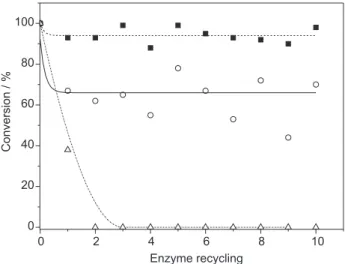
using the biphasic system (water/organic solvent) over the monophasic system (organic solvent) is the possibility to reuse the biocatalyst. The results obtained in this study are given in Figure 4.
Using the monophasic system, the enzymatic activity was completely absence after the second reuse. However, using the biphasic system and with the addition of caprylic acid in the reaction, the lipase was reused at least ten times without losing its activity and the epoxides were formed in high yields (90-99%). Similar results were achieved by Du et al.1 where the lipase was reused 100 times in the
enzymatic transesteriication of soybean oil with ethyl acetate, with a 92% conversion into the product. Another important result obtained here was the non-cleavage of the oxirane rings, which may occur in the chemical epoxidation
of some oils and esters.26,27 In the 1H and 13C NMR spectra,
there was no signal corresponding to the hydrogen or carbon atoms of the hydroxyl groups.
The proposed mechanism for the oxidation of the SOME using the biphasic and monophasic systems with caprylic acid as the acyl donor is shown in Figure 1.
Figure 3. Degree conversion of the chemo-enzymatic epoxidation of SOME with Candida antarctica B lipase using biphasic system (), monophasic system with caprylic acid () and biphasic system with caprylic acid ().
Conclusions
In this study, peracids were obtained by perhydrolysis of methyl esters derived from sunlower oil under mild
conditions catalyzed by Candida antarctica Blipase.
The results showed that chemo-enzymatic methods are extremely eficient in the synthesis of epoxides from unsaturated methyl esters. The products obtained were fully characterized and quantiied. High degrees of conversion and selectivity were achieved under the applied conditions using the mono- and diepoxystearates. These results are important for the chemical industry and present the possibility for the production of oil derivatives through a cleaner technology, using lipase as the catalyst and with a reduction in the use of undesirable chemical reagents.
The use of biphasic and monophasic systems leads to a high degree of conversion to the epoxides, as well as the possibility to reuse the system at least ten times. The presence of caprylic acid as a peracid precursor is of crucial importance in obtaining the products in high yields (> 99%).
In summary, the epoxidation of methyl esters derived from sunlower oil was successfully achieved under mild conditions.
Acknowledgments
This work was supported by the Universidade de Santa Cruz do Sul (UNISC, Brazil), Universidade Federal de Santa Catarina (UFSC, Brazil), Fundo de Apoio a Pesquisa (FAP, UNISC), Financiadora de Estudos e Projetos (FINEP), Conselho Nacional de Desenvolvimento Cientíico e Tecnológico (CNPq) and Fundação de Amparo a Pesquisa do Estado do Rio Grande do Sul (FAPERGS). T. B. B, M. G. N. and L. R. S. L. would like to thank CNPq for their scholarships and we are also grateful to Novozymes for generously donating the lipase.
References
1. Du, W.; Xu, Y.;Liu, D.; Zeng, J.; J. Mol. Catal. 2004, 30, 125. 2. Martinelli,M; Schneider, R. C. S.; Baldissarelli, V. Z; Trombeta,
F.; Caramão, E. B.; J. Chromatogr., A2003, 985, 313. 3. Martinelli,M.; Schneider, R. C. S.; Baldissarelli, V. Z.;
Holleben, M. L.; Caramão, E. B.; J. Am. Oil Chem. Soc. 2005,
4, 82.
4. Shmid, A.; Dordick, J. S.; Hauer, B. K.; Kiener, A.; Wubbolts, M.; Witholt, B.; Nature 2001, 409, 258.
5. Haki, G. D.; Rakshit, S. K.; Bioresour.Technol. 2003, 89, 17. 6. Hasan, F.; Shah, A. A.; Hameed, A. I.; Enzyme Microb. Technol.
2006, 39, 235.
7. Gandhi, N. N.; J. Am. Oil Chem. Soc. 1997, 74, 621. 8. Kiatsimkul, P.; Sutterlin, W. R.; Suppes, G. J.; J. Mol. Catal.
B: Enzym. 2006, 41, 55.
9. Suarez, P. A. Z.; Plentz-Meneghrtti, S. M. P.; Meneghetti, M. R.; Wolf, C. R.; Quim. Nova2007, 30,667.
10. Isbilir. S. S.; Ozcan, H. M.; Yagar, H.; J. Am. Oil Chem. Soc. 2008, 85, 227.
11. Rusch gen Klaas, M.; Warwel, S.; J. Am. Oil Chem. Soc.1995,
73, 1453.
12. Björkling, F.; Frykaman, H.; Godtfredsen, S. E.; Kirk, O.;
Tetrahedron 1992, 48, 4587.
13. Slayden, S. W.; Liebman, J. F.; Sawaky, Y.; The Hydroxyl, Ether and Peroxide Groups, Patai, S., ed.; Wiley: Chichester, 1993. 14. Björkling, F.; Godtfredsen, S. E.; Kirk, O.; J. Chem. Soc.Chem.
Commun. 1990, 1301.
15. Rusch gen Klaas, M.; Warwel, S.; J. Mol. Catal. A: Chemical. 1997, 117, 311.
16. Törnvall, U.; Ornellana-Coca, C.; Hatti-Kaul, R.; Albercreutz, D.; Enzyme Microb. Technol. 2007, 40, 447.
17. Rusch gen Klaas, M.; Warwel, S.; Ind. Crop Prod. 1999, 9, 125. 18. Carboni-Oerlemans, C.; Maria, P. D.; Tuin, B.; Bargeman, G.;
Meer, A.; Gemert, R.; J. Biotechnol. 2006, 126, 140. 19. Piazza, G. J.; Nuñez, A.; Foglia, T. A.; J. Mol. Catal. B: Enzym.
2003, 21, 143.
20. Rios, L. A.; Weckes, H. S.; Schuster, H.; Hoelderich, W. F.;
Appl.Catal. A: Gen.2005, 284, 1-2, 155.
21. Borzani, W.; Biotecnologia Industrial. Fundamentos, 1ª. Ed, Edgard Blucher: São Paulo, Brasil, 2001, 151-171, v.1. 22. Moreira, M. A.; Bitencourt, T. B.; Nascimento, M. G.; Synth.
Commun. 2005, 35, 2107.
23. Oficial Methods and Recommended Practices of the AOCS; 15th ed., Ce 1c-89, Champaign, 1997.
24. Warwel, S.; J. Am. Oil Chem. Soc. 1996, 73, 1453. 25. Yadav, G. D.; Devi, K. M.; Biochem. Eng. J. 2002, 10, 93. 26. Goud, V. V.; Patwardhan, A. V.; Pradhan, N. C.; Bioresour.
Technol.2006, 97, 1365.
27. Okieimen, F. E.; Bakare, O. I.; Okieimen, C. O.; Ind. Crop. Prod.2002, 15, 139.
Received: January 29, 2009