Ar
ti
cl
e
J. Braz. Chem. Soc., Vol. 20, No. 8, 1478-1482, 2009. Printed in Brazil - ©2009 Sociedade Brasileira de Química 0103 - 5053 $6.00+0.00
*e-mail: [email protected]
Synthesis of
α
- and
β
-Lapachone Derivatives from Hetero Diels-Alder Trapping
of Alkyl and Aryl
o
-Quinone Methides
Fernando de C. da Silva,a,b Sabrina B. Ferreira,a,b Carlos R. Kaiser,b Angelo C. Pintob
andVitor F. Ferreira*,a
aDepartamento de Química Orgânica, Instituto de Química CEG, Universidade Federal Fluminense,
Campus do Valonguinho, 24020-150 Niterói-RJ, Brazil
bInstituto de Química, Universidade Federal do Rio de Janeiro, Centro de Tecnologia, Bloco A,
Cidade Universitária, 21949-900 Rio de Janeiro-RJ, Brazil
Foram sintetizados, em um único pote reacional, alguns derivados da α- e β-lapachonas a partir de reação de hetero Diels-Alder, em etanol aquoso, entre estirenos substituídos (como dienóilos) e o-quinonas metídeos (o-QMs) metilênicas e arílicas geradas por condensação de Knoevenagel da 2-hidróxi-1,4-naftoquinona com formaldeído e aldeídos aromáticos.
Methylene and aryl o-quinone methides (o-QMs) generated by Knoevenagel condensation of 2-hydroxy-1,4-naphthoquinone with formaldehyde and arylaldehydes, undergo facile hetero Diels-Alder reaction with some substituted styrenes (as dienophiles) in aqueous ethanol media providing derivatives of α- and β-lapachone.
Keywords: o-Quinone methides, Knoevenagel condensation, Hetero Diels-Alder, Lapachones
Introduction
Quinones have been extensively studied for antitumoral,1
molluscicidal,2 parasiticidal,3 leishmanicidal,4
anti-inlammatory,5 fungicidal,6 antimicrobial7 and trypanocidal8
activities. Reports point out that the biological proiles of these molecules are centralized on their ortho or para -quinonoid moiety that generally accepts one and/or two electrons (redox cycling) to form the corresponding radical anion or dianion species in situ.9 Thus, the semi-quinone
radicals accelerate intracellular hypoxic conditions by producing superoxide anion.10,11 Due to this mechanism,
quinones may present cytotoxicity to mammalian cells, possibly by affecting enzymes such as topoisomerases, a group of enzymes that are critical for DNA replication in cells.12
The data described in the literature so far clearly show that the naphthoquinone frameworks have important signiicance for the development of new substances with promising biological activities.13,14 Therefore, new synthetic
methodologies that could lead to the preparation of these compounds are very important.15
o-Quinone methides (o-QMs) are useful reactive intermediates in organic synthesis (Scheme 1)16 and
involved in a large number of chemical reactions and biological processes, such as enzyme inhibition, reaction with phosphodiester, DNA alkylation and cross-linking.17
Since o-QMs are usually unstable intermediates, they must be generated in situ by processes that can involve photolysis of o-, m- and p-hydroxybenzyl alcohols18,
thermal reactions19,20, and anionic triggering reactions.21
However, some o-QMs may be suficiently stable and can be isolated, depending on their structural arrangement.22
Dalgliesh was the irst one to suggest that an o-QM was a possible intermediate in an organic reaction.23 However,
the irst example of generation and use of an o-QM in intramolecular hetero Diels-Alder reaction was reported by Brougidou and Christol.24,25 Following this discovery
many studies demonstrated that these hetero-diene moieties are suitable for [4 + 2] cycloadditions with a wide range of dienophiles.
Our group became interested in the chemistry of these intermediates in 198226 when we reported a novel preparation
of the tetracyclic α- and β-pyranonaphthoquinones (3 and 4) in 70% yield by the reaction of citronellal (2)27 with
Silva et al. 1479 Vol. 20, No. 8, 2009
in situ, (Scheme 1, Eq. 1) by a Knoevenagel reaction that upon hetero-Diels-Alder cycloaddition formed the pyranonaphthoquinones 3 and 4.
Recently, Nair et al. reported in a series of papers the study of the reactivity and use of several o-QMs28,29
in intermolecular reaction Diels-Alder reaction. This three-component reaction (Scheme, Eq. 2) overcame the limitation regarding the use of aldehydes having the dienophiles in the same structure and it was used for the synthesis of several derivatives of α- and β-lapachone and other heterocyclic compounds. Both intra- and intermolecular hetero Diels-Alder reactions shown in Scheme 1 result in the 1,4-naphthoquinone as the major isomer. This methodology still attracts research groups interested in the synthesis of naphthoquinone derivatives.30,
Despite its scope, this three-components reaction described in Eq.2 (Scheme 1) it still limited to the use of formaldehyde. Other aromatic aldehydes do not react under
these conditions and most of them produce xanthenes (e.g 7, in Scheme 1) instead of Diels-Alder adducts.
In this communication we report our finds on the preparation of α- and β-lapachone derivatives via
methylene and aryl o-quinone methides (o-QMs) generated
in situ by Knoevenagel condensation of 2-hydroxy-1,4-naphthoquinone (1) with formaldehyde and arylaldehydes (8) followed by hetero Diels-Alder reaction with substituted styrenes (9) in aqueous ethanol media (Scheme 2).
Results and Discussion
The reaction of lawsone (1), formaldehyde (8a) and substituted styrenes (9) in dioxane worked as expected according to the protocol developed by Nair et al.28 (entries
1-3, Table 1). Despite the good performance achieved in previous reactions, it did not work with aromatic aldehydes even for periods exceeding 48 h of relux (entries 4-6, Table 1). O O O OH H Me THF Et3N
O O O O O O + 1 H H 3 o-QM O O O 4 H H + 2 dioxane O O O
100oC, 6 h
(CH2O)n
O O O + O O O 5 6 (Eq. 2) o-QM (Eq. 1) O O O O O + 7
Scheme 1. o-QMs as hetero-dienes for constructing chromanes substructures.
O
O OH
R1CHO
R3 R2 O O O R1 R2
R3 O
O
O
R1
R2 R3 8a, R1 = H
8b, R1 = pNO 2C6H4
8c, R1 = C 6H5
8d, R1 = 2-Thiophene
1
9a, R2 = R3 = H
9b, R2 = CH 3, R3 = H
9c, R2 = R3 = CH 3
+
a, R1 = R2 = R3 = H b, R1 = H, R2 = CH
3, R3 = H
c, R1 = H, R2 = R3 = CH 3
d, R1 = pNO
2C6H4, R2 = CH3, R3 = H
e, R1 = C
6H5, R2 = CH3, R3 = H
f, R1 = 2-thiophene, R2 = CH 3, R3 = H
10a-f 11a-f
i, ii or iii
(i) Dioxane, reflux, 48h. (ii) EtOH/H2O (1:1), reflux, 5-8h.
(iii) Dioxane/HOAc, reflux.
O O O R1 O O O R1 I II
Synthesis of α- and β-Lapachone Derivatives from Hetero Diels-Alder Trapping J. Braz. Chem. Soc.
1480
Table 1. Hetero Diels–Alder reactions in dioxane media
Entry R1 R2 R3 Yield % Ratio α/βa
1 H H H 80 4.3
2 H CH3 H 85 4.7
3 H CH3 Me 97 7.1
4 4-NO2Ph CH3 H No reaction
-5 2-thiophene CH3 H No reaction
-6 Ph CH3 H No reaction
-aThe ratio alfa/beta were determinated by 1H-NMR. The reactions were
achieved in 48 hs.
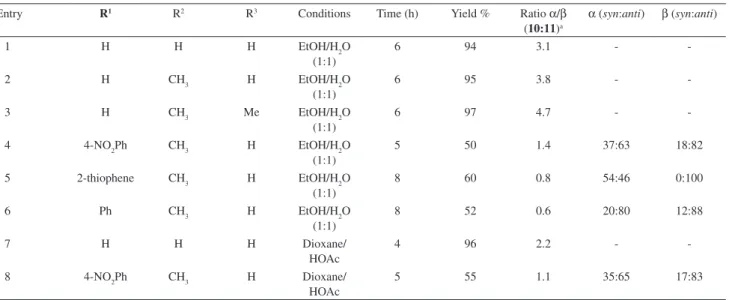
Table 2. Hetero Diels–Alder reactions in aqueous ethanol media or dioxane
Entry R1 R2 R3 Conditions Time (h) Yield % Ratio α/β
(10:11)a
α (syn:anti) β (syn:anti)
1 H H H EtOH/H2O
(1:1)
6 94 3.1 -
-2 H CH3 H EtOH/H2O
(1:1)
6 95 3.8 -
-3 H CH3 Me EtOH/H2O
(1:1)
6 97 4.7 -
-4 4-NO2Ph CH3 H EtOH/H2O
(1:1)
5 50 1.4 37:63 18:82
5 2-thiophene CH3 H EtOH/H2O
(1:1)
8 60 0.8 54:46 0:100
6 Ph CH3 H EtOH/H2O
(1:1)
8 52 0.6 20:80 12:88
7 H H H Dioxane/
HOAc
4 96 2.2 -
-8 4-NO2Ph CH3 H Dioxane/
HOAc
5 55 1.1 35:65 17:83
aThe ratio alfa/beta and the diastereoisomers syn and anti were determinated by 1H-NMR. Aiming to improve the scope of this reaction, and thus
obtain various derivatives of lapachones, we decided to investigate the effect of the solvent, having in mind that the Diels-Alder reactions are accelerated by acids. Several reaction conditions were investigated, however best results were achieved by the reaction in ethanol/water in the proportion of 1:1 under relux. The results are summarized in Table 2.
Comparing the results described in Table 1 (entries 1-3) with those of Table 2 (entries 1-3), we can observe that the mixture of solvents ethanol/water had effect on the yields, reaction time and the ratio between isomers α and β. The reactions were faster and the yields improved as well the proportion of β isomer.
The effect of ethanol/water solvent mixture was more signiicant in the reactions with aromatic aldehydes (8b-d). The reactions that had not worked previously, in this new condition produced the disubstituted naphthoquinones α (syn:anti, 10d-f) and β (syn:anti, 11d-f) in good yields (entries 3-6, Table 2). A very important point that should
be emphasized was the high proportion of β-isomer (11d-f) under these new conditions.
Each of these reactions produced a mixture of α and β isomers that were composed of syn and anti
diastereoisomers. In most cases the proportion of the
anti isomer was higher than the syn (10d-f). The four compounds of these mixtures were separated by lash column chromatography and their structures were determined by 1D and 2D NMR techniques and by ESI-TOF mass spectrometry. The α and β-isomers (10d-f and 11d-f) could be distinguished by the hydrogens of the aromatic region because of a more symmetrical pattern of the α- isomers in comparison with that of the β isomer. The diastereoisomers syn and anti were distinguished by the coupling constants of hydrogens H-3 and H-4 of the pyran rings that showed J equal to 2.4/5.9 and 11.0/7.1 Hz (J3a,4/J3b,4) for the syn and anti isomers, respectivelyand hydrogens H-3 and H-2 with coupling constants values of 2.4/12.0Hz (J3a,2/J3b,2) for syn isomers and 2.2 and 11.2 Hz (J3a,2/J3b,2) for anti isomers.32
Recently, Peng and co-workers33 performed DFT
calculations for the reaction between unsubstituted
Silva et al. 1481 Vol. 20, No. 8, 2009
state. Xu and co-workers30 generated in situ the o-QMs I
and II (Scheme 2) and reacted then with several silyl enol ethers obtaining regioselectively α-lapachone derivatives with anti stereoselectivity in moderate to high yield. The regioselectivity was rationalized by considering favorable pathway to a zwitterion-like transition state of lower energy between the reactants. DFT calculation indicated that o-QM I has lower LUMO energy than II. However, no rationalization was attempted by the author to explain the anti stereoselectivity.
Since the intermediate I is the most stable one, we can speculated that it forms preferentially the α- and β-anti
adducts with the proper regiochemistry by a chair-like endo
transition state as indicated in Figure 1.
The acceleration of the Diels-Alder reactions by aqueous media is well known.34 However, the acidity of
the mixture ethanol:water is more relevant for success of the reactions. In an attempt to investigate this hypothesis, we decided to carry out the reactions of the compound 1 with aldehydes and styrenes in dioxane, containing catalytic amount of acetic acid (entries 7 and 8, Table 2). The comparison between the experiments of entries 1 and 7 of Table 2 clearly show the effect of the acidic media and increasing the proportion of β-isomers. In these experiments formation of the by-product benzoxanthene (type 7) was negligible.
Conclusions
In summary, the methodology described by Nair et al.
has been improved, resulting in β-pyranonaphthoquinones more selectively and in better yields and lower reaction
time. Additionally, with this methodology it was possible to use any type of aldehyde, and not only formaldehyde.
Acknowledgments
This work was supported by CNPq (National Council of Research of Brazil), CAPES, FINEP, PRONEX-FAPERJ (E-26/171.512.2006), UFRJ and UFF.
Supplementary Information
Supplementary data are available free of charge at http://jbcs.org.br, as PDF ile.
References
1. Lee, J. H.; Cheong, J. H.; Park, Y. M.; Choi, Y. H.; Pharmacolog. Res.2005, 51, 553; Skibo, E. B.; Xing, C.; Dorr, R. T.; J. Med. Chem.2001, 44, 3545.
2. dos Santos, A. F.; Ferraz, P. A. L.; de Abreu, F. C.; Chiari, E.; Goulart, M. O. F.; Sant’Ana, A. E. G.; Planta Med.2001, 67, 92; Barbosa, T. P.; Camara, C. A.; Silva, T. M. S.; Martins, R. M.; Pinto, A. C.; Vargas, M. D.; Bioorg. Med. Chem.2005, 13, 6464. 3. Ferreira, V. F.; Jorqueira, A.; Souza, A. M. T.; Da Silva, M. N.; de Souza, M. C. B. V.; Gouvêa, R. M.; Rodrigues, C. R.; Pinto, A. V.; Castro, H. C.; Santos, D. O.; Araújo, H. P.; Bourguignon, S. C.; Bioorg. Med. Chem.2006, 14, 5459; Jorqueira, A.; Gouvêa, R. M.; Ferreira, V. F.; da Silva, M. N.; de Souza, M. C. B. V.; Zuma, A. A.; Cavalcanti, D. F. B.; Araújo, H. P.; Bourguignon, S. C.; Parasitol. Res.2006,99, 429; Silva-Jr, E. N.; Menna-Barreto, R. F. S.; Pinto, M. C. F. R.; Silva, R. S. F.; Teixeira, D. V.; de Souza, M. C. B. V.; Simone, C. A.; de Castro, S. L.; Ferreira, V. F.; Pinto, A. V.; Eur. J. Med. Chem.2008, 43, 1774.
4. Teixeira, M. J.; de Almeida, Y. M.; Viana, J. R.; Holanda, J. G.; Rodrigues, T. P.; Prata, J. R. C..; Coelho, I. V. B.; Rao, V. S.; Pompeu, M. M. L.; Phytother. Res.2001, 15, 44.
5. de Almeida, E. R.; Filho, A. A. S.; dos Santos E. R.; Lopes C. A. C.; J.Ethnopharmacol.1990, 29, 239.
6. Gafner, S.; Wolfender, J. L.; Nianga, M.; Stoeckli-Evans, H.; Hostettmann, K.; Phytochemistry1996, 42, 1315.
7. Tabata, M.; Tsukada, M.; Fukui, H.; Planta Med. 1982,44, 234. 8. Salas, C.; Tapia, R. A.; Ciudad, K.; Armstrong, V.; Orellana,
M.; Kemmerling, U.; Ferreira, J.; Maya, J. D.; Morello, A.;
Bioorg. Med. Chem.2008, 16, 668; Dubin, M.; Villamil, S. H. F.; Stoppani, A. O. M.; Medicina-Buenos Aires2001, 61, 343; Pinto, C. N.; Dantas, A. P.; de Moura, K. C. G.; Emery, F. S.; Polequevitch, P. F.; Pinto, M. D.; de-Castro, S. L.; Pinto, A. V.;
Arzneim. Forsch.2000, 50, 1120.
9. Salmon-Chemin, L.; Buisine, E.; Yardley, V.; Kohler, S.; Debreu, M.-A.; Landry, V.; Sergheraert, C.; Croft, S. L.; Krauth-Siegel, R. L.; Davioud-Charvet, E.; J. Med. Chem.2001,44, 548.
Figure 1. Proposed transition states formed by o-QM I or II with 9a-c. O
O O
R1 δ+ δ
-O
O O
R1 δ+ δ
-R3 R2
Reaction with o-QM I Reaction with o-QM II
O
O O
R1
R2
R3
R2
δ+ δ
-O
O O
R1
R2 δ- δ+
endo syn TS R3
endo syn TS
endo anti TS endo anti TS
Synthesis of α- and β-Lapachone Derivatives from Hetero Diels-Alder Trapping J. Braz. Chem. Soc.
1482
10. Santos, E. V. M.; Carneiro, J. W. M.; Ferreira, V. F.; Bioorg. Med. Chem.2004, 12, 87.
11. Hickman, J. A.; Curr. Opin. Genet. Dev. 2002, 12, 67. 12. Esteves-Souza, A.; Figueiredo, D. V.; Esteves, A.; Camara, C.
A.; Vargas, M. D.; Pinto, A. C.; Echevarria, A.; Braz. J. Med. Biol. Res.2007, 40, 1399.
13. Monks, T. J., Jones, D. C.; Curr. Drug Metabolism2002, 3, 425.
14. Silva, M. N.; Ferreira, V. F.; de Souza, M. C. B. V.; Quim. Nova 2003, 26, 407.
15. da Silva A. R.; da Silva, A. M.; Ferreira, A. B. B.; Bernardes, B. O.; da Costa, R. L.; J. Braz. Chem. Soc. 2008, 19, 1230; Silva, R. S. E.; de Amorim, M. B.; Pinto, M. D. C. F. R.; Emery, F. S.; Goulart, M. O. F.; Pinto, A. V.; J. Braz. Chem. Soc.2007, 18, 759; Uliana, M. P.; Vieira, Y. W.; Donatoni, M. C.; Corrêa, A. G.; Brocksom, U.; Brocksom, T. J.; J. Braz. Chem. Soc. 2008,
19, 1484; Vieira, Y. W.; Nakamura, J.; Finelli, F. G.; Brocksom, U.; Brocksom, T. J.; J. Braz. Chem. Soc.2007, 18, 448. 16. Van De Walters, R. W.; Pettus, T. R. R.; Tetrahedron2002, 58,
5367.
17. Wang, P.; Song, Y.; Zhang, L. X.; He, H. P.; Zhou, X.; Curr. Med. Chem.2005, 12, 2893.
18. Brousmiche, D. W.; Wan, P.; J. Photochem. Photobiol., A2002,
149, 71.
19. Dorrestijn, E.; Pugin, R.; Nogales, M. V. C.; Mulder, P.; J. Org. Chem.1997, 62, 4804.
20. Wojciechowski, K.; Dolatowska, K.; Tetrahedron 2005, 61, 8419.
21. van de Water, R. W.; Magdziak D. J.; Chau J. N.; Pettus, T. R. R.;
J. Am. Chem. Soc. 2000, 122,6502; Jones, R. M.; van de Water, R. W.; Lindsey, C. C.; Hoarau, C.; Ung, T.; Pettus, T. R. R.;
J. Org. Chem. 2001, 66,3435; Kiselyov, A. S.; Tetrahedron Lett.2001, 42, 3053.
22. da Silva, M. N.; Ferreira, S. B.; Jorqueira, A.; de Souza, M. C. B. V.; Pinto, A. V.; Kaiser, C. R.; Ferreira, V. F.; Tetrahedron Lett.2007, 48, 6171.
23. Dalgliesh, C. E.; J. Am. Chem. Soc.1949, 71, 1697.
24. Brougidou, J.; Christol, H.; C. R. Hebd. Acad. Sci. 1963, 257, 3149.
25. Brougidou, J., Christol, H.; C. R. Hebd. Acad. Sci. 1963, 257, 3323.
26. Ferreira, V. F.; Coutada, L. C.; Pinto M. C. F. R.; Pinto, A. V.;
Synth. Commun.1982, 12, 195.
27. Ferreira, V. F.; Pinto, A. V.; Coutada, L. C. M.; An. Acad. Brasil. Cienc.1980, 52, 477.
28. Nair, V.; Mathew, B.; Rath, N. P.; Vairamani, M; Prabhakar, S.;
Tetrahedron 2001, 57, 8349.
29. Nair, V.; Jayan, C. N.; Radhakrishnan, K. V.; Anilkumar, G.; Rath, N. P.; Tetrahedron2001, 57, 5807; Nair, V.; Treesa, P. M.;
Tetrahedron Lett.2001, 42, 4549; Nair, V.; Treesa, P. M.; Jayan, C. N.; Rath, N. P.; Vairamani, M.; Prabhakar, S.; Tetrahedron 2001, 57, 7711; Nair, V.; Menon, R. S.; Vinod, A. U.; Viji, S.;
Tetrahedron Lett.2002, 43, 2293.
30. Peng, D. -Q.; Liu, Y.; Lu, Z. -F.; Shen, Y. -M.; Xu, J. -H.;
Synthesis2008, 1182.
31. Teimouri, M. B.; Khavasi, H. R.; Tetrahedron2007, 63, 10269. 32. General Procedure for preparing 10a-f and 11a-f. To a round-bottom flask equipped with a magnetic stirring bar was added dissolved lawsone (1 mmol) with water (10 mL) and ethanol (10 mL). Then, the appropriate aldehyde (8 mmols for paraformaldehyde or 3 mmols for arylaldehydes) was added, followed by dropwise addition of the substituted styrenes (3 mmol). The reaction mixture was stirred under relux until consumption of the starting material (5-8 h). The ethanol was removed under reduced pressure and ethyl acetate (50 mL) was added to the residue and the mixture was washed with saturated aqueous solution of sodium bicarbonate (2 × 20 mL). The organic phase was washed with water (2 × 50 mL), dried over anhydrous sodium sulphate, iltered and concentrated under vacuum. The residual crude product was puriied by column chromatography on silica gel using gradient mixture of hexane-ethyl acetate. 33. Wang, H.; Wang, Y.; Han, K. -L.; Peng, X. -J.; J. Org. Chem.
2005, 70, 4910.
34. Wijnen, J. W.; Engberts, J. B. F. N.; J. Org. Chem. 1997, 62, 2039; Deshpande, S. S.; Kumar, A.; Tetrahedron, 2005, 61, 8025; Sarma, D.; Pawar, S. S; Deshpande, S. S.; Kumar, A.
Tetrahedron Lett. 2006, 47, 3957.
35. Chen, Y.; Wu, S.; Tu, S.; Li, C.; Shi, F.; J. Heterocycl. Chem. 2008, 45, 931.
Received: January 6, 2009
Su
pp
le
m
enta
ry
Inf
or
m
ati
on
J. Braz. Chem. Soc., Vol. 20, No. 8, S1-S6, 2009. Printed in Brazil - ©2009 Sociedade Brasileira de Química 0103 - 5053 $6.00+0.00
*e-mail: [email protected]
Synthesis of
α
- and
β
-Lapachone Derivatives from Hetero Diels-Alder Trapping
of Alkyl and Aryl
o
-Quinone Methides
Fernando de C. da Silva,a,b Sabrina B. Ferreira,a,b Carlos R. Kaiser,b Angelo C. Pintob
andVitor F. Ferreira*,a
aDepartamento de Química Orgânica, Instituto de Química CEG, Universidade Federal Fluminense,
Campus do Valonguinho, 24020-150 Niterói-RJ, Brazil
bInstituto de Química, Universidade Federal do Rio de Janeiro, Centro de Tecnologia, Bloco A,
Cidade Universitária, 21949-900 Rio de Janeiro-RJ, Brazil
EXPERIMENTAL
General information
Melting points were observed on a Fischer Jones and are uncorrected. Analytical grade solvents were used. Dioxane was distilled before being used. Reagents were purchased from Aldrich or Acros Chemical Co. Column chromatography was performed on silica gel 60 (Merck 70-230 mesh). Yields refer to chromatographically and spectroscopically homogeneous materials. Reactions were monitored by thin-layer chromatography (TLC) carried out on 0.25 mm E. Merck silica gel plates (60F-254) using UV light as visualizing agent and either an ethanolic solution of sulfate. Infrared spectra were recorded on a Perkin-Elmer FT-IR Spectrum One spectrophotometer, calibrated relative to the 1601.8 cm-1 absorbance of polystyrene.
NMR spectra were recorded on a Varian Unity Plus VXR (300 MHz) equipament in DMSO-d6 and CDCl3 solutions and tetramethylsilane was used as the internal standard (d = 0 ppm). High resolution mass spectra (HRMS) were recorded on an MICROMASS Q-TOF MICRO Mass spectrometer using ESI-TOF (electrospray ionization-time of light).
General Procedure for preparation of 10a-f and 11a-f in dioxane media
To a round-bottom lask equipped with a magnetic stirring bar was added lawsone (1 mmol), appropriate aldehyde (8 mmols for paraformaldehyde or 3 mmols for arylaldehydes) and dissolved with dioxane (20 mL). Then substituted styrene
(3 mmols) was added dropwise and reaction mixture was stirred under relux until consumption of the starting material. The dioxane was evaporated, ethyl acetate was added and mixture was washed with saturated aqueous solution of sodium bicarbonate. The organic layer was washed with water, dried over anhydrous sodium sulphate, iltered and concentrated under reduced pressure. The residual crude product was puriied via silica-gel chromatography, using gradient mixture of hexane-ethyl acetate.
General Procedure for preparation of 10a-f and 11a-f in aqueous ethanol media
To a round-bottom lask equipped with a magnetic stirring bar lawsone was dissolved (1 mmol) with water (10 mL) and ethanol (10 mL). Then, the appropriate aldehyde (8 mmols for paraformaldehyde or 3 mmols for arylaldehydes) was added. Styrenes substituted (3 mmols) was added drop-wise and reaction mixture was stirred under relux until consumption of the starting material. The ethanol was removed under reduced pressure, ethyl acetate was added in the residue and mixture was washed with saturated aqueous solution of sodium bicarbonate. The combined organic extracts washed with water, and dried over anhydrous sodium sulphate, was iltered and concentrated under pressure reduced. The residual crude product was puriied via silica-gel chromatography, using gradient mixture of hexane-ethyl acetate.
General Procedure for preparation of 10a/d and 11a/d in dioxane/acetic acid media
Synthesis of α- and β-Lapachone Derivatives from Hetero Diels-Alder Trapping J. Braz. Chem. Soc.
S2
2-phenyl-3,4-dihydro-2H-benzo[g]chromene-5,10-dione (10a)
Yellow solid, m.p.= 168-170 0C; IR (KBr, cm-1): ν 1679,
1649, 1617, 1260, 1202, 1063, 958, 910, 721; 1H NMR
(CDCl3, 300 MHz): d 2.15 (1H, dddd, J = 2.6, 3.2, 5.7 and 14.0 Hz, H-3a), 2.30 (1H, dddd, J = 2.2, 6.2, 6.5 and 14.0 Hz, H-3b), 2.63 (1H, ddd, J = 3.2, 6.2 and 13.7 Hz, H-4a), 2.77 (1H, ddd, J = 2.2, 5.7, and 13.7 Hz, H-4b), 5.22 (1H, dd, J = 2,6 e 6,5 Hz, H-2), 7.32 – 7.40 (5H, m, 2-phenyl), 7.68 (2H, dddd, J = 2.0, 7.5, 9.2 and 11.0 Hz, H-8 e H-7), 8.10 (2H, dddd, J =2.0, 7.5, 9.2 and 10.9 Hz, H-9 e H-6); 13C
NMR (CDCl3, 75 MHz): d 18.3 4), 27.6 3), 78.8 (C-2), 121.4 (C-4a), 125.6 (C-4’-phenyl), 125.8 (C-6), 126.1 (C-9), 128.1 (C-2’-phenyl), 128.4 (C-3’-phenyl), 130.8 (C-9a), 131.7 (C-5a), 132.9 (C-7, C-8), 133.7 (C-Har), 139.1 (C-1’), 152.2 (C-10a), 184.0 (C-5 and C-10). HRMS (ESI) calcd for C19H14O3: 290.0943, Found: 290.0336.
2-(p-tolyl)-3,4-dihydro-2H-benzo[g]chromene-5,10-dione (10b)
Yellow solid, m.p.= 135-1370C; IR (KBr, cm-1): ν
1677, 1645, 1617, 1595, 1341, 1300, 1258, 1200, 1065, 958, 910, 816, 720; 1H NMR (CDCl
3, 300 MHz): d 2.06
(1H, dddd, J = 2.6, 3.4, 6.0 and 13.0 Hz, H-3a), 2.31 (1H, dddd, J = 2.3, 6.4, 6.3 and 13.0 Hz, H-3b), 2.36 (1H, s, CH3), 2,64 (1H, ddd, J = 3.4, 6.4 and 12.7 Hz, H-4a), 2.75 (1H, ddd, J = 2.3, 6.0, and 12.7 Hz, H-4b), 5.18 (1H, dd,
J = 2.6 and 6.3 Hz, H-2), 7.1 (2H, dd, J = 7.7 Hz, H-meta tolyl), 7.27 (2H, dd, J = 7.7 Hz, H-orto tolyl), 7.69 (2H, dddd, J = 1.0, 7.3, 9.0 and 10.7 Hz, H-8 e H-7), 8.09 (2H, dddd, J = 1.0, 7.3, 9.0 and 10.7 Hz, H-9 e H-6); 13C NMR
(CDCl3, 75 MHz): d 18.8 (C-4), 21.4 (CH3), 28.0 (C-3),
79.2 (C-2), 121.8 (C-4a), 126.1 (C-6), 126.2 (C-9), 126.5 2’), 129.5 3’), 131.3 9a),133.7 4’), 134.1 (C-1’), 136.3 (C-5a), 138.3 (C-(C-1’), 155.8 (C-10a), 179.6 and 184.0 (C-5 and C-10). HRMS (ESI) calcd for C20H16O3: 304.1099, Found: 304.1261.
2-(2,4-dimethylphenyl)-3,4-dihydro-2H-benzo[g] chromene-5,10-dione (10c)
Yellow solid, m.p.= 148-152 0C; IR (KBr, cm-1): ν 1673,
1646, 1617, 1590, 1261,1204, 1299, 1063, 961, 825, 718, 676; 1H NMR (CDCl
3, 300 MHz): d 1.99 (1H, dddd, J = 2.4,
3.4, 5.9 and 13.2 Hz, H-3a), 2,25 (1H, dddd, J = 2.4, 6.4, 7.8 and 13.2 Hz, H-3b), 2.32 (3H, s, CH 3), 2.34 (3H, s, CH 3), 2.64 (1H, ddd, J = 3.4, 6.4 and 13.0 Hz, H-4a), 2.85 (1H, m, ddd, J = 2.4, 5.9, and 13.0 Hz, H-4b), 5.25 (1H, dd, J = 2.4 and 7.8 Hz, H-2), 7.01 (1H, s, H-meta tolyl), 7.06 (1H, d, J = 7.8 Hz, H-orto tolyl), 7.30 (1H, d, J = 7.8 Hz, H-meta tolyl), 7.69 (2H, dddd, J = 2.0, 7.8, 9.2 and 10.7 Hz, H-8 e H-7), 8.10 (2H, dddd, J = 2.0, 7.6, 9.2 and 10.9 Hz, H-9 e H-6); 13C NMR (CDCl
3, 75 MHz): d 19.2 (CH3), 19.6 (C-4),
21.3 (CH3), 27.2 3), 77.0 2), 121.6 4a), 125.9 (C-5’ orto tolyl), 126.2 and 126.5 (C-6 and C-9), 127.3 (C-6’), 131.6 (C-3’ orto tolyl), 131.3 (C-9a), 132.2 (C-5a), 133.3 and 134.1 (C-7 and C-8), 134.7 and 134.9 (C-2’ and C-4’), 138.1 (C-1’), 156.2 (C-10a), 179.6 and 184.0 (C-5 and C-10). HRMS (ESI) calcd for C21H18O3: 318.1256, Found: 318.1876
4-(4-nitrophenyl)-2-p-tolyl-3,4-dihydro-2H-benzo[g] chromene-5,10-dione (10d), Syn isomer
Yellow solid, m.p.= 205-207 0C; IR (KBr, cm-1): ν 1677,
1649, 1612, 1516, 1344, 1305, 1266, 1209, 1106, 968, 900, 856, 818, 725; 1H NMR (CDCl
Silva et al. S3 Vol. 20, No. 8, 2009
H-6), 8.22 (1H, d, J =8.6 Hz, H-meta 4-nitrophenyl); 13C
NMR (CDCl3, 75 MHz): d 21.0 (CH3), 35.2 (C-4), 36.5
(C-3), 75.0 (C-2), 120.2 (C-4a), 124.0 (C-3’ 4-nitrophenyl), 126.0 (C-9), 126.3 (C-2’ 4-nitrophenyl), 126.5 (C-7), 128.5 (C-3’ p-tolyl), 129.3 (C-2’ p-tolyl), 131.0 9a), 131.7 (C-5a), 133.3 (C-6), 134.2 (C-8), 135.0 (C-4’ p-tolyl), 138.5 (C-1’ p-tolyl), 146.8 (C-4’ 4-nitrophenyl), 151.0 (C-1’
4-nitrophenyl), 156.6 (C-10a), 179.0 (C-10), 183.1 (C-5).
4-(4-nitrophenyl)-2-p-tolyl-3,4-dihydro-2H-benzo[g] chromene-5,10-dione (10d), Anti isomer
Yellow solid, m.p.= 231-234 0C; IR (KBr, cm-1): ν 1677,
1650, 1607, 1511, 1345, 1301, 1266, 1258, 1199, 961, 724;
1H NMR (CDCl
3, 300 MHz): d 2.25 (1H, dt, J = 2.4 and 14.3
Hz, H-3a), 2.35 (3H, s, CH3), 2.62 (1H, ddd, J = 2.2, 7.1 and 14.4 Hz, H-3b), 4.40 (1H, dd, J = 7.1 and 10.7 Hz, H-4), 5.20 (1H, dd, J = 2.0 and 11.0 Hz, H-2), 7.18 (1H, d, J =8.1 Hz, H-metap-tolyl), 7.30 (1H, d, J =8.1 Hz, H-ortho p-tolyl), 7.35 (1H, d, J =8.8 Hz, H-ortho 4-nitrophenyl), 7.67-7.74 (1H, m, H-7), 7.67-7.74 (1H, m, H-8), 7.90-7.93 (1H, m, H-9), 8.11-8.17 (1H, m, H-6), 8.13 (1H, d, J =8.8 Hz, H-meta 4-nitrophenyl); 13C NMR (CDCl
3, 75 MHz): d 21.0 (CH3),
29.6 (C-3), 38.6 (C-3), 79.2 (C-2), 122.8 (C-4a), 123.9 (C-3’
4-nitrophenyl), 125.9 (C-9), 126.2 (C-2’ 4-nitrophenyl), 126.4 (C-7), 127.6 (C-3’ p-tolyl), 129.3 (C-2’ p-tolyl), 130.8 (C-9a), 131.8 (C-5a), 133.3 (C-6), 134.2 (C-8), 134.8 (C-4’ p-tolyl), 138.6 (C-1’ p-tolyl), 146.4 (C-4’ 4-nitrophenyl), 151.2 (C-1’
4-nitrophenyl), 157.4 (C-10a), 183.2 (C-10), 186.8 (C-5).
4-Phenyl-2-p-tolyl-3,4-dihydro-2H-benzo[g]chromene-5,10-dione (10e)
Yellow solid, m.p. = 203-205 ºC; IR (KBr/cm-1): 1678,
1647, 1615, 1365, 1336, 1302, 1257, 1194, 1068, 1043,
960, 894, 812, 760, 725, 702. 1H NMR (300 MHz, CDCl 3):
d 2.13-2.32 (1H, m, H-3a), 2.34 and 2.35 (3H, s, CH3), 2.44
(1H, ddd, J = 2.0, 7.3 and 14.4 Hz, H-3b), 4.29 (1H, dd, J = 7.3 and 11.0 Hz, H-4 anti isomer) and 4.46 (1H, dd, J = 1.5 and 5.7 Hz, H-4 syn isomer), 5.06 (1H, dd, J = 3.2 and 11.0 Hz, H-2 syn isomer) and 5.12 (1H, dd, J = 1.2 and 11.0 Hz, H-2 anti isomer), 7.14-7.34 (4H, m, p-tolyl), 7.14-7.34 (5H, m, Ph), 7.63-7.72 (1H, m, H-7), 7.63-7.72 (1H, m, H-8), 7.91-7.94 (1H, m, H-9 anti isomer) and 8.02-8.05 (1H, m, H-9 syn isomer), 8.11-8.18 (1H, m, H-6). 13C NMR (75
MHz, CDCl3):d21.4 (CH3), 35.6 and 39.3 (C-4), 37.3 and 41.2 (C-3), 75.5 and 79.9 (C-2), 125.0 (C-4a), 126.5 and 126.6 (C-9), 126.7 (C-7), 126.8 (C-2’ Ph), 127.1 (C-3’ Ph), 128.0 (C-3’ p-tolyl), 128.9 and 129.1 (C-4’ Ph), 129.5 and 129.6 (C-2’ p-tolyl), 131.2 (C-9a), 132.5 (C-5a), 133.3 and 133.4 (C-6), 134.3 and 134.4 (C-8), 135.8 (C-4’ p-tolyl), 138.6 (C-1’ p-tolyl), 143.9 (C-4’ Ph), 157.5 (C-10a), 179.9 (C-10), 183.4 (C-5).
4-(thiophen-2-yl)-2-p-tolyl-3,4-dihydro-2H-benzo[g] chromene-5,10-dione (10f), Syn isomer
Yellow solid, m.p.= 123-125 0C; IR (KBr, cm-1): ν 1680,
1650, 1614, 1338, 1299, 1261, 1205, 1063, 959, 896, 815, 721; 1H NMR (CDCl
3, 300 MHz): d 2.22-2.39 (2H, m, H-3),
2.36 (3H, s, CH3), 4.70 (1H, ddd, J =0.7, 1.9 and 4.9 Hz, H-4), 5.23 (1H, dd, J =2.9 and 11.2 Hz, H-2), 6.92 (1H, dt, J =1.0 and 3.4 Hz, H-3’ thiophen-2-yl), 6.96 (1H, dd,
J =3.7 and 5.1 Hz, H-4’ thiophen-2-yl), 7.20 (1H, dd, J = 1.2 and 5.1 Hz, H-5’ thiophen-2-yl), 7.20 (1H, d, J =8.0 Hz, H-meta), 7.28 (1H, d, J =8.0 Hz, H-ortho), 7.67-7.76 (1H, m, H-7), 7.67-7.76 (1H, m, H-8), 8.06-8.09 (1H, m, H-9), 8.13-8.16 (1H, m, H-6); 13C NMR (CDCl
3, 75 MHz):
d 21.5 (CH3), 30.9 4), 37.4 3), 76.0 2), 122.0
(C-4a), 124.5 (C-5’ thiophen-2-yl), 125.5 (C-9), 126.5 (C-7), 126.7 (C-4’ thiophen-2-yl), 127.3 (C-3’ p-tolyl), 129.6 (C-2’ p-tolyl), 131.4 (C-4’ p-tolyl), 132.3 (C-6), 133.5 (C-8), 134.4 (C-3’ thiophen-2-yl), 136.0 (C-1’ p-tolyl), 138.6 (C-2’
Synthesis of α- and β-Lapachone Derivatives from Hetero Diels-Alder Trapping J. Braz. Chem. Soc.
S4
4-(thiophen-2-yl)-2-p-tolyl-3,4-dihydro-2H-benzo[g] chromene-5,10-dione (10f), Anti isomer
Yellow solid, m.p.= 172-175 0C; IR (KBr, cm-1): ν
1678, 1649, 1611, 1363, 1333, 1300, 1256, 1192, 1041, 954, 892, 847, 814, 721; 1H NMR (CDCl
3, 300 MHz): d
2.28-2.43 (1H, m, H-3a), 2.40 (3H, s, CH3), 2.68 (1H, ddd, 2.1, 7.1 and 14.4 Hz, H-3b), 4.57 (1H, dd, J =7.1 and 11.0 Hz) and 4.65 (1H, dd, J = 1.0 and 3.2 Hz) H-4 conformers, 5.23 (1H, dd, J = 1.9 and 11.5 Hz) and 5.35 (1H, dd, J = 4.4 and 10.0 Hz) H-2 conformers, 6.89 and 6.90 (1H, dd,
J =1.0 and 3.4 Hz, H-3’ thiophen-2-yl conformers), 6.86 and 6.95 (1H, dd, J =3.7 and 5.1 Hz, H-4’ thiophen-2-y conformers), 7.06 and 7.18 (1H, dd, J =1.2 and 5.1 Hz, H-5’ thiophen-2-yl conformers), 7.24 and 7.25 (1H, d, J
=8.0 Hz, H-meta conformers), 7.30 and 7.36 (1H, d, J = 8.0 Hz, H-ortho conformers), 7.54 and 7.57 (1H, td, J = 1.2 and 7.6 Hz, H-8 conformers), 7.63 and 7.65 (1H, dt,
J = 1.2 and 7.6 Hz, H-7 conformers), 7.89 (1H, d, J =7.6 Hz, H-9), 8.09 and 8.13 (1H, dd, J = 1.5 and 7.6 Hz, H-6 conformers) ; 13C NMR (CDCl
3, 75 MHz): d 21.4 (CH3),
30.9 (C-4), 41.5 (C-3), 79.9 (C-2), 124.4 (C-4a), 124.6 (C-5’ thiophen-2-yl), 126.4 (C-9), 126.5 (C-7), 126.6 (C-4’
thiophen-2-yl), 127.0 (C-3’ p-tolyl), 129.6 (C-2’ p-tolyl), 131.2 (C-4’ p-tolyl), 132.5 (C-6), 133.4 (C-8), 134.4 (C-3’
thiophen-2-yl), 135.5 (C-1’ p-tolyl), 138.7 (C-2’ thiophen-2-yl), 146.6 (C-11), 179.8 (C-10), 183.7 (C-5).
2-phenyl-3,4-dihydro-2H-benzo[h]chromene-5,6-dione (11a)
Orange solid, m.p.= 161-163 0C; IR (KBr, cm-1): ν 1696,
1647, 1605,1573, 1397, 1300, 1280, 1232, 1158, 1093,
922, 700; 1H NMR (CDCl
3, 300 MHz): d 2.08 (1H, dddd, J = 2.7, 3.2, 5.6 and 13.8 Hz, H-3a), 2.33 (1H, dddd, J = 3.4, 6.3, 7.4 and 13.8 Hz, H-3b), 2.60 (1H, ddd, J = 3.2, 6.3 and 8.8 Hz, H-4a), 2.76 (1H, ddd, J = 3.4, 5.6 and 8.8 Hz H-4b), 5.27 (1H, dd, J = 2.7 and 7.4 Hz, H-2), 7.39-7.46 (5H, m, 2-phenyl), 7.53 (1H, ddd, J = 1.2, 7.4 and 8.6 Hz,H-8), 7.64 (1H, ddd, J = 1.4, 7.6 and 9.1 Hz, H-9), 7.83 (1H, dd, J = 0.9 and 7.6 Hz, H-10), 8.01 (1H, dd, J = 1.4 and 7.6 Hz, H-7); 13C NMR (CDCl
3, 75 MHz): d 18.2
(C-4), 28.2 (C-3), 79.9 (C-2), 113.8 (C-4a), 123.9 (C-10), 125.6 (C-7), 125.7 (C-4’-phenyl), 128.4 (C-8), 128.5
(C-2’-phenyl), 128.6 (C-3’-phenyl), 129.8 (C-6a), 130.6 (C-9), 131.9 (C-1’-phenyl), 139.2 (C-10a), 162.7 (C-10b), 178.7 and 179.0 (C-5 and C-6). HRMS (ESI) calcd for C19H14O3: 290.0943, Found: 290.0344
2-p-tolyl-3,4-dihydro-2H-benzo[h]chromene-5,6-dione (11b)
Orange solid, m.p.= 165-167 0C; IR (KBr, cm-1): ν 1697,
1647, 1605, 1590, 1572, 1393, 1301, 1280, 1158, 1076, 922,771; 1H NMR (CDCl
3, 300 MHz): d 2.06 (1H, dddd, J = 2.4, 3.6, 5.6 and 12.7 Hz, H-3a), 2.31 (1H, dddd, J = 3.1, 6.2, 7.8 and 12.7 Hz, H-3b), 2.40 (3H, s, CH3), 2.59 (1H, ddd, J = 3.6, 6.2 and 8.7 Hz, H-4a), 2.77 (1H, ddd, J
= 3.1, 5.6 and 8.7 Hz H-4b), 5.24 (1H, dd, J = 2.4 and 7.8 Hz, C-2), 7.25 (2H, d, J = 7.7 Hz, H-meta tolyl), 7.32 (2H, d, J = 7.7 Hz, H-orto tolyl), 7.51 (1H, ddd, J = 1.4, 7.5 and 8.7 Hz, H-8), 7.62 (1H, ddd, J = 1.4, 7.5 and 9.0 Hz, H-9), 7.81 (1H, dd, J = 1.2 and 7.8 Hz, H-10), 8.01 (1H, dd, J = 1.4 and 7.5 Hz, H-7); 13C NMR (CDCl
3, 75 MHz):
18.7 (C-4), 21.4 (CH3), 28.6 3), 80.4 2), 114.3 (C-4a), 124.3 (C-10), 126.1 (C-7), 128.9 (C-8), 129.7
Silva et al. S5 Vol. 20, No. 8, 2009
2-(2,4-dimethylphenyl)-3,4-dihydro-2H-benzo[h] chromene-5,6-dione (11c)
Orange solid, m.p.= 164-167 0C; IR (KBr, cm-1): ν 1694,
1646, 1603, 1574, 1394, 1283, 1231, 1034, 998, 775; 1H
NMR (CDCl3, 300 MHz): d 1.99 (1H, dddd, J = 2.4, 3.0, 5.3 and 12.2 Hz, H-3a), 2.26 (1H, dddd, J = 2.4, 6.6, 7.8 and 12.2 Hz, H-3b), 2.36 (3H, s, CH3); 2.38 (3H, s, CH3), 2.59 (1H, ddd, J = 3.0, 6.6 and 8.7 Hz, H-4a), 2.85 (1H, ddd, J = 2.4, 5.3 and 8.7 Hz H-4b), 5.35 (1H, dd, J = 2.4 and 7.8 Hz, H-2), 7.10 (2H, d, J = 7.8 Hz, H-orto and meta tolyl), 7.33 (1H, d, J = 7.8 Hz, H-meta tolyl), 7.51 (1H, ddd,
J = 1.2, 7.5 and 8.7 Hz,H-8), 7.61 (1H, ddd, J = 1.4, 7.5 and 9.0 Hz, H-9), 7.71 (1H, dd, J = 0.9 and 7.8 Hz, H-10), 8.06 (1H, dd, J = 1.4 and 7.5 Hz, H-7); 13C NMR (CDCl
3,
75 MHz): d 19.2 (CH3), 19.2 (C-4), 21.2 (CH3), 27.5
(C-3), 77.9 (C-2), 114.2 (C-4a), 124.3 (C-5’ orto tolyl), 125.8 (C-6 and C-9), 127.3 (C-6’), 128.9 (C-3’ orto tolyl), 130.9 (C-9a), 131.8 (C-5a), 134.6 (C-1’),130.2 (C-6a), 132.4 (C-10a), 135.1 and 138.5 (C-2’ and C-4’), 163.5 (C-10b), 178.7 and 179.8 (C-5 and C-10). HRMS (ESI) calcd for C21H18O3: 318.1256, Found: 318.1892
4-(4-nitrophenyl)-2-p-tolyl-3,4-dihydro-2H-benzo[h] chromene-5,6-dione (11d)
Orange solid, m.p. = 232-235ºC; IR (KBr/cm-1): 1696,
1645, 1600, 1570, 1513, 1344, 1287, 1233, 1168, 1091, 912, 736, 702. 1H NMR (300 MHz, CDCl
3):d2.19 (1H,
dt, J = 2.4 and 14.4 Hz, H-3a syn isomer) and 2.27 (1H,
dt, J = 11.2 and 14.4 Hz, H-3a anti isomer), 2.38 and 2.39 (3H, s, CH3), 2.55 (1H, ddd, J = 5.9, 12.0 and 14.4 Hz, H-3b syn isomer) and 2.61 (1H, ddd, J = 2.2, 7.1 and 14.4 Hz, H-3b anti isomer), 4.31 (1H, dd, J = 7.1 and 11.0 Hz, H-4 anti isomer) and 4.48 (1H, dd, J = 2.4 and 5.9 Hz, H-4
syn isomer), 5.07 (1H, dd, J = 2.4 and 12.0 Hz, H-2 syn isomer) and 5.31 (1H, dd, J = 2.2 and 11.2 Hz, H-2 anti isomer), 7.25 (1H, d, J =8.1 Hz, H-metap-tolyl), 7.35 (1H, d, J =8.1 Hz, H-ortho p-tolyl), 7.38 and 7.47 (1H, d, J = 8.8 Hz, H-ortho 4-nitrophenyl), 7.56-7.94 (1H, m, H-7), 7.56-7.94 (1H, m, H-8), 8.11 (1H, d, J =8.8 Hz, H-meta 4-nitrophenyl), 8.09-8.23 (1H, m, H-9), 8.09-8.23 (1H, m, H-6). 13C NMR (75 MHz, CDCl
3):d 21.1 (CH3), 34.9
and 38.4 (C-4), 36.7 and 39.8 (C-3), 80.0 (C-2), 115.9 (C-4a), 123.8 and 123.9 (C-3’ 4-nitrophenyl), 124.0 (C-2’
4-nitrophenyl), 125.9 and 126.0 (C-3’ p-tolyl), 127.7 (C-8), 128.6 (C-7), 128.8 and 129.0 (C-2’ p-tolyl), 129.5 (C-10), 130.3 (C-6a), 130.4 (C-1’ p-tolyl), 131.3 (C-9), 131.7 (C-4’
p-tolyl), 135.0 (C-10a), 138.9 (C-4’ 4-nitrophenyl), 151.1 (C-1’ 4-nitrophenyl), 164.9 (C-10b), 177.6 (C-5), 178.7 (C-6). HRMS (ESI) calcd for C26H19NO5H+: 426.1336,
Found: 426.4483.
4-Phenyl-2-p-tolyl-3,4-dihydro-2H-benzo[h]chromene-5,6-dione (11e)
Orange solid, m.p. = 92-95 ºC; IR (KBr/cm-1): 1696,
1653, 1600, 1568, 1382, 1284, 1231, 1164, 1086, 909, 767, 699. 1H NMR (300 MHz, CDCl
3):d2.13-2.37 (1H,
m, H-3a, 2.38 and 2.39 (3H, s, CH3), 2.59 (1H, ddd, J = 2.0, 7.3 and 14.4 Hz, H-3b), 4.20 (1H, dd, J = 7.1 and 11.2 Hz, H-4 anti isomer) and 4.42 (1H, dd, J = 1.7 and 5.4 Hz, H-4 syn isomer), 5.15 (1H, dd, J = 2.7 and 12.0 Hz, H-2
syn isomer) and 5.24 (1H, dd, J = 1.7 and 12.0 Hz, H-2
anti isomer), 7.13-7.38 (4H, m, p-tolyl), 7.13-7.38 (5H, m, Ph), 7.52-7.60 (1H, m, H-7), 7.64-7.70 (1H, m, H-8), 7.88-7.92 (1H, m, H-9), 8.07-8.10 (1H, m, H-6 anti isomer) and 8.12-8.15 (1H, m, H-6 syn isomer). 13C NMR (75 MHz,
Synthesis of α- and β-Lapachone Derivatives from Hetero Diels-Alder Trapping J. Braz. Chem. Soc.
S6
(C-3’ p-tolyl), 126.3 (C-2’ Ph), 126.7 and 126.8 (C-4’ Ph), 128.4 (C-8), 128.5 and 128.6 (C-7), 129.2 and 129.3 (C-2’
p-tolyl), 130.2 (C-6a), 130.8 (C-10), 132.1 (C-1’ p-tolyl), 134.8 (C-9), 135.6 (C-4’ p-tolyl), 138.6 (C-10a), 143.3 (C-4’ Ph), 164.1 (C-10b), 178.0 (C-5), 179.1 (C-6). HRMS (ESI) calcd for C26H20O3H+: 381.1485, Found: 381.4503.
4-(thiophen-2-yl)-2-p-tolyl-3,4-dihydro-2H-benzo[h] chromene-5,6-dione (11f)
Orange solid, m.p. = 83-87 ºC; IR (KBr/cm-1): 1696,
1652, 1599, 1568, 1383, 1284, 1231, 1170, 1086, 907, 818, 722, 697. 1H NMR (300 MHz, CDCl
3): d2.28-2.43
(1H, m, H-3a), 2.40 (3H, s, CH3), 2.68 (1H, ddd, 2.1, 7.1
and 14.4 Hz, H-3b), 4.57 (1H, dd, J =7.1 and 11.0 Hz) and 4.65 (1H, dd, J = 1.0 and 3.2 Hz) H-4 conformers, 5.23 (1H, dd, J = 1.9 and 11.5 Hz) and 5.35 (1H, dd, J = 4.4 and 10.0 Hz) H-2 conformers, 6.89 and 6.90 (1H, dd,
J =1.0 and 3.4 Hz, H-3’ thiophen-2-yl conformers), 6.86 and 6.95 (1H, dd, J =3.7 and 5.1 Hz, H-4’ thiophen-2-y conformers), 7.06 and 7.18 (1H, dd, J =1.2 and 5.1 Hz, H-5’ thiophen-2-yl conformers), 7.24 and 7.25 (1H, d, J
=8.0 Hz, H-meta conformers), 7.30 and 7.36 (1H, d, J = 8.0 Hz, H-ortho conformers), 7.54 and 7.57 (1H, td, J = 1.2 and 7.6 Hz, H-8 conformers), 7.65 and 7.67 (1H, dt,
J = 1.2 and 7.6 Hz, H-9 conformers), 7.90 (1H, d, J =7.6 Hz, H-10), 8.09 and 8.13 (1H, dd, J = 1.5 and 7.6 Hz, H-7 conformers). 13C NMR (75 MHz, CDCl
3):d21.0 (CH3),
30.1 and 33.4 (C-4), 37.1 and 40.9 (C-3), 76.6 and 80.0 (C-2), 115.2 and 117.2 (C-4a), 122.7 and 123.9 (C-5’