Diusion Limited Field Indued
Aggregation of Magneti Liposomes
Pedro Liinio a
and Frederi Frezard b
a
Departamentode Fsia, ICEx,
UniversidadeFederalde MinasGerais,C.P.702,30.123-970,BeloHorizonte,MG, Brasil
b
Departamento deFisiologiaeBiofsia,ICB
UniversidadeFederalde MinasGerais,C.P.486,30.270-970,BeloHorizonte,MG, Brasil
Reeivedon26Deember,2000
Magneti liposomes are spherial vesiles ontaining magneti partiles. Their pratial interest
reliesintheirpotentialuseas\intelligent"drugdeliverysystems,withmagnetidrivingortargeting
possibilities. Inthe presene of a eld, the vesiles beome magnetized and interat. A strong
interationleadstoaggregation andouldinextremelead toundesirablelogginginphysiologial
onditions. Weinvestigatedtheformationofhainaggregatesinliposomedispersionsinthepresene
ofmagnetieldsbylightsatteringmeasurements. Dataanalysisshowedthataggregationnumber
inreasedlinearlywithelapsedtime,asfor ordinaryisotropi olloiddiusionlimitedaggregation.
Therateofaggregation inreasedwiththeeldalsolinearlyforloweldstrengths,andsaturates
athigherelds. Theseresultsare inontrastwithmeasurementsforthepuremagnetiuid,i.e.,
non-enapsulatedmagnetipartiledispersions.
I Introdution
Liposomeshavebeenusedasameanstoarryand
pro-tetdrugseveninharshbodyenvironmentsasthrough
gastrointestinal uids. Theability to deliver
enapsu-lated moleulesonlyat nal targetinreaseseÆieny
while at the same time redues ollateral eets. As
afurtherstepin drugdeliveryresearh,magneti
par-tiles were inorporated into liposomes in suh a way
that use of magnets ould guide or loalize the
eld-responsive vehiles [1℄, [2℄. As another issue in
anti-aner researh, magneti partiles orliposomes were
tailored to target aner ells, and the appliation of
anACmagnetield ausedelldeathbythermolysis
[3℄.
Thebehaviorofaqueousdispersionsofmagneti
li-posomesunderamagnetieldhastheomplexity
typ-ialofnanostruturedmaterials. Transientphenomena
range from the miroseond orientation of individual
magneti grains and vesile deformation up to their
marosopi aggregation. The latter phenomena may
takeuphours to growdepending onabroad rangeof
physio-hemialparameterssuhaseldstrengthand
onentrationsof vesiles andmagneti material. The
understanding of aggregation dynamis is relevant to
thedeterminationof eÆientonentrationofvesiles,
aswellastotheontroloflogginginthinarteries.The
lenging problem of non-equilibrium statistial physis
thatremainsmostlyundislosed. Non-universalluster
time-size saling for diusion limited aggregation has
beenproposed[4℄butsarelyveriedoutsideisotropi
models. Anisotropi aggregationis expeted for
dipo-lar interations asthose prevailing in magneti uids.
Magnetiuidshaveontheirsidebeenlassiedas
fer-rouids ormagnetorheologialuidsaording
respe-tivelyto theferromagneti orparamagneti nature of
theirdispersedpartiles[5℄. Field-induedaggregation
in magnetorheologial uids is expeted sine the
in-terationenergybetweentwomagnetipartilesis
pro-portional to the square of the indued magneti
mo-ments. The dipolar nature of theinteration strongly
favors theformationofstringsof partiles. Inalatter
stage,olumnsmadeofstringaggregateshavebeenalso
reported. This interesting phenomenon has long
at-tratedattentionfrom experimenters(forexample[6℄,
[7℄)andhasbeenstudiedwiththehelpofmodel
simu-lations([8℄,[9℄),ormeaneldtheories([10℄,[11℄).
Pre-viously,wereportedinvestigationsonferrouideld
in-duedaggregation[12℄. Here,weinvestigated thetime
evolutionofaggregation(meanaggregationnumber)in
amagnetorheologialuidomposedofanaqueous
dis-persionofferrouid-ontainingliposomes,sinethe
II Charaterization and sample
preparation
Magneti uidof oatedwater-solublemagneti
parti-les (EMG707)waspurhasedfrom Ferrouidis
Cor-poration,Nashua,NH,USA.Theirmeansizewas
har-aterized by photon orrelation spetrosopy (PCS).
PCS measurements of diluted samples gave eetive
(mass average) hydrodynami radius of 355nm at
small wave-vetorlimit. Dataanalysis showsthat the
samples arequitepolydisperseand themean(number
average)hydrodynamiradiusshouldbemuhsmaller.
Asaomparison,thehigh-qestimateofthisradiusgave
262nm. Sine the magneti ores should be smaller
than10nminordertobestableagainstsedimentation,
weinferthatoatingisomparativelythik.
Liposomes were prepared from the following
lipids (Avanti Polar Lipids In., Alabaster, AL,
USA): L--distearoylphosphatidylholine, holesterol
and distearoylphosphatidylethanolamine-polyethylene
glyol2000atamolarratioof5:4:0.3. Wehavehosen
alipidompositionontainingpolymer-bearinglipidto
inrease liposome stability againstspontaneous
aggre-gation [13℄. Briey, a hloroform solution of 50mg of
lipids was submitted to evaporation that led to the
formation of a thin lipid lm. Multilamellar vesiles
(MLVs) were obtainedfollowing hydration at 60 Æ
Cof
the thin lipid lm with 0.7ml of ferrouid solution
(EMG707). MLVs were transformed into frozen and
thawed MLVs (FATMLVs) by freezing MLVs
suspen-sion in liquid nitrogen and thawing the sample in a
waterbath at 60 Æ
C. Thefreeze-thawprotool was
re-peated 10 times to inrease trapping eÆieny [14℄.
FATMLVswerethen extrudedat70 Æ
C(Extrusion
de-vie, LipexBiomembranes, Vanouver, B.C.) through
two stakedpolyarbonate membranes of 200nm pore
size [15℄. An extruded suspension of magneti
lipo-someswastherebyobtained.
Photonorrelationspetrosopyharaterizationof
hydrodynamiradiusofthemagnetiliposomesgave
-nallyRh10510nmwithlowpolydispersity,ingood
aordanewiththeextrusionstepin preparation.
III Experiment
Asampleofabout10 4
volumeonentrationwas
pre-paredbydilutionindeionizedwater. Theonentration
was roughly estimated from the absorption oeÆient
of the sample againstthe original solution. The glass
satteringellhada5mmoptialpathandwasloated
betweenthe atpoles of an eletromagnet. An HeNe
lasersourewasusedwithpowerunder1mW.Polarized
lightintensity(I
VV
)wasmeasuredataxedsattering
0 1
witharefulalignmentsothatthemagnetield(H
V )
isperpendiulartothesatteringplane. Thisondition
was neessary, sine the anisotropi growth generates
stringsofpartileswhoselengthbeomesomparableto
themirometeralongtheelddiretion,imposingstrit
boundsforthesmallsatteringwavevetorlimitsinthe
paralleldiretion. With aperpendiulargeometry,the
gyrationradiusR
g
alongqisonlyweaklydependenton
aggregationnumber(asfarasthermallyinduedlateral
wigglingofthestrethedhainsisonsidered). Besides,
(qR
g )
2
=3 :02 beomes a small and xed Guinnier
orretion to the hydrodynami limit (q ! 0) of the
struture fator [16℄. From these onsiderations, and
lightsatteringtheory,measuredintensity,I,shouldbe
essentially given as the produt of the xed partile
(low)onentration,apartilesatteringonstant,and
the\z-average"(massaverage)aggregationnumber:
I=I
0 =N
z =<N
2
>=<N> (1)
throughout. The exess mean aggregation number is
then:
N =I=I
0
1: (2)
Intensity as well as orrelation funtions were
mea-suredin logarithmiallyinreasingtimeintervalsupto
4hourssinetheeldwasturnedon. Theeldwasset
to 0.01, 0.02, 0.05, 0.10, 0.20and 0.40T (H upto 3.2
10 5
A/m)atthestartofeah run.
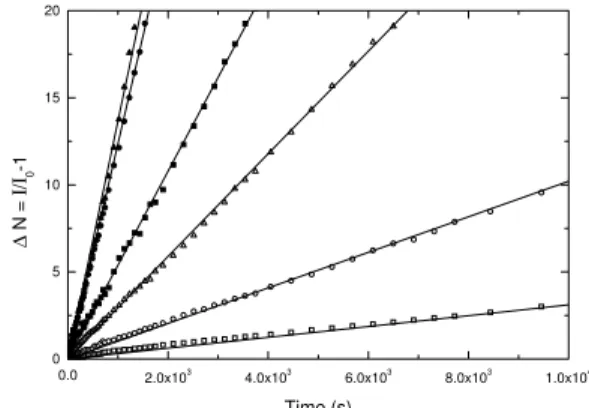
The sattered intensity grew ontinuously as
de-pitedin Fig.1. The growthsare well t bythelinear
relation
N = t (3)
withaelddependentgrowthrate (H):
0.0
2.0x10
3
4.0x10
3
6.0x10
3
8.0x10
3
1.0x10
4
0
5
10
15
20
∆
N =
Ι
/
Ι
0
-1
Time (s)
Figure1. Time evolution ofaggregation numberN, for
6 dierent eld strengths (H= .8, 1.6, 3.2, 8, 16 and 32
10 4
A/m).
NR D
h
: (4)
Eq.(4) ombined with eq.(1) shows that aplot of the
intensityagainsteetivehydrodynamiradius(also
z-average)allowsfor determination of frataldimension
of theaggregates. Theinreasedisplayedin Fig. 2as
alog-logplotshowsthatthelusters onsistofalmost
linear or strethed hains. The small deviation from
the ideal D = 1law anbe aounted for by the
de-tailsofomplexphenomenaaseither partileorhain
length polydispersity (hange of shape forthe
instan-taneous distributions), or thermal wiggling.
Polydis-persityouldleadtosubtlehainmass-sizeorrelation
eets whih analysis is beyond the sope of this
pa-per. Ontheotherside, theextreme wigglingofalong
string (entropy omparable to aligning energy) would
shrink the hain and thus slightly inrease the
ee-tive or observed fratal dimension. The limitingase
of aself-avoiding polymer should apply to a hain of
ferromagnetipartiles(ferrouid)intheabseneofan
externaleld. The analysis of suh problem has been
pioneered by Flory and results in afratal dimension
D1:7[17℄. Seealso[8℄foradisussiononthefratal
dimensionofdipolaraggregates.
100
1000
10
5
10
6
In
tens
it
y
(c
ps
)
Rh(nm)
Figure2. Log-logplotfortheintensityversushydrodynami
radius ina singleaggregation run (H= 810 4
A/m). The
straightlineisapowerlawgivingIR D
h
withD=1:1:1.
The power gives the fratal dimension of aggregates (see
text).
IV Disussion
Thegrowthsenarioweinvokeforthese resultsisthe
diusionlimitedaggregationproess[4℄. Thediusing
liposomes may get lose to eah other to suh an
ex-tentthattheindueddipoleswillinterat. Inaheadto
tailonguration,this interation isattrativeandits
strengthorinterationrangedependsonthemagneti
tothermalstrengthparameter:
=M 2
d 3
=k T (5)
where M =H is theliposome magnetization due to
the eld H, dis itsdiameter, andk
B
T isthe thermal
energy. The rate of aggregation will then depend on
partile mobility, density, and interation range. An
estimate ofarandom walkerollisionrateanbe
eas-ily obtained from rst priniples. From the
diusiv-ity D 2:1 10 8
m 2
/s of partiles with diameter
d200nmatvolumefration10 4
,itgives[8℄:
=6(d=D 2
):03Hz: (6)
Thisestimateisoftherightorderofmagnitudeas
om-pared to the highest measured rates (At saturation,
.014Hz). Ofourse, afration ofthe ollisionsare
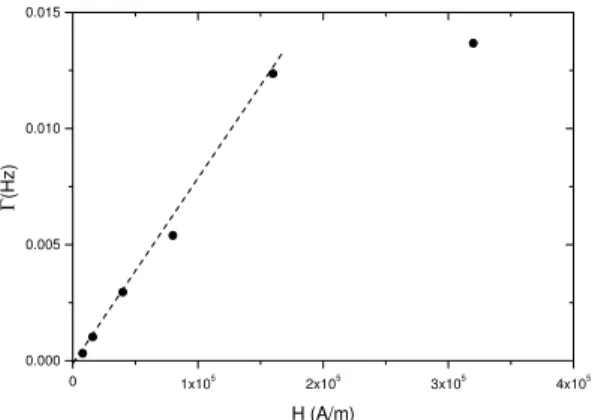
noteetive,astheymayeven berepulsive. InFig. 3
weplottheelddependeneofthegrowthrates. Sine
neitherdiusion,norsizeandonentrationareeld
de-pendent,weare led to theonlusionthat for smaller
elds one orboth the followingphenomena play. An
inreasing fration of the pairwise ollisions may not
bebindingeÆient(dueto theangularnatureand
de-reasingstrenghtofdipolar interations);andat weak
binding, ompetition with dissoiation rates beomes
inreasinglyimportant.
0
1x10
5
2x10
5
3x10
5
4x10
5
0.000
0.005
0.010
0.015
Γ
(H
z)
H (A/m)
Figure3. Growthrateasafuntionofeldstrength. The
saturation value isompatiblewithanestimatefora
pair-wise diusion limited aggregation proess. Dashed line is
a linear behavior at low elds. At strong elds the rate
saturates.
Theratesinreasealmostlinearlywiththeeldbut
seemtosaturateatsomepointaround210 5
A/m. This
orrelatesto aLangevintypesuseptibility,inreasing
interationstrengthuptosaturation(allferrouid
par-tilesin aliposomefully aligned). Asamatteroffat,
thelowesteldsusedouldalreadysaturate the
great-est ferromagneti ores. Using at maximum a 10nm
magnetite partiledipole moment, m210 19
Am 2
,
the saturation elds an be estimated from the
eld-dipole partileinterationenergy:
H k T=m>210 4
Similar experiments were performed by
Ha-genbuhleandLiu[7℄onferrouidemulsionsof466nm
dropletsatloweronentrations,andbyFermigierand
Gast [6℄ on 1.5m paramagneti latex spheres, both
at lowereld strengths. Their resultsontrast to the
ones reported here in two aspets. First, a stronger
(quadrati) eld dependent rate was reported. This
mayberelatedtotheirmeasurementsbeingdonewell
below saturation magnetization. They have also
ob-served non-linear growth N t z
with z :4 to .8.
It isobservedthat this powerinreaseswith both
vol-umefrationandinterationparameter. Clearly,
fur-ther measurements at broader eld strengths and
dif-ferentonentrationsshouldbepursuedtolarifythese
points.
Finallywenotethatthemagnetiliposome
disper-sion aggregation properties are in strong ontrast to
a pure ferrouiddispersion of same magneti ontent
[12℄. First, the ferrouid grows non-linearly (z > 1),
i.e., ooperative eets are more important in these
systems, inreasing the growthrate asaggregates get
bigger. Seond,liposomesgrowmuhfaster,sine
par-tilesarealreadyondensedinsidethevesilesfromthe
beginning.
Aknowledgments
This work was supported by the Brazilian ageny
CNPq.
Referenes
[1℄ H.ChenandR.Langer;\Magnetially-Responsive
Poly-merizedLiposomesasPotentialOralDeliveryVehiles";
Pharm.Res.14/4,537(1997).
[2℄ DeCuiperandM.Joniau,\Magnetoliposomes:
Forma-tion and haraterization"; Eur. Biophys. J. 15, 311
(1988).
[3℄ M.Shinkai, M.Yanase,M.Suzuki, H.Honda,T.
Wak-abayashi, J. Yoshida and T. Kobayashi; \Intraellular
hyperthermia for aner using magnetite ationi
lipo-somes" Journal of Magnetism and Magneti Materials
194,176(1999).
[4℄ T.VisekandF.Family,\DynamiSalingfor
Aggrega-[5℄ R.E. Rosensweig, Ferrohydrodynamis, Dover, NY
(1997).
[6℄ M.FermigierandA.P.Gast,\Strutureevolutionina
paramagneti latexsuspension"; J.M. M. M. 122, 46
(1993).
[7℄ M.HagenbuhleandJ.Liu,\Chainformationandhain
dynamis ina dilute magnetorheologial uid"; Appl.
Opt.36/30,7664(1997).
[8℄ G.Helgesen,A.T.Skjeltorp,P.M.Mors,R.Botet and
R.Julien,\AggregationofMagnetiMirospheres:
Ex-periments and Simulations"; Phys. Rev. Lett. 61/15,
1736(1988).
[9℄ M.Mohebi,N. Jamasbiand J.Liu,\Simulationof the
formationof nonequilibriumstrutures in
magnetorhe-ologial uids subjet to an external magneti eld";
Phys.Rev.E54/5,5407(1996).
[10℄ K.SanoandM.Doi,\TheoryofAgglomerationof
Fer-romagnetiPartilesinMagnetiFluids";J.Phys.So.
Jap.52/8,2810(1983).
[11℄ P.C.Jordan,\Fielddependenthainformationby
fer-romagnetiolloids";Mol.Phys.38/3,769(1979).
[12℄ P.Liinio, A. V.Teixeira, G.A. M. Safar,M. S.
An-drade,L.C.Meira-BeloandU.A.Leito,\Diusion
Lim-itedAggregationofMagnetiPartilesUnder aField";
J.M.M.M. 226-230,1986(2001).
[13℄ D.Needham,T.J.MIntoshandD.D.Lasi;
\Repul-sive interations and mehanial stability of
polymer-grafted lipid membranes"; Biohim. Biophys. Ata
1108,40(1992).
[14℄ L.D.Mayer,M.J.Hope,P.R.CullisandA.S.Jano;
\Solutedistributions andtrappingeÆieniesobserved
infreeze-thawedmultilamellar vesiles", Biohim.
Bio-phys.Ata817,193(1985).
[15℄ R. Nayar, M. J. Hope and P. R. Cullis; \Generation
of large unilamellar vesiles from long-hain saturated
phosphatidylholinesbyextrusiontehnique",Biohim.
Biophys.Ata986,200(1989).
[16℄ B.Chu; Laser Light Sattering, Basi Priniples and
PratieAademiPress, London,1991.
[17℄ P.-G.deGennes;Saling Conepts inPolymer Physis