Ferrouid Hydrodynamis: waves, Jets and Free Drops
H. E. Potts and D. A. Diver
Dept. ofPhysisandAstronomy, KelvinBuilding,
UniversityofGlasgow,Glasgow G128QQ,Sotland, UK
email:hughastro.gla.a.uk
Reeivedon17January,2001
A novel approah to hydrodynamial studies uses the bulk fore properties of magneti liquids
to probe the dynamis of (i) freely suspended drops; and (ii) unstable surfae waves and jets.
Theuiddynamisare imaged by afastCCD amera, allowing thoroughanalysis ofthese
time-dependent phenomena. Ferrouid drops are freely suspended in air by usingmagneti elds to
reateanattrativeforeopposinggravity. Thesuspendeddropthenundergoesforedosillations
byperturbingthesupportingmagnetield,andexhibitshighordernonlinearmodesofosillation
whih an be driven until the drop bifurates. Fluid surfae wavesand jets are investigated in
ylindrialgeometry.Nonlinearwavesaremagnetiallydriven,resultingindramatijetswhenthe
ritial amplitudeis exeeded. Suhjetsare observedto havea maximumaelerationexeeding
70g.
I Introdution
A ferrouid (FF) is a stable, olloidal suspension of
sub-mironsizedsingledomainmagnetipartilesina
liquid arrier, usually alight hydroarbon solvent, an
ester or simply water [1℄. A ferrouid in a magneti
eld,experienesafore perunitvolumegivenby:
f =
0 MrH
0
; (1)
where M is the magnetisation of the uid, and H
0 is
theappliedmagnetield. Theaboveequationassumes
thattheappliedeldisvaryingmuhmoreslowlythan
the magnetisation relaxation time for the ferrouid
(10 7
s). InthisaseMisparalleltoH
0
,andthe
fer-rouidbehaveslikeaparamagnet,loselyfollowingthe
Langevinlaw. ThisforestheFFtomovetotheregion
of strongest magneti eld, oering a straightforward
meansofmanipulatingtheuid.
The aim of this paper is to demonstrate how
fer-rouids an be used as a medium in whih to study
purely hydrodynami systems. The volume fore
de-sribedaboveis used as anon mehanialmehanism
tomanipulatetheuid,allowingsystemstobestudied
whihwouldnotbepossiblebyonventionalmeans.
InSetion IIwestudyofthedynamibehaviourof
freelysuspendedferrouiddrops,andSetionIII
exam-ines non-linearsurfaewavesand jetsexitedby
mag-netifores.
II Suspension of uid drops
Thereisalonghistorytotheproblemofthedynamis
ofthefreelysuspendeddrop,overingbothexperiment
and theory: [2℄-[8℄. In this artile, novel experiments
large(5-8mm)dropsofmagnetiliquidaresuspended
byanativelyontrolledmagnetieldgradient,whih
supportsthedropagainstgravity. Byapplyingasmall
time-dependent purturbation to the supporting
mag-neti eld, the drop an be fored to osillate. The
equilibriumshapeofafree,magnetiseddropis
approxi-matelyellipsoidal[6℄,duethebalanebetweenthe
mag-neti and surfae tension energies (see [9℄ for further
analysis).
II.1 The free suspension
In order to support a droplet of ferrouid against
gravity,thefollowingonditionmustbesatised:
g=
0 MrH
0
(2)
whereisthemassdensityoftheferrouid.
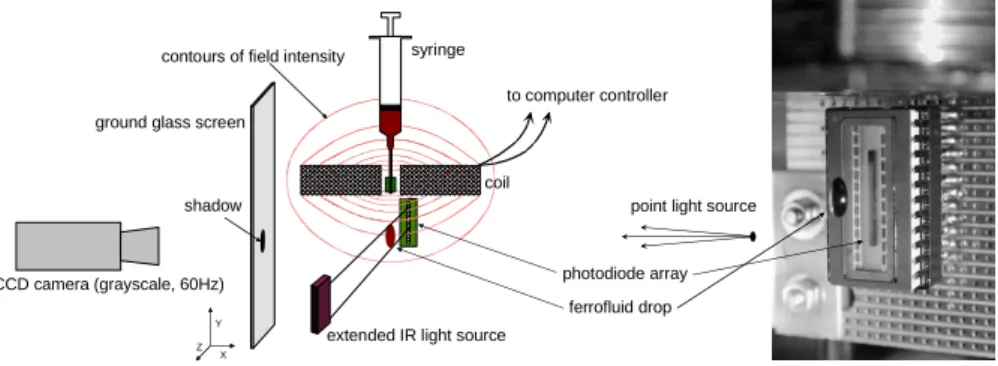
Thepratialimplementationof (2) requiresaoil
arrangementdesigned to onnethe dropin the
hori-zontalplane,withvertialstabilityahievedviaan
a-tivefeedbaksystem. InFig.1arosssetionoftheoil
shapeusedwithontoursofeldstrengthisshown.
In-formation on the drop position was obtained from a
lineararrayof16photodiodeswithaspaingof1mm.
Thesemeasuredtheshadowastbythesuspendeddrop
CCD camera (grayscale, 60Hz)
syringe
coil
to computer controller
photodiode array
extended IR light source
ferrofluid drop
ground glass screen
point light source
contours of field intensity
shadow
X
Y
Z
Figure1. Dropsupportoilwithmagnetieldshapeandimagingarrangement.
fromthesewaspassedtoaontrolomputerthatould
alulate the drop position and vertial axis length
with a resolution of about 0:1mm. To stabilise the
dropinthevertialdiretionthedropposition
informa-tionwasfedintoasoftwareimplemented
proportional-integral-derivative(PID) ontroller whih set the
ur-rentthroughtheoilofthelevitationmagnet. Typial
eld strengths werearound 0:02T.A drop of FF was
launhedfromasyringeinto theapparatus,wherethe
PID ontroller deteted it, and adjusted the eld to
ath and hold it. The volume of the drop dispensed
wasontrolledbythediameteroftheneedle. A
photo-graphofastablysuspendeddropisshowninFig. 1;the
equilibrium shape is learly elliptial in ross-setion.
Imagesofthedropswereobtainedusingadistant
pin-hole light soure to ast ashadow of the drop onto a
ground glass sreen. This was then reorded using a
fastCCDamerainterfaedtotheontrolleromputer
II.2 Fored osillations
Theeetofasinusoidaldisturbaneoftheurrent
in the stabilisingoil is to add aripple to the
poten-tialwell in whih thedrop issitting,ausing thedrop
to osillate. The predominant eet is the alteration
in the ambient magneti eld, whih in turn hanges
thedropshapeviahangesin themagnetitensionat
the surfae of the drop. For suÆiently high driving
frequenies (> 10Hz foraverage sized drops) the
po-sitionoftheentre ofmassof thedrop wasessentially
unhanged. Toinvestigate theformof high amplitude
osillationsthe drop wasdriven at resonane,i.e. the
frequenyatwhih thedropresponse wasmaximalfor
agivenamplitudeinput.
Awiderangeofosillationamplitudeswerepossible,
fromverysmallamplitudesforwhihthedropresponse
was essentiallylinear, to largeperturbations in whih
nonlinearmodeswereevident. Theleft handimage in
Fig.2showsameraframesofasmallamplitudeasein
whihtheequilibriumelliptiitywas0:80,andthedrop
volumewas16mm 3
. Thedrop osillates happilyin a
that as the amera anonly apture frames at 60Hz
theframespresentedinFig. 2arede-aliaseddatafrom
amuh longerontinuoustimeseries.
Figure2.Osillationofadropshownasde-aliaseddataover
ayle. Theleft handimagesshowthedropdrivenatlow
amplitude at resonane at 26Hz. Theright hand images
show the same dropdriven at high amplitude. The
reso-nant frequeny has now droppedto 23Hz. Theferrouid
was Ferrouidis [10 ℄ EMG909 and the drop volume was
16:0mm 3
.
Thesamedropwasthenforedat alargerdriving
amplitude, ausing signiant nonlinearity in the
re-sponse. Theameraimagesshownin intherighthand
yle (de-aliasedasbefore)revealagreaterelongation
of the drop, with the evolution of the proleshowing
learnonlinearityandtheonsetofhigher-ordermodes.
Notethatastheamplitudeofthedrivingperturbation
wasinreased, theresonantfrequenyof thedrop was
observedtoredue,to23Hzinthisase.
Ifthedrop isforedbeyond aritialamplitudeit
eventuallybifurates, as shown in thereal-time frame
sequene in Fig. 3. Note that as this is not a
pe-riodi event, de-aliasing is not possible. The frames
showspetaular higher-order modes in the evolution
towardssplitting. Frames3,6and9showsimilarmodes
tothoseseeninFig.2,albeitatsigniantlyhigher
am-plitude. Note that frame 6 almost ertainly has
on-avetop and bottom surfaes hidden from view sine
theseframesareonlyprojetionsandnotross-setions.
21, theliquidbridgeformsagain,but thistime breaks asthedropbifurates.
Figure3. Conseutiveframesat(16ms)intervalsshowing aferrouiddropdriventobifuration.
II.3 White noise stimulation
Inordertoexploreitsfullfrequenyresponse,a
sus-pendeddrop wasstimulatedbywhitenoiseata1kHz
samplerateandseveralamplitudesviatheontroloil.
Even at high driving amplitudes, the energy ontent
in a single frequeny is small, and the drop
dynam-is remainedloseto linear. TheFouriertransformof
the resulting response is given in Fig.4, in whih the
fundamental osillation frequeny at around 28Hz is
themostprominent,andwithatleastonehigherorder
mode visible in the region of 88Hz. There is also a
feature visibleat56Hz,whihisnotatrue
fundamen-tal mode; ratheritisaharmoniofthenon-sinusoidal
fundamental. Note also the slightdrift downwardsin
frequeny of the fundamental mode at higher driving
amplitudes.
III Surfae wave studies
The onept of a maximum amplitude standing wave
haslongbeenappreiatedexperimentally,and
theoret-ialanalysis ofthe shapeof theone-dimensional
max-imum wave, [12℄, [13℄ agrees with the experiment in
thattheyeahreoveramaximumangleattherestof
astandingwavetobe90 0
,withthetheoretial
assump-withthisritial waveisequalto g,theaeleration
duetogravity.
10
20
30
40
50
60
70
80
90
100
110
0
0.02
0.04
0.06
0.08
0.1
Frequency/Hz
10
20
30
40
50
60
70
80
90
100
110
0
0.1
0.2
0.3
0.4
0.5
0.6
0.7
0.8
0.9
1
amplitude /arbitary units
no drive
1mm
1.5mm
2mm
Figure4.Frequenyresponseofaferrouiddropofvolume
17mm 3
and rest elliptiity 0:81, subjeted to white noise
drivingsignalatdierentamplitudes. Thelowerplotshows
more detail around the resonanes. The response for no
drivingsignalisduetonoiseinthePIDontrollersystem.
Exeeding the maximum steepness of a standing
wave eventually results in uid jetting or splashing.
Pere-Numerial simulations of splashing [15℄ agree losely,
and very reent experimental studies, [16℄ oer
fur-ther insight into the r^ole of singularities and bubbles
in the evolution ofjets from over-fored standing
sur-faewaves.
III.1 The Experimental Setup
Theuidisdrivenbyaoilwrappedarounda
ylin-drial vessel of internal diameter 86mm, asshown in
Fig. 5.
θ
θ
θ
θ
θ = 35 ± 1°
Driving coil; 42 turns, 12 A max
powered by square wave
at 4–8Hz, 50% duty cycle
Laser sheet generator.
Perpendicular to camera
and fluid surface
Ferrofluid (Ferrosound APGJ12
viscosity = 40cp at 25°C)
depth at rest = 25mm
Cylindrical pyrex
container ID = 86 mm
CCD Camera 8 bit greyscale
640x482 pixels, 60 or 120Hz
1ms shutter
Camera view
Illumination system
Figure5.Experimentalsetup.
Themagnetieldproduedbytheoilhasa
gradi-entatthevesseledge,whihpullstheFFoutwardsand
upwards,asdesribed by (1). Forallexperiments,the
FF used was Ferrouidis APGJ12, and the
tempera-tureof theuid was maintainedat 322 0
Cin order
to keepthe visosityonstant. Theuid wasthen
ex-itedoverarangeoffrequenieswitha50%dutyyle
squarewave. Aslossesfromthesystemweresmall,the
requireddriving fore was alsosmall, and had onlyto
be suÆient to ompensate for visous losses. Hene
thesquare wavedriverapplied to theresonantsystem
didnotexitesignianthighharmonis.
Imaging the uid surfae presented onsiderable
tehnial problems, given that FF is blak and very
opaque,somewhat likeused engineoil. Thediuse
re-etions are thereforeveryweak, and thespeular
re-etionsrelativelybright. Togetaproleoftheaxially
symmetrisurfaeproduedby thesurfaewaves,the
wholearrangementwaslitwithavertialsheetoflaser
light,alignedperpendiulartotheamera.
Theuidmotionwasapturedusingafast
progres-sivesanCCD amera,andthe imageswerestreamed
into omputer memory by a frame grabber. Frames
ouldbegatheredatarateof60Hz,at aresolutionof
640482pixelswith256levelsofgreysale,orattwie
the frame rate with half the vertial resolution. The
amerawasangled at35 0
to thehorizontal toallowit
toseeintothebottomofthesurfaewavetroughs. Asa
result,theimagesobtainedwerevertiallyompressed,
the plane of thelaser light allowed the preise nature
and extentof this distortionto bemeasured, allowing
theimagestobeorreted.
This experimental setup produed images
onsist-ing of a dim line from the diuse surfae reetions,
and various bright speular reetions from spurious
soures. The surfae data was extrated
automati-allyfromtheimagesusingaomputeralgorithmthat
searhedforthe harateristiline prole,using
infor-mation from previous frames to predit its likely
po-sition and prole. Examples of surfae wave proles
reoveredbythistehniqueareshowninFig. 6.
III.2 Results
The experimental observations are presented here,
together with analysis of the data, and some simple
modelling. Two aspets of the driven uid were
ex-plored: resonant standing waves, and wave breaking
andjetting.
III.2.1Surfaewaveresponseasfuntionof
driv-ing frequeny
HeretheFFwassubjetedtoadrivingeldoflow
amplitude, for various dierent frequenies. The
res-onant response at 4:41Hz islearly seen in Fig.6,
to-getherwithafurther resonanenear 6:2Hz. Afurther
weakresonanearound(7:90:5)Hzwasalsoobserved,
and hasbeeninludedfor ompleteness. Note that at
be-angle in the imagingsystem asarranged for this
par-tiular experiment,theedgesof thevessel atthewave
heightannotbeviewed,andsotheprolesoftheuid
in Fig.6donotshowthefullwidth ofthedisturbane;
insteadtheaxeshavebeenextendedtoindiatethetrue
widthofthevessel. However,sinetheprimegoalhere
wasto show wave resonanes asa funtion of driving
frequeny, this is not a signiant drawbak,
partiu-larly sine thejetting experiments onentrateon the
fundamental mode. Clearerdataforthis4:4Hz
funda-mental modeare shown in Fig.8,where thefull width
ofthedisturbaneispresented.
A graph of the waveamplitude in response to the
driving frequeny is shown in Fig.7, demonstrating
learlytheresonanesat4:4Hzand6:2Hz. Notethat
theresonanesarerelativelywide,andasymmetri,
re-eting thefat that theuid is visous,allowing
o-resonaneoupling,andthewavesbeingexitedat
res-onane are nite amplitude. Unfortunately, the
reso-nane at 7:94Hz has poor signal-to-noise ratio when
displayed in this graph, but it is observed
experimen-tally,andthereforeworthquoting.
−40
−20
0
20
40
15
20
25
30
35
40
4.08Hz
radial distance /mm
fluid depth /mm
−40
−20
0
20
40
15
20
25
30
35
40
4.25Hz
radial distance /mm
fluid depth /mm
−40
−20
0
20
40
15
20
25
30
35
40
4.30Hz
radial distance /mm
fluid depth /mm
−40
−20
0
20
40
15
20
25
30
35
40
4.41Hz
radial distance /mm
fluid depth /mm
−40
−20
0
20
40
15
20
25
30
35
40
4.50Hz
radial distance /mm
fluid depth /mm
−40
−20
0
20
40
15
20
25
30
35
40
4.65Hz
radial distance /mm
fluid depth /mm
−40
−20
0
20
40
15
20
25
30
35
40
4.78Hz
radial distance /mm
fluid depth /mm
−40
−20
0
20
40
15
20
25
30
35
40
5.34Hz
radial distance /mm
fluid depth /mm
−40
−20
0
20
40
15
20
25
30
35
40
5.74Hz
radial distance /mm
fluid depth /mm
−40
−20
0
20
40
15
20
25
30
35
40
5.93Hz
radial distance /mm
fluid depth /mm
−40
−20
0
20
40
15
20
25
30
35
40
6.05Hz
radial distance /mm
fluid depth /mm
−40
−20
0
20
40
15
20
25
30
35
40
6.17Hz
radial distance /mm
fluid depth /mm
−40
−20
0
20
40
15
20
25
30
35
40
6.36Hz
radial distance /mm
fluid depth /mm
−40
−20
0
20
40
15
20
25
30
35
40
6.75Hz
radial distance /mm
fluid depth /mm
−40
−20
0
20
40
15
20
25
30
35
40
7.94Hz
radial distance /mm
fluid depth /mm
Figure6.Experimentallyreoveredwaveprolesforlowamplitudeosillationsatdierentfrequenies. Truevesseldiameter
isindiatedbytheextentofthehorizontalaxis.
4
4.5
5
5.5
6
6.5
7
7.5
8
5
10
15
20
25
30
35
40
centre amplitude/mm p−p
frequency/Hz
Figure 7. Plot ofamplituderesponse as a funtionof
fre-queny,showing the rst 2resonanes. Notethat a weak
resonane wasalsoobservedat7.9Hz.
The solution for the wave prole for ylindrially
symmetri waterwaves[17℄ issin(!t)J
0
(kr), where J
0
nate,!isthewavefrequenykisthewavenumberand
! 2
=gk. Taking the small-amplitude wavefrequeny
tobeat the entre ofeahresonanein Fig.7 yieldsa
satisfatoryt tothislineartheory.
III.2.2Resonantsurfae wave responseas
fun-tionofdriving amplitude
Inthissetofexperiments,theamplitudeofthe
driv-ingeldwasvariedatthefrequenyofthelowest
reso-nantmode(ataround4:4Hz,allowingforthefatthat
theresonantfrequenydropsasthewaveamplitude
-1
0
1
2
-4
-3
-2
-1
0
1
2
3
4
cm
cm
-1
0
1
2
-4
-3
-2
-1
0
1
2
3
4
cm
cm
Figure 8. Experimentally reovered wave proles for low
(top)andhigh(bottom)amplitudeosillationsforthe
low-estfrequenymode(around4:4Hz). Dottedlines indiate
theprolewhenthepeakisrising;solidlineswhenthepeak
isfalling.
0
5
10
15
3
4
5
6
7
8
9
10
11
maximum downwards acceleration
maximum upwards acceleration
Jetting
stability limit
acceleration = g = 9.81m.s
-1
driving current/A
ma
x
a
cce
ll
e
ra
ti
o
n
a
t
ce
n
tre
/
m
.s
-2
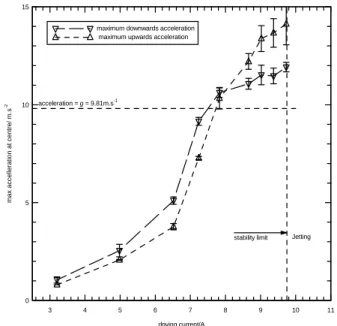
Figure9. Aelerationat therest as afuntionof driver
amplitude.
In the theoretial desriptions [12℄, the maximum
downwardaelerationattherestofthesurfaewave
mustnotexeedthatduetogravity. InFig.9,the
mea-suredaelerationoftherestasafuntion ofapplied
amplitude, driven resonantly, is plotted. Experiment
showsthatjettingbeginsifthedrivingurrentexeeds
I
max
= 9:7 A. For low amplitude waves, the
down-wardaelerationof therestis lessthan theupward,
but for highamplitudewavesthis trend isreversed as
theslopeofthedownwardaelerationurvedereases
markedly,andtendstoavalueofjust under12m s 2
at threshold. Clearly, this maximumdownward
ael-erationexeedsthetheoretialmaximumby20%,and
so there must be another downwardfore in addition
to gravity. This extrafore isprovidedby thesurfae
tension,basedonapplyingtheYoung-Laplaeequation
to the measuredradius of urvature of thewaverest
(see[18℄fordetails).
III.2.3 Surfae Jets
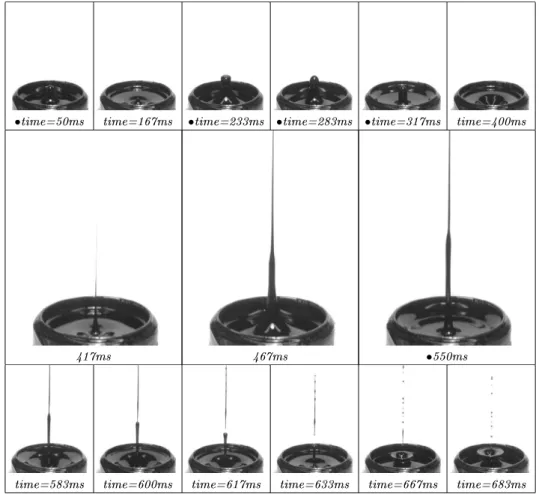
Choosingthelowestharmoniataround4:4Hz,the
amplitude of the standing wave was inreased to
be-yond the maximum amplitude, so that the urrent in
theoilexeededI
max
. Theuid responseisshownin
Fig.10 asa subset of 15 frames, seleted from a
om-plete sequene overing a 633 ms period. The early
framesshowtheextentofthenonlinearityintheuid
motion,withtheproleatteningverylearat233ms.
At417msan extraordinarilyne jetof0:2 mm
diam-eter is seen to erupt from an otherwise relatively at
surfae,andisapreursortoamuh moresubstantial
jetevidentsome50mslater. Takingthesurfaespeed
to beapproximatelyzeroat theentre at400ms, the
preursorjethastravelledavertialdistaneof
approx-imately105mmin the17 mspriorto thenextframe,
whihequatestoanaverageaelerationof726 m s 2
,
with aorrespondingmaximumspeedof 12:3m s 1
.
In ommonwith Ze et al [16℄, we take the initiation
ofthejettobeasingularevent,andnegletgravity.
Jettingoursbeausethesurfaetensionisbroken
by theappearane of asharp feature, assoiatedwith
the attening of the surfae wave prole in the yle
immediatelybeforetheonsetofinstability.
Fig. 11showsthis eetverylearly: notonlyhas
the wave topattened, but a dimple has appeared in
the entre. Whenthe main osillation moves into its
downward stroke, the edges of the dimple meet in a
sharpfeaturethatdestroysthesurfaetension,leading
■✁✄ ❏ ☎ ✝ ✟ ✄ ◆ ■✁✄ ❏ ☎ ✡ ☛ ✌ ✄ ◆ ■✁✄ ❏ ☎ ✏ ✒ ✒ ✄ ◆ ■✁✄ ❏ ☎ ✏ ✔ ✒ ✄ ◆ ■✁✄ ❏ ☎ ✒ ✡ ✌ ✄ ◆ ■✁✄ ❏ ☎ ✕ ✟ ✟ ✄ ◆
✕ ✡ ✌ ✄ ◆ ✕ ☛ ✌ ✄ ◆ ✝ ✝ ✟ ✄ ◆
■✁✄ ❏ ☎ ✝ ✔ ✒ ✄ ◆ ■✁✄ ❏ ☎ ☛ ✟ ✟ ✄ ◆ ■✁✄ ❏ ☎ ☛ ✡ ✌ ✄ ◆ ■✁✄ ❏ ☎ ☛ ✒ ✒ ✄ ◆ ■✁✄ ❏ ☎ ☛ ☛ ✌✄ ◆ ■✁✄ ❏ ☎ ☛ ✔ ✒ ✄ ◆
Figure10. Sequeneofframesshowingarapidlymovingjetevolvingfromanoverforedstanding wave;denotesnon-zero
oilurrent.
Figure. 11 Evolution of a sharp feature on an unsteady
overdrivenosillation. Thelaserlinehasbeenenhanedfor
larity.
IV Conlusions
WehavedemonstratedtheeÆayof magnetiliquids
astoolsintheinvestigationofnon-linear
hydrodynam-ialphenomena.
In this paper we have shown that it is possibleto
ing an ative ontrol system. These suspended drops
anthen be manipulated byapplying ℄arbitrary
time-varying signals to the supporting potential, allowing
drops to be studied as if in mirogravity. The
equi-librium shape as a funtion of applied magneti eld
was veried for suspended drops. For small
ampli-tudeosillations,ellipsoidal(or moreorretly,prolate
spheroidal)modesareobserved. Quantitative
measure-mentsof the modefrequenies were undertaken using
broad-bandwhitenoisestimulation.
Thispaperalsoshowshowmagnetiliquidsanbe
usedtostudysurfaewavesforevensmallvolumesofa
visousliquid(inthisase,145). Thewaveevolution
asafuntionofforingamplitudewasinvestigated,
re-sultinginthereationofrapidlyaeleratingjetswhih
were imaged by a fast, high resolution CCD amera.
This ombination of magneti foring and fast image
aquisitionhasallowedthesurfaeinstabilityand
Aknowledgements
Theauthorsare grateful forresearh funding from
the UK EPSRC, under grant number GR/L90699.
ThanksarealsoduetoRihardBarrett,Sinlair
Brem-ner,PaulMillarandNealWadeforstimulating
disus-sions.
Referenes
[1℄ Rosensweig, R.E.: 1985,Ferrohydrodynamis,
Cam-bridgeUniversityPress,Cambridge,UK.
[2℄ Azuma, H., Yoshihara, S., J. Fluid Meh. 393, 309
(1999).
[3℄ Lee,C.P.,Anilkumar,A.V.,Hmelo,A.B.,Wang,T.G.,
J.FluidMeh.354,43(1998).
[4℄ Lebedev, A.V, Morozov, K.I., JETP Lett. 65, 161
(1997).
[5℄ Bari, J.-C., Cebers, A., Perzynski, R., Phys. Rev.
Lett.72,2705 (1994).
[6℄ Arkhipenko, V.I., Barkov, Yu.D., Bashtovoi, V.G.:
MagnitnayaGidrodinamika3,131(1978).
[7℄ Sero-Guillaume, O.E., Zouaoui, D., Bernardin, D.,
Branher,J.P.,J.FluidMehs.241,215(1992).
[8℄ Suryanarayana,P.V.R.andBayazitoglu,Y.,Phys.
Flu-idsA,3,967(1991).
[9℄ Potts,H.E.,Barrett,R.K.,Diver,D.A.: \Dynamisof
freely-suspendeddrops",JournalofPhysisD:Applied
Physis,342529,(2001).
[10℄ FerrouidisLtd,TalismanBusiness Centre,Biester,
Oxon.OX266HR,UK.
[11℄ Taylor,G.I.,Pro.Roy.So.Lond.A218,44(1953).
[12℄ Penney, W.G., & Prie, A.T., Phil. Trans. Roy.So.
Lond.A244,254(1952).
[13℄ Longuet-Higgins, M.S., Pro. Roy.So. Lond. A331,
445(1973),
[14℄ Peregrine,D.H.,J.FluidMeh.106,59(1981).
[15℄ Anderson,A.,DiverD.A., Peregrine,D.H.1990,Pro
5th International Workshop on Water Waves and
FloatingBodies,Manhester.
[16℄ Ze,B.W.,Kleber,B.,Fineberg,J.,LathropD.P.,
Na-ture,403,401(2000).
[17℄ Stoker,J.J.: 1957,WaterWaves,Intersiene
Publish-ers,NewYork,USA.
[18℄ Potts, H.E., Diver, D.A.: \Largeamplitudeferrouid
surfae wavesand jets"New Journal of Phys.3: