Dynamis of the Labyrinthine Patterns at the
Diuse Phase Boundaries
A. Cebers
InstituteofPhysis,UniversityofLatvia, Salaspils-1,LV-2169,Latvia
Reeivedon15February,2001
Thephase diagram ofa magnetiolloid inaHele-Shaw ell isalulated. As afuntion of the
magnetield strength, of the onentration and of the layerthikness the magnetiolloidan
nditselfinastripephase,thehexagonal phaseor inanunmodulatedstate. Thoseresultsallow
to interpretexperimentsobserving thetransformation ofalabyrinthine patterninto ahexagonal
struture. This possibility is onrmed diretly by the numerial simulation presented here and
showingthetransformation ofthelabyrinthinepatternintothehexagonalstruture.
I Introdution
The wonderful labyrinthine patterns formed by the
magnetiliquids intheHele-Shawells[1℄ havedrawn
attention from dierent points of view [2℄.
Investiga-tionsarriedoutsofarshowthatthelabyrinthine
pat-ternsformedbythemonophasiliquidsonservestheir
topology anddoes notbreak upinto aset of separate
droplets [1, 3, 4℄ asould beexpeted due to the
mu-tualrepulsionof thedipoles. Althoughitisillustrated
in theframeofthelineartheorythatthemagneti
liq-uidstripesareunstablewithrespet tothe
overexten-sions[5℄neverthelessin[6℄itisfoundnumeriallythat
this instability is stabilized at the nonlinear stage by
thevertexsplittinginstability. Thussomeontroversy
stillremainswiththeexperimentalresultsshowninthe
review paper [7℄ where it was found a transformation
of a labyrinthine pattern formed by the onentrated
phaseofamagnetiolloidintoahexagonalstruture.
In thepresentpaper,analytial and numerialresults
are given whih show that this transition an be
ex-plainedbythepeuliaritiesofthephasediagramofthe
magnetiolloidintheHele-Shawell. Theyshowthat
dependingonthevaluesofthephysialparametersthe
dierentphases-thestripephase,thehexagonalphase
andtheunmodulatedphaseanexist. Thusthe
trans-formationof thelabyrinthinepattern intothe
hexago-nalonein theframeof thepresentmodelisonneted
witha transition betweenthose phases. That is
illus-tratedherebytheorrespondingnumerialsimulation
results.
II Phase diagram of the
mag-neti olloid in the Hele-Shaw
ell
Thephasediagramofasimilarsystem-thepolar
am-phiphilemonolayer-hasbeenalulatedin[8,9℄. From
thepointofviewofoursystemthatorrespondstothe
vanishing thikness of the Hele-Shaw ell. The
alu-lation of the phase diagram for the nite thikness is
arriedoutonthebasisof thefreeenergy proposedin
[10℄. Itindimensionlessvariablesreads
F = 1
2 Z
2
dS+ 1
4 Z
4
dS+ 1
2 Z
(r) 2
dS+
Bm
(h=l) 2
Z
dS Z
dS 0
( ~)( ~ 0
)
1
p
( ~ ~ 0
) 2
1
p
( ~ ~ 0
) 2
+(h=l) 2
!
where the following saleshave been introdued ( = 2 M n 2 (H H );= 1 6 3 n 3
): length-l= p
= ,the
on-entrationÆn -p
=,thevolumedensityofthefree
en-ergy 2
=. ~;~ 0
- arethe dimensionlessradius-vetors
ofthepointsontheboundaryoftheHele-Shawell,h
-athiknessoftheell,-adimensionless
onentra-tion, the magneti Bond number is dened aording
to the relation M n 2 h l
. The expression (1) for the
freeenergyorrespondstotheusualLandauexpansion
near the ritial point of the demixing with aount
for the energy term due to thenonhomogenity of the
onentration 2 Z (rÆn) 2 dV
and long-range interations. Allowing the respetive
spatialmodulationaroundfortheonentration
dis-tributioninthestripeandthehexagonalphases
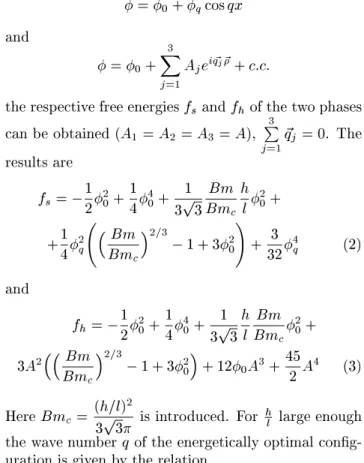
= 0 + q osqx and = 0 + 3 X j=1 A j e
iq~
j ~
+::
therespetivefreeenergiesf
s andf
h
ofthetwophases
anbeobtained(A
1 =A 2 =A 3 =A), 3 P j=1 ~ q j
=0. The
resultsare f s = 1 2 2 0 + 1 4 4 0 + 1 3 p 3 Bm Bm h l 2 0 + + 1 4 2 q Bm Bm 2=3
1+3 2 0 ! + 3 32 4 q (2) and f h = 1 2 2 0 + 1 4 4 0 + 1 3 p 3 h l Bm Bm 2 0 + 3A 2 Bm Bm 2=3
1+3 2 0 +12 0 A 3 + 45 2 A 4 (3)
HereBm
= (h=l) 2 3 p 3
isintrodued. For h
l
largeenough
thewavenumberqoftheenergetiallyoptimal
ong-urationisgivenbytherelation
q= 2Bm (h=l) 2 ! 1=3
whatever the pattern. Minimizing the expression (2)
and (3) withrespet to
q
and A thedependeniesof
the free energies of the stripe and hexagonal phases
ontheaverageonentrationintheHele-Shawellan
be found. The free energies alulated are shown in
Fig. 1 and Fig. 2 for the stripe and the hexagonal
phasesorrespondingly. ConerningFig. 1it is
nees-valuelessthanthevalueBm
orrespondingtothe
tri-ritial point of the transition betweenthe stripeand
unmodulated phasesfound in [11℄. Thevalue ofBm
anbefoundfromtheequation
3 Bm Bm ! 2=3 =4 2 3 p 3 Bm Bm h l
At Bm > Bm
transition between the unmodulated
and thestripephasesis ontinuous. From Fig. 1and
Fig. 2itis lear that arangeof onentrationsexists
where, forthe system,itisthermodynamially
advan-tageous tophaseseparate into thetwodistint phases
- modulated andunmodulated. Theonentrationsof
the phases at equilibrium are found from the double
tangentonstrution f i 0 = f 0 = f i f i where f i ; i
(i=s;h) arerespetivelythevaluesof the
free energy and the onentrations of the modulated
phases, and f; are the orresponding values for the
unmodulated phase. It is important to remark that
the atualequilibrium between thestripe andthe
un-modulated phases, in theframe of the present model,
takesplaeatquitesmallBmvalues. ForvaluesofBm
largeenoughin theintermediate onentrationregion,
astablehexagonalphaseexistsandtheequilibrium
be-tween the stripe and and the hexagonal phases must
be onsidered. The onentrations of those phases at
equilibriumanbefoundfromtheonstrutionsimilar
to theone shown in Fig. 1and Fig. 2. The resulting
phasediagramis alulatedand isshown inFig. 3. It
istheneasytoseethat,aordingtothepresentmodel
and depending on the values of the physial
parame-ters thesystem annditself either in the stripe, the
hexagonalortheunmodulatedphases. Sinethemean
onentration
0
ishereassoiatedto adistane from
the olloidalritial point itdepends onthemagneti
eld strength [12℄. Then a variation of the external
magnetieldallowstogofromtheregion
orrespond-ingtoonephasetotheregionorrespondingtoanother
one. Thusintheframeofthepresentmodelitis
possi-ble togiveaquitenaturalinterpretation tothe
obser-vation in [7℄ of thetransformation of the labyrinthine
pattern to the hexagonalone. Namely due to the
de-pendeneof theritialonentrationonthemagneti
eld strength a eld inrease shifts the systemto the
region of the phase spae where the hexagonal phase
is stable andasaresultthetransition from thestripe
phasetothehexagonalonetakesplae. Thispossibility
0.1
0.2
0.3
0.4
0.5
0.6
0.7
-0.06
-0.04
-0.02
0.02
0.04
f
j
0
Figure1. Freeenergyofthemagnetiolloidbelowthe
tri-ritialpointofthestripe-liquidtransition. ( Bm
Bm
=0:25<
Bm
Bm
;
h
l =10).
0.05
0.1
0.15
0.2
0.25
0.3
-0.055
-0.05
-0.045
-0.04
-0.035
j
0
f
Figure 2. Freeenergiesofthehexagonal andliquidphases
( Bm
Bm
=0:25and h
l
=10). Conentrationsofthephasesin
theequilibriumare foundby thedoubletangent
onstru-tion.
0.1
0.2
0.3
0.4
0.5
0.6
0.7
0.8
0.2
0.4
0.6
0.8
1
Bm
Bm
c
j
0
Figure3. Phasediagramofthemagnetiolloidinthe
Hele-Shawell. h
l =10.
III The results of numerial
sim-ulation of the magneti eld
indued phase
transforma-tion
Theequationdesribingtheonentrationdynamisat
the magneti eld indued phase transformation in a
Hele-Shawellisderivedin[13℄. Ifputina
dimension-lessform itreads
t +
3
+
2Bm
(h=l) 2
Z
J( ~ ~ 0
; h
l )( ~
0
)dS 0
=0 (4)
d
where J( ~;h) = 1
p
~ 2
1
p
~ 2
+h 2
. The algorithm of
the simulation of the onentration dynamis
aord-ing to the equation (4) is based on the
pseudospe-tral tehnique[13℄. Iftheinitial valuesofthephysial
parameters, assoiatedto a labyrinth, arehangedfor
those assoiated to a stable hexagonal pattern, then
the transformation of the labyrinthine pattern to the
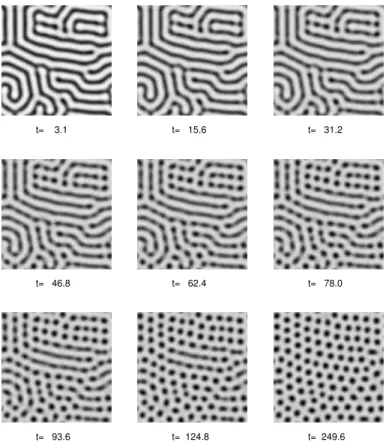
hexagonal takes plae. This is shown in Fig.4. It
should be noted that the proess shown in Fig. 4 is
in good agreement with the phase diagram shown in
Fig. 3sine at the values of the physial parameters
hosen(Bm=Bm =0:78;h=l=10; =0:2) the
sys-temfoundsitselfintheregionofthephasespaewhere
thehexagonalphaseisstable. Thetransitionsbetween
thehexagonalandthestripephasesarereversible. Itis
shownin Fig. 5forthevaluesofthephysial
parame-ters(Bm=Bm
=0:78;h=l=5;
0
=0:05): thestripes
formfromthehexagonalstrutureinitiallyobtainedat
(Bm=Bm
=0:78;h=l=5;
0
=0:2). Finallywean
remarkthatifinitialvaluesofthephysialparameters
ishosenintheintermediateregionbetweenthestripe
andthehexagonalphases,patternontainingamixture
ofdumbbellsandsingledropletsanbeobtained,asit
t= 3.1
t= 15.6
t= 31.2
t= 46.8
t= 62.4
t= 78.0
t= 93.6
t= 124.8
t= 249.6
Figure4. Transformationofthestripestruturetothehexagonalpattern( Bm
Bm =0:78;
h
l
=10;0=0:2).
t= 73.4
t= 220.4
t= 367.2
t= 514.0
t= 734.7
t= 1102.1
t= 1468.3
t= 3665.6
t= 5862.8
Figure 5. Transformation of the hexagonal struture to the stripe struture at the derease of the mean onentration.
Bm
Bm
=0:78; h
l
=5;0=0:05. Initialpattern-thehexagonalstrutureformedat Bm
Bm
=0:78; h
l
t= 76.7
t= 153.4
t= 230.0
t= 766.8
t= 1150.3
t= 2303.8
t= 3841.9
t= 4602.8
t= 6116.5
Figure6. Mixedintermediatestateofthemagnetiolloid( Bm
Bm =0:3;
h
l
=10;0=0:075).
IV Conlusion
The alulated phase diagram of magneti olloids in
aHele-Shawellshowstheexisteneofstripe,
hexago-naland unmodulatedphases. Thetransitionsbetween
those phases anbe aused by thevariation ofan
ex-ternal parameter: the magneti eld strength or the
layer thikness. Those results allow to explain the
experimental observation of the labyrinthine pattern
transformationintoanhexagonalstrutureofseparated
droplets by only the shifting the point in the phase
spae assoiated to the new magneti eld strength.
Aninterestingissueabouttheharaterofthe
topolog-ialtransformation takingplae atthe transformation
of the stripe pattern to the struture of the separate
dropletsremainstobeinvestigated.
Referenes
[1℄ A.Cebers,M.M.Mayorov.Struturesofinterfaeofa
bubbleandmagnetiuidinaeld.Magnitnaya
Gidro-dinamika(inRuss.),16,231(1980).
[2℄ Speial issue Labyrinthinepattern formation.
Magnit-naya Gidrodinamika,35(1999).
[3℄ R.E.Rosensweig,Ferrohydrodynamis Cambridge
Uni-versityPress,NewYork,1985.
[4℄ F. Elias, C. Flament, J.C. Bari, S. Neveu.
Maro-organized patterns in ferrouid layer: experimental
studies.J.PhysiqueI,7,711(1997).
[5℄ A.Cebers,M.M.Mayorov.Magnetostati instabilities
intheplanelayersofmagnetizableuids.Magnitnaya
Gidrodinamika(inRuss.),16,27(1980).
[6℄ A.Cebers,I.Drikis.Anumerialstudyoftheevolution
ofquasi-two-dimensionalmagnetiuid shapes.
Mag-nitnayaGidrodinamika,32,11(1996).
[7℄ J.C.Bari,R.Perzynski,D.Salin.Lesliquides
magne-tiques.Reherhe, 18,1150 (1987).
[8℄ D.Andelman,Fr.Brohard,J.-F.Joanny.Phase
tran-sitions in Langmuir monolayers of polar moleules.
JournalofChemialPhysis,86,3673(1987).
[9℄ D. Andelman, Fr. Brohard, P.-G. de Gennes, J.F.
Joanny. Transitions de monoouhes a moleules
po-laires. C.R.Aad.S.Paris, 301,675(1985).
[10℄ A.Cebers.Onformationofperiodialstruturesinat
layersbyferromagneti olloids. Magnitnaya
Gidrodi-namika(inRuss.),30,132(1986).
[11℄ A. Cebers. Magneti olloid pattern formation at
magnetield induedphase separation. Magnitnaya
Gidrodinamika,35344(1999).
[12℄ A. Cebers. Thermodynami stability of magneti
liq-uids. Magnitnaya Gidrodinamika (in Russ.), 18, 42
(1982).
[13℄ A.Cebers.Instabilitiesofonentrationstripepatterns