824 Brazilian Journal of Physics, vol. 35, no. 3B, September, 2005
Partial Escape Width for Nuclei with Neutron Excess
T. N. Leite1 and N. Teruya2
1 Fundac¸˜ao Universidade Federal do Vale do S˜ao Francisco (UNIVASF)
Colegiado de Engenharia Civil, Juazeiro, BA, Brazil. 2 Departamento de F´ısica, Universidade Federal da Para´ıba
CP 5008, 58051-970 Jo˜ao Pessoa, PB, Brazil
Received on 8 December, 2004
In this work, the escape width for nuclei with neutron excess is calculated by continuum Random Phase Approximation (RPA) with a careful treatment on the differences between the densities of neutrons and protons.
I. INTRODUCTION
In this work, the escape width for nuclei with neutron ex-cess is calculated by continuum Random Phase Approxima-tion (RPA) of the Ref.[1] with a careful treatment on the diffe-rences between the densities of neutrons and protons [2]. The calculation of partial escape width for each single-hole gives a good estimate of the escape width composition for the po-pulation of several single-holes in the residual nucleus. We have applied this method in order to estimate the energy loca-tion and the partial escape widths for pygmy dipole resonance (PDR) in the exotic nucleus60Caand for isoscalar giant dipole resonance (ISGDR) in the208Pb.
In the Sect. II of this work, we presented a summary of the continuumRPA formalism that accommodates the diffe-rences between neutron and proton densities. We present and comment our results in the Sect. III.
II. RPAFORMALISM
The continuum effects in our microscopic calculations are taken into account through a discrete particle-hole basis which accomodates the single-particle resonance widths, resulting in a diagonalization ofRPA-like complex matrixes of standard size [1]. The excited states are implemented in the particle-hole excitation space, and the open channels correspond to unbound particle-hole states with complex energies, of which the imaginary parts give the single-particle escape widths.
The complex particle-hole modes are solved by a diagona-lization of the discreteRPAequations:
µ
A B
−B −A ¶ µ
Xn Yn
¶ =bεn
µ Xn Yn

(1)
where:
Aphp′h′= (bεp−εh)δpp′δhh′+Vph′hp′;Bphp′h′ =Vpp′hh′ ; (2) andbεp (bεp=εp−12iΓp) are the complex energies of the single-particle resonances [3, 4]. Diagonalizing the plex Eq.(1), we have the complex eigenvectors given by com-plexXphn andYphn amplitudes and complex eigenvaluesbεn= εn−12iΓ↑n. Thus, in this discrete particle-hole subspace, the
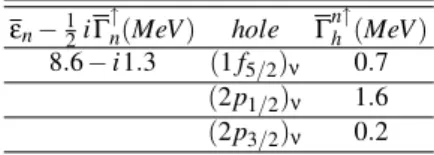
TABLE I: The evaluated escape widths, and the estimates of the par-tial escape widths for each single-hole, of the three main peaks that compose thePDRin∼8.6MeV.
εn−12iΓ ↑
n(MeV) 8.05−i1.29 8.69−i1.35 8.94−i0.40
single−hole Γnh↑(MeV)
(1f5/2)ν 2.26 0.05 0.04 (2p1/2)ν 0.39 2.65 0.09 (2p3/2)ν 0.02 0.20 0.71
TABLE II: Estimates for the mean values of the escape widths for thePDR.
εn−12iΓ ↑
n(MeV) hole Γ
n↑
h (MeV)
8.6−i1.3 (1f5/2)ν 0.7 (2p1/2)ν 1.6 (2p3/2)ν 0.2
escape width is associated with the contribution of all al-lowed unbound particles coupled to their respective single-holes. The partial escape width for each single-hole can be approximate forΓnh↑≃∑p
¯ ¯ ¯Xphn
¯ ¯ ¯ 2
Γp, what gives a good es-timate of the escape width composition for the population of several single-holes in the residual nucleus.
The single-particle energies are evaluated by solving the Schr¨odinger equation with Woods-Saxon potential, inclu-ding the centrifugal and Coulomb (as a uniformly charged sphere) terms [3, 4]. The RPA calculation is done by uti-lizing the Landau-Migdal residual interaction with density dependent parameters. Since the neutron and proton densi-ties are too different in exotic nuclei, it is more appropri-ate to separappropri-ate the nucleon density into neutron and proton parts,ξ(r) =N
Aξν(r) + Z
Aξπ(r), where each part is given by
ξk(r) = 1
1+e(r−Rk)/ak , withk=ν(π)for neutron (proton) [2]. In this same sense, the radial single-particle orbits are re-presented by harmonic oscillator radial wave functions with different size parameters for neutrons and protons, b2
k ≈
4
(3)43
hr2ik(Xk)−13 , whereXk=N(Z)fork=ν(π), andhr2ik≈
3 5R2k+
7
T. N. Leite and N. Teruya 825
TABLE III: Partial escape widths for one neutron and one proton direct decay fromISGDRin208Pbnucleus. Only the main values greater than 0.1MeV are displayed.
εn−12iΓ ↑
n(MeV) hole Γ
↑
h(MeV) hole Γ
↑
h(MeV) hole Γ
↑
h(MeV)
24.40−i1.35 (2f7/2)ν 0.58 (1g7/2)ν 0.25 (1h11/2)π 0.19 (1h9/2)ν 0.47 (1g9/2)ν 0.22 (2d5/2)π 0.13
(2d3/2)ν 0.19 (2d5/2)ν 0.16 (1g7/2)π 0.23
III. RESULTS AND DISCUSSIONS
In this section, we present and discuss some results which we have obtained by using 1p−1h continuum RPA appro-ach, as described in the previous section, for isovector dipole electric transition for60Caand isoscalar dipole transition for 208Pb.
According to previousRPAcalculations for60Ca[5–8], our calculations [2] also predict a considerable strength in the energy region around∼8.6MeV with a broad neutron peak. The broad width is due to the fact of the energy of the re-sonance to be above of the small neutron separation energy, implicating a strong coupling of the external neutrons to the continuum region. These low-lying energy states are the na-tural candidates forPDRbecause they have a dominant con-tribution of ‘neutron skin’ (p f shell), in agreement with hy-drodynamic interpretation. The wide peak in ∼8.6 MeV is composed by the overlap of three main peaks (see TABLE I and II) exhausting about 8% of theEW SR.
In relation to the isoscalarGDRin208Pb, the experimen-tal data are not well defined and present some discrepancy.
There are some discussions in the recent literature in relation to its correct location and their widths [9–12]. Our calculati-ons predict a ccalculati-onsiderable strength in the energy region above 20MeV, which is composed by the presence of various nar-row peaks superposing to exhaust about 82% of theEW SR between 20−30 MeV. These peaks are mainly composed by 3hωtransitions involving the neutrons and protons of the externals shells. The strength of this excitation is separated in two main components, in agreement with all experimen-tal data. The lower-energy component is due to the remai-ning isovector contribution. The higher-energy and broader component is identified as isoscalarGDR. The mean energy centroid and escape width of this component are 24.4 MeV and 2.7MeV, respectively. The partial escape widths for this mode are presented in TABLE III.
IV. ACKNOWLEDGMENTS
This work was supported in part by Conselho Nacional de Desenvolvimento Cient´ıfico e Tecnol´ogico (CNPq), Brazil.
[1] N. Teruya, A.F.R. de Toledo Piza, and H. Dias, Nuclear Physics A556, 157 (1993).
[2] T. N. Leite and N. Teruya, Eur. Phys. J. A21, 369 (2004). [3] N. Teruya, A.F.R. de Toledo Piza, and H. Dias, Phys. Rev. C44,
537 (1991).
[4] T. N. Leite, N. Teruya, and H. Dias, Int. J. Mod. Phys. E,11, 469 (2002).
[5] F. Catara, E. G. Lanza, M. A. Nagarajan, and A. Vitturi, Nuclear Physics A624, 449 (1997).
[6] I. Hamamoto, H. Sagawa, X. Z. Zhang, Phys. Rev. C57R1064 (1998).
[7] D. Vretenar, N. Paar, P. Ring, and G. A. Lalazissis, Nuclear
Physics A692, 496 (2001).
[8] N. D. Dang, T. Suzuki, and A. Arima, Phys. Rev. C61, 064304 (2000); N. D. Dang, V. Kim Au, T. Suzuki, and A. Arima, Phys. Rev. C63044302 (2001).
[9] B. F. Davis et. al., Phys. Rev. Lett.79, 609 (1997).
[10] H. L. Clark et. al. Nuclear Physics A 649 (1999) 57c-60c; H. L. Clark, Y. W. Lui ,and D. H. Youngblood, Phys. Rev. C63, 031301(R) (2001).
[11] M. Uchida et. al., Physics Letters B557, 12 (2003).