Brazilian Journal of Physics, vol. 35, no. 3B, September, 2005 751
Rossi-
α
Experiment in the IPEN/MB-01 Research Reactor
R. Kuramoto, Adimir dos Santos, Rog´erio Jerez, Ulysses D‘Utra Bitelli, Ricardo Diniz, Tufic Madi Filho, and Samuel C. Santos Instituto de Pesquisas Energ´eticas e Nucleares - IPEN/CNEN
Received on 2 December, 2004
One major objective of this work is to experimentally estimate the following kinetic parameters on the IPEN/MB-01 research reactor at S˜ao Paulo: the effective neutron delayed fraction,βe f f, the prompt neutron
generation time,Λ, and the ratioβe f f/Λ. In order to achieve our goal, we will use a microscopic noise
techni-que called Rossi-αmethod. This method is based on the statistical nature of the fission-chain process. Using a coincidence acquisition system, the rationale is to experimentally determine the probability distribution of detecting neutrons from the same chain. Through a least-squares fit of this distribution we estimate the prompt neutron decay constantα= (βe f f−ρ)/Λ. Theαparameter will be measured for three sub-critical levels using
three different source configurations, and the ratioβe f f/Λis obtained via a extrapolation toρ=0. A specific
acquisition system for Rossi-αmeasurements has been developed in order to achieve our objective. This system is based on a multichannel scaler controlled by virtual instruments that records the timing of all neutron events, allowing data analysis during the acquisition. The first measurements were performed using twoBF3detectors positioned at the center of IPEN/MB-01 reactor core. In the future the same measurements described above will be performed using3Heand photodiode detectors. The photodiode detectors have been developed by the Reactor Physics Division of IPEN. In this work we will present a preliminary set of Rossi-αmeasurements performed on the IPEN/MB-01 research reactor at S˜ao Paulo.
I. INTRODUCTION
The Rossi-αexperiment, the first of the neutron counting techniques [1–3], was introduce by Rossi, who suggested that nuclear assemblies were self-modulating because of the pre-sence of long chains and that prompt-neutron lifetime could be obtained by measuring the time average distribution of neutrons associated with a common ancestor. Nowadays, the Rossi-αexperiment is one of the standard techniques of reac-tor noise analysis, and has been used currently for determining the prompt neutron decay constantα= (βe f f−ρ)/Λ.
This technique is based on the fact that the occurrence of a fission in an assembly is nonrandom because the time correla-tion between neutrons that have a common ancestry. Using a coincidence acquisition system, the rationale is to experimen-tally determine the probability distribution of detecting neu-trons from the same chain. To ensure that the time-correlated counts are not lost in the random background, the fission rate must be kept low enough to prevent any significant overlap-ping of chains in the assembly. The Rossi-αdistribution, re-lated to the correlation function of neutrons detection time se-ries, can be derived theoretically through a birth-to-death pro-bability balance equation. In this work we only consider the following Rossi distribution prossi for a point kinetic model without delayed neutrons[4]:
prossi(τ)dtgdtc = εgFodtg×
×
εcFodtc+ εcD 2αΛ2dtce
−ατ
(1)
where:τ=tc−tg.
The above expression can be heuristically derived.
The Rossi-αexperiment is as follows. There are two input channels: a trigger channel with detection efficiencyεgand counting channel with efficiencyεc. Those two channels can be provided by either a single detector (auto-correlation) or
two separated detectors (cross-correlation). A time gate∆T divided in bins of widthδtcis opened at a certain timetgby a pulse from the trigger channel. Some binsδtccorresponding to the elapsed time between the occurrence of a pulse from the counting channel attgand this of the original trigger pulse are then incremented. Since a timemarking acquisition system is capable of recording all events of any detector and thus makes possible an offline data reduction, a time gate of width∆T is opened for each trigger pulse. This data processing is referred as to the Rossi-αtype I in the literature.
According to Eq. (1), the number of coincidences counts nrossiin a binicorresponding to the lagτ=iδtcis given by:
nrossi(τ) =nrand+ncorre−ατ (2) The uncorrelated or random componentnrandis:
nrand=NgεcFoδtc (3) whereNg=εgFoT, the number of time gates, is proportional to the acquisition durationT. The correlated componentncorr is:
ncorr=Ngεc
D
2αΛ2δtc (4)
Assuming that the number of coincidences countsnrossi ap-proximately follows a Poisson distribution, its standard devi-ationσnis:
σn(τ) =
nrossi(τ) (5)
II. PROPERTIES OF ROSSI-αDISTRIBUTION
752 R. Kuramoto et al.
arrival times of all following pulse and these times are regis-tered in time bins ranging from 0 to a predefined value cor-responding to a fixed observation windowOW, chosen long enough to allow proper fitting of the Rossi-α distribution. Typical lengths forOW are several times the die-away time (1/α)[5]. The distribution of the tallies among the different
time bins provides the Rossi-αdistributionnrossitriggered by pulse pairs, e.g., a tally is only made when at least a pulse pair lays within theOW. The way the Rossi-αdistribution is constructed is shown in Fig. 1.
FIG. 1: The response of a quadruplet to the Rossi-αdistribution.
III. THE IPEN/MB01 RESEARCH REACTOR -EXPERIMENTAL SETUP
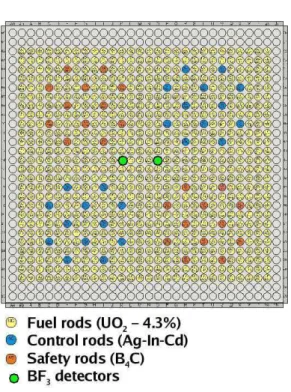
The IPEN/MB-01 reactor[6] is a zero-power critical faci-lity especially designed for measurements of a wide variety of reactor physics parameters to be used as benchmark ex-perimental data for checking the calculational methodologies and related nuclear data libraries commonly used in the field of reactor physics. The IPEN/MB-01 reactor reached its first criticality on November 9, 1988, and since then it has been uti-lized for basic reactor physics research and as an instructional laboratory system. This facility consists of a 28×26 square array ofU O2fuel rods, 4.3% enriched and clad by stainless steel (type 304) inside a light water tank. The control banks are composed of 12Ag−In−Cd rods and the safety banks of 12B4Crods. The pitch of the IPEN/MB-01 reactor was chosen to be close to the optimum moderator ratio (maximum k∞). This feature favors the neutron thermal energy region events. Fig. 2 shows the cross-section view of the IPEN/MB-01 reactor core.
During the execution of the experiment, both of the safety banks were kept completely far away from the 100% with-drawn position. In order to achieve the different subcriticality levels, the system is perturbed with the insertion of control rods. Different subcriticality levels have been measured de-pending on the position of these rods. The preliminary Rossi-αmeasurements were performed with the reactor being driven by the intrinsic source, for reactivities ranging from−30pcm to−10pcm. TwoBF3detectors were placed in the core (see Fig. 2). The two BF3 detectors were cross correlated with each other and electronically summed together and then auto-correlated as a single input signal.
FIG. 2: Schematic view of the IPEN/MB-01 core.
IV. ACQUISITION SYSTEM - VIRTUAL INSTRUMENTS
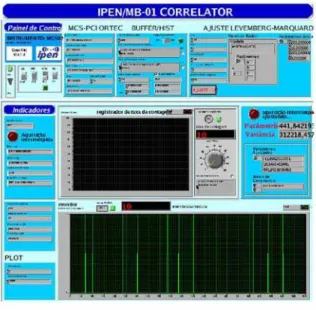
We have developed a new data acquisition system for Rossi-αmeasurements called IPEN/MB-01 Correlator (see Fig. 3), which is a Virtual Instrument (VI) that records the timing of all neutrons events, allowing on-line data analysis. The main part of our timemarking system is a Multi-Channel Scaler PCI card. The LabVIEW software is used to program the Multi-Channel Scaler. With dwell times from 100nsto 1300s, a me-mory length of 65536 channels, and input counting rates up to 150MHz, the IPEN/MB-01 Correlator provide us a high time resolution.
V. PRELIMINARY RESULTS
Fig. 4 shows one of the recorded Rossi-αdistributions for a subcritical level of -13pcm together with the fitted curve ac-cording to the model given by Eq. (2). This curve was obtai-ned with the reactor driven by the intrinsic source, and only oneBF3 detector. The nonlinear regression method used to fit the curve is based on the Levenberg-Marquardt algorithm. For evaluating the goodness of fit, one uses graphical and nu-merical indicators (χ2
ν). The domain of fit range from 0 to 50ms.
Brazilian Journal of Physics, vol. 35, no. 3B, September, 2005 753
FIG. 3: The IPEN/MB-01 Correlator front panel.
Assuming an effective delayed neutron fraction of (7.42±
0.07)×10−3 and a neutron generation time of (32.12± 0.33)×10−6s, which were calculated and measured previ-ously, the α-value of−250.38±4.55s−1 provide us a reac-tivity of:
α=ρ−Λβe f f →ρ=Λα+βe f f=−62.22±18.19pcm (6)
0 0,01 0,02 0,03 0,04 0,05
δt (s) 62500
65000 67500 70000 72500 75000
counts (##)
χ2
ν=0.79
nrand=62921.4(24.5)
ncorr=13773.6(178.3) α=-250.38(4.55)
FIG. 4: Fit of the Rossi-αdistribution for a subcriticality level of -13pcm.
This corresponds reasonable well with the estimated value by the control rods calibration.
Acknowledgments
The authors would like to acknowledge enlightening the fi-nacial support by FAPESP.
[1] R.E.Uhrig, Random Noise Techiques in Nuclear Reactor Sys-tems, The Ronald Press Company (1970)
[2] M.M.R.Williams,Random Processes in Nuclear Reactor, Perga-mon (1974)
[3] J.A.Thie,Reactor Noise, Rowman and Littlefield, Inc. (1963) [4] C.James and G.Perret and G.Imel,First MUSE-4 Experimental
Results Based on Time Series Analysis, PHYSOR (2002) [5] M.Bruggeman, P.Baeten, W. De Boeck and R.Carchon,
Neu-tron Coincidence counting based on time interval analysis with one- and two-dimensional Rossi-alpha distributions: an appli-cation for passive neutron waste assay, Nucl. Instr. and Meth. 382(1996)511-518