ABSTRACT
http://dx.doi.org/10.1590/1678-775720140524
Correlation between clinical performance and
degree of conversion of resin cements: a literature
review
Grace DE SOUZA1, Roberto Ruggiero BRAGA2, Paulo Francisco CESAR2, Guilherme Carpena LOPES3
1- Faculty of Dentistry, University of Toronto, Toronto, ON, Canada.
2- Department of Biomaterials and Oral Biology, Faculty of Dentistry, University of São Paulo, São Paulo, SP, Brazil. 3- Faculty of Dentistry, Federal University of Santa Catarina, Florianópolis, SC, Brazil.
Corresponding address: Grace M. de Souza - 124 Edward Street, room #352 E. - Faculty of Dentistry, University of Toronto.
Toronto, ON – Canada - Postal code: M5G 1G6 - Phone: 416-9794934 - Ext. 4417 - Fax: 416-9794936 - e-mail: [email protected]
R
esin-based cements have been frequently employed in clinical practice to lute indirect restorations. However, there are numerous factors that may compromise the clinical performance of those cements. The aim of this literature review is to present and discuss some of the clinical factors that may affect the performance of current resin-based luting systems. Resin cements may have three different curing mechanisms: chemical curing, photo curing or a combination of both. Chemically cured systems are recommended to be used under opaque or thick restorations, due to the reduced access of the light. Photo-cured cements are mainly indicated for translucent veneers, due to the possibility of light transmission through the restoration. Dual-cured are more versatile systems and, theoretically, can be used in either situation, since the presence of both curing mechanisms might guarantee a high degree of conversion (DC) under every condition. However, it has been demonstrated that clinical procedures and characteristics of the materials may have many different implications in the DC of currently available resin cements, affecting their mechanical properties, bond strength to the substrate and the esthetic results of the restoration. Factors such as curing mechanism, choice of adhesive system, indirect restorative material and light-curing device may affect the degree of conversion of the cement and, therefore, have an effect on the clinical performance of resin-based cements.Keywords: Dental prosthesis retention. Dental materials. Luting agents. Biocompatible materials.
INTRODUCTION
Resin cements are composite resins developed to deliver mechanical properties and handling characteristics that are important for luting indirect restorations. These cements contain different monomers, which are linked together during the polymerization reaction. Due to their application under an indirect restoration, in most cases the physical activation (photo activation) has very limited effect14. Therefore, there is a need for chemical
activators. Activation of the polymerization means to induce the photo initiator (e.g., camphorquinone) or to break the molecule of the chemical initiator
(benzoyl peroxide) so as to form free radicals that will initiate the polymerization. Free radicals link to monomers by breaking carbon-carbon double bonds. The continuous addition of monomers to a growing chain results in a polymeric chain. In general, the maximum degree of conversion (DC) – the percentage of aliphatic C=C (double) bonds converted into C-C (single) bonds to form the polymeric network – reached by resin cements is around 60%,43 due to the increase of cement
viscosity during the polymerization reaction, hindering the mobility of the reactive species49. The
Resin cements have been frequently employed for bonding indirect restorations to the teeth due to their mechanical behavior34 – superior to
conventional cements (resin-free) –, possibility of adhesion to the restorative material50 and to the tooth
structure with7 or without an adhesive system60,
and superior optical properties36 when compared
with conventional cements. However, limitations associated with the incomplete polymerization (low DC) of the cement may result in higher sorption and solubility values67, causing faster degradation
67. Degradation of resin-based cements
reduces the bond strength between them and the
substrate39
at the restoration margin, which may mean the clinical loss of the restoration either by debonding, fracture or secondary caries20. Unreacted monomers
(not bonded to the polymeric chain) may also response18.
There are multiple factors that may interfere with the DC of resin cements and, therefore, compromise the longevity of indirect restorations. Some of them are the material composition (monomers and other components of the activation system)56, possible
inadvertent interactions between the bonding system and the cement63, characteristics of the
restoration to be cemented (optical properties and thickness of the restoration)14,15 and characteristics
of the photo activation step32. This article aims to
perform a comprehensive review of the factors involved in the DC of the resin-based luting systems and the impact of DC on luting system properties.
CURING MECHANISM
As previously mentioned, photo-activated or light-activated resin cements are indicated for situations where the light of the curing unit may pass through the restoration, such as translucent veneers and shallow inlays56. These cements are
provided in a single paste with a photoinitiator system composed of a photosensitive component (usually camphorquinone) and a tertiary amine. The presence of light with a wavelength of 480 nm (blue region of the visible spectrum) activates camphorquinone69, which binds to the tertiary
amine and then releases two free radicals that will start the monomers conversion. Photo-cured resin cements have unlimited working time, with the polymerization starting right after the exposure of the material to light4.
Chemically cured (self-cured) cements are indicated under thick restorations, for luting intrarradicular posts and crowns made of materials that block the light, such as metallic copings or highly opaque ceramics42,68, aiming to guarantee
maximum properties over time in areas that light energy is unable to reach71. The limitations of these
systems are the reduced working time as opposed to the extended setting time77 and the tendency to
become “yellowish”, due to the higher concentration of tertiary amines (activators)29. The polymerization
reaction in self-cured cements requires the components of the activation system – tertiary amine and benzoyl peroxide – to get in contact by the mixing of two pastes, base and catalyst.
Dual-cure resin cements were developed photo and chemically activated systems16,56,77,
obtaining optimized DC in the deepest locations under a restoration, controlled working time and short setting time. In such systems, there is a catalyst paste with a chemical initiator, usually benzoyl peroxide, and a base paste containing the photo-cured resin cement and the tertiary amine responsible for the activation of the self-cure reaction57. When both pastes are mixed together
and exposed to light, the polymerization happens by physical (photo) and chemical (redox) activation. The appropriate working time is controlled by inhibitors of the self-cure reaction or by the amount of activators of the polymerization56. It is
expected that in areas where there is not enough light, the interaction between the tertiary amine and benzoyl peroxide will be enough to ensure the cement polymerization4,57. However, when not
properly photo-activated, dual-cure resin cements may present reduced DC47,49,77, which implicates
in lower hardness57, higher solubility71, lower
11,57 and compressive strengths, and lower
bond strength to dentin in comparison to directly light-cured dual cements7,77. For instance, a
self-adhesive dual cement applied in self-curing mode may show DC as low as 11% after a 10-minute setting time77. Considering the clinical application
of the resin-based luting systems, which are used for the cementation of indirect restorations onto tooth structure, 10 min is an undesirably long time for a luting agent to obtain a great percentage of the optimal setting characteristics, without compromising the integrity of the margins and the cement layer under functional loading8,77.
In general, light-cured and dual-cured cements activated by light through a restoration thinner than 2.0 mm4,36,44,75 have higher DC than self-cured
cements77. When a dual cement is self-cured (no
activation by light), mechanical properties such reduced by 68.9%, 59.2% and 91.1%, respectively, in comparison to original values presented by dual-cured samples34. There are different factors that may
to provide a clinically viable working time, ranging from 2 to 5 minutes, which adversely inhibits polymerization during the luting procedure61
the slow rate of polymerization activation and subsequent propagation of radicals in comparison to a directly light-activated material6,49,51,61
and the low concentration of benzoyl peroxide incorporated into those materials6,49. Furthermore,
the hand-mixing of the two pastes incorporates air bubbles that further inhibit polymerization due to the presence of oxygen79 and may act as stress
concentrators that potentially result in cracking throughout the cement layer56. Although it has been
demonstrated that the high incidence of air voids reduces the stress generated by the polymerization shrinkage of the cement due to a change in ratio of bonded to unbonded surfaces5,
of the inclusion of pores have not been determined. Pores are also incorporated in dual-cured cements during mixing and they may become an esthetic concern when cementing veneers16. To minimize
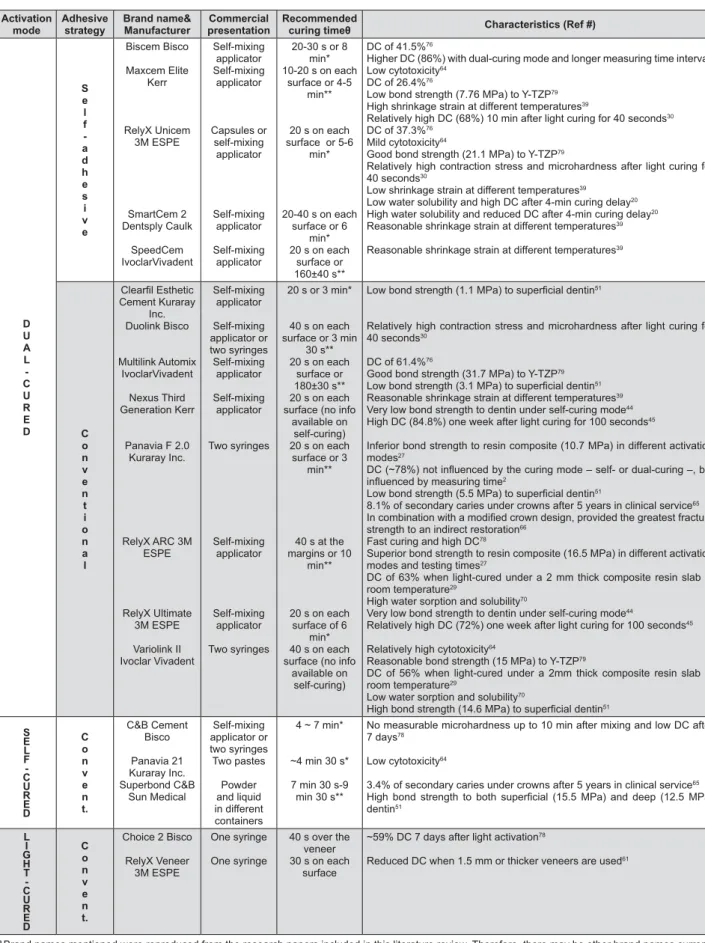
the undesired consequences of the hand-mixing procedure, some manufacturers provide cements in a self-mixing apparatus (Figure 1), which eliminates the manual mixing step, generates a homogeneous mix and reduces the incorporation of bubbles. However, voids have been observed after automatic mixing as well56.
Interestingly, if light incidence on the cement activator of dual cements improves DC when compared to photo-activated-only systems1,7,15,16
! controversial8,14,49 and varies from one material
to another44. It has been demonstrated that the
absence of the self-curing component in light-activated systems negatively affects the DC of these cements when the light-curing component is not able to guarantee an acceptable degree of conversion, for example when applied underneath onlays of greater thickness1. Considering a clinical
application in which almost no light reaches the cement layer, it is desirable to use dual resin cements that present a chemical curing mechanism !8. However, there is
currently no resin luting system in the market capable of overcoming this limitation2,7,45. In general,
the chemical activation of dual cements does not seem enough to compensate for the absence of light under thick or opaque restorations, even 24 hours after the beginning of the activation1,15,32,61,64,65,75.
The DC of a self-adhesive dual cement may vary from 37% when light-cured for 20 seconds77 to
58% when light-cured for 40 seconds43, evidencing
that there is also a direct correlation between light intensity received by a photo-activated material and its DC14,46,49. Laboratorial studies bring evidence that
the activation time generally recommended by the
"#$& in maximum degree of conversion27,77. Therefore,
when highly opaque or thicker restorations need to be employed, a prolonged light exposure time is recommended (please read “Indirect Restorative Material” below), since a gradual increase in light-curing time and, therefore, in light transmission, gradually increases the Knoop hardness of resin-based luting systems64. Additionally, the use of a
dual-cure system should always be considered to possibly increase the DC by means of a chemical activation of the monomeric system.
With regard to post-activation time, the 24-hour DC of light-cured and dual-cured cements is directly related to the DC obtained right after light exposure4,75. Even though DC is maximized
'* +2,79,
some cements present gradual increase in DC for up to 24 hours, mainly when used in the dual-curing mode4,10,28,31,64,79. However, it has been
speculated that a delay in light activation of dual-cured materials would enhance their properties56
by allowing the self-polymerization promoters to react at some extent before being entrapped by the polymeric chains as soon as the photo-activation begins49,74. Delaying the light activation for 2 min
may, for instance, compensate for a lower dose of light reaching the cement layer49, but no effect is
observed on the bond strength of resin cements to the substrate28. On the other hand, prolonged
self-curing of the cement may also compromise the overall DC49 and increase water sorption71 when light
activation is delayed for 10 min for the same reason, indicating that an ideal balance between self-curing and photo-activation is yet to be determined.
Under ideal circumstances, light-activated resin cements show higher DC than chemically cured resin cements, irrespective of brand names49,57.
However, the DC of dual-cured cements is material-related, which means that it is more associated with the brand name than with the per se and some systems + than others1,10,11,15,16,31,51,73,79. Just as an illustration,
the DC of a given dual-cured cement (RelyX ARC, 3M Espe, St. Paul, MN, USA) may vary from 81% to 61% when cured under light as opposed to total absence of light respectively, and from 56% to 26% when another dual-cured cement (RelyX Unicem, 3M Espe, St. Paul, MN, USA) is cured under the same conditions43. This difference may be explained by the
difference in composition between both materials. For instance, some resin-based cements present twice as much benzoyl peroxide than others51.
The lower DC may affect some critical properties of the resin-based cements64. Dual cements cured
Activation mode Adhesive strategy Brand name& Manufacturer Commercial presentation Recommended
!" Characteristics (Ref #)
D U A L -C U R E D S e l f -a d h e s i v e Biscem Bisco Maxcem Elite Kerr RelyX Unicem 3M ESPE SmartCem 2 Dentsply Caulk SpeedCem IvoclarVivadent Self-mixing applicator Self-mixing applicator Capsules or self-mixing applicator Self-mixing applicator Self-mixing applicator
20-30 s or 8 min* 10-20 s on each
surface or 4-5 min**
20 s on each surface or 5-6
min*
20-40 s on each surface or 6
min* 20 s on each
surface or 160±40 s**
DC of 41.5%76
Higher DC (86%) with dual-curing mode and longer measuring time interval2 Low cytotoxicity64
DC of 26.4%76
Low bond strength (7.76 MPa) to Y-TZP79 High shrinkage strain at different temperatures39
Relatively high DC (68%) 10 min after light curing for 40 seconds30 DC of 37.3%76
Mild cytotoxicity64
Good bond strength (21.1 MPa) to Y-TZP79
Relatively high contraction stress and microhardness after light curing for 40 seconds30
Low shrinkage strain at different temperatures39
Low water solubility and high DC after 4-min curing delay20 High water solubility and reduced DC after 4-min curing delay20 Reasonable shrinkage strain at different temperatures39
Reasonable shrinkage strain at different temperatures39
C o n v e n t i o n a l Cement Kuraray Inc. Duolink Bisco Multilink Automix IvoclarVivadent Nexus Third Generation Kerr
Panavia F 2.0 Kuraray Inc.
RelyX ARC 3M ESPE RelyX Ultimate 3M ESPE Variolink II Ivoclar Vivadent Self-mixing applicator Self-mixing applicator or two syringes Self-mixing applicator Self-mixing applicator Two syringes Self-mixing applicator Self-mixing applicator Two syringes
20 s or 3 min*
40 s on each surface or 3 min
30 s** 20 s on each
surface or 180±30 s** 20 s on each surface (no info
available on self-curing) 20 s on each
surface or 3 min**
40 s at the margins or 10
min**
20 s on each surface of 6
min* 40 s on each surface (no info
available on self-curing)
51
Relatively high contraction stress and microhardness after light curing for 40 seconds30
DC of 61.4%76
Good bond strength (31.7 MPa) to Y-TZP79
51
Reasonable shrinkage strain at different temperatures39 Very low bond strength to dentin under self-curing mode44 High DC (84.8%) one week after light curing for 100 seconds45
Inferior bond strength to resin composite (10.7 MPa) in different activation modes27
!"$&'+/;<==;>
'+//2
??51
8.1% of secondary caries under crowns after 5 years in clinical service65 J//>Q< strength to an indirect restoration66
Fast curing and high DC78
Superior bond strength to resin composite (16.5 MPa) in different activation modes and testing times27
DC of 63% when light-cured under a 2 mm thick composite resin slab at room temperature29
High water sorption and solubility70
Very low bond strength to dentin under self-curing mode44
Relatively high DC (72%) one week after light curing for 100 seconds45
Relatively high cytotoxicity64
Reasonable bond strength (15 MPa) to Y-TZP79
DC of 56% when light-cured under a 2mm thick composite resin slab at room temperature29
Low water sorption and solubility70
W[\51 S E L F -C U R E D C o n v e n t. C&B Cement Bisco Panavia 21 Kuraray Inc. Superbond C&B Sun Medical Self-mixing applicator or two syringes Two pastes Powder and liquid in different containers
4 ~ 7 min*
~4 min 30 s*
7 min 30 s-9 min 30 s**
No measurable microhardness up to 10 min after mixing and low DC after 7 days78
Low cytotoxicity64
3.4% of secondary caries under crowns after 5 years in clinical service65 W ?? ^? dentin51 L I G H T -C U R E D C o n v e n t.
Choice 2 Bisco
RelyX Veneer 3M ESPE
One syringe
One syringe
40 s over the veneer 30 s on each
surface
~59% DC 7 days after light activation78
Reduced DC when 1.5 mm or thicker veneers are used61
Figure 1- Summary of some resin-based luting systems currently available and their characteristics based on the papers Q//+Q++/<</
&Brand names mentioned were reproduced from the research papers included in this literature review. Therefore, there may be other brand names currently /_</`j=///<{`W Q and self-curing times may either consider room temperature (~23°C) or mouth temperature (~37°C). *Time after starting the mixture. **Time after placement of prostheses
cured under the self-curing mechanism (chemical only)55,65. Dual curing also leads to a rapid increase
in hardness whereas chemically cured specimens are still soft 30 minutes22 or even one hour64 after
mixing. Dual-curing mode also results in improved bond strength44 and mechanical properties such
comparison to light curing or chemical curing only34,64.
A d h e s i v e a n d s e l f - a d h e s i v e r e s i n cements have functional monomers such as 10-methacryloyloxydecyl dihidrogen phosphate (10-MDP), 4-methacryloxyethyl trimellitate anhydride (4-META) and phosphoric esters. These resin cements generally have a dual-cure mechanism. Self-adhesive cements have acidic functionalities in order to demineralize tooth structure23, and an
acid-base reaction between the acid groups of the or the mineralized tooth surface starts immediately after the mixing of the components and application of the cement on the tooth surface31. However,
those acidic monomers have been shown to negatively affect the cement degree of conversion, since they interfere with the amine initiator77. This
interference compromises both the self-cure and the dual-cure modes76. The very low polymerization
shrinkage strain of some self-adhesive cements may also be an evidence of reduced DC40. Indeed, there
+; materials31,40 and increasing the light-exposure from
20 s to 40 s does not improve DC values after 6 hours31 as much as a temperature increase of the
cement improves40. However, when the absence
(self-cure) and the presence (dual-cure) of photo-activation are compared, the presence of light may result in a 10-fold increase in the material degree of conversion40. Although another initiator system
based on sodium aryl sulfate or aryl-borate salts has been proposed70 to compensate for the interaction
between acidic monomers and the amine initiator in self-adhesive systems, no evidence has been + sodium persulfate-containing materials8,77.
Another way to improve the polymerization kinetics of resin-based luting systems is to increase the temperature of the material30,51. High
+ +; conversion than low viscosity cements24, probably
due to the reduced mobility of the monomers in viscous materials. Increased temperature prior to and during polymerization leads to higher DC, due to increased free radical and monomer mobility1,21 and
collision frequency of the unreacted active groups resulting from the decrease in the viscosity of the material21,30. However, pre-heating (50°C)
dual-cured resin cements with a higher concentration of the chemical activator (benzoyl peroxide) may
; thus compromising the clinical application of the material30,51, and still may not compensate for the
absence of light30. The clinical applicability of the
pre-heating technique is questionable, since the tooth structure could not be possibly heated up to 50°C, which would immediately result in the cement temperature decrease. Therefore, any evaluation on this topic should limit the pre-heating temperature to 37°C51.
BONDING AND CEMENTATION
The bonding between resin cement and the tooth structure (or the core build-up material) is generally made possible by the use of a self-adhesive resin cement or by the application of a bonding agent/ system. The bonding agent/system may either be self-etch or total-etch (etch-and-rinse)13. However,
there are restrictions for the application of some + ;! step total-etch (primer and adhesive in one bottle) and “all-in-one” self-etch systems and resin cements with some chemical activation, either self-cured or dual-cured37. It has been shown that the lower
the pH of the bonding agent employed, the lower the bond strength between self-cured cement and dentin63> +
to a self-cured cement results in 10-50% of the bond strength presented when the same adhesive is bonded to a light-cured cement63.
The reason for those diminished bond strength values is that when simplified-step adhesives are used together with chemical-cured cements, there is an interaction between the residual acidic monomers from the adhesive inhibition layer and the binary peroxide-amine catalytic components that are commonly employed in chemically cured resin composites63. Therefore, the tertiary amine of
the resin cement is neutralized and does not react with the initiator, resulting in low bond strength at the adhesive-cement interface19. Besides that,
+ "!! & incomplete polymerization12,13,and these are then
kept at the interface between the adhesive and the cement, compromising the bonding between those two substrates19,72, which is demonstrated by
exclusively adhesive failure modes63. To maximize
INDIRECT RESTORATIVE MATERIAL
When photo-activation of a resin cement is performed, part of the visible light that reaches the crown is transmitted through the restoration, part is
57.
Consequently, the light intensity that effectively reaches the cement varies according to the optical characteristics of the restorative material15,62,
such as opacity14,44 and shade8,53
thickness of the restoration15,25,48. The higher the
thickness and the lower the value (darkness) of the restoration, the lower the light intensity reaching the cement layer, which may compromise the DC of a given cement15,47,57,79.
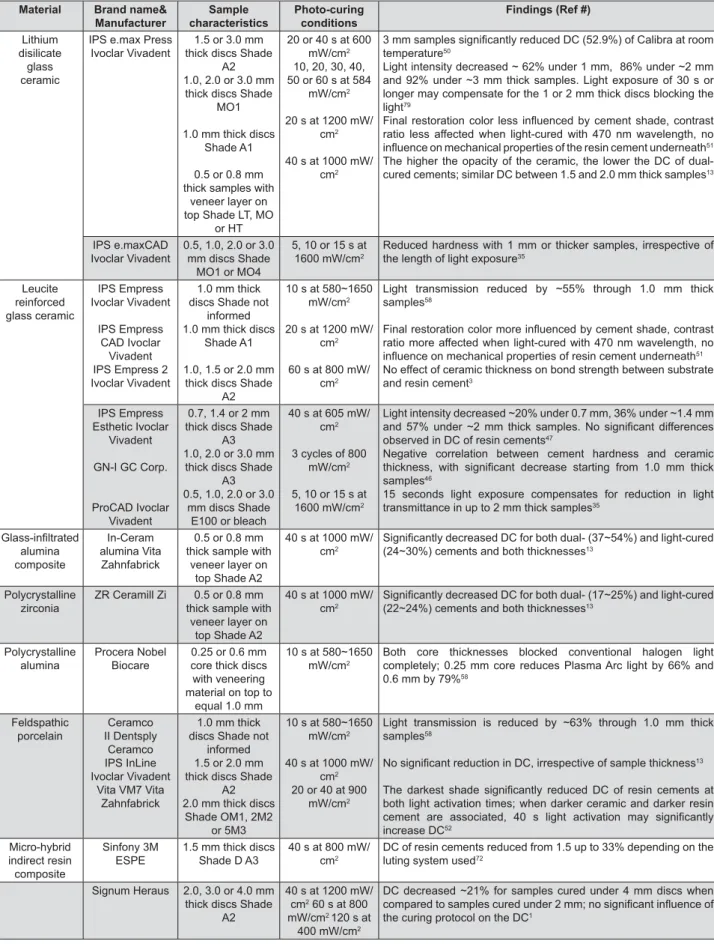
There are many restorative systems nowadays that may be used for the manufacturing of all-ceramic crowns (Figure 2). Each one of these ceramic systems has a microstructure that directly interferes with the amount of light that may be transmitted through the restoration14,78. Considering
restorations with similar shade and thickness, ceramics with a higher number of light scattering centers (interface between different microstructural phases) are more opaque and prone to block visible light14,33,57,58, compromising the intensity of the
physical polymerization of the resin cement57. Pores,
frequently found in feldspathic porcelains and of these materials, act as light scattering centers as well. Light scattering occurs at interfaces of different phases with dissimilar refraction indexes. A free of pores porcelain would be a material with no light scattering interface and would thus show transmittance, resulting in high DC for dual cements even under a 3 mm-thick layer15. A
multi-phase material would scatter the light because the incident light beam will change direction from one phase to another and the result will be a weaker incident light. A multi-phase structure within a material also results in light scattering and low transmittance14. Thereafter, glass-infiltrated
alumina-zirconia (In-Ceram Zirconia System, Vita Zahnfabrik, Bad Säckingen, Baden-Württemberg, Germany) is the most opaque alternative among current clinical options, due to the presence of four distinct phases with different refraction indexes (alumina, Ceria-stabilized zirconia, lantanium glass & ; of only 6% in 0.5 mm-thick copings, and when the thickness of the same material increases to 1.5 mm the transmittance becomes as low as $? @! spinel ceramic (In-Ceram Spinell, Vita Zahnfabrik, Bad Säckingen, Baden-Württemberg, Germany) it has only two phases (glass and spinel), with similar refraction indexes.
When comparing the translucency of lithium-disilicate glass-ceramic and leucite-reinforced glass ceramic, Illie, et al.36"Q**Y&+
is more opaque than the latter (Figure 2). Lithium-disilicate glass ceramic contains a main crystalline phase of “elongated crystals building a scaffold of many small interlocking needle-like crystals randomly oriented”36, with a second crystalline
phase consisting of lithium orthophosphate35. On
the other hand, leucite-reinforced glass-ceramic is a less dense material, characterized by the single crystal formation of leucite crystals35,36, indicating
that lithium-disilicate ceramics scatter more light than leucite ceramics. Light delivered to the cement layer through lithium-disilicate ceramic (shade medium opacity 1) is reduced to 45% under 1 mm ceramic slabs, 16% under 2 mm slabs and approximately 8% under 3 mm slabs80.
Leucite-reinforced glass ceramic slabs reduce the light transmittance to 80%, 64% and 43% under 0.7, 1.4 and 2.0 mm thick samples, respectively47.
As previously mentioned, the relationship between restoration thickness and transmittance is highly dependent on the opacity of the material14,51,54,80. However, the impact of the amount
of light reaching the cement layer on its DC is controversial. Dual-cure resin cements activated by light under a 1.5 mm lithium-disilicate glass ceramic (Shade A2 low translucency) surface presented a DC similar to that of cements cured under direct light exposure51, whilst samples cured through 1.4
mm-thick leucite-reinforced glass-ceramic slabs may54 or
may not48;;+
than groups activated with direct light exposure, depending on the luting system employed. In another study, samples light-cured under 1 or 2 mm thick lithium-disilicate slabs only showed decreased hardness when light exposure time was 20 s or less, indicating that longer exposure times may compensate for light attenuation of the indirect restorative material80. A randomized
clinical split-mouth study evaluating the longevity ! ; ; three different cements (two resin-based and one glass-ionomer) evidenced acceptable survival rates for all groups, with dual-cured cements showing higher survival rate than glass-ionomer cement, indicating that the opacity of the crown did not affect the performance of the cement/restoration66.
[ transmittance values of a restoration would be even more compromised considering the thickness and the optical characteristics of the porcelain veneer layer14. The DC of a dual-cured cement activated
Material Brand name& Manufacturer Sample characteristics Photo-curing conditions
Findings (Ref #)
Lithium disilicate glass ceramic
IPS e.max Press Ivoclar Vivadent
1.5 or 3.0 mm thick discs Shade
A2 1.0, 2.0 or 3.0 mm
thick discs Shade MO1
1.0 mm thick discs Shade A1
0.5 or 0.8 mm thick samples with
veneer layer on top Shade LT, MO
or HT
20 or 40 s at 600 mW/cm2
10, 20, 30, 40, 50 or 60 s at 584
mW/cm2
20 s at 1200 mW/ cm2
40 s at 1000 mW/ cm2
///+?^&</ temperature50
Light intensity decreased ~ 62% under 1 mm, 86% under ~2 mm and 92% under ~3 mm thick samples. Light exposure of 30 s or longer may compensate for the 1 or 2 mm thick discs blocking the light79
' + / > ratio less affected when light-cured with 470 nm wavelength, no
'/</51
The higher the opacity of the ceramic, the lower the DC of dual-cured cements; similar DC between 1.5 and 2.0 mm thick samples13
IPS e.maxCAD Ivoclar Vivadent
0.5, 1.0, 2.0 or 3.0 mm discs Shade
MO1 or MO4
5, 10 or 15 s at 1600 mW/cm2
Reduced hardness with 1 mm or thicker samples, irrespective of the length of light exposure35
Leucite reinforced glass ceramic IPS Empress Ivoclar Vivadent IPS Empress CAD Ivoclar Vivadent IPS Empress 2 Ivoclar Vivadent
1.0 mm thick discs Shade not
informed 1.0 mm thick discs
Shade A1
1.0, 1.5 or 2.0 mm thick discs Shade
A2
10 s at 580~1650 mW/cm2
20 s at 1200 mW/ cm2
60 s at 800 mW/ cm2
Light transmission reduced by ~55% through 1.0 mm thick samples58
/'+/> ratio more affected when light-cured with 470 nm wavelength, no
'/</51
No effect of ceramic thickness on bond strength between substrate and resin cement3
IPS Empress Esthetic Ivoclar
Vivadent
GN-I GC Corp.
ProCAD Ivoclar Vivadent
0.7, 1.4 or 2 mm thick discs Shade
A3 1.0, 2.0 or 3.0 mm
thick discs Shade A3 0.5, 1.0, 2.0 or 3.0
mm discs Shade E100 or bleach
40 s at 605 mW/ cm2
3 cycles of 800 mW/cm2
5, 10 or 15 s at 1600 mW/cm2
Light intensity decreased ~20% under 0.7 mm, 36% under ~1.4 mm ?"& !^ // _ / << observed in DC of resin cements47
Negative correlation between cement hardness and ceramic _> </ // _ samples46
15 seconds light exposure compensates for reduction in light transmittance in up to 2 mm thick samples35
= alumina composite In-Ceram alumina Vita Zahnfabrick
0.5 or 0.8 mm thick sample with
veneer layer on top Shade A2
40 s at 1000 mW/ cm2
+<="!?[&= (24~30%) cements and both thicknesses13
Polycrystalline zirconia
ZR Ceramill Zi 0.5 or 0.8 mm thick sample with
veneer layer on top Shade A2
40 s at 1000 mW/ cm2
+<="!^?&= (22~24%) cements and both thicknesses13
Polycrystalline alumina
Procera Nobel Biocare
0.25 or 0.6 mm core thick discs with veneering material on top to
equal 1.0 mm
10 s at 580~1650 mW/cm2
Both core thicknesses blocked conventional halogen light completely; 0.25 mm core reduces Plasma Arc light by 66% and 0.6 mm by 79%58
Feldspathic porcelain Ceramco II Dentsply Ceramco IPS InLine Ivoclar Vivadent
Vita VM7 Vita Zahnfabrick
1.0 mm thick discs Shade not
informed 1.5 or 2.0 mm thick discs Shade
A2 2.0 mm thick discs
Shade OM1, 2M2 or 5M3
10 s at 580~1650 mW/cm2
40 s at 1000 mW/ cm2
20 or 40 at 900 mW/cm2
Light transmission is reduced by ~63% through 1.0 mm thick samples58
>Q</_13
` _ + < / both light activation times; when darker ceramic and darker resin / > [ Q /+ + increase DC52
Micro-hybrid indirect resin composite
Sinfony 3M ESPE
1.5 mm thick discs Shade D A3
40 s at 800 mW/ cm2
DC of resin cements reduced from 1.5 up to 33% depending on the luting system used72
Signum Heraus 2.0, 3.0 or 4.0 mm thick discs Shade
A2
40 s at 1200 mW/ cm2 60 s at 800
mW/cm2 120 s at
400 mW/cm2
DC decreased ~21% for samples cured under 4 mm discs when //^//'< the curing protocol on the DC1
group, activated under direct light exposure14.
When the impact of the shade of the ceramic system is evaluated, it can be observed that if shades with higher chroma are used, less energy reaches the cement layer, since dark pigments 9, negatively
! Dual-cured cements light-activated under 2 mm-thick samples of darker dentin shade of feldspathic porcelain present significantly lower DC than cements light-activated under lighter shades53.
When yellow and translucent shades of a resin cement were light-activated under the darker porcelain, only prolonged light-exposure time (40 seconds) was capable of increasing the DC of the cement yellow shade53, indicating that the
combination of darker shades in both the cement and the indirect restorative material compromise the overall DC of the cement layer.
With regard to laminate veneers, some studies show that although the bond strength between veneers and tooth structure is not affected by shade or opacity of the ceramic system, the DC of the cement may be diminished by either thicker, darker or more opaque restorations15, frequently
used to mask severely darkened teeth, and a lower DC of the cement layer may compromise the esthetic result due to the continuous discoloration of the material75. The analysis of the DC of a
light-cured resin cement after the superimposition of different veneer materials with different thicknesses indicated that the effect of light attenuation on + ceramic thicknesses of 1.0 mm or less62.
Considering the optical properties of the indirect restorative composites, there are different factors playing a role in light transmittance, such as particle size distribution, thickness of the restoration and shade. The smaller the particles, the more interfaces will be present acting as light scattering centers33, consequently increasing the opacity of
the material employed, which indicates that larger particles allow for deeper activation of the cement layer by light4,57,58. Interestingly, the hardness of
dual resin-based cements is less affected when photo-activation is performed through an indirect restorative composite – either microfilled or micro-hybrid – than when it is performed through an all-ceramic system – lithium disilicate and glass ceramic57.When the effect of thickness is
evaluated, there is indeed an inverse correlation between thickness of an indirect composite resin restoration and Knoop hardness of the resin based luting system26. Dual resin cements cured under 2
mm-thick micro-hybrid composite samples show ; ideal conditions30, and the DC of dual cements is
12% lower under 4 mm onlays in comparison to that
measured under 2 mm thick onlays1. With regard to
the effect of shade on indirect composite resin light transmittance, Arrais, et al.8 (2008) demonstrated
that only 11% of light reaches the cement layer when cured through a 2 mm microhybrid composite A2 shade as opposed to 8% when A4 shade was employed, but no effect on DC was observed for dual-cured resin cements with higher concentration of benzoyl peroxide. The authors pointed out that the adhesive component also presented a chemical activator of the polymerization and could, therefore, compensate for the absence of light8.
LIGHT CURING DEVICE
It has been demonstrated that the hardness of dual-cured cements is dependent on the level of exposure to the curing light32. As previously
mentioned, the component responsible for the chemical activation of the material cannot compensate for the total absence of light3,32.
The higher the light intensity and the longer the exposure time of the resin cement, the higher the Knoop hardness of the dual-cured materials64.
However, even when under direct light exposure, there is a limit above which the DC of a photo or dual-cure cement cannot be increased44.
Quartz-tungsten-halogen (QTH) light curing units (LCU) deliver light irradiance varying between 400 and 1360 mW/cm2 17,50,64. When exposure time
(40 s, 60 s or 120 s) and intensity (1200, 800 or 400 mW/cm2) of light exposure on DC of dual cements
was evaluated, different materials showed different results1, although all the associations resulted in the
same amount of energy (48 J). Activation of dual cements under 2 mm resin composite onlays using low light intensity for prolonged time presented a trend towards higher DC, probably due to the slow increase in the material viscosity, allowing more monomers mobility1.
Light-emitting diodes (LED)-based units were introduced in the market in 200176 and are another
option to activate photo-cured resin cements. These units generate light under a narrower spectrum (between 450 and 490 nm) with the peak around 468 nm, the ideal wavelength for resin-based materials using camphorquinone as the photoinitiator17. When the photo-activation of a
cement is performed through a ceramic system, light transmittance increases for higher wavelengths57.
The higher mean wavelength of LED lights improves the capacity of the equipment to activate resin cements under indirect restorations36,76. However,
light-intensity is also critical, since LED with relatively low light intensity (320 mW/cm2) results
in decreased Knoop hardness at the bottom of dual-cured cement samples53.
mW/cm2) curing units on Knoop hardness of
resin-based cements indicated that there was no effect of LCU on the hardness of dual-cure cements54.
Samples cured under 1.4 and 2.0 mm ceramic slabs (leucite glass ceramic, shade A3) showed lower hardness values than samples cured under direct light exposure and under 0.7 mm slabs54. Authors
observed that hardness on dual-cured luting agents may not be dependent on the light source, as long as the irradiance level for the effective wavelength region to activate the photo-initiator is similar54.
With the application of high-power curing units in dentistry, LED-based equipment with high light intensity (1000-1600 mW/cm2) are being advertised
as an alternative to reduce the curing time of resin-based materials. However, the minimum time required to properly cure a dual-cured luting system is 15 s under ideal conditions, so that maximized mechanical properties can be obtained36. Therefore,
it is not recommended to reduce the light exposure time to less than 15 seconds on each side of a restoration, irrespective of light intensity36. Indeed,
it has been demonstrated that light-curing a dual-cure cement for 9 s with a LED device (1100 mW/ cm2&
conversion41. The authors observed that exposing
dual-cure material to high intensity light may increase its viscosity more rapidly, hindering the migration of active radical components responsible for further polymerization41. Similar results were
obtained when LED device (1100 mW/cm2) with
different activation modes and QTH (600 mW/ cm2) were used to photoactivate resin cements
between ceramic samples (lithium disilicate) and human dentin, and the authors found out that groups photo-activated for 10 s presented inferior bond strength50. Higher bond strength results were
obtained when LED devices under exponential mode and QTH were used, and since the exponential mode was applied for twice as much time as the other LED groups, the overall energy delivered was increased, which may have enhanced the DC50.
Authors also observed that higher light intensity produces higher contraction strains during resin polymerization, which may promote debonding at the adhesive interface50. Therefore, prolonged
exposure times are desirable not only to increase the energy delivered to the luting material, in an attempt to compensate for the attenuation of the light promoted by the indirect restorative material, but also to reduce stress generation at the cement-substrate interface, to ensure preservation of the bonding.
A comparison of different light curing equipment (QTH – 600 mW/cm2]^_$`** j{ 2
ion laser – 600 mW/cm2) used to activate resin
cements under 2 mm-thick samples of composite resin indicated that the degree of conversion
of the resin cements is again more related to the commercial brand and, consequently, to the material composition than to the curing device itself, with LED and argon ion laser devices resulting in lower DC for one of the materials in the photo-cured mode69. Although the short range of the spectra
peak for LED devices may be advantageous when curing under ceramic systems, a wider range may be clinically interesting to photo-activate alternative photoinitiators, promoting a higher DC for QTH lights even in the presence of lower light intensity.
In addition to the factors presented above, there are other variables playing a role in the DC of light-activated resin-based cements, such as the distance between the tip of the curing device and the cement layer4,52,75 and other indirect factors
reducing the light intensity being delivered38,50,52,59.
Based on the results presented and the number of studies indicating that prolonged light-activation ! ! cured cements43,53,80, increasing the light exposure
time, even though this would mean a couple more minutes of clinical procedure, would be certainly restoration.
CONCLUSION
The clinical success of an indirect restoration is not only attributed to the DC of the resin cement or to its mechanical properties, since there are other aspects that determine the clinical performance of dental prostheses. Nonetheless, ensuring a high DC is paramount to obtain the best out of the chemical and physical properties of the resin cement, besides being a critical factor for biocompatibility. When performing a luting procedure, one should pay attention to the characteristics of the indirect restorative material to be employed, and make a conscious decision of using a cement system that would be more indicated to the clinical case necessities. Curing modes and the best light-curing technique are examples of information that is to be available. It is crucial for clinicians to know and understand the cement systems they are working with.
REFERENCES
3- Aguiar TR, Oliveira M, Arrais CAG, Ambrosano GMB, Rueggeberg F, Giannini M. The effect of photopolymerization on the degree + and modulus of self-adhesive resin cements. J Prosthet Dent. Q*$$$'|$QY!'`
`! @ @ [ thickness and polymerization mode of a resin luting agent on early bond strength and durability with a lithium disilicate-based ~Q**`|Q'`!`$
5- Alster D, Feilzer AJ, De Gee AJ, Mol A, Davidson CL. The dependence of shrinkage stress reduction on porosity ~}$Q$|$$!QQ 6- Andrzejewska E. Photopolymerization kinetics of multifunctional Q**$Q|*!
7- Arrais CA, Giannini M, Rueggeberg FA, Pashley DH. Microtensile bond strength of dual-polymerizing cementing systems to dentin ~Q**|! 106.
8- Arrais CA, Rueggeberg FA, Waller JL, de Goes MF, Giannini M. Effect of curing mode on the polymerization characteristics ! ~Q**Y'|`$Y!Q 9- Barghi N, McAlister EH. LED and halogen lights: effect of ceramic thickness and shade on curing luting resin. Compend Contin Educ Q**'Q`|`!***Q*`
$*! }} } [ adhesive system on the extrusion shear strength between +Q***$|'*'! 10.
11- Braga RR, Cesar PF, Gonzaga CC. Mechanical properties of resin cements with different activation modes. J Oral Rehabil. Q**QQ|Q!Q
12- Breschi L, Cadenaro M, Antoniolli F, Sauro S, Biasotto M, Prati C, et al. Polymerization kinetics of dental adhesives cured with LED: correlation between extent of conversion and permeability. Q**Q'|$*!Q
13- Cadenaro M, Antoniolli F, Sauro S, Tay FR, Di Lenarda R, Prati C, et al. Degree of conversion and permeability of dental adhesives. ^~Q**$$'|Q!'*
14- Calgaro PA, Furuse AY, Correr GM, Ornaghi BP, Gonzaga CC. [ of conversion and the hardness of resin cements. Braz Oral Res. Q*$'Q|`*'!
15- Cardash HS, Baharav H, Pilo R, Ben-Amar A. The effect of porcelain color on the hardness of luting composite resin cement. ~$'|Q*!'
16- Caughman WF, Chan DC, Rueggeberg FA. Curing potential of dual-polymerizable resin cements in simulated clinical situations. ~Q**$Y|$*$!
17- Cekic I, Ergun G, Lassila LV, Vallittu PK. Ceramic-dentin bonding: effect of adhesive systems and light-curing units. J Adhes Q**|$!Q'
18- Chang HH, Chang MC, Wang HH, Huang GF, Lee YL, Wang YL, et al. Urethane dimethacrylate induces cytotoxicity and regulates cyclooxygenase-2, hemeoxygenase and carboxylesterase Q*$`$*|QQ! 31.
19- Cheong C, King NM, Pashley DH, Ferrari M, Toledano M, Tay FR. Incompatibility of self-etch adhesives with chemical/dual-cured composites: two-step vs one-step systems. Oper Dent. Q**'QY|`!
20- D'Arcangelo C, Zarow M, De Angelis F, Vadini M, Paolantonio M, Giannoni M, et al. Five-year retrospective clinical study of indirect composite restorations luted with a light-cured composite [+Q*$`$Y|$!Q`
21- Daronch M, Rueggeberg FA, De Goes MF, Giudici R. Polymerization kinetics of pre-heated composite. J Dent Res. Q**Y|'Y!`'
22- Darr AH, Jacobsen PH. Conversion of dual cure luting cements. ~}$QQ|`'!
23- De Munck J, Vargas M, Van Landuyt K, Hikita K, Lambrechts P, Van Meerbeek B. Bonding of an auto-adhesive luting material Q**`Q*|'!$
24- Di Francescantonio M, Aguiar TR, Arrais CA, Cavalcanti AN, +@[+ on degree of conversion of dual-cured resin cements. Eur J Dent. Q*$'|Y$!
25- El-Badrawy WA, El-Mowafy OM. Chemical versus dual curing ~$'|$!Q` Q!^!;}[ { thickness on hardening of dual-cured resin cements. J Can Dent Q***|$`
27- Fan PL, Schumacher RM, Azzolin K, Geary R, Eichmiller FC. Curing-light intensity and depth of cure of resin-based composites tested according to international standards. J Am Dent Assoc. Q**Q$''|`Q!'`
28- Faria-e-Silva AL, Fabião MM, Arias VG, Martins LR. Activation mode effects on the shear bond strength of dual-cured resin Q*$*'|$!Q$
29- Ferracane JL, Moser JB, Greener EH. Ultraviolet light-induced yellowing of dental restorative resins. J Prosthet Dent. $Y`|`Y'!
30- França FA, Oliveira M, Rodrigues JA, Arrais CA. Pre-heated dual-cured resin cements: analysis of the degree of conversion }Q*$$Q|$`! 31- Frassetto A, Navarra CO, Marchesi G, Turco G, Di Lenarda R, Breschi L, et al. Kinetics of polymerization and contraction stress development in self-adhesive resin cements. Dent Mater. Q*$QQY|$*'Q!
32- Hasegawa EA, Boyer DB, Chan DC. Hardening of dual-cured cements under composite resin inlays. J Prosthet Dent. $$|$Y!Q
33- Heffernan MJ, Aquilino SA, Diaz-Arnold AM, Haselton DR, Stanford CM, Vargas MA. Relative translucency of six all-ceramic systems. Part II: core and veneer materials. J Prosthet Dent. Q**QYY|$*!
34- Hofmann N, Papsthart G, Hugo B, Klaiber B. Comparison of photo-activation versus chemical or dual-curing of resin-based ~}Q**$QY|$*QQ!Y
35- Höland W, Schweiger M, Frank M, Rheinberger V. A comparison of the microstructure and properties of the IPS Empress 2 and the [^ ! ~ }Q***'|Q! 303.
36- Ilie N, Hickel R. Correlation between ceramics translucency Q**YQ`|*Y!$`
37- Inoue S, Vargas MA, Abe Y, Yoshida Y, Lambrechts P, Vanherle G, et al. Microtensile bond strength of eleven contemporary +~Q**$'|Q'!`
38- Jung H, Friedl KH, Hiller KA, Haller A, Schmalz G. Curing [+Q**$|$!$
39- Kitasako Y, Burrow MF, Katahira N, Nikaido T, Tagami J. Shear bond strengths of three resin cements to dentine over 3 years in vitro~Q**$Q|$'!``
40- Kitzmüller K, Graf A, Watts D, Schedle A. Setting kinetics and shrinkage of self-adhesive resin cements depend on cure-mode Q*$$Q|``!$
41- Komori PC, Paula AB, Martin AA, Tango RN, Sinhoreti MA, Correr-Sobrinho L. Effect of light energy density on conversion degree and hardness of dual-cured resin cement. Oper Dent. Q*$*'|$Q*!`
42- Krämer N, Lohbauer U, Frankenberger R. Adhesive luting of ~Q***$'|*!
44- Linden JJ, Swift EJ Jr, Boyer DB, Davis BK. Photo-activation of resin cements through porcelain veneers. J Dent Res. $$*|$`!
45- Lührs AK, De Munck J, Geurtsen W, Van Meerbeek B. Composite !Q*$`'*|QQ!'*$ 46- Lührs AK, Pongprueksa P, De Munck J, Geurtsen W, Van Meerbeek B. Curing mode affects bond strength of adhesively luted composite CAD/CAM restorations to dentin. Dent Mater. Q*$`'*|QY$!$
`![ on mechanical properties and polymer structure of dual-cured Q**YQ`|`!
48- Moraes RR, Brandt WC, Naves LZ, Correr-Sobrinho L, Piva E. Light- and time-dependent polymerization of dual-cured resin Q**Y|Q! 61.
49- Moraes RR, Faria-e-Silva AL, Ogliari FA, Correr-Sobrinho L, Demarco FF, Piva E. Impact of immediate and delayed light activation on self-polymerization of dual-cured dental resin luting Q**|Q*!$**
50- Nalcaci A, Kucukesmen C, Uludag B. Effect of high-powered LED polymerization on the shear bond strength of a light-polymerized resin luting agent to ceramic and dentin. J Prosthet Q**`|$`*!
51- Oliveira M, Cesar PF, Giannini M, Rueggeberg FA, Rodrigues J, Arrais CA. Effect of temperature on the degree of conversion and working time of dual-cured resin cements exposed to different Q*$Q'|'*!
Q!@ @> light sources to polymerize composite beneath a simulated ceramic ~Q**`$|$$!
53- Passos SP, Kimpara ET, Bottino MA, Santos GC Jr, Rizkalla AS. Effect of ceramic shade on the degree of conversion of a dual-cure #>[}Q*$'Q|'$!Q' 54- Pazin MC, Moraes RR, Goncalves LS, Borges GA, Sinhoreti MA, Correr-Sobrinho L. Effects of ceramic thickness and curing unit on light transmission through leucite-reinforced material and polymerization of dual-cured luting agent. J Oral Sci. Q**Y*|$'$!
55- Pearson GJ, Longman CM. Water sorption and solubility of resin-based materials following inadequate polymerization by a +! ~}$Y$|!$ 56- Pegoraro TA, Silva NR, Carvalho RM. Cements for use in Q**$|`'!$ 57- Pick B, Gonzaga CC, Junior WS, Kawano Y, Braga RR, Cardoso ^ [ indirect restorative materials on resin cement polymerization. Eur ~Q*$*`|'$`!Q'
58- Pilo R, Cardash HS. Post-irradiation polymerization of different anterior and posterior visible light-activated resin composites. $QY"&|Q!'*`
59- Rasetto FH, Driscoll CF, Prestipino V, Masri R, von Fraunhofer JA. Light transmission through all-ceramic dental materials: a pilot ~Q**`$|``$!
60- Rodrigues RF, Ramos CM, Francisconi PA, Borges AF. The shear bond strength of self-adhesive resin cements to dentin and enamel: an in vitro~Q*$$$'|QQ*! 61- Rueggeberg FA, Caughman WF. The influence of light exposure on polymerization of dual-cure resin cements. Oper $'$Y|`Y!
62- Runnacles P, Correr GM, Baratto Filho F, Gonzaga CC, Furuse AY. Degree of conversion of a resin cement light-cured through ceramic veneers of different thicknesses and types. Braz Dent J. Q*$`Q|'Y!`Q
63- Sanares AM, Itthagarun A, King NM, Tay FR, Pashley DH. Adverse surface interactions between one-bottle light-cured adhesives and chemical-light-cured composites. Dent Mater. Q*$$$|`Q!
64- Santos GC Jr, El-Mowafy O, Rubo JH, Santos MJ. Hardening of dual-cure resin cements and a resin composite restorative cured ;>]^~Q**`*|'Q'!Y 65- Schmid-Schwap M, Franz A, König F, Bristela M, Lucas T, Piehslinger E, et al. Cytotoxicity of four categories of dental Q**Q|'*!Y
66- Selz CF, Strub JR, Vach K, Guess PC. Long-term performance of posterior InCeram Alumina crowns cemented with different luting agents: a prospective, randomized clinical split-mouth study over [+Q*$`$Y|$!*'
67- Silva EM, Noronha-Filho JD, Amaral CM, Poskus LT, Guimarães JG. Long-term degradation of resin-based cements in substances + |+ ~ Q*$'Q$|Q$!
68- Sjögren G, Molin M, van Dijken JW. A 10-year prospective evaluation of CAD/CAM-manufactured (Cerec) ceramic inlays cemented with a chemically cured or dual-cured resin composite. [~Q**`$|Q`$!
69- Souza-Junior EJ, Prieto LT, Soares GP, Dias CT, Aguiar FH, Paulillo LA. The effect of curing light and chemical catalyst on the degree of conversion of two dual cured resin luting cements. ]Q*$QQ|$`!$
70- Suh BI, Feng L, Pashley DH, Tay FR. Factors contributing to the ; !+ ! cured or dual-cured composites. Part III. Effect of acidic resin ~Q**'|Q!YQ
71- Svizero NR, Silva MS, Alonso RC, Rodrigues FP, Hipólito VD, + } ^ ~Q*$''Q|'Q!`$ 72- Tay FR, Pashley DH, Garcia-Godoy F, Yiu CK. Single-step, self-etch adhesives behave as permeable membranes after polymerization. Part II. Silver tracer penetration evidence. Am J Q**`$|'$!QQ
73- Tezvergil-Mutluay A, Lassila LV, Vallittu PK. Degree of conversion of dual-cure luting resins light-polymerized through + Q**|Q*$!
`! >! ! + ~ Biebuyck JJ, Mestdagh M, Larbanois P, et al. A physico-chemical explanation of the post-polymerization shrinkage in dental resins. Q**QQ|`*!$Q
75- Uctasli S, Hasanreisoglu U, Wilson HJ. The attenuation of radiation by porcelain and its effect on polymerization of resin ~}$`Q$|!
!}j~> and indenter load on the Knoop hardness of dental composites polymerized with LED and halogen technologies. Dent Mater. Q**`Q*|Q$!Y
!^@;^j> of four self-etching, self-adhesive resin cements. Dent Mater. Q**Q|$$*`!Y
78- Watts DC, Cash AJ. Analysis of optical transmission by 400-500 nm visible light into aesthetic dental biomaterials. J Dent. $`QQ|$$Q!
79- Yan YL, Kim YK, Kim KH, Kwon TY. Changes in degree of conversion and microhardness of dental resin cements. Oper Q*$*'|Q*'!$*