*e-mail: [email protected], [email protected]
Trabalho apresentado no V Encontro da Sociedade Brasileira de Crescimento de Cristais, Guarujá - SP, 2002.
Characterization of Bi
4Ge
3O
12Single Crystal by Impedance Spectroscopy
Zélia Soares Macedoa*, André Luiz Martinezb, Antonio Carlos Hernandesb*
aDepartamento de Física, Universidade Federal de Sergipe
C.P. 353, 49100-000 São Cristovão - SE, Brazil bInstituto de Física de São Carlos, Universidade de São Paulo
C.P. 369, 13560-970 São Carlos - SP, Brazil
Received: February 10, 2003; Revised: September 8, 2003
Bi4Ge3O12 (bismuth germanate – BGO) single crystals were produced by the Czochralski tech-nique and their electrical and dielectric properties were investigated by impedance spectroscopy. The isothermal ac measurements were performed for temperatures from room temperature up to 750 °C, but only the data taken above 500 °C presented a complete semicircle in the complex impedance diagrams. Experimental data were fitted to a parallel RC equivalent circuit, and the electrical conductivity was obtained from the resistivity values. Conductivity values from 5.4 × 10⁻⁹ to 4.3 × 10⁻⁷ S/cm were found in the temperature range of 500 to 750 °C. This electrical
conductivity is thermally activated, following the Arrhenius law with an apparent activation en-ergy of (1.41 ± 0.04) eV. The dielectric properties of BGO single crystal were also studied for the same temperature interval. Permittivity values of 20 ± 2 for frequencies higher than 103 Hz and a
low-frequency dispersion were observed. Both electric and dielectric behavior of BGO are typical of systems in which the conduction mechanism dominates the dielectric response.
Keywords:bismuth germanate, impedance spectroscopy
1. Introduction
Bismuth germanate (Bi4Ge3O12 – BGO), which has a
cubic crystalline structure known as eulitine, has been de-manded a great deal of interest due to its electro-optic,
electro-mechanical and scintillator properties1-3. In
particu-lar, the use of BGO single crystals in electromagnetic measurements presents many advantages, since it possesses small temperature-dependence of electro-optic effect, high electrical resistivity, no optical activity, no natural
birefringence and no pyroelectric effects2,4. The use of
bis-muth germanate as optical fiber sensor for simultaneous measurement of current and voltage was considered
re-cently5 and it was successfully tested for ac currents from
0.05 to 10 A and voltages from 1 to 235 V.
The literature presents several papers about the BGO crystal structure, scintillation, refractive index, absorption and luminescence over varied wavelengths and conditions.
Dielectric permittivity of Bi4Ge3O12 was reported by Link
et al.6 only at 103 Hz, in the temperature range from 6 to
325 K, and to our knowledge there is no report on the con-ductive behaviour of this crystal. The aim of this paper is to
present data about the electrical and dielectric parameters of BGO single crystals determined by ac measurements for
frequencies between 102 and 106 Hz, in the temperature
in-terval of 500 to 700 °C. This knowledge would provide a better understanding of the defect structure of this material and it would be an advance in the optimization of their properties.
2. Experimental
BGO single crystals were grown by the Czochralski tech-nique from high temperature stoichiometric compositions,
using high purity cylindrical platinum crucibles of 50 cm3
in volume. BGO seeds oriented along the [0 0 1] direction were held in a pure platinum seed holder and used to initi-ate the crystal growth. The runs were carried out in room atmosphere and the growing temperature was 1120 °C. The pulling and rotation rates were 0.2 mm/h and 14 rpm, re-spectively. Transparent single crystals without inclusions were produced with typical sizes of 10 mm in radius and 20 mm in height.
For the impedance spectroscopy measurements, the
alumina powder. The samples were cleaned with acetone in ultrasonic bath for 15 min and dried at 100 °C. Electric con-tact was made by applying Pt paste on the (110) faces of the samples and firing it at 700 °C for 30 min. The measure-ments were made in the frequency range from 100 Hz to 1 MHz, with an applied potential of 500 mV, using a Solartron 1260 Impedance Analyzer controlled by a personal compu-ter. Isothermal ac measurements were taken from room temperature up to 750 °C. The measured values of
imped-ance Z* = Z’ + iZ’’ were analyzed using the software Zview7,
adopting equivalent circuits to simulate the immitance spec-tra and complex diagrams.
3. Results and Discussion
3.1. Electrical Characterization
Figure 1 shows the complex impedance diagrams for measurements acquired at 600, 650, 700 and 750 °C. These complex plots form semicircular arcs, and each experimen-tal point corresponds to a frequency value. The semicircle diameter expresses the electrical resistivity of the sample at the specified temperature and the maximum value
corre-sponds to the relaxation frequency ω = 1/RC. As the
im-pedance measurements performed for BGO below 500 °C did not present a complete semicircle, they were not con-sidered in this study. The diagrams show only the contribu-tion in the high frequency region. No other relaxacontribu-tion mecha-nism, such as the electrode effect and ionic species
diffu-sion, was identified for the analyzed frequency range8.
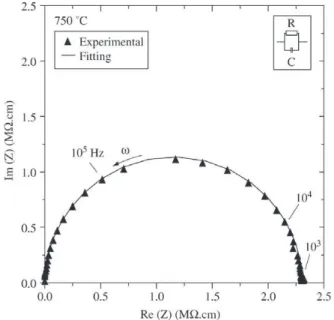
The equivalent circuit adopted to simulate the experi-mental data consisted in a simple parallel RC. The fitting is exemplified in Fig. 2, which shows the experimental data taken at 750 °C, as well as the simulated curve and the equivalent circuit employed. Good agreement between the experimental and theoretical curves was observed. The
elec-trical properties of Bi4Ge3O12 crystal can thus be associated
with a simple RC equivalent circuit.
The existence of a single relaxation mechanism was corroborated by the plots of the imaginary and real parts of Z* as functions of the frequency, as seen in Fig. 3. In these plots, shown for T = 750 °C, it was observed only one maxi-mum value of Z’’ accompanied by an inflexion point in the
Z’ curve at the relaxation frequency f0 = 1/2πRC. For this
temperature f0 = 40 kHz, corresponding to the maximum in
the semicircle of the Fig. 2.
Figure 4 shows the electrical conductivity curves of BGO
as a function of the signal frequency. The values of σ’ were
derived from the impedance data using the relation:
σ’ = Z’/(Z’2 + Z’’2) (1)
BGO electrical conductivity presented a frequency in-dependent part at low frequencies followed by a part in which
it obeys approximately the universal power law σ’(f) ∝ωn,
where 0 < n <1 9,10. The conductivity value at the plateau
(σ’p) is interpreted as the dc conductivity11,12.
The behavior of the electrical conductivity with
fre-Figure 1. Complex impedance diagrams of Bi4Ge3O12 single crys-tal, taken isothermally at 600, 650, 700 and 750 °C. The numbers indicate the signal frequency.
quency agrees with that predicted for conduction mecha-nisms over a random distribution of energy barriers in a
disordered solid12. For dc conduction the largest energy
barriers are overcome, while lower barriers are involved for ac conduction since only a limited distance has to be traveled. At high ac frequencies, the electrical conductivity is increased by the hopping of the charge carrier back-ward and forback-ward at places with high jump probability. This enhancement in the electrical conductivity continues as long as the frequency of the applied field is lower than
the maximum jump frequency in the solid12. In Bi
4Ge3O12
structure, the Ge4+ possesses a tetrahedra of coordination
quite regular, with ions O2- at a distance of 1.740 Å, but
the ion Bi3+ is coordinated by three ions O2- at 2.160 Å and
three ions O2- at 2.605 Å, in a very deformed octaedra13.
This disorder in BGO structure could account for a distri-bution of energy barriers for the conduction process, re-flected in the dispersion of electrical conductivity values at high frequencies.
The plots in Fig. 4 allow us to evaluate the electrical
conductivity σ’p in the frequency independent interval. These
values were taken at the fixed frequency f = 103 Hz and
used to calculate the apparent activation energy of the
process. Additionally, the ac conductivity (σ’ac) of BGO was
determined from the complex impedance diagrams, in which
the semicircle diameter stands for the resistivity ρ = 1/σ’ac
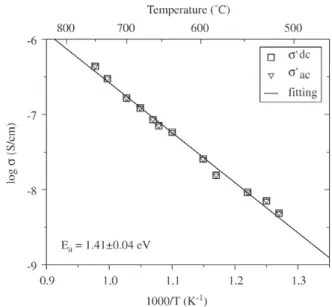
of the system. From our results, it was verified that both σ’p
and σ’ac were thermally activated according to the Arrhenius
law (see Fig. 5):
σ’ = σ0 exp (-Ea/kT) (2)
where σ0 is a pre-exponential factor and Ea, k and T
repre-sent the apparent activation energy for conduction process,
Boltzmann’ constant and the absolute temperature, respec-tively.
The experimental data shown in Fig. 5 were fitted to
Eq. 2 and the apparent activation energy Ea = (1.41 ± 0.04)
eV was deduced from the slope of the calculated curve. This
energy was the same for both sets of σ’p and σ’ac values,
indicating that the ac conductivity in BGO is dominated by a slow, long-range mechanism.
Figure 3. Plots of the imaginary and real parts of Z* as functions of the frequency. The maximum value of Z’’ and the inflexion point in the Z’ curve are observed at the relaxation frequency f0 = 1/2πRC.
Figure 4. Conductivity σ’ of BGO single crystal. The plateau at
low frequencies accompanied by the dispersion at high frequen-cies is generally related to hopping processes in disordered solids12.
Figure 5. Arrhenius plots for dc and ac conductivities in BGO (σ’dc and σ’ac, respectively). The apparent activation energy
Among the possible defects in the BGO structure, the
most probable one is ion substitution14, either in the Bi3+ or
Ge4+ sites. Considering that the grouping (GeO
4)4- is very
stable the charge compensation, if needed, can be supplied
either by the removal of some Bi3+ or O2- from their sites or
by oxidation of Bi3+ into Bi5+ 14,15. This defect structure
re-sults in various trapping centers with different depths since
Bi4Ge3O12 lattice structure contains several non-equivalent
oxygen sites. Kovács et al.16 have determined a
thermoluminescent peak of Bi4Ge3O12 at 130 °C, with
acti-vation energy of 0.86 eV, and all the other trap centers of
BGO were detected at lower temperatures17,18,19. As the band
gap of Bi4Ge3O12 was determined to be 5.0 eV at room
tem-perature20, the activation energy E
a = (1.41 ± 0.04) eV
ob-served in this work could be related to deeper traps than
those registered by Kóvacs et al.3z. It can be hypothesized
that the conduction mechanism in BGO is due to hopping electrons and that, at low frequencies, it is dominated by the electrons released from these deep traps.
3.2. Dielectric Characterization
In a dielectric under external oscillating field, the an-swer of the system can be expressed in terms of the
com-plex dielectric permittivity ε*:
(3)
which is obtained from the complex impedance data Z* by
the expression21:
(4)
where S is the electrode area,
l
is the pellet thickness andε0 is the vacuum permittivity. The real part ε’ is the relative
permittivity, or dielectric constant, and the imaginary part
ε’’ is the loss factor.
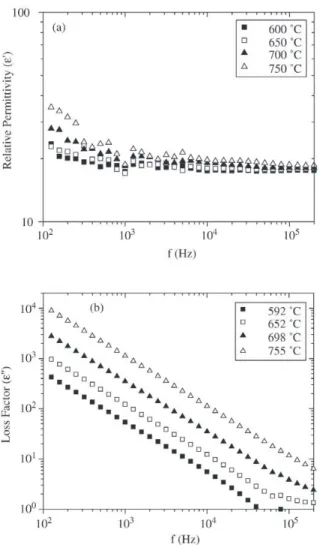
The real and imaginary parts of complex permittivity of BGO were used to evaluate its dependence on frequency.
Figure 6 shows log-log plots of ε’ and ε’’ at several
tem-peratures. For frequency values higher than 103 Hz, ε’
pre-sented a weak dependency on the frequency or tempera-ture. The dielectric constant, calculated from the average
value over the frequency range of 103 to 106 Hz and several
temperatures between 550 and 750 °C, was ε’ = 20 ± 2. This
value is consistent with the value ε’ = 16 determined by
Link et al.6 at f = 103 Hz over the temperature range of 6 to
325 K.
No loss peak was observed in the ε’’ spectra,
character-izing a deviation from the dipolar response of the system,
predicted by the Debye theory22. This feature indicates that
the applied field interacts with the material not only through
reorientation of the electric dipoles9,10,23, but also through
the displacement of the charge carriers, in accordance with the hopping-type conduction proposed for BGO in this work.
4. Conclusions
The electrical and dielectric properties of Bi4Ge3O12
sin-gle crystals, in the frequency interval of 102 -106 Hz and
temperature interval of 500 to 750 °C, were reported by the first time in the present work.
Impedance measurements of Bi4Ge3O12 single crystals
allowed us to determine an unique electrical process, iden-tified by a single semicircle in the complex diagrams. The electrical conductivity curves agree with that proposed by Figure 6. (a) Real part of permittivity ε’; (b) imaginary part of
permittivity ε’’ as a function of frequency at several temperatures
Dyre for conduction mechanisms over a random distribu-tion of energy barriers in a disordered solid. Our results provided some evidence that the conduction process is
as-sociated to defects in the (BiO6)9- octaedra. As these octaedra
are deformed, they can give rise to trapping centers with different depths, which result in a distribution of energy barriers for the conduction process.
The real part of the complex dielectric permittivity was
ε’ = 20 ± 2 for frequency values higher than 103 Hz for all
the measured temperatures, and presented a low-frequency dispersion. This feature, combined to the absence of a loss
peak in the ε’’ vs. f curve, characterized a deviation from
the dipolar response of the system. Both electrical and di-electric behaviors of BGO are typical of systems in which the charge-carrier polarization dominates the dielectric re-sponse.
Acknowledgments
The authors acknowledge CNPq, CAPES and FAPESP by the financial support.
References
1. Raymond, S.G.; Townsend, P.D. The influence of rare-earth ions on the low-temperature thermoluminescence
of Bi4Ge3O12, J. Phys. Cond. Mat., v. 12, p. 2103-122,
2000.
2. Williams, P.A.; Rose, A.H.; Lee, K.S.; Conrad, D.C.; Day, G.W.; Hale, P.D. Optical, thermo-optic, electro-optic, and photoelastic properties of bismuth
germanate (Bi4Ge3O12), Appl. Opt., v. 35, n. 19, p.
3562-69, 1996.
3. Macedo, Z.S.; Silva, R.S.; Valerio, M.E.G.; Martinez, A.L.; Hernandes, A.C. Laser Sintered Bismuth Germanate Ceramics as Scintillator Devices, accepted
for publication in the J. Am. Ceram. Soc., 2003.
4. Nitsche, R. Crystal growth and electro-optic effect of
bis-muth germanate, Bi4(GeO4)3, J. Appl. Phys. v. 36, p.
2358-60, 1965.
5. Li, C.; Yoshino, T. Simultaneous measurement of current and voltage by use of one bismuth germanate crystal,
Appl. Opt., v. 41, n. 25, p. 5391-97, 2002.
6. Link, J.; Fontanella, J. Temperature variation of the di-electric properties of bismuth germinate and bismuth
ger-manium oxide”, J. Appl. Phys., v. 51, n. 8, p.
4352-55,1980.
7. Jonhson, D. software Zview – v. 2, 3d, Scribner Associ-ates, Inc., 2000.
8. Sinclair, D.C.; West, A.R. Electrical properties of a LiTaO3
single crystal, Phys. Rev. B, v. 39, n. 18, p. 13486-13492, 1989.
9. Jonscher, A.K. The universal dielectric response, Nature,
v. 267, p. 673-678, 1977.
10. Niklasson, G.A. Comparison of dielectric response
func-tions for conducting materials, J. Appl. Phys., v. 66, n. 9,
p. 4350-59, 1989.
11.Bianchi, R.F.; Carrió, J.A.G.; Cuffini, S.L.; Mascarenhas
Y.P.; Faria, R.M. Electrical conductivity of SrTi1-xRuxO3,
Phys. Rev. B, v. 62, n. 6, p. 10785-89, 2000.
12.Dyre, J.C. The random free-energy barrier model for ac
conduction in disordered solids, J. Appl Phys. v. 64. n. 5,
p. 2456-68, 1988.
13.Smet, F.M. Crystal Growth and Characterization of
Bis-muth Germanate (BGO), PhD thesis, Katholieke Universiteit van Nijmegen, p. 113, 1989.
14. Lecoq, P.; Li, P.J.; Rostaing, B. BGO radiation damage effects: optical absorption, thermoluminescence and
thermoconductivity, Nucl. Instr. Meth. Phys. Res.,
v. A300, p. 240-258, 1991.
15. Raymond, S.G.; Luff, B.J.; Townsend, P.D.; Feng, S.; Hu, G. Thermoluminescence spectra of doped
Bi4Ge3O12, Radiat. Meas., v. 23, n. 1, p. 195-202, 1994.
16. Kóvacs, L.; Raymond, S.G.; Luff, B.J.; Péter, A.; Townsend, P.D. Thermoluminescence spectra of eulytine
Bi4Si3O12 and Bi4Ge3O12 single crystals, Journal of
Lu-minescence, v. 60&61, p. 574-577, 1994.
17. Sabharwal, S.C.; Prasad, H.; Desai, D.G.; Sangeeta, H.P.; Karandikar, S.C.; Gupta, M.K. Thermoluminescence and
transmission recovery of gamma irradiated Bi4Ge3O12
single crystal, Nucl. Instrum. Meth., v. A329, n. 1-2,
p. 179-82, 1993.
18. Sangeeta, H.P.; Sabharwal, S.C. Crystal stoichiometry
and thermoluminescence of Bi4Ge3O12 and Y3Al5O12, J.
Cryst. Growth, v. 118, n. 3-4, p. 396-400, 1992.
19. Melcher, C.L. Correlation between thermoluminescence
and radiation damage in bismuth germanate, IEEE T.
Nucl. Sci., v. 32,n. 1, p. 545-48, 1985.
20. Barnes, R.G.L. Bismuth Germanate (BGO) optimiza-tion for energy resoluoptimiza-tion and purity, IEEE Tans. Nucl. Sci., v. 31, n. 1, p. 249-252, 1984.
21. Macdonald, J.R. John Wiley & Sons, p. 12-43, 1987. 22. Elissalde, C.; Ravez, J. Ferroelectric ceramics: defects
and dielectric relaxation, J. Mat Chem., v. 11, n. 8,
p. 1957-67, 2001.
23. Jonscher, A.K. Dielectric relaxation in solids, J. Appl