ISSN 0101-8205 www.scielo.br/cam
Static two-player evasion-interrogation games
with uncertainty
∗H.T. BANKS, S.L. GROVE, K. ITO and J.A. TOIVANEN
Center for Research in Scientific Computation, North Carolina State University Raleigh, NC 27695-8205
E-mails: [email protected] / [email protected] / [email protected] / [email protected]
Abstract. We consider electromagnetic evasion-interrogation games wherein the evader can
use ferroelectric material coatings to attempt to avoid detection while the interrogator can manip-ulate the interrogating frequencies (wave numbers) and angles of incidence of the interrogating inputs to enhance detection and identification. The resulting problems are formulated as two player games in which one player wishes to minimize the reflected signal while the other wishes to maximize it. Simple deterministic strategies are easily defeated and hence the players must introduce uncertainty to disguise their intentions and confuse their opponent. Mathematically, the resulting game is carried out over spaces of probability measures which in many cases are appropriately metrized using the Prohorov metric.
Mathematical subject classification: 49N75, 91A05, 91A10, 91A60, 78A30, 78A46.
Key words: pursuit-evasion games with uncertainty, electromagnetic interrogation, inverse
scattering.
1 Introduction
In [8] the authors demonstrated that it is possible to design ferroelectric materi-als with appropriate dielectric permittivity and magnetic permeability to signifi-cantly attenuate reflections of electromagnetic interrogation signals from highly
#688/06. Received: 01/IX/06. Accepted: 04/X/06.
conductive targets such as airfoils and missiles. This was done under assump-tions that the interrogating input signal is uniformly likely to come from a sector of interrogating anglesα ∈ [α0, α1](α= π2−φwhereφis the angle of incidence
of the input signal) but that the evader has knowledge of the interrogator’s input frequency or frequencies (denoted in the presentations below as the interrogator design frequencies ID). These results were further sharpened and illustrated in
[9] where a series of different material designs were considered to minimize over a given set of input design frequencies IDthe maximum reflected field from input
signals. In addition, a second critical finding was obtained in that it was shown that if the evader employed a simple counter interrogation design based on a fixed set (assumed known) of interrogating frequencies ID, then by a rather
sim-ple counter-counter interrogation strategy (use an interrogating frequency little more than 10% different from the assumed design frequencies), the interrogator can easily defeat the evader’s material coatings counter interrogation strategy to obtain strong reflected signals.
From the combined results of [8, 9] it is thus rather easily concluded that the evader and the interrogator must each try to confuse the other by introducing significant uncertainty in their design and interrogating strategies, respectively. This concept, which we refer to as mixed strategies in recognition of previous contributions to the literature on games (von Neumann’s finite mixed strategies to be explained below), leads to two player non-cooperative games with probabilis-tic strategy formulations. These can be mathemaprobabilis-tically formulated as two sided optimization problems over spaces of probability measures, i.e., minmax games over sets of probability measures. The purpose of this paper is to provide a math-ematically precise formulation of such a class of two sided optimization problems and to discuss our initial computational efforts on such problems. Approxima-tion methods are introduced and their computaApproxima-tional efficacy is demonstrated with several simple examples.
2 Problem formulation
fields from an object such as an airfoil or missile and can be computed in one of several ways [8, 9].
Dielectric Coating Ambient
Perfectly conducting half plane
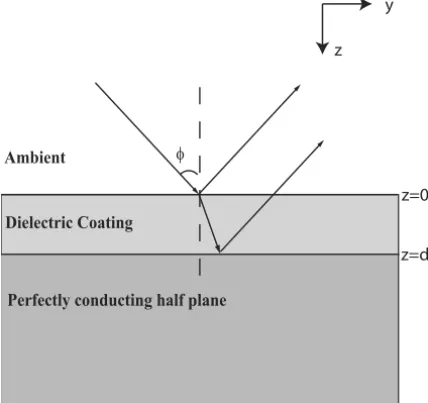
Figure 1 – Interrogating high frequency wave impinging (angle of incidence φ) on coated (thickness d) perfectly conducting surface.
The simplest is the reflection coefficient based on a simple planar geometry (e.g., see Figure 1) using Fresnel’s formula for a perfectly conducting half plane which has a coating layer of thickness d with dielectric permittivityǫand mag-netic permeabilityμ. A normally incident (φ =0) electromagnetic wave with the frequency f is assumed to impinge the half plane. Then the corresponding wavelengthλin air isλ=c/f , where the speed of light is c =0.3×10⁹. The
reflection coefficient R for the wave is given by
R= a+b
1+ab, (1)
where
a= ǫ−
√ǫμ
ǫ+√ǫμ and b=e4i
π√ǫμf d/c. (2)
An alternative and much more computationally intensive approach (which may be necessitated by some target geometries) employs the far field pattern for re-flected waves computed directly using Maxwell’s equations. In two dimensions, for a reflecting bodywith coating layer1and computational domain5with
an interrogating plane wave E(i), the scattered field E(s)satisfies the Helmholtz equation [15]
∇ ∙
1
μ∇E
(s)
+ǫω2E(s)= −∇ ∙
1
μ∇E
(i)
−ǫω2E(i) in 5\ ˉ
E(s)= −E(i) on ∂
1
μ ∂E
∂n
=[E]=0 on ∂1\∂
∂E(s)
∂n −i k E
(s)
− i
2k
∂2E(s)
∂s2 =0 on ∂5
∂E(s)
∂s −i k
3 2E
(s)
=0 at C,
(3)
where the Silver-Müller radiation condition has been approximated by a second-order absorbing boundary condition on ∂5 as described in [2, 17, 18]. The vectors n and s denote the normal and tangential directions on the boundary∂5, respectively, and C is the set of the corner points of5. Here[ ∙ ]denotes the jumps at interfaces. The incident field in air is given by
E(i)=ei k(x1cosα+x2sinα),
whereα is the interrogation angle (α = π2 −φ) and k = 2πf/c =ω/c is the interrogation wave number corresponding to the interrogating frequency f . The corresponding far field pattern is given by [8, 15]
Fα(α+π;ǫ, μ, α,f)
= lim
r→∞
√
8πkr e−i(kr+π/4) E(s)(r cos(α+π ),r sin(α+π );ǫ, μ, α,f), (4)
where E(s)(x
1,x2;ǫ, μ, α, f) is the scattered electromagnetic field. This can
be used as a measure of the reflected field intensity instead of the reflection coefficient R of (1)–(2).
ǫ’s andμ’s ) while the interrogator wants to choose best angles of interroga-tion α and interrogating frequencies f . Each player must act in the presence of incomplete information about the other’s action. Partial information regard-ing capabilities and tendencies of the adversary can be embodied in probability distributions for the choices to be made. That is, we may formalize this by assuming the evader may choose (with an as yet to be determined set of proba-bilities) dielectric permittivity and magnetic permeability parameters(ǫ, μ)from admissible setsE×Mwhile the interrogator chooses angles of interrogation and interrogating frequencies(α, f)from setsA×F. The formulation here is based on the mixed strategies proposals of von Neumann [1, 22, 23] and the ideas can be summarized as follows. The evader does not choose a single coating, but rather has a set of possibilities available for choice. He only chooses the probabilities with which he will employ the materials on a target. This, in effect, disguises his intentions from his adversary. By choosing his coatings randomly (according to a best strategy to be determined in, for example, a minmax game), he prevents adversaries from discovering which coating he will use–indeed, even he does not know which coating will be chosen for a given target. The interrogator, in a similar approach, determines best probabilities for choices of frequency and angle in the interrogating signals. Note that such a formulation tacitly assumes that the adversarial relationship persists with multiple attempts at evasion and detection.
The associated minmax problem consists of the evader choosing distributions Pe(ǫ, μ) over E ×M to minimize the reflected field while the interrogator
chooses distributions Pi(α, f)overA×F to maximize the reflected field. If
BR(ǫ, μ, α, f) is the chosen measure of reflected field andPe = P(E×M)
andPi =P(A×F)are the corresponding sets of probability distributions or
measures overE×MandA×F, respectively, then the cost functional for the minmax problem can be defined by
J(Pe,Pi)= Z
E×M Z
A×F
|BR(ǫ, μ, α, f)|2d Pe(ǫ, μ)d Pi(α, f). (5)
defines upper and lower values for the game by
J = inf
Pe∈Pe
sup
Pi∈Pi
J(Pe,Pi) and J = sup Pi∈Pi
inf
Pe∈Pe
J(Pe,Pi).
The first represents a security level (worst case scenario) for the evader while the latter is a security level for the interrogator. It is readily argued that J ≤ J and if the equality J∗ = J = J holds, then J∗is called the value of the game.
Moreover, if there exist Pe∗∈Peand Pi∗ ∈Pi such that
J∗ = J(Pe∗,Pi∗)= min
Pe∈Pe
J(Pe,Pi∗)=max Pi∈Pi
J(Pe∗,Pi),
then (Pe∗,Pi∗) is a saddle point solution or non-cooperative equilibrium of
the game.
To investigate theoretical, computational and approximation issues for these problems, it is necessary to put a topology on the space of probability measures. Given a set I , a natural choice forP(I)is the Prohorov metric topology [14, 19, 21] as used for minimization/inverse problems in [3, 4, 7, 11]. Prohorov metric (ρ) convergence isweak∗convergence inPwhenPis considered as a subset of the topological dual C∗B(I)of the space CB(I)of bounded continuous functions
on I . More precisely, convergenceρ(Pk,P) → 0 in the Prohorov metric is
equivalent to
Z
I
f(ξ )d Pk(ξ )→ Z
I
f(ξ )d P(ξ )
for all bounded, uniformly continuous f : I →R1.
Theorem 2.1. Let I be a complete, separable metric space,Bthe class of all Borel subsets of I andP(I)the space of probability measures on(I,B). Let I0 = {ξj}∞j=1be a countable, dense subset of I . Then the set of P ∈P(I)such
that P has finite support in I0 and rational masses is dense in P(I) in the ρ
metric. That is,
P0(I)≡
P∈P(I):P =
k X
j=1
pj1ξj,k ∈N +,
ξj ∈ I0, pj rational, k X
j=1
pj =1
is dense inP(I)taken with theρmetric, where1ξj is the Dirac measure with
atom atξj.
It is rather easy to use the ideas and results associated with this theorem to develop computationally efficient schemes. Given
Id = ∞ [
M=1
IM with IM =
ξMj M j=1
(a “partition” of I ) chosen so that Id is dense in I , define
PM(I)=
P ∈P(I): P=
M X
j=1
pj1ξMj , ξ
M j ∈ IM,
pj rational, M X
j=1
pj =1
.
Then we find
(i) PM(I)is a compact subset ofP(I)in theρmetric,
(ii) PM(I)⊂PM+1(I)whenever IM+1is a refinement of IM,
(iii) “PM(I) → P(I)” in the ρ topology; that is, for M sufficiently large, elements inP(I)can be approximated in theρmetric by elements ofPM.
Theorem 2.2. LetF be a weakly compact subset of L2(I), I compact and let
PF(I)≡ {P ∈P(I): P′= p, p∈F}.ThenPF(I)is compact inP(I)in the ρmetric. Moreover, if we define{ℓM
j }to be the linear splines on I corresponding
to the partition IM, where S
M IM is dense I , define
PM ≡
pM : pM =X
j
bMj ℓMj ,bMj rational
and if
PFM ≡
PM ∈P(I):PM = Z
pM, pM ∈PM
,
we haveS
MPFM is dense inPF(I)taken with theρmetric.
A study comparing the relative strengths and weaknesses of these two classes of approximation schemes in the context of inverse problems is given in [5].
3 Theoretical results
To establish existence of a saddle point solution for the evasion-interrogation problems formulated above, one can employ a fundamental result of von Neu-mann [22, 23] as stated by Aubin ([1]-see p. 126).
Theorem 3.1 (von Neumann). Suppose X0,Y0are compact, convex subsets of
metric linear spaces X,Y respectively. Further suppose that
(i) for all y∈Y0,x → f(x,y)is convex and lower semi-continuous;
(ii) for all x∈ X0,y → f(x,y)is concave and upper semi-continuous.
Then there exists a saddle point(x∗,y∗)such that
f(x∗,y∗)=min
X0
max
Y0
f(x,y)=max
Y0
min
X0
f(x,y).
Theorem 3.2. SupposeE,M, 8,F are compact and the spaces X0=P(E×
M), Y0 = P(8×F) are taken with the Prohorov metric. Then X0,Y0 are
compact, convex subsets of X =CB∗(E×M)and Y =C∗B(8×F), respectively. Moreover, there exists(Pe∗,Pi∗)∈P(E×M)×P(8×F)such that
J(Pe∗,Pi∗)= min
P(E×M)Pmax(8×F)J(Pe,Pi)=Pmax(8×F)P(minE×M)J(Pe,Pi).
For computations, we may use the “delta” approximations of Theorem 2.1 and obtain
d Pe(ǫ, μ) ≈ X
pejδ(ǫj,μj)(ǫ, μ)dǫdμ,
d Pi(φ, f) ≈ X
pijδ(φj,fj)(φ, f)dφd f.
As noted above, a convergence theory can be found in [3]. This corresponds precisely to von Neumann’s finite mixed strategies framework for protection by disguising intentions from opponents, i.e., by introducing uncertainty in the players’ choices.
To illustrate the computational framework based on the delta measure approx-imations, we take
d PeM(ǫ, μ) = M X
j=1
pMj δ(ǫM
j ,μMj )dǫdμ and
d PiN(φ, f) = N X
k=1
qkNδ(φN k,f
N k )dφd f,
which can be represented respectively by
ˉ
pM =
pMj M
j=1∈ P M
≡
ˉ
p∈RM| pj ≥0, M X
j=1
pj =1
(6)
and
ˉ
qN =
qkN Nk=1∈ QN ≡
ˉ
q ∈RN|qk ≥0, N X
k=1
qk =1
We note that in this case the pMj ,qkNare the probabilities associated with the use of the material parameters ǫMj , μMj and interrogating parameters φkN, fkNin the mixed strategies of the evader and interrogator, respectively.
Then J(PeM,PiN)reduces to
J(pˉM,qˉN)=
N X
k=1 M X
j=1
pMj BR(ǫMj , μMj , φkN, fkN) 2
qkN
where BR is a measure of the reflected field (either the reflection coefficient or
the far field scattering intensity). Since PM,QNare compact, convex subsets of RM,RN, respectively, we have the following theorem.
Theorem 3.3. For fixed M,N there exists(pˉM
∗ ,qˉ∗N)in PM ×QN such that
J∗ = J pˉ∗M,qˉ∗N
= min
ˉ
pM∈PM qˉmaxN∈QNJ pˉ M,
ˉ
qN
= max
ˉ
qN∈QN pˉMmin∈PMJ pˉ M
,qˉN.
Assume further that (ǫ, μ, φ, f) → BR(ǫ, μ, φ, f) is continuous on E ×
M×8×F which is assumed compact. Then there exists a sequence(pˉM ∗ ,qˉ∗N)
of elements from PM × QN respectively with corresponding (PeM,PiN) in P(E×M)×P(8×F)converging in the Prohorov metric to(P∗
e,Pi∗)which
is a saddle point for the original minmax problem.
Proof. The hypothesis that the map(ǫ, μ, φ, f)→ BR(ǫ, μ, φ, f)be
contin-uous onE×M×8×F implies continuity of the map(Pe,Pi)→ J(Pe,Pi)
on X0×Y0→R1+, where X0=P(E×M)and Y0=P(8×F)are compact
convex in X =C∗B(E×M)and Y =C∗B(8×F), respectively. This is due to the compactness ofE×Mand8×F, and properties of the Prohorov metric. Let PM,QN be defined as in (6), (7), and observe that these are compact convex subsets of RM,RN, respectively. Now let P
e ∈ X0 and Pi ∈ Y0 be
arbitrary. Then by Theorem 2.1 and (iii) above (see also [3]), there exists a sequence pˉM,qˉN ∈ PM,QN with associated measures PeM,PiN, respectively,
such that
Let PM∗ e , P
N∗
i (guaranteed to exist by continuity, compactness, and the von
Neumann theorem) with coordinatespˉ∗M,qˉ∗N, respectively, satisfy
J PeM∗,PiN ≤ J PeM∗,PiN∗ ≤ J PeM,PiN∗ (8)
for all(PeM,PiN) in X0×Y0 with coordinate representations in PM,QN,
re-spectively. Now X0 ×Y0 compact implies that there exists a subsequence
(PeMk∗,PiNk∗) and(P˜e,P˜i) in X0 ×Y0 such that (PeMk∗,P Nk∗
i ) → (P˜e,P˜i) in
X0×Y0.
Consider (8) for indices Mk,Nk, so that
J
PeMk∗,PNk i
≤ J
PeMk∗,PNk∗ i
≤ J
PMk e ,P
Nk∗ i
.
Then given the continuity of J and taking the limit we find
J
˜
Pe,Pi
≤ J
˜
Pe,P˜i
≤ J
Pe,P˜i
.
Since Pe,Pi are arbitrary in X0,Y0 respectively, we have (P˜e,P˜i) is a saddle
point for the original minmax problem.
Further note that since these arguments hold for any subsequence of(PM∗ e ,
PiN∗), then
J PeM∗,P N i
≤ J PeM∗,P N∗ i
≤ J PeM,P N∗ i
and PeM∗ → ˜Peas well as PiN∗ → ˜Pi. That is, any subsequence of PeM∗,PiN∗
has a convergent subsequence toP˜e,P˜i so that the sequence itself must converge
toP˜e,P˜i.
4 Preliminary numerical calculations
following way. For a given assumed interrogator design frequency set ID and
assumed normal incident waves (incident angleφ = 0), the evader designs a material by optimizing over admissible sets forǫ andμ, the criteria
J∞(ǫ, μ)=max
f∈ID
BR(ǫ, μ,0, f)
to obtain “optimal” coating parameters(ǫ∗, μ∗). With the thickness d = 2.5
millimeters, Fresnel’s formula (1)–(2) was used to obtain a series of materials labelled 1R,2R, ...,6R corresponding to(ǫ∗, μ∗)=(ǫ
j R, μj R)in [9].
Adopt-ing the same labellAdopt-ing here, we allow the evader to choose from subsets com-posed of elements from the following six materials denoted by their respective parameter values(ǫj R, μj R),j =1, . . . ,6:
1R: (ǫ1R, μ1R)=(900.4+38.2i,1)optimizing only overǫ
withμ=1 fixed and ID = {1 G H z},
2R: (ǫ2R, μ2R)=(90.7+21.4i,10+2i)for ID = {1 G H z},
3R: (ǫ3R, μ3R)=(90.7+21.4i,10+2i)for ID = [0.8,1.25],
4R: (ǫ4R, μ4R)=(5625.4+95.5i,1)optimizing only overǫ
withμ=1 fixed and ID = {0.4 G H z},
5R: (ǫ5R, μ5R)=(558.6+29.3i,10+1.2i)for ID = {0.4 G H z},
6R: (ǫ6R, μ6R)=(549.3+150i,10+2i)for ID = [0.32,0.5].
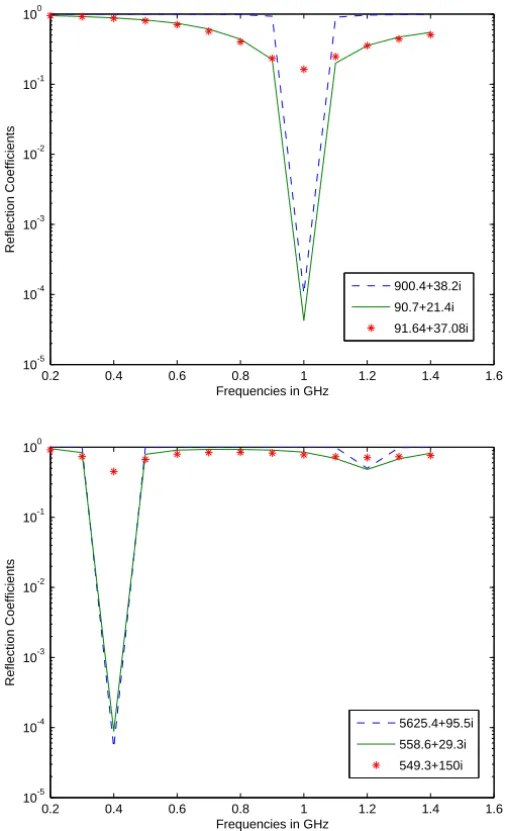
Graphs of the resulting reflection coefficients BR(ǫj R, μj R,0, f) = R(ǫj R, μj R, f) are plotted as a function of possible interrogating frequency in
Fig-ure 2. Note that in the cases 1R,2R,4R,5R,if the interrogator uses the design frequency, the evader has a high likelihood of avoiding detection, but his/her evasion strategy is easily defeated by an interrogating signal away from the design frequency.
4.1 Typical results
0.2 0.4 0.6 0.8 1 1.2 1.4 1.6 10-5
10-4 10-3 10-2 10-1 100
Frequencies in GHz
Reflection Coefficients
900.4+38.2i 90.7+21.4i
91.64+37.08i
0.2 0.4 0.6 0.8 1 1.2 1.4 1.6
10-5 10-4 10-3 10-2 10-1 100
Frequencies in GHz
Reflection Coefficients
5625.4+95.5i
558.6+29.3i 549.3+150i
Figure 2 – Reflection coefficients calculated using (ǫj R, μj R) from materials 1R,
2R, and 3R which are associated with (900.4+38.2i, 1), (90.7+21.4i, 10+2i), and
(91.64+37.08i, 10+2i), respectively (top) and materials 4R, 5R, and 6R which are
asso-ciated with (5625.4+95.5i, 1), (558.6+29.3i, 10+1.2i), and (549.3+150i, 10+2i),
a sample of results obtained for several choices of admissible evader material setsE ×M and interrogator frequency sets F. The minmax calculations are readily carried out using standard MATLAB minimization packages.
Evader Set Interrogator Set
E×M= {(ǫj R, μj R): j=1,2,3} F = {.4, .6,1}
E×M= {(ǫj R, μj R): j=1,2,3} F = {.4,1}
E×M= {(ǫj R, μj R): j=4,5,6} F = {.4, .6}
E×M= {(ǫj R, μj R): j=4,5,6} F = {.4, .6,1}
Results
ˉ
p∗M =(0,0,1) qˉ∗N =(1,0,0)
ˉ
pM
∗ =(0,0.241,0.759) qˉ∗N =(1,0) ˉ
p∗M =(0,0.667,0.333) qˉ∗N =(0,1)
ˉ
pM
∗ =(0,0.667,0.333) qˉ∗N =(0,0.667,0.333)
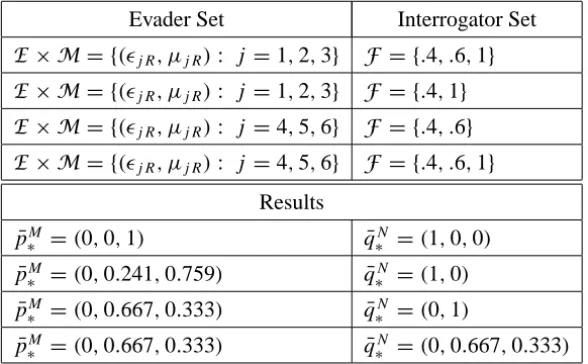
Table 1 – Results of the saddle point calculations for a sample of evader setsE×Mand interrogator setsF.
A few words on the findings in the table are in order. First we note that when materials 1R,2R,3R (all of which are based on an ID of 1 G H z or an interval
around 1 G H z) are available to the evader, the best strategy for the interrogator is to always choose (with probability 1) the interrogating frequency (.4 G H z) furthermost from the design frequencies. The evader’s choice is slightly more delicate. In the first row of Table 1 the evader always chooses material 3R which is based on design for the largest IDamong 1R,2R,3R. However, in the second
5 Concluding remarks
In this note we have presented preliminary ideas for evader-interrogator strate-gies in electromagnetic counter and counter-counter interrogation games. While the ideas are simple, they possess potential for readily implementable strategies in a number of other modern non-cooperative adversarial situations in that similar problems arise in information-misinformation dissemination, data retrieval and analysis, and internet traffic and security. The computational results we present are extremely simple, but illustrate aptly the potential. More realistic problems (currently under investigation) involve multiple layers of materials and the cor-responding Fresnel’s formulae (see [13, 16, 24]) for multiple stacked layers of dielectric materials. And of course one should investigate larger values of M and N than the values M =3 and N =2 or 3 used in the preliminary calculations reported on above.
In our computational examples, Pe and Pi were taken as discrete measures
with a finite number of atoms, i.e., finite weighted combinations of the delta measures. Our current computational efforts are on absolutely continuous mea-sures d Pe(ǫ, μ) = p(ǫ, μ)dǫdμand d Pi(f)=q(f)d f using the linear spline
approximations presented in Theorem 2.2. Specifically, these can be used to obtain approximations
p(ǫ, μ)≈ pM(ǫ, μ) = M X
j=1
pMj ℓMj (ǫ)ℓMj (μ),
q(f)≈qN(f) = N X
k=1
qkNℓkN(f)
which again reduces considerations to a simple minmax problem for
J pˉM,qˉN=
N X
k=1 M X
j=1
pMj A M N j k q
N k ,
where now
AM Nj k =
Z Z
E×M×F Z
ℓMj (ǫ)ℓ M
j (μ)|R(ǫ, μ, f)| 2
More generally, one should consider approximations
p(ǫ, μ)≈ pI M(ǫ, μ) = I X
i=1 M X
j=1
pi jI MℓiI(ǫ)ℓMj (μ),
resulting in a tensor product in the approximating minmax problems with tensor
Ai j kI M N =
Z Z
E×M×F Z
ℓiI(ǫ)ℓMj (μ)|R(ǫ, μ, f)|2ℓNk(f)dǫdμd f.
Of course, in these approximations the p′s and q′s are no longer simple proba-bilities (as in the case of the delta basis elements), but are weighting coefficients for the density basis elements{ℓMj }, etc., and must be properly constrained so that the finite combinations sum to a probability density.
Acknowledgement. This research was supported in part by the U.S. Air Force Office of Scientific Research under grant AFOSR FA9550-04-1-0220. The au-thors would like to thank Dr. Richard Albanese of the AFRL, Brooks AFB, San Antonio, TX, for numerous stimulating and valuable comments and suggestions during the course of this effort.
REFERENCES
[1] J.-P. Aubin, Optima and Equilbria: An Introduction to Nonlinear Analysis, Spring-Verlag, Berlin Heidelberg, 1993.
[2] A. Bamberger, P. Joly and J.E. Roberts, Second-order absorbing boundary conditions for the wave equation: a solution for the corner problem. SIAM J. Numer. Anal., 27 (1990), 323–352.
[3] H.T. Banks and K.L. Bihari, Modeling and estimating uncertainty in parameter estimation. Inverse Problems, 17 (2001), 95–111.
[4] H.T. Banks, D. Bortz, G.A. Pinter and L.K. Potter, Modeling and imaging techniques with potential for application in bioterrorism, Chapter 6 in Bioterrorism: Mathematical Modeling Applications in Homeland Security, H.T. Banks and C. Castillo-Chavez, eds., Frontiers in Applied Mathematics, SIAM, Philadelphia, 2003, pp. 129–154.
[6] H.T. Banks and N.L. Gibson, Well-posedness of solutions with a distribution of dielectric parameters. Applied Mathematics Letters, 18 (2005), 423–430.
[7] H.T. Banks and N.L. Gibson, Electromagnetic inverse problems involving distributions of dielectric mechanisms and parameters, Tech. Report CRSC-TR05-29, Center for Research in Scientific Computation, N.C. State University, Raleigh, NC, August, 2005. Quarterly Applied Math., to appear.
[8] H.T. Banks, K. Ito, G.M. Kepler and J.A. Toivanen, Material surface design to counter electromagnetic interrogation of targets, Tech. Report CRSC-TR04-37, Center for Research in Scientific Computation, N.C. State University, Raleigh, NC, November, 2004. SIAM J. Appl. Math., 66 (2006), 1027–1049.
[9] H.T. Banks, K. Ito and J.A. Toivanen, Determination of interrogating frequencies to maxi-mize electromagnetic backscatter from objects with material coatings, Tech. Report CRSC-TR05-30, Center for Research in Scientific Computation, N.C. State University, Raleigh, NC, August, 2005. Communications in Comp. Physics, 1 (2006), 357–377.
[10] H.T. Banks and K. Kunisch, Estimation Techniques for Distributed Parameter Systems, Birkhauser, Boston, 1989.
[11] H.T. Banks and G.A. Pinter, A probabilistic multiscale approach to hysteresis in shear wave propagation in biotissue. SIAM J. Multiscale Modeling and Simulation, 3 (2005), 395–412.
[12] T. Basar and G.J. Olsder, Dynamic Noncooperative Game Theory, SIAM Publ., Philadelphia, PA, 2ndedition, 1999.
[13] S. Beeler, H.T. Tran and N. Dietz, Representation of GaP formation by a reduced order sur-face kinetics model using p-polarized reflectance measurements. J. Appl. Physics, 86 (1999), 674–682.
[14] P. Billingsley, Convergence of Probability Measures, John Wiley, New York, 1968.
[15] D. Colton and R. Kress, Inverse Acoustic and Electromagnetic Scattering Theory, Vol. 93 of Applied Mathematical Sciences, Springer-Verlag, Berlin, 2nded., 1998.
[16] O.S. Heavens, Optical Properties of Thin Solid Films, Butterworths, London, 1955.
[17] E. Heikkola, Y.A. Kuznetsov, P. Neittaanmäki and J. Toivanen, Fictitious domain meth-ods for the numerical solution of two-dimensional scattering problems. J. Comput. Phys., 145 (1998), 89–109.
[18] E. Heikkola, T. Rossi and J. Toivanen, Fast direct solution of the Helmholtz equation with a perfectly matched layer or an absorbing boundary condition. Internat. J. Numer. Methods Engr., 57 (2003), 2007–2025.
[19] P.J. Huber, Robust Statistics, Wiley & Sons, New York, 1981.
[21] Yu. V. Prohorov, Convergence of random processes and limit theorems in probability theory, Theor. Prob. Appl., 1 (1956), 157–214.
[22] J. von Neumann, Zur theorie der gesellschaftsspiele. Math. Ann., 100 (1928), 295–320.
[23] J. von Neumann and O. Morgenstern, Theory of Games and Economic Behavior, Prince-ton University Press, PrincePrince-ton, NJ, 1944.