ABSTRACT: Like any other manufactured chemical compounds, explosives are produced using chemical reactants and other utilities (steam, heat, compressed air, feed water and electricity) and generate a set of environmental impacts (waste water, solid and water residue and waste heat, for example). On top of that, one can count the intrinsic hazard characteristic of explosives and the possibility of accidents involving these compounds. Within this framework, explosives present themselves as chemical compounds suitable for both LCI (Life Cycle Inventory) and LCA (Life Cycle Assessment). This LCI study takes into account all the raw materials, utilities and wastes taking place during the production process. In this particular article, lead azide has its processed mapped and inventoried under the scope of ISO 14040. ISO 14040:2006 describes the principles and framework for life cycle assessment (LCA), including: deinition of the goal and scope of the LCA, the life cycle inventory (LCI) analysis phase, the life cycle impact assessment (LCIA) phase, the life cycle interpretation phase, reporting and critical review of the LCA, limitations of the LCA, the relationship between the LCA phases and conditions for use of value choices and optional elements. The Lead azide was chosen due its singular explosive characteristics (very sensitive, which makes lead azide the explosive of choice as a primer in several applications. The results and conclusions of this study are drawn from the review of the process, its analysis, as well as from the application of life cycle inventory methods upon the manufactory of lead azide, a highly sensitive primer explosive, providing solid ground for the further studies, such as a full LCA assessment. Furthermore, for explosives, most LCA research works aims towards disposal, not addressing manufacturing, which is the main strength of this work.
KEYWORDS: Lead azide, Manufactory process, Life Cycle Inventory, Life Cycle Impact Assessment, Life Cycle Assessment.
Life Cicle Inventory for Lead Azide
Manufacture
Erick Braga F. Galante1, Assed Haddad2, Dieter Boer3, Danielle Bonifácio4
INTRODUCTION
Explosives are chemical compounds capable of undergoing a very rapid decomposition (detonation), which generates heat and produces gases, which can be converted in usefull work (thermodinamically deined). Overall, explosives have many applications, ranging from military to civilian. While the military applications of explosives are straightforward in its nature (bombs, mortars, missiles, payloads, for example), the quantities of explosives destined to the civil applications are signiicantly larger, due to its usage in infrastructure (mining operations, oil extraction and demolitions, for example).
Like all other manufactured chemical compounds, explosives are produced using chemical reactants and other utilities (steam, heat, compressed air, feed water, and electricity) and generate a set of environmental impacts (waste water, solid and water residue and waste heat, for example). On top of that, one can count the intrinsic hazardous characteristic of explosives and the possibility of accidents involving these compounds. Within this framework, explosives present themselves as chemical compounds suitable for LCI (Life Cycle Inventory) and LCA (Life Cycle Assessment) studies.
his study is a LCI and takes into account all the raw materials, utilities and wastes taking place during the production process. Hence, in this particular study, lead azide was the chosen explosive to have its manufactory process studied. Lead azide was chosen due to its explosive characteristics (very sensitive, which increase risks of detonations but makes it a mandatory compound in almost every explosive use), intense use and the presence of lead in the raw materials (in the form of lead nitrate) and residues.
1. Instituto Militar de Engenharia – Rio de Janeiro/RJ – Brazil 2. Universidade Federal do Rio de Janeiro – Rio de Janeiro/RJ – Brazil 3. Universitat Rovira i Virgili – Tarragona – Spain 4. Indústria de Material Bélico do Brasil – Magé/RJ – Brazil
Author for correspondence: Erick Braga F. Galante | Instituto Militar de Engenharia – Departamento de Engenharia Química – SE/5 – Praça Marechal Tibúrcio 80 CEP 23070-200 – Rio de Janeiro/RJ – Brazil | Email: [email protected]
herefore, for this article, the manufactory process of lead azide was mapped using the fundamentals of ISO 14044, qualitatively analysed and had its environmental impacts identiied and categorized (midpoint and endpoint). ISO 14040:2006 describes the principles and framework for life cycle assessment (LCA) including: deinition of the goal and scope of the LCA, the life cycle inventory (LCI) analysis phase, the life cycle impact assessment (LCIA) phase, the life cycle interpretation phase, reporting and critical review of the LCA, limitations of the LCA, the relationship between the LCA phases and conditions for use of value choices and optional elements. ISO 14040:2006 covers life cycle assessment (LCA) studies and life cycle inventory (LCI) studies. It does not describe the LCA technique in detail, nor does it specify methodologies for the individual phases of the LCA.
Furthermore, for explosives, several LCA works (Alverbro et al., 2009; Hochschorner et al., 2006; Hochschorner and
Finnveden, 2006) aim towards disposal and applications, not addressing manufacturing, which is the focus of this study.
his study aims to disclose the life cycle inventory of a largely used primary explosive (lead azide), aiming to help other researches addressing the environmental impacts in manufacturing lead azide, as well as other lead-based explosives. hus, this study aims to review one of the processes for manufacturing lead azide, as well as to build the life cycle inventory of the overall process as a preparation for modelling the life cycle of lead azide manufacture.
BaCkgROUND INfORmaTION
his section provides useful background regarding LCA, explosives, lead azide and its manufacture processes.
LifE CYCLE ASSESSmEnT (LCA)
Sonnemann and Castells (2004) presents a list of some analytical tools for environmental managing, in which LCA ranks irst as a standardized method for product-oriented environmental impact assessment (ISO 14001; ISO 14040; ISO14040:2006; Zharen, 1998). Alverbro et al. (2009) deined Life cycle assessment (LCA) as a method for assessing the potential environmental impacts and resources used throughout a product’s life from raw material acquisition, production, use and waste management (ISO 14040:2006).
It is important to determine that, under ISO, the term ‘product’ can also include services such as waste management.
he purpose of the LCA study of a particular product is to identify the main environmental impacts caused by the product or service evaluated to better determine the actions required for mitigation of impacts. According to ISO 14.040:2006, the steps of LCA are: goal and scope deinition, inventory analysis, impact assessment, and interpretation. Modern work (Clit et al., 2000) stated that LCAs are commonly carried out to compare alternative ways of delivering some function. he basis for comparison, common between all alternatives, is termed the Functional Unit for the study.
LifE CYCLE invEnTORY
Life cycle inventory is a part of larger initiatives towards environmental management (ISO 14001; Zharen, 1998) under the guidance of ISO standards such as ISO 14001, ISO 14040 and ISO 14040:2006. To perform a life cycle inventory, it is necessary to determine inputs and outputs within a given system, collect data as well as looking at environmental aspects. According to recent work (Haddad et al., 2013), a LCI study must be carried out for each
subsystem involved, materials and energy, generation of products and by-products, as well as pollutants. This inventory is known as LCI. Furthermore, as addressed by Passer et al. (2012) for an environmental construction, LCI is one step prior to the a full LCA. While the LCA aims to determine an indicator that assesses key environmental aspects, the LCI aims to obtain a condensed and reliable array of data.
ExpLOSivES OvERviEW
common way of classifying explosives is according to its detonation velocity and activation energy. Table 1 presents a classification matrix with some examples.
In general, to allow a full detonation to occur, a set of diferent explosives is required. he simplest coniguration starts with a primer, which is ignited by spark, friction, lame or impact and provides energy to ignite other more powerful explosives. Among the primers, lead azide can be counted as the most used both in military and civilian applications.
ThE LEAD AziDE - pRimER ExpLOSivE
he lead azide is an explosive initiator, being more eicient than mercury fulminate. It requires a higher temperature for spontaneous combustion and does not decompose during long storage periods at moderately elevated temperatures. When compressed into a capsule, lead azide ignites detonating or exploding the spark (Ramaswamy et al., 1981), but not as immediately as mercury fulminate. For this reason, the main charge initiation of a blasting cap composed of Pb(N3)2 is generally mixed in deined proportions with lead styphnate or other sensitizers to cause the explosion more easily, though with a less violentlame, which serves to initiate the explosion of azide.
he sensitivity to shock and friction rapidly increases in proportion as the particle size increases. Crystals of 1 mm in length are subject to a spontaneous explosion due to the energy content that they possess. Lead azide should not have needle-shaped crystals with a length greater than 0.1 mm. Lead azide with dextrin may appear to be safely stored under water for a long time. However, there is a belief that crystallized azide becomes more sensitive when stored under water due to an increase in the size of the crystals. Lead azide is produced in two crystal forms: orthorhombic (α), density 4.71 and monoclinic (β), density 4.93. he formation of the orthorhombic form, very
sensitive, prevented the mixture of a diluted solution of lead nitrate and sodium azide, with which lead azide is prepared (Allan et al., 1963; Imbel, 2013; Leslie, 1966).
Lead azide with dextrin can be soluble in cold water to extent measure of 1% because of the presence of dextrin. Both forms are almost insoluble in ether and acetone. Ethanol has little cold solvent action on the product and lead azide can be stored when wetted with a mixture of equal volumes of water and ethanol. Lead azide is soluble in aqueous solutions with ammonium acetate 10%. When exposed to an atmosphere with 90% of relative humidity at 30°C, lead azide in crystal form is hygroscopic and coated with a measure of 0.03 and 0.8%, respectively, of dextrin (Akhavan, 2011; Allan et al., 1963; Cooper, 1996; Holloway et al., 1965; Leslie, 1966; Meyer et al., 2007; Urbanski, 1984). Dry lead azide does not react with or corrode iron, steel, nickel, aluminium, lead, zinc, copper, tin or cadmium. Coatings of acid-proof black ink, shellac or iron surfaces, do not show any efect. In the presence of moisture, it corrodes copper and zinc and, in the latter case, it forms the dangerous and highly sensitive copper azide. For this reason, lead azide is not loaded or placed in contact with uncoated copper or their alloys (bronze, brass and other metals) (Silva and Iha, 2010; Urbanski, 1984).
Lead azide is obtained as a white precipitate, by reaction of a solution of sodium azide in a solution of lead acetate or lead nitrate. It is absolutely necessary that the process be conducted so that the precipitate formed creates very very small crystals. here are several approaches to the manufactory process. Lead azide manufactory is well known in technical literature (Leslie, 1966) and can be obtained with dextrin (Allan et al., 1963; Holloway et al., 1965) or without it. From Meyer et al. (2007) as well as other sources (Akhavan, 2011; Cooper, 1996; Date et al., 2009), one can design the process for dextrinated lead azide as presented in Fig. 1.
A standard plant that is able to hold a production unit as described in Fig. 1 contains vessels for the preparation of solutions (mainly solutions of sodium azide and lead nitrate), jacked vessels for the precipitation of lead azide, as well dosing pumps, iltering and drying installations. Due to the standard reaction using lead nitrate in excess, the wastewater is full of lead, and requires treatment before the inal disposal. his treatment can be carried out using precipitation or other methods (like ionic resin). Since the simpler method is precipitation using sulphate, this study considers it in the inventory.
Table 1. Explosives Classiication matrix (compiled by Authors).
Classiication due to detonation velocity
High explosive Low explosive
Classiication due to activation energy
Primers Lead azide Lead styphnate
Boosters RDX, TNT, HMX
Sodium Azide Distiled Water
NaOH
Sodium citrate Sodium AzideSolution Lead Nitrate Solution Dextrin
Precipitation Vessel
Filter
Wastewater
Lead Azide (wet) Lead Nitrate
figure 1. Manufactory process for lead azide (based on (Allan et al., 1963; Holloway et al., 1965; Imbel, 2013; Leslie, 1966)).
he steam generator consists of a set of equipment for producing water vapour. he water vapour produced is intended to distil the water from the solution, heating the reactive mixture and drying the lead azide produced.
leaD azIDe: lIfe CYCle INVeNTORY
The mapping starts with the identification of the manufacturing process and inventory stages of raw material inputs, energy inputs and service inputs themselves or other factors that may cause environmental impacts. With these data, enough information can be collected to understand the situation, qualitatively and quantitatively.
In the following sections of this chapter, the parameters of the four stages of the the manufacturing process life cycle of lead azide are deined, according to the goal and scope deined by ISO 14040:2006, from the inventory analysis of the life cycle assessment, life cycle impact and interpretation of the life cycle. his inventory was compiled from the processes described by (Allan et al., 1963; Holloway et al., 1965; Leslie, 1966) and used by (Imbel, 2013).
pRODuCTiOn SYSTEmS
he following subsystems are indirectly linked to the cycle of the manufacturing process of lead azide, but were not included in this study:
• Production of fuel oil (boiler fuel);
• Production of electricity;
• Condensing of steam for use of process water;
• Production of steam;
• Manufacture of sodium azide;
• Port logistics (because the company model sodium azide is an imported product);
• Manufacture of lead nitrate;
• Manufacture of dextrin;
• Manufacture of sodium citrate;
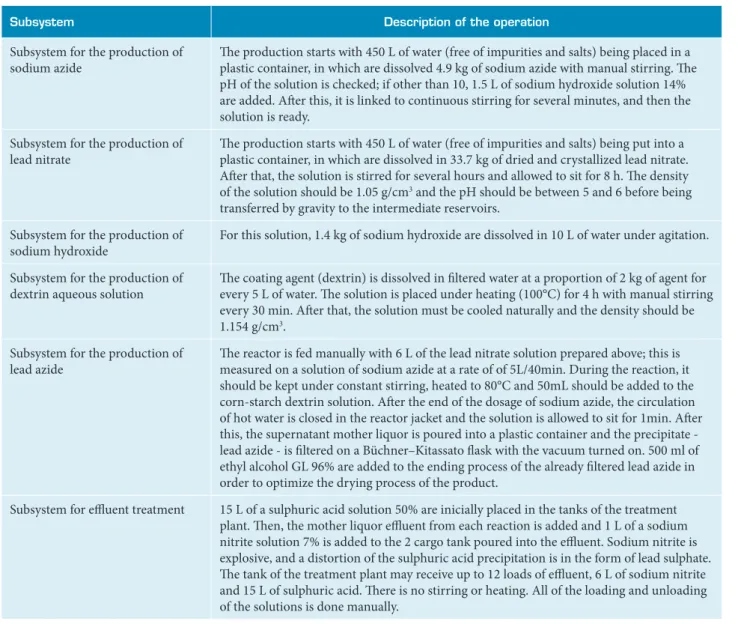
Table 2. Subsystems for production of lead azide.
Subsystem Description of the operation
Subsystem for the production of sodium azide
he production starts with 450 L of water (free of impurities and salts) being placed in a plastic container, in which are dissolved 4.9 kg of sodium azide with manual stirring. he pH of the solution is checked; if other than 10, 1.5 L of sodium hydroxide solution 14% are added. Ater this, it is linked to continuous stirring for several minutes, and then the solution is ready.
Subsystem for the production of lead nitrate
he production starts with 450 L of water (free of impurities and salts) being put into a plastic container, in which are dissolved in 33.7 kg of dried and crystallized lead nitrate. Ater that, the solution is stirred for several hours and allowed to sit for 8 h. he density of the solution should be 1.05 g/cm3 and the pH should be between 5 and 6 before being
transferred by gravity to the intermediate reservoirs.
Subsystem for the production of sodium hydroxide
For this solution, 1.4 kg of sodium hydroxide are dissolved in 10 L of water under agitation.
Subsystem for the production of dextrin aqueous solution
he coating agent (dextrin) is dissolved in iltered water at a proportion of 2 kg of agent for every 5 L of water. he solution is placed under heating (100°C) for 4 h with manual stirring every 30 min. Ater that, the solution must be cooled naturally and the density should be 1.154 g/cm3.
Subsystem for the production of lead azide
he reactor is fed manually with 6 L of the lead nitrate solution prepared above; this is measured on a solution of sodium azide at a rate of of 5L/40min. During the reaction, it should be kept under constant stirring, heated to 80°C and 50mL should be added to the corn-starch dextrin solution. Ater the end of the dosage of sodium azide, the circulation of hot water is closed in the reactor jacket and the solution is allowed to sit for 1min. Ater this, the supernatant mother liquor is poured into a plastic container and the precipitate - lead azide - is iltered on a Büchner–Kitassato lask with the vacuum turned on. 500 ml of ethyl alcohol GL 96% are added to the ending process of the already iltered lead azide in order to optimize the drying process of the product.
Subsystem for eluent treatment 15 L of a sulphuric acid solution 50% are inicially placed in the tanks of the treatment plant. hen, the mother liquor eluent from each reaction is added and 1 L of a sodium nitrite solution 7% is added to the 2 cargo tank poured into the eluent. Sodium nitrite is explosive, and a distortion of the sulphuric acid precipitation is in the form of lead sulphate. he tank of the treatment plant may receive up to 12 loads of eluent, 6 L of sodium nitrite and 15 L of sulphuric acid. here is no stirring or heating. All of the loading and unloading of the solutions is done manually.
• Manufacture of sodium hydroxide;
• Manufacture of ethyl alcohol 96% GL;
• Transportation: sodium azide, lead nitrate, corn-starch dextrin, sodium citrate, sodium hydroxide and ethanol 96% GL.
pRODuCT funCTiOn AnD funCTiOnAL uniT
SYSTEm BORDERS
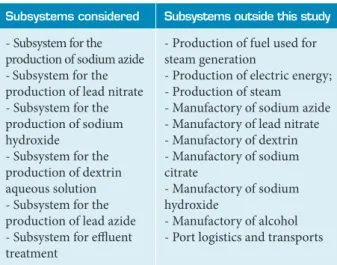
he product system is related with environmental aspects by the following steps: Consumption of natural resources (direct): crude oil and water; Energy consumption: electricity and fossil fuels; and Generation of waste: atmospheric emissions, liquid eluents and solid waste. A full set of borders and subsystems included in the study, as well as the excluded, are listed in Table 3.
SYSTEm BALAnCES
From information, it is possible to consolidate inputs and outputs for each subsystem. hese results are presented in Table 4.
Further analysing the subsystems (Table 4), it was necessary to determine the quantities of each raw material involved in the production of one kilogram of dry lead azide. his information is presented in Table 5, which was compiled using processes described by several sources (Allan et al., 1963; Holloway et al., 1965; Leslie, 1966) and under production in some industries (Imbel, 2013).
Furthermore, it is possible to determine that the two main raw materials are sodium azide and lead nitrate. Sodium azide, being a salt is not hygroscopic. It can be white or yellow. Its density ranges from 1.846 at 20°C in 100 parts of water to 40.7 at 15.2°C in parts of dissolved sodium azide. It is insoluble in ether and 100 g of absolute ethanol at 0°C can dissolve 0.22 g of sodium azide. The aqueous reaction is basic. When heated on a metallic plate, it does not melt, remaining unchanged up to 350°C, and detonates at higher temperature. When heated in vacuum, it decomposes into Na and N2.
Table 3. Summary of the borders and limitations.
Subsystems considered Subsystems outside this study
- Subsystem for the production of sodium azide - Subsystem for the production of lead nitrate - Subsystem for the production of sodium hydroxide
- Subsystem for the production of dextrin aqueous solution - Subsystem for the production of lead azide - Subsystem for eluent treatment
- Production of fuel used for steam generation
- Production of electric energy; - Production of steam
- Manufactory of sodium azide - Manufactory of lead nitrate - Manufactory of dextrin - Manufactory of sodium citrate
- Manufactory of sodium hydroxide
- Manufactory of alcohol - Port logistics and transports
Table 4. Subsystems balances.
Subsystem input Output product
Subsystem for the production of sodium azide
Sodium azide (powder) Process water Electricity Heat Sodium azide 99% Subsystem for the production of lead nitrate
Lead nitrate (powder) Process water Electricity Heat Lead nitrate 98% Subsystem for the production of sodium hydroxide Sodium hydroxide (powder) Process water Electricity Heat Sodium hydroxide 93% Subsystem for the production of dextrin aqueous solution Dextrin Process water Electricity Heat Heat Dextrin (solution) Subsystem for the production of lead azide
Ethanol 96% GL Sodium azide 99% Sodium citrate Sodium hydroxide 93% Dextrin Lead nitrate 98%
Heat Wasted water (with high concentration of lead) Lead azide Subsystem for eluent treatment Waste water (with high concentration of lead) Sulphuric acid Waste water (contaminated with diluted lead) Lead sulphate
Table 5. Material balances.
Raw materials Quantities
Ethanol 96% GL 0.84 L
Sodium azide 99% 0.51 Kg
Sodium citrate trace
Sodium hydroxide 93% 0.01 kg
Dextrin 0.07 kg
Lead nitrate 98% 1.38 Kg
alkali nitrates and alkaline clay turn intoexplosion carbonates or oxides, lead nitrate’s boiling point is at about 160°C. Lead nitrate, similarly to ammonium, has the property of being completely volatile, although only at high temperatures.
EnviROnmEnTAL impACTS
he environmental impacts of using lead azide occur from its manufacture to its disposal. he wastewater contains heavy metals and extremely low alkalinity, and there are also air emissions and solid waste generation. he environmental impacts arising from the manufacture of lead azide can be observed along all subsystems included in the study, in a greater or lesser extent, involved in the life cycle.
Energetic resource consumption
In the manufacture of lead azide, energy consumption comes from fossil fuels (used by the boiler to generate steam), and especially from electricity, which feeds the agitation, vacuum and product classiication equipment, as well as the boiler. In the energy transportation steps, consumption comes from fossil fuel, used only by their respective transportation vehicles.
Atmospheric emissions
The main emissions of the system under study are mainly liquids and solids residues, due to the chemical reaction being a precipitation, taking place in water at temperatures below vaporization point. The majority of atmospheric emissions come from the steam production (CO2, H2O, NOx), which varies depending on the fuel used.
Liquid efluents
For the manufacture of lead azide, excess lead nitrate is used to ensure complete consumption of sodium azide, themost expensive raw material in the manufacturing process. hus, the mother liquor at the end of the reaction contains excess solubilized lead nitrate and traces of lead azide remaining in solution. his is necessary in the eluent treatment process, in which precipitation can lead to disigurement and explosion. Ater addition of these components, a pH adjustment is made and the inal eluent is discarded, considering pH and the legal emission limits of 0.01 mg/L for lead (Conama, 2000).
Solid residues
he solid residue is generated only in the eluent treatment step, in which sulphuric acid is later added to the mother
liquor for the precipitation of lead sulphate. he recovered lead sulphate is a precipitated solid, which can be treated by co-processing (Curtin et al., 2013; Garg et al., 2013; HasanogÍlu et al., 2012), used in cement or other environmental ways of
disposing solid residues.
CONClUSION
From this study, it can be concluded that the Life Cycle Inventory for a standard lead azide manufactory unit was developed in full, allowing further analysis and a full LCA. Thus, considering the limitations and assumptions made during the study, it is understood that the objectives have been achieved with the desired quality. The raw material considered in this study did not have their manufactory and transportation taken into account. Regarding energy and utilities, this may vary according to the actual facility under study.
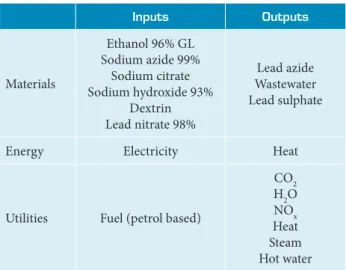
Regarding limitations, one of the most important of this study is the allocation and use of lead azide, due to the complexity of use of the explosive ater being loaded. Given the wide range of environmental aspects raised in an LCI and LCA, Haddad et al. (2013) suggest the application of selection criteria that allow the separation of only the most signiicant environmental aspects from the total surveyed. From this study, it is possible to summarize the inputs and outputs of the lead azide manufactory process, which were presented in Table 6.
Table 6. Summary of inputs and outputs.
inputs Outputs
Materials
Ethanol 96% GL Sodium azide 99%
Sodium citrate Sodium hydroxide 93%
Dextrin Lead nitrate 98%
Lead azide Wastewater Lead sulphate
Energy Electricity Heat
Utilities Fuel (petrol based)
RefeReNCeS
Akhavan, J., 2011, “The Chemistry of Explosives”. Third Edit ed. Norfolk: Biddles Ltd., Kings Lynn, Norfolk.
Allan, G.B., Anders, M.L.L. and Stig, Y.E., 1963, “US 3095268 A - Process for the preparation of lead azide”. No. United States.
Alverbro, K. et al., 2009, “A life cycle assessment of destruction of ammunition”. Journal of hazardous materials, Vol. 170, No. 2-3, pp. 1101–1109, doi:10.1016/j.jhazmat.2009.05.092.
Clift, R., Doig, A. and Finnveden, G., 2000, “The Application of Life Cycle Assessment to Integrated Solid Waste Management”, Part 1ÐMethodology. Institution of Chemical Engineers, Vol. 78.
Conama, 2000, Res. Conama, No. 357.
Cooper, P., 1996, “Explosives Engineering” [S.l.]: Wiley-VCH, Inc. United States of America.
Curtin, V. et al., 2013, “Reducing mechanical activation-induced amorphisation of salbutamol sulphate by co-processing with selected carboxylic acids”. International Journal of Pharmaceutics, Vol. 456, No. 2, pp. 508–516.
Date, P. et al., 2009, “Modelling the risk of failure in explosion protection installations”. Journal of Loss Prevention in the Process Industries, Vol. 22, No. 4, pp. 492–498, doi:10.1016/j.jlp.2009.03.007.
Galante, E., Haddad, A. and Marques, N., 2013, “Application of Explosives in the Oil Industry”. International Journal of Oil, Gas and Coal Engineering (OGCE), Vol. 1, No. 2, pp. 16–22, doi:10.11648/j. ogce.20130102.11.
Garg, N., Dureja, H. and Kaushik, D., 2013, “Co-processed excipients: A patent review”. Recent Patents on Drug Delivery and Formulation, Vol. 7, No. 1, pp. 73–83.
Haddad, A.N. et al., 2013, “Quality Indicators for Life Cycle Inventory: Real Cases Exploratory Application”. Applied Mechanics and Materials, Vol. 431, pp. 350–355, doi:10.4028/www.scientiic.net/ AMM.431.350.
HasanogÍlu, A. et al., 2012, “Co-processing of Turkish high-sulfur coals and their blends with a petroleum asphalt. Part 1: In the absence of a catalyst”. Energy and Fuels, Vol. 26, No. 12, pp. 7220–7229.
Hochschorner, E. et al., 2006, “Environmental life cycle assessment
of a pre-fragmented high explosive grenade”. Journal of Chemical Technology and Biotechnology, Vol. 81, No. 3, pp. 461–475, doi:10.1002/jctb.1446.
Hochschorner, E. and Finnveden, G., 2006, “Life cycle approach in the procurement process: The case of defence materiel”. International Journal of Life Cycle Assessment, Vol. 11, No. 3, pp. 200–208, doi:10.1065/lca2005.10.230.
Holloway, K.J. et al., 1965, “US 3173818 A - Manufacture of dextrinated lead azide”. No. USA, 1965.
IMBEL, “IMBEL”, from www.imbel.gov.br. Accessed inb 17 jul. 2013.
Kinney, G. and Graham, K., 1985, “Explosive Shocks in Air”, 2nd
edition, USA, Springer-Verlag.
Leslie, J.P.M., 1966, “US 3264150 A - Explosive lead azide process”. No. United States of America.
Meyer, R., Köhler, J. and Homburg, A., 2007, “Explosives ”, 6th,
Complete edition, Weinheim: Wiley-VCH Verlag GmbH, Weinheim.
Passer, A., Kreiner, H. and Maydl, P., 2012, “Assessment of the environmental performance of buildings: A critical evaluation of the inluence of technical building equipment on residential buildings”, International Journal of Life Cycle Assessment, Vol. 17, No. 9, pp. 1116–1130, doi:10.1007/s11367-012-0435-6.
Ramaswamy, C.P., Patwardhan, W.D. and Mukherjee, A., 1981, “EP 0070932 B1 - Initiatory explosive for detonators and method of preparing the same”, No. [s.n.].
Silva, G.D. and Iha, K., 2010, “Polimorismo: caracterização e estudo das propriedades de uma fase cristalina”, Journal of Aerospace Technology and Management, Vol. 2, No. 3, pp. 331–338, doi:10.5028/jatm.2010.02038310.
Sonnemann, G. and Castellis, F., 2004, “Integrated Life-Cycle and Risk Assessment for Industrial Processes”, [S.l.]: CRC Press, Lewis Publisher.
Urbanski, T., 1984, “Chemistry and tecnology of explosives, Vol 4”, New York, USA, Pergamon Press.
Zharen, W.M., 1998, “ISO 14000 — Understanding the Environmental Standards”, Rockville, MD.: Published by GaoLi.
Furthermore, this study was successful in illing some of the gaps in the literature regarding the manufacturing of explosives, as well as their life cycle inventory. he environmental impacts