Abstract
This paper is devoted to the vibration of rotating flexible spacecraft. The maneuver of the spacecraft is modeled by a constant torque input acting on the hub. For the first time in this paper the equations of motion of flexible spacecraft are derived based on higher order sandwich panel theory (HSAPT). Hamilton’s principle is used for driving the governing partial differential equations of motion. The generalized differential quadrature method (GDQ) is utilized to solve the partial differential equations of motion. The effect of different parameters on vibration of rotating flexible spacecraft appendage is investigated. It is also investigated the effect of these parameters on natural frequencies. The result of HSAPT and Euler Bernoulli theory is compared with each other. To show the accuracy the natural frequencies of recent paper are compared with the literature.
Keywords
Flexible Spacecraft, Constant torque, Hamilton’s principle, GDQ, HSAPT
Dynamic Analysis of Maneuvering Flexible Spacecraft
Appendage Using Higher Order Sandwich Panel Theory
1 INTRODUCTION
There are many studies on flexible spacecraft which is consisted of a rigid hub in the center and attached flexible appendages. The analysis of these systems is complicated because of coupling between rigid hub and flexible appendage. In these structures vibration of the flexible part causes the rotation of the hub and vice versa (Hu, 2009). There have been a lot of intensive researches on rotating of the flexible spacecraft and finding an appropriate method to suppress the vibrations. They usually consider each appendages as Euler-Bernoulli beam to simplify the equation of motions. Azadi et. al (Azadi, et al., 2011)studied on three axes slewing maneuver and the vibration of a flexible spacecraft. They used an adaptive-robust control scheme to achieve the satellite’s large angel trajectory tracking and suppress the vibration of the appendages. They also applied an Euler-Bernoulli
Milad Azimia
Morteza Shahravi b
Eshagh Farzaneh Joubaneh c
a Malek Ashtar University of Technology, Tehran, Iran. [email protected] b Malek Ashtar University of Technology, Tehran, [email protected]
c Islamic Azad University, South Tehran Branch, Tehran, Iran,
http://dx.doi.org/10.1590/1679-78252326
Latin American Journal of Solids and Structures 13 (2016) 296-313 beam theory for flexible appendage. Maganti et. al (Maganti & Singh, 2007) present the design of a new simple adaptive system for the rotational maneuver and vibration suppression of an orbiting spacecraft with flexible appendages. They choose a control output variable as combination of pitch angle and its derivative without considering elastic mode. Tugrul Oktay (Oktay, 2015) studied on bending control of rotating Euler Bernoulli beam. He assumed that the free fixed elastic beam is attached to a servomotor using variance constrained controller, specifically output variance constrained controller for vibration suppression. Equations of motion of the system obtained via Hamilton’s principle and Galerkin method.
Shahravi and azimi studied on vibration control of smart flexible sub-structure of satellite during attitude maneuver. They compared collocated and non-collocated piezoceramic patches as sensor and actuator to suppress vibration of flexible substructure. They used finite element method associated with lagrangian formulation to derive mathematical model of the slewing flexible spacecraft (Shahravi & Azimi, 2014). Shahravi and Azimi (Shahravi & Azimi, 2014) presented a new control approach for large angle attitude maneuver of flexible spacecraft. They used singular perturbation theory as a useful tool for two time rate scale separation of rigid and flexible body dynamics. The resulting slow and fast subsystems, enabling the use of two control approach for attitude (Modified Sliding Mode) and vibration Strain Rate Feedback (SRF) control of flexible spacecraft, respectively. Shahravi and Azimi (Shahravi & Azimi, 2015) studied on multi-axis attitude control of flexible spacecraft using smart structures and hybrid control scheme. They considered the spacecraft as a rigid hub with two elastic appendages embedded with piezoelectric sensor/actuator patches. Using a modified sliding mode control by introducing a synthesized sliding manifold ensures that the spacecraft follows the shortest possible path to the desired orientation and highly reduce the switching action and excitation of flexible modes. Zhang e. al (Zhang, et al., 2014), used PZT transducers on flexible links as vibration sensors and actuators to suppress the vibration. They derived dynamic model of the flexible links with dynamic of PZT actuators incorporated and discretized the elastic motion of the flexible links by assumed mode method. An Efficient modal control, in which the feedback forces in different modes are determined according to the vibration amplitude or energy of their own, is employed to control the PZT actuators to realize active vibration suppression.
Latin American Journal of Solids and Structures 13 (2016) 296-313
Deformation Theory (FOSDT), which is the beam/plate theory by taking into account the shear rigidity of the core, but this theory is still assumes that longitudinal deformation is linear in the thickness coordinate and the core is infinitely rigid in the transverse direction. FOSDT assumes a uniform shear stain through the height of the panel. Although this model is simple, but it is acceptable when the sandwich core is too stiff through the thickness and statically loaded. In general, and especially in modern sandwich panels, the core is flexible in all directions. There are many modified theories which considered different assumption due to better model the stress, strain, displacement distribution along the thickness. Hoh et al (Hohe, et al., 2006) investigated on the effect of the transverse compressibility of the core on the transient dynamic response of structural sandwich panels under rapid loading conditions. Frostig (Frostig, et al., 1992) is one who has done numerous studies on the behavior of sandwich panels. He offered a higher order sandwich panel theory (HSAPT) for compressible cores which in-plane stresses is neglected in it. Regardless of axial stress in the core and according to the static equilibrium equation, there will be a constant shear distribution within the core thickness and this type of approximation for the sandwich construction with a soft core would be a good approximation of the static problems. Static formulation of HSAPT is being used for many issues. Comparison between HSAPT with elasticity and experiment has shown that HSAPT predicts displacements and axial strain at the surface and near to the supports and concentrated load regions accurately. Regarding the core, though HSAPT is a good approximate theory away from supports, and concentrated load regions, it show inaccurate shear stress and axial strain through-thickness distributions adjacent to regions of concentrated loads and supports. This theory can be used for the study of composite beams and composite plates with soft cores. Frostig et. al (Frostig, et al., 2013) investigated on the free vibration response of a unidirectional sandwich panel with a compressible and incompressible core using the various computational models and it is presented and compared with the numerical investigation. Also it should be added that HSAPT theory divides into two displacement and mixed formulation theories which is different in the formulation of the problem. Frostig and baruch (Frostig & Baruch, 1994) investigated on free vibrations of sandwich beams with a transversely flexible core. The analysis presented embodies a general rigorous approach including higher order effects owing to the non-linearity of the displacement fields of the core caused by its flexibility in the vertical direction. Swanson and kim (Swanson & Kim, 2000) studied on comparison of a higher order theory for sandwich beams with finite element and elasticity analysis.
Latin American Journal of Solids and Structures 13 (2016) 296-313 The present paper provides an analysis to obtain the response of a flexible spacecraft with respect to a constant torque on the hub for a real sample flexible spacecraft. Unlike the previous papers the theory which is applied for flexible spacecraft is HSAPT and the result for vibration analysis is compared with other conventional beams theory.
2 DERIVATION OF THE GOVERNING EQUATIONS
Figure 1 shows the model of a flexible spacecraft, which consists of a rigid hub with radius a, and a cantilever sandwich beam with length L. The sandwich beam with width b is made of three layers. Two thin stiff face sheets with thickness and a thick soft core with thickness .
Figure 1: Geometry of rigid hub with flexible appendage.
The general assumption for derivation of general equation of motion for a sandwich beam is as follow
1. All the deformations and strains are very small and the theory of linear elasticity is applied. 2. The face sheets and the core of the beam are made of isotropic and homogeneous materials.
The sandwich beam is assumed to be symmetric.
3. Transverse normal strains are negligible in the face sheets. 4. There is no slippage of delamination between the layers.
2.1 Displacement Theory
The face sheets deform as Bernoulli-Euler beam theory and the normal stress of the core is negligible and it is soft through the thickness. Here the axial and transverse displacements of the top face sheet are , , , and the transverse and axial displacements of the bottom face sheets are
, , , , respectively. The axial and transverse displacements of the core layer are
, , , respectively.
Latin American Journal of Solids and Structures 13 (2016) 296-313
X:
Tope face
Core
Bottom Face
' 3 3 2 2 1 ' b b c t tyw
u
y
y
y
u
yw
u
f c ch
h
y
h
2
2
2
2
2
2
c c c c fh
h
y
h
h
h
y
(1) Y: Tope face CoreBottom Face
b c tw
y
y
w
w
2 2 1
f c ch
h
y
h
2
2
2 2 cc y h
h
2
2
c f ch
y
h
h
By using the compatibility conditions as
)
2
(
)
2
(
)
2
(
)
2
(
c Bottomface c c Topface ch
y
X
h
y
X
h
y
X
h
y
X
Core Core
)
2
(
)
2
(
)
2
(
)
2
(
c Bottomface c c Topface ch
y
Y
h
y
Y
h
y
Y
h
y
Y
Core Core (2)The displacement fields (Equation 1) change as following
Latin American Journal of Solids and Structures 13 (2016) 296-313
Y:
Tope face
Core
Bottom Face
b c c b t c b t c tw
h
y
w
w
w
h
y
w
w
w
w
2 22
)
2
(
)
(
f c ch
h
y
h
2
2
2
2
c ch
y
h
2 2 c f c h y h h Because the hub is rigid therefore the total potential energy is just for sandwich panel
}
)
(
{
2
1
U
b c t v b x x v c xy xy y y v t x
x
dV
dV
dV
}
)
(
{
2
1
U
2
2
2
2b c t v b x f v c xy c y c v t x
f
dV
E
G
dV
E
dV
E
(4)
Here , are modulus of elasticity of face sheets and the core respectively and is the shear modulus of the core. By substituting the strain displacement relations (3) in potential energy function (4)
}
]
4
)
2
(
1
)
[(
)
(
)
(
{
2
1
2 2 0 2 ' ' 2 ' ' c c c b t c A b t c l b A b b f t A t t fdA
h
y
w
w
w
h
w
w
E
dA
yw
u
E
dA
yw
u
E
U
c b t
(5)
l A c c b c f t c f b t c c ch
y
u
w
h
h
w
h
h
u
u
w
G
0 2 ' ' ' 1]
4
)
2
4
2
4
2
(
)
[(
2
1
dA
c
c A c c c c c b c f t c f bt
dA
dx
h
y
w
h
h
w
h
h
w
h
h
u
u
)
12
]
}
3
6
3
6
3
(
2
1
2 3 2 ' 1 ' '
The kinetic energy for flexible satellite is as
Latin American Journal of Solids and Structures 13 (2016) 296-313
Here is the face sheets density, is the core density, r is the hub radius, and is moment inertia of the rigid hub. The energy of external applied torque is as
.
M
F
(7)Here M is applied external Torque on the hub. By substituting the relation for displacement into energy function and using the Hamilton principle the governing partial differential equations of motion and boundary conditions are being obtained.
0
)
5
2
)
)(
10
3
10
9
(
)
)(
3
1
3
2
(
5
4
3
8
)
(
5
9
)
(
3
4
(
)
2
(
)
(
56
1
)
(
40
1
)
(
70
1
15
1
)
(
28
1
)
(
20
1
(
)
2
(
)
(
' ' ' ' ' 2 '' ' '' .. ' .. ' .. ' .. ' .. .. .. .. .. .. .. .. ..
c c b t c f b t c f c c b t b t c c c t c f f f t f f b t f b t f c c b t b t c t c f f t fw
h
w
w
h
h
w
w
h
h
h
u
u
u
u
u
h
A
G
w
h
h
A
E
u
A
E
w
w
h
w
w
h
h
u
u
u
u
u
m
w
h
h
m
u
m
(8)0
)
5
2
)
)(
10
3
10
9
(
)
)(
3
1
3
2
(
5
4
3
8
)
(
5
9
)
(
3
4
(
)
2
(
))
(
56
1
)
(
40
1
)
(
70
1
15
1
)
(
28
1
)
(
20
1
(
)
2
(
)
(
' ' ' ' ' 2 '' ' '' .. ' .. ' .. ' .. ' .. .. .. .. .. .. .. .. ..
c c b t c f b t c f c c b t b t c c c b c f f f b f f b t f b t f c c b t b t c b c f f b fw
h
w
w
h
h
w
w
h
h
h
u
u
u
u
u
h
A
G
w
h
h
A
E
u
A
E
w
w
h
w
w
h
h
u
u
u
u
u
m
w
h
h
m
u
m
(9) 22 .. .. .. ..
.. .. .. ..
' ' ' '
.. .. .. .. .. .. .. .. .. ..
' ' 2 '' '' 2 '' ''
1 1
( ( ) ( ) ( ) ) ( ( ) ( )
2 4 2 3 2 40 56
1 1 1 1 1 1
( ) ( ) ( ) ( )
30 140 80 12 112 20
1 1
c f c c f f
t
f t t c f t b f t b
f c f c f t b t b f t b t b
h h h h h h l
m w u w r m h u u h u u
h u h h h w w w w h w w w w
.. .. 2 2 '''' '''
' ' ' ' '
2
2 ' 2 2 '' '' 2
1 1
( )( ) ) [( ) ( ) ]
5 10 15 2 4 2 3 2
2 1 9 3 4 2
[ ( )( ) ( )( ) ( )
3 3 10 10 3 3
2 2 1 1 1 9 3
( )( ) ( )( ) (
5 15 3 3 12 20 1
c f f c f
c
c f f t t
c
f c t b f c t b f c c
c
f c c f c f c t b f
h h h h h
h l
w r E A w u
GA
h h u u h h u u h h u
h
h h h h h h h w w h
2
'' '' 2 ''
2
1 )
0 20
1 1 4 8
( ) ( ) ] [ ( ) ( ) ] 0
5 15 3 3
f c c
c c
t b f c c c t b t b c
c
h h h
E A
w w h h h w w w w w w
h
Latin American Journal of Solids and Structures 13 (2016) 296-313
2
2 .. .. .. .. ..
.. .. .. ..
' ' ' ' '
.. .. .. .. .. .. .. .. ..
' 2 '' '' 2 '' ''
1 1 1
( ( ) ( ) ( ) ) ( ( ) ( ) )
2 4 2 3 2 40 56 30
1 1 1 1 1
( ) ( ) ( ) ( )
140 80 12 112 20
1 15
c f c c f f
b
f b b c f t b f t b f c
f c f t b t b f t b t b
h h h h h h l
m w u w r m h u u h u u h u
h h h w w w w h w w w w
2 2 .. .. '''' ''' ' ' ' ' ' 2
2 '' 2 2 '' '' 2
1 1
( )( ) ) [( ) ( ) ]
10 15 2 4 2 3 2
2 1 9 3 4 2
[( )( ) ( )( ) ( )
3 3 10 10 3 3
2 2 1 1 1 9 3
( )( ) ( )( ) (
5 15 3 3 12 20 1
c f f c f
c
c f f b b
c
f c t b f c t b f c c
c
f c c f c f c t b f
h h h h h
h l
w r E A w u
GA
h h u u h h u u h h u
h
h h h h h h h w w h
2 '' ''
2 ''
2
1
)( )
0 20
1 1 4 8
( ) ] [ ( ) ( ) ] 0
5 15 3 3
f c c t b
c c
f c c c t b t b c
c
h h h w w
E A
h h h w w w w w w
h (11)
0
)]
)(
3
2
3
4
(
3
16
)
(
3
8
[
)
(
30
1
)
(
15
1
15
8
(
' ' 2 ' ' .. .. ..
b t c f c b t c c c b t f t b c cw
w
h
h
u
u
u
h
A
G
w
w
h
u
u
u
m
(12)0
]
15
4
)
)(
5
2
15
2
(
5
4
)
(
5
4
[
)
(
140
1
)
(
70
1
)
(
105
2
(
' 2 ' ' 2 2 2 .. ' .. ' .. .. .. .. 2
c c b t f c c c b t c c c c b t c f b t c c cw
h
w
w
h
h
h
h
u
u
h
h
A
G
w
w
h
h
u
u
h
h
m
(13)0
]
3
16
)
(
3
8
[
]
15
8
)
)(
15
1
5
1
(
15
4
)
(
5
2
[
)
)
2
)(
15
2
15
8
(
)
(
15
1
15
8
(
2 '' 2 '' '' 2 ' 2 ' ' 2 .. .. .. ..
c b t c c c c c b t c c f c b t c c c c t b c c cw
w
w
h
A
E
w
h
w
w
h
h
h
h
u
u
h
h
A
G
l
r
w
w
h
w
m
(14)
M
J
rl
l
r
m
m
h
m
h
m
w
l
r
m
w
h
h
m
w
h
h
m
w
l
r
m
m
u
h
m
u
h
m
h c f c c c c c c b f c c t f c c t c f b c c t c c
.. .. 2 2 .. 2 .. 2 .. ' .. ' .. .. .. ..)
3
)(
2
(
105
2
105
2
)
2
(
3
2
140
1
140
1
)
2
)(
6
(
70
1
70
1
(15)The axial forces , , , the shear forces , , , and the bending moments , , :
)
)
2
(
(
2 2x
w
h
h
x
u
A
E
P
t f f t c f t
(16))
)
2
(
(
2 2x
w
h
h
x
u
A
E
P
b c f bLatin American Journal of Solids and Structures 13 (2016) 296-313
2 2 .. ..
'
.. ..
.. .. .. ..
2 ' 2 '
2 2
''' ''
2
((
)
(
)
)
3
4
2
2
( 36
6
28
6
3
18
)
840
((
)
(
)
)
4
2
3
2
[(196
28 )
(1316
532 )
(560
840
f c f c f c
t
t f t
c
f t f b f c f c f b f t
f c f f c
c
f f t t
c c
f c b f c t c
c
h
h
h h
h
h
V
m
w
u
m
h u
h u
h u
h h
h w
h w
h h
h
h
h
h
E A
w
u
G A
h
h u
h
h u
h
h
2 2 '' 2 2 2 '
2 2 '
1120
)
(28
98
28
)
(112
658
532
532
)
(336
112
)
(56
168
)
]
f c
c f f c b c f f f c t
f c c c f c c
h
u
h
h
h h w
h
h
h
h h w
h h
h
h
h h w
2 2 .. ..
'
.. ..
.. .. ..
2 ' 2 '
2 2
''' ''
2
((
)
(
)
)
3
4
2
2
(6
36
28
6
3
18
)
840
((
)
(
)
)
4
2
3
2
[( 196
28 )
(1316
532 )
(560
1120
840
f c f c f c
b
b f b
c
f t f f c f c f t f b
f c f f c
c
f f b b
c c
f c t f c b c
c
h
h
h h
h
h
V
m
w
u
m
h u
h
h u
h h
h w
h w
h h
h
h
h
h
E A
w
u
G A
h
h u
h
h u
h
h
2 2 '' 2 2 2 '
2 2 '
)
(28
98
28
)
(112
658
532
532
)
(336
112
)
(56
168
)
]
f c
c f f c t c f f f c b
f c c c f c c
h
u
h
h
h h w
h
h
h
h h w
h h
h
h
h h w
2 2 ' ' 2 '
2
[ 336
(
)
(224
)
(56
168
)(
)
448
]
840
c c
c f t b c c c f c t b c c
c
G A
V
h u
u
h
h
h h
w
w
h w
h
2 2
'' '
((
)
(
)
)
4
2
3
2
f c f f c
c
t f f t t
h h
h
h
h
h
M
E A
w
u
)
)
2
(
)
3
2
4
((
'' '2 2
b c f b f c f c f f
b
u
h
h
w
h
h
h
h
A
E
M
Latin American Journal of Solids and Structures 13 (2016) 296-313
0
)
,
(
,
0
)
,
0
(
0
)
,
(
,
0
)
,
0
(
0
)
,
(
,
0
)
,
0
(
0
)
,
(
,
0
)
,
0
(
0
)
,
(
,
0
)
,
0
(
0
)
,
(
,
0
)
,
0
(
0
)
,
(
,
0
)
,
0
(
' '
t
l
M
t
w
t
l
V
t
w
t
l
P
t
u
t
l
V
t
w
t
l
M
t
w
t
l
V
t
w
t
l
P
t
u
b b
b b
b b
c c
t t
t t
t t
(17)
3 NUMERICAL RESULTS AND DISCUSSION
There are different arrangements of grid points which are being used in GDQ method. Equal spacing sample of grid points used in earlier papers give some inaccurate results. Here the Chebyshev-Gauss-Lobatto distribution is utilized to discretize the spatial domain as follows (Zong & Zhang, 2009)
)]
1
)
1
(
cos(
1
[
2
N
i
l
x
i
and i=1,…,N (18)Natural frequencies (rad/s) Present paper Ref. (Damanpack & Khalili, 2012) Ref. (Sokolinsky & Nutt, 2004)
1 1031.02 1030.962 1036.725
2 3195.114 3194.948 3210.708
3 5671.588 5617.640 5717.698
4 8517.974 8517.640 8658.229
5 11910.109 11909.750 12189.379
10 15945.013 15944.648 16411.680
Table 1: The lowest natural frequencies for a cantilever sandwich beam (Antisymmetric Modes).
Natural frequencies (rad/s) Present paper Ref. (Damanpack & Khalili, 2012) Ref. (Sokolinsky & Nutt, 2004)
6 14473.978 14473.978 15029.379
7 14490.414 14490.419 15048.228
8 14500.200 14664.758 15236.724
9 15248.520 14664.739 15858.759
Table 2: The lowest natural frequencies for a cantilever sandwich beam (Symmetric Modes).
Latin American Journal of Solids and Structures 13 (2016) 296-313
the natural frequencies of recent paper with the literatures in Tables 1 and 2 and it can be seen a good accuracy of recent analysis with respect to literatures. In figures 2 three diffrenet shape modes of sandwich beam with GDQ method are also compared with Damanpak and Khalili (Damanpack & khalili, 2012) for assuraness of the results. As it can be seen in seventh shape mode which is a symmetric one, the core deformes more than the asymmetric ones.
Latin American Journal of Solids and Structures 13 (2016) 296-313
3.1 Applied Torque on the Hub
In this section it is investigated on vibration behaviors of the flexible spacecraft with physical parameters presented in table 4 for a constant applied torque on the hub . .
Parameters
Face sheets Honeycomb Core Hub
Young’s Modulus/Shear Modulus (GPa) .
Density .
Thickness (m) . .
Width (m) =0.5 =0.5
Length (m) ,
Hub dimension (m) a=0.3
Hub Inertia kgm .
Table 3:Parameters of flexible spacecraft.
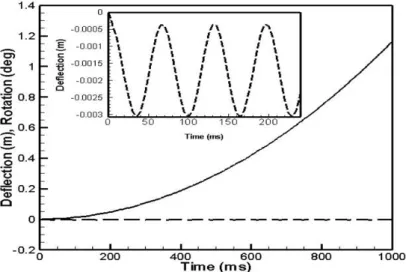
Figure 3 shows that by applying a constant torque on the hub the rotation of the hub changes as parabolic with respect to time which is in comply with the mathematic of the problem. For more clarification it shoud be added that, it is clear that the torque is a kind of acceleration Torque ≅
acceleration Constant C and by one time integrating of a constant acceleration, linear velocity C and two times integrating of that a parabolic rotation will be concluded
θ C . This rotation in figure 4 give us information about the behavior of hub and satellite and how it’s direction with respect to earth changes. By having this information about the rotation of hub (satellite) with respect to time, and by using an appropriate control algurithm it is possible to fix the sattelite in a special direction for sending singal to the earth.
Latin American Journal of Solids and Structures 13 (2016) 296-313
As it can be seen in figure 3 that the deflection of the beam is up to 0.003 (m) and this deflection is logical with respect to the 0.021 (m) thickness of the beam.
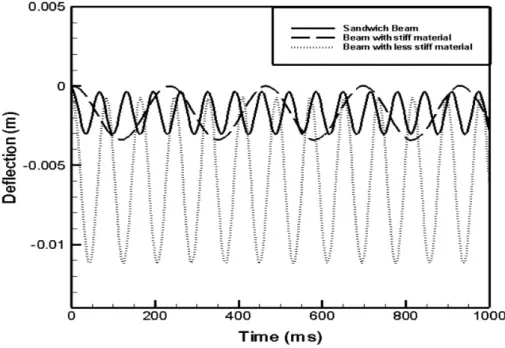
Figure 4 shows lateral deflection of a rotating appendage for three different types of beam; an ordinary beam made of just face sheet’s material (stiff beam), an ordinary beam made of just core’s material (soft material), and a sandwich beam. But the physical dimention for three cases is equal. It can be seen that deflection of flexible appendage for sandwich beam is less than stiff and soft ones. This behavior is being related to parameter EI. The comparison of modulus of elasticity for three different kinds of materials is as E . Modulus of elasticity for stiff beam is more than two other cases. Comparison of moment of inertia is as . Because in sandwich beam the natural axis of stiffen faces is far from the natural axis of core therefore moment of inertia for sandwich beam is more than the two other cases with just on layer (stiff beam or soft beam) and therefore the moment of inertia for sandwich beam is much more than the amount of this parameter for stiffen beam with the same geometry. By multiplication of modulus of elasticity (E) and moment of inertia (I) and by considering the physical parameters from table 3 this comparison
changes as .Whatever this product is smaller the deflection is
Latin American Journal of Solids and Structures 13 (2016) 296-313 Figure 4: Tip deflection of flexible appendage for different types of beam.
Latin American Journal of Solids and Structures 13 (2016) 296-313
Figure 6: Tip deflection of flexible appendage for three different face sheet thicknesses.
Figure 7:Tip deflection of flexible appendage for three different widths of the beam.
Latin American Journal of Solids and Structures 13 (2016) 296-313
frequency for a lateral vibration of beam is as ω (Rao,, n.d.).
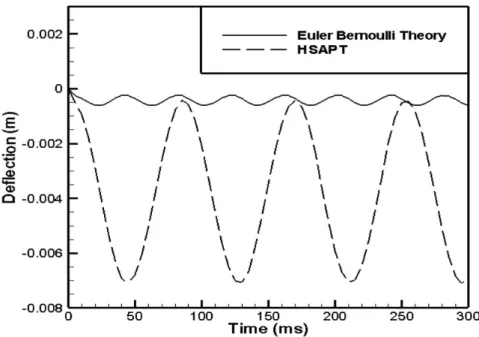
As it can be seen from this relation the frequency will increase by the factor but it remains constant with respect to width of the beam (b). These behaviors can be seen in figure 5-7. As it is mentioned in previous sections, in this paper the HSAPT method is used for the first time for flexible part of the satellite instead of using Euler Bernoulli theory. Therefore here in Figure 8 it is compared these two deformation theories for flexible appendage. It can be seen that the deflection of sandwich beam for HSAPT is more than the Euler Bernoulli. Because in HSAPT it is concerened different parameters such as Shear strain and rotation, therefore the energy function here is more than the Euler Bernoulli theroy and this results in more deflection for HSAPT as it can be seen in figure 8.
Figure 8: Tip deflection of flexible appendage for HSAPT and euler bernulli theory.
4 CONCLUSION
Latin American Journal of Solids and Structures 13 (2016) 296-313
1. The accuracy of GDQ method with respect to other numerical methods can be discovered by comparison of the natural frequencies of this paper with the literatures.
2. The effect of compressible core in sandwich panel structure can be seen in higher frequencies and symmetric shape modes. In these frequencies the core sustains the significant part of deformation.
3. The deflection of the sandwich beam is affected by the important parameter EI. Whatever this product is more the deflection is smaller.
4. Although increasing the core thickness of sandwich beam, increases the proportional of flexible part but it can be seen that the tip deflection decreases. Actually this behavior returns to the effect of moment of inertia (I) on the tip deflection of the beam. Because we are increasing the distance between face sheets and natural axis by increasing the core thickness. As this parameter is more the moment of inertia is more and as a consequent the deflection of sandwich beam decreases.
5. Since the face sheets of sandwich structures are so thin therefore increasing their thickness hasn’t significant effect on the moment of inertia of sandwich beam. But we are actually increasing the proportion of stiff part of the beam by increasing the face sheet’s thickness and this decreases the tip deflection of the beam.
6. Increasing the width of the beam decreases the deflection of the sandwich beam with this difference that the natural frequency remains constant.
7. HSAPT shows higher deflection for sandwich beam with respect to Euler Bernoulli theory.
References
Azadi, E., Fazelzadeh, S., Eghtesad, M. & Azadi, M., 2011. Vibration suppression and adaptive-robust control of a smart flexible satellite with three axes maneuvering. Volume 69, pp. 307-322.
Damanpack, A. & Khalili, S., 2012. Higher-order free vibration analysis of sandwich beams with a flexible core using dynamic stiffness method. Composite Structures, Volume 94, pp. 1503-1514.
Frostig, Y. & Baruch, M., 1994. Free vibrations of sandwich beams with a transversely flexible core: a high order approach, Journal of sound and vibration. Volume 176, pp. 195-208.
Frostig, Y., Baruch, M., Vilnay, O. & Sheinman, I., 1992. High order theory for sandwich beam behavior with transversely flexible core. Journal of Engineering Mechanics, Volume 118, pp. 1026-1043.
Frostig, Y., Phan, C. & Kardomateas, G., 2013. Free vibration of unidirectional sandwich panel, part I: Compressible core. Journal of Sandwich Structures and Materials, Volume 15, pp. 377-411.
Hohe, J., Librescu, L. & Yong Oh, S., 2006. Dynamic buckling of flat and curved sandwich panels with transversely compressible core. Composite structures, Volume 74, pp. 10-24.
Hong, C. et al., 2005. Thermally induced vibration of a thermal sleeve with the GDQ method. Int J Mech Sci, Volume 27, pp. 1789-1806.
Hu, Q., 2009. A composite control scheme for attitude maneuvering and elastic mode stabilization of flexible spacecraft with measurable output feedback. Aerosp Sci Technol, Volume 13, pp. 81-91.
Maganti, G. B. & Singh, S. N., 2007. Simplified adaptive control of an orbiting flexible spacecraft. Acta Astonautica,
Volume 61, pp. 575-589.
Oktay, T., 2015. Output variance constrained bending control of rotating Euler-Bernoulli beam. Journal of Process Mechanical Engineering.
Latin American Journal of Solids and Structures 13 (2016) 296-313
Shahravi, M. & Azimi, M., 2014. A comparative study for collocated and non-collocated sensor/actuator placement in vibration control of a maneuvering flexible satellite. Proceedings of the institution of Mechanical Engineers, Part C: Journal of mechanical engineering science.
Shahravi, M. & Azimi, M., 2014. A Hybrid Scheme of Synthesized Sliding Mode/Strain Rate Feedback Control Design for Flexible Spacecraft Stabilization Using Time Scale Decomposition. International Journal of structural Stability and dynamics, Volume 16, pp. 1-18.
Shahravi, M. & Azimi, M., 2015. Multi-Axis Attitude Control of Flexible Spacecraft Using Smart Structures and Hybrid Control Scheme. J. of control Engineering and applied informatics, Volume 17, pp. 12-21.
Sokolinsky, V. S. & Nutt, S. R., 2004. Consistent higher-order dynamic equations for soft-core sandwich beams. AIAA J., Volume 42, pp. 74-82.
Swanson, S. & Kim, J., 2000. Comparison of a higher order theory for sandwich beams with finite element and elasticity analyses. Journal of Sandwich Structures and Materials, Volume 2, pp. 33-49.
Tornabene, F. & Viola, E., 2009. Free vibration analysis of functionally graded panels and shells of revolution.
Meccanica, Volume 44, pp. 255-281.
Tornabene, F. & Viola, E., 2014. The Local GDQ method applied to general higher-order theories of doubly-curved laminated composite shells and panels. The free vibration analysis, Composite Structures, Volume 116, pp. 637-660. Vinson, J., 1999. The behavior of sandwich structures of isotropic and composite materials. CRC.
Zhang, Q., Jin, J., Zhang, J. & Zhao, C., 2014. Active vibration suppression of a 3-Dof flexible parallel manipulator using efficient modal control. Shock and vibration, pp. 1-10.