BEHAVI OR, KNOW LEDGE AND PERCEPTI ON OF RI SKS ABOUT SEXUALLY TRANSMI TTED
DI SEASES I N A GROUP OF PEOPLE OVER 5 0 YEARS OLD
1Magali Oliv i2 Rosan gela Get ir an a San t an a3 Thais Aidar de Fr eit as Mat hias4
Oliv i M, San t an a RG, Mat h ias TAF. Beh av ior, k n ow led ge an d per cept ion of r isk s abou t sex u ally t r an sm it t ed diseases in a gr oup of people over 50 year s old. Rev Lat ino- am Enfer m agem 2008 j ulho- agost o; 16( 4) : 679- 85.
Th e goal w as t o an aly ze t h e beh av ior , k n ow ledge an d r isk per cept ion abou t sex u ally t r an sm it t ed diseases / AI DS ( STD/ AI DS) in people over 50 year s old. 165 public ser vant s at a St at e Secr et ar y in Mat o Gr osso, Br azil w er e int er view ed. The chi- squar e t est and logist ic r egr ession t est s w er e used for t he analysis of r isk per cept ion an d t h e beh av ior an d k n ow ledge v ar iables abou t STD/ AI DS. Most of t h e r espon den t s w er e fem ale ( 6 0 . 6 % ) , 6 3 . 2 h ad a fix ed par t n er , 7 2 . 4 % h ad sex u al r elat ion s in t h e past six m on t h s, an d on ly 1 3 . 3 % alw ay s w or e condom s, w it h 21.5% being m ale and 8% fem ale. Per cept ion of r isk w as associat ed w it h non- use of condom s in t h eir last sex u al r elat ion ( p< 0 . 0 0 1 ) an d an sw er in g t h at an y on e m ay acqu ir e a STD/ AI DS ( p= 0 . 0 3 9 ) . Th e challenge of public policies is t o incr ease act ions, dir ect ing t hem t o pr om ot e t he healt h of t he adult and elder ly populat ions, especially r egar ding sex ualit y and v ulner abilit y t o STD/ AI DS.
DESCRI PTORS: co n d o m s; k n o w l ed g e; sex u al b eh av i o r ; ag i n g ; sex u al i t y ; sex u al l y t r an sm i t t ed d i seases/ pr ev ent ion & cont r ol; nur sing, t eam ; populat ion at r isk
COMPORTAMI ENTO, CONOCI MI ENTO Y PERCEPCI ÓN DE RI ESGO SOBRE ENFERMEDADES
SEXUALMENTE TRANSMI SI BLES EN UN GRUPO DE PERSONAS CON 5 0 O MÁS AÑOS DE EDAD
El obj et ivo fue analizar aspect os de com por t am ient o, conocim ient o y per cepción de r iesgo de las ETS/ SI DA, en per sonas con 50 o m ás años de edad. Se ent r ev ist ar on 165 ser v idor es de una Secr et ar ía del est ado de Mat o Gr oso, Br asil. Se u t ilizó u n a pr u eba de Ch i cu adr ado y de r egr esión logíst ica par a an alizar la per cepción de r iesgo y las v ar iables de com por t am ient o y conocim ient o sobr e las ETS/ SI DA. La m ay or ía de los ent r ev ist ados er a del sexo fem enino ( 60,6% ) ; par a el com por t am ient o un 63,2 % t enía par ej a fij a y un 72,4 % t uvo r elación sex ual en los últ im os 6 m eses; apenas el 13,3 % ut iliza siem pr e pr eser vat ivo, el 21,5 % de los hom br es y el 8 % de las m uj er es. Se dem ost r ó que exist e una asociación ent r e la per cepción de r iesgo y el uso de pr eser vat ivo en la últ im a r elación sexual ( p < 0,001) ; y, que cualquier per sona puede cont r aer una ETS/ SI DA ( p = 0,039) . El act ual desafío de las polít icas públicas es incr em ent ar las acciones que t ienen com o obj et iv o la pr om oción de la salud de la población adult a y de los adult os m ayor es, pr incipalm ent e en lo que se r efier e a la sexualidad y a la v ulner abilidad delant e de las ETS/ SI DA.
D ESCRI PTORES: co n d o n es; co n o ci m i en t o ; co n d u ct a sex u a l ; en v ej eci m i en t o ; sex u a l i d a d ; en f er m ed a d es sex u alm en t e t r an sm isibles/ pr ev en ción & con t r ol; equ ipo de en fer m er ía; población en r iesgo
COMPORTAMENTO, CONHECI MENTO E PERCEPÇÃO DE RI SCO SOBRE DOENÇAS
SEXUALMENTE TRANSMI SSÍ VEI S EM UM GRUPO DE PESSOAS COM 50 ANOS E MAI S DE I DADE
Ob j e t i v o u - se a n a l i sa r o co m p o r t a m e n t o , co n h e ci m e n t o e p e r ce p çã o d e r i sco à s d o e n ça s se x u a l m e n t e t r ansm issíveis/ AI DS ( DST/ AI DS) em pessoas com 50 anos e m ais de idade. For am ent r evist ados 165 ser vidor es de um a secr et ar ia est adual de Mat o Gr osso, Br asil. Ut ilizou- se o t est e de qui- quadr ado e r egr essão logíst ica par a análise da per cepção do r isco e v ar iáv eis do com por t am ent o e conhecim ent o sobr e DST/ AI DS. A m aior ia dos ent r ev ist ados é do sex o fem inino ( 60, 6% ) , 63, 2% t em par ceir o fix o e 72, 4% t iv er am r elação sex ual nos últ im os 6 m eses e apenas 13, 3% ut ilizam sem pr e o pr eser v at iv o, dos quais 21, 5% hom ens e 8% m ulher es. Houv e associação ent r e per cepção de r isco e não uso de pr eser v at iv o na últ im a r elação sex ual ( p< 0 , 0 0 1 ) e r esponder que qualquer pessoa pode cont r air um a DST/ AI DS ( p= 0,039) . O desafio das polít icas públicas hoj e é incr em ent ar ações dir ecionando- as à pr om oção à saúde da população adult a e idosa, pr incipalm ent e quant o à sex ualidade e v ulner abilidade às DSTs/ AI DS.
DESCRI TORES: pr eser v at iv os; con h ecim en t o; com por t am en t o sex u al; en v elh ecim en t o; sex u alidade; doen ças
sex u alm en t e t r an sm issív eis/ pr ev en ção & con t r ole; equ ipe de en f er m agem ; popu lação em r isco
1 Art icle ext ract ed from Mast er’s Thesis; 2 RN, M.Sc. in Nursing, Universit y of Cuiabá, Brazil, e- m ail: m agaliolivi@hot m ail.com ; 3 St at ist ician, Ph.D. in St at ist ics, e- m ail: r gsant ana@uem .br ; 4 RN, Ph.D in Public Healt h, e- m ail: t afm at hias@uem .br. Mar ingá St at e Univer sit y, Brazil.
I NTRODUCTI ON
S
e x u a l l y t r a n sm i t t e d d i se a se s ( STD ) a r e co n si d e r e d o n e o f t h e m o st co m m o n h e a l t h ca r epr oblem s in t he w or ld and one of t he five m ain fact or s
t h at m ak e people look f or h ealt h car e ser v ices( 1 ). I n Br azil, t her e ar e 12 m illion cases of STD ev er y y ear
an d, sin ce n ot if icat ion is n ot com pu lsor y an d abou t
7 0 % o f p eo p l e w i t h so m e STD seek t r eat m en t i n
dr u gst or es, t h e r eal n u m ber of cases is w ell below
t h e est im at es, n ear ly 2 0 0 t h ou san d cases a y ear( 2 ). Con t r ar y t o com m on belief, STDs m ay h av e ser iou s
co n seq u en ces. A p er so n w i t h a STD h as a h i g h er
c h a n c e o f b e i n g c o n t a m i n a t e d b y t h e h u m a n
im m u n od ef icien cy v ir u s ( HI V) an d t h e con seq u en t
d e v e l o p m e n t o f A c q u i r e d I m m u n o d e f i c i e n c y
Sy n d r om e ( AI DS)( 2 ).
I n Brazil, t he behavior of t he AI DS epidem ic,
since it s onset in t he 1980s, has pr esent ed im por t ant
ch an g es, al l o w i n g f o r t h e i d en t i f i cat i o n o f d i st i n ct
m o v e m e n t s . Th e f i r s t , c h a r a c t e r i z e d b y t h e
p r e d o m i n a n t i n f e ct i o n o f m a l e h o m o se x u a l s a n d
b isex u als; t h e secon d , b y a sig n if ican t in cr ease of
dr u g addict s in t h e y ou n g h et er osex u al popu lat ion ;
and finally, the m arked advance in the transm ission am ong
low - incom e gr oups and w om en, and also t he cur r ent
m om ent of the epidem ic, which consists in increasing cases
of the disease in people over 50 years old(3).
Th e a g e i s m o f t h e p o p u l a t i o n a n d t h e
i n cr e a si n g n u m b e r o f e l d e r l y p e o p l e , a l o n g w i t h
i m p r o v e m e n t s i n q u a l i t y o f l i f e , h a s e n co u r a g e d
b eh av i o r al ch an g es r el at ed t o sex u al i t y, p r o v i d i n g
m or e act ive affect ive r elat ionships t o people. A st udy
ab ou t t h e b eh av ior of t h e sex u ally act iv e Br azilian
p o p u l a t i o n p e r f o r m e d b y t h e Na t i o n a l D ST/ AI D S
Pr ogr am in 2 0 0 3 sh ow ed t h at 6 7 . 1 % of t h e people
b et w een 5 0 an d 5 9 y ear s old an d 3 9 . 2 % of t h ose
over 60 ar e m or e sexually act ive, and t he pr opor t ion
of sex ually act iv e m en ov er 50 y ear s old is t w ice as
high as t he am ount of w om en of t he sam e age( 4). The Minist ry of Healt h has not ified increasing
n u m b er s of AI DS cases in t h e p op u lat ion ov er 4 0
year s old. Of t he t ot al cases not ified in 1992, 15.6%
w er e for m en bet w een 40 and 49 year s old, incr easing
t o 2 4 . 4 % i n 2 0 0 3 . Fo r t h e 5 0 - 5 9 a g e g r o u p , i t
incr eased fr om 4. 5% t o 8. 7% , and for 60 y ear s old
and over, it incr eased fr om 1.8% t o 2.7% in t he sam e
per iod( 5). I n t he Unit ed St at es, 10% of t he AI DS cases in w om en occu r r ed in t h e 5 0 an d older age r an ge,
and 32% of t hese w om en w er e older t han 60 y ear s
old w h en d iag n osed , su g g est in g t h at t h e in f ect ion s
occur r ed aft er t heir m enopause( 6 ).
Despit e an increasing am ount of HI V- infect ion
and AI DS cases in people ov er 50, it is not com m on
f o r t h i s p o p u l a t i o n t o c o n s i d e r i t s e l f a t r i s k o f
cont r act ing STD/ AI DS. Even t hough t hey m ay becom e
involved in r isky behavior s, such as unpr ot ect ed sex,
t h ey st i l l d o n o t see t h em sel v es as v u l n er ab l e t o
STD s( 7 ). Th e m e s a b o u t se x u a l i t y, k n o w l e d g e a n d beh av ior r egar din g STD/ AI DS an d t h e per cept ion of
r isk ar e usually t r eat ed w it h a few select ed gr oups of
t h e p op u lat ion , su ch as ad olescen t s an d ad u lt s of
r e p r o d u ct i v e a g e . To p i cs a b o u t se x u a l i t y f o r t h e
e l d e r l y p o p u l a t i o n , w h i ch i s n o t co n ce r n e d w i t h
cont r acept ion anym or e, ar e t r eat ed by lit er at ur e w it h
e m p h a si s o n a sp e ct s l i k e se x u a l p e r f o r m a n ce o r
dy sf u n ct ion s an d t h eir r elat ion s w it h qu alit y of lif e,
put t ing less em phasis on sexual healt h pr om ot ion and
STD/ AI DS p r ev en t ion .
Act ions for healt h pr om ot ion r elat ed t o STD
should t ak e int o account indiv iduals’ sex ual behav ior
and infor m at ion about t heir sexual pr act ices, and also
consider w hich infor m at ion or w hat t hey k now about
STDs. The under st anding about sex ual pr act ices and
t h e k n o w l ed g e p eo p l e h a v e a b o u t STD s m a y a d d
evidence on r isk fact or s and pr ot ect ion r egar ding t he
disease( 8). As such, considering t he increased num ber of eld er ly p eop le an d cases of AI DS r eg ist er ed f or
t his shar e of t he populat ion, t he pr esent st udy aim ed
t o d e s c r i b e c h a r a c t e r i s t i c s o f s e x u a l b e h a v i o r,
k n ow led g e ab ou t STD/ AI DS an d r isk p er cep t ion in
people ov er 5 0 y ear s old, an d v er ify an associat ion
b e t w e e n t h e p e r c e p t i o n o f r i s k a n d a s p e c t s o f
k n ow ledge an d beh av ior.
METHOD
Th e st u d y p op u lat ion w as com p osed of all
pu blic ser v an t s of a Secr et ar y in t h e st at e of Mat o
Gr osso, aged 50 or older, w or king in t he cit y of Cuiabá,
Br azil, in 2005. Fr om a t ot al of 425, 165 public ser vant s
w er e r an dom ly select ed, ex clu din g t h ose w h o w er e
on an y k in d of leav e, v acat ion or r et ir em en t . Th e
in st r u m en t u sed f or d at a collect ion w as elab or at ed
b y t h e r e se a r ch e r s f r o m q u e st i o n n a i r e s u se d i n
n at ion al st u d ies( 9 - 1 0 ), b ein g p r ev iou sly su b m it t ed t o n u r s e s a n d p s y c h o l o g i s t s a n d p r e - t e s t e d . Th e
quest ions w er e about sex ual act iv it y in t he past six
condom s and dr ugs, k now ledge about differ ent t y pes
of STDs, v ulner abilit y t o disease, pr ev ent ion of STDs
by using condom s and t he m ost com m on sour ces of
t h i s k i n d o f i n f o r m a t i o n . No n e o f t h e 1 6 5 p u b l i c
s e r v a n t s r e f u s e d t o p a r t i c i p a t e . Un i v a r i a t e a n d
m ult iv ar iat e descr ipt iv e analy sis of t he per cept ion of
r i sk w e r e co n si d e r e d a d e p e n d e n t v a r i a b l e , a n d
b e h a v i o r a n d k n o w l e d g e a b o u t S TD / A I D S w e r e
con sider ed in depen den t v ar iables. Th e f r equ en cy of
t he per cept ion of STD/ AI DS r isk , t r ust int er v als and
lev els of sig n if ican ce w er e calcu lat ed w it h t h e ch
i-square t est . All variables show n t o be associat ed w it h
t h e p e r c e p t i o n o f r i s k , w i t h a p < 0 . 0 5 l e v e l o f
sig n if ican ce, w er e in clu d ed in t h e m u lt ip le log ist ic
r eg r ession m od el, b y u sin g t h e sof t w ar e St at íst ica
6 . 0( 1 1 ). Th e p ar t icip an t s sig n ed a t er m of con sen t , g u ar an t eei n g t h ei r an on y m i t y accor d i n g t o et h i cal
pr ocedu r es. Th e r esear ch pr oj ect w as an aly zed an d
a p p r o v e d b y t h e Et h i cs Co m m i t t e e f o r Re se a r ch
I n v olv in g Hu m an Bein g s of t h e St at e Un iv er sit y of
Mar ingá ( pr ot ocol 2 3 0 / 2 0 0 5 ) .
RESULTS
Ag e v ar i ed f r o m 5 0 t o 6 6 y ear s o l d , w i t h
87.4% in t he 50- 59 r ange and pr edom inant ly w om en
( 60.6% ) . Regar ding educat ion, 45% had a univ er sit y
degr ee, 35.7% had high- school educat ion and 66.7%
m en t i o n ed h av i n g p r i v at e h eal t h i n su r an ce p l an s.
Fam ily in com e w as six t im es or m or e t h e m in im u m
w age for 55.5% of t he r espondent s.
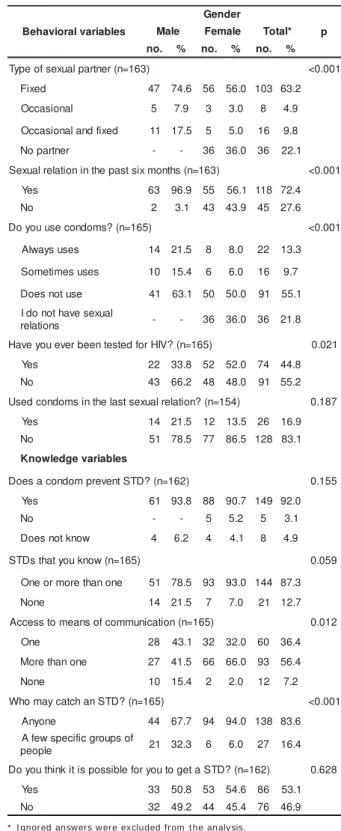
Re g a r d i n g se x u a l b e h a v i o r, 6 3 . 2 % st a t e d
having a fixed par t ner and 72.4% had sexual r elat ions
in t he past six m ont hs. Men have 1.7 t im es as m any
sex u a l r el a t i o n s a s w o m en ( 9 7 % a g a i n st 5 6 . 1 % ;
p < 0 . 0 0 1 ) ( Tab l e 1 ) . On l y 1 3 . 3 % m en t i o n ed u si n g
condom s all t he t im e ( Table 1) . As for using condom s
i n t h e i r l a s t s e x u a l r e l a t i o n , 8 3 . 1 % a n s w e r e d
negat iv ely ( Table 1) , 60% of w hom w er e w om en. Of
t h e r esp on d en t s w h o h ad a HI V t est , 7 0 . 3 % w er e
w om en and 29. 7% m en.
Th e STD s m o s t o f t e n c i t e d w e r e : AI D S,
sy ph ilis, gon or r h ea, h er pes, HPV an d h epat it is, an d
92% agr eed t hat condom s pr ev ent STD/ AI DS. When
ask ed ab o u t STD/ AI DS i n f ect i o n , 8 3 . 6 % sai d t h at
anyone could be infect ed, and 16.4% m ent ioned t hat
i t c o u l d o n l y h a p p e n t o s o m e s p e c i f i c g r o u p s
( P< 0 . 0 0 1 ) , su ch as: m an , w om an , adolescen t , dr u g
u s e r, p r o s t i t u t e a n d m a l e / f e m a l e h o m o s e x u a l .
Reg a r d i n g r i sk p er cep t i o n , 5 3 . 1 % co n si d er ed t h e
possibilit y of cont r act ing an STD; 50.8% of t he m en
and 54.6% of t he w om en ( Table 1) .
Table 1 – Sexual behavior and know ledge about STD/
AI DS in people over 50 year s old, accor ding t o gender,
Cuiabá, MT, 2005
* I gnor ed answ er s w er e excluded fr om t he analysis.
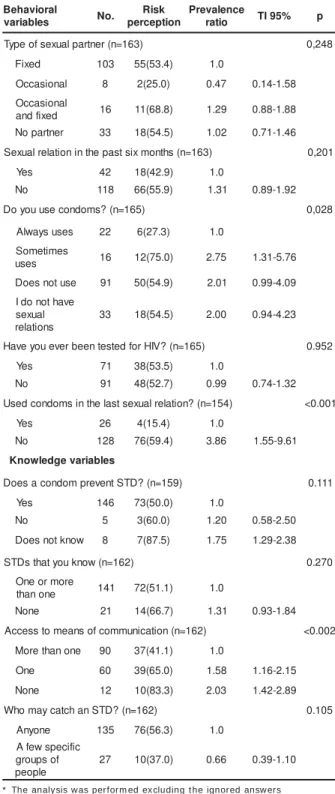
I n t h e u n i v a r i a t e a n a l y s i s , t h e r e w a s a
s t a t i s t i c a l l y s i g n i f i c a n t a s s o c i a t i o n b e t w e e n r i s k s e l b a i r a v l a r o i v a h e B r e d n e G p e l a
M Female Total*
. o
n % no. % no. %
) 3 6 1 = n ( r e n t r a p l a u x e s f o e p y
T <0.001
d e x i
F 47 74.6 56 56.0 103 63.2 l a n o i s a c c
O 5 7.9 3 3.0 8 4.9 d e x if d n a l a n o i s a c c
O 11 17.5 5 5.0 16 9.8 r e n t r a p o
N - - 36 36.0 36 22.1 ) 3 6 1 = n ( s h t n o m x i s t s a p e h t n i n o it a l e r l a u x e
S <0.001
s e
Y 63 96.9 55 56.1 118 72.4 o
N 2 3.1 43 43.9 45 27.6 ) 5 6 1 = n ( ? s m o d n o c e s u u o y o
D <0.001
s e s u s y a w l
A 14 21.5 8 8.0 22 13.3 s e s u s e m it e m o
S 10 15.4 6 6.0 16 9.7
e s u t o n s e o
D 41 63.1 50 50.0 91 55.1 l a u x e s e v a h t o n o d I s n o it a l e
r - - 36 36.0 36 21.8 ) 5 6 1 = n ( ? V I H r o f d e t s e t n e e b r e v e u o y e v a
H 0.021
s e
Y 22 33.8 52 52.0 74 44.8 o
N 43 66.2 48 48.0 91 55.2 ) 4 5 1 = n ( ? n o it a l e r l a u x e s t s a l e h t n i s m o d n o c d e s
U 0.187
s e
Y 14 21.5 12 13.5 26 16.9 o
N 51 78.5 77 86.5 128 83.1
s e l b a i r a v e g d e l w o n K ) 2 6 1 = n ( ? D T S t n e v e r p m o d n o c a s e o
D 0.155
s e
Y 61 93.8 88 90.7 149 92.0 o
N - - 5 5.2 5 3.1 w o n k t o n s e o
D 4 6.2 4 4.1 8 4.9
) 5 6 1 = n ( w o n k u o y t a h t s D T
S 0.059
e n o n a h t e r o m r o e n
O 51 78.5 93 93.0 144 87.3 e
n o
N 14 21.5 7 7.0 21 12.7 ) 5 6 1 = n ( n o it a c i n u m m o c f o s n a e m o t s s e c c
A 0.012
e n
O 28 43.1 32 32.0 60 36.4 e n o n a h t e r o
M 27 41.5 66 66.0 93 56.4 e
n o
N 10 15.4 2 2.0 12 7.2 ) 5 6 1 = n ( ? D T S n a h c t a c y a m o h
W <0.001
e n o y n
A 44 67.7 94 94.0 138 83.6 f o s p u o r g c if i c e p s w e f A e l p o e
p 21 32.3 6 6.0 27 16.4 ) 2 6 1 = n ( ? D T S a t e g o t u o y r o f e l b i s s o p s i t i k n i h t u o y o
D 0.628
s e
Y 33 50.8 53 54.6 86 53.1 o
per cept ion and fr equency of condom use ( p= 0. 028) ,
condom use in t he last sexual r elat ion ( p< 0.001) and
access t o com m unicat ion m eans ( p< 0.002) ( Table 2) .
Table 2 – Sexual behavior and know ledge about STD/
AI DS in people ov er 5 0 y ear s old, accor din g t o t h e
per cept ion of r isk , Cuiabá, MT, 2005
l a r o i v a h e B s e l b a i r a
v No.
k s i R n o i t p e c r e p e c n e l a v e r P o i t a
r TI95% p
) 3 6 1 = n ( r e n t r a p l a u x e s f o e p y
T 0,248
d e x i
F 103 55(53.4) 1.0 l a n o i s a c c
O 8 2(25.0) 0.47 0.14-1.58 l a n o i s a c c O d e x if d n
a 16 11(68.8) 1.29 0.88-1.88 r e n t r a p o
N 33 18(54.5) 1.02 0.71-1.46 ) 3 6 1 = n ( s h t n o m x i s t s a p e h t n i n o it a l e r l a u x e
S 0,201
s e
Y 42 18(42.9) 1.0 o
N 118 66(55.9) 1.31 0.89-1.92 ) 5 6 1 = n ( ? s m o d n o c e s u u o y o
D 0,028
s e s u s y a w l
A 22 6(27.3) 1.0 s e m it e m o S s e s
u 16 12(75.0) 2.75 1.31-5.76 e s u t o n s e o
D 91 50(54.9) 2.01 0.99-4.09 e v a h t o n o d I l a u x e s s n o it a l e r 3
3 18(54.5) 2.00 0.94-4.23
) 5 6 1 = n ( ? V I H r o f d e t s e t n e e b r e v e u o y e v a
H 0.952
s e
Y 71 38(53.5) 1.0 o
N 91 48(52.7) 0.99 0.74-1.32 ) 4 5 1 = n ( ? n o it a l e r l a u x e s t s a l e h t n i s m o d n o c d e s
U <0.001
s e
Y 26 4(15.4) 1.0 o
N 128 76(59.4) 3.86 1.55-9.61
s e l b a i r a v e g d e l w o n K ) 9 5 1 = n ( ? D T S t n e v e r p m o d n o c a s e o
D 0.111
s e
Y 146 73(50.0) 1.0 o
N 5 3(60.0) 1.20 0.58-2.50 w o n k t o n s e o
D 8 7(87.5) 1.75 1.29-2.38 ) 2 6 1 = n ( w o n k u o y t a h t s D T
S 0.270
e r o m r o e n O e n o n a h
t 141 72(51.1) 1.0 e
n o
N 21 14(66.7) 1.31 0.93-1.84 ) 2 6 1 = n ( n o it a c i n u m m o c f o s n a e m o t s s e c c
A <0.002
e n o n a h t e r o
M 90 37(41.1) 1.0 e
n
O 60 39(65.0) 1.58 1.16-2.15 e
n o
N 12 10(83.3) 2.03 1.42-2.89 ) 2 6 1 = n ( ? D T S n a h c t a c y a m o h
W 0.105
e n o y n
A 135 76(56.3) 1.0 c if i c e p s w e f A f o s p u o r g e l p o e p 7
2 10(37.0) 0.66 0.39-1.10
* The analysis w as per for m ed excluding t he ignor ed answ er s
I n t h e l o g i s t i c r e g r e s s i o n a n a l y s i s , t h e
associat ion bet w een t he per cept ion of r isk and condom
u se in t h e last sex u al r elat ion ( p< 0 . 0 0 1 ) r em ain ed,
w it h a chance r at io of 23.43 t im es as high per cept ion
of r isk for t hose w ho did not w ear condom s ( Table 3) .
Table 3 – Logist ic regression for t he variables of sexual
beh av ior an d k n ow ledge abou t STD/ AI DS r egar din g
t he per cept ion of r isk , Cuiabá, MT, 2005
s e l b a i r a v l a r o i v a h e
B Riskperception
R
C SE p
r e n t r a p d e x i
F 2.52 2.79 0.366 r e n t r a p l a n o i s a c c
O 0.37 3.03 0.375 s m o d n o c r a e w t o n s e o
D 0.36 2.72 0.192 d e t s e T -V I
H 0.60 1.52 0.268 n o it a l e r l a u x e s t s a l e h t n i m o d n o c a e s u t o n d i
D 24.43 2.67 0.001
s e l b a i r a v e g d e l w o n
K CR SE p
n o it c e t o r p r o f s m o d n o
C 2.75 3.12 0.374 n o it a m r o f n i f o s e c r u o
S 1.23 1.12 0.054 D T S a t e g y a m o h
W 2.58 1.58 0.039
CR= chance r at io SE= st andar d er r or
DI SCUSSI ON
I m por t ant aspect s of behavior and know ledge
about STD/ AI DS in t he inv est igat ed populat ion w er e
m ade evident , and t hese r esult s, added t o infor m at ion
from ot her st udies, lead t o t he conclusion of indicat ors
t h at m ay con t r ibu t e t o t h e m on it or in g of m easu r es
a n d s t r a t e g i e s t o p r e v e n t s e x u a l l y t r a n s m i t t e d
d i seases.
The fact t hat 72.4% of t he r espondent s had
a sex ual r elat ion in t he past six m ont hs, w it h higher
fr equencies for m en, suggest s sim ilar it y w it h st udies
by t he Br azilian I nst it ut e of Geogr aphy and St at ist ics,
t hat m en can keep high nupt ial r at es t hr oughout t heir
lives, since t hose st udies show ed t hat 70.9% of m en
a n d 2 7 . 9 % o f w o m e n i n t h e a d u l t a n d m a t u r e
popu lat ion liv e w it h spou ses( 1 2 ). On t h e ot h er h an d, t h e sex u al act iv it y of par t icipan t s in t h is st u dy w as
h igh er t h an in a r esear ch ex ecu t ed by t h e Nat ion al
D ST/ AI D S Pr o g r a m , w h i ch v er i f i ed t h a t 6 7 . 1 % o f
people bet w een 5 0 an d 5 9 y ear s old an d 3 9 . 2 % of
people older t han 60 w er e sex ually act iv e( 4).
An o t h er i m p o r t a n t r esu l t f r o m t h i s st u d y,
r elat ed t o behavior, w as t he pract ice of pr ot ect ed sex.
Th e i n t e r v i e w e e s k n o w t h e i m p o r t a n ce o f u si n g
co n d o m s t o p r e v e n t STD / AI D S; h o w e v e r, i t w a s
obser v ed t h at 7 8 . 5 % of t h e m en an d 8 6 . 5 % of t h e
w om en did not use condom s in t he last sexual r elat ion.
St udies r eveal t hat , despit e know ledge about t he for m s
o f STD / AI D S t r a n sm i ssi o n , t h e r e a r e f e w e l d e r l y
ad u lt s r ep or t in g con d om u se in all of t h eir sex u al
discover ed in t he 1980s, older adult s m ay face som e
d if f icu lt y t o b ecom e aw ar e of t h e u se of con d om s,
b ecau se t h is p r act ice is n ot p ar t of t h eir cu lt u r e –
h e n c e , t h e i m p o r t a n c e o f d e v e l o p i n g s p e c i f i c
or ient at ion for t his par t of t he populat ion.
The use of condom s by w om en as a m et hod
of p r ev en t ion in st ead of con t r acep t ion h as n ot y et
been in t er n alized. Lik e y ou n ger w om en , t h e w om en
o v e r 5 0 y e a r s o l d i n t h i s s t u d y r e v e a l e d a l o w
p e r ce p t i o n o f r i sk . Sl i g h t l y o v e r h a l f t h e w o m e n
( 54.6% ) consider ed t he possibilit y of cont r act ing STD/
AI DS. I t is int erest ing t o not ice t hat , even w hen a low
percent age is considered, it w as st ill higher t han levels
found in ot her st udies for t he sam e age r ange( 6) and about t he self- per cept ion of STD in w om en( 9). The low r isk p er cep t ion seen f or w om en m ay b e r elat ed t o
t he feeling of prot ect ion, especially w hen w om en have
a fixed, st able par t ner and ar e not capable of becom ing
pr egnant any m or e, being in t he clim at er ium or post
-m en op au se ag e. Th is f act w as sig n aled in p h r ases
t h e r e s p o n d e n t s w r o t e i n a s p a c e r e s e r v e d f o r
com m en t s in t h e qu est ion n air es. Sev er al com m en t s
w e r e r e a d , j u st i f y i n g t h e n o n - u sa g e o f co n d o m s
b e ca u se t h e r e sp o n d e n t s “ h a d a f i x e d p a r t n e r ”,
“ t r ust ed t heir par t ner ”, and also out of “ fear of hur t ing
t he par t ner ’s feelings”.
The r egr ession analy sis show ed a significant
associat ion b et w een r isk p er cep t ion an d n on - u sag e
of condom s in t he last sex ual r elat ion. I nt er v iew ees
w ho m ent ioned not hav ing used condom s in t he last
sex u al r elat ion h ad a 2 4 t im es h igh er per cept ion of
t h e r i s k o f a c q u i r i n g a S TD / A I D S . O f a l l t h e
in t er v iew ees, 8 3 . 6 % k n ew abou t it , an sw er in g t h at
any one is lik ely t o be infect ed by a STD/ AI DS. That
is, t hey know w hat a STD/ AI DS is, t hey know one or
m or e STDs, t hey believe t hat condom s pr event people
fr om acquir ing a STD and t hat any one can acquir e a
S TD / A I D S . H o w e v e r, t h i s k n o w l e d g e s e e m s t o
in t er f er e on ly in par t of t h e pr ev en t iv e beh av ior of
t he int er v iew ed populat ion, since 63. 1% of t he m en
and 50% of t he w om en never w ear condom s in t heir
s e x u a l r e l a t i o n s . Fr o m t h e h e a l t h p e r s p e c t i v e ,
vulnerabilit y is a consequence of fact ors from t he social
g r o u p t h a t n e g a t i v e l y i n f l u e n c e t h e i n d i v i d u a l ’ s
capacit y of cont rolling his/ her ow n healt h, and is ruled
b y sev er al p er son al f act or s r el at ed t o q u al i t y an d
cover age of pr event ion, healt hcar e and social suppor t
p r og r am s( 1 4 ). Vu ln er ab ilit y st ill d ep en d s on a m or e a ct i v e a n d a u t o n o m o u s a t t i t u d e o f t h e su b j e ct s,
besides t h e r ole of pu blic policies in con t r ibu t in g t o
t he r educt ion of collect iv e v ulner abilit y( 15).
Wom en are know n t o use healt hcare services
m o r e f r e q u e n t l y. A h i g h e r p e r ce n t a g e o f w o m e n
( 62.3% ) t han m en ( 46.7% ) seeks healt hcar e ser vices
in Brazil( 16). Many t im es, t his m ay be j ust ified by t he fact t hat w om en is r esponsible for t he healt h of t he
f am ily, an d ot h er t im es becau se t h ey ar e t h e m ain
c a r e g i v e r s o f s o m e d e p e n d e n t f a m i l y m e m b e r.
Th e r e f o r e , t h e y d e m a n d a l a r g e r n u m b e r o f
p r oced u r es, in clu d in g lab or at or y ex am s. Asp ect s of
w om en ’s m or e f r eq u en t u se of h ealt h car e ser v ices
can also b e n ot iced in t h is r esear ch , sin ce 5 2 % of
w om en and only 33. 8% of m en had been t est ed for
HI V ( Table 1) .
On ce m o r e , t h e b e h a v i o r - r e l a t e d r e su l t s
m ake it evident t hat t he pr oduct ion of know ledge about
STD/ AI DS pr ev ent ion pr act ices should consider m en
an d w om en sin gu lar ly in t h e scope of r elat ion sh ips
a n d t h e i r b e h a v i o r. N e w s t u d i e s , w i t h d e s i g n s
e l a b o r a t e d w i t h f u n d a m e n t a l s f r o m Ps y c h o l o g y,
Sociolog y an d ot h er ar eas, w ou ld b e n ecessar y t o
under st and t he r elat ion bet w een pr ev ent iv e behav ior
and k now ledge about STD/ AI DS. The assim ilat ion of
p r ev en t ion m easu r e p r act ices f or STD/ AI DS is also
p a r t o f t h e a w a r e n e ss o f i t s i m p o r t a n ce b y t h e
h e a l t h c a r e t e a m s t h e m s e l v e s , w o r k i n g i n B a s i c
Healt h car e u n it s, Fam ily Healt h car e Team s an d any
ot her pr ivat e healt h plans or insur ance ser vices. I t is
dif f icu lt f or h ealt h car e pr of ession als t o con sider t h e
sex u al lif e of t h e eld er ly as a r ealit y ; t h ey d o n ot
incor por at e t his r ealit y in t heir w or k agenda and do
n ot discu ss STD/ AI DS pr ev en t ion m easu r es f or t h is
shar e of t he populat ion. What can be obser ved is t hat
h ealt h car e f or t h e p op u lat ion ov er 5 0 y ear s old is
oft en focu sed on fr ee dem an d, w it h pr e- est ablish ed
com plaint s. I t is necessar y for STD/ AI DS pr ev ent ion
p r og r am s t o p r od u ce au d iov isu al m at er ials f or t h e
p o p u l a t i o n o v e r 5 0 y e a r s o f a g e , r e i n f o r ci n g t h e
ur gency of healt h pr om ot ion and also focusing on t heir
sex u alit y.
Ver i f i cat i o n o f sex u al b eh av i o r, k n o w l ed g e
a b o u t t h e i m p o r t a n ce o f p r ev en t i o n m et h o d s a n d
fr equent usage of condom s ar e not r out ine pr ocedur es
i n h e a l t h c a r e s e r v i c e s p r o v i d e d t o t h e e l d e r l y
H e a l t h c a r e t e a m s m a y f a c e d i f f i c u l t i e s o r e v e n
resist ance in dealing w it h t he sexualit y of t he elderly.
Som eh ow , t h er e seem s t o be a con sen su s t h at t h e
elder ly per son is an asex u al bein g, w h ich does n ot
t h in k ab ou t sex( 1 7 ), in cap ab le of sex u ally ar ou sin g ot her people, w hich put s t his populat ion in a sit uat ion
p r o f essi o n a l s r eg a r d i n g ch a n g es i n b eh av i o r,
epidem iological profile and historical context of society is
im portant to im prove their potential of action to transform
the conditions of life and healthcare of the population.
Th e pr ev en t ion of STD/ AI DS am on g people
ov er 50 y ear s old depends on t heir aw ar eness about
t h e ex i st en ce o f r i sk . Ad eq u a t e a w a r en ess w o u l d
con t r ibu t e t o t h e adopt ion of pr ev en t iv e m easu r es.
As for t he concept of risk, part icularly for AI DS, t here
have been changes dur ing t he hist or y of t he epidem ic.
The t er m “ r isk gr oup” w as gr adually r eplaced by “ r isk
b eh av ior ”( 9 ). How ev er, t h e id ea of “ r isk g r ou p ” st ill per sist s in t he com prehension and per cept ion of people
in r elat ion t o t he t r ansm ission of and v ulner abilit y t o
STD/ AI DS. Th is p er cep t ion w as seen in t h is st u d y
w h en 3 2 . 3 % o f m en an sw er ed t h at so m e sp eci f i c
g r ou p s of p eop le w ou ld b e m or e ex p osed t o STD/
AI DS. I t is im port ant t o highlight t hat t he int erview ed
populat ion, in t his st udy, is som ehow differ ent iat ed,
because it consist s of people w ho, besides being act ive
in t he j ob m ar k et , hold a college degr ee or a
high-school educat ion in 80% of cases; 55.5% st at ed having
a fam ily incom e higher t han six t im es t he m inim um
w age, and 66.7% have pr ivat e healt hcar e insur ances.
A n o t h e r f a c t o r t h a t s h o u l d b e o b s e r v e d i s t h e
v ar iabilit y of t h e m agn it u de of beh av ior, k n ow ledge
and per cept ion of t he r isk of cont r act ing a STD/ AI DS
a m o n g t h e r e su l t s f o u n d i n o t h e r st u d i e s( 7 ). Th e p e r ce p t i o n o f r i sk d i f f e r s si g n i f i ca n t l y a m o n g t h e
gr oups of people – young, young adult s, young elder ly
an d old er eld er ly b ey on d t h eir in ser t ion in societ y,
sociodem ogr aph ic an d cu lt u r al aspect s.
I ssu es u n d er ly in g t h e r esu lt s of t h is st u d y
c o u l d b e e x t r a c t e d , s u c h a s s o m e b e h a v i o r a l
ch ar act er ist ics of m en , of f in d in g it easier t o h av e
sex ual par t ner s and st ay ing sex ually act iv e, besides
a h ig h er u sag e of con d om s. I n t u r n , w om en sh ow
g r e a t e r k n o w l e d g e a b o u t STD s, g r e a t e r u sa g e o f
c o m m u n i c a t i o n m e a n s a n d h e a l t h c a r e s e r v i c e s ,
w h i ch m ay h av e l ed t h em t o an sw er t h at an y o n e
m ig h t b e in f ect ed b y a STD m or e f r eq u en t ly t h an
t h e m en .
The adv ances and achiev em ent s in r esear ch
and access t o m edicat ion in t he AI DS epidem ic cannot
b e d e n i e d . H o w e v e r, r e g a r d i n g p r e v e n t i o n , t h e
pr ogr am s m ust be im pr oved, w hich is a challenge for
t h e Si n g l e Heal t h Sy st em t o w o r k ef f ect i v el y an d
efficient ly, increasing act ions t o revert rising incidence
lev els of STD/ AI DS in t h e popu lat ion ov er 5 0 y ear s
old . Man y m or e st u d ies ar e n ecessar y, n ot on ly t o
u n der st an d t h e ph en om en on of ageism , bu t also t o
under st and t he sociocult ur al cont ex t ualizat ion of t his
shar e of t he populat ion, so t hat it can be r ecognized
w it hin societ y as deser ving effect ive r esour ces t o add
qualit y t o t he lat er year s of life. The elder ly populat ion
is ch ar act er ist ically a g r eat u ser of t h e h ealt h car e
ser v ices; t h ey r eg u lar ly seek m ed ical of f ices, b asic
h ealt h car e u n it s an d u se a lar g e sh ar e of h osp it al
beds. Ser v ices and t eam s should t ak e adv ant age of
t h e pr esen ce of elder ly people in basic h ealt h u n it s
a n d b e p r e p a r e d f o r a n e v e r - i n cr e a si n g d e m a n d ,
ad d in g t o t h eir in t eg r al h ealt h car e ag en d a asp ect s
r elat ed t o sex ualit y, behav ior s and k now ledge of t he
elder ly people abou t STD/ AI DS.
REFERENCES
1. Car r et MLV, Fassa AG, Silv eira DS, Ber t oldi SD, Hallal PC.
S i n t o m a s d e d o e n ç a s s e x u a l m e n t e t r a n s m i s s ív e i s e m
adu lt os: pr ev alên cia e f at or es de r isco. Rev Saú de Pú blica
2 0 0 4 ; 3 8 ( 1 ) : 7 6 - 8 4 .
2 . Mi n i st ér i o d a Sa ú d e. Pr o g r a m a n a ci o n a l d e D ST/ Ai d s.
Br asíl i a, DF, 2 0 0 4 . [ Acesso 2 Nov 2 0 0 4 ] . Di sp o n ív el em :
URL: ht t p: / / w w w. aids. gov. br.
3 . Gi o v a n i EM . Es t u d o r e t r o s p e c t i v o d o s a s p e c t o s
dem ogr áf icos e das m an if est ações clín icas bu cais e ger ais,
em pacien t es com idade su per ior a 5 0 an os, sor oposit iv os
para o HI V/ Aids. [ Tese] São Paulo: Faculdade de Odont ologia
- USP; 2 0 0 2 .
4 . Pa i v a V, Ve n t u r i G, Fr a n ç a JRI , Lo p e s F. U s o d e
pr eser v at iv os: Pesquisa Nacional MS/ I BOPE 2 0 0 3 . [ r elat ór io
on- line] . [ Acesso 4 Ago 2004] . Disponív el em : URL: ht t p: / /
w w w. aid s. g ov. b r / f in al/ b ib liot eca/ ib op e_ 2 0 0 3 / b r ief in g 2 . d oc.
5 . Min ist ér io d a Saú d e ( BR) . Bolet im Ep id em iológ ico- Aid s.
1ª a 52ª sem anas epidem iológicas. Br asília ( DF) : Minist ér io
da Saú de; 2 0 0 3 .
6 . H e n d e r s o n S J, B e r n s t e i n LB, Ge o r g e D M, D o y l e JP,
Par anj ape AS, Cor bie- Sm it h G. Older w om en and HI V: how
m uch do t hey know and where are t hey get t ing t heir inform at ion?
J Am Ger iat r Soc 2 0 0 4 Sept em ber ; 5 1 ( 9 ) : 1 5 4 9 - 5 3 .
7 . War d EG, Disch WB, Lev y JA, Schensul JJ. Per cept ion of
HI V/ Ai d s r i sk a m o n g u r b a n , l o w - i n co m e se n i o r - h o u si n g
r esident s. AI DS Educat ion and Pr ev ent ion 2004, 16( 6) :
571-8 571-8 .
8. Car r eno I , Cost a JSD. Uso de pr eser v at iv os nas r elações
sex u ais: est u d o d e b ase p op u lacion al. Rev Saú d e Pú b lica
2 0 0 6 ag ost o; 4 0 ( 4 ) : 7 2 0 - 6 .
9. Silveira MF, Bér ia JU, Hor t a BL, Tom asi E. Aut o per cepção
de v ulner abilidade às doenças sex ualm ent e t r ansm issív eis e
Ai d s e m m u l h e r e s. Re v Sa ú d e Pú b l i ca 2 0 0 2 d e ze m b r o ;
10. Belo MA, Silva JLP. Conhecim ent o, at it ude e pr át ica sobr e
m ét o d o s an t i co n cep ci o n ai s en t r e ad o l escen t es g est an t es.
Rev Saú d e Pú b lica 2 0 0 4 ag ost o; 3 8 ( 4 ) : 4 7 9 - 8 7 .
1 1 STATSOFT, i n c. STATI STI CA. D a t a a n a l y si s so f t w e a r e
s y s t e m . [ c o m p u t e r p r o g r a m ] Tu l s a ( O K ) Ve r s i o n 6 .
w w w . st at sof t . com , 2 0 0 1 .
1 2 . I BGE. PPV a p r of u n d a in v est ig ação sob r e in d icad or es
s o c i a i s [ r e l a t ó r i o o n - l i n e ] 1 9 9 8 . [ Ac e s s o 2 Ja n 2 0 0 6 ] .
Disponív el em : URL: ht t p: / / w w w.ibge.gov.br.
1 3 . Br asileir o MF, Fát im a MI . Repr esen t ações sociais sobr e
aids de pessoas acim a de 50 anos de idade, infect adas pelo
HI V. Rev. Lat in o- am En f er m ag em 2 0 0 6 set em b r o- ou t u b r o;
1 4 ( 5 ) : 7 8 9 - 9 5 .
1 4 . Fig u eir ed o R, or g an izad or. Pr ev en ção as DST/ aid s em
ações de saúde e educação. São Paulo: NEPAI DS/ USP; 1998.
Recebido em : 23.7.2007 Apr ovado em : 24.2.2008
15. Czer esnia D. Do cont ágio à t r ansm issão: ciência e cult ur a
na gênese do conhecim ent o epidem iológico. Rio de Janeir o:
Fiocr u z; 1 9 9 7 , 1 2 3 p.
1 6 . Pin h eir o RS, Viacav a F, Tr avassos C, Br it o AS. Gên er o,
m or bidade, acesso e ut ilização de ser viços de saúde no Br asil.
Ciên c Saú d e Colet iv a 2 0 0 4 ; 7 ( 4 ) : 6 8 7 - 7 0 7 .
1 7 . Pot t es FA, Br it o AM, Gou v eia GC, Ar aú j o EC, Car n eir o
RM. A i d s e e n v e l h e c i m e n t o : c a r a c t e r ís t i c a s d o s c a s o s
com id ad e ig u al ou m aior q u e 5 0 an os em Per n am b u co, d e
1 9 9 0 a 2 0 0 0 . Rev Br as Ep id em iol 2 0 0 7 set em b r o; 1 0 ( 3 ) :
3 3 8 - 5 1 .
1 8 . Ri b ei r o LCC, Jesu s MVN. Av a l i a n d o a i n ci d ên ci a d o s
casos n ot if icad os d e AI DS em id osos n o Est ad o d e Min as
Ger ais n o p er íod o d e 1 9 9 9 a 2 0 0 4 . Cog it ar e En f er m 2 0 0 6