www.atmos-meas-tech.net/9/1473/2016/ doi:10.5194/amt-9-1473-2016
© Author(s) 2016. CC Attribution 3.0 License.
Revisiting benzene cluster cations for the chemical ionization of
dimethyl sulfide and select volatile organic compounds
Michelle J. Kim1,a, Matthew C. Zoerb2,b, Nicole R. Campbell2, Kathryn J. Zimmermann2,c, Byron W. Blomquist3, Barry J. Huebert4, and Timothy H. Bertram2,d
1Scripps Institution of Oceanography, University of California San Diego, La Jolla, CA, USA 2Department of Chemistry and Biochemistry, University of California San Diego, La Jolla, CA, USA 3University of Colorado, Cooperative Institute for Research in Environmental Sciences, Boulder, CO, USA 4School of Oceanography and Earth Sciences and Technology, University of Hawaii, Manoa, Honolulu, HI, USA anow at: Division of Geological and Planetary Sciences, California Institute of Technology, Pasadena, CA, USA bnow at: Department of Chemistry and Biochemistry, California Polytechnic
State University, San Luis Obispo, CA, USA
cnow at: School of Science and Technology, Georgia Gwinnett College, Lawrenceville, GA, USA dnow at: Department of Chemistry, University of Wisconsin-Madison, Madison, WI, USA
Correspondence to:Timothy H. Bertram ([email protected])
Received: 20 July 2015 – Published in Atmos. Meas. Tech. Discuss.: 1 October 2015 Revised: 26 February 2016 – Accepted: 2 March 2016 – Published: 5 April 2016
Abstract. Benzene cluster cations were revisited as a sen-sitive and selective reagent ion for the chemical ioniza-tion of dimethyl sulfide (DMS) and a select group of volatile organic compounds (VOCs). Laboratory character-ization was performed using both a new set of compounds (i.e., DMS, β-caryophyllene) as well as previously studied VOCs (i.e., isoprene, α-pinene). Using a field deployable chemical-ionization time-of-flight mass spectrometer (CI-ToFMS), benzene cluster cations demonstrated high sensi-tivity (> 1 ncps ppt−1)to DMS, isoprene, andα-pinene stan-dards. Parallel measurements conducted using a chemical-ionization quadrupole mass spectrometer, with a much weaker electric field, demonstrated that ion–molecule re-actions likely proceed through a combination of ligand-switching and direct charge transfer mechanisms. Labora-tory tests suggest that benzene cluster cations may be suitable for the selective ionization of sesquiterpenes, where minimal fragmentation (< 25 %) was observed for the detection ofβ -caryophyllene, a bicyclic sesquiterpene. The in-field stability of benzene cluster cations using CI-ToFMS was examined in the marine boundary layer during the High Wind Gas Ex-change Study (HiWinGS). The use of benzene cluster cation chemistry for the selective detection of DMS was validated against an atmospheric pressure ionization mass
spectrom-eter, where measurements from the two instruments were highly correlated (R2> 0.95, 10 s averages) over a wide range of sampling conditions.
1 Introduction
Volatile organic compounds (VOCs) play a central role in atmospheric chemistry by regulating tropospheric ozone and secondary organic aerosol (SOA) production rates (Goldstein and Galbally, 2007). Global emissions of non-methane VOCs are dominated by biogenic VOCs (BVOCs) such as terpenes, where isoprene (C5H8) and monoterpenes (MT; C10H16)
emissions have been shown to be most significant (Arnold et al., 2009). Recent studies have shown that sesquiterpenes (SQT; C15H24)may also play a significant role in secondary
has been shown to drive SOA production, particularly in bo-real and subtropical forests (Guenther et al., 2012). In com-parison, SOA precursors in the marine boundary layer have historically been thought to be dominated by dimethyl sul-fide (DMS) emissions, with isoprene and monoterpenes con-tributing less than 1 % to SOA mass (Myriokefalitakis et al., 2010). The following paper focuses on the development of a chemical-ionization procedure for targeting marine trace gas emissions (e.g., DMS, isoprene, and monoterpenes) that, fol-lowing oxidation, may have consequent impacts on aerosol particle mass loadings and size distributions.
Chemical-ionization mass spectrometry (CIMS) is in-creasingly utilized as a fast, sensitive, and selective mea-surement technique for in situ detection of reactive trace gas species (Huey, 2007). The benefits of CIMS are most pro-nounced when sampling from moving platforms or during in-strumentally tasking sampling methods such as eddy covari-ance, where high time resolution is required. Proton trans-fer mass spectrometry (PTR-MS) has been used extensively for the sensitive, selective determination of VOCs providing direct measurements of concentrations and turbulent fluxes from a variety of mobile platforms (e.g., Lindinger et al., 1998). PTR-MS is well suited for the measurement of small molecules such as DMS and isoprene, but fragmentation of larger volatile organic compounds, such as monoterpenes and sesquiterpenes, can limit quantitative measurement (Kim et al., 2009). In parallel, separation techniques (e.g., gas chro-matography) have been utilized to detect BVOCs with good sensitivity with the added benefit of resolving isobaric inter-ferences at both nominal and fragment masses (Helmig et al., 2004). However, low temporal resolution limits their utility for higher time resolution analyses. In what follows, we ex-tend the early work of Leibrock and Huey (2000) to explore the utility of benzene cluster cations, (C6H6)+n, for the
selec-tive, sensiselec-tive, and rapid detection of various SOA precursors via CIMS in the marine boundary layer.
The use of benzene cations as selective reagent ions dates back to at least the work of Horning et al. (1973), where trace benzene vapor was introduced into an atmospheric pressure ionization mass spectrometer. As discussed by Horning, ben-zene ion chemistry was thought to proceed through either a charge transfer reaction (R1) if the ionization energy (IE) for the analyte (A) was less than that of benzene (9.24 eV) or through a proton transfer reaction (R2) if the gas-phase ba-sicity of the analyte (B) is greater than that of the phenyl radical:
(C6H6)++A→ (C6H6)+A+ (R1) (C6H6)++B →(C6H5)+BH+ (R2)
Horning et al. (1973) demonstrated that large, complex organics (e.g., testosterone) could be detected with mini-mal fragmentation as the molecular ion (M+), while 2,6-dimethyl-γ-pyrone was detected as MH+following R2. It is thus expected that an array of gas-phase bases (e.g., amines)
could be detected using this ion chemistry. With specific ap-plication to atmospheric chemistry, Ketkar et al. (1991) re-visited benzene ion chemistry for the selective detection of 2-chloroethyl ethyl sulfide.
The most complete and recent work on benzene ion chem-istry, with application to atmospheric measurements, is from two papers by Leibrock and Huey, where the potential for benzene cations in the detection of isoprene and monoter-penes, among a suite of other conjugated dienes and aromat-ics, was discussed. Leibrock and Huey (2000) demonstrated that select VOCs with ionization energies lower than that for benzene (9.24 eV) react at or near the collision limit either via direct charge transfer (R1) forming the charge transfer product X+ or through a ligand switching reaction involv-ing the benzene dimer cation (R3) forminvolv-ing the ion-neutral product X+–(C
6H6). It is likely that if ionization proceeds
through R3, the number of molecules that can be detected will be reduced as the ionization energy for the benzene dimer cation has been measured to be significantly less (ca. 8.6 eV) than the monomer (Grover et al., 1987).
(C6H6)+2 +X→X
+
(C6H6)+(C6H6) (R3)
It follows that benzene ion chemistry should be a sensi-tive measurement for a host of molecules of interest to the study of marine air, including DMS (IE=8.6 eV), monoter-penes (IE=8.07 eV,α-pinene), sesquiterpenes (IE=8.3 eV, β-caryophyllene), and their first-generation oxidation prod-ucts, as well as a host of atmospheric amines (through R2) (Al-Joboury and Turner, 1964; Hunter and Lias, 1998; Mc-Diarmid, 1974). The high density of states of C6H6 and
(C6H6)2may also permit the efficient formation of weakly
bound ion-neutral clusters, as collisional energy from the ion–molecule reactions (IMRs) can be readily absorbed. However, the extent to which this is important is governed by the energetics of the specific IMR.
These advantages are not without potential challenges. These challenges include the extensive dehydration of al-cohols can complicate the interpretation of mass spectra. Leibrock and Huey showed that the dehydration of 2-methyl-3-buten-2-ol (MBO) could lead to a positive artifact in the detection of isoprene, despite the fact that the IE for MBO exceeds 9.24 eV. In addition, benzene ion chemistry is not exceedingly selective as compared with other ion-molecule chemistries, resulting in the potential for interferences in low mass resolution instruments, particularly in polluted air masses. Finally, while it is not expected that benzene cations will directly ionize water, it has been shown that under high specific humidity, benzene cations may have a series of at-tached water molecules (Ibrahim et al., 2005; Miyazaki et al., 2004) that may introduce a water dependence in the ion chemistry.
the detection of DMS and select BVOCs. Laboratory ex-periments were conducted using both a chemical-ionization time-of-flight mass spectrometer (CI-ToFMS) (Bertram et al., 2011) and a chemical-ionization quadrupole mass spec-trometer (CI-QMS) to probe IMR mechanisms and adduct stability under different electric field strengths. Field mea-surements from the remote North Atlantic boundary layer were validated against simultaneous measurements of DMS made by an atmospheric pressure ionization mass spec-trometer with an isotopically labeled standard (APIMS-ILS) (Blomquist et al., 2010).
2 Experimental
2.1 Instrument descriptions
The utility of benzene reagent-ion chemistry for the sensitive, selective detection of DMS, isoprene, and monoterpenes was characterized on two CIMS instruments: (1) a field deploy-able CI-ToFMS (Tofwerk AG and Aerodyne Research Inc.) (Bertram et al., 2011) optimized for the sensitive detection of trace gases from mobile platforms and (2) a laboratory-based CI-QMS operated without declustering optics or ion guides, achieving low field electric strengths at the cost of sensitivity. Despite different ion transmission optics and mass analyzers, the two instruments utilize identical IMR chambers. 2.1.1 Chemical-ionization time-of-flight mass
spectrometer
A complete description of the CI-ToFMS hardware can be found in Bertram et al. (2011). Briefly, reagent ions are generated by passing benzene gas diluted in ultra-high purity (UHP) N2 through an α-emitting polonium source
(Sect. 2.1.3), then mixed with ambient air in an IMR cham-ber (PIMR=70 mbar). Reaction times are estimated to be on
the order of 100 ms, significantly longer than the timescale for most weakly bound clusters (e.g., water or benzene) to reach equilibrium. Product ions pass through four addi-tional differentially pumped stages, beginning with the col-lisional dissociation chamber (PCDC=2 mbar) housing an
RF-only quadrupole ion guide. In the CDC, ion–molecule adducts can be dissociated by adjusting the electric field strength or pressure of the chamber. Ions are then passed through the second RF-only quadrupole ion guide housed at 1.4×10⁻²mbar, and then a chamber containing final focus-ing optics that condition the ion beam for entry into the ex-traction region of the ToF mass analyzer, where ions are or-thogonally extracted into a compact time-of-flight mass spec-trometer (Tofwerk AG and Aerodyne Research Inc.). Typical extraction frequencies range between 30 and 85 kHz result-ing in mass spectra spannresult-ing between 11 and 319m/Q. Indi-vidual mass spectra are averaged and saved at 10 Hz follow-ing the procedures outlined in Bertram et al. (2011).
2.1.2 Chemical-ionization quadrupole mass spectrometer
The CI-QMS used in these studies employs the same ion molecule reaction chamber described in Bertram et al. (2011), but operated at a different pressure (PIMR=100 mbar). In contrast to the ToFMS, the
CI-QMS was operated to minimize the declustering of weakly bound ion-neutral clusters prior to detection. The CI-QMS was operated with only three stages of differential pumping and with a series of lenses in place of the RF ion guide de-vices. The resulting instrument achieves minimal collisional declustering at the expense of sensitivity. Ions were mass se-lected using a quadrupole mass analyzer (Extrel Inc.). Trans-mitted ions were detected using a continuous dynode elec-tron multiplier, where single ion events were converted to TTL pulses for measurement and analysis via custom Lab-View software. The CI-QMS was operated in parallel with the CI-ToFMS to provide insight into the ion cluster distri-butions at the point of reaction as the stronger electric fields, and subsequent dissociation of ion-neutral clusters, in the CI-ToFMS limit our ability to monitor ion chemistry occurring in the IMR.
2.1.3 Reagent-ion generation and chemistry
On both platforms, the reagent-ion precursor (benzene gas) was generated by diluting a certified compressed gas stan-dard (150±0.1 ppm in N2, Praxair) with UHP N2
gener-ated from LN2 boil off. The total reagent flow rate is lim-ited by an inline critical orifice (1.8 sL min−1) which also serves the additional purpose of keeping permeable Teflon tubing at positive pressure relative to the atmosphere to pre-vent diffusion of contaminants into the ion generation lines. Downstream of the orifice, gas flow is passed through anα -emitting polonium-210 source (NRD 2021–1000 at 10 mCi initial activity). N+2 ions are formed via electron transfer re-actions withαparticles (R4) and go on to ionize neutral ben-zene (Grover et al., 1987) to form a distribution of benben-zene cations (C6H6)+n(n=1, 2,. . .) (R5–6).
3 Laboratory characterization
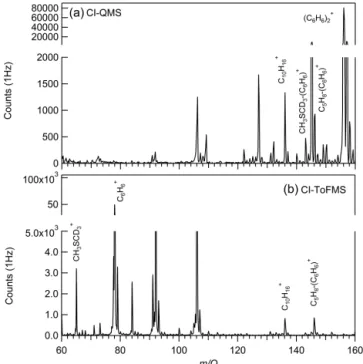
3.1 Factors controlling primary ion distributions During laboratory experiments, the CI-QMS and CI-ToFMS ion generation systems were identical with the exception of the IMR pressure. As shown in Fig. 1, the benzene ion distri-bution as measured by CI-QMS was detected predominantly in the form of (C6H6)+2 at 156m/Q(Fig. 1a). The same gas
mixture was detected by CI-ToFMS in the form of C6H+6 at
bind-ing energy of 15.3 kcal mol−1 (Grover et al., 1987) despite
operating at a relatively weak field strength. Unfortunately, even in the CI-QMS, significant declustering occurs between the IMR and the mass analyzer. As a result, it is not possible to comment directly on the distribution of benzene cluster cations in the IMR and the possibility that the clusters may have attached water molecules. However, based on the CI-QMS spectra, it is most likely that the clusters are at least dimers (n≥2) in both instruments.
3.1.1 Dependence on benzene reagent gas concentration
Background mass spectra were examined by overflowing the sample inlet with UHP zero air while varying the concentra-tion of benzene delivered through the ionizers of both the CI-ToFMS and the CI-QMS instruments. The relative humidity at the sample inlet was less than 5 % during these experi-ments. On the CI-ToFMS, the benzene monomer accounted for 68–91 % of the total ion current (Fig. 2) for benzene pre-cursor ion concentrations ranging between 1 and 45 ppm. Peak benzene ion signal intensities were found at ben-zene reagent gas concentrations of approximately 10 ppm. At lower benzene concentration (< 10 ppm), a wide array of background ions are prevalent in the mass spectra. Al-though the zero air cylinders were assumed to be nominally dry, trace amounts of water (detected as protonated water clusters) were evident in the sample stream at low benzene concentrations. At higher benzene concentrations (> 10 ppm) background peaks at 92, 106, and 120m/Qbecome an in-creasing fraction of the total ion current. At 10 ppm benzene, these ions collectively account for 1–3 % of total ion current. During High Wind Gas Exchange Study (HiWinGS) under-way measurements, the sum of these three peaks comprised an average of 2.6 % (1σ=0.8 %) of the total ion current. These background peaks were observed across all CIMS in-struments and their strength increased with benzene concen-tration (Fig. 2), suggesting they are trace contaminants in the benzene cylinders. We provisionally attribute these peaks to toluene, ethylbenzene, xylene, and trimethylbenzene.
As shown in Fig. 3, the ratio of benzene cation dimer to monomer was approximately 1:104 on the CI-ToFMS and 3×10³:1 for the CI-QMS. The presence of the dimer in the CI-ToFMS mass spectrum provides additional evidence that the reagent-ion distribution primarily exists asn≥2 in both of the IMRs, but the field strength of the RF-only quadrupole ion guide in the CDC of the CI-ToFMS exceeds the benzene dimer binding energy of 15 kcal mol−1(Grover et al., 1987).
3.1.2 Dependence on ambient humidity
Ambient humidity was varied to probe its impact on ion chemistry and product ion distributions. In this experiment, benzene reagent gas concentrations were held at 10 ppm while sampling humid UHP zero air (0–100 % relative
hu-Figure 1. CI-QMS (a) and CI-ToFMS (b) mass spectra utiliz-ing benzene reagent-ion chemistry while samplutiliz-ing a mixture of dimethyl-1,1,1-d3sulfide, isoprene, andα-pinene standards at 40 %
relative humidity and room temperature. The weaker field strength of the CI-QMS transmits clustered forms of benzene ((C6H6)+2)
and dimethyl-1,1,1-d3 sulfide (CH3SCD3-C6H+6). Both are
de-tected at nominal mass by the CI-ToFMS. Isoprene is dede-tected as a benzene cluster (C5H8-C6H+6)andα-pinene (C10H+16)appears at
nominal mass on both instruments.
Figure 2.Partitioning of total ion current (TIC) on the CI-ToFMS between benzene clusters (light blue), O+2 (green), water clusters (dark blue,n=0 to 3), and background peaks (orange and gray) as a function of benzene reagent-ion concentration at < 1 % rela-tive humidity. Molecules corresponding to 92, 106, and 120m/Q are attributed to alkyl-substituted benzene molecules: C6H5-CH+3,
C6H4-(CH3)+2, and C6H4-(CH3)+3, respectively.
Figure 3.Dependence of benzene ion signal intensity on the ben-zene reagent gas concentration for both the CI-QMS (a)and CI-ToFMS(b). Nearly all CI-QMS benzene signal intensity is found at the dimer (156m/Q)while the CI-ToFMS was nearly exclusively in the form of the monomer (78m/Q). On both platforms, the dom-inant benzene peak plateau after 10 ppm neutral benzene concentra-tion.
at 100 % relative humidity (RH), compared with 91 % at < 1 % RH. Absolute benzene monomer count rates showed minimal sensitivity to ambient water vapor (Fig. 4b). Pro-tonated water clusters (H3O+–(H2O)n)were observed upon
the addition of water vapor to sample air. The sum of the ion current for H3O+–(H2O)n (n=0–3) ranged from 0.7 to
8.5 % of the total ion current, increasing with relative humid-ity. Again, trace amounts of water vapor were detected while sampling nominally dry UHP zero air (Praxair) due to a small amount of condensation in zero air cylinders.
Given that the ionization energy of benzene (9.2 eV monomer, 8.69 eV dimer) (Nemeth et al., 1993) is less than water (12.6 eV) (Page et al., 1988), it is unlikely that a ben-zene mediated pathway for the formation of protonated water clusters is active. It is possible that protonated water clusters may be formed by direct ionization (Good et al., 1970) due to back diffusion of ambient water into the Po-210 source, or persistent N+2 from the ionizer may contribute to direct ion-ization of water downstream in the IMR. Similarly, molec-ular oxygen ions (O+2, 12.0 eV) (Tonkyn et al., 1991) from ambient air are observed in trace amounts (< 1.3 % of the to-tal ion current). However, despite the fact that benzene–water clusters were not observed in the mass spectra, we have no
Figure 4.(Top) Dependence of primary ion signal intensities and partitioning between the monomer and dimer on ambient relative humidity ([C6H6]=10 ppm) on the CI-ToFMS. (Bottom) Absolute
benzene ion signal intensities are shown to be nearly independent of ambient relative humidity.
direct evidence that they are not present in the IMR and they may impact instrument sensitivity, as described in Sect. 3.4.
3.2 Instrument calibration
Calibration curves were generated using three parallel CIMS systems (CI-ToFMS, CI-QMS, and CIMS that employs a residual gas analyzer for ion selection and quantification, CI-RGA) to determine the sensitivity of benzene cations to dimethyl sulfide, isoprene, andα-pinene. Results from the first two instruments are included here. Results from the CI-RGA will be discussed in a forthcoming manuscript. Cali-bration factors were determined using atmospherically rele-vant mixing ratios (0 to 3.2 ppb) of dimethyl-1,1,1-d3sulfide
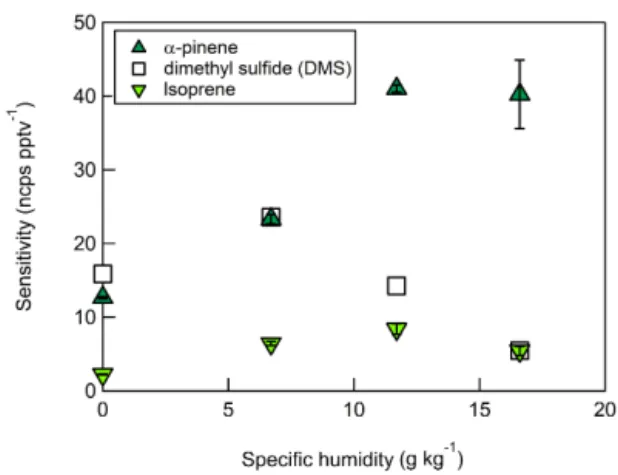
(Praxair certified standard, 0.184×10 %), isoprene (Prax-air certified standard, 0.500×10 %), andα-pinene (Praxair certified standard, 0.497×10 %) at specific humidities (q) from 0 to 16.6 g kg−1. The primary VOC calibration
Figure 5. Humidity dependence of the laboratory-derived CI-ToFMS sensitivities to dimethyl-1,1,1-d3sulfide,α-pinene, and
iso-prene. Error bars indicate 1σ as determined from the slope of the calibration curve.
using measured flow rates and saturation vapor pressures to ensure the humidified air stream was fully saturated. Bubbler temperatures were recorded for specific humidity calcula-tions accounting for cooling at very high flow rates due to gas expansion. All CIMS instruments were positioned around a central manifold (0.635 cm OD PFA tube and 0.635 cm PFA Swagelok fittings) and sampled from its own radial branch. Humidified air was added furthest downstream to minimize the surface area exposed to condensation. Each inlet branch was the same length to within 5 cm. Excess flow was directed from the central manifold line to an exhaust at atmospheric pressure.
Benzene cations were demonstrated to be sensitive to iso-prene andα-pinene (Fig. 5) in agreement with previous work by Leibrock and Huey (2000), as well as DMS. Normal-ized sensitivities (normalNormal-ized counts per second per ppt or ncps ppt−1)were calculated by adjusting product ion count rates to a reference reagent-ion signal of 106cps (Warneke et al., 2001). Thus, absolute sensitivity increases with benzene ion current. Calibration factors are reported as the slope of the linear fit of each calibration curve (1σ=slope standard deviation). Maximum normalized sensitivities were as fol-lows: DMS (23.5 ncps ppt−1),α-pinene (41 ncps ppt−1), and
isoprene (8.3 ncps ppt−1). All three VOCs calibration factors
exhibited unique humidity dependences described in more detail in Sect. 3.3.
3.3 Adduct declustering
VOC product ions were detected at nominal mass (M+)or as a benzene adduct (M-(C6H6)+). On both the CI-QMS
(Fig. 1a) and CI-ToFMS (Fig. 1b) isoprene was detected as an adduct (146m/Q), whileα-pinene appeared at nominal mass (136m/Q). The former indicates that isoprene ioniza-tion proceeds through a ligand switching reacioniza-tion. For the latter, this result suggests thatα-pinene may also undergo a
ligand switching mechanism with subsequent disassociation during transmission or, alternatively, may be ionized via di-rect charge transfer.
In contrast, dimethyl-1,1,1-d3 sulfide was detected
pre-dominately as M+ (65m/Q) on the CI-ToFMS and as a benzene–DMS adduct (143m/Q)on the CI-QMS. This in-dicates that DMS ionization proceeds through a ligand-switching reaction in both instruments, but the adduct dis-sociates in the stronger declustering fields of the CI-ToFMS. Despite attempts to minimize the field strength of the CI-ToFMS, we were not able to observe the DMS–benzene clus-ter.
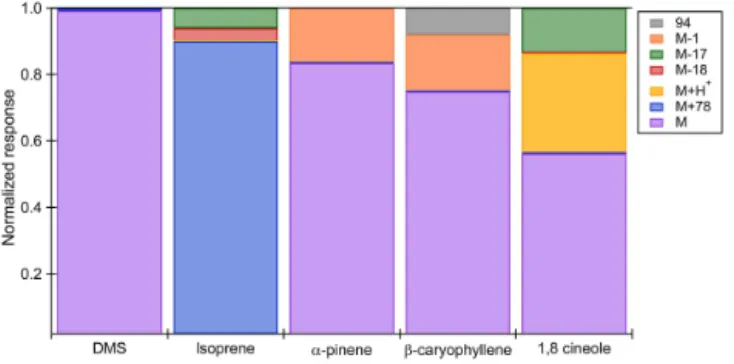
Instrument response to pure, unquantified mixing ratios of a host of other VOCs, including a sesquiterpene and a monoterpenoid, were assessed with the CI-ToFMS. In these experiments a small volume (< 1 mL) of pure β -caryophyllene and eucalyptol standards were deposited into clean flasks and their vapors were delivered to the CI-ToFMS inlet. Product ions were identified and normalized (%) to the sum of all feasible products. As described previously, DMS and α-pinene product ions appear at M+ (99 and 83 %, respectively), while isoprene is detected primarily as a benzene adduct (88 %) (Fig. 6).β-caryophyllene was de-tected as M+ (204m/Q) with very limited fragmentation (< 25 %). Since β-caryophyllene has been demonstrated to fragment more readily that other sesquiterpenes (Kim et al., 2009), these tests suggest that benzene dimer cations show excellent promise as an accurate chemical-ionization method to target easily fragmented terpene species. Euca-lyptol (1,3,3-Trimethyl-2-oxabicyclo[2,2,2]octane), an oxy-genated monoterpenoid (C10H18O), was also detected as M+
(154m/Q)with limited fragmentation (Fig. 6). In the case of eucalyptol, a secondary ionization reaction was evident at the M-H+channel (Maleknia et al., 2007). After accounting for contributions from the carbon-13 isotope, we estimate the ra-tio of charge transfer to proton transfer product ions is about 2:1 at ambient RH for eucalyptol.
3.4 Impact of ambient humidity on sensitivity
The sensitivity of benzene cluster cations to DMS,α-pinene, and isoprene standards was shown to be a strong function of specific humidity (q)(Fig. 5), with peak sensitivity occurring at specific humidities of 6.7 g kg−1 (DMS, 23 ncps ppt−1), 11.7 g kg−1(α-pinene, 41 ncps ppt−1), and 11.7 g kg−1
(iso-prene, 8.3 ncps ppt−1). Sensitivity varied with ambient
spe-cific humidity on all CIMS platforms. On the CI-ToFMS, DMS was observed to be least sensitive to changes in ambi-ent water vapor, whileα-pinene sensitivity increased almost linearly forqvalues between 0 and 11.7 g kg−1.
Figure 6.Normalized response of the CI-ToFMS to a series of VOC standards. Significant products (> 5 % of instrument response) are shown for DMS, isoprene,α-pinene,β-caryophyllene, and euca-lyptol (1,8-cineole). For eucaeuca-lyptol, the ratio of charge transfer to proton transfer products was roughly 2:1. Expected contributions from carbon-13 isotopes were accounted for in the calculated proton transfer products.
Ibrahim et al. (2005) show that the stepwise binding ener-gies for attaching a water molecule to C6H+6 are on the order
of 8.5 kcal mol−1, suggesting that the water molecules are re-moved via collisions in the transfer optics. Laboratory studies have shown previously that benzene–water clusters [C6H6–
(H2O)n]+ can be made efficiently (n=1–23) (Miyazaki et
al., 2004). For large clusters (n≥4) IR spectra of the clusters suggest features that are nearly identical to protonated wa-ter cluswa-ters, suggesting exclusion of benzene and the forma-tion of an attached water cluster. For smaller clusters (n≤3), IR spectra were shown to be consistent with a hydrated ben-zene cation, where benben-zene retains over 90 % of the charge (Ibrahim et al., 2005). It is likely that the sensitivity depen-dence we observe in these experiments is related to the afore-mentioned laboratory studies and depends on the location of the charge (benzene vs. water) and the size of the benzene– water cluster (n), both of which are related toq. However, in our experiments it is almost certain that the reagent ion con-tains more than one C6H6molecule limiting the direct
com-parison between the two studies. In what follows, we show that standard additions under a range of atmospheric values forqare required for accurate measurements of mixing ratios in the atmosphere.
4 CI-ToFMS performance during the High Wind Gas Exchange Study
The CI-ToFMS utilizing benzene cluster cation ion chem-istry was deployed to the Arctic and North Atlantic aboard the R/VKnorrduring the fall of 2013 to characterize BVOCs in the remote marine boundary layer. Here, we analyze in-strument performance over the 5-week HiWinGS to inves-tigate factors controlling reagent-ion stability and sensitivity to VOCs in challenging environmental conditions. The atmo-spheric implications of these measurements will be discussed in a separate forthcoming manuscript. Isoprene, α-pinene,
and UHP zero air gas cylinders were used to determine in-field sensitivities and system baselines, respectively. We val-idate our DMS measurement against a collocated DMS mea-surement made by the University of Hawaii’s APIMS-ILS.
4.1 Inlet characterization
A low-pressure (200 mbar), rapid-response, high Reynolds number (ca. 2400) inlet assembly was designed based on the inlet manifold described in Ellis et al. (2010) and adapted for measurement of VOC mixing ratios and air–sea exchange from research vessels. The complete inlet assembly included separate lines for sample, bypass, baseline, and calibration flows sheathed together by a durable weatherproof exterior (25 m total length, 18 m weatherproofed, 6 cm outside diam-eter; Clayborn Labs). All inlet lines were connected to a glass manifold (Ellis et al., 2010). Inlet flow rates are set by a crit-ical orifice (ca. 1.2 mm ID, 12.56 sL min−1) set within the
2.54 cm OD cylindrical glass body. Upstream manifold sur-faces were treated with Fluoropel (Cytonix). Downstream of the orifice (low-pressure side), sample flow is split into a by-pass (ca. 2.5 sL min−1) and sample (ca. 10 sL min−1) stream. The bypass branch is in-line with the manifold intake. The sample flow follows a series of 90 and 180◦ turns, which serve to eliminate super-micrometer sea spray particles from the sample inlet stream. The manifold was housed in an in-sulated, weather-proofed housing and mounted off the fore-mast. The sample intake was ca. 20 m above mean sea level (a.m.s.l.) and ca. 17 m aft of the bow (Yang et al., 2014). The entire inlet sample line and manifold assembly was heated by a single PID heating circuit (Omega) set to 40◦C.
The inlet assembly comprised of a sample (0.95 cm OD FEP), bypass 0.635 cm OD PFA), baseline (0.95 cm OD FEP), and calibration (0.318 cm OD FEP) line and ran be-tween the manifold and a temperature-controlled instrument van housing the CI-ToFMS on the 02 deck. Baseline and calibration gas flows were controlled by mass flow con-trollers operated by an automated LabView program. Am-bient sample air was pulled through the sample line to the front block, an additional differentially pumped chamber up-stream of the CI-ToFMS IMR and held at the inlet assem-bly pressure (200 mbar). The CI-ToFMS subsampled from the front block, while the rest of the flow rejoined the bypass flow downstream of the instrument. Choked flow conditions in the entire manifold-inlet-front block volume were main-tained by a 500 L min−1scroll pump (Varian TriScroll 600).
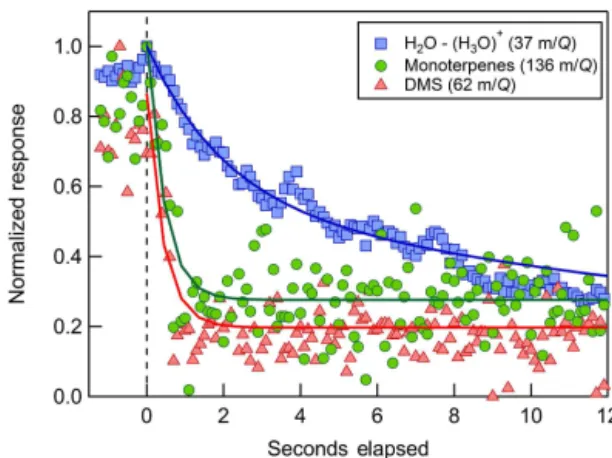
Figure 7.Inlet and instrument response to a prompt switch from ambient sampling to a zero air addition. The first rapid decay is attributed to the gas evacuation time (τ1)and the second decay is
attributed to the inlet wall-equilibration time (τ2). Best fit estimates
of τ1 for H3O+(H2O), DMS, and monoterpenes ranged between
2 and 3 s, in agreement with the volumetric evacuation time of the sample inlet (3.6 seconds).τ2was determined to be 22, 1.2, and
2.5 s, respectively.
weeks of the research cruise utilized isoprene standards be-fore switching toα-pinene during the last 2 weeks. For both calibrations, a 0.500 ppm primary standard in N2 (Praxair)
was used to achieve a constant 638 ppt mixing ratio in the inlet.
4.2 Inlet time response
Ambient VOC signal decays resulting from zero air addi-tions were examined to characterize the inlet’s time response (Fig. 7). Fitting a double exponential curve to signal decays yields two characteristic time constants for the inlet (Ellis et al., 2010). The first exponential decay time,τ1, is attributed
the gas evacuation time and related to the physical opera-tion and characteristics of the inlet itself. The second ex-ponential decay time, τ2, is attributed to the equilibration
constant of the gas and its polarity and solubility. For the n=1 protonated water cluster (H3O+–(H2O)n),τ1 of 3.2 s
agreed well with the volumetric evacuation time of 3.6 s at 12.56 sL min−1. The second characteristic time,τ
2was long
for the protonated water cluster at 22 s, as expected based on the polarity and high surface affinity of water vapor. DMS and α-pinene also exhibited fast τ1 time constants, but τ2
time constants were also fast (1.2 and 2.5 s, respectively), in contrast to H2O, indicating turbulent flow and minimal
inter-action of the analyte with the inlet walls.
4.3 Factors impacting reagent-ion stability
Benzene reagent-ion signal varied between 58 and 89 % of the total ion current (8.02×10⁵ to 6.4×10⁶cps benzene) during HiWinGS. Probability density functions of benzene counts during ambient and baseline periods each showed
Figure 8.Probability density functions of benzene signals (% to-tal ion current, 1 Hz) for ambient and baseline sampling periods. The bimodal distribution corresponds to abrupt temporal shifts in ion current from benzene monomers to protonated water clusters. These shifts correspond to switches in benzene gas cylinders rather than changes in ambient specific humidity, indicating the bimodal distribution is driven by trace water vapor contaminants in the ben-zene gas cylinders.
Table 1.Summary of in-field CI-ToFMS performance on the HiWinGS research cruise for select volatile organic compounds. Isoprene andα-pinene were calibrated against in-field standards. DMS figures of merit utilized simultaneous independent DMS mixing ratios from the University of Hawaii’s APIMS-ILS. Limit of detection (LOD) was calculated for 1 s averaging times using normalized sensitivities corresponding toQ=6 g kg−1.
VOC species Sensitivity Background (1σ) LOD (1 Hz, 3σ)
Dimethyl sulfide 1.0 to 17.9 ncps ppt−1 636±389 cps 25 ppt Isoprene 0.7 to 1.1 ncps ppt−1 19.5±66 cps 15 ppt α-Pinene 0.8 to 6.3 ncps ppt−1 192±191 cps 14 ppt
purified liquid benzene reservoir that would not need to be exchanged during the course of the cruise.
4.4 In-field calibration and sensitivity
As expected, absolute sensitivity to VOC standard additions varied as a function of benzene reagent-ion current and am-bient water vapor. Calibration factors were calculated from raw count rates observed during each VOC standard addition adjusted for ambient contributions calculated by interpolat-ing values from bracketed samplinterpolat-ing periods. DMS calibra-tion factors were derived from concurrent APIMS-ILS deter-mined mixing ratios (cps ppt−1), as discussed in detail below in Sect. 4.5. Mean absolute sensitivities were 19.4, 2.8, and 6.1 cps ppt−1for DMS, isoprene, andα-pinene, respectively. Instrument baselines are computed from the mean of raw count rates (1 Hz) measured during valid instrument zero pe-riods throughout the entire campaign as in (Kercher et al., 2009). Variability in baseline counts are largely driven by fluctuations in the benzene reagent-ion current. Detection limits are calculated as in Bertram et al. (2011) as 3σ of a Gaussian fit for all baseline count rates over the entire cam-paign. A conservative estimate of the CI-ToFMS detection limits, for 1Hz sample averages, were calculated as 152, 13, and 42 ncps for DMS, isoprene, and α-pinene, respectively (Table 1). Using sensitivities reported forq=6 g kg−1, this translates to 1Hz detection limits of 25, 15, and 14 ppt, re-spectively.
After normalizing to the benzene ion current, the humidity dependence of in-field VOC normalized calibration factors (Fig. 9) is consistent with laboratory tests (Fig. 4). However, the values of normalized calibration factors were lower by a factor of 4–7 for each VOC molecule, as is highlighted forα -pinene in Fig. 10. Possible explanations include VOC stan-dard degradation, inlet performance (less probable for non-polar terpenes), or most likely shifts in sensitivity from tun-ing instrument voltages between the two experiments.
In deployments subsequent to the HiWinGS campaign, in-field calibrations have been performed utilizing continuous standard additions of isotopically labeled standards (when commercially available) as developed and used on several previous APIMS-ILS air–sea exchange campaigns (Bandy, 2002; Blomquist et al., 2010; Thornton, 2002).
Figure 9.In-field sensitivities during standard additions as a func-tion of ambient specific humidity. Dots represent hourly values while squares represent mean values for a 2 g kg−1specific humid-ity bin.
Figure 10.Comparison of α-pinene calibration factors observed during laboratory experiments (left axis) and during in-field stan-dard additions (right axis). Similar attenuation with specific humid-ity was observed.
4.5 Underway dimethyl sulfide comparison
Figure 11.Regression of background corrected, benzene normal-ized DMS counts with DMS concentrations measured by APIMS-ILS. Regression analysis indicates a campaign-average CI-ToFMS sensitivity of 6.9 ncps ppt−1.
APIMS-ILS inlet was mounted to the meteorological mast located at the bow of the ship and ca. 16.3 m a.m.s.l. This is about 17 m fore and 4 m below the CI-ToFMS intake posi-tion.
Dimethyl sulfide baseline-adjusted, normalized count rates were calculated by subtracting interpolated baseline values from ambient 62m/Qcounts and scaling to a ben-zene ion current of 106cps (Warneke et al., 2001) (Fig. 11). No adjustments based on ambient humidity were made due to the lack of an active standard gas calibration. A regression analysis between the adjusted, normalized CI-ToFMS signal and APIMS-ILS DMS mixing ratio measurements, for 10 s averages, showed excellent agreement (R2=0.97) over ex-treme wind speeds, low ambient loadings, and temperatures below freezing (Figs. 11 and 12). This agreement between two independent DMS measurements lends confidence to the selectivity of both ionization methods and their robustness in the field. It also indicates both sampling locations were functionally equivalent and sampled air masses did not suffer from flow distortion around the superstructure of the ship. As suggested by laboratory tests, the calibration factor is largely constant over the humidity range (1.6–12.8 g kg−1) experi-enced during the cruise (Fig. 12), indicating robustness to ambient humidity fluctuations.
5 Summary and future directions
Benzene cluster cations have been revisited as a chemical-ionization method for the detection of DMS and select volatile organic compounds. DMS andβ-caryophyllene were identified as novel VOC targets and product ions exhibited limited fragmentation. Sensitivity to DMS, isoprene, andα -pinene was determined using CI-ToFMS in laboratory ex-periments and in-field standard additions with a focus on hu-midity dependencies for performance in the remote marine boundary layer. Laboratory-based calibration factors ranged
Figure 12.Hourly measurements from the High Wind Gas Ex-change Study (HiWinGS) research cruise. Normalized CI-ToFMS count rates compared well (R2=0.80, hourly averages during en-tire campaign) with dimethyl sulfide mixing ratios measured by the University of Hawaii’s APIMS-ILS. No corrections were made for ambient humidity.
between 2 and 41 ncps ppt−1, with varying water vapor
de-pendencies. These trends were well conserved between lab-oratory and field measurements, but normalized sensitivity values were lower in the field by a factor of 4 to 7. Mi-nor background peaks attributed to alkyl-substituted benzene were traced to contamination in the benzene source. Water vapor in the benzene cylinder standards was also found to degrade benzene reagent-ion signal significantly during field operations. Future directions will explore the use of a liquid benzene reservoir that would not need to be exchanged dur-ing the course of the cruise and the potential extension of this ion chemistry beyond the select VOCs studied here.
Acknowledgements. This work was supported by a National Sci-ence Foundation (NSF) CAREER Award (grant no. AGS-1151430), the Office of Science (Office of Biological and Environmental Re-search), US Department of Energy (grant no. DE-SC0006431), and National Aeronautics and Space Administration (NNX12AL94G). The authors thank the entire High Wind Gas Exchange Study science team. A special thanks to the WHOI Marine Operations staff, Captain Kent Sheasley and the capable crew of the R/V
Knorr. The authors also thank Emma Mungall and Jonathan Abbatt of the University of Toronto for helpful discussions.
References
Al-Joboury, M. I. and Turner, D. W.: 851. Molecular photoelec-tron spectroscopy. Part II. A summary of ionization potentials, J. Chem. Soc., 4434–4441, 1964.
Arnold, S. R., Spracklen, D. V., Williams, J., Yassaa, N., Sciare, J., Bonsang, B., Gros, V., Peeken, I., Lewis, A. C., Alvain, S., and Moulin, C.: Evaluation of the global oceanic isoprene source and its impacts on marine organic carbon aerosol, Atmos. Chem. Phys., 9, 1253–1262, doi:10.5194/acp-9-1253-2009, 2009. Bandy, A. R.: Determination of the vertical flux of dimethyl
sulfide by eddy correlation and atmospheric pressure ioniza-tion mass spectrometry (APIMS), J. Geophys. Res., 107, 4743, doi:10.1029/2002JD002472, 2002.
Bertram, T. H., Kimmel, J. R., Crisp, T. A., Ryder, O. S., Yatavelli, R. L. N., Thornton, J. A., Cubison, M. J., Gonin, M., and Worsnop, D. R.: A field-deployable, chemical ionization time-of-flight mass spectrometer, Atmos. Meas. Tech., 4, 1471–1479, doi:10.5194/amt-4-1471-2011, 2011.
Blomquist, B. W., Huebert, B. J., Fairall, C. W., and Faloona, I. C.: Determining the sea-air flux of dimethylsulfide by eddy cor-relation using mass spectrometry, Atmos. Meas. Tech., 3, 1–20, doi:10.5194/amt-3-1-2010, 2010.
Ellis, R. A., Murphy, J. G., Pattey, E., van Haarlem, R., O’Brien, J. M., and Herndon, S. C.: Characterizing a Quantum Cascade Tun-able Infrared Laser Differential Absorption Spectrometer (QC-TILDAS) for measurements of atmospheric ammonia, Atmos. Meas. Tech., 3, 397–406, doi:10.5194/amt-3-397-2010, 2010. Goldstein, A. H. and Galbally, I. E.: Known and unexplored organic
constituents in the earth’s atmosphere, Environ. Sci. Technol., 41, 1514–1521, 2007.
Good, A., Durden, D. A., and Kebarle, P.: Ion-Molecule Reactions in Pure Nitrogen and Nitrogen Containing Traces of Water at To-tal Pressures 0.5–4 torr. Kinetics of Clustering Reactions Form-ing H+(H2O)n, J. Chem. Phys., 52, 212–221, 1970.
Grover, J., Walters, E., and Hui, E.: Dissociation energies of the benzene dimer and dimer cation, J. Phys. Chem., 91, 3233–3237, 1987.
Guenther, A. B., Jiang, X., Heald, C. L., Sakulyanontvittaya, T., Duhl, T., Emmons, L. K., and Wang, X.: The Model of Emissions of Gases and Aerosols from Nature version 2.1 (MEGAN2.1): an extended and updated framework for modeling biogenic emis-sions, Geosci. Model Dev., 5, 1471–1492, doi:10.5194/gmd-5-1471-2012, 2012.
Helmig, D., Bocquet, F., Pollmann, J., and Revermann, T.: Analyti-cal techniques for sesquiterpene emission rate studies in vegeta-tion enclosure experiments, Atmos. Environ., 38, 557–572, 2004. Horning, E. C., Horning, M. G., Carroll, D. I., Dzidic, I., and Still-well, R. N.: New picogram detection system based on a mass spectrometer with an external ionization source at atmospheric pressure, Anal. Chem., 45, 936–943, 1973.
Huey, L. G.: Measurement of trace atmospheric species by chem-ical ionization mass spectrometry?: speciation of reactive nitro-gen and future directions, Mass Spectrom. Rev., 26, 166–184, 2007.
Hunter, E. P. L. and Lias, S. G.: Evaluated Gas Phase Basicities and Proton Affinities of Molecules: An Update, J. Phys. Chem. Ref. Data, 27, 413–656, 1998.
Ibrahim, Y. M., Meot-Ner, M., Alshraeh, E. H., El-Shall, M. S., and Scheiner, S.: Stepwise hydration of ionized aromatics. Energies,
structures of the hydrated benzene cation, and the mechanism of deprotonation reactions, J. Am. Chem. Soc., 127, 7053–7064, 2005.
Jaoui, M., Kleindienst, C. T. E., Docherty, B., Lewandoswki, M., and Offenberg, J. H: Secondary organic aerosol formation from the oxidation of a series of sesquiterpenes?: α-cedrene , β -caryophyllene ,α-humulene andα-farnesene with O3, OH and
NO3radicals, Environ. Chem., 10, 178–193, 2013.
Kanakidou, M., Seinfeld, J. H., Pandis, S. N., Barnes, I., Dentener, F. J., Facchini, M. C., Van Dingenen, R., Ervens, B., Nenes, A., Nielsen, C. J., Swietlicki, E., Putaud, J. P., Balkanski, Y., Fuzzi, S., Horth, J., Moortgat, G. K., Winterhalter, R., Myhre, C. E. L., Tsigaridis, K., Vignati, E., Stephanou, E. G., and Wilson, J.: Organic aerosol and global climate modelling: a review, At-mos. Chem. Phys., 5, 1053–1123, doi:10.5194/acp-5-1053-2005, 2005.
Kercher, J. P., Riedel, T. P., and Thornton, J. A.: Chlorine activation by N2O5: simultaneous, in situ detection of ClNO2and N2O5
by chemical ionization mass spectrometry, Atmos. Meas. Tech., 2, 193–204, doi:10.5194/amt-2-193-2009, 2009.
Ketkar, S. N., Dulak, J. G., Dheandhanoo, S., and Fite, W. L.: Ben-zene charge exchange at atmospheric pressure for low-level de-tection of pollutants in ambient air, Anal. Chim. Acta, 245, 267– 270, 1991.
Kim, S., Karl, T., Helmig, D., Daly, R., Rasmussen, R., and Guen-ther, A.: Measurement of atmospheric sesquiterpenes by proton transfer reaction-mass spectrometry (PTR-MS), Atmos. Meas. Tech., 2, 99–112, doi:10.5194/amt-2-99-2009, 2009.
Leibrock, E. and Huey, L. G.: Ion chemistry for the detection of isoprene and other volatile organic compounds in ambient air, Geophys. Res. Lett., 27, 1719–1722, 2000.
Lindinger, W., Hansel, A., and Jordan, A.: On-line monitoring of volatile organic compounds at pptv levels by means of proton-transfer-reaction mass spectrometry (PTR-MS) medical applica-tions, food control and environmental research, Int. J. Mass Spec-trom., 173, 191–241, 1998.
Maleknia, S. D., Bell, T. L., and Adams, M. A.: PTR-MS analysis of reference and plant-emitted volatile organic compounds, Int. J. Mass Spectrom., 262, 203–210, 2007.
McDiarmid, R.: Assignments of Rydberg and valence transitions in the electronic absorption spectrum of dimethyl sulfide, J. Chem. Phys., 61, 274–281, 1974.
Miyazaki, M., Fujii, A., Ebata, T., and Mikami, N.: Infrared Spec-troscopy of Size-Selected Benzene-Water Cluster Cations [C6H6
-(H2O)n ]+ ( n=1–23): Hydrogen Bond Network Evolution
and Microscopic Hydrophobicity, J. Phys. Chem. A, 108, 10656– 10660, 2004.
Myriokefalitakis, S., Vignati, E., Tsigaridis, K., Papadimas, C., Sciare, J., Mihalopoulos, N., Facchini, M. C., Rinaldi, M., Den-tener, F. J., Ceburnis, D., Hatzianastasiou, N., O’Dowd, C. D., van Weele, M., and Kanakidou, M.: Global Modeling of the Oceanic Source of Organic Aerosols, Adv. Meteorol., 2010, 1– 16, 2010.
Nemeth, G. I., Selzle, H. L., and Schlag, E. W.: Magnetic ZEKE experiments with mass analysis, Chem. Phys. Lett., 215, 151– 155, 1993.
Thornton, D. C.: Fast airborne sulfur dioxide measurements by At-mospheric Pressure Ionization Mass Spectrometry (APIMS), J. Geophys. Res., 107, 4632, doi:10.1029/2002JD002289, 2002. Tonkyn, R. G., Wiedmann, R., Grant, E. R., and White, M. G.:
Ro-tationally resolved photoionization of H2O, J. Chem. Phys., 95,
7033–7040, 1991.
Warneke, C., van der Veen, C., Luxembourg, S., de Gouw, J., and Kok, A: Measurements of benzene and toluene in ambient air us-ing proton-transfer-reaction mass spectrometry: calibration, hu-midity dependence, and field intercomparison, Int. J. Mass Spec-trom., 207, 167–182, 2001.
![Figure 4. (Top) Dependence of primary ion signal intensities and partitioning between the monomer and dimer on ambient relative humidity ([C 6 H 6 ] = 10 ppm) on the CI-ToFMS](https://thumb-eu.123doks.com/thumbv2/123dok_br/18258204.343096/5.918.81.439.102.484/figure-dependence-primary-intensities-partitioning-ambient-relative-humidity.webp)