Quantum Baker Maps for Spiraling Chaotic Motion
Pedro R. del Santoro, Ra´ul O. Vallejos, and Alfredo M. Ozorio de Almeida
Centro Brasileiro de Pesquisas F´ısicas (CBPF), Rua Dr. Xavier Sigaud 150, 22290-180 Rio de Janeiro, Brazil
Received on 22 January, 2007
We define a coupling of two baker maps through aπ/2 rotation both in position and in momentum. The classical trajectories thus exhibit spiraling, or loxodromic motion, which is only possible for conservative maps of at least two degrees of freedom. This loxodromic baker map is still hyperbolic, that is, fully chaotic. Quan-tization of this map follows on similar lines to other generalized baker maps. It is found that the eigenvalue spectrum for quantum loxodromic baker map is far removed from those of the canonical random matrix ensem-bles. An investigation of the symmetries of the loxodromic baker map reveals the cause of this deviation from the Bohigas-Giannoni-Schmit conjecture.
Keywords: Quantum chaos; Baker map; Spiraling motion
I. INTRODUCTION
The essential feature of classically chaotic motion is hyper-bolicity, that is both stretching and squeezing, within a con-fined region of phase space. The simplest textbook examples, as far as (conservative) Hamiltonian systems are concerned, are two-dimensional (2D) maps, which may be pictured as Poincar´e sections of motion in a 4Dphase space. However, hyperbolicity is in no way confined to lower dimensions. In particular, a conservative return map in four dimensions may exhibit spiralling, or loxodromic motion onto a fixed point. This would not be allowed in two dimensions since it would violate area conservation, but is compensated in four dimen-sions by outward spiralling in a complementary plane. The linearization of hyperbolic conservative maps of arbitrarity high dimension can be decomposed into products of simple hyperbolic motion in eigenplanes together with loxodromic motion in 4D-subspaces [1].
Hyperbolic motion is generally described by horseshoe maps in the qualitative theory of dynamical systems [2, 3]. The idea is to describe by symbolic dynamics the successive visits of a trajectory to a well chosen finite set of domains of phase space. The problem, as far as conservative systems are concerned, is that most orbits are not restricted to this finite set of domains, so that the horseshoe map itself is not conser-vative. This is the motivation for the develoment of a specially convenient model known as the baker map.
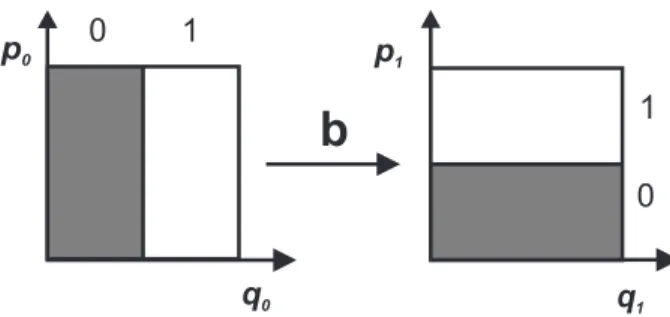
The baker map displays the essential features of classically chaotic motion in such a simplified form as to be almost a car-icature [4, 5]. It may be described as a space-filling horseshoe map that linearizes the hyperbolic motion. Thus, essentially chaotic motion is exhibited, which can be followed through very simple computations. The binary symbolic dynamics propagates vertical strips in the unit square onto horizontal strips. The vertical and horizontal rectangles become nar-rower, for longer binary codes pertaining to multiple iterations of the baker map. The primary digit specifies either of the two half-squares, so that it is responsible for a coarse-grained de-scription of the motion. The way in which horizontal strips are piled up by the mapping is also determined by the primary binary digit (see Fig. 1).
Higher dimensional generalizations of the baker map have
recently been presented [6]. The products of horizon-tal rectangles for each degree of freedom define hyper-parallelepipeds that are stretched and squeezed into horizontal parallelepipeds. Even though the increased dimension admits a much richer range of possibilities for restacking these do-mains, none of these leads to spiralling motion. Here we show how a rotation can be added which leads to spirals, without violating any of the essential attributes of generalized baker maps.
The various quantization schemes that have been proposed for the baker map generally respect the main division of the square into a pair of vertical rectangles, which split the posi-tion states into Hilbert subspaces. These are mapped respec-tively onto a pair of momentum state subspaces according to the primary binary digit. The discrete and finite nature of the Hilbert space prevents the association of longer codes to ever thinner strips [7]. Thus, to some extent, the primary digit is even more important in quantum mechanics.
Initially, it may have seemed that the introduction of binary symbols to describe evolving quantum systems could only serve as an artificial prop for the study of the semiclassical limit. However, the growing interest in quantum computation has brought the binary structure to the fore. In this context, the quantum baker map has reemerged as an ideal simplified model. Schack and Caves [8] have indeed developed an entire class of quantum baker maps, based on the 2N-dimensional Hilbert space ofN qubits, which include the original quanti-zations of Balazs and Voros [9] and Saraceno [10] as special cases. The Schack-Caves family was recently further enlarged by Ermann and Saraceno [11], who also explained the general structure of all these maps. We here adopt the Balazs-Voros-Saraceno [10] map throughout.
quan-tum system to be the tensor product ofNtwo-level systems. This would correspond to a hypercube in a 2N-dimensional phase space, but it would be stretching it to ascribe a classi-cal correspondence to this quintessentially quantum system. We shall here keep to the original quantization schemes and, hence, interpret each quantum baker map as corresponding to a classical two-dimensional phase space, so that the coupling of two baker maps corresponds to a four-dimensional phase space. The four possible combinations of primary binary dig-its,(0,0),(0,1),(1,0),(1,1), then correspond to four squares in the classical position space, (q1,q2)and hence four par-allelepipeds in the unit 4-cube, (q1,q2,p1,p2) in which the classical motion is defined.
The interaction between baker maps here involves a rotation of the four parallelepipeds into which the primary digits of both maps divide the four dimensional phase space. Choosing this to be ofπ/2, merely exchanges the parallelepipeds, so that the doubled binary decription is respected. The interesting point is that the equilibrium and all the classical periodic or-bits become ”loxodromic”, i.e. the positions spiral outwards, while the momenta spiral inwards, because the eigenvalues of the stability matrix are general complex numbers: Neither are they real, nor do they lie on the unit circle. Obviously, this example models more closely a two dimensional motion for a single particle than any easily conceivable dynamics for a pair of one-dimensional particles. Loxodromic behaviour does not arise for equilibria of simple p2+V Hamiltonians, but it is a generic possibility for the Poincar´e map around pe-riodic orbits in higher dimension. So far, not much effort has been made towards quantizing loxodromic motion, except for higher dimensional cat maps [13], another simplified model.
The analysis of the loxodromic baker map is preceeded by a brief review of the ordinary two-dimensional baker map and its quantization. We point out the possibilities for different pil-ings that lead to the simplest couplpil-ings of baker maps [6]. Sec-tion 3 then presents the loxodromic baker map and its quanti-zation. It is shown in section 4 that, contrary to the generalized baker maps in [6], the quantum eigenvalue spectrum does not obey a generic random matrix ensemble. The reason for this failure of the BGS conjecture is shown to be that theπ/2 rota-tion commutes with the component baker map. This leads to a nontrivial decomposition into a tensor product of two maps, so that the quantum quasi-energy spectrum in this case is highly degenerate.
II. REVIEW OF CLASSICAL AND QUANTUM BAKER MAPS
In this section we present the well known classical and quantum ingredients of baker maps. The classical baker transformation is an area preserving, piecewise–linear map, b:(p0,q0)→(p1,q1)of the unit square (periodic boundary conditions are assumed) defined as
p1= 1
2(p0+ε0), q1=2q0−ε0; (1)
b
0
1
0
1
q
0p
0q
1p
1FIG. 1: The baker map propagates a pair of vertical rectangles onto a pair of horizontal rectangles. Inside each separate region the evo-lution is linear.
whereε0= [2q0], the integer part of 2q0. The two regions into which the phase space is separated and their evolution is shown in Fig. 1.
This map is known to be uniformly hyperbolic, the stabil-ity exponent for orbits of periodLbeingLlog 2. Moreover it admits a useful description in terms of a complete symbolic dynamics. A one to one correspondence between phase space coordinates and binary sequences,
(p,q)↔. . .ε−2ε−1·ε0ε1ε2. . . ,εi=0,1, (2)
can be constructed in such a way that the action of the map is conjugated to a shift map, i.e., to shifting the dot to the right in the binary sequence above. The symbols are assigned as follows: εi is set to zero (one) when thei–th iteration of
(p,q)falls to the left (right) of the lineq=1/2, i.e.[2qi] =εi.
Reciprocally, given an itinerary
. . .ε−2ε−1·ε0ε1ε2. . . , (3) the related phase point is obtained through the specially sim-ple binary expansions
q=
∞
∑
i=0εi
2i+1 , p=
∞
∑
i=1ε−i
2i . (4)
Once the dynamics has been mapped to a shift on binary se-quences it is very easy to analize the dynamical features of the map. In particular, periodic points are associated to infi-nite repetitions offinitesequences of symbols.
Due to its piecewise linear nature, the baker map admits a (mixed) generating function which is a piecewise bilinear form,
Wε0(p1,q0) =2p1q0−ε0p1−ε0q0, ε0=0,1. (5) It is not defined on the whole spacep1–q0but on the classi-cally allowed domains
With respect to the quantum map, we will follow the origi-nal quantization of Balazs and Voros [9], as later modified by Saraceno [10] to preserve in the quantum map all the symme-tries of its classical counterpart. In the mixed representation the baker’s propagator can be written as aD×Dblock–matrix (Deven):
hpm|BbD|qni=
µ
GD/2 0 0 GD/2

, (7)
where position and momentum eigenvalues run on a discrete mesh with step 1/D=h(h= Planck’s constant), so that qn= (n+1/2)/D, pm= (m+1/2)/D, 0≤n,m≤D−1 ;
(8) andGD is the antiperiodic Fourier matrix, which transforms
from theqto thepbasis, GD=hpm|qni= (1/
√
D)e−2πiDpmqn . (9) It will be useful to consider this matrix as theq-representation of the Fourier operatorGbD.
The propagator for the baker map has the standard structure of quantized linear symplectic maps [14],
hpm|BbD|qni=
p
2/D e−i2πDW0(pm,qn) if (p
m,qn)∈R0
p
2/D e−i2πDW1(pm,qn) if (p
m,qn)∈R1
0 otherwise.
(10) In this quantization, only those transitions are allowed that respect the rule[2pm] = [2qn], a reflection of the classical shift
property. To be able to iterate the quantum baker map, the state must be brought back to the position representation. This is achieved by an inverse Fourier transform, so that the matrix (7) is multiplied byG−D1.
Following Schack and Caves [8], we can reinterpret this quantum map as the evolution ofNqubits if the dimension of the Hilbert space satisfiesD=2N. Then the position states
can be defined as product states for the qubits in the basis,
|qni=|ε1i ⊗ |ε2i ⊗...|εNi, (11)
wherenhas the binary expansion
n=ε1...εn= N
∑
j=1εj2N−j (12)
and qn= (n+1/2)/D=0·ε1...εN1. The connection with
the classical baker map is specified by the symbolic dynam-ics. The bi-infinite strings (3) that determine points in the unit square are made to correspond to sets of orthogonal quantum states. Half of the position states lie in either of the two rec-tangles,R0orR1defined in (6), which correspond respectively to 0, or 1 eigenstates of the principal qubit.
The full unitary operator for the quantum baker can be writ-ten explicitly as
b
BD=Gb−D1[ˆ12⊗GbD/2], (13)
where ˆ12is the unit operator for the first bit andGbD/2is the Fourier operator on the remaining qubits. The operator in the
b
0
1
q
0p
01
0
q
1p
1´
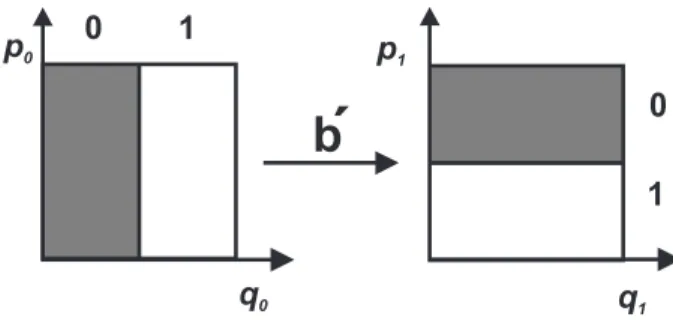
FIG. 2: The alternative baker map also propagates a pair of vertical rectangles onto a pair of horizontal rectangles, but their stacking is interchanged.
square brackets preserves the first qubit, while evolving sepa-rately the remaining qubits, within each domainRε1. It is the final inverse Fourier operator that mixes the principal qubit in with the rest, because it acts globaly on the states in both do-mains. This step is not explicitated in the mixed representation (7).
So far we have only allowed for a single possibility in which to stack the rectangles in the baker transformation, but alter-native to (1), the classical map,b′:(p0,q0)→(p1,q1), shown in Fig. 2,
p1= 1
2(p0+1−ε0), q1=2q0−ε0, (14) has very similar properties. This variation is tantamount to reversing the primary classical bit and it corresponds to the quantum mapBb′, represented by the matrix:
hpm|Bb′D|qni=
µ
0 GD/2 GD/2 0

. (15)
In other words, we here substitute the operator ˆI2, which acted on the principal qubit, byXb2represented by the Pauli matrix:
X2=
µ
0 1 1 0

, (16)
so thatBb′D=Gb−D1[Xb2⊗GbD/2].
Of course, we are free to substitute any other unitary op-erator acting on the primary qubit, but it is onlyBb′ that can be interpreted classically as an equivalent alternative piling of the baker map. We can still split up the evolution into do-mains equivalent to (6), though with a different matching ofq0 andp1segments. The classical evolution within each domain is again determined by classical generating functions like (5) which becomes the exponent of the propagator.
q
02
00
01
10
11
00
01
10
11
q
01
p
12
p
11
b
1b
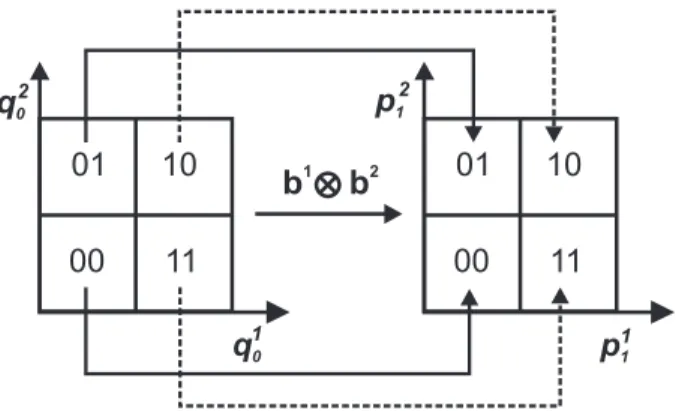
2FIG. 3: The partition of phase space into disjoint domains is re-spected by the product of baker maps. 4D-parallelepipeds, projecting onto squares in the position space are transformed ontohorizontal parallelepipeds that project onto squares in momentum space.
00 01
10 11
00 01
10 11
p0
p1
p1
p0
1 2
2
1
r
p/2 m
FIG. 4: Possible repiling of the partition of the domains of the prod-uct of baker maps.
no spiraling motion could be generated in the corresponding classical map. This possibility is now realized by rotating the domains into which the baker’s phase space is partitioned.
III. DEFINITION OF THE LOXODROMIC BAKER MAP
The direct product of a pair of classical baker maps,b1⊗ b2, is itself a generalized baker map defined within a 4D-hypercube, (p1,q1)⊗(p2,q2). Indeed the motion is hyper-bolic and the partition of phase space into disjoint domains is again respected. These are specified by a doubled binary code,ε0=ε01⊗ε02, definingvertical4D-parallelepipeds that project onto squares in the position space(q1,q2), while cov-ering the full available momentum space. The effect of a sin-gle iteration of this product map is to transform these domains onto horizontal parallelepipeds that project onto squares in momentum space, as shown in Fig. 3.
The main difference between this product map and the gen-eralized bakers defined in [6] is that in the latter case the sym-bolic mapping is no longer the identity. One could certainly define a generalized baker by repiling the product maps within each domain so as to obtain the symbolic evolution displayed in Fig. 4, though this possibility was not singled out in [6].
However, the same effect (as far as the symbolic evolution is concerned) can be obtained by combining the product baker with a canonical point transformation,rm
π/2, that simply rotates
q1
p/2 q2
p1
p2
Xq 0
Xq
‘
Xq Xp Xp
0
Xp
Xp
‘
p/2
FIG. 5: A canonical point transformation,rm
π/2, that simply rotates
both the position and the momentum spaces around the midpoint of the hypercube,m= (1/2,1/2,1/2,1/2), has the same effect on the partition of the product of baker maps as the repiling in Fig. 4.
both the position and the momentum spaces around the mid-point of the hypercube,m= (1/2,1/2,1/2,1/2), as shown in Fig. 5.
This loxodromic baker map, rmπ/2◦[b1⊗b2] = b L : (p0,q0)→(p1,q1)is given explicitely by
p11 = 1− 1 2p0
2−1 2ε0
2 (17)
p12 = 1 2p0
1−1 2ε0
1 (18)
q11 = 1−2q02− 1 2ε0
2
(19) q12 = 2q01−
1 2ε0
1. (20)
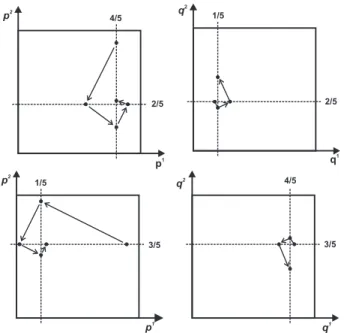
This is no longer a product map within each separate do-main and Fig. 6 shows how an orbit spirals onto a fixed point in momentum space and spirals outwards in position space.
The loxodromic baker map can also be described by sym-bolic dynamics. This now has a four letter alphabet, two bi-nary digits, instead of one for the ordibi-nary baker map. Fur-thermore, the relation between the symbolic description and the phase space trajectories is not so direct. The details may be obtained in [16].
The quantum version of the loxodromic baker map is de-fined in strict correspondence with the foregoing classical construction. This is always possible for linear classical evo-lutions, i.e. we can define a quantum unitary transformation,
b
Rmπ/2, which corresponds to the classical transformation,rm π/2, so that, in combination with the definition of the usual baker map (13), we then stipulate that
b
BL=Rbmπ/2BbD⊗BbD. (21)
The only thing that is now missing is the full definition of the rotation operator in the above formula. Recalling that the classical rotation is about the midpointm in phase space, it follows that, if the rotation operator about the origin by an angleαis
b
2/5 4/5
p2
p1
p1
p2
1/5
3/5
q2
q1
3/5 4/5
q1
q2
2/5 1/5
FIG. 6: Typical classical trajectories of the loxodromic baker map spiral out of the fixed points in the q-plane and into the fixed points in the p-plane. Every four iterations they return to the same radial line, because the rotation angle isπ/2.
then
b
Rmα =TbmRb0αTb−m, (23) whereTbξis the quantum operator corresponding to a uniform translation (or displacement) by the phase space vectorξ(see e.g.[18]).
A considerable simplification is possible for theπ/2 rota-tion, which is the only one allowed for a generalized baker map. In this case, it is easy to verify that the classical rotation about the midpoint,m, can be written as a composition
rmπ/2=tη◦r0π/2, (24) where tη is the classical translation by the vector η =
(1,0,1,0)andr0π/2theπ/2 rotation around the origin. There-fore, we can quantize this form directly so as to obtain
b
Rmπ/2=TbηRb0π/2. (25)
IV. SYMMETRIES AND LEVEL REPULSION
The celebratedBGS conjecturepredicts the correspondence between chaotic classical motion and quantum level repul-sion. Specifically, for quantum maps, the eigenvalue spectrum of the unitary operator should have fluctuations in agreement with the canonical CUE, or COE ensembles of random matrix theory (RMT). Exceptions do arise because of symmetries, or even more subtle arithmetic anomalies which may be hidden in the definition of the map. However, the BGS conjecture has become so well established that its negation is taken as a sure sign that hidden structure should be sought out.
0 1 2 3 4
0,0 0,2 0,4 0,6 0,8 1,0
P(s)
s
FIG. 7: Distribution of level spacings –normalized to unit average– for the repiled baker maps (full dimension equal to 512; big dots). We also display the predictions of random matrix theory (dotted line: COE, dashed: CUE) and the Poisson distribution (full line).
In relation to the baker map, it should be noted that the original quantization by Balazs and Voros [9] did not conform properly to the conjecture. Saraceno then discovered that this form of quantization did not incorporate an exact classical symmetry and proposed a modification [10]. The individual symmetry classes of this new map are satisfactory examples of the BGS conjecture as can be verified in [15].
Even though the direct product of two baker maps is cer-tainly a chaotic classical system, its quantization does not sat-isfy the BGS conjecture. Indeed, the eigenvalues will be the products of the baker eigenvalues, leading to degeneracies stead of level repulsion. In general, the addition of some in-teraction between the two maps, while taking the precaution to preserve the hyperbolicity of the classical motion, should lead again to an RMT spectrum. In the case of the gener-alized “repiled” baker maps studied in [6] the level spacing distribution, shown in Fig. 7, does not comply with the BGS conjecture. Its intermediate nature between a Poisson spec-trum and a COE specspec-trum suggests the nearness of a symme-try, as was found for the original Balasz-Voros quantization of the baker map. However, Fig. 8 clearly rules this possibil-ity out in the case of the loxodromic baker map. The Poisson profile indicates independent samples and, furthermore, there are many degeneracies, just as with the simple product map. Therefore we must seek out the symmetry that is responsi-ble. It turns out that this involves the reflection symmetry of the classical baker map,R:(q,p)→R(q,p) = (1−q,1−p), included in the Saraceno quantization [10]. Of course, both factors of the product map, b1⊗b2, commute with the re-spective reflections,R1andR2. Another obvious symmetry of the product map is the permutation,P:(q1,p1,q2,p2)→ P(q1,p1,q2,p2) = (q2,p2,q1,p1). Combining these, we then obtain:
R1P(q1,p1,q2,p2) =R1(q2,p2,q1,p1) =
0 1 2 3 4 5 0,0
0,2 0,4 0,6 0,8 1,0
s P(s)
FIG. 8: Histogram of level spacings for eigenangles of a loxodromic baker map with dimension equal to 1296. The smooth curve corre-sponds to the Poisson spectrum.
Thus, we find that the special nature of theπ/2 rotation, that was chosen because it respects the geometrical divisions of the baker map, can now be reinterpreted as a particular product of the symmetries ofb1⊗b2.
It is then neither surprising, nor hard to prove, thatrπ/2 it-self is a symmetry of the classical and the quantum product baker map. The consequence is thatRbπ/2andBbD⊗BbDhave
common eigenfunctions and they must share these withBbL, as
defined by (21). Thus, if we divide the spectrum of the product map into the symmetry classes of the quantum rotationRbπ/2,
with eigenvalues {+1,−1,+i,−i}, the eigenvalues of BbL in
each class are just the corresponding multiple of the eigen-values of the quantized product map. In conclusion, the lox-odromic baker map belongs to the class of quantized chaotic maps which fail to satisfy the BGS conjecture because of a symmetry.
V. DISCUSSION
The quantization of spiraling chaotic motion has not re-ceived the attention it deserves, because, so far, work has con-centrated on two-dimensional maps. For systems with many degrees of freedom, it must be borne in mind that Poincar´e maps will generally exhibit spiraling behaviour along with the more familiar features studied in two-dimensional maps. The complexity of higher dimensional motion encourages the search for specially simple models with which to study the classical-quantum correspondence and the semiclassical limit. The generalized baker map presented here was an obvious candidate, but the restriction to rotations ofπ/2, amounting roughly to a permutation of the variables between the two cou-pled maps, turns out to be too severe. The commutation of this rotation with the baker product map leads to a totally unsatis-factory eigenvalue spectrum for a chaotic quantum map. This is in sharp contrast to even simpler couplings developed for baker maps in [6]
Another possibility that has also been investigated are lox-odromic cat maps, i.e. linear maps on the 4-torus [13]. There is then a richer range of possibilities, but still there are re-strictions to the distribution of eigenvalues common to all cat maps. These arise from the necessity of quantum cat maps to be periodic, albeit the period may be very high. Presumably, the search for simple loxodromic quantum models will only heat up when a loxodromic algorithm is invented for quantum information theory.
[1] V. I. Arnold, Mathematical Methods of Classical Mechanics (Springer, New York, 1978).
[2] J. Guckenheimer and P. Holmes,Nonlinear Oscillations, Dy-namical systems and Bifurcations of Vector Fields (Springer, New York, 1983).
[3] A. M. Ozorio de Almeida,Hamiltonian Systems: Chaos and Quantization(Cambridge University Press, Cambridge, 1988). [4] V. I. Arnold and A. Avez,Ergodic Problems of Classical
Me-chanics(Benjamin, New York, 1968).
[5] A. J. Lichtenberg and M. A. Lieberman,Regular and Stochastic Motion(Springer, New York, 1983).
[6] R. O. Vallejos, P. R. del Santoro, and A. M. Ozorio de Almeida, J. Phys. A: Math. Gen.39, 5163 (2006).
[7] M. Saraceno and A. Voros, Physica D79, 206 (1994). [8] R. Schack and C. M. Caves, Appl. Algebra Eng. Commun.
Comput.10, 305 (2000).
[9] N. L. Balazs and A. Voros, Ann. Phys.190, 1 (1989). [10] M. Saraceno, Ann. Phys.199, 37 (1990).
[11] L. Ermann and M. Saraceno, arXiv:nlin.CD/060602.
[12] O. Bohigas, in Chaos and Quantum Physics –Proc. Les Houches Summer School 1989–, ed M. J. Giannoni, A. Voros and J. Zinn-Justin (North-Holland, Amsterdam, 1991). [13] A. M. F. Rivas, M. Saraceno, and A. M. Ozorio de Almeida,
Nonlinearity13, 341 (2000).
[14] A. M. Ozorio de Almeida and M. Saraceno, Ann. Phys.210, 1 (1991).
[15] P. W. O’Connor and S. Tomsovic, Ann. Phys.207, 218 (1991). [16] P. R. del Santoro, PhD Thesis (in preparation).
[17] J. H. Hannay, J. P. Keating, and A. M. Ozorio de Almeida, Non-linearity7, 1327 (1994).