Article
J. Braz. Chem. Soc., Vol. 27, No. 9, 1667-1678, 2016. Printed in Brazil - ©2016 Sociedade Brasileira de Química 0103 - 5053 $6.00+0.00
*e-mail: [email protected]
A Kinetic, Equilibrium, and Thermodynamic Study on the Biosorption of Tl
+and
Cd
2+by
Eichhornia crassipes
Roots Using Carbon Paste Electrode
Carolina Martínez-Sánchez,a Luz M. Torres-Rodríguez*,a and Ramón F. García-de la Cruzb
aLaboratorio de Electroquímica and bLaboratorio de Bioquímica Vegetal, Centro de Investigación y
Estudios de Posgrado (CIEP), Facultad de Ciencias Químicas, Universidad Autónoma de San Luis Potosí, Avenida Manuel Nava No. 6, Zona Universitaria, C.P. 78210, San Luis Potosí-S.L.P., México
In this work, Eichhornia crassipes roots were used as a modifier for carbon paste electrode in a biosorption study of thallium (Tl+) and cadmium (Cd2+) ions. The ions were accumulated on
modified electrode surfaces at open circuit potential and analyzed by square wave anodic stripping voltammetry. Before the biosorption study, the effect of ratio of biomass and binder in uptake metal was evaluated. The biosorption study shows that adsorption of ions was dependent on pH. The kinetic study showed that, for both ions, experimental data were well described by the pseudo-second order model (R2 > 0.99) and the equilibrium was better described by the Langmuir model.
The value of dimensionless equilibrium parameter (RL) obtained in the equilibrium study showed
that Eichhornia crassipes can be considered an effective biomaterial for Tl+ and Cd2+ removal from
an aqueous solution. The thermodynamic parameters calculated, enthalpy (∆H°), entropy (∆S°)
and Gibbs energy (∆G°), indicated that the biosorption process was spontaneous and endothermic.
Keywords: modified carbon paste electrode, Eichhornia crassipes, biosorption, thallium, cadmium
Introduction
Heavy metal pollution is one of the most serious environmental problems today. This is because the heavy metals are released into the environment by industries such as electroplating, mining, and metallurgy. Heavy metals also occur in the environment due to the use of rodenticides, insecticides, dyes, and the like.1 Cadmium (Cd2+) and
thallium (Tl+) are two heavy metals present in natural
waters.
Cd2+ is one of the most toxic heavy metals associated
with considerable environmental and occupational concern because it combines with protein sulfhydryl groups and restrains the enzyme activity in human beings. Long-term exposure to Cd2+ can cause anemia, hypertension,
muscular cramping, osteoporosis, and renal damage.2 On
the other hand, thallium is present in the environment in low concentrations and in natural waters as Tl+. Because
the solubility of thallium compounds is high, the Tl+ is
easily transported throughout aquatic systems and is more toxic than many other metal ions, such as Cd2+. Thallium
ions can damage the heart, lungs, liver, and nervous
system; therefore, removing thallium compounds from water and aqueous solutions, as well as controlling their impact on the environment, is very important.3,4 There are
different methods to remove these heavy metals,4-6 for
example, the biosorption. This removal technology uses biological materials for binding and concentration of the pollutant from an aqueous solution. Biomass of non-living
Eichhornia crassipes (water hyacinth) is a good option for
biosorption. In fact, this free-floating aquatic plant features vegetative reproduction and a vigorous growth rate. A typical biomass from land plants is composed of 30-50% cellulose, 20-40% hemicellulose, and 15-30% lignin.7 In
addition, this plant has a high tolerance to pollution and is regarded as an economic adsorbent.7 The biomass of
Eichhornia crassipes has been used largely for removal of
Cd2+,8-11 and other ions such as Pb2+,12 Cu2+,13 and Zn2+.12
In contrast, the biosorption of Tl+ by Eichhornia crassipes
has not been studied previously. There are only some works that have studied the elimination of Tl+ by biomass
such as Ulmus carpinifolia,14 modified sugar beet pulp,15 Aspergillus niger,16 and eucalyptus leaves.17
periodically sampling them for later analysis. In earlier works, our work team has proposed the use of carbon paste electrodes modified with biomass.18,19 With this method the
electrode modified with biomass is exposed to a solution containing the ion studied, and the ion fixed to the electrode through biomass is analyzed by electrochemical techniques. This methodology has the advantage of requiring a small quantity of biomass and reagents moreover the time used for experiments is considerably smaller than the batch studies. However, the uptake of ion for the biomass is carried out on a surface, and the charge or the current are used as a measure of uptake. As a consequence, the constant obtained from empirical models cannot be interpreted by habitual form.
Hence, this work proposed the use of modified carbon paste electrodes for studied the removal of Tl+ by
Eichhornia crassipes roots. In order to compare the uptake
of a monovalent and divalent ion, a parallel study for Cd2+
was realized under the same conditions.
Experimental
Reagents
All reagents were of analytical grade, and obtained from Sigma Aldrich (St. Louis, MO. USA). The graphite powder and mineral oil were purchased from Alfa Aesar (Haverhill, MA, USA). The solutions 0.01 mol L−1 of
Tl2CO3 and Cd(NO3)2 were prepared and used to perform
dilutions for the purpose of obtaining the working solutions. The sodium perchlorate (NaClO4, 0.1 mol L−1) was used as
a supporting electrolyte. All solutions were prepared with deionized water (18.6 MΩ cm).
Instruments
The voltammetric measurements were performed while employing the modified carbon paste electrode (MCPE) with Eichhornia crassipes roots as a working electrode
having a surface area of 0.193 cm2, an Ag|AgCl|NaCl
3.0 mol L−1 and platinum wire were used as electrode
reference and as counter electrode, respectively.
To perform the electrochemical studies, potentiostat/ galvanostat BASi EC epsilon was used and controlled by the BASi Epsilon-EC software version 1.31.65 NT (Bioanalytical Systems Inc., West Lafayette, IN, USA).
To control the temperature, a heating bath Lauda Eco Silver (Lauda-Brinkmann, LP, Delran, NJ, USA) was used. The MCPEs (modified carbon paste electrodes) were exposed to a cell that contained the working solutions.
Electrochemical impedance spectroscopy measurements were performed with a potentiostat/galvanostat Autolab
PGSTAT302N (Metrohm Autolab BV, Utrecht, The Netherlands). Measures were performed using the same three electrode-cell setup described previously. Parameters of the electrical equivalent circuits were obtained via the Zview 2 program.
A Metrohm pHmeter (Metrohm Autolab BV, Utrecht, The Netherlands) was used to adjust the pH of the solutions.
Treatment of Eichhornia crassipes roots
Eichhornia crassipes plants, obtained from Dam San
José in the municipality of San Luis Potosí (San Luis Potosí, Mexico) were transported to the greenhouse at the Faculty of Chemical Sciences of Universidad Autónoma de San Luis Potosí and grown there. The roots of the
Eichhornia crassipes were first washed with running
water, and then with deionized water. After, the roots were separated from the rest of the plant. These roots were frozen and subjected to a drying process in a freeze vacuum pump model 7522900 (Labconco, Kansas City, MO, USA) at −48 °C for 16 h. The roots were then pulverized in an analytical mill Cole-Parmer (London, UK) and stored in bottles at room temperature.
Determination of pHzpc
To determine the pH of zero point charge (pHzpc),
this study followed the methodology reported by Leyva et al.,20 for which 0.1 g of acidulated root in 20 mL
of a solution of 0.01 mol L−1 KCl-0.004 mol L−1 KOH
were added. The suspension was stirred for 48 h and, after that time, it was titrated with the addition of 0.1 mL of 0.1 mol L−1 HCl to register the pH of the solution
after each addition. Also, the assessment of a solution of 0.01 mol L−1 KCl-0.004 mol L−1 KOH was performed under
the same conditions but without the root. The point where the titration curves (with and without the root) intersect is the pHzpc because the pH of the solution with and without
the root is the same, which means that the root has no charge; so that is the value of extrapolating the intersection of both lines is pHzpc.
Preparation of modified carbon paste electrodes
Three carbon paste electrodes were prepared by mixing 0.43 g of nujol, 0.50 g of graphite powder and 0.07 g of lyophilized Eichhornia crassipes root. The paste that
control electrode without the root was prepared by mixing 0.60 g of graphite powder and 0.40 g of nujol.
Characterization of MPECs by impedance
Impedance spectra were recorded with electrodes in a NaClO4 solution for the purpose of characterizing the
modified electrodes. The initial frequency used was 10 kHz, and the final frequency used was 10 mHz, with 10 points
per decade. The alternating current amplitude was 10 mV
under open circuit potential conditions.
Electrochemical experiments
To study the uptake of metal by electrochemistry, experiments were carried out in both controlled temperature and room temperature. MCPEs were submerged in ion solutions unstirred during a selected time at open circuit. After this, the electrode was rinsed with water and transferred to a solution containing only support electrolyte (NaClO4 0.1 mol L−1). Square wave anodic stripping
voltammetry (SWASV) experiments were carried out, and a deposition potential (Edep) of −0.75 V was applied during
120 s for Cd2+, while for Tl+ E
dep was −0.8 V and was applied
for 60 s. These conditions were obtained in earlier works for Cd2+,19 and obtained experimentally for Tl+. For both
ions, a square wave with a frequency of 10 Hz, amplitude of 0.02 V, and potential step size of 0.004 V was applied at a range of −1.2 to 0.2 V. All experiments were performed in triplicate, and the standard deviation was calculated.
To study the effects of pH, MCPEs were exposed to a single metal ion solution concentration of 1.0 mmol L−1
of Tl+and Cd2+ ions for 15 min. The pH of the solutions
changed within a range of 2.6 to 9.7. Solutions of different pH were obtained by addition of 0.1 mol L−1 HCl and/or
NaOH 0.1 mol L−1. After exposure, the MCPEs were rinsed
and transferred to the working cell that contained only the supporting electrolyte.
To perform the kinetic and equilibrium study, in the preconcentration step, the MCPEs were exposed to ion solutions of different concentrations (0.1 to 6.0 mmol L−1)
for different times (1, 2, 3, 4, 5, 7, 10, 15, 20 and 30 min) while maintaining the temperature constant. After exposure, the MCPEs were transferred to the working cell, and the response was obtained via SWASV, as mentioned previously.
Data treatment
In this work, the metal adsorption was correlated to current (I) measured in an electrochemical experiment. The
surface under the current-potential (time) curve represents the electroactive coverage Γ (mol cm−2), and the amount of
heavy metal immobilized in the surface electrode is given by equation 1:
(1)
where Q is the charge, A is the surface of the electrode, n is the number of electrons transferred, and F the Faraday constant. Note that if the number of moles is Q/nF and Q = It, then electroactive coverage (equation 1) can be expressed by (equation 2):
(2)
In this expression, the current and the electroactive coverage are proportional. The electrochemical response was obtained via the technique of SWASV. This technique has two stages. In the first, the ion accumulated in the surface of the electrode is reduced by application of a potential during a certain time. In the second, the metal formed is stripping. The reactions carried out during this stage are:
Tl 0→ T+ + e– (3)
Cd0→ Cd2+ + 2e– (4)
In consequence, n is one and two for Tl+ and Cd2+,
respectively. To compare adsorption of both ions, it was considered that the surface of the electrode and the scan rate (time) of equation 2 are the same for both ions, but n is different. As a consequence, the current measured was divided between n. The value of the current used and reported in voltammograms was corrected by subtraction of the capacitive current of the current measured. The value of the current used in the graphs was the average of three measures.
Results and Discussion
Selection of composition of MCPEs for adsorption studies
cell, and the voltammetric response was obtained. Figure 1 shows the response of Tl+, and a peak can be observed in the
center at −0.79 V, which is characteristic of this metal. The I, which is proportional to uptake metal, increased when the amount of root in the electrode increased. This shows that when there are more root, there are a large number of sites for metal uptake and a higher adsorption.
However, the amount of metal that accumulated in the 10% modified electrode was very similar to that in the 7% modified electrode with Eichhornia crassipes roots
(Figure 1). In this proportion, the electrode surface probably is fully covered by the roots. Based on these results, we chose
to modify the electrode with a ratio of 7% roots, since a lesser amount of biomass is required to modify the electrode.
The accumulation of ion in an unmodified electrode (CPE) also was studied. The same procedure was repeated, and the curve obtained did not present response of Tl+
(Figure 1). This showed that the ions are not immobilized in the carbon paste, and are accumulated only on the roots.
Selection of the amount and type of binder for preparing MCPEs
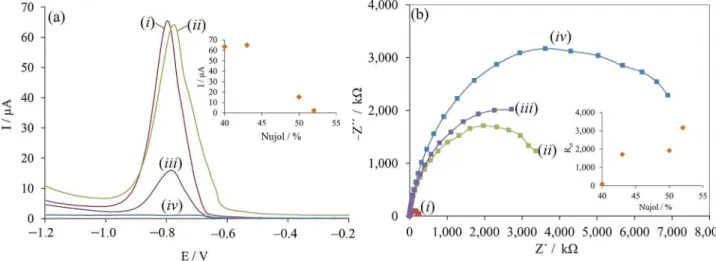
After determining that the optimal amount of root to modify the electrode was 7%, we proceeded to test the effect of the amount and nature of the binder. Tests were conducted with varied proportions of nujol in the MCPEs between 40 and 52%, while maintaining the ratio of the root at 7% and proportions of graphite necessary to reach 100%. MCPEs cannot be elaborated with proportions of nujol lower than 40% because the paste acquires a very stiff consistency and cannot be manipulated. The MCPEs were exposed to the Tl+ solution, and the metal uptake was then
analyzed by SWASV (Figure 2a). The maximum current, or the maximum accumulation of heavy metal, was obtained at ratios of 40 and 43% of nujol. However, the consistency of the paste electrode prepared at 40% nujol was very stiff, and this texture made the experiments difficult because the electrode is pulverized easily. The current decreased considerably when the nujol ratio was 50%, and no voltammetric response was obtained by modifying the MCPE with 52% of nujol (inset Figure 2a).
Diminution of adsorption with an increase of nujol can be due to the nujol has increased electrical and Figure 1. Square wave anodic stripping voltammetry (SWASV) response
of 0.1 mmol L−1 of Tl+ using different percentages of Eichhornia crassipes roots (1, 3, 5, 7, and 10%) in a modified carbon paste electrode. The accumulation time was 20 min at open circuit potential; supporting electrolyte was NaClO4 0.1 mol L−1. Inset corresponds to the curve of peak current vs. percentage of root in the modified carbon paste electrode
(MCPE). CPE: Unmodified electrode.
Figure 2. (a) Voltammograms obtained in NaClO4 from modified carbon paste electrode (MCPE) with 7% of root after being exposed for 15 min to a solution of 0.1 mmol L−1 of Tl
diffusional resistance of the electrode.21 On the other hand,
the number of ions accumulated also can be diminished because the nujol is hydrophobic, therefore increasing the hydrophobicity of the electrode surface.
In order to determine how the conductivity of MCPEs changes with the binder, electrochemical impedance tests were carried out. The Nyquist diagram in Figure 2b shows that the experimental data form a semicircle and the diameter of the circle changes with the proportion of nujol. In fact, as the paste contains a lower proportion of nujol, the diameter of the semicircle related to the electrochemical process decreases, suggesting that as the amount of nujol decreases, the charge transfer resistance (Rct) is minor (inset Figure 2b). These results
are congruent with the results obtained by SWASV for the study of accumulation of Tl+ in which the response
of accumulated metal in the MCPEs decreased with the amount of nujol.
Finally, to determine the effect of hydrophobicity, MCPE was prepared using the ionic liquid (IL) 1-butyl-3-methylimidazolium hexafluorophosphate (BMI·PF6)
as a binder (MCPE IL). This binder was chosen because it is highly hydrophobic but is a good ionic conductor. Figure 3 shows the voltammetric response of MCPE IL after exposure to a solution of Tl+.
It was observed that the response featured much noise and a capacitive current; therefore, the peak was less defined than that obtained with the MCPE prepared with nujol (Figure 3). These results indicate that a greater number of the Tl+ ions interacted with the electrode prepared with
nujol. This may have occurred because the BMI·PF6 is
more dense and viscous than nujol, which makes the Tl+
ion diffusion difficult. The results suggest that the MCPEs prepared with 43% nujol are the best choice for use in the study of adsorption of Tl+ and Cd2+ ions.
Effect of pH in uptake of Tl+ and Cd2+ by Eichhornia crassipes
roots
Once the preparation of MCPEs was optimized, the study of bioaccumulation was carried out. First, the effect of pH was analyzed because it is one of the most important factors influencing the efficiency of the adsorption of metal ions in biomass; pH is able to change the surface properties of the biosorbent and the form which the metal ions can exist in the solution. The electrodes were exposed to the solutions with different pH values, and then their response was obtained in NaClO4. The results of accumulation are
illustrated in Figure 4.
It can be observed that the peaks are localized at ca. −0.8 V for Tl+ and −0.6 V for Cd2+. The ion adsorption,
or the current, is dependent on pH in the range studied (between 2 and 8). The amount of adsorbed ions increases Figure 3. Voltammograms obtained in NaClO4 from (i) modified carbon paste electrode (MCPE) with Eichhornia crassipes roots prepared using
the ionic liquid (IL) 1-butyl-3-methylimidazolium hexafluorophosphate (BMI·PF6) as a binder (MCPE IL); and (ii) MCPE after being exposed for 15 min to a solution of 1.0 mmol L−1 of Tl
2CO3.
with increasing pH, between 2 and 6, in contrast with pH higher than 8, for which the adsorption diminishes. This behavior can be explained for the composition of
Eichhornia crassipes roots. Recent work has determined
through infrared spectroscopy and potentiometric titration that the groups present in the roots of Eichhornia crassipes
are alcohols, carboxylic acids, amines, sulfonates and esters.18 This means that the root has acid sites where the
metallic ions can be adsorbed, and that the accumulation of ions in the roots is dependent on pH. It can be observed that the adsorption is significant after pH = 2; this can be related with the pHzpc. pHzpc calculated for Eichhornia crassipes
root was 2.3; then for a high pHzpc, the acid groups
present in the root are primarily in dissociated form. As a consequence, the acid groups present a negative charge, which is adequate for the accumulation of ions. When pH increases, the dissociated groups increase and the adsorption increase. However, when the pH is higher than 8, the adsorption diminishes, which may be due to an excess of OH− interacting with the ions in the bulk solution. It is
noteworthy that in this pH range both Tl+ and Cd2+ are held
in ionic form. The evolution of uptake with pH was similar for Tl+ and Cd2+; this likely shows that both ions should be
fixed to the root through the same acid groups. On the other hand, the values of the current were higher for Tl+ than Cd2+;
thus we can deduce that the Tl+ is accumulated in greater
amount than Cd2+; probably because as Tl+ is monovalent,
for each divalent acid site it can be accumulated two unity of Tl+, while only a Cd2+ unit can be accumulated in a
divalent site.
Effect of ionic strength in uptake of Tl+ and Cd2+ by
Eichhornia crassipes roots
On the other hand, wastewater normally contains a
certain amount of electrolytes with a variety of ionic species. The presence of salt or co-ions in the solution can affect the adsorption of metal ions.22 To determine the effect of ionic
strength on the accumulation of Tl+, MCPEs were exposed
for 15 min to solutions of Tl+ prepared in NaClO
4 0.1, 0.01
and 0.001 mol L−1. After, the voltammetric response was
obtained. The value of I obtained, which is proportional to the amount of accumulated metal, were 166, 175, and 207 µA for NaClO4 0.1, 0.01 and 0.001 mol L−1, respectively. These
results indicate that the amount of Tl+ accumulated decreases
with the ionic strength, possibly because the Na+ ions
compete with Tl+ for the active sites of the root, so that the
more concentrated the electrolyte, the lower its adsorption. The same trend was observed in the case of Cd2+.
Kinetic study
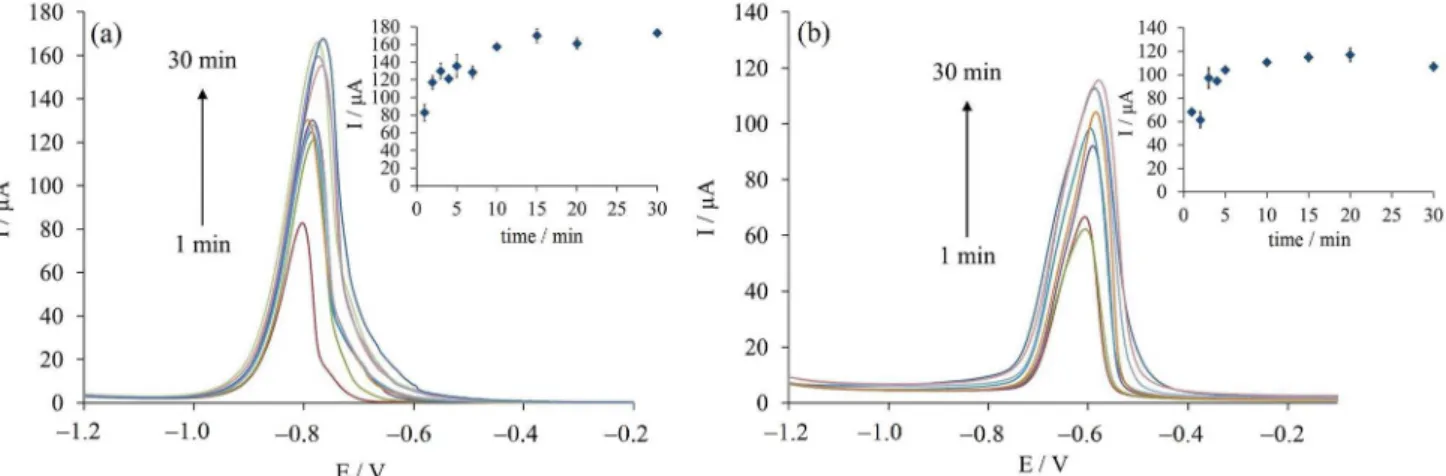
The amount of ion accumulated was studied as a function of time, and the curves obtained are shown in Figure 5. As the exposure time increases, the peaks broaden and the current increases, indicating that the amount of accumulated metal increases; the increment is more evident in the first minutes. For both ions, after 10 min, the I remains virtually constant, which indicates that, although the electrode is exposed for longer durations, the number of ions that accumulate are practically the same. This also indicates that equilibrium is attained, and the time necessary to reach equilibrium is the same for both ions. I is greater for Tl+ than Cd2+, which means that Tl+ adsorption is higher
than Cd2+.
The evolution of ion accumulation over time can be due to the fact that the root surface of Eichhornia crassipes
initially has more unoccupied active sites, offering easy interaction; therefore, in the first min, the concentration gradient of the ions between the solid-liquid interface
Figure 5. Voltammograms of modified carbon paste electrode (MCPE) with Eichhornia crassipes roots obtained at different times to 0.9 mmol L−1 concentration of (a) Tl+; and (b) Cd2+ at 308 K. Supporting electrolyte was NaClO
4 0.1 mol L−1. Insets correspond to the curve of peak current (I) evolution
is large enough to allow the ion to exceed the resistance between liquid and solid phases, during which, in the first 10 min, adsorption is rapid. As time passes, the active sites are occupied until saturate, and the concentration gradient of the ions between the solid-liquid interfaces decreases so that the equilibrium is reached,23 as observed for 10 min
in the inset of Figure 5, which shows the current for each exposure times.
These experimental resultswere fitted to the pseudo-second order model, which linearized equation is as follows (equation 5):
(5)
where t is the exposure time (min), and qe (mg g−1) and
qt (mg g−1) are the amounts of solute adsorbed at equilibrium
and at time t, respectively. From the slope and intercept of the graph t/qtvs. t were obtained qe and k2, respectively.24
Equation 5 can be written in terms of the current since the experimental data are obtained in terms of I, which is proportional to q (equation 6):
(6)
where Ie (µA) and It (µA) are the equilibrium current and
at time t, respectively. Figure 6 illustrates the graph of t/It vs. t for a concentration of 2.0 mmol L−1. It can be
observed that experimental data of Tl+ and Cd2+ present
a good linear fit; this observation is confirmed by the correlation coefficient being higher than 0.99, which indicates a good fit for this model and then the adsorption kinetics is of pseudo-second order. This result coincides with the studies in batch processes, which determined that the kinetic of adsorption of Cd2+ on Eichhornia crassipes
follows the pseudo-second order model.8-11 As this kinetic
model assumes that the chemisorption is the limiting step in the adsorption process, the limiting step in this case is probably the interaction between Tl+ and Cd2+ ions and the
functional groups of the root.
From the slope and the intercept of graphs in Figure 6, Ie and k2 were obtained and the initial velocity (h) was
obtained from h = k2qe2 . Values are presented in Table 1 and
Ie, calculated from equation 6, is similar to the experimental
value (Ie(exp)); this indicates a good fit for the pseudo-second
order model.
It can be observed that h is higher for Tl+;therefore the
monovalent ion interacts more quickly with the functional groups of the cell wall. The fact that the kinetic constants are higher for Tl+ than Cd2+ may occur because the radius
Table 1. Kinetic parameters for adsorption of Tl+ and Cd2+ on Eichhornia crassipes roots at three different temperatures, starting from a solution of 2.0 mmol L−1
Ion Temperature / K h / (µA min−1) k
2 / (µA−1 min−1) Ie / µA Ie(exp) / µA Rw R2
Tl+
303 111.6 0.0032 186.07 182 0.053 0.996
308 128.07 0.0019 254.96 232 0.064 0.995
313 162.47 0.0025 256.04 246 0.050 0.993
Cd2+
303 87.19 0.0069 111.68 105 0.041 0.999
308 94.45 0.0071 115.48 107 0.039 0.999
313 170.93 0.0098 131.49 130 0.025 0.995
h: Initial velocity; Ie: equilibrium current; Ie(exp): experimental current value; k2: pseudo-second order constant; Rw: approaching equilibrium factor; R2: correlation coefficient.
of the hydrated ion of Cd2+ (4.25 Å) is larger than that of
Tl+ (3.3 Å), that is why the Tl+ mobilizes easier through the
pores of the root, which has diameter of 176.30 Å.18 On the
other hand, Ie was higher for Tl+ than Cd2+, meaning that
Eichhornia crassipes root can accumulate more quantity
of Tl+ than Cd2+. As Cd2+ and Tl+ follow the pseudo-second
order model, it is very probably that a chemical reaction should be carried out between a functional group of the plant and the ions. The difference between both probably is that the stoichiometry of reaction of Cd2+ and the functional
group should be 1:1, and for Tl+ 1:2; therefore, Tl+ is
accumulated in more quantity than Cd2+.
Once the kinetic behavior to a fix temperature was defined, an analysis was carried out for different temperatures. As can be seen in Figure 6 and Table 1, the data agreed well with the pseudo-second order model for all temperatures. For all temperatures studied, the adsorption was faster for Tl+ than Cd2+, and the root accumulated more
Tl+ than Cd2+. In relation to the evolution of adsorption
kinetics and temperature, values of Table 1 show that the initial velocity constant, h, increases as the temperature increases. The increment in the initial rate is due to the following factors. First, there is an increase in the ions kinetic energy because there is an increase in the mobility of the ions, which interact quickly with the functional groups of the root. Second, as the temperature increases, the viscosity of the ion solution decreases, which facilitates the movement of ions.25 Finally, another factor may be
that increasing temperature can cause swelling within the internal structure of the root, allowing the ions to penetrate more easily, as Ho et al.26 pointed out in the case of the
adsorption of heavy metals in ferns.
From the kinetic constant of Table 1, the approaching equilibrium factor (Rw) was calculated for all studied
temperatures. Rw indicates whether equilibrium is reached;
when Rw = 1, the equilibrium is not approaching. The
characteristic adsorption curve is called approaching equilibrium, in the range 1 > Rw > 0.1; well approaching
pseudo equilibrium in the range 0.1 > Rw > 0.01; and
drastically approaching equilibrium when Rw < 0.01. The
value is obtained using the following equation:27
(7)
It is written in current terms as:
(8)
where tref is the longest operation time used in kinetic
experiments, Ie is the equilibrium current and k2 is the
pseudo-second order constant, both calculating from equation 6. Rw values obtained for Tl+ varied from
0.053 to 0.050, while for Cd2+, adsorption fluctuated
between 0.041 and 0.025. These results establish that the equilibrium for adsorption of both ions is well approaching in all temperatures. On the other hand, Rw decreases with
increasing temperature. This behavior indicates that the increase in temperature facilitates equilibrium.
It is important to note that the results obtained in this part of the work for Cd2+ adsorption coincides with
the studies in batch processes, which determined that the kinetic of adsorption of Cd2+ on the whole plant of
Eichhornia crassipes9-11 and on the roots8 follow the
pseudo-second order model. In addition, Rw values are
similar to those calculated from data of earlier works for adsorption of Cd2+ in Eichhornia crassipes by batch
procedure.28
Equilibrium study
The analysis of the experimental data by adjusting the pseudo-adsorption isotherms is important in determining the model that describes the adsorption step. The Freundlich and Langmuir models were applied to the data (Ie used was
obtained in kinetic experiments using equation 6 for each concentration) obtained at three temperatures studied.
The Langmuir isotherm assumes monolayer adsorption onto a surface containing a finite number of uniform adsorption sites without the migration of adsorbed molecules on the surface; through this model, we obtain the Langmuir constant (kL), which shows the affinity of the
biomass by the metal ion and qmax represents the maximum
amount of metal that can accumulate in the biosorbent.29
The equation of this model in its linearized form is as follows:
(9)
where qe is the amount of metal adsorbed at equilibrium
(mg g−1), [Mz+] is the concentration of the metal in the bulk
solution (mg L−1), q
max is the maximum adsorption capacity
(mg g−1), and k
L is the constant related to the affinity of the
binding sites (L mg−1). Langmuir constants, q
max and kL
can be obtained by the slope and intercept from the graph [Mz+]/q
evs. [Mz+]. This equation can be written in terms of
the current, as follows:
where Ie is the equilibrium current for each concentration
and it was obtained from equation 6 and Imax is the maximum
current measured due to the ions adsorbed.
The Freundlich model relates the concentration of the adsorbed metal on the surface of a biosorbent with the metal concentration in the solution that is in contact. It is based on the surface of the biosorbent as heterogeneous, such that the active sites have affinities or different energies; this means that sites with higher affinity or energy are filled first with a more powerful bond than the sites with lower levels of energy.29 Its equation, in linearized form, can be
written as follows:
(11)
where qe is the amount of adsorbed metal at equilibrium
(mg g−1), [M+] is the concentration of the metal ion in the
solution, and kF and n are Freundlich constants related to the
capacity and to the adsorption intensity, respectively. Thus, from the slope and intercept of the graph logqevs. log[M+],
the constants values of n and kF, respectively, are obtained.
Equation 11 can be written in terms of the current, as follows:
(12)
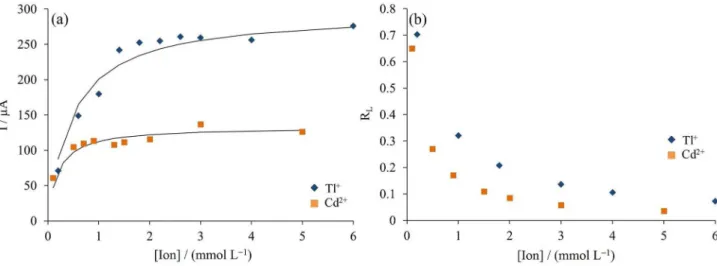
The data were adjusted to the Langmuir and Freundlich models, and we can observe that these are better adjusted to the Langmuir model (Figures 7a and 8). The values of Langmuir and Freundlich constants were calculated, and the results, presented in Table 2, illustrate that the data are better adjusted to the Langmuir model, according to the correlation coefficients for different temperatures. This
indicates that probably the adsorption is carried out by forming a monolayer of metal. It is noted that kL increases
with increases in temperature. These values obtained with MCPE are the same order as those reported in the literature for accumulation of Cd2+ in Eichhornia crassipes, which
were obtained from batch processes.8
The essential characteristics of the Langmuir isotherm parameters can be used to predict the affinity between the sorbate and sorbent using the separation factor or dimensionless equilibrium parameter, RL, expressed as in
the following equation:30
(13)
where kL is the Langmuir constant and C0 is the initial
concentration of Tl+ or Cd2+. The value of the separation
parameter RL provides important information about the
nature of adsorption: if RL = 0 is irreversible; if 0 < RL < 1
is favorable; if RL = 1 is linear; and if RL > 1 is unfavorable.
Figure 7b shows the values of RL for Tl+ and Cd2+ at different
concentrations. The values of the dimensionless parameter RL calculated for studied ions are between 0 and 1, which
indicates that the adsorption of Tl+ and Cd2+ in the roots
of Eichhornia crassipes is favorable at all concentrations
studied.
On the other hand, n calculated per Freundlich model
increases from 2.67 to 3.98 for Tl+ and from 2.38 to 6.05
for Cd2+ in the range of temperatures studied, where n
indicates the intensity of the adsorption. If the value of n is less than 1, it is considered poor adsorption; if the value found is between 1 and 2, the adsorption is moderately difficult; and if it is between 2 and 10, adsorption is considered good.31
Based on our results, therefore, the adsorption of both ions is considered good at the three temperatures studied, which coincides with the results obtained with RL
parameter; in addition, according to the n values, increase in temperature increases the adsorption intensity.
As shown in Table 2, the association constants, kL, and
n values calculated are greater for Cd2+ than for Tl+ at each
of the studied temperatures, indicating that the interactions between the divalent ion and the functional groups root are more intense compared to those of the monovalent ion. The probable cause for this is that Cd2+ has a greater
electronegativity value (1.7) than Tl+ (1.62). Although Cd2+
interacts more strongly with the active sites of the root, Imax
is greater for Tl+; for example, at 308 K, I
max is 295.83 µA,
while for Cd2+, it is 133.24 µA (Figure 7a). This result may
be due to the hydrated ion radius, as mentioned earlier: the radius of Cd2+ is 5 Å, and the radius of the Tl+ is 3.3 Å, that
is why Tl+ has easier access to the active sites of the roots
and interacts with them in greater quantities.
It has been reported that for the adsorption of Ag+
and Cd2+ in various biomaterials, such as Chlorella
vulgaris, Scenedesmus quadricauda,32Aspergillus niger,
Mucor rouxii,33 and Sphaerotilus natans,34 the monovalent
ion is adsorbed in greater quantities compared to the divalent ion, which coincides with the results obtained in this study while using modified electrodes. According to the results obtained in this work, Tl+ is adsorbed in greater
amounts than Cd2+; therefore, Eichhornia crassipes can be
considered an effective adsorbent for removal of Tl+ ions
from aqueous solutions.
Thermodynamic study
The thermodynamic study provides information on the nature of the adsorption process. The parameters to determine are the changes in the Gibbs energy (∆G°), in
enthalpy (∆H°), and in entropy (∆S°). The change in ∆G°
indicates the spontaneity of a chemical reaction. Reactions occur spontaneously if ∆G° at a given temperature is
negative. The change in Gibbs free energy is given by equation 14:
∆G° = –RTlnk
L (14)
Figure 8. Langmuir pseudo-isotherms plots for biosorption of (a) Tl+; and (b) Cd2+ on Eichhornia crassipes roots at three different temperatures (2.0 mmol L−1 concentration).
Table 2. Langmuir (kL) and Freundlich (kF) constants obtained at different temperatures for adsorption of Tl+ and Cd2+ on Eichhornia crassipes roots
Ion Temperature / K Langmuir Freundlich
kL / (L mmol−1) Imax / µA R2 kF / µA n R2
Tl+
303 1.00 295.35 0.988 137.60 2.67 0.913
308 2.11 295.83 0.998 170.60 2.95 0.802
313 3.13 292.60 0.996 195.96 3.98 0.674
Cd2+
303 3.34 132.18 0.991 91.02 2.38 0.717
308 5.40 133.24 0.993 104.96 5.07 0.848
313 7.65 135.30 0.998 112.99 6.05 0.779
where R is the universal gas constant and T is the absolute temperature, in Kelvin. The equilibrium constant, kL,
obtained from the Langmuir model, can be expressed in terms of the change in enthalpy of adsorption and in entropy, as a function of temperature. kL and the relationship
between temperature is given by the Van’t Hoff equation:35
(15)
∆H° and ∆S° can be determined from the slope and intercept of the graph of lnkLvs. 1/T (Figure 9).
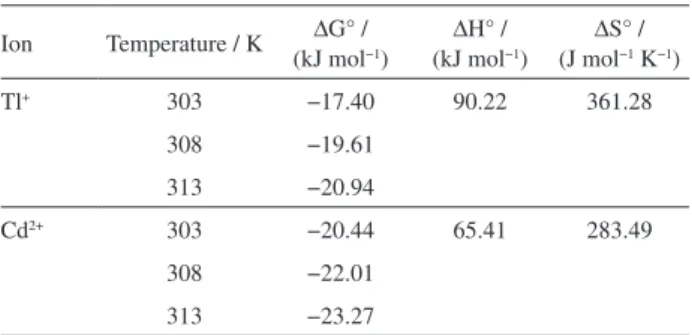
The thermodynamic parameters obtained are shown in Table 3. The negative values of ∆G° indicate that
the adsorption process of Tl+ and Cd2+ ions on the
Eichhornia crassipes roots was spontaneous.
The ∆H° calculated is 90.22 and 65.41 kJ mol−1 for Tl+
and Cd2+, respectively. The positive values indicate that the
process is endothermic; so the adsorption is improved with increasing temperature.
Additionally, the magnitude of ∆H°gives information
on the type of biosorption, which can be physical or chemical. ∆H° ranging from 2.1-20.9 kJ mol−1 corresponds
to physisorption, and ranges from 20.9 to 418.4 kJ mol−1,
a chemisorption.36 In our study, calculated ∆H° value of
Tl+ and Cd2+ ions fell into the range of chemisorption,
although for Tl+ at 303 and 308 K, the value is close to
the physisorption. Based on this result, the biosorption processes of Tl+ and Cd2+ ions onto Eichhornia crassipes
roots probably occurred via chemisorption.
By the intercept of the graph of Figure 9, the ∆S° was
obtained with a value of 361.28 and 283.49 J mol−1 K−1 for
Tl+ and Cd2+, respectively. The positive ∆S° values suggest
an increased randomness in the solution-solid interface
during the adsorption process. This occurs as a result of redistribution of energy among the metal ions and the biomass. Before the adsorption, metal ions that are found near the surface of the adsorbent are more ordered than when the ions have been adsorbed. When ions are adsorbed, water molecules that were previously bound to the metal ions are released and dispersed in the solution, increasing the disorder of the system; this is the result of the increase in the entropy change.35
Conclusions
The results showed the following differences between the adsorption processes of monovalent and divalent ions in Eichhornia crassipes roots: first, the kinetic constants
showed that Tl+ adsorbs faster than Cd2+, both following
a pseudo-second order kinetics; second, biosorption equilibrium data were better described by the Langmuir model and showed that the monovalent ion was adsorbed in greater amounts on the Eichhornia crassipes roots
at all temperatures used during the study; and third, the thermodynamic parameters indicate that, according to the negative ∆G° values and the positive ∆H° values,
the biosorption process of Tl+ and Cd2+ was spontaneous
and endothermic. Additionally, the results showed that the adsorption is dependent on pH, indicating that the ions probably are accumulated in acid sites. Kinetic, equilibrium, and thermodynamic study indicated that both monovalent and divalent ions are accumulated in biomass by a similar mechanism and in the same acid sites. However, stoichiometric reaction is different for monovalent (1:2) and divalent (1:1); as a consequence, a major quantity of monovalent ion can be accumulated in biomass.
Based on the results of the present work,
Eichhornia crassipes is an effective alternative for the
removal of Tl+ ions from an aqueous medium. According
to literature, the trend in the kinetic and equilibrium adsorption of Cd2+ ions obtained from batch processes
Table 3. Thermodynamic parameters obtained for the adsorption process of Tl+ and Cd2+ on Eichhornia crassipes roots
Ion Temperature / K (kJ mol∆G° / −1) (kJ mol∆H° / −1) (J mol∆S° / −1 K−1)
Tl+ 303 −17.40 90.22 361.28
308 −19.61
313 −20.94
Cd2+ 303 −20.44 65.41 283.49
308 −22.01
313 −23.27
∆G°: Gibbs energy; ∆H°: enthalpy; ∆S°: entropy.
is similar to that obtained in this study using MCPEs; therefore, the use of MCPEs is an excellent choice for studying the biosorption processes of different metal ions.
Acknowledgments
The authors thank SEP-CONACYT (2009-133456) for their financial support. C. Martínez-Sánchez is also grateful for the CONACYT scholarship 328265/229789.
References
1. Barakat, M. A.; Arabian J. Chem. 2011, 4, 361.
2. Zhang, F.; Wang, X.; Yin, D.; Peng, B.; Tan, C.; Liu, Y.; Tan, X.; Wu, S.; J. Environ. Manage. 2015, 153, 68.
3. Galván-Arzate, S.; Santamaría, A.; Toxicol. Lett. 1998, 9, 1.
4. John-Peter, A. L.; Viraraghavam, T.; Environ. Int. 2005, 31, 493. 5. Khairy, M.; El-Safty, S. A.; Shenashen, M. A.; TrAC, Trends
Anal. Chem. 2014, 62, 56.
6. Mudhoo, A.; Garg, V. K.; Wang, S.; Environ. Chem. Lett. 2012, 10, 109.
7. Sanmuga-Priya, E.; Senthamil-Selvan, P.; Arabian J. Chem., in press, DOI: 10.1016/j.arabjc.2014.03.002.
8. Murithi, G.; Onindo, C. O.; Wambu, E. W.; Muthakia, G. K.;
BioResources 2014, 9, 3613.
9. Amboga-Anzeze, D.; Mmari-Onyari, J.; Mwanza-Shiundu, P.; Gichuki, J. W.; IOSR J. Appl. Chem. 2014, 7, 29.
10. Ibrahim, H. S.; Ammar, N. S.; Soylak, M.; Ibrahim, M.;
Spectrochim. Acta, Part A 2012, 96, 413.
11. Módenes, A. N.; Espinoza-Quiñones, F. R.; Borba, C. E.; Trigueros, D. E. G.; Lavarda, F. L.; Abugderah, M. M.; Kroumov, A. D.; Water Sci. Technol. 2011, 64, 1857.
12. Mahamadi, C.; Nharingo, T.; Bioresour. Technol. 2010, 101, 859.
13. Módenes, A. N.; Espinoza-Quiñones, F. R.; Trigueros, D. E. G.; Lavarda, F. L.; Colombo, A.; Mora, N. D.; Chem. Eng. J. (Amsterdam, Neth.) 2011, 168, 44.
14. Zolgharnein, J.; Asanjarani, N.; Mousavi, S. N.; Clean: Soil, Air, Water 2011, 39, 250.
15. Zolgharnein, J.; Asanjarani, N.; Shariatmanesh, T.; Toxicol. Environ. Chem. 2011, 93, 207.
16. John-Peter, A. L.; Viraraghavan, T.; Bioresour. Technol. 2008, 99, 618.
17. Khavidaki, H. D.; Aghaie, H.; Clean: Soil, Air, Water 2013, 41, 673.
18. Martínez-Sánches, C.; Torres-Rodríguez, L. M.; García-de la Cruz, R. F.; Av. Cienc. Ing. 2013, 4, 1.
19. Martínez-Sánchez, C.; Torres-Rodríguez, L. M.; Velázquez-Jiménez, L. H.; Sustaita-Martínez, J. I.; García-de la Cruz, R. F.; Electroanalysis 2012, 24, 1121.
20. Leyva, R.; Díaz, P. E.; Guerrero, R. M.; Mendoza, J.; Aragon, A.;
Rev. Soc. Quim. Mex. 2004, 48, 196.
21. Kalcher, K.; Kauffmann, J. M.; Wang, J.; Svancara, I.; Vytras, K.; Neuhold, C.; Yang, Z.; Electroanalysis 1995, 7, 5. 22. Miretzky, P.; Muñoz, C.; Carrillo-Chavéz, A.; Bioresour.
Technol. 2010, 101, 2637.
23. Babalola, J. O.; Overah, L. C.; Adesola, B.; Vincent, O. O.; Olatunde, A.; J. Appl. Sci. Environ. Manage. 2011, 15, 607. 24. Ho, Y. S.; Mckay, G.; Water Res. 2000, 34, 735.
25. Shroff, K. A.; Vaidya, V. K.; Chem. Eng. J. (Amsterdam, Neth.)
2011, 171, 1234.
26. Ho, Y. S.; Huang, C. T.; Huang, H. W.; Process Biochem. (Oxford, U. K.) 2002, 37, 1421.
27. Wu, F.-C.; Tseng, R.-L.; Huang, S.-C.; Juang, R.-S.; Chem. Eng. J. (Amsterdam, Neth.) 2009, 151, 1.
28. Martínez, C.; Torres, L. M.; Quim. Nova 2013, 36, 1227. 29. Subbaiah, M. V.; Yuvaraja, G.; Vijaya, Y.; Krishnaiah, A.;
J. Taiwan Inst. Chem. Eng. 2011, 42, 965.
30. Hall, K. R.; Eagleton, L. C.; Acrivos, A.; Vermeulen, T.; Ind. Eng. Chem. Fundam. 1966, 5, 212.
31. Hamdaoui, O.; Naffrechoux, E.; J. Hazard. Mater. 2007, 147,
401.
32. Harris, P. O.; Ramelow, G. J.; Environ. Sci. Technol.1990, 24,
220.
33. Mullen, M. D.; Wolf, D. C.; Beveridge, T. J.; Bailey, G. W.; Soil Biol. Biochem. 1992, 24, 129.
34. Lodi, A.; Solisio, C.; del Borghi, M.; Bioprocess Biosyst. Eng.
1998, 19, 197.
35. Shaker, M. A.; Am. J. Appl. Sci. 2007, 4, 605.
36. Aryal, M.; Liakopoulou-Kyriakides, M.; Colloids Surf., A 2011,
387, 43.
Submitted: January 20, 2016