INTRODUCTION
According to Marmel (2008), there are two kinds of tasks in a project: one oriented by resources and one that is not oriented by resources. Resource-oriented tasks are those in which the addition or subtraction of resources directly affects the length or the quality of the task. On the other hand, tasks that are not oriented by resources have special characteristics that cause their length not to depend on addi-tion or subtracaddi-tion of resources.
Concerning the mentioned types of tasks, one of the ways to improve the development performance of a subsystem or component of a product is to add resources, when these are completely or partially comprised of resource-oriented tasks.
Even when adding resources results in the improvement of the performance, the amount is always a limiting factor for any project, thus it is necessary to identify the sources of LQHI¿FLHQF\DQGWRWDNHLQLWLDWLYHVWRPD[LPL]HWKHHI¿FDF\ concerning the use of resources. Aiming at managing this situation, one of the tools to operate such variables is the performance evaluation that enables the manager to identify
which aspects of a project need to be improved.
,QWKHSDVWGHFDGHVWKHLQFUHDVHGFRPSOH[LW\RIRUJDQL-]DWLRQDOFRQWH[WVUHVXOWHGLQWKHLQFUHPHQWRIWKHQXPEHURI variables to be taken into account during the performance HYDOXDWLRQSURFHVV7KHUHIRUHPDQ\VWXGLHVLQWKLV¿HOGEHJDQ to search for methods that would enable the simultaneous evaluation of multiple criteria, thus using the multi-criteria GHFLVLRQDLGLQJ0&'$7KHVWXGLHVE\%RUWROX]]Let al. (2011; 2010), Gallon et al. (2011), Nascimento et al. (2011), Ensslin et al. DQG'XWUDDUHH[DPSOHV
,QWKLVFRQWH[WWKLVVWXG\DLPHGDWLQYHVWLJDWLQJWKHDSSOLFD-WLRQRIWKHIROORZLQJPHWKRGV3UHIHUHQFH5DQNLQJ2UJDQL]DWLRQ Method for Enrichment Evaluations – Group Decision Support System (PROMETHEE GDSS) (Macharis et al., 1998) and Graphical Analysis for Interactive Assistance (GAIA) (Hayes et al., 2009) to evaluate the performance in the subsystems GHYHORSPHQWRIFRPSOH[SURGXFWV
In this study, a group decision-making method was chosen to use, due to the need for the team members to participate in WKHDFWLRQV7KHVHDFWLRQVDLPHGDWPLQLPL]LQJWKHFULWLFDOLW\ RIWKHVXEV\VWHPVLGHQWL¿HGE\WKHPHWKRGZKRVHUHVXOWVDUH PRUHHDVLO\UHFRJQL]HGZLWKWKHDGRSWLRQRIDQDSSURDFKWKDW FDQPD[LPL]HWKHSDUWLFLSDWLRQRIWKHWHDPPHPEHUVDQGWKDW incorporates their values and preferences.
Performance Evaluation with PROMETHEE GDSS and GAIA:
A Study on the ITA-SAT Satellite Project
Tiago José Menezes Gonçalves*, Mischel Carmen Neyra Belderrain ,QVWLWXWR7HFQROyJLFRGH$HURQiXWLFD±6mR-RVpGRV&DPSRV63±%UD]LO
Abstract: The increased complexity of organizational contexts in the end of the 20th century and beginning of the 21st century has resulted in the increment of the variables number to be considered during a performance evaluation. Therefore, many professionals began to search methods that would enable the simultaneous analysis of multiple crite-ria. Thus, this paper has investigated the application of a multicriteria approach to evaluate the performance in the development of subsystems during the development of complex products, by using the PROMETHEE GDSS and the GAIA methods. To achieve this objective, a study on the ITA-SAT satellite project was performed, in which a perception analysis of the members of the project regarding the development of each subsystem was carried out. Once these perceptions were captured, the proposed approach was used to identify subsystems with less satisfactory performances. Finally, the results were analyzed and brought to discussion at a meeting with managers and project members with a feedback to the conclusions of this study.
Keywords: PROMETHEE GDSS, GAIA, ITA-SAT Satellite.
Received: 01/08/11 Accepted: 01/06/12 *author for correspondence: [email protected]
THEORETICAL BASIS
MCDA
Most decision-related problems consist of issues involv-ing contradictory multiple criteria, which represent one of the characteristics of a problem approached by MCDA. Since there is rarely one action that can simultaneously present the best performance in the considered criteria, the MCDA can EHGH¿QHGDVDQHIIRUWWRVROYHWKHGLOHPPDRIFRQÀLFWLQJ criteria (Zeleny, 1982).
It involves a set of methods that can be found in literature with different names, such as: Multi-Attribute Decision Making (MADM), Criteria Decision Making (MCDM), Multi-Objective Decision Making (MODM) or Multiple Multi-Objective Decision Aiding (MODA) (Gomes and Gomes, 2001).
According to Roy (1996), MCDA can be used to face four kinds of decision-related issues, as follows:
W\SHĮVHOHFWLRQSUREOHPV±3ĮVHOHFWVWKHEHVWDFWLRQ among the ones being taken into account;
W\SHȕFODVVL¿FDWLRQSUREOHPV±3ȕVHSDUDWHVHDFKDFWLRQ into classes, according to the performance;
W\SHȖRUGHUSUREOHPV±3ȖRUGHUVWKHFRQVLGHUHGDFWLRQV according to the performance;
W\SHıGHVFULSWLRQSUREOHPV±3ıEHWWHUXQGHUVWDQGVWKH problem by describing it.
1H[W ZH SUHVHQW WKH WKHRUHWLFDO EDVLV FRQFHUQLQJ WKH methods PROMETHEE GDSS (Macharis et al., 1998) and GAIA (Hayes et al., 2009), which were used in this study.
PROMETHEE GDSS
The PROMETHEE GDSS belongs to the outranking methods, also understood as subordination, prevalence, or outranking. Such methods aim at building an outranking rela-tion to represent the preferences of the decision-makers and to VROYHWKHRUGHUSUREOHPV3Ȗ
According to Le Téno and Mareschal (1998), the basic principle of outranking methods is that if one action performs better than another in most of the criteria and it does not pres-HQWZRUVHSHUIRUPDQFHLQWKHRWKHUVWKHQWKH¿UVWDFWLRQZLOO be the chosen one. Besides, these methods consider that small GLIIHUHQFHVLQWKHHYDOXDWLRQVGRQRWDOZD\VKDYHDVLJQL¿FDQW impact on the decision-maker (Vincke, 1992).
According to Silva et al. (2010), one of the advantages of the PROMETHEE method (I, II, III, IV, V, VI, and GDSS)
is how each criterion is assessed by the preference functions. This leads to a more reliable understanding of perception differences among the decision-makers at evaluating each action, and it also does not allow an unlimited compensation of major advantages between the actions.
For Brans and Mareschal (2005), two kinds of informa-tion are necessary to use the PROMETHEE method: between criteria and within each criterion.
Information between criteria is comprised of the weight assigned to each of them. According to Macharis et al. (2004), with the PROMETHEE method, it is assumed that decision-makers are capable of properly evaluating the criteria weights without using any additional methods when the number of criteria is not high, in a way that the sum of weights is equal to one.
However, information within each criterion refers to the preference functions related to each criterion and its parameters (Chart 1), in which “q” represents the threshold of indifference, “s” represents the threshold of strict preference, and “ı” represents a value between “q” and “s” (Brans and Mareschal, 2005).
7KXVDIWHUGH¿QLQJWKHZHLJKWVDQGFKRRVLQJWKHSUHIHU-ence functions for each criterion (as well as the parameters), the calculation of deviation modules dk (ai, aj) between judg-ments fk(ai) and fk(aj) for each pair of actions “ai” and “aj” wee performed, according to each considered criterion “k” and to the equation: dk (ai, aj) = fk(ai) – fk(aj). The results of such equa-WLRQDUHWKHLQSXWVIRUWKHSUHIHUHQFHIXQFWLRQV%HK]DGLDQ et al.DQGWKH\DUHFRQVLGHUHGHTXDOWR]HURZKHQGk<0. $FFRUGLQJWR%HK]DGLDQet al. (2010), for each value result-ing from dk (ai, aj), a preference function is used that translates the difference between the evaluations obtained by two actions “ai” and “aj” over a criterion k in a value of pk(dk), which ranges IURP]HURWRRQH7KHYDOXHVUHVXOWLQJIURPWKHSUHIHUHQFHIXQF-tions are called intensities of preference, and they are the basis WRFDOFXODWHWKHSUHIHUHQFHLQGH[ZKLFKUHSUHVHQWVWKHLQWHQVLW\ with which an action “ai” is preferred over an “aj”, considering WKHZHLJKWȦk of each criterion “k” for the “n´FULWHULDDQDO\]HG
Chart 1. Judgment scale.
Verbal scale Numeric scale
Very good (VG) 5
Good (G) 4
Medium (M) 3
Poor (P) 2
Very poor (VP) 1
Its calculation is performed according to Eq. 1: (1) , a a p d i j k k n k k k k 1 1 r ~ ~ = = = ^ ^ h h
/
/
$IWHUFDOFXODWLQJWKHSUHIHUHQFHLQGH[HVWKHSRVLWLYHQHJD-WLYHDQGQHWÀRZVZHUHFDOFXODWHGIRUHDFKDFWLRQ$FFRUGLQJ WR%UDQVDQG0DUHVFKDOWKHVHÀRZVZHUHFDOFXODWHG according to Eqs. 2, 3 and 4, respectively, where “ai” represents WKHDFWLRQVIRUZKLFKWKHÀRZLVEHLQJFDOFXODWHGDQG³aj” varies representing the m-1 different actions of “ai”., a m a a 1 i i k i j 1 { r = -+ = ^ ^ h h
/
(2) , a m a a 1 i i j j i 1 { r = -6! -^ ^ h h/
(3)a a a
i i i i i i
{^ h={+^ h-{-^ h (4)
$FFRUGLQJWR%HOWRQDQG6WHZDUWWKHSRVLWLYHÀRZ represents the intensity with which an action is chosen over WKHRWKHUV7KHQHJDWLYHÀRZUHSUHVHQWVWKHLQWHQWLRQZLWK which an action is overcome by others.
7KHQHWÀRZUHSUHVHQWVWKHEDODQFHEHWZHHQWKHSRVLWLYH DQGQHJDWLYHÀRZVWKHUHIRUHWKHKLJKHUWKHYDOXHRIWKHQHW ÀRZWKHEHWWHUWKHSHUIRUPDQFHRIDQDFWLRQLVFRQVLGHUHG 1LNROLüet al., 2011).
$IWHU REWDLQLQJ WKH QHW ÀRZV RI WKH DFWLRQV DFFRUGLQJ
WRHDFKGHFLVLRQPDNHUWKH¿QDORUGHUZLWK3520(7+(( GDSS can be conducted.
According to Macharis et al. (1998), in the PROMETHEE *'66 WKH QHW ÀRZV RI HDFK GHFLVLRQPDNHU DUH XVHG WR FRPSRVHDSHUIRUPDQFHPDWUL[DQGZHLJKWVDUHDVVLJQHGIRU each of them, as demonstrated in Fig. 1 for four decision-makers and seven actions.
7KXVWKHQHWÀRZRIHDFKGHFLVLRQPDNHULVXVHGWREXLOG DPDWUL[LQRUGHUWRFDOFXODWHWKH¿QDOQHWÀRZVRIHDFKDFWLRQ resulting in the group evaluation (Brans and Mareschal, 2005).
GAIA
One of the advantages to use the PROMETHEE family methods is the possibility of interpreting geometrically the results by the GAIA method (Mareschal and Brans, 1988). ,Q WKLV PHWKRG DW ¿UVW D XQLFULWHULRQ ÀRZ IRU WKH criterion “l” is calculated according to Eq. 5, where “ai” represents the action “i´IRUZKLFKWKHÀRZLVEHLQJFDOFX-lated (Hayes et al., 2009).
, ,
a
m 1 p d a a p d a a 1
l i l i j l j i
j m
1
{ =
- =
-^ h
/
" 6 ^ h@ 6 ^ h@, (5)(TXDWLRQLVWKHQXVHGWRFDOFXODWHWKHXQLFULWHULRQÀRZ PDWUL[ĭZKHUHHDFKFROXPQUHSUHVHQWVDFULWHULRQDQGHDFK row, an action.
a a a a m n n m 1 1 1 1 h g j g h { { { { U= ^ ^ ^ ^ h h h h
>
H
(6)Using the biplot method (Kohler and Luniak, 2005) in PDWUL[), the actions and criteria are projected in a plane shaped E\WKHWZR¿UVWHLJHQYHFWRUVZKLFKLVFDOOHG*$,$SODQH
In GAIA plane, actions are represented by points and criteria by vectors. Moreover, the vector of weights W(Ȧ1Ȧ2«Ȧn) in the k-dimensional space can be projected on the GAIA plane, as demonstrated in Fig. 2. The projec-tion of the weight vector on the GAIA plane is called GHFLVLRQVWLFNȕ
According to Alencar and Almeida (2010), the GAIA PHWKRG SURYLGHV JUDSKLF LQIRUPDWLRQ DERXW FRQÀLFWLQJ aspects concerning the criteria and about the impact of ZHLJKWVLQWKH¿QDOGHFLVLRQWKXVHQULFKLQJWKHYLHZRIWKH decision-makers one the issue.
Brans and Mareschal (2005) state that the analysis of the GAIA plane helps at understanding the structure of the problem: I I I I I I I I I I I I I I I I I I I I I I I I I I I I I I I I I I I I I I I I I I I I I I I I I I I I I I I I 11 12 13 14 15 16 17 21 22 23 24 25 26 27 31 32 33 34 35 36 37 41 42 43 44 45 46 47 Judgment matrix – decision-maker 1 Judgment matrix – decision-maker 2 Judgment matrix – decision-maker 3 Judgment matrix – decision-maker 4 11 12 13 14 15 16 17 21 22 23 24 25 26 27 31 32 33 34 35 36 37 41 42 43 44 45 46 47
Judgment matrix – group
Weight of decision-makers
Figure 1. Functioning of PROMETHEE GDSS. (Adapted of Brans
FULWHULDUHSUHVHQWHGE\ORQJHUYHFWRUVLQWKH*$,$SODQH indicate more variable criteria;
FULWHULDZLWKMXGJPHQWVWKDWSUHVHQWDSRVLWLYHFRUUHODWLRQ FRHI¿FLHQWDUHUHSUHVHQWHGE\YHFWRUVSRLQWLQJWRWKHVDPH GLUHFWLRQRUDSSUR[LPDWHO\WRWKHVDPHGLUHFWLRQ
FULWHULDZLWKMXGJPHQWVWKDWSUHVHQWDQHJDWLYHFRUUHODWLRQ FRHI¿FLHQWDUHUHSUHVHQWHGE\YHFWRUVLQRSSRVLWHGLUHFWLRQV FULWHULDZLWKODUJHZHLJKWVDUHUHSUHVHQWHGE\YHFWRUVZLWK
directions near to that of the decision stick;
FULWHULDWKDWDUHQRWVWDWLVWLFDOO\FRUUHODWHGDUHUHSUHVHQWHG by vectors in orthogonal directions;
VLPLODUDFWLRQVDUHUHSUHVHQWHGE\SRLQWVWKDWDUHFORVHWR one another; and
DFWLRQVWKDWVWDQGRXWIRUEHLQJJRRGDWDFHUWDLQFULWHULRQ are represented by points located in the direction of the vector concerning the criterion in question.
In order to meet the objectives of this study, this approach was applied to evaluate the development of the ITA-SAT satellite project.
ITA-SAT SATELLITE PROJECT
The ITA-SAT satellite project is part of the pluri-annual plan of “Desenvolvimento e Lançamento de Satélites Tecnológicos de Pequeno Porte”, concerning the development and launch of small technological satellites. It was created by Action number IURPWKH%UD]LOLDQ6SDFH$JHQF\$(%ZKLFKDLPVDW SHUIRUPLQJDVHULHVRIPLVVLRQVLQRUGHUWRH[SHULPHQWGHYHORS and test technological innovations of satellites and to enhance WKH%UD]LOLDQLQGXVWU\LQRUGHUWKDWLWFDQPHHWWKHIXWXUHQHHGV concerning micro and nano-satellites.
This activity involves AEB, the National Institute for Space Research (INPE), and the Technological Institute of Aeronau-tics (ITA). Other upper education institutions may be associated with the project by means of a cooperation term with ITA.
The ITA-SAT project was subdivided into stages, according to the Standards of the European Space Agency: (0) mission DQDO\VLVQHHGVLGHQWL¿FDWLRQ$IHDVLELOLW\%SUHOLPLQDU\ GH¿QLWLRQ & GHWDLOHG GH¿QLWLRQ ' TXDOL¿FDWLRQ DQG SURGXFWLRQ(XWLOL]DWLRQDQG)GLVSRVDO0RUHGHWDLOVRQ each stage can be observed in the standard ECSS-M-ST-10C of the European Space Agency (ESA) (ESA, 2009).
The ITA-SAT project began in 2009, and stages 0, A and B are concluded, with their respective revisions, Mission 'H¿QLWLRQ5HYLHZ0'53UHOLPLQDU\5HTXLUHPHQWV5HYLHZ (PRR), System Requirements Review (SRR), and Preliminary Design Review (PDR). Details may also be seen in the stan-dard ECSS-M-ST-10C of the ESA.
During the performance of this study, the ITA-SAT satellite project was facing many problems, including WKH GLI¿FXOW\ WR HVWDEOLVK D ZHOOGH¿QHG VFRSH IRU WKH project. The types of activities that should be performed were not previously known, so the scope was periodically DOWHUHGDVWKHWHDPEHFDPHPRUHH[SHULHQFHGDQGREWDLQHG more knowledge on the product that was being designed. Concerning deadlines and objectives, the pace of develop-ment in the project was different in several subsystems, and many activities were on hold because they depended on the conclusion of others, which were not concluded on time. Also, the communication and documentation of the DFWLYLWLHVZHUHQRWHI¿FLHQWLQWKHVXEV\VWHPVDQGPXFK of the knowledge that resulted from an activity was lost when a member of the team left the project. Such problems
)LJXUH ,QWHUQDO DQG H[WHUQDO FRQILJXUDWLRQ DQG GLVSRVLWLRQ RI equipment in the ITA-SAT satellite project. (Sato et al., 2011) 0
ȕ
W
GAIA plane
Figure 2. Vector of weights projected on GAIA plane. (Brans and
MXVWL¿HG WKH GHYHORSPHQW SHUIRUPDQFH HYDOXDWLRQ LQ WKH ITA-SAT satellite project in order to search for ways to improve, solve, or ease those issues.
Identi¿cation and analysis of the decision conte[t
The ITA-SAT satellite project, whose preliminary FRQ¿JXUDWLRQFDQEHVHHQLQ)LJLQYROYHVWKHGHYHORSPHQW of subsystems for attitude control (AC), on-board computer (OBC), potency (PT), thermal control (TC), structure (ST), and telecommand and telemetry (TT).
The functions of these subsystems, according to Larson and Werts (1999) apud Sato et al.DUHQH[WVKRZHG
AC
It controls the direction the satellite should be pointed at, since it is necessary that some of its instruments are pointed at DVSHFL¿FSRLQW
OBC
It controls internal communication, the satellite, and on-board data processing. Two types of data are processed by WKLVVXEV\VWHPKRXVHNHHSLQJGDWDDQGVFLHQWL¿FRQHV7KH ¿UVWRQHVDUHUHODWHGWRHOHFWULFDOWHQVLRQSRVLWLRQVWDWXVRI the active subsystems, temperature etc., which are used by the ground segment to work on the subsystems’ function. Scien-WL¿FGDWDKRZHYHUDUHFROOHFWHGE\RQERDUGLQVWUXPHQWVIRU studies, such as images and radiation measurements. Due to the different nature of the activities in subsystem OBC, we divided the subsystem into OBC – Software (OBC-S) and Hardware (OBS-H).
PT
It generates, stores, conditions, and distributes energy for the satellite subsystems.
TC
It ensures that all subsystems and components of the satel-OLWHZLOOIXQFWLRQZLWKLQWKHWHPSHUDWXUHUDQJHVGH¿QHGE\WKH project.
ST
It represents the mechanical connection between the different subsystems and components in the satellite. It should be able to sustain the efforts during launch and at the moment of uncoupling the launch vehicle, consisting of a surface on which the equipment is put together. Also, it should provide
protection against radiation, it should have a coupling interface with the launch vehicle, besides being in charge of grounding for thermal and electrical ends.
TT
,WHQDEOHVWKHLQIRUPDWLRQH[FKDQJHEHWZHHQWKHVDWHOOLWH and the ground control station. As to decision-makers, four representatives were selected among the participants of the project. The general manager considered them as those who had more knowledge on the subject.
Structuring the problem and the multicriteria model
7DNLQJ LQWR DFFRXQW WKDW ,7$6$7 FRQVLVWV RI WKH ¿UVW SURMHFWIRUWKHGHYHORSPHQWRID%UD]LOLDQXQLYHUVLW\VDWHO-lite, many traditional management methods established in literature, such as those mentioned in the Project Management Body of Knowledge (PMBOK) (PMI, 2008), were not used in this project. Therefore, no development indicators were prepared when this research was carried out.
Furthermore, the indicators used to assess each subsystem were obtained by literature analyses on management develop-ment indicators of projects. We have chosen to use the ones described in PMBOK and those by Terribili Filho (2010).
Time management
,W HYDOXDWHV WKH HI¿FDF\ RI WKH SURMHFW PDQDJHPHQW WR GH¿QH DQG FRQWLQXH DFWLYLWLHV WR HVWLPDWH WKH OHQJWK DQG necessary resources, to develop, and to control the project timetable.
Communication effectiveness
,WDQDO\]HVWKHHI¿FLHQF\RIWKHSURMHFWPDQDJHPHQWWR make sure the information is properly generated, collected, VWRUHGGLVWULEXWHGUHFRYHUHGDQGRUJDQL]HG
Risk management
,W HYDOXDWHV WKH HI¿FDF\ RI WKH SURMHFW PDQDJHPHQW FRQFHUQLQJSODQQLQJLGHQWL¿FDWLRQDQGDQDO\VLVSURFHVVHVDV well as response planning, monitoring, and risk control.
Integration management
Cost management
,W HYDOXDWHV WKH HI¿FDF\ RI WKH SURMHFW PDQDJHPHQW WR estimate, budget, and control costs in order to conclude the SURMHFWZLWKRXWH[FHHGLQJWKHEXGJHW
Quality management
,WDQDO\]HVWKHHI¿FDF\RIWKHSURMHFWPDQDJHPHQWLQRUGHU WRGH¿QHTXDOLW\SROLFLHVREMHFWLYHVDQGUHVSRQVLELOLWLHVVR that the needs for which the project was initiated could be met.
Among the mentioned criteria, we observed that since this LVWKH¿UVWSURMHFWRIDXQLYHUVLW\VDWHOOLWHLQ%UD]LOPDQ\RI the necessary technologies should be developed. This fact did not allow us to predict the aspects related to cost or to the quality of the project, since we could not tell which type of WHFKQRORJ\ZRXOGEHXVHGLQWKHSURMHFW¶V¿QDOFRQ¿JXUDWLRQ Because of that, the cost management criteria, as well as the TXDOLW\FULWHULDZHUHH[FOXGHGIURPWKHGHFLVLRQPRGHO
In this study, we tried to evaluate the performance based on the perception of the project’s team, using a judgment scale FRPSULVHGRI¿YHFDWHJRULHVDVSUHVHQWHGE\)UHLWDVet al. 7KLVVFDOHUDQJHVIURPRQHYHU\SRRUWR¿YHYHU\ good), and it is detailed in Chart 1.
In order to determine the preference functions, the ones demonstrated in Chart 2 were presented to the decision-makers, and the usual function was considered as the most adequate for the used criteria and by the decision makers in this study. During the interviews, they said that, according to the adopted scale, any difference between judgments was VLJQL¿FDQWWKHUHIRUHLWZRXOGEHWDNHQLQWRDFFRXQWIRUWKH ¿QDOUHVXOW$IWHUWKHGH¿QLWLRQRIWKHHYDOXDWLRQVFDOHDQG the preference functions, each decision-maker was asked to ponder the criteria. Besides, the general manager was asked to ponder the knowledge of each decision-maker concerning the SURMHFW7KHVHGDWDFDQEHVHHQLQ$SSHQGL[
Individual analysis
With the objective of evaluating the development performance of the project’s subsystems, individual evalu-ations with the perceptions of each decision-maker were SHUIRUPHG7KHUHIRUH DIWHU D EULHI H[SODQDWLRQ DERXW WKH PROMETHEE method, the verbal and numeric scales in Chart 1 were presented. Afterwards, every decision-maker was asked to think of an alternative that represented, in their RSLQLRQDµYHU\SRRU¶SHUIRUPDQFHLQDQDQDO\]HGFULWHULRQ Based on this hypothetical alternative, each decision-maker had to answer how much better they considered the ITA-SAT satellite project in the evaluated criterion. Many of them answered they had pictured the ITA-SAT project as a ‘very poor’ alternative, thus obtaining one in the numeric scale. In other occasions, they said the ITA-SAT project performed twice, three times or four times better than the very poor hypothetical alternative. It is important to mention that no decision-maker considered the performance of the ITA-SAT SURMHFWHTXDORU¿YHWLPHVEHWWHUWKDQWKHFRQVLGHUHGK\SR -thetical alternative. With these questions, the evaluations of the decision-makers about the performance of each subsys-WHPDUHGHPRQVWUDWHGLQ$SSHQGL[
After collecting judgments, the subsystems were individu-ally assessed with the software D-Sight (Macharis et al., 2010). 1HWÀRZVFRQFHUQLQJWKHSHUIRUPDQFHRIHDFKVXEV\VWHPIRU each decision-maker DMi (i=1,2,3,4) are demonstrated in Table 1, with the order of priority of each subsystem. It is ZRUWKWRPHQWLRQWKDWZKHQWKHQHWÀRZVZHUHWKHVDPHWKH number corresponding to the order of priority was repeated for the tied subsystems.
Each decision-maker analysis concerning the GAIA plane is presented in Chart 3. In these planes, vectors ZLWKVTXDUHGH[WUHPLWLHVUHSUHVHQWHGWKHFULWHULDWULDQJOHV represented the actions; and the vector with the circular H[WUHPLW\WKHGHFLVLRQVWLFN
7DEOH 1HWÀRZVRIHDFKVXEV\VWHPIRUHDFKGHFLVLRQPDNHU
Subsystems DM1 Order DM2 Order DM3 Order DM4 Order
Attitude Control (AC) -0.3833 6 -0.9167 7 -0.4333 3 -0.8333 4
Thermal Control (TC) 0.1667 3 0.8667 1 0.7333 1 0.5417 1
Structure (ST) -0.4833 7 -0.1167 4 -0.4333 3 -0.0833 3
OBC – Hardware (OBC-H) 0.5667 1 0.7167 2 0.7333 1 0.5417 1
OBC – Software (OBC-S) 0.0167 4 0.2167 3 0.2667 2 0.5417 1
Potency (PT) -0.1167 5 -0.5833 6 -0.4333 3 -0.8333 2
For decision-maker 1 (DM1), the analysis of the GAIA plane showed that criteria with more heterogeneous judg-ments were: integration management (IM), communication effectiveness (CE), and time management (TM). Also,
ZKHQDQDO\]LQJWKHGLUHFWLRQRIWKHYHFWRUVWKHSUHVHQFHRI FRQÀLFWVEHWZHHQULVNPDQDJHPHQWFULWHULD50&DJDLQVW
time management (TM) and communication effectiveness (CE) were observed. This means that according to DM1, the
VXEV\VWHPV WKDW SUHVHQWHG EHWWHU SHUIRUPDQFH LQ WKH ¿UVW
criterion did not have good results in the last two ones, and vice-versa.
6XFKGLVFUHSDQF\LQMXGJPHQWVZDVMXVWL¿HGE\'01 as
related to resource allocation. The subsystems have limited resources to invest in managerial aspects related to each
crite-ULRQDQGRQO\RQHVXEJURXSRXWRIWKHVHFULWHULDLVSULRULWL]HG
as to the adoption of managerial evaluations; this is why the performances differ in the subgroups.
&RQFHUQLQJGHFLVLRQPDNHUVDQGWKHVL]HRIFULWHULD YHFWRUVLQGLFDWHVWKDWWKH\SUHVHQWDSSUR[LPDWHYDULDQFHVWKXV LQÀXHQFLQJWKH¿QDORUGHULQDPRUHKRPRJHQRXVPDQQHU 0DQ\FULWHULDH[SUHVVVLPLODUSUHIHUHQFHVVRWKHYHFWRUVDUH
pointed to the right. Besides, the subsystems AC, ST and PT are always located in an opposite direction to that of the
FULWHULDYHFWRUVZKLFKVKRZVWKHUHLVFRQÀLFWRISUHIHUHQFH
(judgments of lower value) and, consequently, higher criti-cality, which can be observed in three out of the four orders
H[SRVHGLQ7DEOH
6SHFL¿FDOO\ LQ UHODWLRQ WR GHFLVLRQPDNHU YHFWRUV FRQFHUQLQJULVNPDQDJHPHQWDQGLQWHJUDWLRQSUHVHQWDSSUR[L -mate directions, as well as those referring to CE and TM,
WKXVUHÀHFWLQJPRUHVLPLODUMXGJPHQWVZKHQERWKJURXSVRI
criteria are compared.
In relation to decision-maker 3, we observed the presence of two groups of criteria with the same judgments, and those
Chart 2. Preference functions used by the PROMETHEE methods.
Criterion Preference function Graphic representation Criterion Preference function Graphic representation
Usual p (d) 0, se d 0
1, se d > 0
=) =
p(d)
d 0
1
Linear d q
s p (d)
0, se d q
q, se q d s 1, se d s
1 2 # # -= -Z [ \ ]] ]] p(d) d s q 0 1
U Form p (d) 0, se d q 1, se d2q
# =) p(d) d q 0 1 Gaussian 0
1 exp 0
p (d) 0, se d 2
d , se d
2 2 2 = v =
- c- m
* p(d) d ı 0 1
V Form p (d) d 0
0, se d q
s, se d s
1, se d s 1 2 # = = Z [ \ ]] ]] p(d) d s 0 1 Multistage 0 , , ,
1, 1 max (.)
d
d
d
s d s
1
0 1
2
1 2
p (d) 0, se d
sse
s se
s s 1
se s 2 s 1
se rj
f 1 1 1 1 # # # # # = = - - -Z [ \ ] ] ] ]] ] ] ] ]] p(d) d 2
1 s-1 s
0 1
1/s
With
levels p (d) 0, 5
0, se d q
, se q d s
1, se d s 1 2 # # =
*
p(d) d s q 0 10.5 C Form
0 , 1, d s 0 p (d)
0, se d
s d
se
referring to RM were similar to those of TM; the ones refer-ring to CE are the same as the judgments of IM. Besides, two
JURXSVRIDFWLRQVDUHVLPLODUWKH¿UVWRQHLVFRPSULVHGRI37
TT, ST and AC, and the second one is comprised of TC and OBC-H. Something similar happened in relation to the GAIA plane of decision-maker 4, with similar judgments for two criteria (RM and TM) and two groups of action with the same
MXGJPHQWVEHLQJWKH¿UVW7&2%&+DQG2%&6DQGWKH
second PT and AC.
$IWHUDQDO\]LQJGDWDIURPWKH*$,$SODQHVLWZDVREVHUYHG
that the planes by decision-makers 2, 3 and 4 are very similar. The groups of criteria observed in these planes lead to the conclusion that decision-makers 3 and 4 associated RM with TM, which also brings similarities between CE and IM.
Global analysis
After the individual evaluations, the global analysis was
SHUIRUPHGZLWK3520(7+((*'66,QWKLVVWHSQHWÀRZV
of each decision-maker presented in Table 1 were used to make
DSHUIRUPDQFHPDWUL[DVSUHVHQWHGLQ7DEOH3URFHGXUHV
of PROMETHEE II were used with data in this performance
PDWUL[ LQ RUGHU WR FDOFXODWH WKH ÀRZV RI HDFK VXEV\VWHP
resulting in the group evaluation.
It is worth to mention that subsystems AC, ST and PT were considered as the most critical ones in the global evaluation, which is in accordance with many of the results
REWDLQHGZLWKWKHLQGLYLGXDODQDO\VHV$IWHUSULRULWL]LQJWKH
VRIWZDUH '6LJKW REWDLQLQJ WKH PLQLPXP DQG PD[LPXP intervals; in between, the weight values of each decision-maker can vary without changing the priority order of the subsystems. As demonstrated in Table 3, the priority order is not even changed after 25% alterations (or more) in the pondering of the decision-makers, which makes the priority of the subsystems more acceptable for this study.
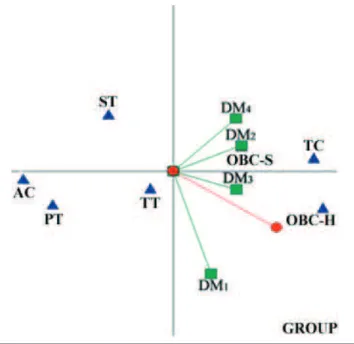
Chart 4 presents the GAIA plane of the group decision, DQGLWLVSRVVLEOHWRREVHUYHWKHUHLVDFRQÀLFWRISUHIHUHQFHV between DM1 and the others. As seen, DM1 is the same that had QHWÀRZVZLWKPDMRUGLIIHUHQFHVLQUHODWLRQWRWKHRWKHUV7KLV aspect was seen as an indication that this decision-maker knew more about the project and, consequently, his/her judgment was different from the others, since the general manager pondered it as being the most important one (according to Chart A4). :KHQDQDO\]LQJWKHFRQÀLFWSUHVHQWHGE\WKHGHFLVLRQ makers, we noticed that DM1 presented the three subsystems ST, AC and PT as those with the worst performances, while decision-makers 2 and 3 consider subsystems AC, PT and TT KDYLQJWKHZRUVWSHUIRUPDQFHV7KHH[FHSWLRQLVGHFLVLRQ maker 4, who presents (because of ties) the four subsystems previously presented (AC, ST and TT) as those with the worst performances. Such discrepancy was discussed in a workshop with the general manager, with the decision-makers, and the other members of the team. The consensus was that the
considerations of DM1 were more coherent to the reality of the project. It is important to say that the three subsystems regarded as having the worst performance by the group of decision-makers coincided with the choice of DM1.
With the objective of addressing the actions and improv-ing the performance within the subsystems that had the worst performance, a complementary analysis took place to identify ZKLFKLQGLFDWRUVZHUHPRUHGH¿FLHQW,QWKLVDQDO\VLVWKH considerations of each decision-maker in relation to each indicator and subsystem were added, as presented in Table 4. )RUH[DPSOHWRREWDLQWKHSHUIRUPDQFHLQGH[RIVXEV\VWHP AC, in relation to the criterion TM, the judgments of deci-sion-makers 1, 2, 3 and 4 in this criterion were added, and, DFFRUGLQJWR$SSHQGL[WKHUHVXOWLV
With this procedure, the priority orders to perform the improvement actions in each subsystem were obtained. The most critic situations were in subsystems AC and PT, concern-ing indicator CE, and in the subsystem ST, the indicator RM. With this result, the auditing of the indicators that presented worse performance in the subsystems was proposed to the general manager.
7DEOH3HUIRUPDQFHDQGÀRZPDWUL[IRUHDFKVXEV\VWHP
Subsystems DM1 DM2 DM3 DM4 ij Order
Attitude Control (AC) -0.3833 -0.9167 -0.4333 -0.8333 -0.713 7
Thermal Control (TC) 0.1667 0.8667 0.7333 0.5417 0.643 2
Structure (ST) -0.4833 -0.1167 -0.4333 -0.0833 -0.570 5
OBC – Hardware
(OBC - H) 0.5667 0.7167 0.7333 0.5417 0.837 1
OBC – Software
(OBC - S) 0.0167 0.2167 0.2667 0.5417 0.267 3
Potency (PT) -0.1167 -0.5833 -0.4333 -0.8333 -0.527 6
TT (TT) 0.2333 -0.1833 -0.4333 0.1250 0.063 4
Table 3. Range of variation of the weights.
Decision-makers Minimum weight (%)
Current weight (%)
0D[LPXP
weight (%)
1 12.68 38.00 100.00
2 0.00 18.00 48.10
3 0.00 26.00 100.00
4 0.00 18.00 100.00
7DEOH3ULRULWL]LQJLQGLFDWRUVZLWKLQHDFKVXEV\VWHP
Subsystems/Criteria TM CE RM IM
Attitude control (AC) 5 4 6 5
Structure (ST) 7 10 6 10
Potency (PT) 6 5 6 7
FINAL CONSIDERATIONS
This study aimed at investigating the application of PROMETHEE GDSS and GAIA methods for the perfor-mance evaluation in the subsystems of the ITA-SAT project. Based on the study, advantages were observed as to the use of such methods.
+LJKHU DGKHUHQFH RI WKH SURMHFW¶V WHDP WKH XVH RI PROMETHEE GDSS enabled the higher adherence of the team to the obtained results, due to the participation of differ-ent decision-makers, each one represdiffer-enting differdiffer-ent interests inside the project.
0RUHGHSHQGDELOLW\WRDQDO\]HMXGJPHQWVGXHWRWKHXVH of preference functions, the behavior of the values given by decision-makers in relation to different performances presented by a criterion can be shaped in a way to get better accuracy as to the characteristics, which are really valuable for the decision-makers.
*HRPHWULF LQWHUSUHWDWLRQ RI GDWD WKH *$,$ PHWKRG HQDEOHG WKH LGHQWL¿FDWLRQ RI VLPLODULWLHV DQG FRQÀLFWV RI preference between decision-makers and criteria, which can be used to check a consensus among them.
&RQFHUQLQJWKH¿UVWPHQWLRQHGDGYDQWDJHLWZDVSURYHG to be essential when the results were presented during a meeting for the other project members. Therefore, it was questioned if there was the participation of members with SRLQWVRIYLHZWKDWUHÀHFWHGWKHGLYHUVLW\RIWKHZRUNJURXSV Even though the PROMETHEE GDSS method does not restrict the number of decision-makers for the performance of judgments, their number can be limited due to the lack of accessibility of the facilitator and/or because of their PD[LPXP DELOLW\ WR FROOHFW DQG LQVHUW GDWD LQ WKH PRGHO Therefore, the general manager was asked to point out the most important decision-makers, indicating the four ones mentioned in this study.
In order to assist the general manager in facing the problems of the project, improvement actions were proposed on the subsystems and indicators that presented worse performances. Such actions consisted of creating or improv-LQJWKHPDQDJHPHQWSODQVIRUHDFKDQDO\]HGVXEV\VWHPDQG LQGLFDWRUUHGH¿QLQJWKHIUHTXHQF\ZLWKZKLFKHDFKPDQDJH -ment plan is revised and updated; updating the manage-ment plan, in order to involve the representatives of the project’s subsystems; implementing mechanisms of learned lessons; consolidating a system of periodic evaluation/auditing; developing methods to make sure each member of the team
is being instructed as to the activities to be performed, and, ¿QDOO\WRFRPHXSZLWKZD\VWRPDNHVXUHWKHPHPEHUVRI the project have feedback on their performance.
In relation to the limitations of this study, it is important to say that we did not consider the criteria CM and QM, which PLJKWKDYHLQÀXHQFHGWKHPRGHOLQRUGHUWRFKDQJHWKHSHUIRU -mance ranking of the subsystems. In this sense, it is clear that the results obtained in this study do not completely show the general performance of each subsystem, but their performance in relation to the criteria TM, CE, RM and IM. Besides, the adopted scale uses qualitative levels (concerning the following SHUIRUPDQFHV9**03DQG93ZLWKXQFOHDUGH¿QLWLRQV which possibly resulted in the imprecision of judgments.
Finally, the suggestion is that future researchers perform studies with the objective of handling the presented limitations, EHLWE\LQYHVWLJDWLQJZD\VIRUWKHGHFLVLRQPDNHUVWRGH¿QH their judgments concerning cost and quality indicators in innovation projects, be it with the construction of scale of judg-PHQWVWKDWXVHTXDOLWDWLYHOHYHOVZLWKDPRUHSUHFLVHGH¿QLWLRQ Furthermore, it is possible to investigate the use of other MCDA methods to evaluate the performance of each subsystem.
REFERENCES
Alencar, M. H. and Almeida, A. T., 2010, “A model for select-ing project team members usselect-ing multicriteria group decision making”, Pesquisa Operacional, Vol. 30, No. 1, pp. 221-36. DOI: 10.1590/S0101-74382010000100011
%HK]DGLDQ0et al., 2010, “PROMETHEE: A
comprehen-sive literature review on methodologies and applications”, European Journal of Operational Research, Vol. 200, No. 1, pp. 198-215. DOI: 10.1016/j.ejor.2009.01.021
%HK]DGLDQ0et al., 2011, “PROMETHEE Group Decision
Support System and the House of Quality”, Group Decision and Negotiation, pp. 1-17. DOI: 10.1007/s10726-011-9257-3
Belton, V. and Stewart, T. J., 2002, “Multiple criteria deci-sion analysis”, Ed. Kluwer Academic Publishers, United Kingdom, 372 p.
%RUWROX]]L 6 &et al., 2011, “Avaliação de desempenho
%RUWROX]]L6&et al., 2010, “Avaliação de desempenho dos aspectos tangíveis e intangíveis da área de mercado: Estudo de caso em uma média empresa industrial”, Revista Brasileira de Gestão de Negócios, Vol. 12, No. 37, pp. 435-46.
Brans, J. P. and Mareschal, B., 1994, “The PROMCALC & GAIA decision support system for multicriteria decision aid”, Decision Support Systems, Vol. 12, pp. 297-310. DOI: 10.1016/0167-9236(94)90048-5
Ensslin, L. et al., 2010, “Avaliação do desempenho de
empre-VDVWHUFHLUL]DGDVFRPRXVRGDPHWRGRORJLDPXOWLFULWpULRGH
apoio à decisão – construtivista”, Pesquisa Operacional, Vol. 30, No. 1, pp. 125-52.
ESA – European Space Agency, 2009, “ECSS-M-ST-10C – Space project management: Project planning and Imple-mentation”, Retrieved in 2012 Feb. 7, from http://www.ecss. nl/forums/ecss/_templates/default.htm?target=http://www. ecss.nl/.
Dutra, A., 2008, “Sistema de Avaliação de Desempenho das Secretarias de Desenvolvimento Regional do Governo do Estado de Santa Catarina: Resultados Preliminares da Aplicação de um Modelo Construtivista”, Proceedings of the Encontro de Administração Pública e Governança, Vol. 1, Salvador, Brasil, pp. 1-16.
Freitas, A. L. P. et al., 2009, “Emprego de uma abordagem
PXOWLFULWpULRSDUDFODVVL¿FDomRGRGHVHPSHQKRGH,QVWLWXLo}HV
de Ensino Superior”, Ensaio: Avaliação de Políticas Públicas em Educação, Vol. 17, No. 65, pp. 655-74. DOI: 10.1590/ S0104-40362009000400006
Gallon, A. V. et al.³$YDOLDomRGHGHVHPSHQKRRUJDQL]D -cional em incubadoras de empresas por meio da metodologia multicritério de apoio à decisão construtivista (MCDA-C): a
H[SHULrQFLDGRPLGLWHFQROyJLFR´5HYLVWDGH$GPLQLVWUDomRH
Inovação, Vol. 8, No. 1, pp. 37-63.
Gomes, C. F. S. and Gomes, L. F. A. M., 2001, “A função de decisão multicritério – Parte I: Dos conceitos básicos à modelagem multicritério”, Revista do Mestrado em Administ-ração e Desenvolvimento Empresarial, Vol. 2, No. 3, Retrieved in 2012 Feb. 7, from http://www.estacio.br/revistamade/03/.
Hayes, Q. et al.³1HZ*$,$9LVXDOL]DWLRQ0HWKRGV´ Proceedings of the 13th International Conference Information Visualisation, Vol. 1, Barcelona, pp. 247-51. DOI: 10.1109/ IV.2009.15
Kohler, U. and Luniak, M., 2005, “Data inspection using biplot”, The Stata Journal, v. 5, n. 2, pp. 208-223.
/DUVRQ:-DQG:HUW]-5³6SDFH0LVVLRQ$QDO\VLV
and Design”, 3. ed., Ed. Microcosm, Pennsylvania State University, United States, 969 p.
Le Téno, J. F. and Mareschal, B., 1998, “An interval version of PROMETHEE for the comparison of building products’
GHVLJQZLWKLOOGH¿QHGGDWDRQHQYLURQPHQWDOTXDOLW\´(XUR -pean Journal of Operations Research, Vol. 109, pp. 522-529. DOI: 10.1016/S0377-2217(98)00074-5
Macharis, C. et al., 2010, “PROMETHEE in a multi actors setting: the use of the multi actor multi criteria analysis (MAMCA) methodology with D-SIGHT”, Proceedings of the OR52 Conference, London, England.
Macharis, C. et al., 1998, “The GDSS PROMETHEE procedure: a PROMETHEE-GAIA based procedure for group decision support”, Journal of Decision Systems, Vol. 7, pp. 283-307.
Macharis, C. et al., 2004, “PROMETHEE and AHP: The design of operational synergies in multicriteria analysis – Strengthening PROMETHEE with ideas of AHP”, European Journal of Operational Research, Vol. 153, pp. 307-317. DOI: 10.1016/S0377-2217(03)00153-X
Mareschal, B. and Brans, J. P., 1988, “Geometrical representa-tions for MCDA”, European Journal of Operational Research, Vol. 34, pp. 69-77. DOI: 10.1016/0377-2217(88)90456-0
0DUPHO(³0LFURVRIW2I¿FH3URMHFW$%tEOLD´
Ed. Alta Books, Rio de Janeiro, Brasil, 960 p.
Nascimento, S. et al., 2011, “Mapeamento dos indicadores de
GHVHPSHQKRRUJDQL]DFLRQDOHPSHVTXLVDVGDiUHDGH$GPLQ
-LVWUDomR&LrQFLDV&RQWiEHLVH7XULVPRQRSHUtRGRGHD
1LNROLü'et al., 2011, “Multi-criteria analysis of soil pollu-tion by heavy metals in the vicinity of the Copper Smelting Plant in Bor (Serbia)”, Vol. 76, No. 4, pp. 625-641. DOI: 10.2298/JSC100823054
PMI – Project Management Institute, 2008, “PMBOK – A Guide to the Project Management Body of Knowledge”, Ed. Project Management Institute, Pennsylvania, United States.
3RGYH]NR9DQG3RGYLH]NR$³'HSHQGHQFHRIPXOWL
criteria evaluation result on choice of preference functions and their parameters”, Technological and Economic Develop-ment of Economy, Vol. 16, No. 1, pp. 143-158. DOI: 10.3846/ tede.2010.09
Roy, B., 1996, “Multicriteria methodology for decision aiding”, Ed. Kluwer Academic Publishers, London, England, 292 p.
Sato, L. H. S. et al., 2009, “ITASAT – Desenvolvimento de um computador de bordo tolerante a falhas com comunicação padrão
&'66´3URFHHGLQJVRIWKH%UD]LOLDQ6\PSRVLXPRQ$HURVSDFH
Engineering & Applications, São José dos Campos, Brasil.
Sato, L. H. S. et al., 2011, “ITASAT-1: uma proposta de continuidade do sistema brasileiro de coleta de dados ambi-entais”, In Proceedings of the XV Simpósio Brasileiro de Sensoriamento Remoto, Curitiba, Brasil.
Silva, V. B. S., et al., 2010, “A multicriteria group decision
PRGHO WR VXSSRUW ZDWHUVKHG FRPPLWWHHV LQ %UD]LO´ :DWHU
Resource Management, Vol. 24, No. 14, p. 4075-91. DOI: 10.1007/s11269-010-9648-2
Terribili Filho, A., 2010, “Indicadores de gerenciamento de projetos: Monitoração contínua”, Ed. M. Books, São Paulo, Brasil, 136 p.
9LQFNH30XOWLFULWHULDGHFLVLRQDLG(G:LOH\%UX[ -elas, Bélgica, 154 p.
Zeleny, M., 1982, Multiple criteria decision making, Ed.McGraw Hill, Nova York, United States, 1982. 563 p.
Appendi[ Judgments and weights of the decision-maNers
Chart A1: Decision-maker 1
Criteria TM CE RM IM
Attitude Control (AC) 2 1 3 2
Thermal Control (TC) 4 4 1 2
Structure (ST) 2 2 1 4
OBC – Hardware (OBC-H) 3 4 3 4
OBC – Software (OBC-S) 3 2 2 4
Potency (PT) 2 2 3 3
TT (TT) 3 4 2 3
Chart A2: Decision-maker 2
Criteria TM CE RM IM
Attitude Control (AC) 1 1 1 1
Thermal Control (TC) 4 4 3 4
Structure (ST) 2 3 2 2
OBC – Hardware (OBC-H) 3 4 4 4
OBC – Software (OBC-S) 3 3 2 2
Potency (PT) 2 1 1 2
TT (TT) 2 2 3 3
Chart A3: Decision-maker 3
Criteria TM CE RM IM
Attitude Control (AC) 1 1 1 1
Thermal Control (TC) 2 2 2 2
Structure (ST) 1 1 1 1
OBC – Hardware (OBC-H) 2 2 2 2
OBC – Software (OBC-S) 2 1 2 1
Potency (PT) 1 1 1 1
TT (TT) 1 1 1 1
Chart A4: Decision-maker 4
Criteria TM CE RM IM
Attitude Control (AC) 1 1 1 1
Thermal Control (TC) 3 4 3 4
Structure (ST) 2 4 2 3
OBC – Hardware (OBC-H) 3 4 3 4
OBC – Software (OBC-S) 3 4 3 4
Potency (PT) 1 1 1 1
TT (TT) 3 3 3 3
Chart A5: Weights of criteria and decision-makers
Decision
maker TM CE RM IM
Weights of decision makers
DM1 0.30 0.30 0.30 0.10 0.38
DM2 0.40 0.40 0.10 0.10 0.18
DM3 0.20 0.30 0.40 0.10 0.26