Short Report
S
Printed in Brazil - ©2015 Sociedade Brasileira de Química 0103 - 5053 $6.00+0.00*e-mail: [email protected]; [email protected]
Synthesis of Alkylseleno-Carbohydrates and Evaluation of their Antioxidant Properties
Jaqueline P. Vargas,a Lucimar M. Pinto,b Lucielli Savegnago*,b and Diogo S. Lüdtke*,a
aInstituto de Química, Universidade Federal do Rio Grande do Sul (UFRGS),
Av. Bento Gonçalves 9500, 91501-970 Porto Alegre-RS, Brazil
bGrupo de Pesquisa em Neurobiotecnologia (GPN), CDTec, Universidade Federal de Pelotas
(UFPel), 96160-000 Pelotas-RS, Brazil
In the present study, we describe the synthesis of alkylseleno carbohydrates with different sugar scaffolds and the evaluation of their antioxidant activity profile. A compound possessing a C8 alkyl chain presented the best results in the free radical scavenging activity.
Keywords: organoselenium,organochalcogens, antioxidant, selenocarbohydrates
Introduction
The chemistry and biology of simple small molecules containing selenium in their structures has received increased attention over the past decades. The first of such compounds to be developed was ebselen and after the discovery of its properties,1,2 a number of different small molecules containing selenium have been synthesized.3-8 The great deal of attention that has been paid to these compounds stems from the discovery of a selenium atom at the catalytic site of glutathione peroxidase (GPx).9,10 GPx is a key enzyme present in mammals with antioxidant activity and its mechanism of action involves the reduction of H2O2 at the expense of the oxidation of glutathione.11,12 A number of studies have been reported in the literature describing that small organic selenium compounds can effectively scavenge and eliminate reactive oxygen species (ROS) thus mimicking the activity of GPx enzyme.13-16 ROS are commonly generated in normal cellular oxygen metabolism playing important biological roles.17 However, an increase in the ROS production over cellular endogenous antioxidant system capacity of response could result in a condition characterized as oxidative stress (OS), which causes damage to cells leading to age related degenerative diseases, cancer and a wide range of different human diseases.18,19 A simple and effective way of preventing these conditions is by inhibition of the oxidative damage and, therefore, there is a great interest in the search for new organoselenides which could represent good pharmacological alternatives
to counteract oxidative stress. In this context, our groups have been interested in the synthesis and biological properties of selenium-containing carbohydrates and as a result, we have developed a straightforward approach for the introduction of an organoselenium moiety at non-anomeric positions of sugars.20-22 Most of our efforts have been focused on the synthesis of arylselenium derivatives of carbohydrates and of diselenides, which were used as building blocks for the synthesis of more complex non-glycosidically linked selenium-linked pseudodisaccharides and neoglycopeptides.23 In addition, previous studies of our group demonstrated that arylseleno-furanosides and a carbohydrate-derived diselenide did not inhibited
δ-aminolevulinate dehydratase (δ-ALA-D), demonstrating low toxicity and antioxidant effects.21 More recently, we demonstrated that arylseleno-furanoside therapy was effective in restoring δ-ALA-D activity from ovary that was inhibited by cadmium24 and arylseleno- and aryltelluro-xylofuranosides attenuate manganese-induced toxicity in Caenorhabditis elegans.25
In view of the above, herein we report additional studies on this area, more specifically on the synthesis of seleno-carbohydrates possessing an alkylselenium moiety and the evaluation of their in vitro antioxidant profile.
Results and Discussion
Chemistry
furanoside derivatives 2 and 3, readily available from the parent carbohydrates D-xylose and D-ribose, respectively, and a pyranoside substrate, derived from D-galactose (Figure 1).
The tosylates 2-4 reacted with a selenium nucleophile, generated by reductive cleavage of the corresponding
dialkyldiselenide with NaBH4, to yield seleno-carbohydrates
5-7 (Table 1). The reaction was performed using a 3:1 mixture of tetrahydrofurane (THF) and ethanol as solvents. The tosylate displacement reaction with furanoside derivatives 2 and 3 was easier than with the pyranoside derivative 4, which took longer reaction times to afford
O TsO HO O O Me Me 2 O O O O O TsO Me Me Me Me 4 O TsO O O OMe Me Me 3
Figure 1. Sugar tosylates 2-4.
Table 1. Synthesis of alkyl-Se-carbohydrates
O TsO
2-4
n OPG THF/EtOH (3:1) reflux
(alkylSe)2,NaBH4 alkylSe O
5-7
n OPG
entry Tosylate Product time / h Yield / %a
1 O TsO HO O O Me Me 2 O C8H17Se
HO O O Me Me 5a 24 65 2 O TsO HO O O Me Me 2 O C10H21Se
HO O O Me Me 5b 24 53 3 O TsO O O OMe Me Me 3 O O O OMe Me Me 6a C8H17Se
24 66 4 O TsO O O OMe Me Me 3 O O O OMe Me Me 6b C10H21Se
24 60 5 O O O O O TsO Me Me Me Me 4 O O O O O C8H17Se
Me Me Me Me 7a 72 51 6 O O O O O TsO Me Me Me Me 4 O O O O O C10H21Se
Me Me Me Me 7b 72 50
reasonable yields of the corresponding products. The reason for this behavior is the opposing influence of the fixed dipole caused by the presence of the axial C−O bond at the C-4, combined with the steric hindrance imposed by the acetonide protecting group that hinders the backside approach of the selenium nucleophile at C-6.26,27
Deprotection of the acetonide, followed by acetal formation at the anomeric position with MeOH, under acidic conditions delivered the desired seleno-furanosides
8a-b, 9a-b, and 10a-b (Scheme 1).
Antioxidant activity
Previous data have demonstrated that the biological activity of organoselenium compounds is significantly dependent of the substitution pattern of the molecule and subtle structural variations can lead to significant differences in the biological profile.28-30 With this in mind, we screened
selected selenocarbohydrates for their in vitro antioxidant activity. We first screened the new alkylseleno carbohydrate in the 2,2-diphenyl-1-picrylhydrazyl (DPPH), 2,2’-azino-bis(3-ethylbenzothiazoline-6-sulphonic acid) (ABTS), ferric ion reducing antioxidant power (FRAP) assays. As can be seen in Table 2, xylo-pyranoside 8a presented ABTS and DPPH radical scavenging at concentration of 50 and 500 µM, respectively. Compound 8a possessed potent inhibitory activity against ABTS radical with IC50 value of 210 µM. In addition, compound 8a exhibited ferric-reducing ability, and the ferric-reducing power was improved by increasing its concentration. Comparing the values of the DPPH, ABTS and FRAP assays, we can suggest that the mechanism of antioxidant action of compound 8a is most likely based on single electron transfer.
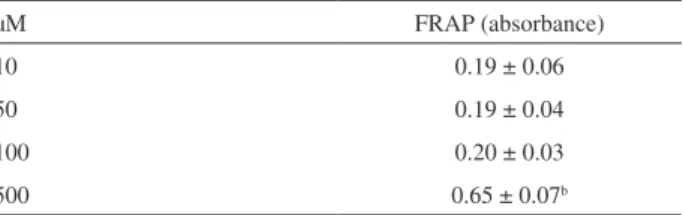
On the other hand, compound 8b, possessing the longer C-10 alkyl chain and displaying a ribo-furanoside backbone,exhibited ferric-reducing ability (Table 3) but
i.CF3CO2H, H2O (50%) rt, 1 h
ii. MeOH, H+(cat) rt, 24 h
MeOH, H+(cat),reflux, 5 h O
RSe
HO
O O
Me
Me
5a-b
O
O O
O O RSe
Me Me
Me
Me
7a-b
O
O O
OMe
Me Me
6a-b
RSe
O RSe
8a:R = C
8H17,95%
8b:R = C10H21,95%
HO
OH OMe
O
HO OH
OMe
9a:R = C8H17,80% 9b:R = C
10H21,80% RSe
O RSe
i.CF3CO2H, H2O (50%) rt, 1 h
ii. MeOH, H+(cat) rt, 24h
OH
OH HO
OMe
10a:R = C
8H17,95%
10b:R = C
10H21,95%
Scheme 1. Synthesis of deprotected seleno-carbohydrates.
Table 2. Antioxidant activity of compound 8a on ABTS, DPPH and FRAP assaysa
µM Scavenging ABTS / % µM Scavenging DPPH / % µM FRAP (absorbance)
10 2.27 ± 1.79 10 0.03 ± 0.05 10 0.19 ± 0.04
50 13.60 ± 1.57c 50 0.26 ± 0.45 50 0.22 ± 0.03
100 25.99 ± 1.61c 100 0.13 ± 0.22 100 0.26 ± 0.02
500 81.69 ± 0.90c 500 5.49 ± 3.40b 500 0.57 ± 0.08c
IC50 210 − − − −
aDenote p < 0.05; bp < 0.01; cp < 0.001 as compared to the respective control sample (one way ANOVA/Newman-Keuls). IC
50: concentration (µM) providing
didn’t show significant results in both DPPH and ABTS assays (data not shown).
The galactose-derived compounds 10a-b were also evaluated. Galacto-pyranoside 10a presented ABTS scavenging at concentration of 500 µM (Table 4) but didn’t show significant result in both assays DPPH and FRAP (data not shown). On the other hand, results presented in Table 5 indicated that galacto-pyranoside derivative 10b
presented ABTS scavenging at concentrations 50-500 µM and exhibited ferric-reducing ability (at 500 µM). However, it didn’t exhibit any protection against DPPH radical at any concentration tested (data not shown).
Compounds 5b and 9b were also evaluated against ABTS, DPPH and FRAP assays but didn’t show any significant antioxidant effects. In addition to the ABTS, DPPH and FRAP studies, compounds 5b, 8a, 8b, 9b,
10a and 10b had their superoxide dismutase (SOD)-like, nitric oxide31 and hydroxyl radical32 scavenging activities evaluated (data not shown) and none of them displayed
significant activity, therefore ruling out these mechanisms as being responsible for their antioxidant profile.
Inspection of all the results gathered revealed that seleno-xylofuranoside 8a, containing an alkyl group with eight carbon atoms, showed the highest antioxidant activity when compared with the closely related compound 8b
(with an alkyl group with ten carbon atoms) and seleno-galactopyranoside 10b, which possesses a C-8 alkyl chain. Direct comparison between 8a and the acetonide-protected compounds 5a-b revealed that the presence of the acetonide moiety has a deleterious effect for the antioxidant activity, since 5 did not exhibit antioxidant activity, suggesting that the increased water-solubility of 8a when compared to 5a
might play a role on its antioxidant profile.
Conclusions
Herein we have reported a straightforward synthesis of simple alkylseleno carbohydrates with different sugar scaffolds. Screening of selected compounds for antioxidant activity revealed that the presence of an alkyl group with eight carbon atoms has an important influence in the free radical scavenging activity of these compounds and therefore they can potentially prevent damage of protein and lipids.
Experimental
General procedure for the synthesis of 5-7
Under an argon atmosphere, sodium borohydride (2.5 equiv) was added to a solution of the dialkyldiselenide (1.0 mmol) in THF (7.5 mL). Ethanol (2.5 mL) was then added dropwise and the clear solution formed was stirred at room temperature for 10 min. After this time, a solution of the appropriate tosylate (1.5 mmol in 1 mL THF) was added dropwise. After stirring under reflux for the time indicated in Table 1, the reaction mixture was quenched with aqueous saturated NH4Cl (10 mL) and extracted with CH2Cl2 (3 × 25 mL). The combined organic layers were dried with MgSO4, filtered and concentrated. The crude product was purified by flash chromatography, first eluting with hexanes and then with a mixture of hexanes/ethyl acetate.
Analytical data for compound 5a: yield 65%; white solid; purified using hexane:EtOAc 80:20; [α]D20 = −54 (c 1.0, AcOEt); m.p. 62 °C; IR (film) νmax/cm−
1 3398, 2922, 1372, 1217, 1089, 1014, 817; 1H NMR (300 MHz, CDCl
3)
δ 5.93 (d, 1H, J 3.7 Hz, CH), 4.53 (d, 1H, J 3,7 Hz, CH), 4.34 (ddd, 1H, J 9.0, 5.3, 2.5 Hz, CH), 4.27 (dd, 1H, J 5.3, 2.5 Hz, CH), 2.82 (dq, 2H, J 12.0, 7.3 Hz, CH2), 2.69-2.60 (m, 2H, CH2), 1.72-1.62 (m, 2H, CH2), 1.50 (s, 3H, CH3),
Table 5. Antioxidant activity of compound 10b on ABTS and FRAP assaysa
µM Scavenging ABTS / % µM FRAP (absorbance)
10 3.04 ± 4.10 10 0.20 ± 0.04
50 12.47 ± 3.74 50 0.20 ± 0.03
100 24.90 ± 5.81c 100 0.23 ± 0.06
500 21.01 ± 7.87b 500 0.54 ± 0.07c
aDenote p < 0.05; bp < 0.01; cp < 0.001 as compared to the respective
control sample (one way ANOVA/Newman-Keuls).
Table 4. Antioxidant activity of compound 10a on ABTS assaya
µM Scavenging ABTS / %
10 3.47 ± 0.47
50 4.24 ± 3.93
100 7.64 ± 4.90
500 31.77 ± 19.26b
aDenote p < 0.05; bp < 0.01 as compared to the respective control sample
(one way ANOVA/Newman-Keuls).
Table 3. Antioxidant activity of compound 8b on FRAP assaya
µM FRAP (absorbance)
10 0.19 ± 0.06
50 0.19 ± 0.04
100 0.20 ± 0.03
500 0.65 ± 0.07b
aDenote p < 0.05; bp < 0.01 as compared to the respective control sample
1.43-1.27 (m, 10H, 5 × CH2), 1.31 (s, 3H, CH3), 0.88 (t, 3H, J 6.7 Hz, CH3);
13C NMR (75 MHz, CDCl
3) δ 111.5, 104.7, 85.0, 80.1, 75.0, 31.7, 30.5, 29.7, 29.0, 28.9, 26.6, 26.0, 24.9, 22.5, 19.9, 13.9; HRMS-ESI m/z calcd. for C16H30O4Se + Na+: 389.1202; found: 389.1206.
General procedure for the synthesis of 8 and 10
In a round bottomed flask, the appropriate selenocarbohydrate (0.5 mmol) was stirred in an aqueous solution of trifluoracetic acid (50% v/v, 10 mL) for 1 h at room temperature. After this time, the reaction mixture was concentrated in vacuum, co-evaporated with toluene (3 × 10 mL) and the residue dissolved in MeOH (10 mL), in the presence of a catalytic amount of sulfuric acid, and stirred for additional 24 h, at room temperature. Following this time, the mixture was neutralized by the addition of solid sodium bicarbonate. The mixture was filtered and the solvents evaporated to afford the product.
Analytical data for compound 8a:yield 95%; yellow oil; mixture of anomers (1.0:0.66); IR (film) νmax/cm−1 3421, 2925, 1456, 1208, 1112, 1024; 1H NMR (300 MHz, CDCl
3)
δ 4.99 (d, 0.46H, J 4.5 Hz, CHβ), 4.85 (s, 0.7H, CHα), 4.51 (ddd, 0.7H, J 7.9, 6.9, 4.1 Hz, CH), 4.36 (ddd, 0.46H, J 7.4, 6.5, 5.1 Hz, CH), 4.24 (dd, 0.7H, J 4.5, 3.7 Hz, CH), 4.20 (s, 0.7H, CH), 4.13 (dd, 0.46H, J 4.1, 3.5 Hz, CH), 4.07 (d, 0.46H, J 4.6 Hz, CH), 3.49 (s, 1.38H, CH3α) 3.38 (s, 2.1H,
CH3β), 2.82 (m, 4H, 2 × CH2), 2.64 (m, 4H, 2 × CH2), 1.67 (m, 4H, 2 × CH2), 1.30 (m, 20H, 2 × 5 × CH2), 0.88 (t, 6H, J 6.8 Hz, 2 × CH3);
13C NMR (75 MHz, CDCl
3) δ 108.5, 101.7, 83.5, 79.6, 78.6, 78.5, 77.0, 76.2, 55.8, 55.1, 31.7, 30.6, 30.5, 29.87, 29.82, 29.12, 29.10, 29.06, 29.03, 24.91, 24.87, 22.65, 22.56, 21.9, 14.0.
Acknowledgements
This work was supported by CNPq, CAPES and FAPERGS. L. S. and D. S. L. are recipients of CNPq research fellowships. J. P. V. acknowledges CAPES for a PhD fellowship.
Supplementary Information
Supplementary information (full experimental procedures, analytical data and copies of NMR spectra) is available free of charge at http://jbcs.sbq.org.br as PDF file.
References
1. Müller, A.; Cadenas, E.; Graf, P.; Sies, H.; Biochem. Pharmacol.
1984, 33, 3235.
2. Wendel, A.; Fausel, M.; Safayhi, H.; Tiegs, G.; Otter, R.;
Biochem. Pharmacol. 1984, 33, 3241.
3. Nogueira, C. W.; Rocha, J. B. T.; Organoselenium and Organotellurium Compounds: Toxicology and Pharmacology.
In Patai’s Chemistry of Functional Groups; John Wiley & Sons,
2011.
4. Mugesh, G.; du Mont, W. W.; Sies, H.; Chem. Rev. 2001, 101, 2125.
5. Nogueira, C. W.; Zeni, G.; Rocha, J. B. T.; Chem. Rev. 2004,
104, 6255.
6. Alberto, E. E.; Nascimento, V.; Braga, A. L.; J. Braz. Chem. Soc. 2010, 21, 2032.
7. Nogueira, C. W.; Rocha, J. B. T.; J. Braz. Chem. Soc. 2010, 21, 2055.
8. Rocha, J. B. T.; Saraiva, R. A.; Garcia, S. C.; Gravina, F. S.; Nogueira, C. W.; Toxicol. Res. 2012, 1, 85.
9. Rotruck, J. T.; Pope, A. L.; Ganther, H. E.; Swanson, A. B.; Hafeman, D. G.; Hoekstra, W. G.; Science1973, 179, 588. 10. Flohé, L.; Günzler, W. A.; Schock, H. H.; FEBS Lett.1973, 32,
132.
11. Alwi, S. S.; Cavell, B. E.; Donlevy, A.; Packham, G.; Cell Stress Chaperones2012, 17, 529.
12. Rayman, M. P.; Lancet2000, 356, 233.
13. Meotti, F. C.; Stangherlin, E. C.; Zeni, G.; Nogueira, C. W.; Rocha, J. B. T.; Environ. Res.2004, 94, 276.
14. Nogueira, C. W.; Rocha, J. B. T.; Arch. Toxicol. 2011, 85, 1313. 15. Gerzson, M. F.; Victoria, F. N.; Radatz, C. S.; de Gomes,
M. G.; Boeira, S. P.; Jacob, R. G.; Alves, D.; Jesse, C. R.; Savegnago, L.; Pharmacol., Biochem. Behav.2012, 102, 21. 16. Victoria, F. N.; Martinez, D. M.; Castro, M.; Casaril, A. M.;
Alves, D.; Lenardão, E. J.; Salles, H. D.; Schneider, P. H.; Savegnago, L.; Chem.-Biol. Interact. 2013, 205, 100. 17. Halliwell, B.; Gutteridge, J. M. C.; Free Radicals in Biology
and Medicine, 4th ed.; Oxford University Press, Oxford, 2007. 18. Rahal, A.; Kumar, A.; Singh, V.; Yadav, B.; Tiwari, R.;
Chakraborty, S.; Dhama, K.; BioMed Res. Int.2014, in press, DOI: 10.1155/2014/761264.
19. Brawek, B.; Loffer, M.; Wagner, K.; Huppertz, H. J.; Wendling, A. S.; Weyebrock, A.; Jackish, R.; Feuerstein, T. J.; Brain Res. Bull.2010, 81, 484.
20. Braga, A. L.; Severo-Filho, W. A.; Schwab, R. S.; Rodrigues, O. E. D.; Dornelles, L.; Braga, H. C.; Lüdtke, D. S.; Tetrahedron Lett. 2009, 50, 3005.
21. Braga, H. C.; Stefani, H. A.; Paixão, M. W.; Santos, F. W.; Lüdtke, D. S.; Tetrahedron 2010, 66, 3441.
22. Braga, H. C.; Wouters, A. D.; Zerillo, F. B.; Lüdtke, D. S.;
Carbohydr. Res. 2010, 345, 2328.
23. Affeldt, R. F.; Braga, H. C.; Baldassari, L. L.; Lüdtke, D. S.;
Tetrahedron 2012, 68, 10470.
Leivas, F. G.; Santos, F. W.; J. Appl. Toxicol. 2013, 33, 679. 25. Wollenhaupt, S.; Soares, A. T.; Salgueiro, W. G.; Noremberg, S.;
Bohrer, D.; Gubert, P.; Soares, F. A.; Affeldt, R. F.; Lüdtke, D. S.; Santos, F. W.; Denardin, C. C.; Aschner, M.; Avila, D. S.;
Food Chem. Toxicol. 2014, 64, 192.
26. Richardson, A. C.; Carbohydr. Res.1969, 10, 395.
27. Hough, L.; Richardson, A. C. In Biological Compounds; Barton, D.; Ollis, W. D.; Haslam, E., eds.; Pergamon Press: Oxford, 1979, vol. 5, ch. 26.1.
28. Prigol, M.; Wilhelm, E. A.; Schneider, C. C.; Nogueira, C. W.;
Chem.-Biol. Interact.2008, 176, 129.
29. Sabir, S. M.; Salman, S. M.; Rocha, J. B. T.; Environ. Toxicol.
Pharmacol.2012, 34, 446.
30. Acker, C. I.; Luchese, C.; Prigol, M.; Nogueira, C. W.; Neurosci. Lett.2009, 455, 168.
31. Feelisch, M.; Schmidt, H. H.; Hofmann, H.; Schindler, U.; Shutenko, Z. S.; Cunningham, D. D.; Proc. Natl. Acad. Sci. U. S. A.1996, 93, 14492.
32. Yoshikawa, T.; Naito, Y.; Masui, K.; Fujii, T.; Boku, Y.; Nakagawa, S.; Yoshida, N.; Kondo, M.; Biomed. Pharmacother.
1997, 51, 328.
Submitted: October 23, 2014
Published online: February 6, 2015