Article
J. Braz. Chem. Soc., Vol. 26, No. 4, 676-686, 2015. Printed in Brazil - ©2015 Sociedade Brasileira de Química 0103 - 5053 $6.00+0.00
A
*e-mail: [email protected]; [email protected]
Application of Headspace Solid-Phase Microextraction and Gas
Chromatography-Mass Spectrometry (HS-SPME-GC/MS) on the Evaluation of Degradation Efficiency of
Phenolic Compounds and Identification of By-Products from Produced Water
Cesar A. Silva and Luiz A. S. Madureira*
Universidade Federal de Santa Catarina, Departamento de Química, Campus Universitário Trindade, 88040-900 Florianópolis-SC, Brazil
Application of the headspace solid-phase microextraction and gas chromatography-mass spectrometry (HS-SPME-GC/MS) technique as an analytical tool to monitoring the degradation of phenolic compounds and the formation of by-products in produced water by UV photolysis and UV/peroxide is proposed. All of the experimental conditions for the degradation tests were carried out according to the response of the surface modeling methods developed. The direct photolysis and the UV/H2O2 processes were capable to degrade more than 99% of the initial concentrations
of total phenolic components of produced water. The main by-product found was 2,6-di-tert-butylbenzoquinone (DBQ). The presence of DBQ and other hydroxy compounds, constituting the major fraction of by-products identiied, demonstrates that the degradations are initiated by the oxidation of the aromatic phenolic ring generating quinones, diphenols, benzoic acids and phenones.
Keywords:SPME, phenols, produced water, by-products, photodegradation
Introduction
Produced water is co-produced during recovery of natural gas and crude oil from onshore and offshore operations. This water is considered the largest volume of waste stream in the exploration and production process of oil and gas. During oil exploration, water from the reservoir containing petroleum is pumped to the surface. It is usually reinjected into wells to enhance oil recovery. However, with continuous pumping, the ratio of produced water increases signiicantly, and part of the water has to be discharged into the sea, rivers, other water bodies and surrounding soils.1 Global produced water production is estimated to
be around 250 million barrels per day to around 80 million barrels per day of oil. As a result, more than 40% of it is discharged into the environment.2 Due to the increasing
volume of waste all over the world in the current decade, the outcome and effect of discharging produced water on the environment has lately become a signiicant issue of environmental concern.3
Produced water is a complex mixture containing in its natural composition dispersed oil and dissolved organic compounds, including aromatic hydrocarbons, organic acids, phenols, inorganic compounds as well as traces
of chemicals added in the production/separation steps. Studies on the evaluation of the acute and chronic toxicity of produced water have evidenced that the aromatic hydrocarbons and the alkylated phenols are the most important contributors to the toxicity.4,5 In this context, the
decision on selecting appropriate treatment technologies capable of achieving a desired end use quality for this effluent has become a challenge to oil refineries and petroleum industries.
The growing demand for detoxiication of polluted waters has led, in the last few decades, to the development of new and more effective technologies. Alternative technologies like oxidative processes can be successfully applied to a broad spectrum of organic compounds. Among these, advanced oxidation processes (AOP’s) are innovative environmental remediation technologies that are gaining importance for degradation of a great variety of organic pollutants.6-8
problems minimizing time consumption and common errors associated with extraction eficiency and sample manipulation. This solvent-free technique is simple, rapid, relatively inexpensive, and compatible with analytical separation techniques such as GC and HPLC.
Recently, works applying the hyphenation of SPME with GC/MS have been used in degradation studies of environmental organic pollutants, proving to be a very suitable analytical technique.10,11 The present study
describes the application of SPME as an analytical tool to monitoring the degradation of phenolic compounds and by-products in produced water exposed to direct UV and UV/peroxide photolysis. For this purpose all experimental conditions involving the degradation tests were performed according to response surface modeling methods.
Experimental
Chemicals and standard solutions
Photolysis experiments were performed initially with phenol (99.5% pure) obtained from Sigma-Aldrich (St. Louis, USA). Stock solutions were prepared in deionized water and kept at 4 °C in the absence of light. Hydrogen peroxide was purchased by Merck (Darmstadt, Germany). The produced water samples were kindly supplied by TRANSPETRO located at Santa Catarina State in Brazil and kept stored at 4 °C (pH < 2) until analysis.
P h e n o l , o- c r e s o l , p- c r e s o l , o- e t h y l p h e n o l (o-EtP), p-ethylphenol (p-EtP), 2,6-dimethylphenol ( 2 , 6 - D M P ) , 3 , 4 - d i m e t h y l p h e n o l ( 3 , 4 - D M P ) , 1-naphthol, 2,3,5-trimethylphenol (2,3,5,-TMP) and 2,3,5,6-tetramethylphenol (2,3,5,6-TeMP) were supplied by Accustandard Inc. (New Haven, USA). Pentachlorophenol (PeCP) and 2,4,6-trichlorophenol (2,4,6-TCP) were purchased from Sigma-Aldrich (St. Louis, USA). Acetic anhydride and potassium carbonate obtained from Carlo Erba (Milan, Italy) were used as derivatizing reagents previous to SPME analysis.
Photolysis experiments
The photodegradation studies were carried out in a thermostated reactor containing 200 mL of wastewater (25 ± 1 °C). The photoreactor system consists of a 500 mL cylindrical glass body with a 13 W germicidal low pressure mercury vapor lamp (UV-C at 253.7 nm) surrounded with quartz jacket. The mixture inside the reactor was magnetically stirred. The irst set of the experiments were carried out with phenol solution (50 mg L-1) to obtain
optimum conditions by multivariate experimental design.
A second set of experiments was performed using produced water samples. Initial pH was adjusted with solution of NaOH or HCl 0.1 mol L-1. The progress of the phenol
degradation was monitored by emission fluorescence spectra recorded using a Perkin Elmer LS-50 model spectroluorimeter (Waltham, USA). In order to obtain emission spectra of the undissociated form of phenol, luorescence was measured in buffer solution (HCl/KCl 0.2 mol L-1, pH 2) using excitation wavelength of 270 nm
and the emission band recorded at λ
max = 300 nm.
Sample preparation and analysis by HS-SPME-GC/MS
An aliquot of 10 mL of water containing phenol was placed into a 22 mL vial. About 4.0 g of sodium chloride and the derivatizing reagents potassium carbonate (0.4 g) and acetic anhydride (100 µL) were successively added and the vial immediately sealed. Before headspace extraction the test solution was previously heated (45 ºC) and stirred for 5 min to achieve equilibrium. The HS-SPME analysis of phenol solution was performed with a 75 µm CAR-PDMS iber housed in a manual Supelco SPME holder (St. Louis, USA) during 30 min under magnetic stirring. The iber, after extraction, was directly inserted into the injection port of the GC for 5 min at 270 °C (splitless mode).
The procedure described above was employed to evaluate the photodegradation processes and to identify the organic intermediates. The GC-MS analysis was performed with a Thermo Finnigan GC ultra gas chromatograph (San Jose, USA) equipped with a split/splitless injector and a DB-5MS column (30 m x 0.25 mm x 0.25 µm ilm thickness). The GC oven temperature program was: 70 °C for 5 min, heated to 120 °C at 8 °C min-1, then at 2 °C min-1
until 135 °C, and inally at 8 °C min-1 to 280 °C. Helium
was used as carrier gas (constant low of 1 mL min-1). The
ion trap mass spectrometer PolarisQ Thermo Finnigan (San Jose, USA) was operated in the electron ionization mode and full scan (50 to 450 m/z). Ion trap and transfer line temperatures were set at 200 and 250 °C, respectively.
Multivariate experimental optimization
The optimization processes involving UV photolysis and UV/H2O2 experiments were carried out according to
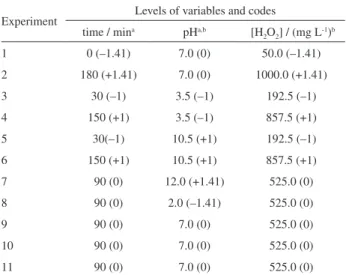
the response surface modeling methods using a central composite design (CCD). To estimate the pH effect vs. time in the removal eficiency of phenol and to select the best conditions for UV photolysis the CCD optimization was performed as shown in Table 1. For the UV/H2O2 process,
only the levels of pH and H2O2 variables to the multivariate
Results and Discussion
Analytical figures of merit
Several parameters were examined in order to optimize the method for the determination of phenols in produced water proposed herein. The main analytical igures of merit obtained were: linearity, linear correlation coeficient, limits of detection and precision. The results can be observed in Table 2.
Phenolic composition of Produced Water
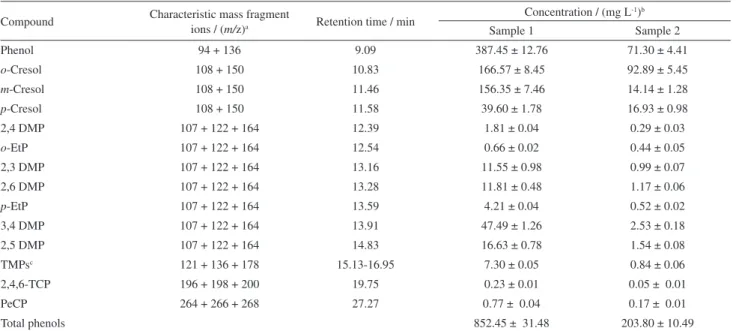
Two samples of produced water collected in different days were used to evaluate the optimum conditions established by the multivariate experiments. An important remark to be made is that in both samples the presence of a thin layer of oil and dispersed oil droplets were signiicant. These samples were taken from a settling tank, kept stored for long periods to separate oil/water. The longer is the period of storage in these tanks, the higher is the concentration of phenolic compounds partitioned from the oil into the aqueous fraction. The compounds were identiied and quantiied by HS-SPME-GC/MS technique as described in Table 3. To minimize the matrix effect and that the concentration levels of phenolic compounds in the samples it into the linear range, an appropriate dilution (500 fold) was performed. It can be noted the high levels of phenolic compounds, much more than has already been reported in the literature.3,7,12-16 So there is a demand for an
oxidative treatment in order to attain levels required for inal disposal imposed by the Brazilian National Environmental Council - CONAMA (0.5 mg L-1 for total phenols of
wastewaters).17 The direct UV photolysis experiments were
performed using Sample 1, and H2O2/UV processes were
carried out with Sample 2.
According to Neff,4 phenols in produced water are
mainly alkyl radicals containing 1-9 atoms of carbon. In this study alkyl radicals with up to four atoms of carbon were identiied, with predominance of mono, di and trialkyl phenols. The presence of chlorophenols can be considered as by-products due to chlorination process applied in some oil stations. This is a speculative hypothesis, since we had no information about treatment processes. However, it is known from the literature that during the oil and gas production, chemicals such as corrosion inhibitors, biocides and emulsion breakers are added to prevent operational problems.3
Degradation processes with synthetic aqueous solution of phenol
Preliminary degradations were performed using synthetic aqueous solution of phenol at 50.0 mg L-1
monitored by fluorescence emission spectra for 300 min. Figure 1 shows the degradation proiles of phenol solution with UV and UV/H2O2 processes. For the UV
photolysis the degradation rate is fast at the initial period of the reaction but it slows down later on (Figure 1a). In the initial period of reaction, the rate is higher because of the formation of oxidants (HO· and H2O2 possibly formed)
reacting with phenol. As the reaction goes on, a great
Table 1. Codiied levels of variables in CCD layout applied to optimize phenol degradation by UV and UV/H2O2 photolysis
Experiment Levels of variables and codes time / mina pHa,b [H
2O2] / (mg L-1)b
1 0 (–1.41) 7.0 (0) 50.0 (–1.41)
2 180 (+1.41) 7.0 (0) 1000.0 (+1.41)
3 30 (–1) 3.5 (–1) 192.5 (–1)
4 150 (+1) 3.5 (–1) 857.5 (+1)
5 30(–1) 10.5 (+1) 192.5 (–1)
6 150 (+1) 10.5 (+1) 857.5 (+1)
7 90 (0) 12.0 (+1.41) 525.0 (0)
8 90 (0) 2.0 (–1.41) 525.0 (0)
9 90 (0) 7.0 (0) 525.0 (0)
10 90 (0) 7.0 (0) 525.0 (0)
11 90 (0) 7.0 (0) 525.0 (0)
avariables applied to optimize UV photolysis; bvariables applied to
UV/H2O2 processes.
Table 2. Analytical quality parameters for HS-SPME/GC-MS analysis of phenols
Compound Correlation coeficient (r)
LOD / (µg L-1)
RSD / % (n = 5) (5.0-50.0 µg L-1)
Phenol 0.99751 0.0037 7.5-1.3
o-Cresol 0.99817 0.0034 6.4-2.0
p-Cresol 0.99805 0.0044 10.3-2.2
2,6-DMP 0.99614 0.0030 13.7-3.0
3,4-DMP 0.99717 0.0086 14.6-7.6
o-EtP 0.99871 0.0055 13.7-3.0
p-EtP 0.99756 0.0037 12.0-1.7
1-Naphtol 0.99854 0.0008 13.8-4.5
2,3,5-TMP 0.99677 0.0021 14.3-5.1
2,3,5,6-TeMP 0.99875 0.0026 12.1-7.2
2,4,6-TCP 0.99891 0.0004 9.5 -7.5
PeCP 0.99981 0.0017 10.3-8.1
Linear range: 0.1-1000 µg L-1; DMP: dimethylphenol; EtP: ethylphenol;
number of intermediate compounds generated react with available oxidants competing with phenol. It was observed that there was no signiicant alteration in the removal of phenol after 180 min, varying from 82.5% to 87.1% at the end of the experiment (300 min). Based on these results, all the experiments were restricted to 180 min. To optimize UV/H2O2 process, all the experiments were performed up
to 60 min.
Multivariate experimental design to phenol removal
UV photolysis
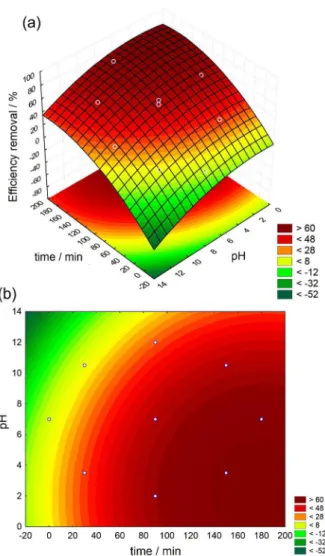
The use of three-dimensional plots of regression models are highly recommended for the graphical interpretation of the factor interactions. The response surface methodology (RSM) is a statistical modeling technique employed for multiple regression analysis. The RSM uses quantitative data obtained from properly designed experiments to solve multivariable equations being simultaneously used in several studies.18-23 The results depicted in Figures 2a
and 2b describe the response surface plot as function of time and pH for the highest eficiency removal of phenol at 180 min, as described in the irst test (Figure 1a). The eficiency removal obtained was higher in a considerable range of pH, from acidic to neutral pH values. However the contour plot (Figure 2b) shows acidic pH reaching the highest removal in a short period of time compared to the other pH values.
For direct photolysis of phenol, previous studies reported that the rates of degradation under acidic
Table 3. Characteristic mass fragments and phenolic composition of produced water samples
Compound Characteristic mass fragment
ions / (m/z)a Retention time / min
Concentration / (mg L-1)b
Sample 1 Sample 2
Phenol 94 + 136 9.09 387.45 ± 12.76 71.30 ± 4.41
o-Cresol 108 + 150 10.83 166.57 ± 8.45 92.89 ± 5.45
m-Cresol 108 + 150 11.46 156.35 ± 7.46 14.14 ± 1.28
p-Cresol 108 + 150 11.58 39.60 ± 1.78 16.93 ± 0.98
2,4 DMP 107 + 122 + 164 12.39 1.81 ± 0.04 0.29 ± 0.03
o-EtP 107 + 122 + 164 12.54 0.66 ± 0.02 0.44 ± 0.05
2,3 DMP 107 + 122 + 164 13.16 11.55 ± 0.98 0.99 ± 0.07
2,6 DMP 107 + 122 + 164 13.28 11.81 ± 0.48 1.17 ± 0.06
p-EtP 107 + 122 + 164 13.59 4.21 ± 0.04 0.52 ± 0.02
3,4 DMP 107 + 122 + 164 13.91 47.49 ± 1.26 2.53 ± 0.18
2,5 DMP 107 + 122 + 164 14.83 16.63 ± 0.78 1.54 ± 0.08
TMPsc 121 + 136 + 178 15.13-16.95 7.30 ± 0.05 0.84 ± 0.06
2,4,6-TCP 196 + 198 + 200 19.75 0.23 ± 0.01 0.05 ± 0.01
PeCP 264 + 266 + 268 27.27 0.77 ± 0.04 0.17 ± 0.01
Total phenols 852.45 ± 31.48 203.80 ± 10.49
aacetyl phenols; b(average ± uncertainty with conidence limit of 95%, n = 3); csum of all isomers.
0 20 40 60 80 100 120 140 160 180 200
0 20 40 60 80 100
time / min (a)
0 10 20 30 40 50 60
0 20 40 60 80 100
time / min
Removal / %
Removal / %
(b)
Figure 1. Degradation proile for phenol obtained by luorescence spectra. Initial conditions: (a) UV photolysis: 50.0 mg L-1 and pH 5.3 (natural pH);
(b) 50.0 mg L-1; pH 7 and 525 mg H
conditions are faster than those in alkaline conditions.24
Ionic species derived from phenol are predominant when pH exceeds 10.0 (equal to pKa value of phenol, at 25 °C) and are less susceptible to photolysis than the molecular species, which predominates when pH < pKa. Also, it has been found that the quantum yield of phenol photoxidation is pH dependent, reaching maximum at pH values < 2 and minimum at pH 11.6.25 The pH effect in the removal of
phenol is clearly observed in Figure 3, which shows that phenol degradation is faster at lower pH, reaching 87.2% in pH 2 whereas in alkaline conditions the removal eficiency drops to 54.7% (pH 12). Esplugas et al.,8 studied the effect
of pH on photolytic removal of phenol (100 mg L-1) at pH 4,
6.8 and 11.4 obtaining 24.2, 14.0 and 5.0% of removal, respectively, after 30 min of treatment.
Based on the results previously described, the experiments of direct photolysis to remove phenolic compounds were conducted at pH 2. The acidic condition is an important factor in the process of degradation of phenolic compounds in produced water to minimize the scavenger
effect of carbonate ion. At pH < 4.5, the HO· scavenging becomes negligible since all carbonate species are in the form of carbonic acid, which has a very low reactivity with HO·.26 It is also known that hydroxyl radical scavenging
role of chloride ions. Studies by Liao et al.,27 reported
the scavenger effect caused by the presence of carbonate and chloride ions versus pH in H2O2/UV process. The
authors suggested a careful pH adjustment (acidic pH) in the presence of both chloride and bicarbonate species to achieve the best response for oxidative processes.
UV/H2O2 process
To UV/H2O2 processes a multivariate experiment of
type 22 with a central composite design was employed
to establish the relationship between pH effect and H2O2
concentration (Figure 4).
Figure 2. (a) Fitted surface and (b) contour plot for removal of phenol with direct UV photolysis after 180 min of irradiation.
0 20 40 60 80 100 120 140 160 180 200
0,0 0,5 1,0 1,5
2,0 pH 2.0 pH 3.5 pH 7.0 pH 10.5 pH 12.0
-l
n
(C
/C
0
)
time / min
Figure 3. Plot of -ln(C/C0) vs. time at different pH values in the removal of phenol by UV photolysis.
Figure 4. Fitted surface response for the removal of phenol after 60 min by UV/H2O2 process.
0 20 40 60 80 100 120 140 160 180 200 0,0
0,5 1,0 1,5
2,0 pH 2.0
pH 3.5 pH 7.0 pH 10.5 pH 12.0
-l
n
(C
/C
0
)
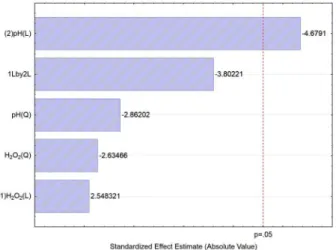
The surface response fitted showed a regression coeficient R2 (0.8642) ensures a satisfactory adjustment
of the quadratic model to the experimental data. Analysis of variance indicated signiicance only to pH linear effect (p-value <<0.05). According to the Pareto chart (Figure 5) the removal increases as pH linear effect decreases. Nevertheless as can be seen through the 3D plot, the oxidation rate was independent of pH and peroxide interaction. Within the peroxide concentration range studied there are no signiicant variations in response over a wide pH range (2-10) after 60 min of treatment. The optimal observed concentration of H2O2 required to obtain
maximum removal was around 600 mg L-1 at neutral pH.
This visual interpretation agrees with the values calculated by the model as critical values which are observed from the best response for the model. The critical values calculated were 586.5 mg H2O2 L-1 of and pH 6.2, obtaining 99.9% of
removal eficiency (experimental data: 99.2%). The H2O2
concentrations studied varied from 50 to 1000 mg L-1
resulting in a range of H2O2/phenol concentration ratios
of 1 to 20. In most degradation experiments performed using UV/H2O2, it has been found that the rate is H2O2
concentration dependent, increasing to an optimum value, beyond which an inhibitory effect takes place. At higher H2O2 concentrations, the H2O2 photolysis exercises a
competitive mechanism acting as a free-radical scavenger itself, consuming hydroxyl radicals to be recombined and regenerate H2O2. So to avoid an excess of H2O2 that
could retard the degradation, and taking into account the interaction effect of pH, we performed all the efluent oxidation process with 600 mg H2O2 L-1 at pH 7. According
to the studies reported by De Laat et al.,28 eficiencies of
UV/H2O2 processes were not affected by pH below 8,
although a decrease was observed for higher pH. The photochemical process is more eficient in alkaline media
because the concentration of the conjugate anion of hydrogen peroxide increases with pH, and this species has a higher absorption coeficient (ε
254 = 240 mol L–1 cm–1)
than H2O2, favoring light absorption and increasing HO •
production.29 However, as shown in Figure 4 at pH > 10
there is a decrease in the removal of phenol, probably due to the fast decomposition of peroxide and hydroxyl radicals at higher pH as observed by Christensen et al.30 In this
work the direct photolysis of phenol was accelerated in acidic pH. In contrast, the synergistic effect between UV radiation and the use of the oxidant H2O2 was more effective
in neutral pH as described by Alnaizy and Akgerman.31
Therefore, for the removal of the phenolic compounds from produced water the degradation process with UV/H2O2 was
performed at pH 7.
Produced water: phenolic compounds removal
Once established the optimum conditions for phenol removal, experiments were conducted using produced water samples. The removal proile of phenolic compounds during irradiation with UV (180 min) can be observed through the analysis of the chromatograms obtained by HS-SPME-GC/MS (Figure 6).
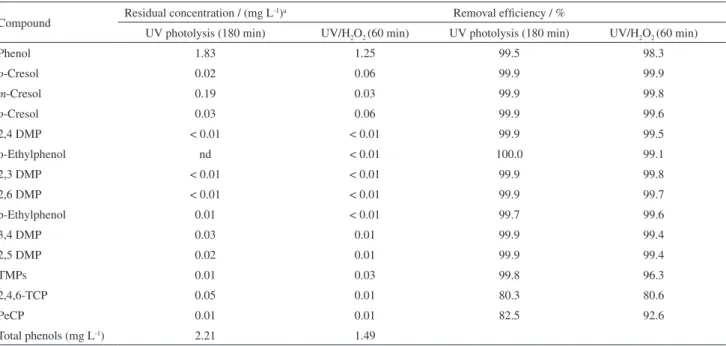
Analysis of HS-SPME-GC/MS allowed us to assess eficiently the removal of phenolic compounds, proving to be a promising analytical tool in studies to monitor photodegradation of organic pollutants. Based on these results, we observed that the UV photolysis was able to quantitatively remove the majority of the phenolic compounds, reducing 80.3% up to 99.9% of their initial concentrations after 180 min of treatment (Figure 7).
Despite lower concentrations of chlorophenols detected in the sample (Table 4), compared to the concentrations of other phenolic compounds, the degradation rate of chlorophenols are among the lowest values (80.3% for 2,4,6-TCP and 88.9% for PeCP). These results are consistent with earlier studies, which found the lower susceptibility to degradation of chlorophenols by direct UV irradiation.32,33 The lower removal is due to the fact
that the dissociated forms of chlorophenols absorb UV radiation more strongly, so for a faster and eficient removal of these compounds, direct photolysis should be conducted in alkaline conditions.32 Despite the lower removal of CPs,
an increase in their degradation rate can be proposed with an increase in radiation time. Titus et al.,33 reported several
studies showing that the degradation of different CPs are faster when decreasing the number of chlorine atoms in alkali medium at constant values of initial CP concentration, radiation intensity and temperature. In contrast, in their work they found this trend seems not to be applied in
acidic conditions, where the kinetic constant for 2,4,6-TCP degradation was higher than the one for 2,4-DCP. In our work we can observe the same trend to the acidic condition. Even with concentration three times lower than PeCP, the 2,4,6-TCP compound had a slower rate of removal.
With respect to monoalkyl and dialkylphenols, similar degradation profiles reaching almost their complete mineralization in solely 45 min (93.8-99.9%) were estimated as shown in Figure 7. The exception occurred to m-cresol and p-ethylphenol reaching 86.6 and 80.2% of removal, respectively, during the same period of treatment. The rate of phenol removal was also slow yielding only 75.1%. Some factors may be accounted to the slower removal of these compounds. Firstly we must consider
the large concentration of aromatic compounds such as benzene, toluene and other alkyl substituted benzenes present in produced water, which through oxidative processes involving hydroxyl radical can be oxidized generating phenols and other substituted phenolic isomers. A second consideration should be made regarding the decomposition process of phenol by direct photolysis. The absorption of UV light at 254 nm leads to the generation of phenoxyl radical caused by the formation of an excited state of phenol with subsequent deprotonation. The phenoxyl radical can exist as ortho-carbon, para-carbon or resonant structures with oxygen-centered as described by Alapi and Dombi34 and depicted in Scheme 1. Although the formation
of ortho, meta and para-cresols as intermediate products from UV photolysis of phenol in produced water has not been widely discussed in the literature, the kinetic proile of degradation described in Figure 7 suggests that can also happen concomitantly a pathway production of substituted phenols by methyl or other alkyl radicals from aromatic and aliphatic hydrocarbons found in large amounts in these samples. As observed through removal proile obtained to m-cresol and p-ethylphenol, the degradation rate was similar to phenol degradation during the initial 30 min, even with concentrations of about 2 up to 100 times smaller than initial concentration of phenol. This fact supports our hypothesis that simultaneous to the phenol degradation, an increase in the concentration of some alkyl phenols occur coming from the attack by methyl/alkyl radicals making the degradation of these compounds more slowly. This apparent slow degradation rate could then be attributed to a possible formation of alkyl phenols from the resonance structure as depicted in Scheme 1.
Figure 6. Chromatograms of phenolic compounds in produced water exposed to UV photolysis. DMP: dimethylphenol; EtP: ethyl phenol; TMP: trimethylphenol; TCP: triclorophenol; PeCP: pentachlorophenol.
0 20 40 60 80 100 120 140 160 180 200
0 20 40 60 80 100
time / min
Efficienc
y
re
m
o
v
a
l
/
%
phenol o-cresol m-cresol p-cresol (2,4 DMP) o-ethylphenol (2,3 DMP) (2,6 DMP) p-ethylphenol (3,4 DMP) (2,5 DMP) TMPs 2,4,6-TCP PeCP
Figure 7. Proile showing removal of phenolic compounds during the treatment of produced water by UV photolysis. DMP: Dimethylphenol; EtP: ethyl phenol; TMP: trimethylphenol; TCP: thriclorophenol; PeCP: pentachlorophenol.
0 20 40 60 80 100 120 140 160 180 200 0
20 40 60 80 100
time / min
Efficienc
y
re
m
o
v
a
l
/
%
Based on the results described in Table 4 we can afirm that the oxidative process via direct photolysis is an eficient process for the removal of phenolic compounds in produced water. Despite the high concentrations determined, the process was eficient in removing 99.7% of the phenolic compounds studied. The total concentration of residual phenolic compounds (2.2 mg L-1) reached
values close to those permitted by CONAMA 430 for total phenols (0.5 mg L-1).17 These are outstanding results
when compared to those obtained by testing a synthetic solution using phenol as model compound. Although the samples had concentrations much higher than the test solution (50 mg L-1), this process showed very satisfactory
results. A plausible explanation for this eficiency can be attributed to the presence of salts and metal hydroxides that could act synergistically as catalysts increasing the rate of degradation of phenolic compounds in produced water. Another important aspect to be considered is the high content of dissolved organic matter (DOM) present in produced water. It is well known that DOM acts as an important agent photosensitizer increasing photoreactivity of many organic compounds by the indirect formation of highly reactive species like radicals.35 Future studies will
be conducted to understand the effects of these constituents in the process of photolysis.
UV/peroxide degradation process of phenolic compounds found in the produced water monitored by HS-SPME-GC/MS showed removal eficiency > 90% for most studied compounds already within the irst 15 min of degradation (Figure 8). Similarly in the UV photolysis, the 2,4,6-TCP also showed lower degradation rate by UV/peroxide (80.6%). Although the sample subjected to degradation by UV/peroxide contains a much lower concentration of phenols, the results obtained by the two methods were very similar, differing only in the kinetics of the reaction for the process of UV/H2O2, proved to be
Table 4. Residual concentration and removal eficiency of phenolic compounds obtained by the degradation processes
Compound Residual concentration / (mg L
-1)a Removal eficiency / %
UV photolysis (180 min) UV/H2O2 (60 min) UV photolysis (180 min) UV/H2O2 (60 min)
Phenol 1.83 1.25 99.5 98.3
o-Cresol 0.02 0.06 99.9 99.9
m-Cresol 0.19 0.03 99.9 99.8
p-Cresol 0.03 0.06 99.9 99.6
2,4 DMP < 0.01 < 0.01 99.9 99.5
o-Ethylphenol nd < 0.01 100.0 99.1
2,3 DMP < 0.01 < 0.01 99.9 99.8
2,6 DMP < 0.01 < 0.01 99.9 99.7
p-Ethylphenol 0.01 < 0.01 99.7 99.6
3,4 DMP 0.03 0.01 99.9 99.4
2,5 DMP 0.02 0.01 99.9 99.4
TMPs 0.01 0.03 99.8 96.3
2,4,6-TCP 0.05 0.01 80.3 80.6
PeCP 0.01 0.01 82.5 92.6
Total phenols (mg L-1) 2.21 1.49
amean concentration (n=3); nd: not detected.
faster. This improvement in removal (shorter treatment time) obtained by the UV/H2O2 process is due to different
mechanisms of formation resulting in a more eficient generation of hydroxyl radicals.
By-products identification by GC-MS
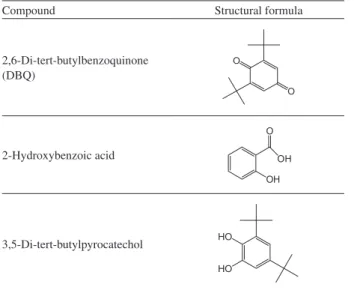
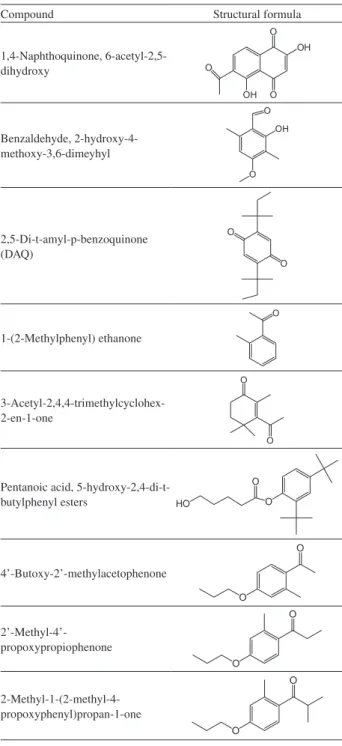
Table 5 describes the main by-products formed during the UV and UV/H2O2 processes. These compounds were
identiied by HS-SPME-GC/MS and comparison with NIST library data, authentic standards and based on literature. The results revealed the formation of several hydroxylated compounds, aromatic esters, chlorophenols,
some organic acids and alkyl benzenes. Although reported in the literature, hydroquinones and benzoquinones were not identiied in the inal treated residue.36,37 However,
the formation of these by-products was noted during the degradation processes due the appearance and rapid disappearance of a yellowish-brown color in solution within the irst minutes of treatment, indicating the formation of these by-products as transient intermediates. The main by-product detected was 2,6-di-tert-butylbenzoquinone (DBQ) in samples subjected to both UV and UV/H2O2
treatment. The presence of this compound as well as hydroxy compounds constituting the major fraction of by-products identiied demonstrates that the main pathway
Figure 8. Total ionchromatograms (TIC) showing the distribution of phenolic compounds in produced water after applying UV/H2O2 treatment for 60 min. DMP: dimethylphenol; EtP:ethylphenol; TMP: trimethylphenol (see other codes at the foot note of Table 2).
Table 5. Main by-products formed during the UV and UV/H2O2 processes tentatively identiied by GC-MS
Compound Structural formula
2,6-Di-tert-butylbenzoquinone (DBQ)
O O
2-Hydroxybenzoic acid OH
O
OH
3,5-Di-tert-butylpyrocatechol
HO HO
Compound Structural formula
3,5-Di-tert-butyl-4-hydroxyacetophenone
OH
O
2,5-Di-tert-butylhydroquinone (DTBHQ)
HO
OH
3,5-Di-tert-butyl-4-hydroxybenzaldehyde
Table 5. Main by-products formed during the UV and UV/H2O2 processes tentatively identiied by GC-MS (cont.)
Compound Structural formula
1,4-Naphthoquinone, 6-acetyl-2,5-dihydroxy
OH
OH O
O O
Benzaldehyde, 2-hydroxy-4-methoxy-3,6-dimeyhyl
OH
O O
2,5-Di-t-amyl-p-benzoquinone (DAQ)
O O
1-(2-Methylphenyl) ethanone
O
3-Acetyl-2,4,4-trimethylcyclohex-2-en-1-one
O
O
Pentanoic acid,
5-hydroxy-2,4-di-t-butylphenyl esters HO O
O
4’-Butoxy-2’-methylacetophenone
O
O
2’-Methyl-4’-propoxypropiophenone
O
O
2-Methyl-1-(2-methyl-4-propoxyphenyl)propan-1-one
O O
Compound Structural formula
1-(2,6-dimethyl-4-propoxyphenyl)-2-methyl-propan1-one
O O
pentanedioc acid,
(2,4-di-t-buthylphenyl) mono-ester O OH
O O
2,4,6-Tris(1,1-dimethyl)-4-methylcyclohexa-2,5-dien-1-one O
Propanoic acid, 2-methyl-,1- (1,1,dimethyl)-2-methyl-1,3-propanediyl ester
O
O O
O
Ethanone,
1,1’-(6-methoxy-2,5-benzofurandiyl)bis O O
O O
7,9-Di-tert-butyl-1-oxaspiro(4,5) deca-6,9-diene-2,8-dione
O
O
O
1,2-Benzenedicarboxylic acid,
butyl cyclohexyl ester O
O O O
of degradation is initiated by the oxidation of the aromatic phenolic ring generating quinones, diphenols, benzoic acids and phenones. The cleavage of the aromatic ring results in the production of organic acids and aliphatic hydrocarbons, shown in this study but at low concentrations. The non-identiication of these compounds in high concentrations indicates that despite the high eficiency of the treatment process, the complete mineralization of the sample was not achieved possibly due to the high organic content. A large number of compounds identified denote the
countless possibilities of by-products that may be formed when complex samples such as produced water are subjected to chemical processes of oxidation, indicating the importance of further studies focusing on the toxicity of such compounds.
Conclusions
statistical tool to monitoring and evaluate the removal processes of phenolic compounds in complex samples like produced water. The direct photolysis and UV/H2O2
processes were capable to degrade more than 99% of the initial total concentration of phenolic compounds present in the produced water. The HS-SPME-GC/MS was successfully used for the determination of the residual concentration of phenolic compounds, as well as the formation of by-products proving to be an important analytical tool in wastewater treatment studies.
Supplementary Information
Supplementary data (luorescence spectra, ANOVA tables and spectra of by-products) are available free of charge at http://jbcs.sbq.org.br as PDF ile.
Acknowledgments
The authors are thankful to TRANSPETRO for the samples provided, to the Brazilian Federal Agency for Support and Evaluation of Graduate Education (CAPES) and PETROBRAS for the inancial support.
References
1. Lu, J. R.; Wang, X. L.; Shan, B. T.; Li, X. M.; Wang, W. D.;
Chemosphere2006, 62, 322.
2. Ahmadum, F. R.; Pendashteh, A.; Abdullah, L. C.; Biak, D.R.A.; Madaeni, S. S.; Abidin, Z. Z.; J. Hazard. Mater.2009, 170, 530. 3. Farag, A. M.; Harper, D. D.; Int. J. Coal Geol. 2014, 126, 157. 4. Neff, J. M.; Bioaccumulation in Marine Organisms;Elsevier:
Oxford, 2002.
5. The International Association of Oil & Gas Producers (OGP), Report 364: London, 2005.
6. Stepnowski, P.; Siedlecka, E. M.; Behrend, P.; Jastorff, B.; Water Res. 2002, 36, 2167.
7. Coelho, A.; Castro, A.V.; Dezotti, M.; Sant’Anna, G. L.;
J. Hazard. Mater.2006, 137, 178.
8. Esplugas, S.; Gimenez, J.; Contreras, S.; Pascual, E.; Rodriguez,M.; Water Res. 2002, 36, 1034.
9. Louch, D.; Motlagh, S.; Pawliszyn, J.; Anal. Chem. 1992, 64, 1187.
10. Sanchez-Prado, L.; Llompart, M.; Lores, M.; Garcia-Jares,C.; Bayona, J. M.; Cela, R.; Chemosphere 2006, 65, 1338.; Alvarez-Rivera, G.; Llompart, M.; Garcia-Jares, C.; Lores, M.;
J. Chromatogr. A2014, 1349, 105.
11. Mascolo, G.; Ciannarella, R.; Balest, L.; Lopez, A.; J. Hazard. Mater. 2008, 152, 1138.
12. Boitsov, S.; Meier, S.; Klungsoyr, J.; Svardal, A.; J. Chromatogr. A 2004, 1059, 131.
13. Lee, K.; Neff, J. M.; Produced Water Environmental Risks and Advances in Mitigation Technologies, Springer: New York, 2011.
14. Faksness, L. G.; Grini. P. G.; Daling, P. S.; Mar. Pollut. Bull.
2004, 48, 731.
15. Boitsov, S.; Mjos, S. A.; Meier, S.; Mar. Environ. Res. 2007,
64, 651.
16. Igunnu, E. T.; Chen, G. Z.; J. Low-Carbon Technol.2014, 9, 157.
17. Conselho Nacional do Meio Ambiente (CONAMA), Resolução 430. Available in http://www.mma.gov.br/port/conama/legiabre. cfm?codlegi=646 acessed in January 2015.
18. Gaya, U. I., Abdullah, A. H., Zainal, Z.; Hussein, M. Z.;
J. Hazard. Mater. 2009, 168, 57.
19. Naidu, G. S. N.; Panda, T.; Biochem. Eng.J. 1998, 2, 71. 20. Montgomery, D. C.; Runger, G. C.; Hubele, N. F.; Engineering
Statistics, John Wiley and Sons Inc.: Hoboken, 2001. 21. Vining, G. G. Statistical Methods for Engineers, Duxburg Press:
London, 2003.
22. Mason, R. L.; Gunst, R. F.; Hess, J. J.; Statistical Design and Analysis of Experiments with Applications to Engineering and
Science, John Wiley and Sons Inc.: Hoboken, 2003.
23. Guaracho, V. V.; Kaminari, N. M. S.; Ponte, M. J. J. S.; Ponte, H. A.; J. Hazard. Mater.2009, 172, 1087.
24. Castrantas, H. M.; Gibilisco, R. D.; ACS Symp. Ser. 1990, 422, 77.
25. Audureau, J.; Filiol, C.; Boule, P.; Lemaire, J.; J. Chim. Phys. PCB1976, 73, 613.
26. Liao, C. H.; Kang, S. F.; Wu, F. A.; Chemosphere,2001, 44, 1193.
27. Liao, C. H.; Gurol, M. D.; Environ. Sci. Technol. 1995, 29, 3007. 28. Delaat, J.; Tace, E.; Dore, M.; Water Res. 1994, 28, 2507. 29. Andreozzi, R.; Caprio, V.; Insola, A.; Marotta, R.; Catal. Today
1999, 53, 51.
30. Christensen, H.; Sehested, K.; Coritzen, H.; J. Phys. Chem. 1982, 86, 1588.
31. Alnaizy, R.; Akgerman, A.; Adv. Environ. Res. 2000,4, 233. 23. Trapido, M.; Hirvonen, A.; Veressinina, Y.; Hentunen, J.;
Munter, R.; Ozone:Sci. Eng. 1997,19, 75.
33. Pera-Titus, M.; Garcia-Molina, V.; Banos, M. A.; Gimenez, J.; Esplugas, S.; Appl. Catal., B.2004, 47, 219.
34. Alapi, T.; Dombi, A.; J. Photoch. Photobio., A2007, 188, 409. 35. Miller, P. L.; Chin, Y. P.; Environ. Sci. Technol.2005, 39, 4454. 36. Kusic, H.; Koprivanac, N.; Bozic, A. L.; Chem. Eng. J. 2006,
123, 127.
37. Busca, G.; Berardinelli, S.; Resini, C.; Arrighi L.; J. Hazard. Mater. 2008, 160, 265.
Submitted: August 17, 2014