Article
J. Braz. Chem. Soc., Vol. 26, No. 9, 1914-1919, 2015. Printed in Brazil - ©2015 Sociedade Brasileira de Química 0103 - 5053 $6.00+0.00
A
*e-mail: [email protected]
p
-Cymenesulphonyl Chloride: A Bio-Based Activating Group and Protecting Group
for Greener Organic Synthesis
Thomas J. Farmer,*,a James H. Clark,a Maite L. Gothe,b Duncan J. Macquarriea and
James Sherwooda
aGreen Chemistry Centre of Excellence, Department of Chemistry, University of York, YO10 5DD Heslington, UK
bInstituto de Química, Universidade de São Paulo, 05508-000 São Paulo-SP, Brazil
A bio-derived protecting/activating group has been synthesized by introducing a sulphonyl chloride group to the aromatic ring of p-cymene derived from citrus peel waste. The resulting
p-cymenesulphonyl chloride was evaluated as an activating group by reacting with 1-octanol, 2-octanol, phenol and piperidine, and further reactions of the activated alcohols. The comparison to tosyl chloride demonstrates that the bio-based alternative can be effectively utilized as a direct replacement for the current fossil derived equivalent.
Keywords: citrus waste, p-cymene, sulphonyl chloride, activating group, protecting group
Introduction
An essential part of synthetic chemistry, activating groups and protecting groups are often used in more than one molar equivalent to the substrate, thus accounting for a significant share of the total amount of reagents used. Tosyl chloride is an example of such reagent. It is widely used as a protecting group1 or an activating group2 for alcohols
and amines in the synthesis of complex molecules.Within the 12 principles of green chemistry it is explicitly stated that “unnecessary derivatization should be minimized or avoided if possible, because such steps require additional reagents and can generate waste” (principle 8).3 However
progress in achieving this goal has been slow and limited to specific examples,4 due to the need for protecting and
activating groups in some areas of synthetic organic chemistry. It would be considerable benefit, if just an intermediate step towards the eventual elimination of activating and protecting groups, to obtain these chemicals from a renewable source instead of petroleum (coinciding with principle 7).
Under the encouragement of the Brazilian government,5
the European Comission6 and other nations, the share
of bio-based products in the global chemical market is projected to grow.7 Consumer pressure8 and some
government procurement strategies,9 are also helping to
accelerate the development of greener and renewable products. Greater demand means that biomass utilization will have to be increasingly directed towards valorizing waste streams instead of using food crops.
Citrus waste is a good example of a food waste with huge potential as a renewable chemical feedstock.10 Citrus
fruit juice production leaves behind approximately half of the fruit mass, estimated to amount to 15 million tons of citrus peel waste per year.11 The waste is usually dried and
incorporated into cattle feed. Because the energy cost of the drying process is high and the value of animal feed is low, the profit in the current process is not satisfying.12,13
As a means of getting more value from the citrus peel waste, the essential oil can be extracted by a variety of methods.14 Extraction of essential oil from citrus peel
waste has been demonstrated to be economically feasible in a large scale bio-refinery by using explosive pressure reduction (flashing) methods.13,15 Taking into account the
yields of essential oil extraction from citrus waste, and the high limonene content in the essential oil (> 90%), it can be estimated that the capacity for limonene production in Brazil is 82,500 tons per year.16
methodology described by Cremlyn,18 a sulphonyl chloride
functional group can be added onto the aromatic ring. The resulting p-cymenesulphonyl chloride abbreviated to CymCl (2), has been applied in this work as an activating group for alcohols and amines, and its reactivity compared to that of TsCl.
Experimental
Synthesis of p-cymenesulphonyl chloride
The synthesis of p-cymenesulphonyl chloride (CymCl) was carried out following the procedure described by Brown et al.19 Cold p-cymene (6.95 g, 52 mmol) was added
drop-wise to 5 equivalents of chlorosulphonic acid (17 mL, 260 mmol) in an ice bath, under magnetic stirring. After 90 minutes the reaction mixture was poured onto crushed ice. A purple oily layer formed which was washed several times with distilled water until the purple color disappeared. The resulting light brown oil (9.64 g, 81%) was isolated in a separation funnel, and the product stored at −18 °C. The product was analyzed by gas chromatography with flame ionization detector (GC-FID), gas chromatography-mass spectrometry (GC-MS), nuclear magnetic resonance (NMR) and infrared (IR) spectroscopy (spectra and chromatograms are provided in the Supplementary Information).
p-Cymene-α-sulphonyl chloride
1H NMR (400 MHz, CDCl
3) d 1.26 (d, 6H, J 6.95 Hz,
CH3), 2.73 (s, 3H, Ar–CH3), 2.97 (m, 1H, J 6.95 Hz,
Ar−CH), 7.32 (d, 1H, J 8.05 Hz, Ar–H), 7.46 (dd, 1H,
J 1.80 Hz, 7.69, Ar–H), 7.89 (d, 1H, J 1.80 Hz, Ar–H);
13C NMR (100 MHz, CDCl
3) d 19.9, 23.8, 33.8, 126.6,
128.6, 133.5, 135.4, 142.9, 148.1; MS (EI +) m/z 232 [M]+.
p-Cymene-β-sulphonyl chloride
1H NMR (400 MHz, CDCl
3) d 1.32 (d, 6H, CH3), 2.40
(s, 3H, Ar–CH3), 3.98 (m, 1H, Ar–CH), 7.23 (d, 1H, Ar–H),
7.46 (dd, 1H, Ar–H), 7.83 (d, 1H, Ar–H).
Activation of reagents
The reaction of 1-octanol, 2-octanol, phenol and piperidine was performed according to the method described by Yoshida et al.20 The activating agent, TsCl
or CymCl, was present in 1.50 molar equivalents and dissolved in 1 mL of the chosen solvent. The solution was added drop-wise to a reagent mixture composed of 1.00 mmol of the chosen nucleophile, 1 molar equivalent of Me3N.HCl in 2.5 molar equivalents of Et3N, all dissolved
in 1 mL of the chosen solvent in ice bath under magnetic
stirring. The solvent was toluene, p-cymene or acetonitrile. After one hour, the reaction mixture was quenched with water, extracted with ethyl acetate, then washed with brine, dried with MgSO4 and concentrated in vacuo to give the
crude arylsulphonyl derivative of the substrate that was analyzed by GC-FID, GC-MS, NMR spectroscopy and IR spectroscopy as appropriate. The conversion was calculated using GC-FID of the crude mixture against a calibration curve.
Reactions of the activated octanol
The methodology for the reactions of the protected alcohols with sodium methoxide was based on the work of Hiroya etal.21 and Sarmah etal.22 In the first instance
sodium metal (5 molar equivalents) was added slowly to excess methanol, and to the resulting sodium methoxide solution was added protected alcohol and stirred overnight at reflux. After 15 hours, the methanol was evaporated
in vacuo, and the resulting residue dissolved in chloroform. After washing successively with water and brine, the organic phase was dried with MgSO4 and concentrated
in vacuo to give the product.
For the alternative reaction of the activated alcohols with morpholine, based on the protocol of Hamrick and Hauser,23 an excess of morpholine (5 mL) was added
to the protected alcohols (0.33 mmol) and stirred for 4 hours at 100 oC, then left to stand overnight at room
temperature. The remaining morpholine was then removed by evaporation, and the resulting residue extracted with ether, washed with distilled water, and the organic phase separated, dried with MgSO4 and concentrated in vacuo to
give the alkylated amine.
Results and Discussion
Synthesis of p-cymenesulphonyl chloride
The synthesis of p-cymenesulphonyl chloride (2) from
Of the reaction conditions attempted, the highest yield of CymCl was achieved when 5 molar equivalents of chlorosulphonic acid was employed. Table 1 shows the yields of CymCl, obtained from duplicate experiments, and an e-factor (environmental factor) for each set of reaction conditions.24 The e-factor analysis justifies the larger
excess of chlorosulphonic acid to some extent because the improvement in yield results in less reactant waste, almost cancelling out the impact of the additional mass of chlorosulphonic acid used.
The use of p-cymenesulphonyl chloride as an activating group
The functionalization of piperidine, phenol, 1-octanol (3a) and 2-octanol (3b) by TsCl and CymCl was performed
according to literature precedent.20 The protected
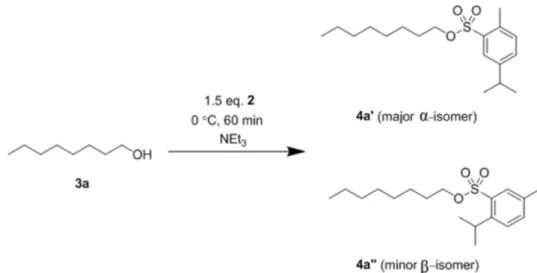
nucleophile was the only product observed, which was present as isomers in the case of reactions with CymCl. A representative reaction is shown in Scheme 1.
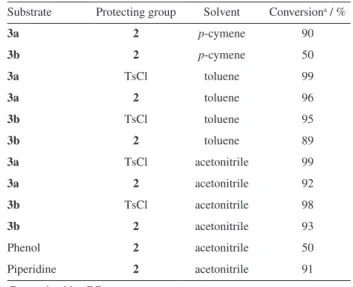
The conversion rates of each substrate under different reaction conditions are shown in Table 2.
p-Cymenesulphonyl chloride (CymCl) met expectations as an activating group, meaning generally high yields and no significant side reactions. The conversions achieved were comparable to those obtained with TsCl for both primary and secondary alcohols. The functionalization of phenol is hindered by its low nucleophilicity but piperidine was successfully reacted with CymCl. The two isomers of CymCl are both reactive, with the regioselectivity of the sulphonylation reasonably preserved, as shown in Table 3 for all four substrates for reactions in acetonitrile. The CymCl isomers for these reactions had a starting ratio by GC of 80.0% major (α) to 20.0% minor (β), Figure 2. Table 1. Yield in the p-cymenesulphonyl chloride synthesis
Molar equivalent of HOSO2Cla
Reaction
time / h Yieldb / % E-factorc
5 1.5 81 2.8
2 1.5 35 3.5
2 17 49 2.2
aHOSO
2Cl = chlorosulphonic acid; byield accounting for all isomers
(combined α and β); cenvironmental factor, calculated from mass ratio
of waste to product, excluding water.
Figure 1. Example reaction in the p-cymenesulphonyl chloride synthesis.
Scheme 1. Esterification of 1-octanol with arylsulphonyl chlorides.
Table 2. Activation of 1-octanol (3a) and 2-octanol (3b)
Substrate Protecting group Solvent Conversiona / %
3a 2 p-cymene 90
3b 2 p-cymene 50
3a TsCl toluene 99
3a 2 toluene 96
3b TsCl toluene 95
3b 2 toluene 89
3a TsCl acetonitrile 99
3a 2 acetonitrile 92
3b TsCl acetonitrile 98
3b 2 acetonitrile 93
Phenol 2 acetonitrile 50
Piperidine 2 acetonitrile 91
Therefore sulphonylation of the substrates showed a very slight preference for the major, less sterically hindered, α isomer to react. The piperidine substrate showed the highest shift in selectivity between the isomers, with a drop in the more sterically hindered β isomer from 20.0% to 14.5%. This more pronounced drop is logical as piperidine possesses the greatest steric bulk in the location of the reaction center of all the different nucleophiles investigated.
Often TsCl is used in conjunction with its parent molecule, toluene, a common solvent despite possessing a flash point below room temperature and possible chronic human toxicity.25 From a health, safety, and environmental
perspective, it was fitting to assess the potential of p-cymene
to replace toluene as the solvent.26 Although 1-octyl
p-cymenesulphonate (4a) was obtained in good yield, the conversion to 2-octyl p-cymenesulphonate (4c) when attempted in p-cymene was too low to have practical use. The lower dipolarity of p-cymene compared to toluene might have resulted in insufficient stabilization of the more sterically hindered activated complex. Another factor to consider is substrate solubility. Acetonitrile was the only solvent investigated for experiments with phenol and piperidine for this reason.
Reactions of activated octanol
The reaction of 1-octyl p-cymenesulphonate (4a) and 2-octyl p-cymenesulphonate (4c) with sodium methoxide led to the formation of the desired methyl octyl ethers (Scheme 2), as evidenced by NMR spectroscopy and GC-MS (Supplementary Information). The yields of methyl 1-octyl ether (5a) and for optimal conditions methyl 2-octyl ether (5b) are presented in Table 4, and are comparable to those established in the literature on similar substrates.27 When the activated alcohols were reacted
with excess morpholine, the p-cymenesulphonate esters underwent the anticipated substitution reaction, with yields of 68% (N-1-octyl morpholine, 6a) and 82% (N-2-octyl morpholine, 6b) achieved (Scheme 3).
Figure 2. Example reaction of nucleophiles once protected with CymCl by reactions in acetonitrile.
Table 3. Relative ratios of major and minor isomers of nucleophiles once protected with CymCl by reactions in acetonitrile
Substrate Conversiona / % Major
isomerb / %
Minor isomerb / %
3a (1-octanol) 92 82.5 (4a’) 17.5 (4a’’)
2-octanol 93 82.3 17.7
Phenol 50 83.0 17.0
Piperidine 91 85.5 14.5
aConversion determined by GC-FID viaa calibration curve; bthe
percentage of the major and minor isomers were determined by taking the ratio of major and minor isomer peaks and assuming that each had the same relative response factor.
Conclusions
The synthesis of p-cymenesulphonyl chloride (CymCl) by reaction of p-cymene and chlorosulphonic acid was successful, with the two regioisomers able to form activating groups on alcohols and amines. The activated alcohols could then be reacted with sodium methoxide or morpholine to give the desired substitution products. Further optimization and scale-up of the production of CymCl would result in a practical renewable auxiliary for organic chemistry, complimenting a growing catalogue of functional chemicals and materials derived from Brazilian sourced citrus waste.10,16,28
Supplementary Information
Supplementary information (including spectra of compounds) is available free of charge at http://jbcs. sbq.org.br as PDF file.
Acknowledgements
MLG would like to thank the Science Without Borders (Ciência sem Fronteiras-CAPES) scholarship program for financial support.
References
1. Hiroya, K.; Suzuki, N.; Yasuhara, A.; Egawa, Y.; Kasano, A.; Sakamoto, T.; J.Chem. Soc. Perkin Trans. 1 2000, 4339; Masnovi, J.; Koholic, D.; Berki, R.; Binkley, R.; J. Am. Chem. Soc. 1987, 109, 2851; Sadanandan, E. V.; Cava, M. P.;
Tetrahedron Lett.1993, 34, 2405; Wuts, P. G. M.; Greene,
T. W.; Greene’s Protective Groups in Organic Synthesis, Wiley-Interscience: Hoboken, USA, 2007; Schelhaas, M.; Waldmann, H.; Angew. Chem. Int. Ed. 1996, 35, 2056; Sarmah, M. P.; Shashidhar, M. S.; Sureshan, K. M.; Gonnade, R. G.; Bhadbhade, M. M.; Tetrahedron 2005, 61, 4437; Pozsgay, V.; Dubois, E. P.; Pannell, L.; J. Org. Chem. 1997, 62, 2832. 2. Hamrick, P. J.; Hauser, C. R.; J. Org. Chem. 1961, 26, 4199;
Jawale, D. V.; Pratap, U. R.; Mulay, A. A.; Mali, J. R.; Mane, R. A.; J. Chem. Sci. 2011, 123, 645; Kazantsev, A. V.; Butyaikin, V. V.; Gaas, I. E.; Otrashchenkov, E. A.; Aksartov, M. M.; Russ. J. Org. Chem. 2001, 37, 1107; Chen, H. -H.; Gross, S.; Liao, J.;
McLaughlin, M.; Dean, T.; Sly, W. S.; May, J. A.; Bioorg. Med. Chem. 2000, 8, 957; Kim, D.; Shim, P. J.; Lee, J.; Park, C. W.;
Hong, S. W.; Kim, S.; J. Org. Chem. 2000, 65, 4864; Liao, J.; Kuo, L.; US pat. 20120220784, 2012; Liu, G.; Romo, R.; Angew. Chem. Int. Ed. 2011, 50, 7537.
3. 12 Principles of Green Chemistry, ACS, http://www.acs. org/content/acs/en/greenchemistry/what-is-green-chemistry/ principles/12-principles-of-green-chemistry.html, accessed in June 2015.
4. Young, I. S.; Baran, P. S.; Nat. Chem. 2009, 1, 193.
5. Business Week online, http://www.bloomberg.com/news/ articles/2012-09-19/brazil-doubling-sugar-cane-biomass-research-plan-to-988-million, accessed in July, 2015. 6. Bio-based Economy, http://www.biobasedeconomy.eu/
standardisation, accessed in June 2015.
7. USDA report, Opportunities in the Emerging Bioeconomy, October 2014, http://www.usda.gov/wps/portal/usda/usdame diafb?contentid=2014/10/0224.xml&printable=true&conten tidonly=true, accessed in June 2015; European Commission Ad-hoc Advisory Group for Bio-based Products, Taking Bio-based from Promise to Market, November 2009, http://
ec.europa.eu/enterprise/sectors/biotechnology/files/docs/ bio_based_from_promise_to_market_en.pdf, accessed in June 2015.
8. Hall, J.; J. Cleaner Prod. 2000, 8, 455; de Bakker, F. G. A.; Fisscher, O. A. M.; Brack, A. J. P.; J. Cleaner Prod. 2002, 10, 455; Akenji, L.; J. Cleaner Prod. 2014, 63, 13.
9. USDA ‘Bio-preferred’ Federal Purchasing Program, http://www. biopreferred.gov/BioPreferred/faces/pages/AboutBioPreferred. xhtml, accessed in July, 2015.
Scheme 3. Nucleophilic substitution reaction of morpholine on 1-octyl p-cymenesulphonate (4a).
Table 4. Yields of methyl octyl ethers
Condition Product yield / %
5 equivalents of sodium (room temperature) 15 (5a)
5 equivalents of sodium (reflux) 62 (5a); 88 (5b)
10. Clark, J. H.; Pfaltzgraff, L. A.; Budarin, V. L.; Hunt, A. J.; Gronnow, M.; Matharu, A. S.; Macquarrie, D. J.; Sherwood, J. R.; Pure Appl. Chem. 2013, 85, 1625.
11. Marín, F. R.; Soler-Rivas, C.; Benavente-García, O.; Castillo, J.; Pérez-Alvarez, J. A.; Food Chem. 2007, 100, 736.
12. Garzón, C. G.; Hours, R. A.; Bioresour. Technol. 1992, 39, 93. 13. Widmer, W.; Zhou, W.; Hazra; Bioresour. Technol. 2010, 101,
5242.
14. Mira, B.; Blasco, M.; Berna, A.; Subirats, S.; J. Supercrit. Fluids 1999, 14, 95; Farhat, A.; Fabiano-Tixier, A. S.; Maataoui,
M. E.; Maingonnat, J. F.; Romdhane, M.; Chemat, F.; Food Chem.2011, 125, 255; Li, Q.; Siles, J. A.; Thompson, I. P.;
Appl. Microbiol. Biotechnol.2010, 88, 671; Attard, T. M.;
Watterson, B.; Budarin, V. L.; Clark, J. H.; Hunt, A. J.; New J. Chem. 2014, 38, 2278.
15. Lohrasbi, M.; Pourbafrani, M.; Niklasson, C.; Taherzadeh, M. J.; Bioresour. Technol. 2010, 101, 7382; Pourbafrani, M.; Forgács, G.; Horváth, I. S.; Niklasson, C.; Taherzadeh, M. J.;
Bioresour. Technol. 2010, 101, 4246.
16. Clark, J. H.; Fitzpatrick, E. M.; Macquarrie, D. J.; Pfaltzgraff, L. A.; Sherwood, J.; Catal. Today 2012, 190, 144.
17. Martin-Luengo, M. A.; Yates, M.; Rojo, E. S.; Huerta Arribas, D.; Aguilar, D.; Ruiz Hitzky, E.; Appl. Catal. Gen. 2010, 387, 141; Martín-Luengo, M. A.; Yates, M.; Martínez Domingo, M. J.; Casal, B.; Iglesias, M.; Esteban, M.; Ruiz-Hitzky, E.; Appl. Catal. B Environ. 2008, 81, 218.
18. Cremlyn, R. J. W.; Chlorosulfonic Acid: A Versatile Reagent; Royal Society of Chemistry: Cambridge, UK, 2002.
19. Brown, S. M.; Thomson, G. H.; J. Chem. Soc. 1950, 1019. 20. Yoshida, Y.; Sakakura, Y.; Aso, N.; Okada, S.; Tanabe, Y.;
Tetrahedron 1999, 55, 2183.
21. Hiroya, K.; Suzuki, N.; Yasuhara, A.; Egawa, Y.; Kasano, A.; Sakamoto, T.; J.Chem. Soc. Perkin Trans. 1 2000, 4339. 22. Sarmah, M. P.; Shashidhar, M. S.; Sureshan, K. M.; Gonnade,
R. G.; Bhadbhade, M. M.; Tetrahedron 2005, 61, 4437. 23. Hamrick, P. J.; Hauser, C. R.; J. Org. Chem. 1961, 26, 4199. 24. Sheldon, R. A.; Pure Appl. Chem. 2000, 72, 1233.
25. Toluene Material Safety Data Sheet, http://www.sciencelab. com/msds.php?msdsId=9927301, accessed in July, 2015. 26. Paggiola, G.; Hunt, A. J.; McElroy, C. R.; Sherwood, J.; Clark,
J. H.; Green Chem. 2014, 16, 2107; Clark, J. H.; Macquarrie, D. J.; Sherwood, J.; Chem. Eur. J. 2013, 19, 5174; Clark, J. H.; Macquarrie, D. J.; Sherwood, J.; Green Chem. 2012, 14, 90. 27. Allentoff, N.; Wright, G. F.; J. Org. Chem. 1957, 22, 1; Shirley,
D. A.; Zietz, J. R.; Reedy, W. H.; J. Org. Chem. 1953, 18, 378. 28. Pfaltzgraff, L. A.; de Bruyn, M.; Cooper, E. C.; Budarin, V.;
Clark, J. H.; Green Chem. 2013, 15, 307; Tsukamoto, J.; Durán, N.; Tasic, L.; J. Braz. Chem. Soc. 2013, 24, 1537; Clark, J. H.; Farmer, T. J.; Macquarrie, D. J.; Sherwood, J.; Sustainable Chem. Processes 2013, 1, 23; White, R. J.; Budarin, V. L.; Clark,
J. H.; Chem. Eur. J. 2010, 16, 1326.
Submitted: April 27, 2015
Published online: July 8, 2015