Article
Printed in Brazil - ©2015 Sociedade Brasileira de Química0103 - 5053 $6.00+0.00A
*e-mail: [email protected]
Screening of By-Products of Esfenvalerate in Aqueous Medium Using SBSE Probe
Desorption GC-IT-MS Technique
Renata Colombo,*,a,b Tanare C. R. Ferreira,b Janete H. Yariwakeb and Marcos R. V. Lanzab
aEscola de Artes, Ciências e Humanidades, Universidade de São Paulo, 03828-000 São Paulo-SP, Brazil
bInstituto de Química de São Carlos, Universidade de São Paulo, CP 780, 13560-970 São Carlos-SP, Brazil
The pyrethroids, their metabolites and by-products have been recognized as toxic to environment and human health. Despite several studies about esfenvalerate toxicity and its detection in water and sediments, information about its degradation products is still scanty. In this work, esfenvalerate degradation products were obtained by chemical oxidation with hydrogen peroxide and their structure was elucidated using a procedure known as stir bar sorptive extraction (SBSE) probe desorption gas chromatography-ion trap mass spectrometry (GC-IT-MS) analysis. This procedure consists of the thermal desorption of analytes extracted from a SBSE stir bar introduced by a probe into a gas chromatograph (GC) coupled to an ion trap mass spectrometry (IT-MS) system. Based on IT-MS data, a degradation pathway of esfenvalerate is proposed with ten products of chemical oxidation of esfenvalerate that are fully identiied. Among these compounds, 3-phenoxybenzoic acid and 3-phenoxybenzaldehyde were detected, reported as being environmental metabolites of some pyrethroids, with endocrine-disrupting activity.
Keywords: esfenvalerate, stir bar sorptive extraction, chemical oxidation, gas chromatography-ion trap mass spectrometry
Introduction
Pyrethroids are powerful insecticides that, in the last few decades, have increasingly replaced organochlorine pesticides due to their relatively low mammalian toxicity, selective insecticide activity and low environmental persistence.1
Although pyrethroids are thought to be safe for humans, they are highly toxic to ish - even at very low concentrations (< 0.5 µg L-1 water), to bees, aquatic
arthropods, birds and mammals, and have also shown carcinogenic properties.2-6 Several reversible symptoms of
poisoning and suppressive effects on the immune system have also been reported in humans after their exposure to pyrethroids.7 Esfenvalerate [IUPAC name: (S)-α
-cyano-3-phenoxybenzyl-(S)-2-(4-chlorophenyl)-3-methylbutyrate] is a persistent compound of the class of pyrethroids that is present in numerous formulations of insecticides marketed worldwide. The “Final Work Plan” adopted by the U. S. Environmental Protection Agency (USEPA) in 2010 calls for a detailed evaluation of esfenvalerate with respect to its potential risks to the environment and to human health.
Moreover, this compound is included in the initial list of pesticides to be screened under the Endocrine Disruptor Screening Program (EDSP), organized by the USEPA, and remains on the 2013 list.8 Despite the high hydrophobicity
(log Kow 6.42), the very low water solubility (a few ng L-1)
and the apparently high biodegradation rate of esfenvalerate, a growing number of investigations have recently reported its widespread occurrence in water and sediment,9-12 and
its harm to aquatic organisms.13 Its ecological risks are
associated with esfenvalerate molecule and also with the by-products generated during the environmental degradation of esfenvalerate, which may occur through either by oxidation at one or more sites located in the alcohol or acid moieties or by hydrolysis of the central ester bond. These degradation by-products, which include 3-phenoxybenzoic acid and 3-phenoxybenzaldehyde, have shown very similar toxicological consequences in aquatic environments.14,15
salts, semiconductors and/or UV-Vis irradiation can give rise to the formation of hydroxyl radicals (•OH), which are very powerful oxidants with high oxidation potential (2.8 V as opposed to standard hydrogen electrodes).16,17
To evaluate the eficiency of oxidation processes and monitor the degradation of the target pollutant, as well as the intermediates and by-products generated in the oxidation reaction, simpler techniques, solvent-less and which allow extraction and concentration in a single step, such as solid-phase micro extraction (SPME) and stir bar sorptive extraction (SBSE), have recently been applied successfully.18-20 These methods also provide enhanced
sensitivity because the extracted fraction (the former on a iber and the latter on a stir bar) can be introduced quantitatively into a gas chromatography (GC) system by thermal desorption.21 Due to the small volume of extractant
used in SPME phases, analytical methods using SBSE have higher analytical recovery rates and consequently higher sensitivity: the amount of polydimethylsiloxane (PDMS) used in the SPME ibers is typically ≤ 0.5 µL, while SBSE stir bars contain ca. 50-300 µL PDMS ilm.22-24 The SBSE
technique combined with hyphenated chromatographic techniques such as GC-mass spectrometry (MS) has been used for esfenvalerate analysis in water samples at trace levels, allows rapid analysis, low solvent consumption, and higher analytical precision and sensitivity.25,26 Although
methods describing the use of SBSE-GC-MS for analysis of pyrethroids are reported in literature,25-28 the application
of this technique for analysis of pyrethroids degradation products is still rare. In this work, an approach called “SBSE probe desorption” was employed as an alternative to combine the advantages of SBSE and the power of GC-ion trap (IT)-MS as the detection technique in order to identify esfenvalerate degradation products in aqueous solution. In this procedure, the different analytes are sorbed in SBSE bar in a unique step (extraction) and are desorbed thermally placing the SBSE bar in an appropriate probe, without using the commercial SBSE thermal desorption system.
Experimental
Reference substances, chemicals, and reagents
Esfenvalerate (analytical standard; 97% purity), 3-phenoxybenzoic acid (analytical standard; 98% purity) and 3-phenoxybenzaldehyde (analytical standard; 98% purity) were obtained from Sigma-Aldrich (St. Louis, MO, USA). All the other reagents were of analytical grade, unless otherwise stated. Methanol, acetonitrile, chloric acid, sodium chlorate and sodium hydroxide were obtained from Mallinckrodt (Xalostoc, Edomex, Mexico). Sodium
sulite and formic acid (reagent grade) were obtained from Merck (Darmstadt, Germany) and a 30% (m/m) solution of hydrogen peroxide (reagent grade) was supplied by Ecibra (São Paulo, SP, Brazil). Puriied water (resistivity 18.2 MΩ cm) was obtained by using a Millipore (Eschborn, Germany) Milli-Q water puriication system.
Chemical oxidation process
The intermediates and by-products of esfenvalerate were obtained by a chemical oxidation process optimized in a previous study described in the literature.29 In this
optimization, reproducibility of the oxidative process was checked in replicate using as criteria the chromatographic proile (retention time and peak area) of the degradation compounds of esfenvalerate. Laboratory-scale chemical oxidation assays were performed using a stock solution of esfenvalerate prepared by dissolving an appropriate amount of standard in methanol, followed by dilution with deionized water (1:99 v/v) to a final concentration of 90 mg L-1
esfenvalerate. An aliquot of 50 mL was diluted with methanol (1:1 v/v) to a inal concentration of 45 mg L-1 esfenvalerate.
The pH of this solution was adjusted to 10.95 (with a sodium hydroxide solution) and the reactional mixture was subjected to degradation with 25 mg L-1 hydrogen peroxide, under
magnetic agitation for 4 h at room temperature (25 °C). After this time interval, the reaction was immediately interrupted by addition of sodium sulite.
SBSE extraction of the esfenvalerate degradation products
An aliquot of 1.5 mL of the esfenvalerate solution (50% methanol and pH 10.95) subjected to the chemical oxidation process was diluted to 5 mL using ultrapure water (inal solution = 15% methanol). The ionic strength was then adjusted to 5% by adding 0.25 g of NaCl and the pH was adjusted to 1.50 by adding a 20% (v/v) hydrochloric acid solution.
The degradation products were then extracted using a SBSE stir bar (10 mm × 0.5 mm, 24 µL PDMS coating, Twister®, Gerstel, Mülheim an der Ruhr, Germany), which
was stirred at 700 rpm for 120 min at 60 °C. After the extraction process, the SBSE bar was removed from the extraction lask, washed with ultrapure water and dried with a lint-free tissue prior to the desorption of the analytes by liquid desorption or by thermal desorption.
are described below. The conditions of the extraction of the esfenvalerate degradation products by SBSE followed by liquid desorption were previously optimized by using a factorial experimental design. The inluence and interaction effects of organic modiier, ionic strength, extraction time, temperature and pH were simultaneously evaluated. The utilization of different organic solvents and desorption times were also investigated to establish the optimal conditions for SBSE liquid desorption.30
SBSE-GC-IT-MS analysis
SBSE-probe desorption-GC-IT-MS analysis was performed in a CP 3800 gas chromatograph equipped with a ChromatoProbe@ device coupled to an ion trap
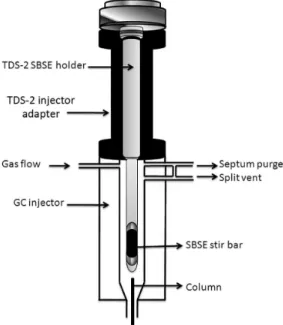
MS/MS Saturn 2000 (Varian, Walnut Creek, USA). The stir bar containing the analytes was placed in the GC injector chamber (Figure 1) and thermal desorption was performed by programming the GC injector temperature from 40 to 250 °C (held for 16 min), at a heating rate of 105 °C min-1, in
the splitless mode. Helium was used as carrier gas at a low rate of 1.2 mL min-1. The GC analysis was performed in a
DB-5 ms fused silica capillary column (30 m × 0.25 mm i.d., 0.5 µm ilm thickness, Agilent, Santa Clara, United States). The oven temperature was programmed from 70 °C (held for 0.5 min) to 300 °C (held for 6 min), at a heating rate of 20 °C min-1. The IT-MS analyses were performed in the
scan mode (m/z 40 to 450), using electron impact ionization (70 eV) in the positive mode. The temperature of the transfer line, ion trap and manifold were set at 300, 220 and 40 °C, respectively.
Results and Discussion
SBSE-GC-IT-MS analysis and identification of the chemical oxidation products of esfenvalerate
A f t e r c h e m i c a l o x i d a t i o n t h e c o m p o u n d s 3-phenoxybenzoic acid and 3-phenoxybenzaldehyde were identiied in the reactional mixture according to high-performance liquid chromatography-UV/diode array detection (HPLC-UV/DAD) (with the help of standards and comparison of their tR and UV spectra), described in
scientiic literature.29 These three compounds (esfenvalerate,
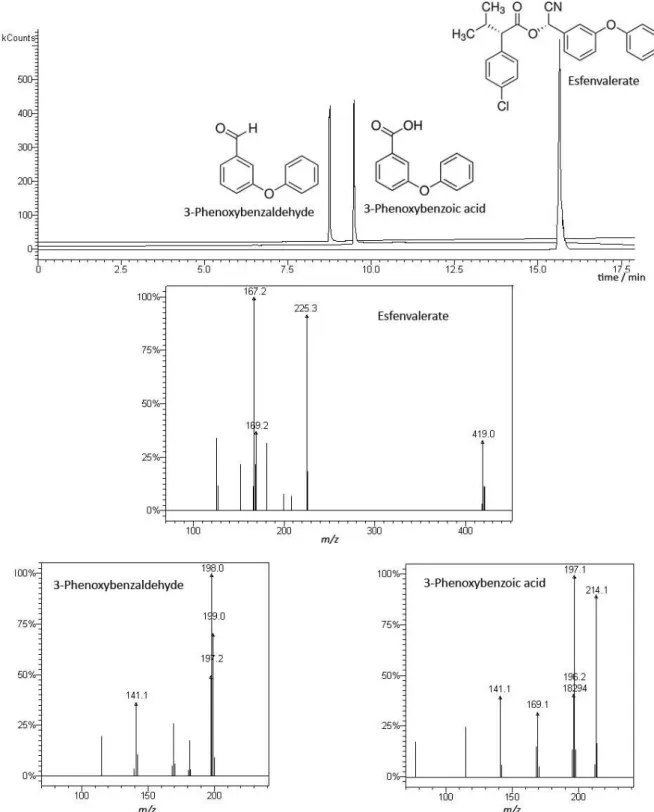
3-phenoxybenzoic acid and 3-phenoxybenzaldehyde) were used to evaluate the inluence of the oven temperature and ionization conditions in the GC-IT-MS analyses, based on an analysis of solutions of analytical standards (Figure 2).
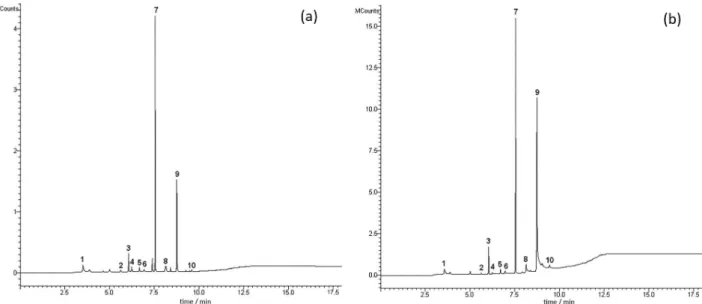
These analyses showed that the GC-IT-MS conditions which do not degrade the standard compounds, conirming that the other compounds detected by GC-IT-MS (Figure 3) are generated by chemical degradation. A potential disadvantage of SBSE thermal desorption is the possibility of degradation of thermolabile compounds; besides, desorption temperature (= probe heating) must be compatible with the programming of temperature into the GC oven. However, milder temperatures of the GC column leads to longer analysis times. So, several temperature conditions were tested and the optimized temperature conditions are described in the Experimental section (SBSE-GC-IT-MS analysis). The total ion chromatogram (TIC GC-IT-MS) proiles of the chemical degradation products obtained by SBSE-liquid desorption (the latter was optimized in a previous work)29 were compared against
those obtained by probe (thermal) desorption (Figure 3) in order to evaluate comparatively the effectiveness of the SBSE-probe desorption procedure. All the 10 compounds found in the solution left over after the chemical degradation products were desorbed eficiently by both SBSE-liquid desorption (Figure 3a) and by probe desorption (Figure 3b), indicating the eficacy of the latter.
The thermal desorption allowed enhanced sensitivity because the degradation products present in the solution are adsorbed by stir bar, which is inserted into the probe, allowing direct entrance of these analytes in the GC-MS system. In liquid desorption the sensitivity is subject to the volume of solvent used for the analytes desorption (which should ensure complete immersion of the stir bar), beyond the volume of sample injected into the GC-MS system. Besides the enhanced sensitivity the thermal probe desorption mode allows the elimination of solvent usage and minimize the analysis time, since the step of the analytes desorption in the solvent is not required.
Figure 2. Totalion chromatogram (TIC) and mass spectra of methanolic standard solutions of 3-phenoxybenzaldehyde (0.2 mg L-1, t
R = 8.77 min),
3-phenoxybenzoic acid (0.2 mg L-1, t
R = 9.47 min) and esfenvalerate (0.3 mg L-1, tR = 15.63 min).
The fragmentation patterns in the mass spectra were evaluated in full-scan mode, in which the target (base peak) and fragment ions obtained were appropriate for the structural elucidation of compounds. Low resolution GC-MS is limited in comparison with high resolution mass spectrometry measurements, to establish the elemental
Table 1. GC-IT-MS data of the esfenvalerate degradation products. Compound (peak) number as in Scheme 1
No. Compound M+ / m/z EI-MS fragment ions (relative intensity / %)
1 methyl N-hydroxybenzene carboximidoate 151 (base peak) 135 (20), 134 (10), 133 (76), 77(20), 73 (3), 68 (3), 45 (17), 42 (1)
2 1-chloro-4-prop-2-en-1-ylbenzene 151 153 (7), 132 (9), 131 (100), 125 (17), 116 (21), 115 (40), 103 (2), 91 (34), 89 (20), 63 (15)
3 1-chloro-4-(1-methylprop-2-en-1-yl)benzene 166 (base peak) 168 (33), 153 (13), 151 (43), 131 (97), 116 (45), 115 (73), 103 (13), 91 (41), 89 (20), 63 (20)
4 2-(4-chlorophenyl)ethanol 157 156 (7), 155 (100), 139 (10), 125 (9), 91 (37), 77 (7), 75 (5)
5 1-chloro-4-ethylbenzene-methane 141 140 (7), 139 (100), 113 (10), 111 (30), 76 (5), 75 (24), 74 (3), 51 (3), 50 (7)
6 (4-chlorophenyl)methanol 143 141 (100), 115 (15), 113 (50), 78 (7), 77 (70), 75 (7), 51 (15), 50 (7)
7 2-(4-chlorophenyl)propanoic acid 184 (base peak) 186 (30), 169 (20), 167 (30), 154 (23), 152 (73), 127 (20), 125 (55), 115 (18), 91 (11), 89 (25)
8 2-(4-chlorophenyl)-3-methylbutanoic acid 212 172 (34), 170 (100), 154 (15), 152 (45), 127 (13), 125 (44), 115 (13), 89 (20), 77 (18), 43 (15), 41 (10)
9 3-phenoxybenzaldehyde 198 (base peak) 197 (57), 181 (30), 169 (67), 141 (72), 115 (36), 77 (20), 63 (16), 51 (31), 50 (15)
10 3-phenobenzoic acid 214 198 (35), 197 (100), 196 (40), 194 (15), 169 (60), 168 (20), 141 (63), 115 (34), 77 (30)
EI-MS: electron ionization mass spectrometry.
Figure 3. TIC-GC-IT-MS of the degradation products of esfenvalerate, obtained by (a) liquid desorption and (b) SBSE-GC-IT-MS probe desorption.
(3-phenoxybenzoic acid and 3-phenoxybenzaldehyde) and the comparison with mass spectra libraries (National Institute of Standards and Technology (NIST) MS Search 7.0) led to the identiication proposed for peaks 1-10 (Figure 3 and Table 1). The similarities found comparing experimental mass spectra of peaks 1-10 with mass spectra libraries were between 81-93%, being therefore acceptable for structural proposition.
Scheme 1 depicts the proposed chemical oxidation reaction pathway and the corresponding products identiied by GC-IT-MS.
The compounds remaining after the chemical oxidation of esfenvalerate consisted mostly of two major by-products:
2-(4-chlorophenyl) propanoic acid (7, m/z 184, tR 7.54 min)
and 3-phenoxybenzaldehyde (9, m/z 198, tR 8.76 min).
The peaks of other eight compounds were found at low intensity. The identiication of 1, methyl N-hydroxybenzene carboximidoate (m/z 151, tR 3.56 min), considered the
Scheme 1. Proposed degradation pathway of esfenvalerate by chemical oxidation, based on GC-IT-MS data. Esfenvalerate degradation products: (1) methyl
N-hydroxybenzene carboximidoate; (2) 1-chloro-4-prop-2-en-1-ylbenzene; (3) 1-chloro-4-(1-methylprop-2-en-1-yl)benzene; (4) 2-(4-chlorophenyl)ethanol; (5) 1-chloro-4-ethylbenzene-methane; (6) (4-chlorophenyl)methanol; (7) 2-(4-chlorophenyl)propanoic acid; (8) 2-(4-chlorophenyl)-3-methylbutanoic acid; (9) 3-phenoxybenzaldehyde; and (10) 3-phenoxybenzoic acid.
Cleavage of the esfenvalerate molecule also leads to the compound 2-(4-chlorophenyl)-3-methylbutanoic acid (8, m/z 212, tR 8.12 min). In the case of 8, the structural
modification of the molecule follows two possible pathways: one possibility is the loss of the carboxyl group and rearrangement of a methyl group with loss of hydrogen, leading to the compound 1-chloro-4-(1-methylprop-2-en-1-yl)benzene (3, m/z 166, tR 6.04 min). Further demethylation
of 3 generates 1-chloro-4-prop-2-en-1-ylbenzene (2, m/z 151, tR 5.62 min) and the loss of a methylene group
from 2 leads to 1-chloro-4-ethylbenzene-methane (5, m/z 141, tR 6.69 min). Oxidation of the side chain of 5
at α- or β-positions may lead to compounds 4 [m/z 157, tR 6.23 min; 2-(4-chlorophenyl)ethanol] and 6 [m/z 143,
tR 6.97 min; (4-chlorophenyl)methanol], respectively.
Another degradation pathway of compound 8 may lead to the formation of compounds 4 and 7: the demethylation of
8 forms compound 7. The demethylation and hydrogenation
of the carboxyl group of 7 may also generate the alcohol 4. The compound 3-phenoxybenzaldehyde (9) is formed by cleavage of the esfenvalerate molecule and loss of a cyano group. The oxidation of 9 leads to 3-phenobenzoic acid (10, m/z 214, tR 9.44 min).
The chemical oxidation with hydrogen peroxide and the SBSE-GC-IT-MS technique has been shown to be effective in the generation and analysis of esfenvalerate degradation products. Comparing to the hydrolysis and photolysis process described in the literature,31,32 the degradation
breakdown of the molecule at the carboxyl group forming the ten degradation products present. Among these ten esfenvalerate degradation products, 2-(4-chlorophenyl)-3-methylbutanoic acid, 3-phenoxybenzaldehyde and 3-phenoxybenzoic acid are in common with the reported studies.
Conclusions
The probe desorption strategy proved to be a very important tool for combining SBSE and GC-IT-MS, allowing the rapid and reliable analysis of esfenvalerate and its intermediates and by-products into a relatively complex reactional mixture (aqueous solution). Other reports about the analysis of esfenvalerate by using SBSE-GC-MS focused on simpler water samples (real samples25 or water
samples spiked with pyrethroids26), but to the best of our
knowledge, this is the irst application of SBSE-GC-MS for the identiication of esfenvalerate degradation products. The SBSE-GC-IT-MS approach herein shown is limited to the screening (detection/identiication) of these degradation products, but it allows the direct analysis of the target compounds without the use of organic solvents (liquid desorption)25 or a commercial (and more expensive) SBSE
thermal desorption system.26
Acknowledgements
The authors are indebted to FAPESP (grant numbers 2007/08314-3, 2007/04759-0 and 2010/05711-4) and CNPq (grant numbers 150772/2010-6 and 500200/2010-6) for the provision of fellowships and inancial support.
References
1. http://www.epa.gov/endo/pubs/edsp_orders_status.pdf accessed in June 2015.
2. Santos, M. A. T.; Areas, M. A.; Reyes, F. G. R.; Aliment. Nutr.
2007, 18, 339.
3. Waring, H.; Harris, R. M.; Mol. Cell. Endocrinol. 2005, 244, 2.
4. Viran, R.; Erkoç, F. Ü.; Polat, H.; Koçak, O.; Ecotoxicol. Environ. Saf. 2003, 55, 82.
5. Laskowski, D. A.; Rev. Environ. Contam. Toxicol. 2002, 174, 49.
6. Narahashi, T.; Pharmacol. Toxicol. 1996, 79, 1.
7. Mak, S. K.; Shan, G.; Lee, H. J.; Watanabe, T.; Stoutamire, D. W.; Gee, S. J.; Hammock, B. D.; Anal. Chim. Acta2005,
534, 109.
8. http://water.epa.gov/lawsregs/rulesregs/sdwa/ucmr/ucmr2/ basicinformation.cfm#list accessed in June 2015.
9. Afful, S.; Awudza, J. A. M.; Osae, S.; Twumasi, S. K.; Eur. Chem. Bull. 2013, 2, 183.
10. Feo, M. L.; Eljarrat, E.; Barceló, D.; J. Chromatogr. A2010,
1217, 2248.
11. Mehler, W. T.; Li, H.; Lydy, M. J.; You, J.; Environ. Sci. Technol.
2011, 45, 1812.
12. Ensminger, M.; Bergin, R.; Spurlock, F.; Goh, K. S.; Environ. Monit. Assess. 2011, 175, 573.
13. Rasmussen, J. J.; Wiberg-Larsen, P.; Kristensen, E. A.; Cedergreen, N.; Friberg, N.; Environ. Pollut.2013, 182, 479. 14. Jin, M.; Li, L.; Xu, C.; Wen, Y.; Zhao, M.; J. Environ. Sci.2010,
22, 290.
15. Lafin, B.; Chavez, M.; Pine, M.; Toxicology2010, 267, 39. 16. Ikehata, K.; El-Din, M. G.; J. Environ. Eng. Sci. 2006, 5, 81. 17. Klamerth, N.; Malato, S.; Agüera, A.; Fernández-Alba, A; Water
Res.2013, 47, 833.
18. Mekebri, A.; Crane, D. B.; Blondina, G. J.; Oros, D. R.; Rocca, J. L.; Bull. Environ. Contam.Toxicol.2008, 80, 455.
19. Parilla-Vazquez, P.; Mughari, A. R.; Martinez-Galera, M.;
J. Chromatogr. A2008, 1188, 61.
20. Ochai, N.; Sasamoto, K.; Kanda, H.; Pfannkoch, E.;
J. Chromatogr. A2008, 1200, 72.
21. Sun, J.; Hu, S.; Sharma, K. R.; Keller-Lehmann, B.; Yuan, Z.;
Water Res. 2014, 52, 208.
22. He, M.; Chen, B.; Hu, B.; Anal. Bioanal. Chem. 2014, 406, 2001.
23. Xu, H.; Sun, X.; Song, D.; Anal. Methods2012, 4, 4161. 24. Feo, M. L.; Eljarrat, E.; Barceló, D.; TrAC, Trends Anal. Chem.
2010, 29, 692.
25. Serôdio, P.; Nogueira, J. M.; Anal. Bioanal. Chem. 2005, 382, 1141.
26. Hoeck, E. V.; David, F.; Sandra, P.; J. Chromatogr. A2007,
1157, 1.
27. Pintado-Herrera, M. G.; González-Mazo, E.; Lara-Martín, P. A.; Anal. Chim. Acta2014, 851, 1.
28. Guart, A.; Calabuig, I.; Lacorte, S.; Borrell, A.; Environ. Sci. Pollut. Res.2014, 21,2846.
29. Colombo, R.; Yariwake, J. H.; Lanza, M. R. V.; J. Liq. Chromatogr. Relat. Technol. 2012, 35, 1081.
30. Colombo, R.; Yariwake, J. H; Lanza, M. R. V.; Quim. Nova
2014, 37, 535.
31. Katagi, T.; J. Agric. Food Chem. 1991, 39, 1351. 32. Camilleri, P.; J. Agric. Food Chem. 1984, 32, 1122.
Submitted: May 5, 2015 Published online: June 26, 2015