A bstract
In the current research to model anisotropic asymmetric sheet metals a new non-AFR criterion is presented. In the new model, Modified Yld2000-2d proposed by Lou et al. (2013) is considered as yield function and Yld2000-2d proposed by Barlat et al. (2003) is considered as plastic potential function. To calíbrate the presen-ted criterion, the yield function which is a pressure dependent criterion requiers ten directional yield stresses such as uniaxial tensile stresses in three directions of °, °, °, uniaxial com-pressive yield stresses in six directions of °, °, °, °, °,
° from the rolling direction along with biaxial yield stress. Mo-reover, the plastic potential function which is a pressure indepe-dent criterion needs eight experimental data points such as tensile
R-values in seven directions of °, °, °, °, °, °, ° from the rolling direction and also biaxial tensile R-value. Finally with comparing the obtained results with experimental data points, it is shown that the presented non-AFR criterion predicts compressive yield stress, biaxial tensile yield stress and R-values more accura-tely than Modified Yld2000-2d and it would be considered as a new criterion for anisotropic asymmetric metals.
Keywords
Yld2000-2d, Modified Yld2000-2d, Anisotropic asymmetric yield functions, Non-associated flow rule, Downhill Simplex Method.
Combination of Modified Yld2000-2d and Yld2000-2d
in Anisotropic Pressure Dependent Sheet Metals
1 INTRODUCTION
To model the behavior of anisotropic metals more precisely, their pressure dependency is conside-red in the recent new studies. Spitz and Richmond (1984) by the aid of experimental data of iron-based materials and aluminum showed that there is no need that the pressure dependency of yiel-ding to be associated with irreversible plastic dilatancy. Liu et al. (1997) considered tensile and compressive strengths far apart and presented a new criterion based on the criterion presented by
Hill and Drucker-Prager. Barlat et al. (1997) proposed a generalized yield description to account
Farzad Moayyedian a Mehran Kadkhodayan b
a Ph. D. Student of Solid Mechanical
Engineering, Ferdowsi University of Mashhad, Iran
b Professor of Solid Mechanical
Engineer-ing, Ferdowsi University of Mashhad, Iran [email protected]
http://dx.doi.org/10.1590/1679-78251372
Latin American Journal of Solids and Structures 12 (2015) 92-114 for the behavior of the strengthened aluminum alloy sheets. It was subsequently shown that this yield function was suitable for the description of the plastic behavior of any aluminum alloy sheet. Barlat et al. (2003) used two linear transformations on the Cauchy stress tensor to propose a new plane stress yield function for aluminum alloy sheets to consider the anisotropy effects. Stoughton and Yoon (2004) proposed a non-AFR based on a pressure sensitive yield description with isotropic hardening to account the strength differential effect (SDE) that was consistent with the Spitzig and Richmond (1984) results. Lee et al. (2008) developed a continuum plasticity model to consider the unusual plastic behavior of magnesium alloy in finite element analysis. A hardening law based on two-surface model was further extended to consider the general stress strain response of sheet metals including the Bauschinger effect, transient behavior and unusual
asymmetry. In terms of anisotropy and asymmetry of the initial yield stress, the Drucker Pra–er’s
pressure dependent yield surface was modified to include the anisotropy of magnesium alloy.
Cvi-tanić et al. (2008) developed a finite element formulation based on non-associated plasticity. In the constitutive formulation, isotropic hardening was assumed and an equation for the hardening parameter consistent with the principle of plastic work equivalence was introduced. The yield function and plastic potential function were considered as two different functions. Algorithmic formulations of constitutive models that utilized associated or non-AFR were derived by
applica-tion of implicit return mapping procedure. Aretz (2009) presented t—e issue of t—e yield function’s
convexity in the existence of hydrostatic pressure for sensitive yield conditions. Stoughton and Yoon (2009) proposed a model based on a non-AFR and explicitly integrated it into the yield criterion. Their results had no effects on the accuracy of the plastic strain components defined by the gradient of a separate plastic potential function. Hu and Wang (2009) proposed a new theory in which a corresponding constitutive model can be constructed and characterized experimentally via two steps. The constitutive model involved two functions, yield function and plastic potential. A relationship between two functions was suggested. Drucker Prager yield function was employed to express the yielding behavior of material and a differently experimental characterization of the model was created as the corresponding plastic potential to describe the feature of plastic flow of material. The constitutive model could also well predict stress strain relations with different pres-sures loaded on the material. They showed that the feature of plastic flow was not that sensitive to the pressure loaded on the material when the yielding stress was. Huh et al. (2010) evaluated the accuracy of accepted anisotropic yield criteria contain Hill48, Yld89, Yld91, Yld96, Yld2000-2d, BBC2000 and Yld2000-18p rooted in the root-mean square error (RMSE) of the yield stresses and the R-values. They concluded that Yld2000-18 yield criterion was the most proper one to
precisely describe the yield tress and R-value directionalities of sheet metals. Taherizadeh et al.
(2011) extended a generalized finite element formulation of stress integration method for non-quadratic yield and potential functions with combined non-linear hardening with non-AFR. Park and Chung (2012) developed a novel formulation under the structure of mixed isotropic-kinematic
hardening rule which led to the symmetric stiffness modulus for the non-AFR. Cleja-Ţi–oiu and
Latin American Journal of Solids and Structures 12 (2015) 92-114
deformation became available. Numerical simulations for the homogeneous deformation process on the sheets and comparisons with experimental data made possible a selection among the plas-tic spins introduced in their research, aiming at obtaining a good agreement with the experiments performed for an in-plane stress state. Lou et al. (2013) introduced a method to extend symmetric yield functions to concern the strength differential (SD) effect in sheet metals. Adding a weighted pressure term for anisotropic materials the SD effect was coupled with symmetric yield functions. This method was applied to the symmetric Yld2000-2d and this yield function was modified to describe the anisotropic and a symmetric yielding of two aluminum alloys with small and strong SD effects. Safaei et al. (2013) proposed a non-associated plane stress anisotropic constitutive model with combined isotropic-kinematic hardening. The quadratic Hill48 and non-quadratic Yld2000-2d yield criteria were used with the non-AFR model to consider anisotropic behavior. Safaei et al. (2014) introduced anisotropy evolution in terms of both distortional hardening and variation of Lankford coefficients. A non-AFR based on Yld2000-2d anisotropic yield model was used in which separate yield function and plastic potential were considered which could provide excellent accuracy and flexibility for the model. Safaei et al. (2014) showed that by scaling the plastic potential function, the equality of equivalent plastic strain and compliance factor can be
reserved. The effect of scaling of the non-AFR based on Barlat et al.’s (2003) anisotropic model
(called Yld2000-2d) was comprehensively studied with FE simulation of tensile loading under uniaxial tensions along with different orientations as well as balanced biaxial stress condition. A fully implicit return-mapping scheme was introduced for stress integration of the constitutive model in a User-defined MATerial subroutine (UMAT). The results proved that the proposed simplified technique was a reliable alternative for the full expression. Yoon et al. (2014) proposed a general asymmetric yield function with dependence on the stress invariants for pressure sensi-tive metals. The pressure sensitivity of the proposed yield function was consistent with the exper-imental result of Spitzig and Richmond (1984) for steel and aluminum alloys while the asym-metry of the third invariant was preserved to model strength differential (SD) effect of pressure insensitive materials. The proposed yield function was transformed in the space of the stress tri-axaility, the von Mises stress and the normalized invariant to theoretically investigate the possi-ble reason of the SD effect. The yield function reasonably modeled the evolution of yield surfaces for a zirconium clock-rolled plate during in-plane and through thickness compression. The yield function was also applied to describe the orthotropic behavior of a face-centered cubic metal of AA2008-T4 and two hexagonal close-packed metals of high-purity a-titanium and AZ31 magnesi-um alloy.
In the current research the modified Yld2000-2d and Yld2000-2d are used as yield and plastic potential functions in new criterion called Modified Yld2000-2d II. The yield and the plastic po-tential functions are calibrated with ten and eight experimental results, respectively. Finally it is
shown that the Modified Yld2000-2d II predicts C
, T b
, TR
and T bR
more accurately than newLatin American Journal of Solids and Structures 12 (2015) 92-114
2 MODIFIED Yld2000-2d II IN PLANE STRESS PROBLEMS
In the current research a new non-AFR is introduced (Modified Yld2000-2d II) in which the Mo-dified Yld2000-2d proposed by Lou et al. (2013) and Yld2000-2d proposed by Barlat et al. (2003) are selected as yield and plastic potential functions, respectively. In the proposed model the pres-sure dependency of yield function and prespres-sure independency of plastic potential function are considered accurately. Moreover, the number of experimental data points for calibrating the pro-posed criterion are increased from ten in Modified Yld2000-2d to eighteen. In the following, cali-brating of the Modified Yld2000-2d II is explained in detail.
To consider the anisotropic effects in yield stress function, two linear transformation matrices (
L
ij
andL
ij
) in stress tensor are introduced. Then the first modified deviatoric stress tensorX
ij
can be presented by Barlat et al. (2003) as bellow:
11 12 21 22 66
0
0
0
0
xx yy x yy y xy x xL
L
L
L
L
X
X
X
(1)in which
ij is the stress tensor andL
ij
can be expressed with three anisotropic parameters
1, 2
and
7 as following:11
12 1
21 2
22 7
66
2
0
0
1
0
0
1
0
1 0
3
0
2
0
0
0
3
L
L
L
L
L
(2)In this case the first modified principal deviatoric stresses
X
1
andX
2
can be shown as:
2 21 2
1
,
4
2
xx yy xx yy xyX
X
X
X
X
X
X
(3)
and the second modified deviatoric stress tensor
X
ij
can be introduced as:11 12 21 22 66
0
0
0
0
xx yy xy xx yy xyX
L
L
X
L
L
X
L
(4)Latin American Journal of Solids and Structures 12 (2015) 92-114 11 3 12 4 21 5 22 6 66 8
2
2
8
2
0
1
4
4
4
0
1
4
4
4
1
0
9
2
8
2
2
0
0
0
0
0
9
L
L
L
L
L
(5)In this case the second modified principal deviatoric stresses
X
1
andX
2
can be expressed as:
2 21
,
21
4
2
xx yy xx yy xyX
X
X
X
X
X
X
(6)Using these principal deviatoric stresses, the Modified Yld2000-2d can be obtained by Lou et al. (2013) equation as:
1
1 2
2
2 12
1 22
a a a a
p x xx y yy
X
X
X
X
X
X
F
h
h
(7)in which
h
x andh
y are the parameters for considering the pressure dependency of theanisotro-pic criterion which is an anisotroanisotro-pic asymmetric (pressure dependent) one. In this criterion � =
for BCC and � = for FCC materials are the best choices and
pdefines the isotropic
har-dening behavior of materials considered by Lou et al. (2013).
Similarly for plastic potential function it can be shown that
Y
2
(the first modified deviatoricstress tensor) can be expressed with a linear transformation
M
ij
such as:11 12 21 22 66
0
0
0
0
xx xx yy yy xy xyM
M
M
M
M
Y
Y
Y
(8)where
M
ij
can be presented with three anisotropic parameters of
1,
2 and
7 as following:11
12 1
21 2
22 7
66
2
0
0
1
0
0
1
0
1 0
3
0
2
0
0
0
3
Latin American Journal of Solids and Structures 12 (2015) 92-114 where the first modified principal deviatoric stresses
Y
1
andY
2
are:
2 21 2
1
,
4
2
xx yy xx yy xyY Y
Y
Y
Y
Y
Y
(10)and
Y
ij
(the second modified deviatoric stress tensor) can be presented with another lineartrans-formation
M
ij
as:11 12
21 22
66
0
0
0
0
xx xx
yy yy
xy xy
Y
M
M
Y
M
M
Y
M
(11)
in which
M
ij
are presented with five anisotropic parameters of
3,
4,
5,
6 and
8 as:3 11
12
21
22
66
4
5
6
8
2
2
8
2
0
1
4
4
4
0
1
4
4
4
1
0
9
2
8
2
2
0
0
0
0
0
9
M
M
M
M
M
(12)
where the modified principal deviatoric stresses
Y
1
andY
2
are:
21 2
2
1
,
4
2
xx yy xx yy xyY Y
Y
Y
Y
Y
Y
(13)Finally the Yld2000-2d for anisotropic pressure independent materials can be considered as:
1
2 1 2
1
2
2 12
2
a a a a
Y
Y
Y
G
Y
Y
Y
(14)
In this case � = for BCC and � = for FCC materials are the best choices as Modified
Yld2000-2d mentioned by Barlat et al. (2003).
Latin American Journal of Solids and Structures 12 (2015) 92-114
11 21 12 22
11 21 11 21
11 21 12 2
1
1
1 2 1 2
1 2 2
2 1 1 2 2 ˝ 2 2
11 21 11 21
2
2
[ 2
2
2
18
3
3
2
4
3
2
4
a a xx yy xx a xx yy xx yyM
M
M
M
M
M
G
G
K
K
M
M
M
M
M
M
M
M
K
K
K
M
K
M
11 21 12 22
12 22 12 22
11 21 12
12 22
1
1 2
1
1
1 2 1 2
1 2 2
2 1 ˝ 12 1 2 22 ˝ 2
3
]
2
2
[
2
2
2
18
3
3
2
4
3
2
a a a xx yy yy a xx yy xxM
M
M
M
M
M
M
M
M
M
M
M
M
M
M
K
K
G
G
K
K
K
K
K
M
1 1 2 2 2 2 2 11 1 1
7
2 1 2
22 66 1 2 2 2 6 2 6
3
]
4
2
2
3
3
2
a yy
a
a a a
xy ״ xy
K
K
K
G
G
K
M
K
K
M
K
K
K
K
K
(15) where
1 211 21 12 22
11 21 12 22
66
1 2 1 2
2
2
1 2 1 2
7 1 2 2 2
2
2
6
2
2
6
2
2
xx yy xx yy xy xx yy xx yy xyK
K
M
M
M
M
M
M
K
K
M
M
M
Latin American Journal of Solids and Structures 12 (2015) 92-114
3 CALIBRATION OF MODIFIED Yld2000-2d II IN PLANE STRESS PROBLEMS
In this part the yield function of Modified Yld2000-2d II which is an asymmetric function (pressu-re dependent criterion) is calibrated with ten st(pressu-ress experimental data points such as uniaxial tensile yield stresses
T
in °, °, °, uniaxial compressive yield stresses
C
in °, °,°, °, °, ° from rolling direction along with biaxial yield stress,
bT . On the other hand,the plastic potential function of Modified Yld2000-2d II which is a symmetric function (pressure
independent criterion) is calibrated with eight experimental data such as R-values
p yy T
p zz
d
R
d
in °, °, °, °, °, °, ° from the rolling direction and also biaxial tensile R-value
p yy T
b p
xx
d
R
d
. Since the yield function is pressure dependent, the experimental tests should beemployed in tensile and compressive directions. In tensile test (in � angle from rolling direction)
the stress tensor will be:
2
2
T xx
T yy
T xy
cos
sin
sin cos
(17)
and similarly in compression test it is found that:
2
2
,
,
.
Cxx
C yy
C xy
cos
sin
sin cos
(18)
For biaxial test the state of stress is as below:
,
,
0.
T xx b T yy b xy
(19)
Latin American Journal of Solids and Structures 12 (2015) 92-114
1
1 1 2 1 1
2 2
1
1 1 2 1 2
2 2
1 2
11 21 12 22 11 21
2 3 3
2
2 3 3
2
2 2 2 2
3
p T
a a a a
p p p p p
x y
p C
a a a a
p p p p p
x y p T b a a x y
K K K K K
h cos h sin
K K K K K
h cos h sin
L L L L L L
h h
1 12 22 2 a a L L (20) in which,
2 21 2 1 2
1
2
2 2
2
1 2 1 2
2 7
2 2
11 21 12 22
1
2
2 2
2
11 21 12 22
2 66
2
2
6
2
2
6
2
2
p p p pcos
sin
K
cos
sin
K
sin cos
L
L
cos
L
L
sin
K
L
L
cos
L
L
sin
K
L sin cos
(21)Using Eqs. (20) and (21) along with stress components in Eqs. (17) to (19), the Modified Yld2000-2d as a yield function can be calibrated.
Latin American Journal of Solids and Structures 12 (2015) 92-114 p xx xx p yy yy p xy xy
G
d
d
G
d
d
G
d
d
(22)With considering the new presented plastic potential function in Eq. (14) which is pressure inde-pendent the assumption of incompressibility can be stated as bellow:
p p p
zz xx yy
d
d
d
(23)Moreover, from the definition of R-values it can be shown that:
2 2
p
yy xx yy xy
T p zz xx yy p yy yy T b p xx xx
G
G
G
sin
cos
sin cos
d
R
G
G
d
G
d
R
G
d
(24)Using the stress components in Eqs. (17) to (19) and also
ij
G
obtained from Eqs. (15) and (16)the Yld2000-2d as a plastic potential function can be calibrated.
4 PARAMETER EVALUATION AND ROOT MEAN SQUARE ERRORS OF THE YIELD STRESSES AND
R
-VALUESTen material constants denoted as
i
i
1,8
,h
x andh
y for the yield function and also eightparameters of
i
i
1,8
for the plastic potential function can be computed from eighteenexpe-rimental data points such as as
0T ,45
T
,
90T , T b
,
0C ,15
C
,
45C,60
C
,
75C,90
C
, 0TR
, 15TR
, 30T
R
, 45TR
, 60TR
, 75TR
, 90TR
and Tb
R
for Modified Yld2000-2d II. These experimental data pointsLatin American Journal of Solids and Structures 12 (2015) 92-114
0 . 30 . 45 . 90 .
1
0 . 30 . 45 . 90 .
2 2 2
0 15
. . .
0 15
. . .
1
1
1
1
1
1
1
T T T T
pred pred pred pred
T T T T
exp exp exp exp
T C C
b pred pred pred
T C C
b exp exp exp
E
2 245 . 60 .
45 . 60 .
2 90 . 90 .
1
1
1
0
C C pred pred C C exp exp C pred C exp
(25) and
20 . 15 . 30 . 45 .
2
0 . 15 . 30 . 45 .
2
60 . 75 . 90 .
60 . 75 . 90 .
1
1
1
1
1
1
1
T T T T
pred pred pred pred
T T T T
exp exp exp exp
T T T
pred pred pred
T T T
exp exp exp
R
R
R
R
E
R
R
R
R
R
R
R
R
R
R
R
2 . .1
T b pred T b expR
(26)These error functions can be minimized by the Downhill Simplex method to identify the material parameters which were more explained by Hu et al. (2010) and Barlat et al. (2013).
The root-mean square errors (RMSEs) of the tensile
E
T and compressive
E
C yield stresses, the tensile biaxial stress
E
Tb , the tensile R-values
E
RT and the tensile biaxial R-value
TbE
can be computed as follow:
2 2 2
0 . 0 . 15 . 15 . 30 . 30 .
0 . 15 . 30 .
2 2
45 . 45 . 60 . 60 . 75 . 75
45 . 60 .
1
7
T T T T T T
exp pred exp pred exp pred
T T T
exp exp exp
T T T T T T
exp pred exp pred exp pred
T T T exp exp
E
1 2 2 . 75 . 290 . 90 .
Latin American Journal of Solids and Structures 12 (2015) 92-114 and,
2 2 2
0 0 15 15 30 30
. . . .
0 . 15 . 30 .
2 2
45 . 45 . 60 . 60 . 75 . 75
45 60
. .
1 7
C C C C C C
exp pred exp pred exp pred
C C C
exp exp exp
C C C C C C
exp pred exp pred exp pred
C C C exp exp E
1 2 2 . 75 . 2 90 90 . . 90 . 100 C exp C C exp pred C exp
(28) and,
. . .100
T T
b exp b pred Tb T b exp
E
(29)and,
2 2 2
0 0 15 15 30 30
. . . .
0 . 15 . 30 .
2 2
45 . 45 . 60 . 60 . 75 . 75
45 . 60 .
1 7
T T T T T T
exp pred exp pred exp pred
T T T
exp exp exp
T T T T T T
exp pred exp pred exp pred
T
R T T
exp exp
R R R R R R
R R R
R R R R R R
E R R
1 2 2 . 75 . 2 90 90 . . 90 . 100 . T exp T T exp pred T exp R R R R (31) and,
. . .100
T T
b exp b pred Tb R T b exp
R
R
E
R
(32)The tensile and compressive yield stresses along with the tensile R-values determined from
Latin American Journal of Solids and Structures 12 (2015) 92-114
M aterial
0T
15T
30T
T45
T60
75T
90T
TbAl 2008-T4 211.67 211.33 208.5 200.03 197.3 194.3 191.56 185.0
Al 2090-T3 279.62 269.72 255 226.77 227.5 247.2 254.45 289.4
Table 1: Experimental results for Al 2008-T4 and Al 2090-T3 in tension presented by Lou et al. (2013).
M aterial
0C
15C
30C
C45
60C
75C
90CAl 2008-T4 213.79 219.15 227.55 230.25 222.75 220.65 214.64
Al 2090-T3 248.02 260.75 255 237.75 245.75 263.75 266.48
Table 2: Experimental results for Al 2008-T4 and Al 2090-T3 in compression presented by Lou et al. (2013).
M aterial
R
0TR
15TR
30TR
45TR
60TR
75TR
90TR
bTAl 2008-T4 0.87 0.814 0.634 0.5 0.508 0.506 0.53 1.000
Al 2090-T3 0.21 0.33 0.69 1.58 1.05 0.55 0.69 0.670
Table 3: Experimental results for Al 2008-T4 and Al 2090-T3 for R-value in tension presented by Lou et al. (2013).
5 RESULTS AND DISCUSSIONS
The Modified 2d II constructed by Modified 2d employed as yield and Yld2000-2d used as plastic potential functions. These criteria are compared with experimental results in Figs. (1) to (6) for Al 2008-T4 (as a BCC material) and Al 2090-T3 (as a FCC material). The mechanical properties of these materials in different angles from the rolling direction are available in Tables (1) to (3). In Tables (4) and (5) parameters
i(
i
1 8)
,h
x andh
yalong with(
1 8)
ii
are computed with minimizing the error functionsE
1 andE
2 in Eqs. (26) and (27)using Downhill Simplex Method for Al 2008-T4 and Al 2090-T3.
M aterial
1
2
3
4
5
6
7
8h
xh
yAl 2008-T4 -0.0904 1.8021 1.8149 0.8574 -0.8184 0.0519 0.6291 1.6161 0.0173 0.0732
Al 2090-T3 1.1685 1.1393 0.5730 0.1067 0.6042 1.9914 -0.9788 1.8900 -0.0504 0.0385
Latin American Journal of Solids and Structures 12 (2015) 92-114
M aterial
1
2
3
4
5
6
7
8Al 2008-T4 0.0189 -0.0001 0.0047 0.0095 0.0079 0.0078 0.0076 0.0132
Al 2090-T3 0.1442 0.0755 0.0354 0.1284 0.1552 0.2693 0.1156 -0.0000
Table 5: Material parameters in plastic potential function in Yld2000-2d of Al 2008-T4 and Al 2090-T3.
Figures (1) and (2) show the
xx
yy for yield surfaces using Eq. (7) and coefficients given inTable (4) and plastic potential surfaces using Eq. (14) and coefficients given in Table (5) for Al 2008-T4 and Al 2090-T3. In these figures the differences between the yield and plastic potential surfaces for both materials can be observed because of non-AFR assumption. For both materials the yield surfaces of Modified Yld2000-2d and the Modified Yld2000-2d II are fitted to experimen-tal data with acceptable accurately. For Al 2008-T4, both criteria are close to each other but their difference in the third quadrant is more than other parts.
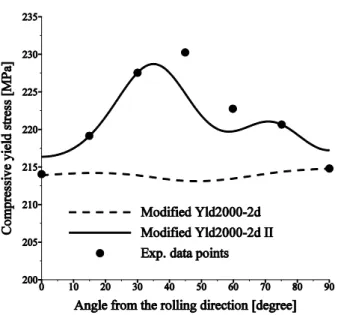
Figures (3) and (4) show tensile and compressive yield stresses in different angles from the ro-lling direction for Al 2008-T4 and Al 2090-T3 and the obtained results are compared with expe-rimental results. For Al 2090-T3, these criteria differ essentially and since the available experi-mental data are limited, it cannot be precisely said which one is more accurate.
It is observed that the Modified 2d II is more successful than the Modified Yld2000-2d in predicting compressive yield stresses compared with experimental results. However, in pre-dicting tensile yield stresses, the Modified Yld2000-2d is still more accurate. Figures (5) and (6)
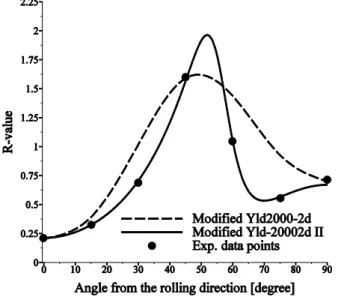
show the R-values in different angles from the rolling directions for Al 2008-T4 and Al 2090-T3.
It is seen that the Modified Yld2000-2d II can predict the experimental results more precisely than Modified Yld2000-2d especially for Al 2090-T3.
Latin American Journal of Solids and Structures 12 (2015) 92-114 (1-b)
Figure 1: (a) Yield function of Modified Yld 2000-2d and Modified Yld 2000-2d II in compared with experimental results, (b) plastic potential surface of Modified Yld 2000-2d II for Al 2008-T4.
Latin American Journal of Solids and Structures 12 (2015) 92-114 (2-b)
Figure 2: (a) Yield function of Modified Yld 2000-2d and Modified Yld 2000-2d II in compared with experimental results, (b) plastic potential surfaces of Modified Yld 2000-2d II for Al 2090-T3.
Latin American Journal of Solids and Structures 12 (2015) 92-114 (3-b)
Figure 3: Comparison of the yield stress directionality for Al 2008-T4: (a) uniaxial tensile yield stress; and (b) uniaxial compressive yield stress.
Latin American Journal of Solids and Structures 12 (2015) 92-114 (4-b)
Figure 4: Comparison of the yield stress directionality for Al 2090-T3: (a) uniaxial tensile yield stress; and (b) uniaxial compressive yield stress.
Latin American Journal of Solids and Structures 12 (2015) 92-114
Figure 6: Comparison of the R-value directionality for Al 2090-T3.
As it is observed, to calibrate the yield function in compressive yield stresses the experimental data points are increased from two
0,
90
C C
in Modified Yld2000-2d to seven in ModifiedYld2000-2d II
0,
15,
45,
60,
75,
90
C C C C C C
and consequently Modified Yld2000-2d II can predict the compressive yield stresses more accurately, Figs. (3-b) and (4-b). To calibrate the yield fun-ction for tensile yield stresses, however, three experimental data points
0,
45,
90
T T T
are selected for both criteria and it is seen that the Modified Yld2000-2d is closer to experimental data than Modified Yld2000-2d II, Figs. (3-a) and (4-a). To calibrate the yield function for biaxial yield stress
Tb
one data point is used for both criteria and they could predict the experimental datapoint reasonably, Figs. (1-a) and (2-a). The relative errors for these cases are computed in Tables (6) and (7).
In order to calibrate the plastic potential function in Modified Yld2000-2d II seven experimen-tal data points are used
0,
15,
45,
60,
75,
90
T T T T T T
R
R
R
R
R
R
which are much more than three data pointsin yield function of Modified Yld2000-2d
0,
45,
90
T T T
R
R
R
and consequently the obtained resultsare more accurate than those of Modified Yld2000-2d, Figs. (5) and (6). For T b
R
, one point is selected for both criteria and they predict the experimental data point properly. The relative error for this case computed in Tables (6) and (7).Latin American Journal of Solids and Structures 12 (2015) 92-114 In Modified Yld2000-2d and Yld2000-2d the experimental data points employed for calibration are a combination of yield stresses and R-values in different angles from rolling direction, while
for the Modified Yld2000-2d II they are yield stresses and R-values for the yield and plastic
po-tential functions, respectively. In the following the relative errors are computed in Tables (6) and (7) for Al 2008-T3 and Al2008-T4 from Eqs. (28) to (32) and compared with experimental results.
Criterion
E
TE
CE
TbE
TRTb R
E
Modified Yld2000-2d 0.2704 1.5915 6.0536e-007 3.985 0.0187
Modified Yld2000-2d II 0.5838 0.4617 1.8179e-009 1.8179e-009 0.00076
Table 6: The obtained computation errors for Al 2008-T4 compared with experimental results (in percentage).
Criterion
E
T CE
TbE
TR
E
E
RTbModified Yld2000-2d 0.7350 2.4651 2.3763e-010 12.889 0.0017
Modified Yld2000-2d II 1.2207 0.6645 8.2811e-010 0.754 0.000098
Table 7: The obtained computation errors for Al 2008-T4 compared with experimental results (in percentage).
Tables (6) and (7) show that Modified Yld2000-2d II predicts C
, T b
, TR
and TR
moreaccu-rately than Modified Yld2000-2d for Al 2008-T4 (a BCC material) and Al2090-T3 (a FCC mate-rial).
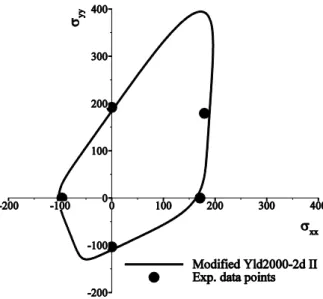
In the following to check the proposed criterion for strong strength differential effect, AZ31 which is a HCP material at 3% plastic strain is choosen for study. Its experimental data points is
utilized from Yoon et al. (2014). Figure (7) show the yield function for AZ31 in
xx
yy and asLatin American Journal of Solids and Structures 12 (2015) 92-114
Figure 7: The Modified Yld2000-2d II and experimental data points for AZ31.
Latin American Journal of Solids and Structures 12 (2015) 92-114 (8-b)
Figure 8: Comparison of the Modified Yld2000-2d II with experimental results for AZ31: (a) uniaxial tensile yield stress, (b) uniaxial compressive yield stress.
In Table 9, the obtained errors of Modified Yld2000-2d II in predicting tensile yield stress, com-pressive and biaxial yield stresses in compared with experimental results are shown and as it is seen the proposed criterion is also successful for a HCP material.
Criterion
E
TE
CE
TbModified Yld2000-2d II 0.1980 0.3896 1.9173e-010
Table 9: The obtained computation errors for AZ31 compared with experimental results (in percentage).
6 CONCLUSIONS
Latin American Journal of Solids and Structures 12 (2015) 92-114
References
Aretz, H. (2009). A consistent plasticity theory of incompressible and hydrostatic pressure sensitive metals II, Mechanics Research Communications, 36: 246 251.
Barlat, F., Brem, J.C., Yoon, J.W., Chung, K., Dick, R.E., Lege, D.J., Pourboghrat, F., Choi, S.H. and Chu, E. (2003). Plane stress yield function for aluminum alloy sheets part 1: theory, International Journal of Plasticity, 19: 1297 1319.
Barlat, F., Maeda, Y., Chung, K., Yanagawa, M. Brem, J.C., Hayashida, Y., Lege, D.J., Matsui, K., Murtha, S.J., Hattori, S., Becker, R.C. and Makosey, S. (1997). Yield function development for aluminium alloy sheets, Journal of the Mechanics and Physics of Solids, 45: 1727-1763.
Cleja-Ţi–oiu, S. and Lancu, L. (2013). Orientational anisotropy and strength-differential effect in orthotropic elasto-plastic materials, International Journal of Plasticity, 47: 80 110.
Cvitanić, V., Valk, F. and Lozina, Ž. (2008). A finite element formulation based on non-associated plasticity for
sheet metal forming, International Journal of Plasticity, 24: 646 687.
Gao, Z., Zhao, J. and Yao, Y. (2010). A generalized anisotropic failure criterion for geomaterials, International Journal of Solids and Structures, 47: 3166 3185.
Hua, W. and Wang, Z.R. (2009). Construction of a constitutive model in calculations of pressure-dependent mate-rial, Computational Materials Science, 46: 893 901.
Huh, H., Lou, Y., Bae, G. and Lee, C. (2010). Accuracy analysis of anisotropic yield functions based on the root-mean square error, AIP Conference Proceeding of the th NUMIFORM, 1252: 739-746.
Lee, M.G., Wagoner, R.H., Lee, J.K., Chung, K. and Kim, H.Y. (2008). Constitutive modeling for anisotro-pic/asymmetric hardening behavior of magnesium alloy sheets, International Journal of Plasticity, 24: 545 582. Liu, C., Huang, Y. and Stout, M.G. (1997). On the asymmetric yield surface of plastically orthotropic materials: a phenomenological study, Acta Metallurgica, 45: 2397-2406.
Lou, Y., Huh, H. and Yoon, J.W. (2013). Consideration of strength differential effect in sheet metals with symme-tric yield functions, International Journal of Mechanical Sciences, 66: 214 223.
Park, T. and Chung, K. (2012). Non-associated flow rule with symmetric stiffness modulus for isotropic-kinematic hardening and its application for earing in circular cup drawing, International Journal of Solids and Structures, 49: 3582 3593.
Safaei, M., Lee, M. G., Zang, S. L. and Waele, W.D. (2014). An evolutionary anisotropic model for sheet metals
based on non-associated flow rule approach, Computational Materials Science, 81: 15 29.
Safaei, M., Zang, S.L., Lee, M.G. and Waele, W.D. (2013). Evaluation of anisotropic constitutive models: Mixed anisotropic hardening and non-associated flow rule approach, International Journal of Mechanical Sciences, 73:
53 68.
Safaei, M., Yoon, J.W. and Waele, W.D. (2014). Study on the definition of equivalent plastic strain under non- associated flow rule for finite element formulation, International Journal of Plasticity, 58: 219 238.
Yoon, J.W., Lou, Y., Yoon, J. and Glazoff, M.V. (2014), Asymmetric yield function based on the stress invariants for pressure sensitive metals, International Journal of Plasticity, 56: 184 202.
Spitzig, W.A. and Richmond, O. (1984). The effect of pressure on the flow stress of metals, Acta Metallurgica, 32: 457-463.
Stoughton, T.B. and Yoon, J.W. (2004). A pressure-sensitive yield criterion under a non-associated flow rule for sheet metal forming, International Journal of Plasticity, 20: 705 731.
Stoughton T.B. and Yoon, J.W. (2009). Anisotropic hardening and non-associated flow in proportional loading of sheet metals, International Journal of Plasticity, 25: 1777 1817.