Abstract
This paper presents an investigation on interaction equation between the required flexural strength, M, and the required shear strength, V, of cold-formed C-channels with web holes and bearing stiffeners. The primarily shear condition test was employed to study total 8 back to back lipped C channel sections of 95 and 100 mm depth when bearing stiffeners and circular holes were placed at center and both ends of specimens. The interaction equation were evaluated via Direct Strength Method, DSM, in accordance with the American Iron and Steel Institute for the design of cold-formed steel structural members, AISI 2007. A nonlinear finite element model was devel-oped and verified against the test results in terms of failure buckling modes. It was concluded that the M-V interaction equation for spec-imens with web stiffeners was conservative where these specspec-imens experienced plastic failure mode rather than local (Msl) or distor-tional (Msd) buckling mode. Moreover, the results indicated that proposed M-V interaction equation calculated by local buckling strength (Msl) adequately predicted the behavior of specimens with circular web holes.
Keywords
cold-formed steel; pure bending test; Direct Strength Method; ine-lastic buckling strength; local buckling; distortional buckling; non-dimensional slenderness.
Effect of Web Holes and Bearing Stiffeners on Flexural-Shear
Interaction Strength of Steel Cold-Formed C-Channel Sections
1 INTRODUCTION
Cold-formed steel joists are typically C-channel sections where they usually experience web buckling (or web crippling) under relatively low concentrated loads that usually occur at supports. To preclude such drawback resulted to web crippling, web bearing stiffeners are attached to the beam sections in
Iman Faridmehr a Mohd Hanim Osman a Mamood Md. Tahir a Abbas Razavykia b Ali Farokhi Nejad b
a UTM Construction Research Centre (CRC), Institute of Smart Infrastruc-tures and Innovative Construction, Uni-versiti Teknologi Malaysia (UTM), Skudai, Johor Bahru, 81300, Malaysia
b Deparment of Mechanical and Aerospace Engineering (DIMEAS), Politecnico di Torino, Corso Duca degli Abruzzi, Torino, Italy
Corresponding author: Mahmood Md. Tahir [email protected]
http://dx.doi.org/10.1590/1679-78252033
order to transfer the vertical loads. Generally, smaller C-channel sections are considered as web bear-ing stiffeners which are attached to the back of the sections or install fit to fit between two flanges of C-sections as shown in Figure 1(a). The self-drilling screws are employ to connect the bearing stiffeners and web’s sections. The stiffeners resist to the concentrated vertical loads at the preliminary stage of loading protocol, but web crippling occur when the section is expose to sufficiently high load. After this stage, the web bearing stiffeners act as short columns to transferring axial load from the top flange surface to the bottom flange.
Moreover, to facilitate electrical, plumbing and heating pipe the circular holes are placed in the webs of joists. Therefore, web crushing or crippling at this points are common failure mode of C-channel sections where they are subjected to significant concentrated load as this sections are not stiffened against this type of loading. Fig. 1(b) shows one example of floor joists with web that demand web crippling phenomenon to be taken into account on its design procedure.
(a) (b)
Figure 1: Bearing stiffeners (a) and web holes (b) at steel cold-formed joists.
The short span and cantilever beams are subjected to high bending and shear stress at their support regions. These beam webs shall resist against buckling as a result of combination of bending and shear stresses. For beams with unreinforced webs, the required flexural strength, M, and required shear strength, V, shall satisfy the following interaction equation in accordance with section C3.3 of American Iron and Steel Institute, AISI 2007:
∅ ∅ . (1)
For beams that have transverse web stiffeners, once / ∅ . and / ∅ . , the following interaction equation in accordance with section C3.3 of AISI 2007 must be satisfied by M and V:
. ∅ ∅ . (2)
where:
Mn= nominal flexural strength once bending alone is taken into account
ϕb= resistance factor for bending (0.9)
Vn= nominal shear strength once shear alone is taken into account
V= required shear strength
Φv= resistance factor for shear (0.95)
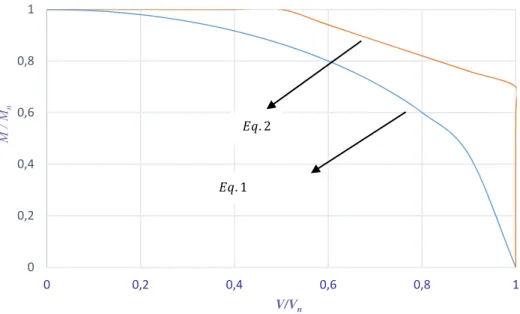
The interaction equation for unreinforced web and web with transverse stiffeners is demonstrated in Figure 2. This specific interaction is resulted from an approximation of theoretical interaction of local buckling due to shear and bending that was calculated by Timoshenko and Gere (1961).
Figure 2: The interaction equation for unreinforced web and web with transverse stiffeners.
In order to investigate the structural performance of reinforced and unreinforced beam webs under shear stress, bending stress, web crippling load and combinations thereof, a research titled “Webs for Cold-Formed Steel Flexural Members” and funded by the American Iron and Steel Institute was conducted at the University of Missouri-Rolla. (Laboube and Yu 1978) and (Hetrakul and Yu 1978) are the two references that entail the results of this project. Based on their work, the load carrying capacity of transverse stiffeners was calculated according to column formulae that considered an adjacent portion of the web as a part of the stiffener column. Finding this effective portion of the web was a difficult task for analytical analysis because factors like elastic and inelastic instability of the stiffener, web crippling strength of a combination of stiffener and beam web and finally plate element local buckling of the stiffener have to be involved in this process. In later studies aimed at developing design rules for thin-walled members and/or stiffened plates, (Hoon, Rhodes et al. 1993) and (Bernard, Bridge et al. 1993) published their experimental investigations results. In another study, some modi-fications to the safety and design checking procedures of stiffened members were recommended by (Schafer 2002) to investigate the possibility of using intermediate stiffeners within the cross-section walls. The experimental and numerical work conducted by (Narayanan and Mahendran 2003), (Teter and Kolakowski 2004) and (Yang and Hancock 2004) regarding the load-carrying capacity and
post-0 0,2 0,4 0,6 0,8 1
0 0,2 0,4 0,6 0,8 1
M /
M
n
V/V
n .
buckling behavior of cold-formed steel lipped channel columns having web and flange intermediate stiffeners is of great importance.
The shear capacity of beam sections with web openings could be reduced as a result of reduced web area. The significant shear capacity reduction of lipped channel beams will occur due to primary shear resisting area reductions. Yet, web openings do not affect the flexural capacity since they are commonly placed at web centers. Numerous variables influence the shear capacity of members with web openings like location, size and shape of web openings along with slenderness of web elements. Previous studies of researchers like (LaBoube, Yu et al. 1997), (Eiler, LaBoube et al. 1997) regarding the strength and shear behavior of cold-formed steel sections having web openings were only focused on to ‘C’ sections. (LaBoube, Yu et al. 1997) suggested a reduction factor (qs) to calculate the nominal shear capacity of cold-formed lipped channel beams having web openings. This factor was applied to the solid web strength of the shear element. LaBoube et al.'s work was continued and improved by (Eiler, LaBoube et al. 1997) with inclusion of the performance of web elements with openings under linearly varying shear force. In his tests, a uniform load with no constant shear was applied to cold-formed steel beams with web openings.
The shear performance of hollow flange channel beams aka Lite Steel beams having circular web openings were experimentally and numerically investigated by (Poologanathan and Mahendran 2012) (Keerthan and Mahendran 2012). In their studies, design equations regarding the shear capacity with web openings (Vnl) were developed according to a reduction factor qs applied to the shear capacity of Lite Steel beams without web openings (Vv). An isoparametric spline finite strip procedure was hired by (Pham and Hancock 2009) to study the elastic buckling of lipped and un-lipped channel sections under shear stresses. Their work included the influence of flanges over the shear buckling of web elements of channel sections. In a more recent study, 84 tests were conducted by (Zhou and Young 2010) on aluminium alloy square hollow sections having circular holes placed at the bottom center of the bearing plates. Two loading conditions namely Interior-Two-Flange (ITF) and End-Two-Flange (ETF) were used in web crippling tests. Also, they proposed a few reduction factors as well.
2 EXPERIMENTAL INVESTIGATION
2.1 Test Specimens
Figure 3: (a) Cross section of back to back lipped C-channel Section, (b) location of circular hole and web bearing stiffeners.
Section Thickness (mm)
D (mm)
B (mm)
L (mm) SC
150-16 1.6 150 130 16
SC
100-10 1.0 100 50 12
Table 1: Lipped C-channel sections' dimensions.
Two specimens were longitudinally considered from the web center of each C-channel to run the tensile tests. The tensile specimen’s dimensions were in conformity with ASTM E 8 – E8M using a gauge with a width and length of 12.5 and 50 mm, respectively (Faridmehr, Osman et al. 2014). Table 2 illustrates the material properties of tested specimens based on tensile test results.
Specimen E
(GPa)
Fy at (0.2%) (MPa)
%Strain at 0.2% Yield
Fu (MPa)
%Strain at Maximum
Stress
SC 150-16 192.02 478.01 0.448 510.59 6.82
SC 100-10 207.43 636.64 0.511 642.22 1.263
Table 2: Material properties of tested specimens.
2.2 Test Rig and Operation
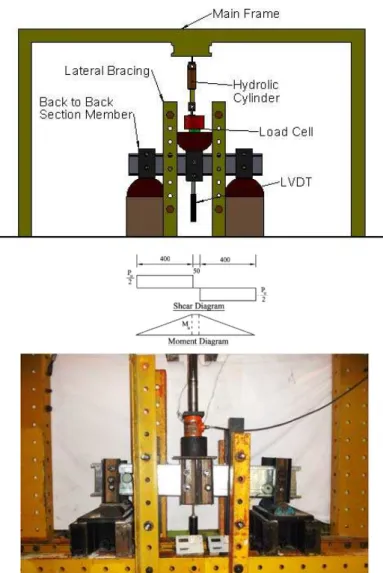
Figure 4: Primarily shear condition test setup configuration.
2.3 Test Results
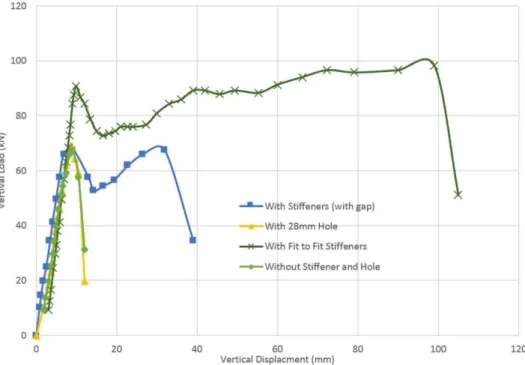
also create moments at the top and bottom of the joist web that will start to curve the web outward as shown in Figure 7. Moreover, the significant nonlinear behavior for sections with web bearing stiffeners proved that local buckling was the governing failure mode in them.
Figure 5: Load versus vertical displacement for SC 150-16 specimens.
Figure 7: Stiffener Deformation Stages.
3 FINITE ELEMENT MODELING
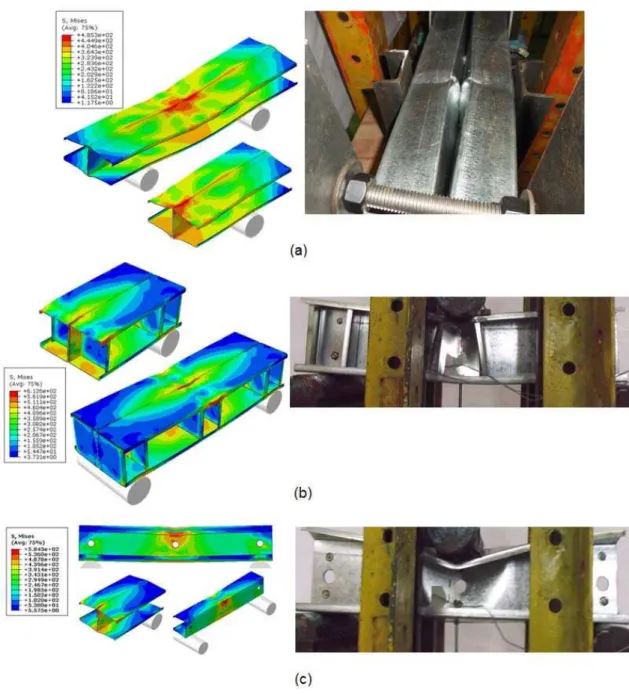
Figure 8: A comparison between experimental and numerical failure modes (a) specimen without stiffeners and hole, (b) specimen with web bearing stiffeners and (c) specimens with web circular holes.
4 INTERACTION RELATION FOR BENDING AND SHEAR
strength used as distortional buckling (Msd) and nominal flexural strength used for local buckling (Msl), is given in Eq. (3)
min , (3)
Since installation of lateral bracing results in no torsional buckling, the specimens could be treated as fully braced beams. Therefore, referring to Appendix 1.2.2.1 of the North American Specification AISI 2007, the yield moment (My ) is used instead of the nominal flexural strength (Mn) for lateral- torsional buckling (Mse) in fully braced beams.
The nominal member moment capacity at local buckling ( ) will be calculated from Appendix 1, Section 1.2.2.2 of AISI 2007 (2012):
. : (4)
˃ . : . . . (5)
where,
= non-dimensional slenderness incorporated to calculate = ⁄ ; = nominal moment capacity of the member regarding the lateral torsional buckling of the full section; = elastic local buckling moment of the section: ; = the section's elastic local buckling stress in bending; = section modulus about a horizontal axis of the full section. As mentioned before, lateral braces have been used in this study to prevent the lateral-torsional buckling so that
in Eq. (5), where .
Appendix 1, Section 1.2.2.3 of AISI 2007 (2012) is used to determine the nominal moment capacity of the member at distortional buckling (Msd):
. : (6)
˃ . : .
. .
(7)
where,
= non-dimensional slenderness incorporated to calculate = ⁄ ; = the sec-tion's elastic distortional buckling moment - ; = the section's elastic distortional buckling stress in bending; = section modulus of the full section about a horizontal axis; and
finally .
The nominal shear strength, Vn, of specimens were determined in conformity with Section C3.2.1 of AISI 2007 as shown in follow:
For / . . / (9)
For . / / (10)
where
Vn = nominal shear strength
Aw= area of web element (h×t) where h= depth of flat portion of web
t=web thickness
E= modulus of elasticity of steel
Kv= shear buckling coefficient (for unreinforced web, Kv= 5.34) μ= Poisson’s ratio for steel = 0.3
The shear buckling coefficient for web with transverse stiffeners is calculated as follows based on section C3.2.1 of AISI 2007:
For / .
(11)
For / . (12)
Where,
a= shear panel length of unreinforced web element (clear distance between bearing web stiffeners, 300mm)
For C-section webs with circular holes, the shear strength shall be calculated in accordance with Eq 8 to 10, multiplied by the reduction factor qs as defined with following equation:
For / . (13)
For / / (14)
Where
/ .
Specimen (kN) Pu (kN.m) Mt (kN) Vt (kN.m) Vn (kN.m) Msl (kN.m) Msd (kN.m) Mp
SC150-16
Without Web Stiffener
and hole
66.50 14.13 33.25 50.40 19 15.8 24.84 0.74 0.89 0.56 0.70
With Web Stiffeners (with gap)
67.65 14.37 33.82 60.03 19 15.8 24.84 0.75 0.90 0.57 0.60
With Fit to Fit Stiffeners
101.2
0 21.50 50.60 60.03 19 15.8 24.84 1.13 1.36 0.86 0.88 With 28mm
Web holes 66.00 14.02 33.00 38.00 19 15.8 24.84 0.73 0.88 0.56 0.91
SC100-10
Without Web Stiffener
and hole
25.50 5.41 12.75 20.00 6.22 5.05 9.41 0.86 1.07 0.57 0.64
With Web Stiffeners (with gap)
34.48 7.32 17.24 21.65 6.22 5.05 9.41 1.17 1.44 0.77 0.80
With Fit to
Fit Stiffeners 44.55 9.46 22.27 21.65 6.22 5.05 9.41 1.52 1.87 1.00 1.02 With 18mm
Web holes 26.50 5.63 13.25 16.00 6.22 5.05 9.41 0.90 1.11 0.60 0.82
Table 3: Demand to capacities ratio for primarily shear condition tests of SC150-16 and
SC100-10 lipped C-channel sections.
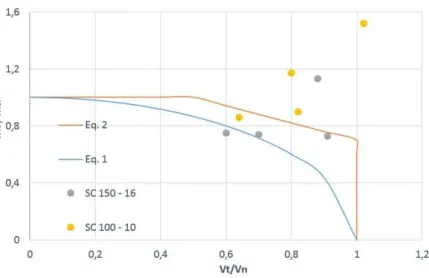
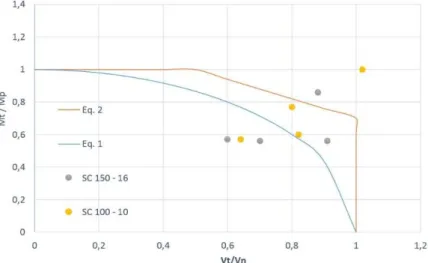
In order to evaluate the adequacy of the existing M-V interaction equation suggested by the North American Specification (2012) for sections with web stiffeners and holes, three different cases (A,B and C) were considered. The horizontal axes in cases A, B and C are constant which represent Vt / Vn while vertical axes represent Mt / Msl , Mt / Msd and Mt / Mp , respectively.
Figure 8: Interaction equation between (Mt /Msl) and (Vt /Vn) (case A).
Figure 10 reveals that Eq.1 provides a better prediction for specimens without web stiffeners and holes by using distortional buckling strength (Msd). However, Eq. 2 established more conservative results for specimens with web bearing stiffeners and holes compare to those of Figure 9. One hy-pothesis about the behavior of a C-sections with web bearing stiffeners is that, the capacity of the stiffened assembly is the addition of the web crippling capacity of the joist web and the axial capacity of the stiffener. Due to the restraint provided to the joist web by the stiffener, it can be argued that the web crippling of the stiffened joist behaves more like a built-up section than a single web member. Accordingly, the web bearing stiffeners enhance the tension field action and therefore, specimens are enforced to experience the plastic failure mode. All in all, incorporation of the distortional buckling moment into Eq. 1 gives more accurate predictions of M-V interaction behavior for specimens without web stiffeners and holes.
Figure 11 shows the M-V interaction where the plastic moment Mp was employed to calculate the interaction equation. The curve indicates that Eq. 2 establishes good predictions for specimens with fit to fit stiffeners, especially for SC 150-100 section. This is because plastic moment, Mp, is higher than Msl and Msd and accordingly, using the plastic moment, Mp, for this sections that experienced the plastic failure mode resulted in more accurate predictions. On the other hand, Eqs.1 is un-conservative for specimens without holes and stiffeners and specimens with web holes. This issue can be explained by the fact that this specimens experienced failure as a result of elastic distortional or local buckling before developing the full plastic moment.
Figure 10: Interaction equation between (Mt /Mp) and (Vt /Vn) (case C).
5 CONCLUSION
Acknowledgments
The authors wish to thank Steelon Roofing System SDN BHD, for supplying the test material. Moreover, the authors wish to acknowledge Dr. John Papangelis, School of Civil Engineering, University of Sydney, NSW, Australia, for his technical support regarding the THIN-WALL software. Also, the financial support provided by Universiti Teknologi Malaysia Construction Research Center (CRC) for conducting the experimental work is also appreciated.
References
AISI. (2012). North American specification for the design of cold-formed steel structural members, AISIS100-12. Wash-ington, D.C., American Iron and Steel Institute.
Bernard, E. S., R. Q. Bridge and G. J. Hancock (1993). "Tests of profiled steel decks with V-stiffeners." Journal of Structural Engineering 119(8): 2277-2293.
Eiler, M. R., R. A. LaBoube and W.-w. Yu (1997). "Behavior of web elements with openings subjected to linearly varying shear."
Faridmehr, I., M. H. Osman, A. B. Adnan, A. F. Nejad, R. Hodjati and M. A. Azimi (2014). "Correlation between Engineering Stress-Strain and True Stress-Strain Curve." American Journal of Civil Engineering and Architecture 2(1): 53-59.
Hetrakul, N. and W. Yu (1978). "Structural behavior of beam webs subjected to web crippling and a combination of web crippling and bending." Final report, civil engineering study: 78-74.
Hoon, K., J. Rhodes and L. Seah (1993). "Tests on intermediately stiffened plate elements and beam compression elements." Thin-walled structures 16(1): 111-143.
Keerthan, P. and M. Mahendran (2012). "New design rules for the shear strength of LiteSteel beams with web open-ings." Journal of Structural Engineering 139(5): 640-656.
Laboube, R. A. and W.-w. Yu (1978). Webs for Cold-formed Steel Flexural Members: Structural Behavior of Beam Webs Subjected to Bending Stress, Department of Civil Engineering, University of Missouri--Rolla.
LaBoube, R. A., W. W. Yu, J. Langan and M. Shan (1997). "Cold-formed steel webs with openings: Summary report." Thin-walled structures 27(1): 79-84.
Narayanan, S. and M. Mahendran (2003). "Ultimate capacity of innovative cold-formed steel columns." Journal of Constructional Steel Research 59(4): 489-508.
Pham, C. H. and G. J. Hancock (2009). "Shear buckling of thin-walled channel sections." Journal of Constructional Steel Research 65(3): 578-585.
Poologanathan, K. and M. Mahendran (2012). "Shear behaviour and strength of LiteSteel beams with web openings." Advances in Structural Engineering 15(2): 197-210.
Schafer, B. W. (2002). Stiffened elements with multiple intermediate stiffeners and edge stiffened elements with inter-mediate stiffeners. Sixteenth international specialty conference on cold-formed steel structures., Missouri S&T (formerly the University of Missouri-Rolla).
Teter, A. and Z. Kolakowski (2004). "Interactive buckling and load carrying capacity of thin-walled beam–columns with intermediate stiffeners." Thin-walled structures 42(2): 211-254.
Yang, D. and G. J. Hancock (2004). "Compression tests of high strength steel channel columns with interaction between local and distortional buckling." Journal of Structural Engineering 130(12): 1954-1963.