JPediatr(RioJ).2017;93(5):497---507
www.jped.com.br
ORIGINAL
ARTICLE
Genomic
imbalances
in
syndromic
congenital
heart
disease
夽
,
夽夽
Miriam
Coelho
Molck
a,
Milena
Simioni
a,
Társis
Paiva
Vieira
a,
Ilária
Cristina
Sgardioli
a,
Fabíola
Paoli
Monteiro
a,
Josiane
Souza
b,
Agnes
Cristina
Fett-Conte
c,
Têmis
Maria
Félix
d,
Isabella
Lopes
Monlléo
e,
Vera
Lúcia
Gil-da-Silva-Lopes
a,∗aUniversidadeEstadualdeCampinas(UNICAMP),DepartamentodeGenéticaMédica,Campinas,SP,Brazil bCentrodeAtendimentoIntegralaoFissuradoLábioPalatal(CAIF),Curitiba,PR,Brazil
cFaculdadedeMedicinadeSãoJosédoRioPreto,DepartamentodeBiologiaMolecular,SãoJosédoRioPreto,SP,Brazil dHospitaldeClínicasdePortoAlegre,Servic¸odeGenéticaMédica,PortoAlegre,RS,Brazil
eUniversidadeFederaldeAlagoas(UFAL),HospitalUniversitário,FaculdadedeMedicina,Servic¸odeGenéticaClínica,Maceió,
AL,Brazil
Received27July2016;accepted21November2016 Availableonline21March2017
KEYWORDS
DNAcopynumber variations; Congenitalheart defects;
22q11deletion syndrome;
Comparativegenomic hybridization; Chromosome aberrations
Abstract
Objective: Toidentifypathogenicgenomicimbalancesinpatientspresentingcongenitalheart
disease (CHD) with extra cardiac anomalies and exclusion of 22q11.2 deletion syndrome
(22q11.2DS).
Methods: 78patientsnegativeforthe22q11.2deletion,previouslyscreenedbyfluorescence
insituhybridization(FISH)and/ormultiplexligationprobeamplification(MLPA)weretestedby
chromosomalmicroarrayanalysis(CMA).
Results: Clinically significantcopy numbervariations(CNVs ≥300kb) were identifiedin10%
(8/78) ofcases. In addition,potentially relevant CNVs were detected intwo cases (993kb
duplicationin15q21.1and706kbduplicationin2p22.3).GenesinsidetheCNVregionsfound
inthisstudy,suchasIRX4,BMPR1A,SORBS2,ID2,ROCK2,E2F6,GATA4,SOX7,SEMAD6D,FBN1,
andLTPB1areknowntoparticipateincardiacdevelopmentandcouldbecandidategenesfor CHD.
Conclusion: ThesedatashowedthatpatientspresentingCHDwithextracardiacanomaliesand
exclusion of22q11.2 DSshould beinvestigated by CMA.The present study emphasizesthe
possibleroleofCNVsinCHD.
©2017SociedadeBrasileiradePediatria.PublishedbyElsevierEditoraLtda.Thisisanopen
accessarticleundertheCCBY-NC-NDlicense(http://creativecommons.org/licenses/by-nc-nd/
4.0/).
夽
Pleasecitethisarticleas:MolckMC,SimioniM,VieiraTP,SgardioliIC,MonteiroFP,SouzaJ,etal.Genomicimbalancesinsyndromic
congenitalheartdisease.JPediatr(RioJ).2017;93:497---507.
夽夽
StudyconductedatUniversidadeEstadualdeCampinas(UNICAMP),DepartamentodeGenéticaMédica,Campinas,SP,Brazil.
∗Correspondingauthor.
E-mail:[email protected](V.L.Gil-da-Silva-Lopes).
http://dx.doi.org/10.1016/j.jped.2016.11.007
498 MolckMCetal.
PALAVRAS-CHAVE
Variac¸õesdonúmero decópiasdeDNA; Cardiopatias congênitas;
Síndromededelec¸ão 22q11;
Hibridizac¸ão genômica comparativa; Aberrac¸ões cromossômicas
Desequilíbriosgenômicosnacardiopatiacongênitasindrômica
Resumo
Objetivo: Identificar desequilíbrios genômicos patogênicosem pacientesapresentando
Car-diopatiasCongênitas (CC)eanomalias extracardíacas, eexclusão daSíndromede Delec¸ão
22q11.2(SD22q11.2).
Métodos: Umtotalde78pacientesnegativosparaadelec¸ão22q11.2,previamentetestadospor
hibridac¸ãoinsitucomfluorescência(FISH)e/ouamplificac¸ãodemúltiplassondasdependentes
deligac¸ão(MLPA),foramavaliadospormicroarraycromossômico(CMA).
Resultados: Foramidentificadasvariac¸õesdonúmerodecópiasdeDNA(CNVs)clinicamente
significativas(≥300kb)em 10%(8/78)dos casos,alémdeCNVs potencialmente relevantes
em doiscasos (duplicac¸ãode993kb em15q21.1 eduplicac¸ãode706kb em 2p22.3).Genes
envolvidoscomoIRX4,BMPR1A,SORBS2,ID2,ROCK2,E2F6,GATA4,SOX7,SEMAD6D,FBN1e
LTPB1sãoconhecidosporatuaremnodesenvolvimentocardíacoepodemsergenescandidatos
aCC.
Conclusão: EstesdadosmostramquepacientesapresentandoCC,comanomaliasextra
cardía-caseexclusãodaSD22q11.2,devemserinvestigadosporCMA.Ainda,esteestudoenfatizaa
possívelfunc¸ãodasCNVsnasCC.
©2017SociedadeBrasileiradePediatria.PublicadoporElsevierEditoraLtda.Este ´eumartigo
OpenAccesssobumalicenc¸aCCBY-NC-ND(http://creativecommons.org/licenses/by-nc-nd/4.
0/).
Introduction
Congenitalheartdisease(CHD)isacommonmalformation affectingapproximatelysixper1000livebirths.Itoccursas anisolatedtrait orrelated tomultiple congenital anoma-lies,amongwhichthe22q11.2deletionsyndrome(22q11.2 DS)is the most common.1 CHD is the most critical mani-festation and representsthe major morbimortality factor in22q11.2DS,affectingbetween74%and80%ofpatients. Among the variety of CHDs reported,conotruncal and/or aorticarch defectsarethe mostprevalent.2The causeof cardiacphenotypicheterogeneityisnotknown,butthereis noevidenceofcorrelationwithsex,race,22q11.2deletion size,orparentaloriginofthedeletion.3
Itisrecommendedthatallnewbornsorchildren present-ingCHDanddysmorphismorothercongenitalanomaliesbe screenedfor22q11.2deletion.4Inaddition,genomic imbal-ancesofotherchromosomalregions,including10p12-p15, 4q21-q35, 8p21-p23, 17p13, and 18q21, can be found in patientswithclinicalsuspicionof 22q11.2DSandwithout 22q11.2deletion.5
Currently, the application of chromosomal microarray analysis(CMA) for clinical diagnosis allows the identifica-tion of previously undetectable submicroscopic genomic imbalances,bringingnewinformationaboutthegenesisof congenitaldefects.Thecurrentstudyinvestigatedagroup ofindividualspresentingCHDwithextracardiacanomalies andexclusionof22q11.2DStoidentifypathogenicgenomic imbalances.
Patients
and
methods
Patients
TheResearchEthicsCommitteeoftheUniversityof Camp-inasapprovedthisstudy(No.487/2009 and433/2010).All participantsortheirguardianssignedthewritteninformed
consent. The evaluation included a standardized protocol aspartofamulticenterstudyoftheBrazilianCraniofacial Project,andallindividualswereseenbyageneticist.
Initially,agroupof108patientshavingCHD withextra cardiacanomaliesandclinicalsuspicionof22q11.2deletion werescreenedbyfluorescence insituhybridization(FISH) and/ormultiplexligation probeamplification(MLPA).Only 78patients(43malesand35females)without22q11.2 dele-tionwereincludedinthepresentstudy.
AmongtheCHDsinthiscohort,tetralogyofFallot(ToF) wasobservedin40%,ventricularseptaldefect(VSD)in22%, andatrialseptaldefect(ASD)in8%ofcases.In9%ofcases, twoof thesethreedefectswere observed.The remaining 21%ofcasespresentedothercardiacdefectssuchas trun-cusarteriosus(TA),bicuspidaorticvalve(BAV),andpatent ductusarteriosus(PDA),amongothers.
The main clinical features found in these patients, in additiontoCHD,were:facialdysmorphisms---96%(75/78), neurocognitive and behavioral-developmental abnormali-ties --- 65% (51/78), skeletal abnormalities --- 58% (45/78), palatalabnormalities---43%(34/78),immunological abnor-malities --- 41% (32/78), growth delay and/or feeding abnormalities --- 32% (25/78),gastrointestinal anomalies ---23%(18/78),hearingloss---10%(8/78),urinarytract anoma-lies --- 10% (8/78), eye abnormalities --- 9% (7/78), and neurologicalabnormalities---5%(4/78).
Methods
GenomicimbalancesandCHD 499
108 patients
Tested by FISH and/or MLPA
30 patients positive for 22q11.2 deletion
78 patients negative for 22q11.2 deletion
Screened by CMA (Affymetrix)
CNVs detected by ChAS (Affymetrix)
≥ 300 kb
Confirmed by nexus copy number
Confirmed by comparing with a Brazilian internal control (FCM-Unicamp)
Yes Yes
Relevant CNVs
Tested by CMA (Agilent) for confirmation
Searched in: DGV, DECIPHER and OMIM Excluded from this study
Figure1 Flowchartofthepatientpopulationandthetechniquesapplied.FISH,fluorescenceinsituhybridization;MLPA,multiplex
ligationprobeamplification;CMA,chromosomalmicroarray;CNVs,copynumbervariations;ChAS,chromosomeanalysissuite;DGV,
databaseofgenomicvariants;DECIPHER,databaseofchromosomalimbalanceandphenotypeinhumansusingensembleresources;
OMIM,OnlineMendelianInheritanceInMan.
markersfordeletionand50forduplicationswereapplied, asrecommendedbythemanufacturer,andaminimum seg-ment lengthof 300kb for both duplications anddeletions wasalsoapplied(definedaslargecopynumber variations ---CNVs).TheseCNVswereconfirmedusingtheNexusCopy Numbersoftware(BioDiscovery®,USA).CNVswerefurther comparedwithan internal control CNVdataset,including 105controlsfromtheBraziliangeneralpopulation,designed by using CytoscanHD (Affymetrix®). Only genomic imbal-ancesfoundbyalltheapproacheswereselectedforfurther investigation,usingthefollowing databases:the Database of Genomic Variants (DGV),6 the Database of Chromoso-mal Imbalance and Phenotype in Humans using Ensembl Resources (DECIPHER),7 and the Online Mendelian Inher-itance in Man (OMIM).8 CNVs considered relevant were carriedforwardtoconfirmationbyanothermicroarray plat-form.Thisconfirmationwasperformedfor18patientsusing theAgilent humangenome G3SurePrint8x60Kmicroarray (AgilentTechnologies®,USA).DNAextractedfrompatients
andreferencecontrols(Promega®,USA)weremeasuredfor
concentration and purity with a Qubit® spectrophotome-ter (Life Technologies®, USA). The quantity of 500ng of
DNAfromthepatientandofasex-matchedreferenceDNA wereprocessedforlabelingandhybridizationaccordingto themanufacturer’sprotocol(Agilentoligonucleotide array-basedCGH forgenomic DNAanalysis--- Enzymaticlabeling protocolv.7.3).Slideswerescannedinadual-laserscanner G4900DA(AgilentTechnologies®,USA)andtheimageswere
extractedandanalyzedbyusingAgilentfeatureextraction software(v.11.5.1.1).Arraydatawereanalyzedusing Agi-lentcytogenomicssoftware(v.3.0.1.1).Aflowchartwiththe patientpopulationthatwasstudiedissummarizedinFig.1.
Results
500 MolckMCetal.
overlapof DECIPHERcasesand CNVswithmore thanfour occurrencesintheDGV(overlappingmorethan50%)were notconsideredpotentiallyrelevant.
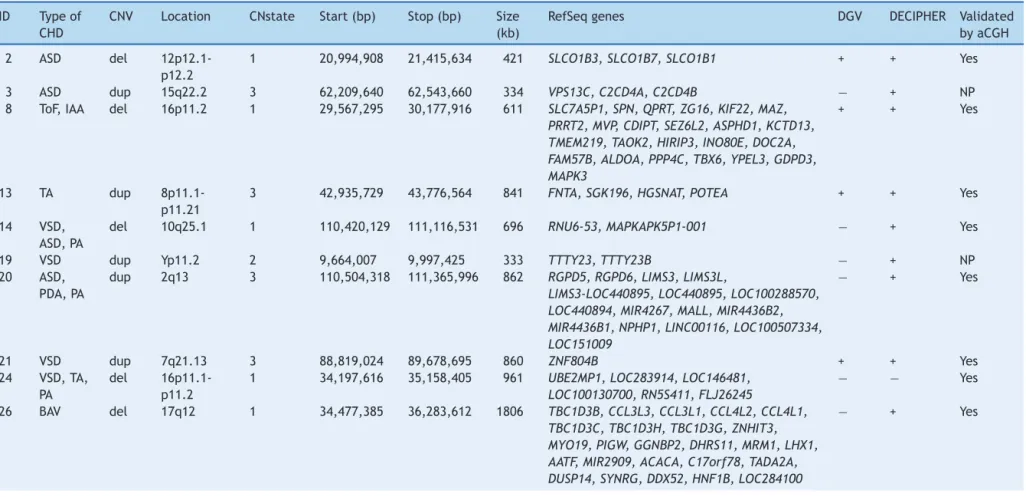
Among67CNVs≥300kb,25encompassedgenes;11 dele-tions and 14 duplications. Eighteen CNVs were confirmed by another microarray platform and twohad been previ-ouslydetectedby FISHand/or MLPAtechniques (Table1). Syndromes of multiple congenital anomalies have already been reported in the literature involving eight of these CNVs: 16p11.2 deletion syndrome OMIM 611913 (case 8), 17q12deletionsyndromeOMIM614527(case26),5pdeletion syndromeOMIM123450(case29),3qduplicationsyndrome (case40),10q22-q23deletionsyndromeOMIM612242(case 71),4qdeletionsyndrome(case 72),8p23.1deletion syn-drome (case 77), and 22q13.33 deletion syndrome OMIM 606232(case78).Thesepatientshadclinicalfeaturesthat overlapwith22q11.2DS(Table2).
Therefore,pathogenicCNVsweredetectedineightoutof 78patients(10%),withsizesfrom611kbto17.4Mb.Genes recognizedtoparticipateincardiacdevelopmentand can-didategenesfor CHDarereportedin Table3.Inaddition, twopotentiallyrelevantCNVsencompassingcardiacgenes were identified(993kb duplication in 15q21.1 and 706kb duplicationin2p22.3).
Discussion
Elucidatingthe genetic contribution of complex disorders is difficult due to the large number, low frequency, and variableeffectof predispositionloci.GenomicCNVs have been established as a major source of human genetic variation underlying several multiple congenital anomaly syndromes, including 22q11.2 DS. Determining whether a CNV contributes to a phenotype depends on various fac-tors,includingthemodeofinheritance,genecontent,the copy number state (a loss or a gain), the array platform used, and if it was found in controls from the general population.9Ingeneral,largerCNVshaveahigherpotential ofbeingpathogenic, asitis morepossible that a dosage-sensitivegeneisinvolved,and/oralargernumberofgenes are included in the imbalance, resulting in an abnormal phenotype.10
TheclassificationofaCNVnotreportedbefore,andnot includingapreviouslyknowndiseasegene,canvarybetween differentpopulations.10 Therefore,thepresentCNV analy-siswas conductedfocusing ondiagnosis and according to threeanalyticalapproaches,asthereisnotaBrazilian con-trolpopulation databaseavailable yet.Aminimumsizeof 300kbwasconsidered(definedaslargeCNVs),thenumber of genetic markers recommended, and only CNVs identi-fiedbyallthreeapproacheswereselectedforresearchand confirmation.
PathogenicCNVsweredetectedineightoutof78patients (10%) andgenes involved suchas IRX4, BMPR1A, SORBS2, ID2,ROCK2,E2F6,GATA4,andSOX7areknowntoparticipate incardiacdevelopmentandwouldbecandidategenesfor CHD.11---18
Case 8 showed a 611kb deletion overlapping the crit-ical region of 16p11.2 deletion syndrome. Patients with thissyndrome usuallypresent developmentaldelay, intel-lectual disability, features of autism spectrum disorders,
seizures (epilepsy), and obesity,19 not presented in this patient.Lessfrequently, CHD,minorfacialdysmorphisms, and speech delay were observed,19 in concordance with this patient. This patient had ToF and interrupted aortic arch.Thisdeletedregiondoesnotallocatecandidategenes relatedtoCHD,todate.
Case26showeda1.8Mbdeletionoverlappingthecritical regionof17q12deletionsyndrome.Deletionsofthisregion, includingtheHNF1ˇgene,havebeenfoundinpatientswith maturity-onsetdiabetesoftheyoungtype5(MODY5),andin patientswithcysticrenaldisease,renaldilations, pancre-aticatrophy,andliverabnormalities,20 notpresent inthis patient.Recently,intellectualdisability,speechdelay,and facialdysmorphismswereassociatedwiththisdeletion,21in commonwiththispatient,butCHDhasbeennotmentioned. ThispatienthadBAV.Therearenocandidatesgenesrelated toCHDreportedinthisdeletedregion,todate.
Case29presenteda17.4Mbdeletionin5p15.1-p15.33, harboringthe5pdeletionsyndrome(criduchatsyndrome). Infantswiththisconditionoftenhaveahigh-pitchedcrythat soundslikethatofakitten,microcephaly,lowbirthweight, andhypotonia,22 notreportedbypatient’sparents (evalu-atedwith1year).Affectedindividualsalsohaveintellectual disability and developmentaldelay, distinctive facial fea-tures,includinghypertelorism,low-setears,smalljaw,and CHD,22 asobservedinthepresentpatient.The low resolu-tionofthepreviouskaryotype[46,XY]hinderedthediagnosis ofthispatient,whichwasimprovedusingaGH.Thepatient presentsPDA.Thedeletedregionallocatesacardiac tran-scriptionfactorgene,IRX4,inwhichmutationswererelated toCHD.11
Case 40 presented a 2Mb duplication in 3q26.2, not harboring the critical region of 3q duplication syndrome (defined as 3q26.31-q27.3). Recently, cases with partial 3q duplications involving the region of this CNV have been reported and associated with this syndrome.23 The phenotypeusuallyinvolvesCHD,brainabnormalities, micro-cephaly,andatypicalfacialdysmorphismsincommonwith thispatient.ThepatienthadToF,ASD,pulmonary atresia, andpersistentleftsuperiorvenacava.Thereareno candi-dategenesrelatedtoCHDreportedinthisduplicatedregion, todate.
Case71showeda7.8Mbdeletionin10q22.3-q23.2;this regionwasrecentlyassociatedwithanewsyndrome charac-terizedbybehavioralandneurodevelopmentalimpairment, includingcognitivedelay,autism,hyperactivity,and psychi-atric ilness.24 This patient presented only developmental delay.Inaddition,mildfacialdysmorphismsandCHDwere observedlessfrequentlyin10q22-q23deletionsyndrome,25 both present in this patient. The patient had ToF. This deleted regionharbors the BMPR1A gene, suggested as a candidate gene for CHD because of its role in embryonic developmentandheartformation.12
Genomic
imbalances
and
CHD
501
Table1 TypeofCHDandCNVs≥300kbobservedinthecohort.
ID Typeof
CHD
CNV Location CNstate Start(bp) Stop(bp) Size
(kb)
RefSeqgenes DGV DECIPHER Validated
byaCGH
2 ASD del
12p12.1-p12.2
1 20,994,908 21,415,634 421 SLCO1B3,SLCO1B7,SLCO1B1 + + Yes
3 ASD dup 15q22.2 3 62,209,640 62,543,660 334 VPS13C,C2CD4A,C2CD4B − + NP
8 ToF,IAA del 16p11.2 1 29,567,295 30,177,916 611 SLC7A5P1,SPN,QPRT,ZG16,KIF22,MAZ,
PRRT2,MVP,CDIPT,SEZ6L2,ASPHD1,KCTD13, TMEM219,TAOK2,HIRIP3,INO80E,DOC2A, FAM57B,ALDOA,PPP4C,TBX6,YPEL3,GDPD3, MAPK3
+ + Yes
13 TA dup
8p11.1-p11.21
3 42,935,729 43,776,564 841 FNTA,SGK196,HGSNAT,POTEA + + Yes
14 VSD,
ASD,PA
del 10q25.1 1 110,420,129 111,116,531 696 RNU6-53,MAPKAPK5P1-001 − + Yes
19 VSD dup Yp11.2 2 9,664,007 9,997,425 333 TTTY23,TTTY23B − + NP
20 ASD,
PDA,PA
dup 2q13 3 110,504,318 111,365,996 862 RGPD5,RGPD6,LIMS3,LIMS3L,
LIMS3-LOC440895,LOC440895,LOC100288570, LOC440894,MIR4267,MALL,MIR4436B2, MIR4436B1,NPHP1,LINC00116,LOC100507334, LOC151009
− + Yes
21 VSD dup 7q21.13 3 88,819,024 89,678,695 860 ZNF804B + + Yes
24 VSD,TA,
PA
del
16p11.1-p11.2
1 34,197,616 35,158,405 961 UBE2MP1,LOC283914,LOC146481,
LOC100130700,RN5S411,FLJ26245
− − Yes
26 BAV del 17q12 1 34,477,385 36,283,612 1806 TBC1D3B,CCL3L3,CCL3L1,CCL4L2,CCL4L1,
TBC1D3C,TBC1D3H,TBC1D3G,ZNHIT3, MYO19,PIGW,GGNBP2,DHRS11,MRM1,LHX1, AATF,MIR2909,ACACA,C17orf78,TADA2A, DUSP14,SYNRG,DDX52,HNF1B,LOC284100
502
Molck
MC
et
al.
Table1 (Continued)
ID Typeof
CHD
CNV Location CNstate Start(bp) Stop(bp) Size
(kb)
RefSeqgenes DGV DECIPHER Validated
byaCGH
29 PDA del
5p15.1-p15.33
1 113,576 17,511,896 17,398 PLEKHG4B,LRRC14B,CCDC127,SDHA,PDCD6,
AHRR,C5orf55,EXOC3,PP7080,SLC9A3, MIR4456,CEP72,TPPP,ZDHHC11,BRD9,TRIP13, LOC100506688,NKD2,SLC12A7,MIR4635, SLC6A19,SLC6A18,TERT,MIR4457,CLPTM1L, SLC6A3,LPCAT1,SDHAP3,LOC728613,MIR4277, MRPL36,NDUFS6,IRX4,IRX2,C5orf38,
LOC285577,IRX1,LOC340094,ADAMTS16, KIAA0947,FLJ33360,MED10,UBE2QL1, LOC255167,NSUN2,SRD5A1,PAPD7,MIR4278, MIR4454,LOC442132,ADCY2,C5orf49,FASTKD3, MTRR,LOC729506,LOC100505738,MIR4458, SEMA5A,MIR4636,LOC100505806,SNORD123, TAS2R1,LOC285692,FAM173B,CCT5,CMBL, MARCH6,ROPN1L,ANKRD33B,DAP,CTNND2,TAG, DNAH5,TRIO,FAM105A,FAM105B,ANKH, LOC100130744,MIR4637,FBXL7,MARCH11, ZNF622,FAM134B,MYO10,LOC285696,BASP1, LOC401177
− + NP
30 ASD dup 5q33.2 3 154,330,014 154,664,212 334 MRPL22,KIF4B − − NP
35 ToF,PA,
PLSVC
dup 15q21.1 3 48,023,616 49,017,024 993 SEMA6D,SLC24A5,MYEF2,CTXN2,SLC12A1,DUT,
FBN1
− + Yes
40 ToF,PA,
ASD, PLSVC
dup 3q26.2 3 168,485,398 170,468,489 1983 EGFEM1P,MECOM,TERC,ACTRT3,MYNN,LRRC34,
LRRIQ4,LRRC31,SAMD7,LOC100128164,SEC62, GPR160,PHC3,PRKCI,SKIL,CLDN11,SLC7A14
− + Yes
52 ToF,PA,
ASD
dup 2p22.3 3 32,628,617 33,334,307 706 BIRC6,MIR558,TTC27,MIR4765,LINC00486,
LOC100271832,LTBP1
+ + Yes
58 ToF,PA dup 6q14.3 3 87,387,316 87,921,049 534 HTR1E,CGA,ZNF292 - + Yes
59 ToF,PA,
MVP
dup 16q23.1 3 77,923,068 78,596,237 673 VAT1L,CLEC3A,WWOX - + Yes
63 ToF,PA dup 3p26.3 3 1,750,535 2,205,306 455 CNTN4,CNTN4-AS2 + + Yes
67 ToF dup 3p26.3 3 1,775,844 2,158,248 382 CNTN4,CNTN4-AS2 + + No
71 ToF del
10q22.3-q23.2
1 81,446,577 89,253,430 7807 LOC650623,LOC642361,LOC100288974,MBL1P,
SFTPD,LOC219347,C10orf57,PLAC9,ANXA11, LOC439990,MAT1A,DYDC1,DYDC2,FAM213A, TSPAN14,SH2D4B,NRG3,GHITM,C10orf99, CDHR1,LRIT2,LRIT1,RGR,LOC170425,FAM190B, GRID1-AS1,GRID1,MIR346,WAPAL,OPN4,LDB3, BMPR1A,MMRN2,SNCG,C10orf116,AGAP11, FAM25A,GLUD1,FAM35A,FAM22A,LOC728190, LOC439994,FAM22D,LOC728218
Genomic
imbalances
and
CHD
503
Table1 (Continued)
ID Typeof
CHD
CNV Location CNstate Start(bp) Stop(bp) Size
(kb)
RefSeqgenes DGV DECIPHER Validated
byaCGH
72 VSD,PA,
ASD,TGA
dup
2p24.3-p25.3
3 12,770 14,851,012 14,838 FAM110C,SH3YL1,ACP1,FAM150B,TMEM18,
LOC339822,SNTG2,TPO,PXDN,MYT1L, LOC730811,TSSC1,TRAPPC12,ADI1,RNASEH1, LOC100506054,RPS7,COLEC11,ALLC,
LOC100505964,LOC727982,SOX11,LOC150622, LOC400940,LINC00487,CMPK2,RSAD2,
LOC386597,RNF144A,LOC100506274,LOC339788, LINC00299,ID2,KIDINS220,MBOAT2,ASAP2, ITGB1BP1,CPSF3,IAH1,ADAM17,YWHAQ,TAF1B, GRHL1,KLF11,CYS1,RRM2,C2orf48,MIR4261, HPCAL1,ODC1,SNORA80B,NOL10,ATP6V1C2, PDIA6,KCNF1,FLJ33534,C2orf50,PQLC3,ROCK2, LINC00570,E2F6,GREB1,MIR4429,NTSR2,LPIN1, MIR4262,TRIB2,MIR3125,LOC100506474,FAM84A
− + Yes
del
4q35.1-q35.2
1 186,464,011 190,957,473 4493 SORBS2,TLR3,FAM149A,FLJ38576,CYP4V2,
KLKB1,F11,LOC285441,MTNR1A,FAT1,
LOC339975,ZFP42,TRIML2,TRIML1,LOC401164, HSP90AA4P,FRG1,LOC100288255,FRG2
− + Yes
del 16p12.2 1 21,576,802 21,951,415 375 METTL9,IGSF6,OTOA,RRN3P1 + + Yes
77 VSD,PA,
ASD, PLSVC
del 8p23.1 1 8,093,065 11,935,465 3842 FLJ10661,SGK223,CLDN23,MFHAS1,ERI1,
MIR4660,PPP1R3B,LOC157273,TNKS,MIR597, LINC00599,MIR124-1,MSRA,PRSS55,RP1L1, C8orf74,SOX7,PINX1,MIR1322,XKR6,MIR598, MTMR9,SLC35G5,TDH,C8orf12,FAM167A,BLK, LINC00208,GATA4,NEIL2,FDFT1,CTSB,DEFB136, DEFB135,DEFB134,LOC100133267,DEFB130
− + PV
78 BAV,EA,
SV
del 22q13.33 1 50,100,435 51,197,838 1097 BRD1,LOC90834,ZBED4,ALG12,CRELD2,PIM3,
IL17REL,MLC1,MOV10L1,PANX2,TRABD,SELO, TUBGCP6,HDAC10,MAPK12,MAPK11,PLXNB2, FAM116B,PPP6R2,SBF1,ADM2,MIOX,LMF2, NCAPH2,SCO2,TYMP,ODF3B,KLHDC7B,SYCE3, CPT1B,CHKB-CPT1B,CHKB,LOC100144603, MAPK8IP2,ARSA,SHANK3,ACR,RPL23AP82
− + PV
ID,patientidentification;CHD,congenitalheartdisease;ASD,atrialseptaldefect;ToF,tetralogyofFallot;IAA,interruptedaorticarch;TA,truncusarteriosus;VSD,ventricularseptal
defect;PA,pulmonaryatresia;PDA,patentductusarteriosus;BAV,bicuspidaorticvalve;PLSVC,persistentleftsuperiorvenacava;MVP,mitralvalveprolapse;TGA,transpositionofthe
greatarteries;BAV,bicuspidaorticvalve;EA,ectasiaoftheaorta;SV,sinusofValsalva;CNV,copynumbervariation;del,deletion;dup,duplication;bp,basepairs;kb,kilobases;DGV,
DatabaseofGenomicVariants;6DECIPHER,DatabaseofChromosomalImbalanceandPhenotypeinHumansusingEnsemblResources;7+,presence;−,absence;aCGH,arraycomparative
504
Molck
MC
et
al.
Table2 ClinicalfeaturesofpatientspresentingCNVsrelatedtosyndromeswithmultiplecongenitalanomaliesthatoverlapwith22q11.2DS.
Case8 Case26 Case29 Case40 Case71 Case72 Case77 Case78 22q11.2DSa
Genomicimbalance del16p11.2 del17q12 del5p15.1-p15.33 dup3q26.2 del10q22.3-q23.2 del4q35.1-q35.2 del8p23.1 del22q13.33 del22q11.2
Sizeofaberration 611kb 1.8Mb 17.4Mb 2.0Mb 7.8Mb 4.5Mb 3.8Mb 1.1Mb 1.5---3.0Mb
Gender Male Male Male Female Male Female Female Male Evenlydistributed
Ageatevaluation 7y 11y 1y 2y 3y 39y 5y 10y 56%≤5y
Growthdelay + − + − − − − − NR
Congenitalheart
disease
+ + + + + + + + 74%
Palatalabnormalities + + + + − − + − 69%
Facialdysmorphisms + + + + + + + + Common
Immunological abnormalities
+ − − − + − + + Common
Developmentaldelay − + + − + + + + 70−90%
Feedingproblems − − − − − − − + 30%
Hearingloss + + − − − − − − 39%
Eyeabnormalities − − − − − − − − ≥69%
Neurological abnormalities
− − − − − − − − NR
Urinarytract
anomalies
− − + − − − − − 37%
Gastrointestinal anomalies
+ − + − − − + − NR
Skeletal abnormalities
− − − + + + + + NR
del,deletion;dup,duplication;kb,kilobases;Mb,megabases;y,years;+,presence;−,absence;NR,notreported;22q11.2DS,22q11.2deletionsyndrome.
GenomicimbalancesandCHD 505
Table3 CandidategenesforCHDinvolvedinclinicallysignificantCNVsdetected.
Gene OMIM Functions Process
IRX4 606199 Sequence-specificDNAbinding Establishmentoforganorientation;heart
development;regulationoftranscription;
DNA-templated
BMPR1A 601299 BMPreceptor,RNApolymeraseII
transcriptionfactor,protein
homodimerizationandprotein
serine/threoninekinaseactivity;ATP,
sequence-specificDNA,SMAD,
glycoprotein,metalionandprotein
binding
BMPsignalingpathway;cardiacconduction
systemdevelopment;cardiacrightventricle,
dorsalaortaandmitralvalvemorphogenesis;
heartformation
SORBS2 616349 Cytoskeletaladaptoractivity;metal
ion,poly(A)RNAandproteinbinding;
structuralconstituentof
cytoskeleton;structuralconstituent
ofmuscle
Actinfilamentorganization;biologicalprocess;
celladhesion;cellgrowthinvolvedincardiac
musclecelldevelopment;cellmigration
ID2 600386 ATP,RhoGTPase,metalion,poly(A)
RNAandproteinbinding;protein
dimerizationactivity
Membranousseptummorphogenesis;
metanephrosdevelopment;multicellular
organismdevelopment;naturalkillercell
differentiation
ROCK2 604002 Rho-dependentprotein
serine/threoninekinase,protein
serine/threoninekinaseand
structuralmoleculeactivity
Centrosomeduplication;corticalactin
cytoskeletonorganization;cytokinesis;ephrin
receptorsignalingpathway;negative
regulationofangiogenesis
E2F6 602944 DNA,proteinandtranscriptionfactor
activity,sequence-specificDNA
binding;transcriptioncorepressor
activity
NegativeregulationoftranscriptionfromRNA
polymeraseIIpromoter;regulationof
transcriptioninvolvedinG1/Stransitionof
mitoticcellcycle;transcription,
DNA-templated
GATA4 600576 DNA,NFATprotein,RNApolymeraseII
transcriptionfactor,activating
transcriptionfactor,chromatin,
co-SMAD,enhancersequence-specific
DNAandsequence-specificDNA
binding;transcriptioncoactivator
activity;zincionbinding
Anatomicalstructureformationinvolvedin
morphogenesis;atrialseptum,cardiac
ventriclemorphogenesis;bloodcoagulation;
celldevelopment;cellgrowthinvolvedin
cardiacmusclecelldevelopment;embryonic
hearttubeanterior/posteriorpattern
specification;endocardialcushion
development;heartlooping
SOX7 612202 Protein,transcriptionfactoractivity,
sequence-specificDNAand
transcriptionregulatoryregionDNA
binding
Endodermformation;negativeregulationof
cellproliferation;negativeregulationof
transcription,DNA-templated;positive
regulationofcysteine-typeendopeptidase
activityinvolvedinapoptoticprocess;
regulationofcanonicalWntsignalingpathway;
transcription,DNA-templated
OMIM,OnlineMendelianInheritanceInMan.8
pulmonaryatresia,andtranspositionofthegreatarteries. The4q35.1-q35.2deletedregionallocatestheSORBS2gene, which is highly expressed in intercalated discs of normal hearttissues.13The2p24.3-p25.3duplicatedregionharbors theID2,ROCK2,andE2F6genes,whichhaverolesinheart developmentandarecandidategenesforCHD.14---16
Case77showeda3.8Mbdeletionharboringthecritical regionof8p23.1deletionsyndrome;CHDisthehallmarkof thissyndrome,mainlyatrioventricularseptaldefects,atrial septaldefect,andpulmonarystenosis,5incommonwiththe findingsofthispatient.Inaddition,ithasbeenobservedthat microcephaly, facial dysmorphisms, developmental delay,
andbehavioralproblemsareassociatedwiththissyndrome.5 ThepresentpatienthadVSD,ASD,pulmonaryatresia,and persistentleftsuperiorvenacava.Thisdeletedregion har-borsGATA4andSOX7genes,bothtranscriptionfactorsthat haverolesin cardiacembryogenesis.They havebeen sug-gestedascandidategenesforCHD,basedonanimalmodels, mutationsreportedbypatients,andCNVsstudies.17,18
506 MolckMCetal.
Inaddition,lessfrequently,facialdysmorphisms,recurrent infections,CHD,anddifficultfeeding28havebeenobserved, incommon withthis patient.The patienthad BAV, aortic ectasia,andsinusofValsalva.Thisdeletedregiondoesnot allocatecandidategenesrelatedtoCHD,todate.
CNVstudiesinpatientswithsimilarphenotypesof well-known diseases can contribute to a better knowledge of phenotypes, and tothe identification of genes and path-ways involved in specific CHDs and other defects.29 The CNVsdetectedinthisstudythatwerepreviouslydescribed in clinically recognizable syndromes can help the clinical managementandoffer appropriategeneticcounseling for thesepatientsandtheirfamilies.Thesefindingsalso rein-forcetheimportanceofCMAforthediagnosis.Inaddition, twoCNVshereindetectedarepotentiallyrelatedtoCHD.
Case 35 presented a duplication in 15q21.1 (993kb), includingsevengenes,twoofwhichshouldbehighlighted. SEMA6D plays an essential role in heart morphogenesis30; FBN1operatesincardiacdevelopmentandmutationsinthis genehavebeenassociatedwithCHD.31ThisCNVisdescribed in four individuals in DECIPHER (286150, 250179, 260222, 278520)whohavethisvariantalone;however,noneofthem hadCHD.ThisCNVwasnotdetectedintheDGV.Thepresent patienthadToF,pulmonaryatresia,andpersistentleft supe-riorvenacava.
Case 52 presented a duplication in 2p22.3 (706kb), includingseven genes such as LTPB1, which is the major regulatorof theTGFB1geneandacts inthe development ofheartvalve.32ThisCNVhasbeenfoundintwoindividuals inDECIPHER(249550,249780), whopresent onlythis vari-ant;however,withoutCHD.ThisCNVhasbeendescribedin fourstudiesintheDGVthe(variation 8367,variation53694, variation5203, variation5202). The present patient had ToF,pulmonaryatresia,andASD.
Clinically significant CNVs were identified in 10% of cases, reinforcing that CMA is a reliable technology for patientspresenting CHDwithextracardiacanomaliesand exclusion of 22q11.2 DS. There is an overlap among the clinical manifestations of various syndromes listed here, although comprising distinct frames. The same applies to thephenotypeofthepresentpatients.Itreinforcesthe com-plexmechanismsinvolvedinhuman embryogenesis,which impliesthecorrect interactionbetween genes. Asseveral geneinteractionmechanismshavenotbeencompletely elu-cidated,thisstudyemphasizesthepossibleroleofCNVsin CHD.
Funding
This study received financial support by the State of São Paulo Research Foundation (FAPESP) (2008/10596-0, 2008/50421-4, 2009/08756-1, and 2011/23794-7) and the National Council for Scientific and Technological Develop-ment(CNPq)(149600/2010-0and471422/2011-8).VLGSLis supportedby(CNPq304455/2012-1).
Conflicts
of
interest
Theauthorsdeclarenoconflictsofinterest.
Acknowledgments
The authors would like to acknowledge the patients and their parents for cooperation, and colleagues Priscilla Bernardi, AnaCarolinaXavier,GabrielaFerraz and,Chong Ae Kim, whoreferred samples.They thank Ana Paula dos Santos and Benilton de Sa Carvalhoas well, for assisting withthetechniqueandanalysis.Theyalsoacknowledgethe MicroarrayLaboratoryattheBrazilianBiosciencesNational Laboratory (LNBio)in theBrazilian Centerfor Researchin EnergyandMaterials(CNPEM)andtheLaboratoryof Molec-ularGeneticsoftheFacultyofMedicalSciences-Unicamp. TheyareindebtedtoProfessorÍsciaLopes-CendesandFabio Rossi Torres for collaborating with samples in the control group.
References
1.Fahed AC, Gelb BD, Seidman JG, Seidman CE. Genetics of congenital heart disease: the glass half empty. Circ Res. 2013;112:707---20.
2.McDonald-McGinn DM, KirschnerR, Goldmuntz E,Sullivan K, EicherP,GerdesM,etal.ThePhiladelphiastory:the22q11.2 deletion:reporton250patients.GenetCouns.1999;10:11---24.
3.MlynarskiEE,SheridanMB,XieM,GuoT,RacedoSE, McDonald-McGinn DM, et al. Copy-number variation of the glucose transportergeneSLC2A3andcongenitalheartdefectsinthe 22q11.2deletionsyndrome.AmJHumGenet.2015;96:753---64.
4.ZiolkowskaL,KawalecW,Turska-KmiecA,Krajewska-Walasek M, Brzezinska-Rajszys G, Daszkowska J, et al. Chromo-some 22q11.2 microdeletion in children with conotruncal heart defects: frequency, associated cardiovascular anoma-lies, and outcome following cardiac surgery. Eur J Pediatr. 2008;167:1135---40.
5.MolckMC,MonteiroFP,SimioniM,Gil-da-Silva-LopesVL.8p23.1 Interstitialdeletion inapatientwithcongenitalcardiopathy, neurobehavioraldisorders,andminorsignssuggesting22q11.2 deletionsyndrome.JDevBehavPediatr.2015;36:544---8.
6.DatabaseofGenomicVariants(DGV).[citedJun2016].Available
from:http://projects.tcag.ca/variation.inpress.
7.DatabaseofChromosomalImbalanceandPhenotypeinHumans usingEnsemblResources(Decipher).[citedJun2016].Available from:http://decipher.sanger.ac.uk.
8.Online Mendelian Inheritance in Man, OMIM®. McKusick-Nathans Institute of Genetic Medicine, Johns Hopkins Uni-versity (Baltimore, MD). [cited Jun 2016]. Available from:
https://omim.org//.
9.Ionita-Laza I, RogersAJ, Lange C,Raby BA, Lee C.Genetic associationanalysisofcopy-numbervariation(CNV)inhuman diseasepathogenesis.Genomics.2009;93:22---6.
10.KaminskyEB,KaulV,PaschallJ,ChurchDM,BunkeB,KunigD, etal.Anevidence-basedapproachtoestablishthefunctional andclinicalsignificanceofcopynumbervariantsinintellectual anddevelopmentaldisabilities.GenetMed.2011;13:777---84.
11.ChengZ,WangJ,SuD,PanH,HuangG,LiX,etal.Twonovel mutationsoftheIRX4geneinpatientswithcongenitalheart disease.HumGenet.2011;130:657---62.
12.BreckpotJ,TrancheventLC,ThienpontB,BautersM,TroostE, GewilligM,etal.BMPR1Aisacandidategeneforcongenital heartdefectsassociatedwiththerecurrent10q22q23deletion syndrome.EurJMedGenet.2012;55:12---6.
GenomicimbalancesandCHD 507
analysisofcardiac tissuesfrom patients. JAm HeartAssoc. 2013;2:e000565.
14.Jongbloed MR, Vicente-Steijn R, Douglas YL, WisseLJ, Mori K, Yokota Y, et al. Expression of Id2 in the second heart field and cardiac defects in Id2 knock-out mice. Dev Dyn. 2011;240:2561---77.
15.AksoyM,UygunH,BaspinarO,DemiryurekS,OztuzcuS,Cengiz B,et al.Is thereanyassociationbetween childhoodcardiac septaldefectsandROCK2genepolymorphism?GenetMolRes. 2014;13:1949---54.
16.MovassaghM,BicknellKA,BrooksG.Characterisationand reg-ulationofE2F-6andE2F-6bintheratheart:apotentialtarget for myocardial regeneration? J Pharm Pharmacol. 2006;58: 73---82.
17.HeinekeJ,Auger-MessierM,XuJ,OkaT,SargentMA,YorkA, et al. CardiomyocyteGATA4 functions as a stress-responsive regulatorof angiogenesisin themurineheart.JClinInvest. 2007;117:3198---210.
18.TakashW,Ca˜nizaresJ,BonneaudN,PoulatF,MattéiMG,JayP, etal.SOX7transcriptionfactor:sequence,chromosomal local-isation,expression,transactivationandinterferencewithWnt signalling.NucleicAcidsRes.2001;29:4274---83.
19.BijlsmaEK,GijsbersAC,Schuurs-HoeijmakersJH,van Haerin-genA,FransenvandePutteDE,AnderlidBM,etal.Extending thephenotypeofrecurrentrearrangementsof16p11.2: dele-tions in mentally retarded patients without autism and in normalindividuals.EurJMedGenet.2009;52:77---87.
20.NagamaniSC,ErezA,ShenJ,LiC,RoederE,CoxS,etal.Clinical spectrumassociatedwithrecurrentgenomicrearrangementsin chromosome17q12.EurJHumGenet.2010;18:278---84.
21.Palumbo P, Antona V, Palumbo O, Piccione M, Nardello R, FontanaA,etal.Variablephenotypein17q12microdeletions: clinicalandmolecularcharacterizationofanewcase.Gene. 2014;538:373---8.
22.Mainardi PC, Pastore G, Castronovo C, Godi M, Guala A, Tamiazzo S, et al. The natural history of cri du chat syn-drome.A reportfromtheItalian Register.EurJMedGenet. 2006;49:363---83.
23.RodríguezL,BhattSS,García-CastroM,PlasenciaA, Fernández-Toral J, Abarca E, et al. A unique case of a discontinuous duplication3q26.1-3q28resultingfromasegregationerrorof amaternalcomplexchromosomalrearrangementinvolvingan insertionandaninversion.Gene.2014;535:165---9.
24.BalciunieneJ,FengN,IyaduraiK,HirschB,CharnasL,BillBR, etal.Recurrent10q22-q23deletions:agenomicdisorderon10q associatedwithcognitiveand behavioralabnormalities.AmJ HumGenet.2007;80:938---47.
25.AllimanS,CoppingerJ,MarcadierJ,ThieseH,BrockP,Shafer S,etal.Clinicalandmolecularcharacterizationofindividuals withrecurrentgenomicdisorderat10q22.3q23.2.ClinGenet. 2010;78:162---8.
26.StrehleEM,GruszfeldD,SchenkD,MehtaSG,SimonicI,Huang T.Thespectrumof4q-syndromeillustratedbyacaseseries. Gene.2012;506:387---91.
27.DharSU, delGaudio D, GermanJR, Peters SU,Ou Z,Bader PI, et al.22q13.3 deletion syndrome:clinicaland molecular analysisusingarrayCGH.AmJMedGenetA.2010;152A:573---81.
28.SarasuaSM,BoccutoL, SharpJL,DwivediA,ChenCF,Rollins JD,etal.Clinicalandgenomicevaluationof201patientswith Phelan-McDermidsyndrome.HumGenet.2014;133:847---59.
29.Busse T, GrahamJM Jr, FeldmanG, Perin J, Catherwood A, KnowltonR,etal.High-resolutiongenomicarraysidentifyCNVs thatphenocopythechromosome22q11.2deletionsyndrome. HumMutat.2011;32:91---7.
30.ToyofukuT,ZhangH,KumanogohA,TakegaharaN,SutoF,Kamei J,etal.DualrolesofSema6Dincardiacmorphogenesisthrough region-specificassociationofitsreceptor,Plexin-A1,with off-trackandvascularendothelialgrowthfactorreceptortype2. GenesDev.2004;18:435---47.
31.PepeG,NistriS,GiustiB,SticchiE,AttanasioM,PorcianiC, etal.Identificationoffibrillin1genemutationsinpatientswith bicuspidaorticvalve(BAV)withoutMarfansyndrome.BMCMed Genet.2014;15:23.