On The Possibility of Quasi Small-World Nanomaterials
M.A. Novotny and Shannon M. Wheeler
Departament of Physics and Astronomy, ERC Center for Computational Sciences;
P.O. Box 5167, Mississippi State University, Mississippi State, MS 39762-5167, USA
Received on 6 September, 2003
The possibility of materials that are governed by a fixed point related to small world networks is discussed. In particular, large-scale Monte Carlo simulations are performed on Ising ferromagnetic models on two different small-world networks generated from a one-dimensional spin chain. One has the small-world bond strengths independent of the length, and exhibits a finite-temperature phase transition. The other has small-world bonds built from atoms, and although there is no finite-temperature phase transition the system shows a slow power-law change of the effective critical temperature of a finite system as a function of the system size. An outline of a possible synthesis route for quasi small-world nanomaterials is presented.
1
Introduction
Many materials have novel physical properties that are at-tributed to the quasi-low-dimensional nature of their struc-ture, as can be seen in recent research in a number of ar-eas. Examples of quasi-one-dimensional materials include conductors and superconductors [1]. Two-dimensional thin films lead to novel effects, including the quantum Hall ef-fect [2] and low-dimensional magnetism [3]. The change from one effective dimension to another may lead to inter-esting physical effects. For example, it may be responsi-ble for the onset of high-temperature superconductivity [4]. This type of dimensional crossover can lead to effective non-integer dimensional fixed points [5]. However, quasi-dimensional materials have constraints due to their low-dimensional behavior. These include the absence of a phase transition both in one-dimensional systems and in some two-dimensional systems where two is below the lower critical dimension.
Recently there has been a great deal of interest in works that are not regular lattices, such as small-world net-works [6]. The study of these netnet-works has been motivated mainly by social organizations (such as six degrees of sep-aration) and connectivities of computers (such as the scale-free world-wide-web network) [6]. Such connectivities have also been used, for example, in non-trivial parallelization of short-ranged discrete event simulations [11, 8, 10, 9, 7]. Simulations of models such as Ising spin models on these networks have been studied, but no attempt has been made to ask whether these theoretical models could actually be de-signed and built via various synthesis routes. This question is addressed in this manuscript. There is a difference be-tween the models studied to date and the question of whether or not materials can be made that are governed by small-world fixed-points. The difference is that materials must be constructed from atoms and must be embedded in three-dimensional space.
2
Model and Methods
The models studied here are Ising models withN0spins on
a linear chain, with a nearest-neighbor ferromagnetic inter-action constantJ1.
In the first model, model 1, if there is a small-world con-nection between spinsiandjandi≥j+ 1a ferromagnetic interaction of strengthJ2(i, j)is added. The Hamiltonian is
H=−J1
i
σiσi+1−
SW
J2(i, j)σiσj (1)
where periodic boundary conditions are used (spinN0+ 1
equals spin 1) and the Ising spinsσ = ±1. Terms in the second sum are only present if there exists a small world connection between spinsiandj. We construct a (random) small-world network algorithmically by: i) start with spin 1, and randomly connect it to any of the otherN0−1spins; ii)
if spin 2 is not connected to spin 1, then randomly connect it to one of theN0−2spins that are not already connected; iii)
continue for allN0spins. Note that hereN0must be even.
This algorithm gives each spinithree connections, two of strengthJ1to spinsi−1andi+ 1and one of strengthJ2
to the small-world connection between spini andj. This type of small-world connection has been used in the past to obtain perfectly scalable parallel discrete-event simulations [7]. A study of the Ising model on a similar small world network with J2(i, j) = Jr−ijα (i.e. having a power-law dependence on distance) has recently been performed [12]. There they conclude that any non-zero value forαdestroys the finite-temperature phase transition in the thermodynamic limit. This result differs from the case withJ2(i, j) = J2
(independent of length), where a finite-temperature phase transition has been observed [13, 14, 15, 16, 17]. Our first model has all small-world bonds of strengthJ2, independent
In our second model, model 2, we construct the small-world connections from Ising spins. In particular, for each small-world bond constructed as in our first model between spinsiandj, we addrij + 1 Ising spins and couple each of them together with interactions of strength J2. These
additional Ising chains are coupled to the original Ising spinsiandjwith interaction strengthJ2. Thus, the
small-world connections have been constructed using the same lattice constant as the original lattice (but different nearest-neighbor interactions).
We have performed a standard importance-sampling Monte Carlo simulation [18]. We measured the magneti-zationm =iσi/Ntot, order parameter, susceptibilityχ,
internal energy, specific heat, and the Binder 4th order cu-mulant for the order parameterU = 1− m
4
3m22. The code
was run using trivial parallelization on a cluster, using up to 128 processing elements. The parallel random number generator SPRNG 1.0 [19] was used. The spins to be up-dated were chosen randomly, a Glauber spin-flip probabil-ity was used. For each temperatureT, 105 Monte Carlo
steps per spin (MCSS) were used for thermalization and averages were taken over 106 MCSS (with measurements
taken every10MCSS). The energy units were chosen such thatJ1/kB = 1, wherekBis Boltzmann’s constant. In this
paper the choiceJ2= 4J1was made.
100 101 102 103 104 105 106
N
010−1 101 103 105 107 109 1011
N
totNtot std(Ntot)
0.127 N01.999 0.105 N0
1.497
Figure 1. The total number of Ising spinsNtotas a function of the
number of spinsN0 in the one-dimensional chain is shown. The
solid line is a fit to the data forN0≥2 10
. Also shown is the stan-dard deviation ofNtotfrom the mean (squares), and a fit to those
data (dashed line).
3
Data and Analysis
In our second model, one question is the average number of total Ising spinsNtot starting with a spin chain of length
N0. For a chain of lengthL and lattice constant a, one
has L = N0a. Here we take the lattice spacing a = 1,
so N0 = L. It is shown in Fig. 1 thatNtot ∝ N0x with
exponentx ≈ 2. A fit to data (averaged over 103
differ-ent small-world bond connections) for 210 ≤ N
0 ≤ 220
givesNtot= 0.127N01.999. A fit with the same range ofN0
for the standard deviation of the mean givesstd(Ntot) =
0.105N1.497 0 .
The relationshipNtot ∝ N02 can be understood easily
in an approximate fashion, by ignoring correlations between the small-world interconnections. Although the number of spins scales as the square of the linear distanceN0, the fixed
point governing the system is not expected to be the two-dimensional fixed point since the bond connectivity is dif-ferent from that of a two-dimensional lattice. The average length of a connection isN0a/4. This is because the lengths
of the connections are chosen uniformly up to the maximum possible distance of a connection, which isN0a/2due to the
periodic boundary conditions. There areN0/2such
connec-tions (the factor of 2 is to take into account double counting). Ignoring factors in the number of spins that are proportional toN0thus givesNtot ≈ 18N02. As seen in the fit in Fig. 1,
both the fitted exponent and prefactor are in excellent agree-ment with this arguagree-ment for N0 ≥ 27. An extension of
this argument shows that if only a fractionpconnectof spins
were connected, then the total number of spins should scale likeNtot ≈ pconnect8 N02for largeN0. Simulations were
per-formed with values ofN0= 8and forN0up toN0= 16384
for model 1 andN0= 256for model 2.
Figure 2 shows the average internal energy per Ising spin, in units of J1, as a function of temperature. The
in-ternal energy is the expectation value of the Hamiltonian, E =H. Model 1, Fig. 2(a), has the low-energy value for E/N independent ofN, since in the ground state (all spins the same direction) the energy is E/N = (2J1 +J2)/2
where the division by2takes into account double counting. For model 1, J1 = 1andJ2 = 4, soE/N = −3 at low
temperatures. Note that model 1 has a singularity develop-ing with largeNnearT = 2.5J1. Model 2, Fig. 2(b), looks
different. Note that for model 2, this energy is divided by the total number of Ising spins,Ntot. The ground-state energy
per spin has the form NEtot = N0(2J1+J2)+2J2(Ntot−N0)
2Ntot ,
which at low temperatures approaches−4sinceNtot≫N0
for largeN0.
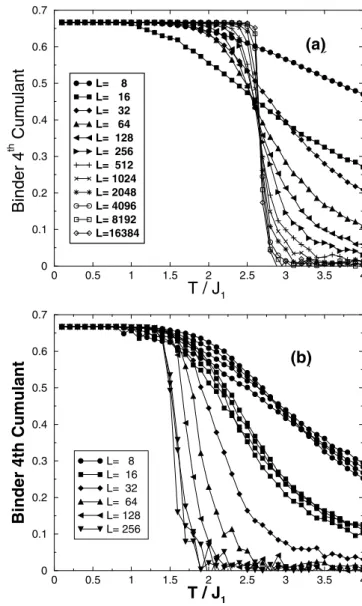
Figure 3 shows the Binder4th-order cumulant for the magnetization as a function of the temperature for both mod-els. The temperature where two of these curves for different N0cross is an estimate for the critical temperature. An
al-ternative estimate can be obtained by choosing a value such as 0.5, and letting the estimate of the critical temperature be where the cumulant crosses the value of 0.5. (Ideally, one would like to use the value of the infinite-lattice cumulant, but this is often unknown unless the universality class of the model is known.) Model 1, Fig. 3(a), shows a very nice indi-cation of a critical point nearT ≈2.7J1. Model 2, Fig. 3(b),
0 0.5 1 1.5 2 2.5 3 3.5 4
T / J
1
−3 −2.8 −2.6 −2.4 −2.2 −2 −1.8 −1.6
E / N
L= 8 L= 16 L= 32 L= 64 L= 128 L= 256 L= 512
(a)
0 0.5 1 1.5 2 2.5 3 3.5 4
T / J
1−4 −3.5 −3 −2.5
E / N
L= 8 L= 16 L= 32 L= 64 L= 128
(b)
Figure 2. The internal energy per Ising spin for (a) model 1, and (b) model 2. These are parameterized by the chain length,L=N0a,
whereais the lattice spacing andN0is the number of spins in the
one-dimensional backbone.
be obtained. Note that for model 2 there are a number of different quenched small-world bond configurations for N0= 8,16, and256.
Figure 4 shows the susceptibilityχper Ising spin times the temperatureT. For model 1, Fig. 4(a), shows a sharp-ening maximum at T ≈ 2.7. Fig. 5, for model 1, shows the maximum value forχT as a function ofN0. There are
five different quenched small-world connections shown for each value ofN0. The slope of this log-log plot gives an
es-timate for the exponent ratioγ/ν, withγthe susceptibility exponent andν the correlation length exponent. The value obtained for the slope is0.73using all lattice sizes, and it is0.65using only the sizes256and512. Although simula-tions for largerN0 may give lower slopes yet, we estimate
thatγ/ν= 0.6±0.1.
0 0.5 1 1.5 2 2.5 3 3.5 4
T / J
10 0.1 0.2 0.3 0.4 0.5 0.6 0.7
Binder 4
th
Cumulant
L= 8 L= 16 L= 32 L= 64 L= 128 L= 256 L= 512 L= 1024 L= 2048 L= 4096 L= 8192 L=16384
(a)
0 0.5 1 1.5 2 2.5 3 3.5 4
T / J
1 00.1 0.2 0.3 0.4 0.5 0.6 0.7
Binder 4th Cumulant
L= 8
L= 16 L= 32
L= 64
L= 128 L= 256
(b)
Figure 3. The Binder fourth-order cumulant for (a) model 1, and (b) model 2.
The maxima of χT /Ntot for model 2, Fig. 4(b),
de-crease with temperature asN0increases. This indicates that
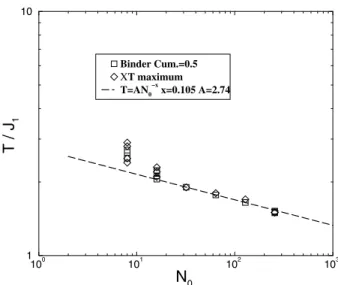
there may be no finite-temperature phase transition in the thermodynamic limit. This conclusion is further supported in Fig. 6. There the location of both the crossing of the Binder cumulant and 0.5 and the maximum ofχT /Ntot is
shown. Both estimates for the ‘finite system-size’ critical point agree. They both also have a reasonable fit, based on N0≥32, ofTc=AN0xwithx=−0.105andA= 2.74.
4
Possibilities for Small World
Mate-rials
0 1 2 3 4
T / J
1
10−2 10−1 100 101 102
Χ
T / N
L= 8 L= 16 L= 32 L= 64 L= 128 L= 256 L= 512 L= 1024 L= 2048 L= 4096 L= 8192 L=16384
(a)
0 1 2 3 4
T / J
110−1 100 101 102 103
Χ
T / N
L= 8 L= 16 L= 32 L= 64 L= 128 L= 256
(a)
Figure 4. The susceptibility times temperature for (a) model 1, and (b) model 2.
1 10 100 1000
N0
10−1 100 101 102
T
Χ
max/N
Monte Carlo y=0.223 N00.73 y=0.362 N00.65
Figure 5. The maximum of the susceptibility times the tempera-ture for model 1. The slope of this gives an estimate for the ratio of critical exponentsγ/ν.
100 101 102 103
N0 1
10
T / J
1
Binder Cum.=0.5
ΧT maximum
T=AN0−x x=0.105 A=2.74
Figure 6. The summary for model 2 of the various indicators of critical behavior are shown as a function of the system size. Note that this fit (dashed line) suggests that a finite-temperature phase transition does not survive taking the thermodynamic limit.
dimension. Nevertheless, there are a large number of ef-fective one-dimensional materials [1]. Small-world models with fixed connection sizes, such as model 1, exhibit a finite temperature critical point. Building these small-world con-nections from atomic spins as in model 2 provides the small-world bonds. However although the small-small-world fixed point is unstable at finite temperatures, the flow from this unsta-ble fixed point seems to be extremely slow. Consequently, the outlook for quasi small-world materials is better than for quasi-one-dimensional materials.
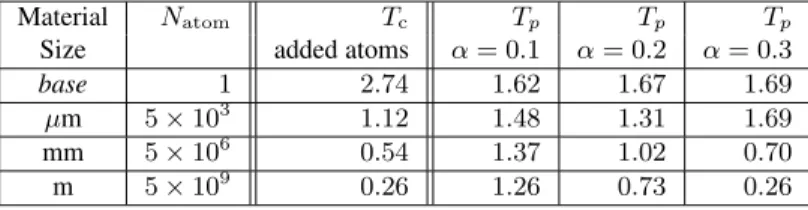
Table I shows the effectiveTc,eff for a given size of
ma-terial for model 2. Also shown from ref. [12] are values ofTc,eff for small-world connections with strengths that
be-have asJ1rij−α, for different values ofα. All temperatures are in units ofJ1. Due to the slow decrease in the critical
point with the system size, Table I shows that even for large systems (of the size of meters) the system should exhibit an effective critical temperature that can still occur at a reason-ably high temperature.
TABLE I: Extrapolated values for the finite-size effective critical temperature (for exampleTp, the location of the maximum inχT) for various sizes corresponding to the given number of atoms in a one-dimensional chain material. See the text for the assumptions. The last three columns represent the data of ref. [12], as explained in the text.
Material Natom Tc Tp Tp Tp Size added atoms α= 0.1 α= 0.2 α= 0.3
base 1 2.74 1.62 1.67 1.69
µm 5×10³ 1.12 1.48 1.31 1.69
mm 5×10⁶ 0.54 1.37 1.02 0.70 m 5×10⁹ 0.26 1.26 0.73 0.26
There are several factors that may make quasi small-world nanomaterials easier to synthesis than the synthesis route outlined above. It has been shown that not all origi-nal atoms (ones that are not in the small-world connections) need to be connected with small-world bonds for the sys-tem to be controlled by the small-world fixed point [7, 12]. Rather, what is required is just a finite density of small-world bonds. Hence, the prefactor in front of the power law for the number of total atoms per original atom may be made arbitrarily small. It is also possible to consider starting with a two-dimensional thin film, and synthesiz-ing small-world connections on the film in a fashion similar to the one-dimensional route outlined above. Some studies of crossover from two- and three-dimensional fixed points to small-world fixed points have been performed [20, 21]. However, it is anticipated that for any finite density of small-world connections the dominant fixed point should be the small-world fixed point. Furthermore, since these original one and two-dimensional systems are embedded in three di-mensions, it is possible to make some of the longer-distance small-world connections very short-ranged by bending or folding the original lattice to minimize the total length of all small-world bond connections. Finally, just as in quasi-one-dimensional materials there is the possibility of allow-ing weak interactions in three dimensional crystals to stabi-lize the fixed point in different dimensions before the system exhibits a cross-over to the three-dimensional fixed point.
5
Discussion and Conclusions
The ferromagnetic Ising model on two small-world net-works has been studied. One model, related to models pre-viously studied by others [13-17], has only fixed-strength interactions for the small-world connections. This model exhibits a finite-temperature second-order phase transition. We have determined from finite-size scaling of the maxi-mum of the susceptibility the exponent ratioγ/ν= 0.6(1) for the system sizes simulated. A study by other researchers with small-world connections that fall off as a power-law with actual distance shows no finite-temperature phase tran-sition, but a logarithmic decrease with N0 of an effective
finite system size critical temperatureTc,eff[12].
The second Ising model studied here is more realistic for the possibilities of quasi small-world materials. The small-world connections have been constrained to be built from spins using the same lattice spacing. This models what would have to be accomplished in actual quasi small-world
materials, since atoms are the fundamental building blocks. For this model, no finite-temperature phase transition was found to survive the thermodynamic limit. In particular, in terms of the number of linear spinsN0, an effective
crit-ical temperature Tc,eff was found to behave as N0x with
x ≈ −0.105. Furthermore, on general grounds the total number of spins scales asNtot∼N02for a one-dimensional
system withN0spins.
From these studies a theoretical picture emerges about the difficulty in synthesizing quasi small-world materials. The number of atoms needed to connect small-world bonds may be large, and is expected to scale as a power law of the number of atoms in the none small-world system. How-ever, it has been shown that not all none small-world atoms need to be connected with small-world bonds for the sys-tem to be controlled by the small-world fixed point [7, 12]. Consequently, the prefactor in front of the power law for the number of small-world atoms may be made arbitrarily small in principle. For strengths of small-world connections that decrease as a power law [12], a logarithmic fall-off of the ef-fective critical temperature with system size has been found. Using some order-of-magnitude assumptions and the differ-ent power law results from this work and ref. [12], one finds that a reasonable value ofTc,eff is possible for systems in
the size ranges of microns, millimeters, or even meters. For the model studied here, where the small-world connections were built from atomic spins, a small power-law fall-off of the effective critical temperature was found. Thus nanoscale and mesoscale materials should exhibit an effective critical behavior related to the small-world bonds. A possible syn-thesis route to materials effectively governed by small-world fixed points was outlined.
Acknowledgements
I acknowldge useful discussions with a number of peo-ple, particularly Torsten Clay, Seong-Gon Kim, Alice Ko-lakowska, Gyorgy Korniss, Chris Landee, Per Arne Rikvold, and Zoltan Toroczkai. Supported in part by NSF grants DMR-0120310 and DMR-0113049. Computer time from the Mississippi State University ERC and NERSC was crit-ical to this study.
References
[2] E. Peled, D. Shahar, Y. Chen, D.L. Sivco, and A.Y. Cho, Phys. Rev. Lett.90, 246802 (2003).
[3] L.E. Svistov, A.I. Smirnov, L.A. Prozorova, A.O. Petrenko, L.N. Dernianets, and A.Ya. Shapiro, Phys. Rev. B67, 094434 (2003).
[4] A. Menzel, R. Beer, and E. Bertel, Phys. Rev. Lett. 89, 076803 (2002).
[5] M.A. Novotny, Phys. Rev. Lett.70, 109 (1993).
[6] R. Albert and A.-L. Barab´asi, Rev. Mod. Phys.74, 47 (2002).
[7] G. Korniss, M.A. Novotny, H. Guclu, Z. Toroczkai, and P.A. Rikvold, Science299, 677 (2003).
[8] G. Korniss, Z. Toroczkai, M.A. Novotny, and P.A. Rikvold, Phys. Rev. Lett.84, 1351 (2000).
[9] A. Kolakowska, M.A. Novotny, and G. Korniss, Phys. Rev. E 67, 046703 (2003).
[10] G. Korniss, M.A. Novotny, P.A. Rikvold, H. Guclu, and Z. Toroczkai, Materials Research Society Symposium Proceed-ings Series Vol. 700, p. 297 (2002).
[11] G. Korniss, M.A. Novotny, and P.A. Rikvold, J. Comp. Phys. 153, 488 (1999).
[12] D. Jeong, H. Hong, B.J. Kim, and M.Y. Kim, Phys. Rev. E 68, 027101 (2003).
[13] M. Gitterman, J. Phys. A: Math. Gen.33, 8373 (2000).
[14] A. Barrat and M. Weigt, Eur. Phys. J. B13, 547 (2000).
[15] A. Pekalski, Phys. Rev. E64, 057104 (2001).
[16] H. Hong, B.J. Kim, and M.Y. Choi, Phys. Rev. E66, 018101 (2002).
[17] B.J. Kim, H. Hong, P. Holme, G.S. Jeon, P. Minnhagen, and M.Y. Choi, Phys. Rev. E64, 056135 (2001).
[18] D.P. Landau and K. Binder,A Guide to Monte Carlo Sim-ulations in Statistical Physics(Cambridge University Press, Cambridge, UK, 2000).
[19] See http://sprng.cs.fsu.edu
[20] C.P. Herrero, Phys. Rev. E65, 066110 (2002).