Origin, State of the Art
and Some Prospets of the Diamond CVD
Boris V. Spitsyn, LeonidL. Bouilov,Alexander E. Alexenko
Institute ofPhysialChemistry,RussianAademyofSienes,
31LeninskyProspekt,117915 Mosow,Russia
Reeived6May,2000
AshortreviewonthediamondCVDorigin,togetherwithitsstateoftheartandsomeprospets
wasgiven. NewhybridmethodsofthediamondCVDpermittogain1.2to6timesofgrowthratein
omparisonwithordinarydiamondCVD's.Reentresultsonn-typediamondlmsynthesisthrough
phosphorusdopingintheourseoftheCVDproessarebrieydisussed. Inomparisonwith
high-pressurediamondsynthesis,theCVDproessesopennewfaetsofthediamondasultimaterystal
for siene and tehnology evolution. It was stressed that, mainly on the basis ofnew CVDs of
diamond, the properties of naturaldiamond are not only reprodued, butanbesurpassed. As
examples,mehanial(fratureresistane),physial(thermalondutivity),andhemial(oxidation
stability)propertiesarementioned. Somepresentissuesintheeldareonsidered.
I Introdution
Diamonds for longtime attratedspeial attention of
men due to unsurpassed hardness and noble
appear-ane produedby reeted andrefrated lightbeams.
Now it is widely known that the diamond, being one
of therystalline phasesof purearbon, hasan
exlu-siveombinationof mehanial,physial and hemial
properties. Fromthelist we shallnote, extremely low
ompressibility,enormous thermalondutivity,
exel-lent radiativeresistane,and also highhemial
inert-ness. Together with many other individual properties
and,inpartiular,ontheirtotality[1℄diamondfar
sur-passes any known material. Therefore itoupies the
highestlevelintheirhierarhy,andanbetermedasa
uniquesupermaterial.
Theplurality ofexlusiveproperties ofdiamondis
aused, onthe onehand,bythe presene in its
stru-ture of short and strong ovalent hemial bonds
be-tween arbon atoms, with onsiderable radialand
an-gularrigidity. Itisindeedtheoriginalreasonofextreme
mehanial and physial harateristis and hemial
stability of diamond. On the other hand, the rather
low nulear hargeof arbon atom, together with the
abovementioned bondsstrongness, auseshigh
radia-tiveresistaneofdiamond,by2-3 ordersofmagnitude
exeedingtheradiativeresistaneofsilion.
However,thewideuseofspei propertiesof
dia-mond, and their ombinations in sienti and
indus-trialpratiewererestritedbothbylimitationsof
nat-uralresouresofdiamondandspeiityoftraditional
diamondsoures:
-naturaldeposits.
-synthesisatstatihighpressureandtemperature.
- synthesisat dynami high pressureand
tempera-ture(explosiveand detonationmethods). Inexplosive
proessdesignedbyDuPont(1970),thedurationofthe
explosion,reatinghighpressureandtemperature,was
1ms, and size ofrystalgrains of diamondamounts
1-50m. Indetonationproessdisoveredinthe
eight-ies by the Russian researhers, the duration and size
areequalto0.3s4nm,respetively.
- synthesis from a gas phase in the onditions of
thermodynamimetastability ofdiamond atlow
pres-sures.
This review will be devoted to the last method of
synthesis,whihafter apioneeringpubliation [2℄,has
beenstudied and developed worldwideduring thelast
eighteenyears.
II From the analysis to the
synthesis
The synthesis of diamond beame possible only after
theestablishmentof its hemial omposition and
de-terminationofarystallinestruture. Itisremarkable,
however, that even before of the qualitative analysis
of diamond arried out by A.Lavoisier (Frane) and
itsquantitativeanalysisperformedbyS.Tennant
(Eng-land), the Russian sientist M.V. Lomonosov in 1762
minerals. Thoughto Lomonosovdidnotknowneither
thehemialompositionofdiamondnoritsrystalline
struture,his ideahasappearedasprophetial.
Forthemodernhemistries,physiohemistriesand
physiists,highlysuggestiveinthesearhofalternative
inroadstothediamondsynthesiswasthehemial
on-stitution ofthe diamond. Thestruture of latter
rep-resents huge moleuleonstruted from atoms of
ar-bon,onnetedwitheahotherbyovalentsp 3
-bonds.
Thoughthis struturalstateisnotthermodynamially
stable, there were not some prohibitions for trials of
its hemial synthesis. In organi hemistry, for
ex-ample, synthesis of not absolutely stable moleules is
rather a rule, than an exeption. The diamond,
be-ing metastable under usual onditions in relation to
graphite, onserveits own struture at pressurelose
andbelow1atmandtemperatureuptoandmorethan
1000 o
C, depending on the nature of surrounding gas
medium. Inultra-highvauumorin anatmosphereof
ultra-pure hydrogen thediamond retain the struture
of surfae layer idential to the bulk up to
tempera-turesintherangeof1300-1400 o
C[3℄. Thereforeould
arise theideato takeadvantageofthis relative
stabil-ityofdiamondforitssynthesisat theexpensesofnew
arbonatoms. Itwas supposed that,under theation
of diretional ativity of surfaefores, the bonds
be-tween the atoms at the diamond surfae and arbon
atomsfromdeomposingarbonaeoussubstaneswill
rebuild diamond,if exlusively sp 3
-bonding formation
wasprovided. Thus,itwasrequiredto ndonditions
at whih mainly and with high enoughrate only sp 3
-type arbon-arbon bonds are formed and the
forma-tion of other typesof bonding betweenarbon atoms
at the surfae of growing diamondare ompletely
ex-luded. Suhmethodsofhemialsynthesisorhemial
vapordeposition (CVD)ofdiamondwereproposed
al-mostsimultaneouslyin Russia(USSR) and in USAin
the seond half of the fties of now expired last
en-tury. As moleules-arriersof arbonatomsit was
of-feredmethaneanditsleaststablederivative,like
tetra-bromomethane and tetraiodomethane, simple organi
methyl- ontainedmoleules and arbon monoxide
[4-6℄. Thetypialdeomposition temperature wasequal
to900-1100 o
Candthepressurerangedfrompartsof
Torrupto 100atm.
Proesses[4-6℄ demonstrate, for therst time, the
opportunity to grow an artiial diamond by nearly
isothermal pyrolisis of simple arbon-ontained
sub-stanes. However, the mentioned above hemial
in-ertnessof diamonddidnotpromotewellenough
ee-tivity. The rst proesses [4-6℄ were haraterized by
lowgrowthrateofnewdiamond,1nm/h,anddidnot
haveseletivity;togetherwithdiamonddeposition,
en-tersofgraphiteandothernondiamondstatesofarbon
arose,andthroughtheirpropagationdiamondregrowth
eased andnally stopped. Besides, theoriginally
of-seed rystals orhighly disperse diamondpowders. In
the rst open publiation on the diamond CVD, the
deposition of nondiamond arbon was delared as
in-evitable [7℄, though, at that time, the results about
depositionofsubmirometerandmirometerthik
dia-mondlms(DF)withouto-depositionofnondesirable
graphite(see SetionIV) inamodeofhemial
trans-port[8-10℄,andalsowiththegas-transportingset-up
[11,12℄werenotpublishedyet.
Asthebodyofthepubliationisthesynthesisof
di-amond asmetastable phaseofarbon,it isreasonable
toonsidertheenergetiofthebasispeiesofarbon.
III Energeti of the basi
arbon speies
Energeti of aseries of solid arbon states (diamond,
arbines, graphite, monoplaneof graphite - graphene,
amorphous tetrahedral arbon, fullerene C-60 and
single-wall arbon nanotubesof aminimumdiameter)
and gaseousarbon(atom in the groundand rst
ex-ited state)in simpliedonsideration,i.e. takinginto
aountonlystandardenthalpyof formation(pressure
-1atm,temperature-298 o
TheanalysisofFig. 1allowsonetomakethe
follow-ing basionlusions. First, theenthalpydierene of
diamondandgraphiteisratherlow,inomparisonthe
values for C-60 and arbon nanotubes. Seondly, the
physialondensation ofarbonatom from itsground
eletronistate,inwhihitisdivalent,mostlikelylead
to formationof nondiamond-likephase, but
graphite-like arbon phase (as points arrow 1). On the other
hand, in the ase of arbon atom being in
eletroni-allyexited(tetravalent)state,theirondensationina
solidarbonlmwithmainlytetrahedraloordination
ofatomswillbepreferablyformed,withtheformation
oftheso-alledtetrahedralordiamond-likeamorphous
arbon(arrow2inFig. 1). Itispossibletogetdiamond
arbonwithtetrahedraloordinationofatomsnotonly
in rst,butalsoin seondandin thesubsequent
oor-dinationspheres. Oneofthemandatoryonditionsfor
suhperfetvolumetrirystallizationshouldberather
lowsupersaturationoftheproess. Butinitialproesses
of the CVD suer of extremelylowgrowthrates even
at highsupersaturation.
IV Searh of systems for rapid
rystallization of diamond
from vapor
Nevertheless, one of the authors (B. V. S.) deide to
onentrateattentiononoveromingat leastof oneof
the above-stated drawbaks of the primary diamond
CVD's - extremely low linear growth rate, amounted
only 1 nm/h. It was reasonable to expet quik
diamond growth in systems in whih it is possible to
implement aprompt ething of diamond. Apparently,
the growthrate should be of thesameorder orbelow
the value of the ething rate. In the sixties, it was
not known of promptproesses ofething diamondin
gaseous media, exept for inammability of diamond
in pureoxygen, whih beginsat 850 o
C.However,this
proessompletely shifted to oxidizing produts- CO
andCO
2
,andannotbemadereversible.
Inthe beginning of 1965the Gulbransen's and
o-authors paper[13℄,hasappeared. Itwasshownbythe
authorsthattheethingofgraphiteinpurehydrogenat
pressureofsomeTorrattemperature1650 o
Cproeeds
withrateof2.4mm/day.
Atthatpointaroseanideaonuseofyieldsof
high-temperature interation of graphite with hydrogen as
rystallizingmedium fordiamondupsaling. Theseed
rystal of diamond with temperature about 1000 o
C,
wasplaedneargraphiteheated upto 2000 o
C, at
hy-drogenpressureof12Torr. Ontotheseedrystalof
di-amond, adeposit of whiteondensedarbonis found,
that has allowed to state that a transport of arbon
fromgraphiteondiamondwithpartiipationofatomi
B.V.SpitsynandA.V.Lavrent'ev. As farbakas
O-tober,1966theydemonstrateforthersttimethe
epi-taxialDF regrowthonnatural(111) fae with rate of
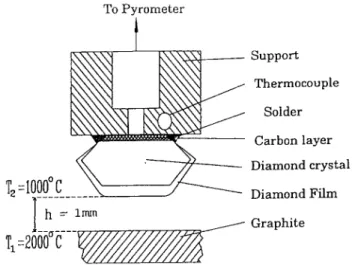
1m/h.Theset-upoftheexperimentisshowninFig.
2. Remarkably, that at long-termed experiments the
DFthiknessouldbeabout10mandmore,without
formationofanytraesofgraphitein theomposition
ofthelm. Suhabseneofthegraphiteo-deposition
allowed for the rst time to study kinetis of
rystal-lization,forexample,dependeneofDFgrowthratevs.
temperature[11℄. Thebasimehanismofthehemial
transportwasestablished:
Graphite (2000 o
C)+(H
2
,H)!C
2 H
2 !
diamond( 1000 o
C)+H
2
: (1)
Atprolongedarryingouttheproess(1),ethingof
thegraphiteholder(Fig. 2)ofdiamondseedrystalwas
observed. Quantitativelyto explore thisphenomenon,
onaplaeofseedrystalofdiamond(Fig. 2),aplateof
isotropiarbonwithdensityof2.06g/m 3
wasplaed.
Inratherwidetemperaturerange- from800 o
Cupto
1300 o
Cgraphitewassubjetedtoethingin thesame
onditions,in what DF growthourred. Theething
rateofthegraphiteplaterisewithtemperature
lower-ing and beame equal to 6 m/h at 800 o
C [14℄. In
the Fig. 3, the kinetis of DF growth and graphite
interation with a gaseous phase with a nearly
iden-tial omposition at 60 Torr is plotted. One an see
thatthereisaratherwiderangeinwhihthediamond
growthispossibleandgraphitegrowth(and,obviously,
itself-nuleation)isimpossible. It isenlighteningthat
the`solubility'(attotalpressure=76Torr)ofarbon
inthegasphase,[C℄/[C℄+[H℄,presentedintheFig. 3,
passesthroughaminimum,whihposition,however,is
farfromthemaximumofthegrowthrateofadiamond
lm.
Figure 2. General set-up of HGCTR. Afterequilibration
at T1 inH2 at 12 Torr, C2H2, H and H2 are transported
by diusion to the diamond seed surfae and at T
Figure3. DFgrowth rate,V
d
(triangles), andgraphite
in-terationrate,Vgr (irles),vs. substratetemperature,T2,
undernearly identialonditionsofthehemialtransport
reation(T1=2000 o
C,h=1mm,Ptot=60 Tor). Dottedline
presentsC/C+H ratio inthevapor phaseatit total
pres-sure,Ptot=76 Tor.
During less than two deades the ativated CVD
was widely disseminated, improved and are explored
in hundredsoflaboratoriesof alltehniallyadvaned
ountriesoftheworld. Inthebaseofmodernativated
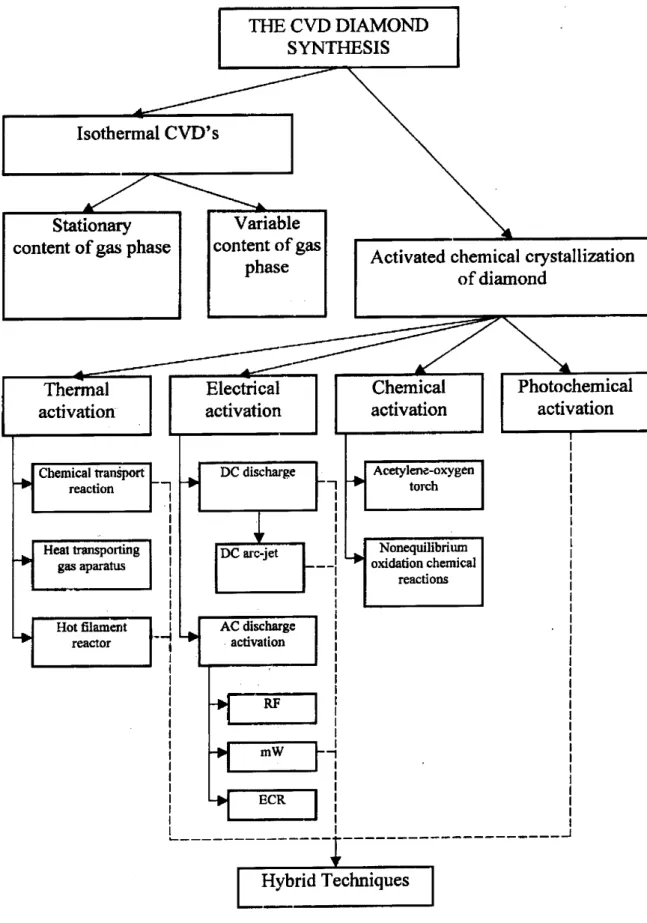
CVD ofdiamond[15,16℄,there arefourbasimethods
ofgasphaseativation:
-thermal,
-eletrial (DC,RFandmWdisharges),
-hemial,
-photohemial.
ThepluralityoftheCVD'sandativated CVD'sis
demonstratedinFig. 4.
Amongtheativated CVD methods, the most
dis-seminatedare
V Plasma hemial methods of
diamond synthesis
For plasma-hemialdiamond synthesis (PDS) nearly
anyoftheknownlowtemperatureplasmareatorsan
beused. Thegasphaseontainsinitiallyhydroarbons
in mixture with hydrogen, and also various
ombina-tions of intermixtures CO, CO
2 , H
2 O, H
2
, simple
or-gani ompounds (alohols, et.), and
halogenohydro-arbons. It was exposed to a heating and
simultane-ouslyonversionin various kindsof eletridisharge.
AnalprodutPDSis,dependingonplasmaonditions
and substrate nature, singlerystal orpolyrystalline
DF. However ontrarily to preipitation of so named
diamond-likearbon,atPDSapurediamond,withthe
ontentofarbonatomsinsp 3
eletronistate,loseto
100% wasahieved. As aresult, themirosopi and
marosopi properties of synthesized diamond
(hard-ness, thermal ondutivity, et.) are nearly idential
of thepropertiesof naturaldiamond. High seletivity
(noo-depositionofanykindofsolidarbon,exeptof
diamond) ofthePDS isaused byaonsiderable
on-entrationoffreeradials: H,O,OH,et. intheplasma
volume. Theirpreseneprovidesapreferredethingof
any nondiamond arbons. Atomi hydrogen beome
not onlyakeysubstane forsmoothitsown diamond
surfaeregrowth,butinthespontaneousself-nuleation
ofdiamondonnondiamondsubstrates(metals,oxides,
arbides,nitrideset.).
Asastartinggaseousmixture(0.5-5)%CH
4 inH
2
willusuallybeutilized,atpressureintherangeoftens
andhundredsTorr.Afterstartinginthemixtureofan
eletri disharge, the onversion of stable moleules
CH
4
into neutralandhargedhydroarbonaeous
par-tiles: C 2 H 2 , C 2 H 4 , CH 3 , C 2 H, CH 2 , C 2 , CH + , CH + 2 ,
et. proeeds. Theonsiderablefration (fromseveral
%upto90%)ofH
2
moleulesdissoiatestoHatoms,
andalsotoionsH +
,H +
3
,H . Theplasmaionization
de-greein the majorityof theplasmareatorsis 10 7
.
The DF rystallization temperature usually is 700 to
900 o
C, and the average temperatureof the ativated
gas phase is muh higher (from 2000 up to 5000 o
C).
CrystallizingmediumatPDSis,asarule,lassiedas
lowtemperature nonequilibrium plasma. Most widely
for PDS thefollowingkindsof dishargesare applied:
adireturrentanditsupdating(ar-jet),RF
(prefer-ably,indution),mirowave,andECR.
Inomparisonwithaglowdisharge,thed-eletri
ar(DCEA)hasthreeessentialpeuliarities: high
pres-sure of a gaseous disharge, usually tens and
hun-dreds Torr, onsiderably smaller gap between
ele-trons andheavypartilestemperature(nearly
isother-malplasma),andhighonentrationsofatomi
hydro-gen and hydroarbon partiles ensuring onsiderable
growthratesofdiamond.
DCEA belongs to stationary self-sustained
dis-hargesoperatingatvoltagefrom50toseveral
hun-dreds Volts. The mosttypial pressureof gas - upto
hundreds of Torr, and urrentdensity on the anode
-up to several A.m 2
. The athode is made of
high-melting metals ortheir arbides (W, Ta). The anode
usuallyservedastheholderofsubstratesforDF
depo-sition. Inthelatterase,beauseofthehighdieletri
propertiesofdiamonddownto1000 o
C,problemswith
homogeneityofdishargeneartothesurfaeofgrowing
DFours. Theyanbesolvedbyvariousmethods,in
partiular, by arrangement of a substrate for DF
re-growthimmediatelybehindtheperforatedanode[17℄.
Reators for DCEA an operate with `hot' [18,19℄
and `warm' [20℄ athode, with athode to anode ratio
of the areasof << 1and >1,respetively. Tungsten
ortantalumarbidesare themostappropriate
materi-alsfor`hot'athode. Typialathodetemperaturedoes
notexeeds 2500 o
Candannotbeessentiallyboosted
withouthazardofquiksputteringof theathode
Molybdenum usually serves as the warm athode
(800-1200 o
C).ThestabilityofdishargeatDCEA
pro-vided with a ballast resistor, or by ative eletroni
ontroller. Theseondaryion-eletroni emission may
ontainappreiablefrationofeletronsesapingfrom
`hot'athode. Alsotheemissionshouldbedominating
in theaseof the`warm'athode. Itresultsthat`hot'
athode DCEA provides (in omparison with `warm'
athodeDCEA)DFwithhigherquality,ontheareaof
1m
2
. Alsoareknownmulti-athodesystems(with
several parallel hot athodes) allowing produing the
DFontheareaofsomeentimeterssquare.
Thesimpliityandrelativeheapnessofdesignand
operation is harateristifor DCEA.The yield of
di-amond in relation to arbon-ontained gas ow may
amountupto30%.
Some diÆulties desribed abovewith the DCEA,
maybe anelled in diret urrentplasmatron (DCP)
[21℄.
InDCP,thelow-voltageeletrialarisignited
be-tweenoaxiallyloatedthoriatedtungstenathodeand
water-ooledopperanode. Asplasma-forminggas,the
mixtureofArwith20%H
2
,andarbon-ontainedgas
(methane) is served. The owveloityis in the range
of1-10km/s[22℄. Remotedfromdishargegapplasma
torh direted to water-ooledsubstrate, e.g.
molyb-denum. The average temperatureof plasmanear to a
growingDFsurfaeis900-1900 o
C.Highlineargrowth
rateofDF in DCP(up to 1mm/hand 0.2mm/h,for
polyrystallineandsinglerystalDF,respetively)and
onsiderable transformation of arbon of a gas phase
intosynthetidiamond(upto8%)makeDCPsuitable
fortheCVDdiamondprodutioninommerialsale.
InthePDS,thetwoRF-dishargemodesanbe
uti-lized: apaitive(RFC)andindutive(RFI)one. The
rstpositiveresultsonPDSwereahievedinRFC
dis-hargeraisedwithuseoffrequeniesfrom100Hzto10
MHzinhydroarbon-hydrogengasphasesatpressure
0.08-15Torr [23℄. Various RFC versions inluding
su-perimposition onplasma of an exteriormagneti eld
are tested for overingby DF largesurfaearea.
Ob-tainedsubmirorystallineDF,asarule,ontainssome
nondiamondarbonphases. However,likewasreently
demonstrated[24℄,RFCprovidesnanosizegrainedDF
with97%ofdiamondphaseontent,highlyompatible
withmediineaimedboneprosthesis.
RFI disharges being eletrodeless, allows,
basi-ally,avoidingpollutionbyeletrodeimpuritiesinboth
plasmaandgrowingDF.Theimpuritysupplyfromthe
wallsofareativevesselanbereduedbytheir
ush-ing bythegas owthat hasbeennotinvolvedin
RF-disharge[25℄. Theahieved growth rate of
polyrys-tallineDF inthe40kWRFI-dishargeis30m/h. At
a substrate diameter of 100 mm diamond CVD goes
withprodutivityupto 5arat/h[26℄.
The mirowavedisharge is also eletrodeless and
anbearriedoutinareatorwithquartz[27℄orooled
metal wall [28℄. On the basis of disharges with
fre-queny of 2.45 and 0.915 GHz, an industrial
produ-tionof PDSreatorswithworking areaupto 100mm
diameterandmoreanbeorganized. However,apital
rates onprodutionof the reatorsand working osts
(replaementofmagnetrons,et.) arehigh. Therefore,
forsomeofthepratialpurposesthePDSin reators
withDCEAandDCPanbepreferable.
The plasma gained in a mode of an eletroni
y-lotron resonane (ECR) [29℄, essentially diers from
allbeforesurveyed. Themotionoftheaelerated
ele-trons inamagnetield witharesonantfrequeny
al-lowspressureofgas(H
2
plusCH
4
)offrationofTorrto
ahieveionization degree lose to 100%. Aordingly,
energyof heavypartilesanreahsomeeV.It allows
to reeive DF well adhering to surfae of metals and
dieletrisevenattemperaturedownto200-300 o
C.
Only restrited number of publiations reporting
the useof laser plasma [30℄ show, that,despite of
ap-parentexpensivenessofthismethod,itangiveunique
opportunitiesatPDS,forexamplebythedepositionof
ultra-thinDF onasurfaeofpolymers.
Inplasma enhaned CVD's morethan one
ativa-tionation towardsto gasphaseandgrowingDF
sur-fae have been existed. Together with eletrial and
thermal ativation the UV radiations ation typially
takeplae.
VI Hybrid methods of the
diamond CVD
Itisinterestingtoknowmoreaboutintentional
apply-ing o-ation of dierent ativation modes to the
dia-mondCVD's insonamedhybriddiamondCVD
meth-ods[31℄.
TheCVDeÆieny(e.g. DFgrowthrate)is
propor-tionaltotheenergyinput. However,inaseriesofases,
an intentional introdued auxiliaryativation into the
diamondCVDsystemproduedmuhmoreeetthen
asimplesuperpositionofativationations. At
supple-mentaryenergyontributionof0.01-10%inrelationto
thebasione,thegrowthrateaninrease1.2-6times
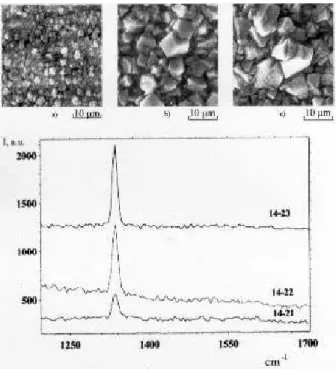
[32-34℄. TheDFqualityinaseriesofasesisnot
wors-ened(Fig. 5).
Depending on theharater and the diretionality
ofationonthesystem`rystallizationmedium-
rys-tal', two opportunities an be surveyed: ation on a
gasphase(homogeneous)andonasurfaeofagrowing
rystal(heterogeneoushemialreations).
Onemayspeulateabouthowtheextraativation
inuene the basiproesses of the diamondCVD. It
shouldbementionedthefollowing,probablynotan
ex-haustivelist,ofspeiresponseoftheCVDsystemto
additionalativation:
-partiipationinformationofsolidarboninsome
exitedmoleulesofaetylene[35,38℄andother
hydro-arbonmoleulesandpartiles,havinghigh reativity;
- partiipation of adsorbed hydrogen atoms
dur-ing formation of diamond nulei (the adsorption of
moleules of aetylene anbe arriedout ontwonext
enters,oneofwhihisfree,andanotherisengagedin
atom ofhydrogen[39-41℄);
-anirradiationofasurfaebyeletronsandquanta,
that resultstohargingofadsorbedmoleules[42,43℄,
to enhanement of a surfae diusion [44, 45℄ and/or
hydrogendesorption rate[33℄.
All above fators may inuene nuleation and
growthrateof diamondanditsquality. However
har-aterandmeasureoftheinuene,isunonditional,
de-pend on thelevelof additional ativation, nature and
onentrationofarbonpreursors,substrate
tempera-tureandotherparametersoftheproess.
Anotherimportantpoint-depositionofsolidphases
(diamond andnotdiamondarbon)andtheir
gasia-tion in diamond CVD's, proeed on dierent routes.
That is whysimultaneoususe ofseveralenergymodes
allows to inuene almost independent as DF growth
rate, and onseletivityof theproess. Thus, of
inter-estistheintentionalombinationofvariousativations
aimedtolariationoftherystallizationmehanism,
gaininprodutivityofproessandqualityofdiamond
material. Thus, thehybridmethods of hemial
rys-tallizationofdiamondfromativatedgasphaseprovide
hallengingreserveforthediamondCVDeÆieny
rais-ing, andalsofordefetstrutureandimpurity
ompo-sitionontrol ofDF.
Figure 5. SEMimage of the morphologyof DF's ##
14-21, 14-22,and 14-23 grown by HF tehniqueatbiases: a)
0 V (#14-21); b)+70 V (#14-22), )+85 V (#14-23).
Bottom: RamanspetraoftheDFsamples.
VII Doping of diamond lms
Doping of diamond, as well as any other rystal, is
meantastheformationinitofanatomiallydispersive
(true) solid solution,in whih the impurityatoms
o-upysubstitution orinterstitialpositions ofrystalline
lattie. Diamond doping ours or enfored
uninten-tionallyorintentionally. Inthelatterase,
experimen-talistspursue diretional hange of mehanial,
physi-al,orhemialpropertiesofdiamond. Owingtorather
lowdiusivityvalueofthemajorityofimpuritiesin
di-amond, the solid solution an be maintained in wide
temperaturerange. Therefore,thestabilityof optial,
eletrialand otherpropertiesof dopeddiamondhave
provided.
Thenumberofimpuritiesapabletoreplaea
ar-bon atom in alattie of diamond is rather restrited,
owing to small ovalent radius of arbon atom in
di-amondrystalline lattie and very high bond energies
betweenatoms[46℄. However,theadaptationof
impu-ritiesas atrue solidsolution (equilibrium or
nonequi-librium) is a neessary, but not enough ondition for
onversionofdieletridiamondintoadoped
semion-dutor materialwith ahigh level of ondutane. For
providingoflowativationenergyofimpurityrelevant
ondutivity theposition of additional energylevelin
forbiddenband-gapshoulddefendnottoofar,nomore
than approximately 0.5 eV, from the top of valene
band(holesemiondutor)and,aordingly,from
bot-tomofondution band(eletronsemiondutor).
Apparently, CVD methods of rystallizationof
di-amond provide more favorable opportunities for
dop-ing diamond than high pressure - high temperature
method. Atually lose to room temperature
(tem-perature on an inlet in CVD reator) pratially any
hemialelementanbefoundinformofhemial
om-pound, orevenin thepure state[47℄. It looks likeby
ativatedCVDsomeextraopportunitiesbothfor
equi-librium and, probably, nonequilibrium DF doping in
theourseoftheirgrowthmightbeappeared. Anyway,
dopingDFbyhydrogen[48,49℄,andbyboron,
phospho-rusandsulfur[50℄wasahievedinahemialtransport
reationmode,dopingbyhydrogeninthehot-lament
reator [51,52℄, by phosphorus in isothermal diamond
CVD[53℄andinmW-disharge[54℄,andalsobysulfur
-intheMWACVD[55℄.
Hydrogen is ustomary onstituent of vaporphase
inmanymethodsofativatedCVDofdiamond. Thatis
whyitisfrequentlyabakgroundimpurityinthedoped
DF. Thehydrogenis onsideredasaneutralimpurity
indiamond. However,itaninteratwithother
impu-rityatoms,thushangingtheireÆienyaseletrially
ative impurity [56℄. Aording to ref. 52 hydrogen
inpolyrystallineDF anenterin onentrationsfrom
0.02 up to 0.2 at.%, with redution of rystallization
Now there are many publiations [57℄ on epitaxial
DF doping by boron, with obtaining of
semiondu-tor lm with p-type ondutivity. The hole mobility
reahes1590m 2
/V.s[58℄,thatislosetohole's
mobil-ityinnaturalsemiondutordiamondoftheIIbtype.
Then-typediamondsemiondutorisnotfoundin
Nature. The attempts of its high-pressure synthesis
andalsousingthemethodofionimplantationhavenot
onludedbyessentialsuess. Onlyinourpubliation
[50℄,werequotedtherstpositiveresultsonthe
synthe-sisofondutiveDF,dopedbyphosphorusandsulfur.
Later persistent and onsistent Japanese researhers
onrmedarealityofregrowthofepitaxialDF, doped
by phosphorus [53, 54℄ and bysulfur [55℄. It isworth
to note that aording to theRutherford
baksatter-ing tehniqueupto 90%of phosphorus atomsreplae
arbon atoms in a diamond lattie [59℄. It supports
ourpreview [47℄,that phosphorus anbeaepted by
diamondlattie. Webasedouronlusiononthe
pro-totypemoleuleapproah. Infat,theovalentradius
offour-oordinatedphosphorusinphosporus-ontained
moleules (tetraalkylphosphonium halogenide) has
lower value than in three-oordinated
phosporus-ontained moleules (trialkylphosphyne). The eet
maybemuhmorepronounedintheweak
phosphorus-in-thediamondsolidsolution. Thereasonouldbeone
of importane forlowstress phosphorus adaptationin
thestateofadilutesolidsolutionindiamondstruture
[47℄.
Reent publiations onrms the formation of
n-typeepitaxialDF, dopedin ourseofgrowthby
phos-phorus. Thesignofahargeofarriers,partiularlyby
theHallmethod,speiestheformationofthediamond
semiondutorwith aneletronitypeofondutivity.
TheHallmobilityofarriersontainedfrom23toabout
1000m 2
/V.s[53,54,60℄.
VIII DF properties
The mehanial harateristis of the vapor-deposited
diamond (elasti modulus, hardness) are lose to the
properties of natural diamond. On other properties,
suh,asresistanetobrittlefailure,thepolyrystalline
plate of diamond obtained by the CVD method an
surpasstheperformaneofnaturaldiamond.
The experiene on the diamond doping (Setion
VII),haveshownthatustomarilyhighlydieletri
dia-mond(10 12
10 14
Ohm.m)an,throughthe
introdu-tionofsmallamountof(<1at.%)boronand
phospho-rusdopant,tobetransformedinasemiondutorwith
RTresistivityof2:10 3
and30hm.m,respetively.
CombinationsoftheCVD andhigh-pressure
meth-ods provide the synthesis of monoisotopi
diamond-C-12 (99.98 % of the C-12 isotope). This rystal
es-sentiallyexeed thethermalondutivitylevelofpure
=98.8:1.2.,by1.5timesat300K.
Theoptialtranspareneofhighlyperfetepitaxial
DFnear fundamentalabsorption edge(about220nm)
anexeedthis quantityfortheIIadiamond.
In whih onerns the resistane against oxidizing
bymeltedpotassiumnitrate,theborondopedepitaxial
DF surpasses by approximately6 times (111) natural
diamonds,onwhihitwasregrown[46℄.
Thus, mainly on thebasis of new CVD's diamond
weareableto statethatthepropertiesofgenuine
dia-mondarerealistinotonlytobereprodued,butexel
seriously.
Atthispoint,ofimportanewillbetohighlightthat
revieweddiamondCVDsandvapor-growndiamondare
preferably not ompetitors to other diamond
synthe-sis methods and diamond soures. They look rather
omplementarymethodsandresouresfortheDiamond
MaterialsSiene. Thepotentialofthisfasinatingarea
in basi terms will be demonstrated in the following
Setions.
IX Heteroepitaxy of wide
band-gap semiondutor on
diamond
Some expetable new results in benets of solid state
eletronis,optoeletronis and lasersanbeahieved
byjoiningdiamondwithotherwideband-gap
semion-dutors(SiC,AlN,GaN,andBN).Oneoftheexamples
ofthisombinationissurfaeaoustiwavesdeviesin
two-layersystem: CVD diamond-polyrystallineAlN
[62℄. The ative aoustoeletroni struture was
re-atedbyombinationofd-dishargeandRFmagnetron
sputteringforDFandAlNlm,respetively.
Other stepsin hybridstrutures may promote the
demonstrated reently [63℄ heteroepitaxial AlN lm
deposition on nearly (111) fae of natural diamond.
The proess take plae by monopreursor substane,
NH
4 AlBr
4
,thermaldeompositionintheultra-pureAr
owat 900 o
C.
X Appliation of the CVD
diamondmethods and the
va-por grown diamond
In many ases the eletrodeless diamoned CVD's are
preferable, beause the pollution of DF by impurities
of metals is prevented. However,evenin eletrodeless
methods plasma volume neighbor with walls or
win-dowsmadefromaquartzglass. Thatanresultin the
DF pollution by Si and O impurities. The O and N
nondiamondarbon. Itontentmaybeminimizedonly
at theexpensesofthegrowthrate.
Disoveredanddevelopedoriginallyin Russia,now
diamondCVD'slookslikemostexiblesynthesis
meth-ods. Being an alternative to the appreiated
high-pressure diamond synthesis, the CVD proesses open
newfaetsofthediamondasultimaterystalforsiene
and tehnologyevolution. Moreover,diamondCVDis
rather not ompetitor to other diamond soures, but
rather the tehnology, providing muh easy
opportu-nity to integer dierent diamond soures (Setion I),
withrealpromisetosynthesizeaboutanydiamondand
diamond-basedompositematerialinsoftonditionsof
diamonds thermodynamimetastability.
Thermal ativation of a gas phase (hot lament
method), diret urrent ar-jet and mirowave
en-haned diamond CVD are most suitable for
ommer-ial use in DF, diamond foil and diamond plates
pro-dution. Theseprodutsndsuessfulappliation as
wear-resistantoatings for instruments, frition pairs,
windows for UV, visible, IR, mW, and X-ray
radia-tion, thermal spreaders and heat-sinks, tensoresistive
and termoresistive sensors, UV- and X-ray detetors,
et.
XI Near future hallenges and
prospets
ThebasiproblemsintheeldofnewCVDmethodsof
diamondsynthesisandinnewdiamondmaterialsareat
dierent stages of theirdevelopmentand solution. In
thenalwehavetonote themostessentialissuesofR
&Dinsieneandtehnologyofvapor-growndiamond:
-studyofthemehanismofthediamondCVD,
-quantitativeexaminationofhybridmethodsof
a-tivated CVDofdiamond,
-anexaminationofeetiveDFdopinginourseof
itsgrowth,
-largearearegrowthofheteroepitaxialDFonheap
singlerystalsofnondiamondnature,and
-ombinationofdiamondandotherwideband-gap
semiondutormaterials(SiC,AlN,GaN,et.) in
two-andmulti-lmstruturesforbenetsofhigh-frequeny
andhigh-powereletronis,optoeletronis,lasers,and
soon.
XII General onlusion
ThediamondCVDandrelatedareasisaratheryoung
eld of R&D, and is still urious, attrative, and
prospetivefor sientistsandengineers. Itprovidesus
bymanyneweetiveappliations,andpromisesusby
many hidden disoveries. It looks obvious, that next
areawill be feasible mainly with interdisiplinary
ap-proahesandwithinternationalooperationinoutlined
fasinatedareaofphysis,hemistryandtehnologies.
Aknowledgments
TheauthorshighlyappreiatedA.A.Botevfor
par-tiipationinexperiments. Wewishtoexpressgratitude
toA.D.AlievforSEM mirographs,andN.N.Mel'nik
andT.N.Zavaritskaya-fortheRamanstudyofthe
di-amondlms. WealsoarethankfultoN.A.Abatourova
and I.V. Galoushko for assistane in preparing of the
manusript. We highly aknowledge partial support
of researh from grantsSandia National Laboratories
(USA)AN-8800,Argonne NationalLaboratory(USA)
951932404,andRBRF(Russia) 98-03-32601.
Referenes
[1℄ J.T.Field,Ed.,PropertiesofNaturalandSyntheti
Di-amond,Aad.Press,London,1992.
[2℄ B.V. Spitsyn, L.L. Bouilov, and B.V. Deryaguin, J.
Cryst.Growth52,219(1981).
[3℄ J.J. Lander and J. Morrison, Surfae Siene 4, 241
(1966).
[4℄ B.V.SpitsynandB.V.Deryaguin,USSRAuthor's
Cer-tiateNo339134,Appl.964957/716358,ledJuly10,
1956.
[5℄ W.G.Eversole, USPatent No 3030187, led July23,
1958.
[6℄ W.G.Eversole, USPatent No 3030188, led July23,
1958
[7℄ B.V. Deryaguin and D.V. Fedoseev, Uspekhi Khimii
39,1661(1970).
[8℄ B.V.Spitsyn, Ph.D. Thesis, Inst. Phys. Chem. RAS,
Mosow,1966.
[9℄ B.V. Deryagin, B.V. Spitsyn, D.V. Fedoseev, V.A.
Ryabov, A.V. Bohko, and A.V. Lavrent'ev,
Fiz.-Khim.Probl.Kristalliz.1971, 2,90(inRussian).
[10℄ B.V. Deryaguin, D.V. Fedoseev, V.N. Bakul', V.A.
Ryabov, B.V. Spitsyn, Yu. I. Nikitin, A.V. Bohko,
V.P. Varnin, A.V. Lavrent'ev, and V.L. Primahuk.
Physial-Chemial Synthesis of Diamond from Vapor
Phase,Tekhnika,Kiev,1971.
[11℄ B.V.Spitsyn,Dr.Si.Thesis,Inst.Phys.Chem.RAS,
Mosow,1973.
[12℄ B.V. Spitsyn, The roads to metastable diamond
growth,DiamondMaterials,ed.J.P.DismukesandK.
V.Ravi,EletrohemialSoietyPro.,v.93-17,1993,
345.
[13℄ E.A.Gulbransen, et.al., J. Eletrohem.So. 112,44
(1965).
[14℄ A.V.Botev,MasterThesis,Mosow,1978.
[15℄ B.V. Spitsyn, Growth of diamond lms from the
[16℄ Handbook ofIndustrial DiamondandDiamond Films.
M.A.Prelas et al., eds., Marel Dekker, N. Y., 1998,
1224pp.
[17℄ Inref. 15,p.415.
[18℄ A.E.AlexenkoandB.V.Spitsyn,Diam.Relat.Mater.
1,705(1992).
[19℄ K. Suzuki, A. Sawabe, H. Yasuda, and T.Inuzuka,
Appl.Phys.Lett.50,728(1985).
[20℄ K. Suzuki, A. Sawabe, and T.Inuzuka, JpnJ. Appl.
Phys.29,153(1990).
[21℄ K.Kurihara,K.Sasaki,M.Kawarada,andN.Koshino,
Appl.Phys.Lett.52,437(1988).
[22℄ M.A. Cappelli, in: Handbook of Industrial Diamond
and Diamond Films.M.A. Prelas et al., eds., Marel
Dekker,N.Y.,1998, 865.
[23℄ R.Mania,L.Stobierski,andP.Pampuh,Cryst. Res.
Tehnol.16,785(1981).
[24℄ S.Mitura,A. Mitura,P.Niedzielski, andP.Couvrat,
Chaos,Solitons&Fratals10,2165(1999).
[25℄ S.Matsumoto,M.Hino,andT.Kobayashi,Appl.Phys.
Lett.51,737(1987).
[26℄ M.Kohzaki,K.Higuhi,S.Noda,andK.Uhia,Diam.
Relat.Mater.2,612(1993).
[27℄ M. Kamo, Y. Sato,S. Matsumoto,and N. Setaka,J.
Cryst.Growth62,642(1983)
[28℄ P.K. Bahmann,in: Handbook of Industrial Diamond
and Diamond Films, M.A.Prelas et al., eds., Marel
Dekker,N.Y.,1998, 821.
[29℄ J. Wei, H. Kawarada, J. Suzuki, and A. Hiraki, J.
Cryst.Growth99,1201(1990).
[30℄ P.W.Morrison Jr. and J.T. Glass, in: Propertiesand
Growth of Diamond, G. Davies, Ed., EMIS
Datare-views, Series No 9 , Short Run Press Ltd., Exeter
(1994),392.
[31℄ B.V.Spitsyn,A.E.Alexenko,andL.L.Bouilov,Diam.
Relat.Mater8,1371 (1999).
[32℄ A.Sawabeand T.Inuzuka,Appl.Phys.Lett. 46,146
(1985).
[33℄ M.Kamo,T.AndoY.Sato,K.Bando,andJ.Ishikawa,
Diam.Relat.Mater.1,104(1992).
[34℄ S.K. Baldwin, T.G. Owano, M. Zhao, and Ch.H.
Kruger,Diam.Relat.Mater.,6,202(1997).
[35℄ M.Tsuda,etal.,J.Am.Chem.So.108,5780 (1986).
[36℄ M. Frenklah and K.E. Spear, J. Mater. Res.3, 133
(1988).
[37℄ S.J.Harris,J.Appl. Phys.65,3044(1989).
[38℄ A.E.Alexenko,Ph.D.Thesis,Inst.Phys.Chem.RAS,
Mosow,1989.
[39℄ B.V.Derjaguin,B.V.Spitsyn,L.L.Bouilov,A.E.
Alex-enko,and A.A. Botev,in: Superhard Materials:
Syn-thesis, Properties, Appliations, N.V. Novikov, Ed.,
Kiev(1983),50(inRussian).
[40℄ L.L. Bouilov, Ph.D.Thesis, Inst. Phys. Chem. RAS,
[41℄ L.L. Bouilov, 2-nd Int. Symp. on Diamond Films /
NATO AdvanedWorkshop on Wide Bandgap
Ele-troni Materials (Minsk, 1994), Abstr. Booklet, 160
(1994).
[42℄ K.I.Chopra,J.Appl.Phys.37(6),249(1966).
[43℄ V.B.KazanskyandN.D.Tshuvylkin,Dokl.AkadSSSR
223(4),910(1975).
[44℄ M.FrenklahandS.Sokov,J.Phys.Chem.B101,3025
(1997).
[45℄ K.Larsson,Pro.5-thAppl.Diam.Conf./1stFrontier
CarbonTehnol.Conf.,Tsukuba,Japan,(1999)42.
[46℄ B.V. Spitsyn and A.E. Alexenko, Arhivum Nauki o
Materialakh6,201(1986).
[47℄ B.V.Spitsyn,A.V. Dobrynin,A.F.Belyanin,I.V.
Ga-louhko, A.B. Spitsyn, A.E. Alexenko, L.L. Bouilov,
and V.P. Stoyan, Pro. 5-th Int. Symp. onDiamond
Materials, Ed.byJ.L.Davidson,W.D.Brown, A.
Gi-quel, B.V. Spitsyn, and J.C. Angus. Vol. 97-32, 70
(1998).
[48℄ L.D.KislovskiiandB.V.Spitsyn,SovietPhysis
Crys-tallography25,239(1980)
[49℄ L.G. Karaseva, T.A. Karpukhina, and B.V. Spitsyn,
SovjetPhysialChemistry,1983,302.
[50℄ B.V.Spitsyn, Pro.of the NIRIMInt.Symp. on
Ad-vanedMaterials '94, Tsukuba, Japan, Marh 13-17,
1994. Ed.byM. Kamo,H.Kanda,Y.Matsui,and T.
Sekine,NIRIM,1994,169.
[51℄ S.Khasawinah,T.Sung,B.Spitsyn,W.H.Miller, G.
Popovii,M.A.Prelas,E.J. Charlson, E.M.Charlson,
J. Meese, and T. Stay, in: Diamond Materials, ed.
J.P.DismukesandK.V.Ravi,EletrohemialSoiety
Pro.v.93-17,1032(1993).
[52℄ A.B. Spitsyn,I.V. Galoushko, and A.F. Belyanin, in:
Pro.4-thInt.SymposiumonDiamondFilmsand
Re-latedMaterials,Kharkov,Ukraine,20-25September,
1999,ed.byA.F.Belyanin,M.A.Prelas,V.M.Shulaev,
andB.V.Spitsyn,Kharkov,1999,23.
[53℄ T.Nishimori,etal.,Appl.Phys.Lett.71,945(1997).
[54℄ S.Koizumi,etal.,Appl.Phys.Lett.71,1095(1997).
[55℄ I. Sakaguhi, M.N.-Gamo, Y. Kikuhi, E. Yasu, H.
Haneda, T. Suzuki, and T. Ando,Phys. Rev., B 60,
R2139(1999).
[56℄ J.Chevallier, B.Theys, A.Lusson,C.Grattepain,A.
Deneuville, andE. Gheeraert, Phys.Rev.B58, 7966
(1998).
[57℄ K.Okano,inDiamond: EletroniPropertiesand
Ap-pliations,L.S.PanandD.R.Kania,eds.,Kluwer
Aa-demiPublishers,Dordreht,1995,139.
[58℄ B.A.Fox, M.I.Hartsell, D.M. Malta, H.A. Wynands,
C.-T.Cao,L.S.Plano,G.J.Tessmer,R.B.Henard,J.S.
Holmes, A.J. Tessmer, and D.L. Dreifus, Diam.Rel.
Mater.4,622(1995).
[59℄ Mikka N.-Gamo, personal ommuniation, Otober,
1999.
[60℄ T.Nishimori,6-thInt.Symp.onDiam.Mater.
[61℄ T.R.Anthony,W.R.Banholzer,J.F.Fleisher,L.Wei,
P.K.Kuo, R.L. Thomas, and R.W.Prior, Phys.Rev.
B42,1104(1990).
[62℄ A.F. Belyanin, L.L. Bouilov, V.V. Zhirnov, A.I.
Kamenev, K.A. Koval'sky, and B.V. Spitsyn, Diam.
Rel.Mater.8,369(1999).
[63℄ A.E.Gorodetsky,R.Kh.Zalavutdinov,A.P.Zakharov,
W.L. Hsu, B.V. Spitsyn, L.L. Bouilov, and V.P.