Abs tract
A one-dimensional finite element model for buckling analysis of hybrid piezoelectric beams under electromechanical load is pre-sented in this work. The coupled zigzag theory is used for making the model. The inplane displacement is approximated as a combi-nation of a global third order variation across the thickness with an additional layer wise linear variation. The longitudinal electric field is also taken into account. The deflection field is approximat-ed to account for the transverse normal strain inducapproximat-ed by electric fields. Two nodded elements with four mechanical and a variable number of electric degrees of freedom at each node are considered. To meet the convergence requirements for weak integral formula-tion, cubic Hermite interpolation function is used for deflection and electric potential at the sub-layers and linear interpolation function is used for axial displacement and shear rotation. The expressions for the variationally consistent stiffness matrix and load vector are derived and evaluated in closed form using exact integration. The present 1D-FE formulation of zigzag theory is validated by comparing the results with the analytical solution for simply-supported beam and 2D-FE results obtained using ABAQUS. The finite element model is free of shear locking. The critical buckling parameters are obtained for clamped-free and clamped-clamped hybrid beams. The obtained results are com-pared with the 2D-FE results to establish the accuracy of the zig-zag theory for above boundary conditions. The effect of lamination angle on critical buckling load is also studied.
Ke ywords
Piezoelectric beam, FEM, Buckling, Zigzag theory, ABAQUS.
Finite element modeling for buckling analysis of hybrid
piezoelectric beam under electromechanical loads
1 INTRODUCTION
Structural components made with hybrid composite laminates and sandwich structures with surface bonded or embedded piezoelectric layers are increasingly being used in various engineering
N aj ee b u r Ra hm an a , * M. Na us ha d A l am b
a Department of Mechanical Engineering, Aligarh Muslim University, Aligarh,U.P-202002, India.
b Department of Mechanical Engineering, Aligarh Muslim University, Aligarh,U.P-202002, India.
Received in 14 Feb 2013 In revised form 20 Jun 2013
*Author email:
applications in aerospace, naval, civil, and mechanical industries. This is due to their attractive properties in strength, stiffness, and lightness. In such applications buckling phenomenon is often observed which is critically dangerous to structural components as it usually occurs at a lower ap-plied stress for such structures, and it generates large deformation. Understanding their dynamic and buckling behaviour is of increasing importance.
Vo and Inam (2012) presented vibration and buckling analysis of cross-ply composite beams using refined shear deformation theory. The theory accounts for the parabolical variation of shear strains through the depth of beam. They obtained numerical results for composite beams to investigate modulus ratio on the natural frequencies, critical buckling loads and load-frequency interaction curves.
Qiao et al. (2010) derived local delamination buckling formulas for laminated composite beams based on the rigid, semi rigid, and flexible joint models with respect to three bilayer beam theories. They analyzed two local delamination buckling modes and obtained their critical buckling loads based on the three joint models. Chakrabarti et al. (2012) studied stability analysis of laminated soft core sandwich beam by a FE model developed by the authors based on higher order zigzag theory (HOZT).The proposed model satisfies the condition of stress continuity at the layer interfaces and the zero stress condition at the top and bottom of the beam for transverse shear. Alam and Anas (2009) have used an efficient one dimensional finite element model developed for the buckling analysis of composite laminated beams, using the efficient layer wise zigzag theory. They compared 1D-FE results for cantilever beam with the 2D-FE results, obtained using ABAQUS. Sherwani and Alam (2009) have used an efficient one dimensional finite element model for the buckling analysis of smart beam, using the efficient layer wise zigzag theory. The employed finite element model is free of shear locking and obtained results of buckling parameters for cantile-ver smart beam. Kapuria and Alam (2005) developed a new efficient electromechanically coupled geometrically nonlinear zigzag theory for buckling analysis of hybrid piezoelectric beams, under electrothermomechanical loads. The thermal and potential fields are approximated as piecewise linear in sublayers. Analytical solutions for buckling of symmetrically laminated simply supported beams under electro-thermal loads are obtained for comparing the results with the available exact two-dimensional piezo-thermoelasticity solution. Pandit et.al (2008) have proposed a higher order zigzag theory for the static and buckling analysis of sandwich plates with soft compressible core. They employed a nine node isoparametric element with 11 field variables per node. To overcome the problem of C1continuity the authors have used separate shape functions to define the derivatives of transverse displacements. Matsunaga (1996, 2001) developed a one dimensional global higher order theory, in which the fundamental equations were derived based on the power series expansions of continuous displacement components to analyze the vibration and buckling problems. Cetkovic and Vuksanovic (2009) and many others assume unique displacement field in each layer and displacement continuity across the layers. In these theories, the number of unknowns increases directly with the increase in the number of layers due to which it required huge computational involvement. Aydogdu (2006) carried out the vibration and buckling analysis of cross-ply and angle-ply with different sets of boundary conditions by using Ritz method. Iqbal et al. (2011) have studied free vibration response of laminated sandwich beams having a soft core by using a C0 finite
thickness whilst the out-of-plane displacement varies linearly. Herbert et al. (2012) used a consistently linearized Eigen-problem to derive mathematical conditions in the frame of the Finite Element Method (FEM) for loss of static stability of elastic structures at prebuckling states. Cai etal. (2011) presented the buckling behaviours of composite long cylinders subjected to external
hydrostatic pressure by using deterministic and probabilistic finite element analyses. They studied the effects of uncertainties of material properties and physical dimensions on the critical buckling pressure. Kheirikhah et al. (2012) presented an accurate 3D finite element model for bucking analysis of soft-core rectangular sandwich plates. They studied the effect of geometrical parameters of the sandwich plate.
A detailed review of literature shows that although considerable research work has been done on buckling of composite beams, but the finite element modelling for buckling analysis of hybrid beams for various boundary conditions using zigzag theory is missing. Keeping this point in view a one-dimensional finite element model is presented in this work for buckling analysis of hybrid piezo-electric beams under electromechanical load. The coupled zigzag theory by Kapuria and Alam (2004) is used for making the model. The inplane displacement is approximated as a combination of a global third order variation across the thickness with an additional layer wise linear variation. The longitudinal electric field is also taken into account. The deflection field is approximated to account for the transverse normal strain induced by electric fields. Two nodded elements with four mechanical and a variable number of electric degrees of freedom at each node are considered. The critical buckling parameters are obtained for clamped-free and clamped-clamped smart beams. The 1D-FE results are compared with 2-D FE results obtained using ABAQUS.
2 ONE DIMENSIONAL COUPLED ZIGZAG THEORY FOR HYBRID PIEZOELECTRIC
BEAM
Consider a hybrid beam having any lay-up, whose thickness h and the number of layers L may
vary segment-wise [Kapuria and Alam (2004)] due to the presence of piezoelectric patches. The longitudinal and thickness axes are along x− and z−directions. The xy−plane is chosen to be the
plane which is the midplane for most of the length of the beam. Let the planes z z = 0 and z z = L be the bottom and top surfaces of the beam, which may vary segment-wise. The z−coordinate of the
bottom surface of the th
k layer (numbered from the bottom) is denoted as
1
k
z
− and its material
symmetry direction 1 is at an angle
θ
k to the x−axis. The reference plane z=0 either passesthrough or is the bottom surface of the 0
th
k layer. All the elastic and piezoelectric layers are
perfect-ly bonded. It is loaded transverseperfect-ly on the bottom and top with no variation along the widthb.
The piezoelectric layers have poling direction along z−axis.
The approximations of the coupled zigzag theory presented by Kapuria and Alam (2004) are as
follows. For a beam with a small width, a state of plane stress is assumed i.e. 0
y yz xy
σ =τ =τ = . For
infinite panels, a plane strain state (εy =γyz =γxy =0) is considered. The transverse normal stress is
assumed to be independent of y. With these assumptions, the general 3D constitutive equations of a piezoelectric medium for stresses σ
x,τzx and electric displacements Dx, Dz reduce to
11 31
ˆ ˆ
x Q x e Ez
σ
=ε
− , ˆ55 ˆ15zx Q zx e Ex
τ
=γ
−15 ˆ11 ˆ
x zx x
D =e
γ
+η
E ,31 ˆ33
ˆ
z x z
D =e
ε
+η
E (1)WhereQˆ11, 55 ˆ
Q ;eˆ31,eˆ15;
η
ˆ11,η
ˆ33 are the reduced stiffness coefficients, piezoelectric stress constants and electric permittivities respectively.The potential field φ is assumed as piecewise linear between n
φ points j
zϕ across the thickness:
(
,)
Ψj( ) j( )x z φ z x
φ
=φ
(2)where
( )
(
,)
j j
x x zφ
φ
=φ
.( )
(
) (
)
(
) (
)
1 1
1 1 1
1 1
0
Ψ /
/
j j
j j j j j j
j j j j
if z z or if z z
z z z z z if z z z
z z z z if z z
φ φ
φ φ φ φ φ φ
φ φ φ φ
− +
− − −
+ +
≤ ≥
= − − < <
− − < zφj+1
⎧ ⎫ ⎪ ⎪ ⎪ ⎪ ⎨ ⎬ ⎪ ⎪ < ⎪ ⎪ ⎩ ⎭ (3)
Ψj( )
z
φ are linear interpolation functions and summation convention is used with the summation
index j, taking values 1, 2,...,n
φ. This description allows the piezoelectric layers to be divided into a
number of sub-layers and a series of elastic layers to be combined into one, for effective modeling of
φ across the thickness. The variation of deflection w is obtained by integrating the constitutive equation for
ε
z by neglecting the contribution ofσ
x via Poisson’s effect compared to that due tothe electric field: w,z ; −d33 ,
φ
z⇒(
,)
0( )
( ) ( )
,j j
w x z =w x − Ψφ z
φ
x (4)where
( )
33 ,( )
0
Ψ
z
j j
z
z d z dz
φ φ
Ψ =
∫
is a piecewise linear function. The axial displacement u for the th klayer is approximated to follow a global third order variation across the thickness with a layerwise linear variation:
(
)
( )
( )
( )
2( )
30 0,
, x k ( )
For the 0 th
k
layer through which the planez
0
=
passes, denote( )
( )
(
)
( )
( )
0 k0 , 0 , 0 k0
u x =u x =u x
ψ
x =ψ
x . Thus u0 andψ
0 are the axial displacement and the shearrotation at 0z= , respectively. Using the (L−1) conditions each for the continuity of
τ
zx and u atthe layer interfaces and the two shear traction-free conditions
τ
zx 0= atz= ±h/ 2, the functions, , ,
k k
u
ψ ξ η
are expressed in terms of u0 andψ
0 to yield(
,)
0( )
0,( )
( )
0( )
( )
, ( )k kj j
x x
u x z =u x −zw x +R z ψ x +R z Φ x (6)
where R z Rk( ), kj( )z are cubic functions of z whose coefficients are dependent on the material
prop-erties and lay-up.
Thus, even though w u, have layerwise distributions, they are expressed in terms of only three
displacement variables u0, , w0
ψ
0 by Eqns. (4) and (6).Eqns. (6) and (4) foru, w can expressed as
1( ) 1
u= f z u , w= f z u2( ) 2 (7)
with
T
1 0 0, 0 ,
j
x x
u w
u =⎡⎣ − ψ φ ⎤⎦ ,
T
2 0
j u =⎡⎣w −φ ⎤⎦
( )
1 1 ( ) ( )
k kj
f z =⎡⎣ z R z R z ⎤⎦, f2
( )
z =⎡⎣1 Ψφj( )z ⎤⎦,(8)
where elements with index j mean a sequence of elements with j 1 to n= φ. Using Eqn. (7) and (2),
the strains and the electric fields can be expressed as
εx=u,x= f1
( )
z ε1 , γzx=u,z+w,x= f5( )
z ε5( )
( )
( ) ( )
, Ψ , , , Ψ
j j j j
x x x z z
E =−
φ
=− φ zφ
x E =−φ
=− φ zφ
x(9)
where
1 1, 0, 0, 0, , ,
T j
x x xx x xx
u u w
ε = =⎡⎣ − ψ φ ⎤⎦
5 0 , ,
T j x ε =⎡⎣ψ φ ⎤⎦
( )
{
( )
}
5 , ( ) , ( )
k kj j
z z
f z =⎡⎣R z R z − Ψφ z ⎤⎦
(10)
Let 1 2
p , pz z be the normal forces per unit area on the bottom and top surfaces of the beam in
di-rection z. Let there be distributed viscous resistance force with the distributed viscous damping
inter-face at z zji
φ
= where the potential is prescribed, the extraneous surface charge density isqji. Using
the notation … =
k=1
L
∑
z
k−1
+
z
k −
∫
( )
… bdz for integration across the thickness, the extended Hamilton’sprinci-ple for the beam reduces to
x
∫
σxδεx+τzxδγzx−DxδEx+DzδEz+bDz(
x,z0,t)
δφ 1−bDz
(
x,zL,t)
δφnφ−bqjiδφji
⎡
⎣ ⎢ ⎢ ⎢
⎤
⎦ ⎥ ⎥ ⎥
dx
−σxδu+τzxδw+Dxδφx=0
(11)
Substituting the expressions (7) and (2) for u w, ,
φ
and (9) forε γ
x, zx, Ex, Ez into Eqn. (11) yieldsx
∫
δε1T
F1+δε5TF5+δφ,xjHj+δφjGj+
δw0,xNxw0,x−
( )
F4j δφj⎡
⎣ ⎢ ⎢ ⎢
⎤
⎦ ⎥ ⎥ ⎥
dx
−⎡Nxδu0+Vxδw0−Mxδw0,x+Pxδψ0+
(
Hj−Vφj)
δφj+Sxjδφ,xj⎣ ⎤⎦x
=0
(12)
where an over-bar on the stress and electric resultants and on u w0, 0, ψ φ0, j means values at the
ends.
3 FINITE ELEMENT MODEL OF HYBRID BEAM
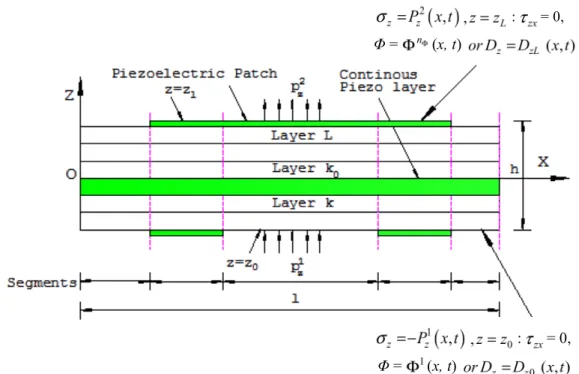
A finite element model using the 1D coupled zigzag theory is developed for the buckling analysis of hybrid piezoelectric beams (Fig.1) under electromechanical loads. Two noded elements are used for the electromechanical variables.
The highest derivatives of u0, ψ0, w0, φjappearing in the variational Eqn. (12) are
0, , 0, , 0, , ,
j
x xx x xx
u ψ w φ . To meet the convergence requirements, the interpolation functions for
0, 0, 0, , ,
j x x
u ψ w φ must be continuous at the element boundaries. Hence w0, φjare expanded using cubic Hermite interpolation in terms of the nodal values ofw0, w0,x and , ,
j j x
φ φ respectively, and a linear
interpolation is used for , u0
ψ
0. Thus, at the element level, each node will have four degrees offree-dom u0, , w0 w0,x,
ψ
0 for the displacements and 2nφ degrees of freedom of , ,j j
x
φ φ for the electric
po-tential. This leads to elements with variable numbers of degrees of freedom, since n
φ can be
Figure 1 Geometry of hybrid beams with continuous and patch piezoelectric layers.
3.1 Interpolation and variational equation
Denote the values of an entity (.) at the nodes 1 and 2 by (.)1 and (.)2 respectively. u0, ψ0, w0, φ
j
are interpolated in an element of length a as
u0=Nu0e, w0=Nw0e, ψ0=Nψ0e, φj=Nφje (13)
with
u 0
e
= u 01
u 02
⎡
⎣⎢ ⎤⎦⎥
T
, ψ0e= ψ0
1 ψ02
⎡
⎣⎢ ⎤⎦⎥
T
,
w
0
e
= w
01 w0,x
1
w
02 w0,x
2
⎡ ⎣⎢
⎤ ⎦⎥ T
,φje = φ1j φ,x 1
j φ
2
j φ
,x2 j
⎡ ⎣⎢
⎤ ⎦⎥
T (14)
and
N= N
1 N2
⎡
⎣ ⎤⎦, N= N1 N2 N3 N4
⎡
⎣ ⎤⎦, (15)
: = 0,
Φ= (x, t)
: = 0,
where,
N
1=1−x/a, N2=x/a,N1=1−3x 2/a2
+2x3/a3, N
2=x−2x 2/a
+x3/a2,
N 3=3x
2
/a2−2x3/a3, N 4=−x
2
/a+x3/a2. (16)
The integrand in the variational Eqn. (12) for the case of static mechanical load can be expressed as
[
0
a
∫
(N
x) δuo e
N
,x +( Px )δψo
e N
,x+δψ N (Qx)+ Sx j
N,xxΦo e
+QxN δψo e
+ Qxj N ,x δΦo
e
- δ e o
w N
,xx (Mx ) + δw (N,xNcr) N,xwo e
+HjN,xδΦ
o e
+GjN,xδΦ
o e
]
-F4jδΦj]dx =0
(17)
the contribution e
T of an element to the integral in Eqn. (12) is obtained as
Te=
0 a
∫
δεˆT ˆDε − δˆ uˆTfuφ
⎡
⎣ ⎤⎦dx, (18)
where,
f
uφ = 0 −F4
j ⎡
⎣⎢ ⎤⎦⎥
T
(19)
Defining generalized displacementsuˆ, generalised strains εˆ and generalised stress resultants Fˆ as
ˆ
u=⎡⎣⎢ u1T u2T ⎤⎦⎥
T
=⎡ u0 −w0,x ψ0 φ,xj w0 −φj
⎣⎢ ⎤⎦⎥
T
,
1 5 ,
ˆ εT T φjx j T
ε =⎡ ε φ ⎤
⎣ ⎦ = u0,x −w0,xx ψ0,x φ,xx j ψ
0 φ,x j φ
,x j φj ⎡
⎣⎢ ⎤⎦⎥
T ,
ˆ
F= F1
T
F5 T
Hj Gj
⎡ ⎣⎢
⎤ ⎦⎥
T
=⎡⎣⎢ Nx Mx Px Sxj Qx Qxj Hj Gj ⎤⎦⎥
T
(20)
The generalized beam constitutive relation may be expressed as
ˆ
F=Dˆεˆ (21)
3.2 Element strains
Defining the element generalized displacement vector e
U as
0 0 0
T T T T T
e e e e e
U =⎡u w
ψ
φ
⎤⎢ ⎥
and using Eqn. (13) the generalized displacements uˆ and strains εˆ defined in Eqn. (20) can be related to e
U as
ˆ ˆ ˆ ˆ e, e,
u=NU
ε
=BU (23)where , , , , , , , ,
0 0 0
0 0 0 0 0 0
0 0 0 0 0 0
0 0 0 0 0 0
ˆ , ˆ
0 0 0 0 0 0
0 0 0 0 0 0
0 0 0 0 0 0
0 0 0
x xx x x xx x x x N N N N N N N N N B N N N N N N ⎡ ⎤ ⎢ − ⎥ ⎡ ⎤ ⎢ ⎥ ⎢ − ⎥ ⎢ ⎥ ⎢ ⎥ ⎢ ⎥ ⎢ ⎥ ⎢ ⎥ =⎢ ⎥ =⎢ ⎥ ⎢ ⎥ ⎢ ⎥ ⎢ ⎥ ⎢ ⎥ ⎢ ⎥ ⎢ ⎥ − ⎢ ⎥ ⎣ ⎦ ⎢ ⎥ ⎢ ⎥ ⎣ ⎦ (24)
Substituting the expressions for uˆ and εˆ from Eqn. (23) into Eqn. (18), Tecan be expressed as
0
ˆ ˆ ˆ ˆ
T T
a
e e T e T e e e e
u
T =
∫
δU ⎣⎡B DBU −N fφ⎦⎤dx=δU ⎡⎣K U −P ⎤⎦ (25)with
0 0
ˆ ˆˆ , ˆ .
a a
e T e T
u D
K =
∫
B Bdx P =∫
N fφdx (26)Nx, Mx, Px, and Qx are substituted so that to obtain general equation after integration as:
KeUe=Pe (27)
1 2 0 , , , ,
z z z zL ji
p p D D q are linearly interpolated in terms of their nodal values,
0 0
1 1 2 2
, , , ,
L L i i
e e e e e
z z z z z z z z j j
p =Np p =Np D =ND D =ND q =Nq (28)
pe= 0
0
0
c10pϕ je ⎡ ⎣ ⎢ ⎢ ⎢ ⎢ ⎢ ⎢ ⎢ ⎢ ⎤ ⎦ ⎥ ⎥ ⎥ ⎥ ⎥ ⎥ ⎥ ⎥ (29) and
( )
e jjiji jn e z j e z L j e z j z e z e z
q
D
D
z
p
p
p
p
p
L e eδ
δ
δ
φ φφ
=
−
Ψ
−
+
+
+
=
1 1 2 1 0,
(30)3.3 FEM for buckling of hybrid beam under axial loading
For buckling of laminated composite beams under axial loading it is assumed that lateral load is zero and the axial forces applied are compressive in nature at the ends. From the variational equa-tion let Nx = Nx - Ncr
F2 = 0 and F4j=0 (lateral load) (31)
where Ncr is the buckling critical load at which buckling occurs, be substituted other terms such as
shape functions and primary variables are substituted from equations (13), (14),(15) and (16) to obtain buckling eigen value equation from variational equations
[
0 a
∫
(Nx-Ncr)δ ,e
o x
u N +(Px)δ
,x N
e o
ψ +δψNQx+ ,
j e
x xx o
S N Φ +
Q
xNδ e oψ + ,
j
x x
Q N δ e o
Φ -δ ,
e
o xx
w N
Mx+δw(N,xNx- Ncr) ,
e x o
N w +
, ,
j e j e
x o x o
H N δΦ +G N δΦ
]-0 4 ]
j j a
F δΦ =0
(32)
N x, Mx, Px, and Qx are substituted to obtain eigen value problem, after integration
Ke Ue – Ncr KG Ue = 0 (33)
Ncr is an eigen-value of the generalized eigen-value problem .The lowest eigen-value is the critical
value of the axial load at which buckling occurs. KG is the element geometric stiffness matrix
KG = 3 22
0 0 0 0
0 0 0
0 0 0 0
3 0
a c =
∫
(,x ,x
N N )dx (35)
The critical axial strain εcr for buckling under axial load corresponding to critical load is given by εcr= -Ncr /A11 and the critical load Ncr is non-dimensionalised as
3
/
cr cr T
N =N S Y a (36)
The critical axial strain εcr is non-dimensionalised as
ε
cr=SεThe critical potential
φ
cr is non-dimensionalised as φ cr = . crdThS
φ
The mechanical boundary conditions for a movable supported end, immovable simply-supported (hinged) end, clamped end and free end are taken as follows:
simply-supported end : Nx=0 movable
(
)
oru0 =0 immovable
(
)
,w0 =0,Mx=0,Px=0clamped end : u
0=0,w0=0,w0,x =0,Ψ0=0,
free end :N
x =0,Vx =0,Mx =0,Px =0.
4 RESULTS AND DISCUSSIONS
4.1 Validation
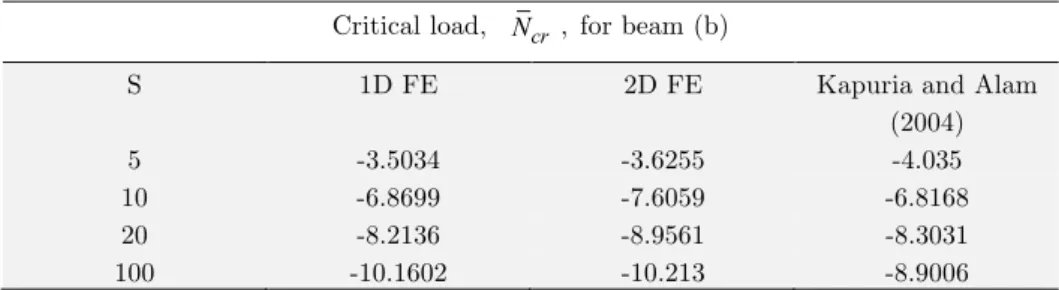
The present 1D-FE formulation of zigzag theory is validated by comparing the results for critical load, and critical strain of the simply-supported beam with the results of Kapuria and Alam (2004) and 2D-FE Abaqus. Results are presented for two types of simply supported hybrid beams of dif-ferent symmetric laminate configurations (b) and (c) (Fig.2). The beams have two piezoelectric layers of PZT-5A of thickness 0.1h bonded to their elastic substrate on top and bottom surfaces. The substrate (b) is a graphite-epoxy composite laminate with 4 layers of equal thickness 0.2h with layup [00/900/900/00]. The substrate (c) is a 3-layer sandwich having graphite-epoxy composite faces and a soft core. For a beam of span ‘a’ and thickness ‘h’, the thickness parameter S=a/h.
Table 1 Comparison of results of Critical load,Ncr , for simply supported hybrid beam, beam (b).
Critical load, Ncr , for beam (b)
S 1D FE 2D FE Kapuria and Alam
(2004)
5 -3.5034 -3.6255 -4.035
10 -6.8699 -7.6059 -6.8168
20 -8.2136 -8.9561 -8.3031
Table 2 Comparison of results of Critical load,Ncr , for simply supported hybrid beam, beam (c).
Critical load, Ncr , for beam (c)
S 1D FE 2D FE Kapuria and Alam
(2004)
5 -2.798 -2.2170 -1.7233
10 -4.015 -4.1232 -3.9561
20 -7.1254 -6.9856 -6.1141
100 -8.7475 -8.8562 -7.4128
Table 3 Comparison of results of Critical strain,εcr, for simply supported hybrid beam, beam (b).
Critical strain, εcr, for beam (b)
S 1D FE 2D FE Kapuria and Alam
(2004)
5 -0.4067 -0.4209 -0.4685
10 -0.7976 -0.8830 -0.7914
20 -1.0128 -1.2121 -0.9639
100 -1.179 -1.2510 -1.0333
Table 4 Comparison of results of Critical strain,εcr, for simply supported hybrid beam, beam (c).
Critical strain, εcr, for beam (c)
S 1D FE 2D FE Kapuria and Alam
(2004)
5 -0.5823 -0.4611 -0.3584
10 -0.8351 -0.8113 -0.8228
20 -1.4379 -1.5828 -1.2716
100 -1.8193 -1.9298 -1.5417
4.2 Numerical Example
For the numerical study, two hybrid beams (b) and (c) with composite and sandwich substrates, respectively are considered (Fig. 2). Both the beams have a PZT-5A layer of thickness 0.1h bonded to the top and bottom of the elastic substrate. The PZT−5A layers have polling in +z direction.
Figure 2 Configuration of the Hybrid Composite beam (beam b) and Sandwich beam (beam c)
The composite substrate of beam (b) is a graphite-epoxy (material 1) composite laminate with 4 layers of equal thickness 0.2h with lay-up [0 / 90 / 90 / 0 ]° ° ° ° and the sandwich substrate of beam
(c) has graphite-epoxy faces of material 2 and a soft core with thicknesses 0.08h/ 0.64h/ 0.08h.
The Young’s ModuliYi, Shear ModuliGij, Poisson’s Ratioνij, Piezoelectric Strain Constants dij and Electric Permittivitiesηij, are given by:
[
Y , Y , Y , G , G , G , 1 2 3 12 23 31 ν12, ν13, ν23]
(
)
Material 1: [ 181, 10.3, 10.3, 7.17, 2.87, 7.17 GPa, 0.28, 0.28, 0.33]
(
)
Material 2: [ 131.1, 6.9, 6.9, 3.588, 2.3322, 3.588 GPa, 0.32, 0.32, 0.49]
-5 -5
Core: [(0.2208,0.2001, 2760, 16.56, 455.4, 545.1)GPa, 0.99, 3×10 , 3×10 ]
(
)
PZT-5A:[ 61, 61, 53.2, 22.6, 21.1, 21.1 GPa, 0.35, 0.38, 0.38]
(
d , d , d , d , d31 32 33 15 24) (
, η11, η22, η33)
⎡ ⎤
⎣ ⎦
-12 -8
=[(-171, -171, 374, 584, 584)×10 m/V, (1.53, 1.53, 1.5)×10 F/m].
4.3 Buckling analysis
The pre-buckling load condition with uniform axial strain 0
x
Ú and zero potential i.e.
0 ) 0
[ ( )Ψ z =Ψ(zL = ] at the top and bottom surfaces is considered. The critical buckling strain and
corresponding axial force are denoted as
ε
cr and Ncrrespectively.cr
N is the eigenvalue of the generalized eigenvalue problem .The lowest eigenvalue for n=1 is the
critical value of the axial compressive load for which buckling occurs. These eigenvalue problems have been solved for two end conditions of both the beams viz: Clamped and Clamped-Free.
4.3.1 Buckling response for clamped-clamped hybrid beam
varia-tion in values of critical load and strain for different modes. Further the 1D-FE results are in good agreement with 2D-FE results.
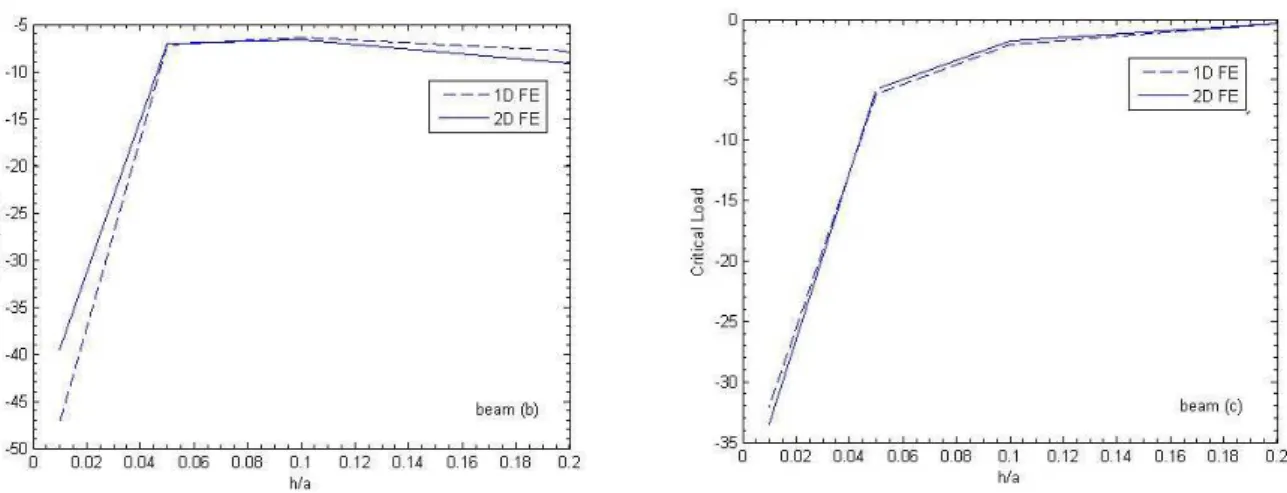
The variation of critical load for first mode (n=1)with thickness to span ratio (h/a) of both the clamped-clamped hybrid beams are shown in Fig.3.The value of the critical load increases as the beams are made thicker for the same span length.
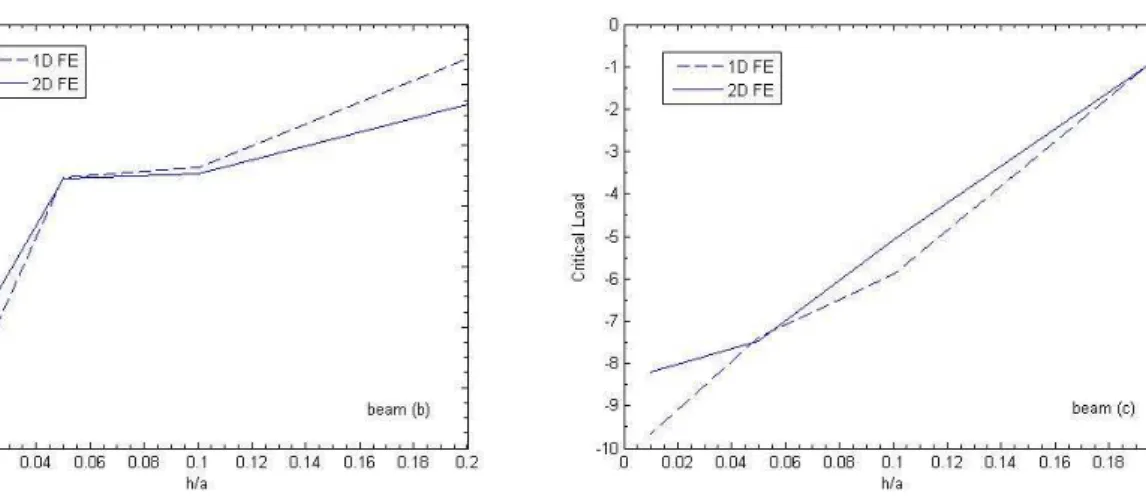
Fig.4 shows the variation of critical load with angle for clamped-clamped hybrid beam, beam (b). The results are shown for span to thickness ratio, S=10.The critical load is maximum for 0 deg and exponentially reduces as the angle increases and become 90 deg. The 1D-FE and 2D-FE plots are in good agreement.
Table 5 Comparison of 1D & 2D FE buckling response for clamped-clamped hybrid beam, beam (b)
Buckling response for clamped-clamped beam, beam(b)
S Mode
n
Critical load, Ncr Critical strain, εcr
1D FE 2D FE 1D FE 2D FE
5 1 -7.7717 -9.0870 -0.6044 -0.7067
2 -7.7717 -9.0870 -0.6044 -0.7067 3 -7.7717 -9.0788 -0.6044 -0.8007
10 1 -6.3801 -6.5725 -0.4960 -0.5110
2 -6.0982 -6.5725 -0.4740 -0.5110 3 -6.6717 -6.6696 -0.5180 -0.5180
20 1 -7.126 -7.097 -0.5542 -0.5520
2 -8.3351 -7.6405 -0.6482 -0.5942 3 -8.3351 -7.6521 -0.6482 -0.5913
100 1 -46.726 -39.9579 -0.3670 -0.3078
2 -46.737 -39.9580 -0.3684 -0.3078 3 -46.7576 -46.3030 -0.3701 -0.3340
Table 6 Comparison of 1D & 2D FE buckling response for clamped-clamped hybrid beam, beam (c)
Buckling response for clamped-clamped beam, beam (c)
S Mode
n
Critical load, Ncr Critical strain, εcr
1D FE 2D FE 1D FE 2D FE
5 1 -0.3799 -0.3734 -0.0790 -0.0777
2 -0.4470 -0.4378 -0.0930 -0.4378 3 -0.4476 -0.47378 -0.0931 -0.0911
10 1 -2.1384 -1.8381 -0.4447 -0.3823
2 -1.6561 -1.8381 -0.3444 -0.3823 3 -2.1446 -1.9807 -0.4460 -0.4119
20 1 -6.2458 -5.8260 -1.2990 -1.2117
2 -6.6858 -5.8260 -1.3905 -1.2116 3 -7.9913 -5.9970 -1.6620 -1.2431
100 1 -33.059 -33.48 -6.6670 -6.9646
Figure 3 Variation of critical load,Ncr, with thickness to span ratio, h/a, of clamped-clamped hybrid beams
Figure 4 Variation of critical load,Ncr, with angle for clamped-clamped hybrid beam, beam (b) with S=10
4.3.1 Buckling response for clamped-free hybrid beam
1D FE and 2D-FE (Abaqus) buckling results are obtained and compared for critical buckling load and strain of laminated hybrid beams for clamped-free boundary condition. The results are listed in table-7 and table-8.It may be observed that the 1D-FE results are in good agreement with 2D-FE results.
Table 7 Comparison of 1D & 2D FE buckling response for clamped-free hybrid beam, beam (b)
Buckling response for clamped-free beam, beam(b)
S Mode
n
Critical load, Ncr Critical strain, εcr
1D FE 2D FE 1D FE 2D FE
5 1 -3.1354 -4.6408 -0.3640 -0.5388
2 -5.3592 -5.5340 -0.6222 -0.6425 3 -7.3192 -7.4058 -0.8497 -0.8598
10 1 -6.7144 -6.9226 -0.7795 -0.8037
2 -9.8951 -9.8687 -1.1488 -1.1457 3 -24.592 -24.5440 -2.8550 -2.8495
20 1 -7.0738 -7.0975 -0.8218 -0.8240
2 -11.1845 -11.0276 -1.2985 -1.2803 3 -28.9359 -29.2200 -3.3593 -3.3931
100 1 -14.987 -13.2990 -1.740 -1.5441
2 -42.915 -41.8252 -4.982 -4.8557 3 -118.784 -115.98 -15.421 -13.4648
Table 8 Comparison of 1D & 2D FE buckling response for clamped-free hybrid beam, beam (c)
Buckling response for clamped-free beam, beam(c)
S Mode
n
Critical load, Ncr Critical strain, εcr
1D FE 2D FE 1D FE 2D FE
5 1 -0.0666 -0.0721 -0.0138 -0.015
2 -0.0973 -0.1015 -0.0202 -0.0211 3 -0.1206 -0.1358 -0.0251 -0.0282
10 1 -5.8896 -5.0816 -1.2246 -1.0569
2 -6.2787 -6.7732 -1.3058 -1.4087 3 -6.2787 -6.9959 -1.3058 -1.4550
20 1 -7.3843 -7.4620 -1.5358 -1.5520
2 -9.3565 -9.4380 -1.9460 -1.9629 3 -18.2191 -17.723 -3.7892 -3.7860
100 1 -9.6674 -8.2145 -2.0086 -1.7085
Figure 5 Variation of critical load,Ncr, with thickness to span ratio, h/a, of clamped-free hybrid beams
Figure 6 Variation of critical load,Ncr, with angle for clamped-free hybrid beam, beam (b) with S=10
Fig.6 shows the variation of critical load with angle for clamped-free hybrid beam, beam (b) with span to thickness ratio, S=10.The critical load is maximum for 0 deg and exponentially reduces as the angle increases and becomes 90 deg. The 1D-FE and 2D-FE plots are in good agreement.
4 CONCLUSIONS
References
Song S.J., Waas, A.M., (1997). Effects of shear deformation on buckling and free vibration of laminated composite beams. Composite Structures, 37(1):33–43.
Chandrashekhra, K., Bhatia, K. (1993). Active buckling control of smart composite plates-finite-element analysis. Smart Materials and Structures 2:31–9.
Khdeir, A.A., Reddy, J.N. (1997). Buckling of cross-ply laminated beams with arbitrary boundary conditions. Composite Structures 37:1-3.
Wang, Q. (2002). On buckling of column structures with a pair of piezoelectric layers. Engineering Structures 24(2):199–205.
Wang, Q, Quek, ST. (2002). Enhancing 5utter and buckling capacity of column by piezoelectric layers. International Journal of Solids and Structures 39(16):4167–80.
Thompson, SP, Loughlan, J. (1995). The active buckling control of some composite column structure strips using piezoceramic actuators. Composite Structures 1(32):59–67.
Kapuria, S., Alam, N. (2004). The Exact two-dimensional piezoelasticity solution for buckling of hybrid beams and cross-ply panels using transfer matrices. Composite Structures 64: 1–11.
Kapuria, S., Alam, N. (2004). Zigzag theory for buckling of hybrid piezoelectric beams under electromechanical loads. International Journal of Mechanical Sciences 46: 1–25.
Kamruzzaman, M., Umar, A, Naqvi, S. Q. A. and Siddiqui, N. A. (2006). Effect of composite type and its configuration on buckling strength of thin laminated composite plates. Latin American Journal of Solids and Structures 3: 279-299.
Kapuria, S., Alam, N. (2005). Nonlinear Zigzag Theory for Buckling of Hybrid Piezoelectric Rectangular Beams under Electrothermomechanical Loads. Journal of Engineering Mechanics 131: 367-376.
Anas., M., Hussain, I. and Alam, N. (2011). Buckling of Laminated Composite Beams using Zigzag Theory. International journal of advanced engineering sciences and technologies 11: 292 – 296.
Anas., M., Hussain, I. (2012). Finite Element Modeling and Simulation for Vibration of Symmetric Composite Beams using Zigzag Theory. International Journal of Advanced Scientific and Technical Research 1: 71-78. Vo, T., Inam, F. (2012). Vibration and Buckling of Cross-Ply Composite Beams using Refined Shear Deformation Theory. 2nd International Conference on Advanced Composite Materials and Technologies for Aerospace Applications, Wrexham, UK.
Qiao, P., Shan, L., Chen, F., and Wang, J. (2010).Local Delamination Buckling of Laminated Composite Beams Using Novel Joint Deformation Models. Journal of Engineering Mechanics 136: 541–550.
Chakrabarti, A., Chalak, H.D., Iqbal, M.A. Sheikh, A.H. (2012). Buckling analysis of laminated sandwich beam with soft core. LAJSS 9: 367 – 381.
Alam, M.N., Anas, M. (2009). Buckling Analysis of Laminated Composite Beams Using zigzag theory MATLAB and ABAQUS. Proceedings of ICEAE 2009, Bangalore, India.
Sherwani, S.F.K., Alam, M.N. (2009). Buckling Analysis of Smart Beam Using zigzag Theory and MATLAB, MEMS,ISSS 2009, 14-16 Oct.2009, Kolkata.
Kapuria, S., Alam, M.N. (2005). A coupled nonlinear zigzag theory for buckling of hybrid piezoelectric beam un-der electro-thermo-mechanical loads. ASCE J. Engineering Mechanics, 131: 367-376.
Matsunaga, H. (1996). Buckling instabilities of thick elastic beams subjected to axial stresses. Computers and Structures 59(5):859–868.
Matsunaga, H. (2001). Vibration and buckling of multilayered composite beams according to higher order deformation theories. Journal of Sound and Vibration 246(1):47–62.
Cetkovic, M., Vuksanovic, D. (2009). Bending, free vibration and buckling of laminated composite and sandwich plates using a layerwise displacement model. Composite Structures 88:219–227.
Aydogdu, M. (2006). Buckling analysis of cross-ply laminated beams with general boundary conditions by ritz method. Composite Science and Technology 66(10):1248–1255.
Iqbal ,A., Chakrabarti, A. , Chalak, H.D. , Sheikh, A.H. (2011). A new fem model based on higher order zigzag theory for the analysis of laminated sandwich beam with soft core. Composite Structures 93:271–279.
Moy, S.S.J., Nayak, A.K., Shenoi, R.A. (2005). A higher order finite element theory for buckling and vibration analysis of initially stressed composite sandwich plates. Journal of Sound and Vibration 286:763–780.
Dawe, D.J., Yuan, W.X. (2001). Overall and local buckling of sandwich plates with laminated faceplates, Part I: Analysis. Computer Methods in Applied Mechanics and Engineering 190(40):5197-5213(17).
Herbert, A. Mang, Xin Jia, Gerhard H¨ofinger. (2012). Finite element analysis of buckling of structures at special prebuckling states. Journal of Theoretical And Applied Mechanics 50(3):785-796.
Cai, B., Liu, Y., Li, H., Liu., Z. (2011). Buckling analysis of composite long cylinders using probabilistic finite element method. Mechanika 17(5): 467-473.