EUROSTEEL 2014, September 10-12, 2014, Naples, Italy
ANALYSIS OF THE INTERACTIVE BUCKLING IN STIFFENED PLATES
USING A SEMI-ANALYTICAL METHOD
Pedro Salvado Ferreiraa, Francisco Virtuosob
aPolytechnic Institute of Setúbal, Escola Superior de Tecnologia do Barreiro, ICIST, Portugal [email protected]
bUniversity of Lisbon, Instituto Superior Técnico, DECivil-ICIST, Portugal [email protected]
INTRODUCTION
Recent work in the field of semi-analytical methods used for the nonlinear analysis and design of stiffened plates with buckling problems have shown an important and alternative tool that provide an efficient and understandable response [1-4].
Nowadays two computational programs use the semi-analytical method to analyse the post-buckling behaviour of plates and to predict their ultimate strength. The computer program ALPS/ULSAP [5], which uses a semi-analytical method previously known as the incremental Galerkin method [6] and the computer program PULS [7] developed at Det Norske Veritas (DNV) and accepted as general buckling code for ship and offshore platform structures as part of the DNV specifications [8]. The existing semi-analytical models are restricted to stiffened plates supported by rigid transverse and longitudinal girders. This type of arrangement is typical in ship, aircraft, tanks and offshore platform structures where it is assumed that the analysed stiffened plate is simply supported and the in-plane displacements perpendicular to the edges are constrained to remain straight in all edges. Generally, in bottom flanges of steel box girder bridges there are no neighbouring panels in the longitudinal edges to provide this kind of constraint and it is more conservative to consider the longitudinal edges with fully free in-plane displacements that are characteristic of edges free from stresses.
This paper presents a computational semi-analytical model for the post-buckling analysis and ultimate strength prediction of stiffened plates under longitudinal uniform compression. The possibility of considering fully free in-plane displacements at longitudinal edges (or unloaded edges) is the innovation of this model over existing models. Comparisons between the semi-analytical model and nonlinear finite element model results are presented.
1 METHOD OF ANALYSIS
1.1 General
In order to validate the semi-analytical model that was developed, all nonlinear simulations were performed using the semi-analytical and finite element methods. The simulations with both methods were performed considering a yield stress (fy) of 355 Nmm-2, Young's modulus (E) of 2.1x10⁵
Nmm-2 and Poisson's coefficient (ν) of 0.3.
The stiffened flanges were considered simply supported under longitudinal uniform compression (σ) with the in-plane displacements perpendicular to the edges constrained to remain straight at loaded edges and free at unloaded edges.
1.2 Implementation of the semi-analytical method
In a second step approximate solutions for the unknown amplitudes (q) of the out-of-plane displacements are obtained solving the equilibrium equation using a variational method. Based on the approximate solutions for the unknown amplitudes of the out-of-plane displacements, the kinematic and constitutive relations and the yield criterion it is possible to analyse the post-buckling behaviour and to predict the ultimate strength of plates.
The computational implementation of the semi-analytical model developed in the framework of this study uses the Rayleigh-Ritz method to solve the equilibrium equation and it was implemented using the programming language of Mathematica6 [12]. The initial imperfections (w0) and
out-of-plane displacements (w) considered in the semi-analytical model, which satisfy the boundary conditions for simply supported plates, are given as follow
∑ ∑
∞ = ∞ = = 1 1 , 00 sin sin
m n mn b y n a x m q
w π π (1)
∑ ∑
∞ = ∞ = = 1 1 sin sin m n mn b y n a x m qw π π , (2)
where m represents the number of half-waves in the longitudinal direction, n represents the number of half-waves in the transverse direction, q0 represents the prescribed amplitudes of the initial imperfection, q represents the unknown amplitudes of the out-of-plane displacement, a represents the plate length, b represents the plate width, x represents the longitudinal coordinate and y
represents the transverse coordinate. The xy plane coincides with the plate mid-surface. Fig. 1
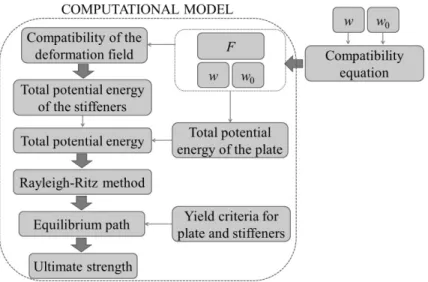
illustrates an overview of the semi-analytical model developed.
Fig. 1. Overview of the semi-analytical model developed
The stiffened plate analysis through this semi-analytical model is achieved considering the separate analyses of the plate and the stiffeners. Plate and stiffeners are modelled as an isotropic plate and as beam elements, respectively.
The compatibility equation for the isotropic plate used in the first step of the semi-analytical model to obtain the analytical solution for the Airy stress function (F) is expressed as
(
wxy wxxwyy w xywxy w xxwyy w yywxx)
E
F ,2 , , 0, , 0, , 0, ,
4
2 − −
+ −
=
∇ (3)
( )
[
(
st)
xx]
y ysl mx
sl z = ε − z−z w, =
ε , (4)
where z represents the coordinate perpendicular to the xy plane and measured from the plate mid-surface, zst represents the coordinate z of the geometric centre of the cross-section composed of the
plate and the stiffeners.
The transverse (or lateral) displacements and the torsional rotation of the stiffeners are accounted for in the total potential energy of the stiffeners. By compatibility the angle of twist (θ) and the transverse displacement at the shear centre of the single stiffener (vsc) are defined as
y
w,
=
θ (5)
sc y
sc w z
v =− , , (6)
where zsc represents the coordinate z of the shear centre of the single stiffener.
The local buckling effect of the stiffener elements is not considered in the response. This assumption is reasonable if the local buckling problems in the stiffener elements are prevented by satisfying minimum requirements for the stiffener geometric properties as established in the European standard [9]. These minimum requirements are used in the standards because the collapse of stiffened plates by local buckling of the stiffeners (lateral torsional buckling of the stiffener or local buckling of the stiffener elements) may exhibit an unstable response.
This semi-analytical model enables to take into account the initial imperfections, cases CF and CC for the in-plane displacement boundary conditions, the interaction between local and global buckling, the geometric nonlinearity and, in an approximate way, the material nonlinearity associated with the stiffness reduction after reaching the yield in the extreme fibre of the plate. The von Mises yield criterion was assumed for the plate and the stiffeners.
The plate yield criterion was defined for the sum of membrane and bending stresses at one-quarter of the plate thickness. This criterion allows for the formation of plasticity through the possibility of an additional strength after yielding in outer fibres in order to take into account in an approximate way for the material nonlinearity.
The stiffener yield criterion was defined by the yield stress, in tension or compression, at the location of the maximum stiffener stress. This criterion gives conservative ultimate strength predictions for global buckling cases when the stiffener extreme fibres are compressed.
The complete definition of each step and the procedures of the developed semi-analytical model can be found in the work of Ferreira [13].
1.3 Finite element modelling
The commercial program ADINA [14] was used to perform the nonlinear simulations by the finite element method. The program uses a large displacement/small strain with a Total Lagrangian formulation. The stiffened plates were modelled using a four-node shell element for the plate and the stiffeners. This type of element allows for finite strains due to in-plane displacements (membrane) and out-of-plane displacements (bending). A collapse analysis was performed in the full range behaviour of the stiffened plates, including the pre-buckling and post-buckling.
The nodes of each stiffener at loaded edges were connected with rigid links in order to assure their planar rotation about the supported edge. For the plate edges with in-plane displacements constrained to remain straight it was used a constraint for all nodes of the edge to ensure a uniform in-plane displacement.
2 RESULTS AND DISCUSSIONS
2.1 Elastic buckling analysis
An ideally perfect stiffened plate with an asymmetric stiffener positioned in the middle of the plate width was considered. The stiffened plate has a plate aspect ratio (ratio between the plate length a to the plate width b) of 1.5, a plate slenderness (ratio between the plate width b to the plate thickness t) of 113 and a panel slenderness (ratio between the width of the panels between stiffeners bp to the
plate thickness t) of 56.
The stiffener is composed of two panels that form a tee (T) cross-section positioned on one side of the plate, it is fully effective and fulfils the requirements to avoid torsional buckling problems. In order to assess the stiffener stiffness for which the critical stresses for the local and global buckling modes are equal an elastic buckling analysis was performed considering the stiffened plate with a relative cross-sectional area δ (ratio between the cross-sectional area of the stiffeners without any contribution of the plate Asl to the cross-sectional area of the plate (bt)) of 0.12 and a variable
relative flexural stiffness γ (ratio between the second moment of area of the stiffened plate Ist to the
second moment of area for bending of the plate corrected by the effect of the Poisson coefficient (bt3/[12(1-ν2)])). The variation of the relative flexural stiffness was considered through the change
of the geometric dimensions of the stiffener.
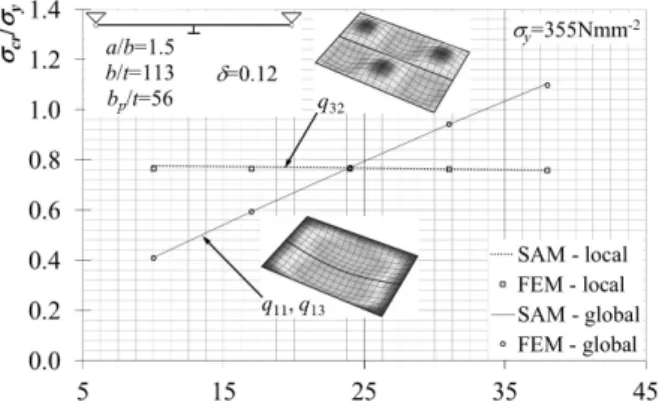
In the semi-analytical model the following cases of non-zero unknown amplitudes for the out-of-plane displacements were considered: (i) q11 and q13 to obtain the global buckling mode and (ii) q32
to obtain the local buckling mode. Fig. 2 shows the variation of the elastic critical buckling stress for the local and global buckling modes obtained by the semi-analytical and finite element models.
Fig. 2. Elastic critical buckling stress for the local and global buckling modes obtained by the semi-analytical (SAM) and finite element (FEM) models
as non-zero unknown amplitude for the out-of-plane displacements. The result for the combined global out-of-plane displacement mode was obtained assuming the terms q11 and q13 as non-zero
unknown amplitudes for the out-of-plane displacements. The elastic critical buckling stresses for the global buckling mode from the finite element model results are also presented.
Fig. 3. Elastic critical buckling stress for the individual and combined global out-of-plane displacement modes obtained by the semi-analytical model
From the analysis of Fig. 3 it can be noted that (i) for a slender stiffened plate (small γ), the individual and combined global out-of-plane displacement modes give similar results and (ii) for the plates with intermediate and high values of relative flexural stiffness (γ) it is necessary to consider the combined global out-of-plane displacement mode to obtain satisfactory results.
2.2 Post-buckling behaviour and ultimate strength
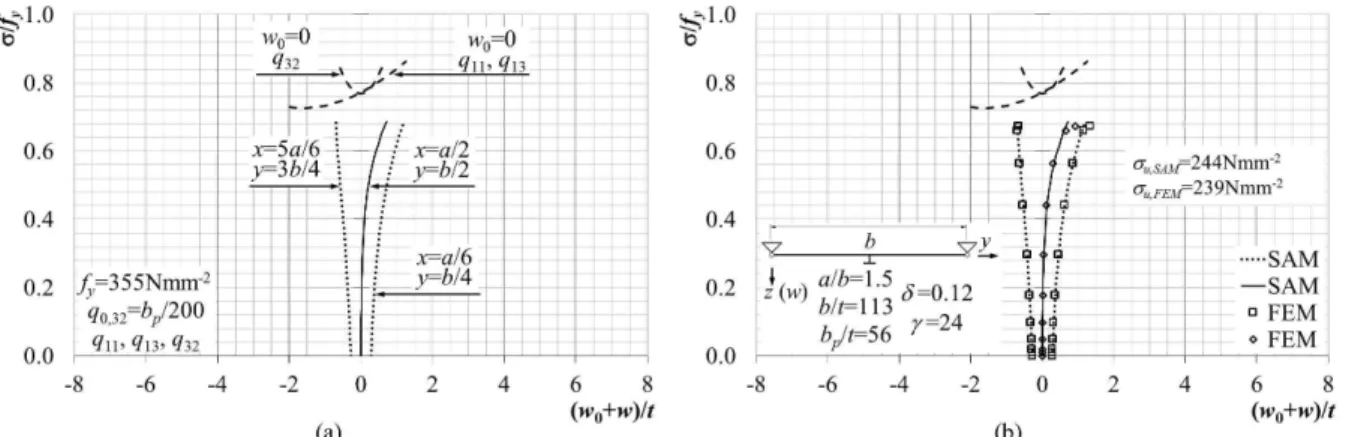
In order to analyse the interaction between local and global buckling in a plate with approximate values of elastic critical buckling stresses for the local and global buckling modes, an analysis was performed considering the previously stiffened plate with a relative flexural stiffness (γ) of 24. In the analysis an equivalent geometric imperfection was considered with the shapes of the local buckling mode (q0,32) with an amplitude of bp/200. The equivalent geometric imperfections include
the geometric imperfections and residual stresses, in accordance with European rules [9]. The terms q11, q13 and q32 were the unknown amplitudes for the out-of-plane displacements assumed to be
non-zero.
Fig. 4 shows the comparison between the equilibrium paths obtained by the semi-analytical and finite element models. Fig. 4(a) shows the results from the semi-analytical model and Fig. 4(b) shows the comparison between the results obtained by both models.
Fig. 4. Equilibrium path obtained by the semi-analytical (SAM) and finite element (FEM) models: (a) results from the semi-analytical model and (b) comparison between the results obtained by both models
semi-analytical method and the nonlinear finite element simulations concerning the ultimate strength (σu) is about 2%.
A detailed analysis of the results obtained from these calculations showed that the equilibrium paths obtained considering an equivalent geometric imperfection with the shape of the local buckling mode (q0,32) have modal participation from the local (q32) and global (q11 and q13) deflections. This
can be explained by the fact that, for the perfect stiffened plate, the post-buckling path associated with the global buckling mode has a wider concavity while the post-buckling path associated with the local buckling mode has a tighter concavity. Therefore, the global buckling mode has a higher participation in the final response than the local buckling mode and the interaction between the local and global buckling is clearly identified.
3 SUMMARY AND ACKNOWLEDGMENT
A computational semi-analytical model for the nonlinear stability analysis of stiffened plates under compression was presented. From this study the main conclusions can be summarised as follows: (i) the results of the semi-analytical model are in close agreement with the results of the nonlinear finite element simulations and (ii) the semi-analytical model prove to have a clear potential to provide accurate solutions require only a short computer time.
This work was carried out in the framework of the research activities of ICIST, Instituto de Engenharia de Estruturas, Território e Construção and was funded by FCT, Fundação para a Ciência e Tecnologia.
REFERENCES
[1] Shufrin I., Rabinovitch O., Eisenberger M., 2009. “Elastic nonlinear stability analysis of thin rectangular plates through a semi-analytical approach”. International Journal of Solids and Structures, Vol. 46, pp. 2075–92.
[2] Jaberzadeh E., Azhari M., 2009. “Elastic and inelastic local buckling of stiffened plates subjected to non-uniform compression using the Galerkin method”. Applied Mathematical Modelling, Vol. 33(4), pp. 1874–85.
[3] Liu Y., Wang Q., 2012. “Computational study of strengthening effects of stiffeners on regular and arbitrarily stiffened plates”. Thin-Walled Structures, Vol. 59, pp. 78-86.
[4] Brubak L., Andersen H., Hellesland J., 2013. “Ultimate strength prediction by semi-analytical analysis of stiffened plates with various boundary conditions”. Thin-Walled Structures, Vol. 62, pp. 28-36. [5] Paik J., Thayamballi A., 2003. Ultimate Limit State Design of Steel-Plated Structures. John Wiley &
Sons Ltd, Chichester.
[6] Ueda Y., Rashed S., Paik, J., 1987. “An incremental Galerkin method for plates and stiffened plates”.
Computers & Structures, Vol. 27, pp. 147-56.
[7] Bycklum E., Steen E., Amdahl J., 2004. “A semi-analytical model for global buckling and postbuckling analysis of stiffened panels”. Thin-Walled Structures, Vol. 42, pp.701-17.
[8] DNV-RP, 2002. Recommended Practice DNV-RP-C201 – Buckling Strength of Plated Structures. Det Norske Veritas, Høvik.
[9] EN-1993-1-5, 2006. Eurocode 3 – Design of Steel Structures – Part 1-5: Plated Structural Elements. European Committee for Standardization, Brussels.
[10] Timoshenko S., Woinowsky-Krieger S., 1959. Theory of Plates and Shells. McGraw-Hill, New York. [11] Marguerre K., 1937. “The apparent width of the plate in compression”. Technical Memorandum 833.
National Advisory Committee for Aeronautics, Washington.
[12] Wolfram S., 2007. Mathematica Documentation Center. Wolfram Research, Inc, Champaign.
[13] Ferreira P., 2012. Stiffened compression flanges of steel box girder bridges: postbuckling behaviour and
ultimate strength. Ph.D thesis. University of Lisbon, Instituto Superior Técnico, Lisbon.
[14] Bathe K., 2006. ADINA System Documentation. ADINA R&D Inc, Massachusetts.
EUROSTEEL 2014, September 10-12, 2014, Naples, Italy
ANALYSIS OF THE INTERACTIVE BUCKLING IN STIFFENED PLATES
USING A SEMI-ANALYTICAL METHOD
Pedro Salvado Ferreiraa, Francisco Virtuosob
aPolytechnic Institute of Setúbal, Escola Superior de Tecnologia do Barreiro, ICIST, Portugal [email protected]
bUniversity of Lisbon, Instituto Superior Técnico, DECivil-ICIST, Portugal [email protected]
KEYWORDS: Stiffened plates; Stability; Interactive buckling; Ultimate strength; Semi analytical method.
ABSTRACT
Recent work in the field of semi-analytical methods used for the nonlinear analysis and design of stiffened plates with buckling problems have shown an important and alternative tool that provide an efficient and understandable response [1,2].
Nowadays two computational programs use the semi-analytical method to analyse the post-buckling behaviour of plates and to predict their ultimate strength. The computer program ALPS/ULSAP [3], which uses a semi-analytical method previously known as the incremental Galerkin method and the computer program PULS [4] developed at Det Norske Veritas (DNV) and accepted as general buckling code for ship and offshore platform structures as part of the DNV specifications.
The existing semi-analytical models are restricted to stiffened plates supported by rigid transverse and longitudinal girders. This type of arrangement is typical in ship, aircraft, tanks and offshore platform structures where it is assumed that the analysed stiffened plate is simply supported and the in-plane displacements perpendicular to the edges are constrained to remain straight in all edges. Generally, in bottom flanges of steel box girder bridges there are no neighbouring panels in the longitudinal edges to provide this kind of constraint and it is more conservative to consider the longitudinal edges with fully free in-plane displacements that are characteristic of edges free from stresses.
This paper presents a computational semi-analytical model for the post-buckling analysis and ultimate strength prediction of stiffened plates under longitudinal uniform compression. The possibility of considering fully free in-plane displacements at longitudinal edges (or unloaded edges) is the innovation of this model over existing models. Comparisons between the semi-analytical model and nonlinear finite element model results are presented.
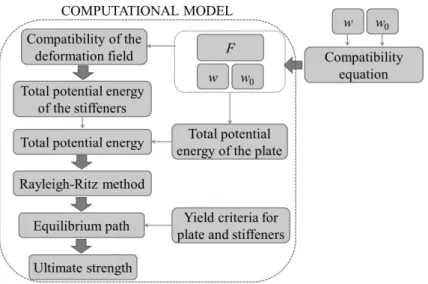
The semi-analytical method uses the two nonlinear fourth order partial differential equations of the large deflection theory, the equilibrium and compatibility equations derived by von Kármán in 1910 for perfect plates and extended to plates with initial imperfections by Marguerre. The method is called semi-analytical because in a first step an analytical solution for the Airy stress function (F) is obtained solving the compatibility equation. Trigonometric series satisfying the boundary conditions are adopted for the out-of-plane displacements (w) and for the initial imperfections (w0).
In a second step approximate solutions for the unknown amplitudes (q) of the out-of-plane displacements are obtained solving the equilibrium equation using a variational method. Based on the approximate solutions for the unknown amplitudes of the out-of-plane displacements, the kinematic and constitutive relations and the yield criterion it is possible to analyse the post-buckling behaviour and to predict the ultimate strength of plates.
Fig. 1. Overview of the semi-analytical model developed
This semi-analytical model enables to take into account the initial imperfections, the interaction between local and global buckling, the geometric nonlinearity and, in an approximate way, the material nonlinearity associated with the stiffness reduction after reaching the yield in the extreme fibre of the plate. The semi-analytical model allows two different boundary conditions for the in-plane displacements: (i) in-in-plane displacements perpendicular to the edges considered constrained to remain straight in all edges or (ii) in-plane displacements perpendicular to the edges considered constrained to remain straight at loaded edges and considered free at unloaded edges.
The complete definition of each step and the procedures of the developed semi-analytical model can be found in the work of Ferreira [5].
CONCLUSIONS
From this study the main conclusions can be summarised as follows: (i) the results of the semi-analytical model are in close agreement with the results of the nonlinear finite element simulations and (ii) the semi-analytical model prove to have a clear potential to provide accurate solutions require only a short computer time.
ACKNOWLEDGMENT
This work was carried out in the framework of the research activities of ICIST, Instituto de Engenharia de Estruturas, Território e Construção and was funded by FCT, Fundação para a Ciência e Tecnologia.
REFERENCES
[1] Shufrin I., Rabinovitch O., Eisenberger M., 2009. “Elastic nonlinear stability analysis of thin rectangular plates through a semi-analytical approach”. International Journal of Solids and Structures, Vol. 46, pp. 2075–92.
[2] Brubak L., Andersen H., Hellesland J., 2013. “Ultimate strength prediction by semi-analytical analysis of stiffened plates with various boundary conditions”. Thin-Walled Structures, Vol. 62, pp. 28-36. [3] Paik J., Thayamballi A., 2003. Ultimate Limit State Design of Steel-Plated Structures. John Wiley &
Sons Ltd, Chichester.
[4] Bycklum E., Steen E., Amdahl J., 2004. “A semi-analytical model for global buckling and postbuckling analysis of stiffened panels”. Thin-Walled Structures, Vol. 42, pp.701-17.
[5] Ferreira P., 2012. Stiffened compression flanges of steel box girder bridges: postbuckling behaviour and