ACPD
12, 5705–5738, 2012Methanol-CO correlations in Mexico City pollution
outflow
Y. Xiao et al.
Title Page
Abstract Introduction
Conclusions References
Tables Figures
◭ ◮
◭ ◮
Back Close
Full Screen / Esc
Printer-friendly Version Interactive Discussion
Discussion
P
a
per
|
Dis
cussion
P
a
per
|
Discussion
P
a
per
|
Discussio
n
P
a
per
|
Atmos. Chem. Phys. Discuss., 12, 5705–5738, 2012 www.atmos-chem-phys-discuss.net/12/5705/2012/ doi:10.5194/acpd-12-5705-2012
© Author(s) 2012. CC Attribution 3.0 License.
Atmospheric Chemistry and Physics Discussions
This discussion paper is/has been under review for the journal Atmospheric Chemistry and Physics (ACP). Please refer to the corresponding final paper in ACP if available.
Methanol-CO correlations in Mexico City
pollution outflow from aircraft and
satellite during MILAGRO
Y. Xiao1, K. E. Cady-Pereira1, V. H. Payne1, D. B. Millet2, M. W. Shephard3,
M. Luo4, M. Alvarado1, K. C. Wells2, E. C. Apel5, T. L. Campos5, H. B. Singh6, and G. W. Sachse7
1
Atmospheric and Environmental Research, Inc., Lexington, Massachusetts, USA
2
University of Minnesota, Department of Soil, Water and Climate, St. Paul, Minnesota, USA
3
Atmospheric and Climate Applications (AC Apps), Inc., East Gwillimbury, Ontario, Canada
4
Jet Propulsion Laboratory, California Institute of Technology, Pasadena, California, USA
5
National Center for Atmospheric Research, Boulder, CO, USA
6
NASA Ames Research Center, CA, USA
7
NASA Langley Research Center, VA, USA
Received: 19 December 2011 – Accepted: 18 January 2012 – Published: 22 February 2012 Correspondence to: Y. Xiao ([email protected])
ACPD
12, 5705–5738, 2012Methanol-CO correlations in Mexico City pollution
outflow
Y. Xiao et al.
Title Page
Abstract Introduction
Conclusions References
Tables Figures
◭ ◮
◭ ◮
Back Close
Full Screen / Esc
Printer-friendly Version Interactive Discussion
Discussion
P
a
per
|
Dis
cussion
P
a
per
|
Discussion
P
a
per
|
Discussio
n
P
a
per
Abstract
The correlation between methanol (CH3OH) and carbon monoxide (CO) is of particular
interest for characterizing biogenic and anthropogenic emission sources of CH3OH and
other chemical species. Here, the CH3OH/CO enhancement ratio (∆CH3OH/∆CO) in the lower to middle troposphere is examined using coincident CH3OH and CO
observa-5
tions from aircraft (NCAR C-130 and NASA DC-8) and from the Tropospheric Emission Spectrometer (TES) satellite during the MegaCity Initiative: Local and Global Research Observations (MILAGRO) in the Mexico City region in March 2006.∆CH3OH/∆CO
ra-tios from the two in-situ aircraft measurements are far higher than previously reported CH3OH emission ratios relative to CO from US cities. This may reflect combustion
10
of different fuel types in this area, and possibly photochemical production of CH3OH in Mexico City outflow. TES CH3OH and CO retrievals over the MILAGRO domain
show relatively high sensitivity in the 600–800 hPa range, associated with Mexico City pollution outflow. The TES derived ∆CH3OH/∆CO ratios during MILAGRO are 18– 24 ppt ppb−1, which are similar to those observed from the DC-8 (26–39 ppt ppb−1),
15
but lower than the C-130 observations (41–55 ppt ppb−1). Differences between the
∆CH3OH/∆CO ratios measured aboard the two aircraft preclude an absolute
valida-tion of the TES-derived ratios for this dataset. The ∆CH3OH/∆CO ratios observed
from TES over this domain reflect bulk enhancements of CH3OH and CO in Mexico City outflow. Although the TES measurements are not expected to resolve small-scale
vari-20
ability in the∆CH3OH/∆CO ratio downwind of the strong source region of Mexico City,
it is demonstrated that TES can clearly distinguish differences in the ∆CH3OH/∆CO
ratio due to different source categories of CH3OH. An example of this is shown by con-trasting measurements over Mexico City (strong anthropogenic emissions) with those over the Amazon Basin (strong biogenic emissions). The results from this case study
25
ACPD
12, 5705–5738, 2012Methanol-CO correlations in Mexico City pollution
outflow
Y. Xiao et al.
Title Page
Abstract Introduction
Conclusions References
Tables Figures
◭ ◮
◭ ◮
Back Close
Full Screen / Esc
Printer-friendly Version Interactive Discussion
Discussion
P
a
per
|
Dis
cussion
P
a
per
|
Discussion
P
a
per
|
Discussio
n
P
a
per
|
1 Introduction
Methanol (CH3OH) is one of the most abundant volatile organic compounds (VOCs).
It is a significant source of tropospheric carbon monoxide (CO) and formaldehyde (CH2O) (Duncan et al., 2007; Millet et al., 2005; Hu et al., 2011). CH3OH can also
have an important influence on air quality in and around polluted urban areas (Molina
5
et al., 2010). CH3OH may also contribute to particulate pollution (Blando and Turpin,
2000). The first global detection of methanol was made by Singh et al. (1995). Globally the major sources of CH3OH are biogenic processes with∼50 %–80 % of the estimated
emissions involving plant growth (Harley et al., 2007; Karl et al., 2003) and, to a lesser extent, plant decay (Warneke et al., 1999). Other sources include biomass burning
10
(Paton-Walsh et al., 2008; Dufour et al., 2006), anthropogenic sources from vehicles and industrial activities (de Gouw et al., 2005, 2009), as well as oxidation of methane and other volatile organic compounds (Tyndall et al., 2001; Madronich and Calvert, 1990). Although these other sources are much less important than the biogenic source on a global scale, they can be responsible for large CH3OH enhancements on regional
15
or continental scales. The main sink of CH3OH is oxidation by OH (Heikes et al., 2002).
Dry and wet deposition to the surface constitutes a minor sink (Karl et al., 2010). The resulting overall atmospheric lifetime of CH3OH is approximately 5–10 days (Jacob et
al., 2005).
Estimates of the source strength, seasonality, and spatial distribution of CH3OH in
20
the atmosphere have previously been obtained from field measurements (e.g. Heikes et al., 2002; Singh et al., 2000), chemical transport modeling in combination with ground and airborne measurements of CH3OH (e.g. Millet et al., 2008; Jacob et al., 2005; Tie et al., 2003; Galbally and Kirstine, 2002), and from remotely sensed measurements from ground-based infrared spectrometers (e.g. Rinsland et al., 2009;
25
Paton-Walsh et al., 2008). These studies have provided much-needed insight into CH3OH sources and atmospheric abundance. However, large uncertainties persist
in terms of CH3OH source magnitudes, seasonality, and its spatial distribution in the
ACPD
12, 5705–5738, 2012Methanol-CO correlations in Mexico City pollution
outflow
Y. Xiao et al.
Title Page
Abstract Introduction
Conclusions References
Tables Figures
◭ ◮
◭ ◮
Back Close
Full Screen / Esc
Printer-friendly Version Interactive Discussion
Discussion
P
a
per
|
Dis
cussion
P
a
per
|
Discussion
P
a
per
|
Discussio
n
P
a
per
Satellite measurements offer the advantage of high spatial and temporal coverage, albeit with lower resolution than in situ observations. For example, CH3OH has been
measured in biomass burning plumes in the upper troposphere from the Atmospheric Chemistry Experiment Fourier Transform Spectrometer (ACE-FTS), a limb-viewing in-strument with relatively high vertical resolution and sensitivity to minor trace gases
(Co-5
heur et al., 2007; Dufour et al., 2006). More recently, it has been shown that nadir in-struments can measure enhanced CH3OH in the lower troposphere. CH3OH retrievals have been performed using data from the Tropospheric Emission Spectrometer (TES) on the NASA Aura satellite (Cady-Pereira et al., 2012; Beer et al., 2008) and from the Infrared Atmospheric Sounding Instrument (IASI) onboard the polar-orbiting
MetOp-10
A satellite (Razavi et al., 2011). In addition, TES and IASI observations have been employed to better constrain the seasonality of methanol emissions from northern mid-latitude ecosystems (Wells et al., 2012) and to constrain biogenic and biomass burning emissions of methanol (Stavrakou et al., 2011). Both TES and IASI use the same spec-tral region (centered at 1033 cm−1) for CH3OH retrieval. TES has high spectral
reso-15
lution of 0.06 cm−1 at nadir providing the ability to distinguish the target species from interferences, while the IASI instrument has larger spatial coverage providing global coverage twice per day due to the wide scans across its track.
Constraints on the importance of various CH3OH source types can be gained by examining the correlations between CH3OH and other measured species. The
cor-20
relation between CH3OH and CO is of particular interest in source characterization
(Warneke et al., 2007; de Gouw et al., 2005), and simultaneous measurements of CH3OH and CO are available from the satellite instruments listed above. CH3OH and CO share common anthropogenic and biomass burning sources. However, biogenic CH3OH emissions can modify the CH3OH-CO ratio to varying degrees depending on
25
their importance relative to combustion sources. In general, both molecules exhibit a similar vertical distribution since their sources are mainly at the surface, although both CH3OH and CO do have atmospheric sources from the oxidation of CH4 and other
ACPD
12, 5705–5738, 2012Methanol-CO correlations in Mexico City pollution
outflow
Y. Xiao et al.
Title Page
Abstract Introduction
Conclusions References
Tables Figures
◭ ◮
◭ ◮
Back Close
Full Screen / Esc
Printer-friendly Version Interactive Discussion
Discussion
P
a
per
|
Dis
cussion
P
a
per
|
Discussion
P
a
per
|
Discussio
n
P
a
per
|
The Megacity Initiative: Local And Global Research Observations (MILAGRO) field campaign was conducted over the Mexico City Metropolitan Area (MCMA) and the Gulf of Mexico in March 2006, with the goal of examining the properties, evolution, and export of atmospheric emissions of trace gases and particles generated in the MCMA and to evaluate the regional and global impacts of these emissions (Molina et al., 2010;
5
Singh et al., 2009). Major sources of pollutants in the MCMA include motor vehicles (Apel et al., 2010), pervasive incomplete combustion of fossil fuels including Liquid Petroleum Gas (LPG) for low-temperature household cooking and heating (Blake and Rowland, 1995), and biomass burning (Crounse et al., 2009; Yokelson et al., 2007). During MILAGRO, urban and regional measurements of a number of air pollutants
10
were obtained by the National Center for Atmospheric Research (NCAR) C-130 and the National Aeronautics and Space Administration (NASA) DC-8 aircraft. In this anal-ysis, we utilize MILAGRO aircraft measurements to determine correlations between CH3OH and CO, as well as between CH3OH and other trace gas pollutants, in order to qualitatively assess the influence of different sources on the CH3OH concentrations in
15
the Mexico City outflow.
During MILAGRO TES also made a number of special observations over the MCMA. Retrievals of CH3OH and CO have been performed based on these observations.
Di-rect comparisons of aircraft in situ profiles of CH3OH and CO with satellite retrievals
during MILAGRO proved challenging as there were very few targeted profile
under-20
flights of the satellite track by either the C-130 or DC-8 aircraft over Mexico City, which limited sampling coincidence within reasonable spatial and temporal criteria. Instead, we have utilized CH3OH-CO correlations to evaluate the ability of the satellite data to capture the important source information offered by aircraft measurements, with the goal of assessing whether such space-borne data can be reliably applied to other
re-25
gions and time periods where no aircraft measurements are available. In addition, in order to further explore the utility of CH3OH-CO correlations from TES, we have
com-pared and contrasted satellite CH3OH-CO correlations from MILAGRO (dominated by
ACPD
12, 5705–5738, 2012Methanol-CO correlations in Mexico City pollution
outflow
Y. Xiao et al.
Title Page
Abstract Introduction
Conclusions References
Tables Figures
◭ ◮
◭ ◮
Back Close
Full Screen / Esc
Printer-friendly Version Interactive Discussion
Discussion
P
a
per
|
Dis
cussion
P
a
per
|
Discussion
P
a
per
|
Discussio
n
P
a
per
(dominated by biogenic emissions – e.g. Karl et al., 2007).
Descriptions of the aircraft and TES satellite measurements are provided in Sect. 2, and the analysis and results in Sect. 3.
2 Measurements during MILAGRO
2.1 Aircraft measurements
5
Figure 1 shows the aircraft flight tracks (along with TES footprint locations) during MI-LAGRO. All the data used in this work were collected within 12◦N–30◦N and 102◦W– 90◦W, covering the region downwind of Mexico City and the northern part of the Gulf of Mexico. The MCMA (19.43◦N, 99.12◦W) is located in the Valley of Mexico, a large basin 2.2 km a.s.l. The basin is surrounded on three sides by mountain ridges, with a
10
broad opening to the north. The C-130 flight tracks are closer than those of the DC-8 to the urban area of Mexico City, though some of the flights were designed to fly over remote regions either to detect long-range plume transport (more than 1000 km from Mexico City) or to measure biomass burning plumes. The DC-8 flight tracks cover a larger geographical domain and the measurements are more representative of outflow
15
at a distance from the sources.
Airborne measurements of CH3OH were made by the Total Organic Gas
Ana-lyzer (TOGA) (Apel et al., 2010) onboard the C-130, and the Peroxy Acetyl Ni-trate/Aldehyde/Ketone Photo Ionization Detector (PANAK) (Singh et al., 2004) onboard the DC-8. The reported CH3OH uncertainty for both aircraft instruments is 20 % at 1σ
20
level. However, intercomparisons of TOGA (C-130) and PANAK (DC-8) measurements during MILAGRO have shown that the CH3OH values from the C-130 are generally higher than those from the DC-8, by as much as a factor of 2. This suggests a possible inconsistency in calibration between the CH3OH measurements onboard the two
air-craft (Kleb et al., 2011, more details at http://www-air.larc.nasa.gov/missions/intex-b/
25
ACPD
12, 5705–5738, 2012Methanol-CO correlations in Mexico City pollution
outflow
Y. Xiao et al.
Title Page
Abstract Introduction
Conclusions References
Tables Figures
◭ ◮
◭ ◮
Back Close
Full Screen / Esc
Printer-friendly Version Interactive Discussion
Discussion
P
a
per
|
Dis
cussion
P
a
per
|
Discussion
P
a
per
|
Discussio
n
P
a
per
|
Volume mixing ratios of CO were measured by the Ultra-Violet Fluorescence (UVF) instrument on the C-130 (Holloway et al., 2000) with a quoted accuracy of 10 %, and by the Differential Absorption CO Measurement (DACOM) instrument (Sachse et al., 1987), a mid-IR diode laser spectrometer that measured CO, CH4, and N2O on the DC-8 aircraft. DACOM’s quoted CO accuracy is 2 % or 2 ppb. A suite of
simultane-5
ous observations of other related hydrocarbons on the C-130 aircraft are also used in Sect. 3 for quantification of the source signature of CH3OH. All those species were measured with an estimated accuracy of ≤20 % (Singh et al., 2009). The MILAGRO data is supplied on a 1 min merge. However, the TOGA CH3OH measurements were
actually made with 2.8 min temporal resolution. Therefore, in this analysis we have
10
further merged the data to 3 min intervals for instances where CO differs by more than 10 ppb between time steps, but CH3OH values are constant. To reduce the influence
of a small number of extreme outliers on the correlation analysis, we removed any data with CO concentrations greater than 500 ppb. These points were all located within 300 km of the city center and comprised around 3 % of the whole dataset. Any errors in
15
the airborne CH3OH and CO measurements are assumed independent and not taken
into account for the correlation analysis in Sect. 3.
2.2 Satellite measurements from TES
TES is a Fourier transform spectrometer flying on the NASA Aura satellite. The instru-ment has high spectral resolution (0.06 cm−1) and a relatively small (5×8 km) nadir
20
footprint. The TES instrument measures radiances in the spectral range 650 to 3050 cm−1(Beer et al., 2001) that are very stable (Conner et al., 2011) with good radiomet-ric calibration and signal-to-noise (Shephard et al., 2008). These instrument charac-teristics provide TES with the capability to provide information on the vertical profiles of temperature and numerous trace gases in the atmosphere. Profiles of
tempera-25
ture, water vapor (H2O and HDO), ozone (O3), CO, methane (CH4) and ammonia
ACPD
12, 5705–5738, 2012Methanol-CO correlations in Mexico City pollution
outflow
Y. Xiao et al.
Title Page
Abstract Introduction
Conclusions References
Tables Figures
◭ ◮
◭ ◮
Back Close
Full Screen / Esc
Printer-friendly Version Interactive Discussion
Discussion
P
a
per
|
Dis
cussion
P
a
per
|
Discussion
P
a
per
|
Discussio
n
P
a
per
operationally. CH3OH is scheduled to be processed routinely as part of the TES Ver-sion 6 algorithm release.
TES conducted several special “step-and-stare” observations during the MILAGRO campaign. The TES nadir footprints in these observations are separated by∼45 km
along the Aura ground track. The Aura overpass times for Mexico City are 01:45 and
5
13:45 LT.
The first space-based nadir retrievals of CH3OH were reported by Beer et al. (2008) for a limited number of TES special observations over Beijing (Northeast China), and San Diego (California, USA). Since then, the TES CH3OH retrieval approach has been
developed further and applied to larger volumes of data. The algorithm is based on an
10
optimal estimation approach with a priori constraints. Details of the retrieval algorithm are reported in Cady-Pereira et al. (2012). The TES retrieval errors for CH3OH
dur-ing MILAGRO range from 10 % to 50 %, with larger relative errors for small retrieved CH3OH values. The TES retrievals have been validated against vertical profiles from an ensemble of aircraft measurements over North America, where a 3-D chemical
15
transport model was used as an intercomparison platform (Wells et al., 2012).
The TES operational CO product (Version 4) used in this analysis has been exten-sively validated against aircraft and other satellite measurements (Luo et al. 2007a, 2007b; Lopez et al., 2008), and showed a negative bias of <10 % in the lower and middle troposphere near Houston during INTEX-B and a positive bias of ∼5–10 % in
20
the tropics. Here we assume no correlation between the TES measurement errors for CH3OH and CO as they are in retrieved in different spectral bands. Any measurement
errors should thus have little impact on the derived CH3OH-CO enhancement ratios. Figure 2 shows example averaging kernels for both CH3OH and CO. Both species
have peak sensitivity in the 600–800 hPa region. The TES CO and CH3OH retrievals
25
contain a limited amount of vertical information, with∼1.4 degrees of freedom for signal
ACPD
12, 5705–5738, 2012Methanol-CO correlations in Mexico City pollution
outflow
Y. Xiao et al.
Title Page
Abstract Introduction
Conclusions References
Tables Figures
◭ ◮
◭ ◮
Back Close
Full Screen / Esc
Printer-friendly Version Interactive Discussion
Discussion
P
a
per
|
Dis
cussion
P
a
per
|
Discussion
P
a
per
|
Discussio
n
P
a
per
|
For both species, the number of vertical levels used in the retrieval is significantly greater than the number of DOFS for the measurement. Performing the retrieval in this way allows variations in vertical sensitivity between different profiles to be character-ized via the averaging kernels. However, it also means that the details of the result on any given retrieval level are highly sensitive to the shape of the chosen a priori profile.
5
In order to mitigate this issue, a post-processing step is performed to map the result from the relatively fine retrieval grid to a representation that better reflects the informa-tion available in the measurement. The exact details of the mapping depend on the sensitivity (averaging kernels) for each individual measurement. For CH3OH with ∼1
(or less) DOFS, we report a single “representative volume mixing ratio” (RVMR) value.
10
Further details of this approach can be found in Payne et al. (2009) and Shephard et al. (2011). The end result is that the RVMR value is less sensitive to assumptions about the a priori profile shape than a value at a single retrieval level would be. In or-der to assess the CH3OH-CO correlations, the CH3OH-sensitivity-based mapping was also applied to the CO retrieval in each case to produce a “pseudo CO RVMR”. The
15
same approach has been used to determine the emission ratio of ammonia and formic acid relative to CO using TES observations of boreal biomass plumes (Alvarado et al., 2011). In addition, an acceptance criterion of the CH3OH RVMR>0.1 ppb was applied
to exclude those retrievals with very weak CH3OH signals in the TES spectra.
3 Results
20
3.1 Source characterization of CH3OH in Mexico outflow
Vertical profiles of CH3OH and CO mixing ratios from the DC-8 and C-130 during MI-LAGRO (not shown) indicate outflow mainly at 600–800 hPa near the city center, due to the high elevation of Mexico City. Downwind of the city center, enhanced CH3OH
and CO were detected up to 600 hPa and down to the surface (∼1000 hPa), with the
ACPD
12, 5705–5738, 2012Methanol-CO correlations in Mexico City pollution
outflow
Y. Xiao et al.
Title Page
Abstract Introduction
Conclusions References
Tables Figures
◭ ◮
◭ ◮
Back Close
Full Screen / Esc
Printer-friendly Version Interactive Discussion
Discussion
P
a
per
|
Dis
cussion
P
a
per
|
Discussion
P
a
per
|
Discussio
n
P
a
per
topography leading to a very efficient “air pump” exporting pollutants to the free tropo-sphere (de Foy et al., 2006).
To examine the contributions of various source types to atmospheric CH3OH
dur-ing MILAGRO, we examined a suite of gases indicative of anthropogenic, biogenic, and biomass burning sources (the presumed sources of CH3OH), and their
correla-5
tions with CH3OH. These indicator tracers include CO, acetone ((CH3)2CO), benzene
(C6H6), acetylene (C2H2), hydrogen cyanide (HCN) and acetonitrile (CH3CN). CO is a
general tracer for combustion sources (fossil fuel, biofuel, and biomass burning). Ace-tone can be a good tracer of biogenic sources due to its relatively long lifetime (Singh et al., 1995). There is also a large source of acetone from atmospheric oxidation of
10
anthropogenic VOCs at northern midlatitudes (Fisher et al., 2012). Benzene can be regarded as an indicator of anthropogenic emissions involving solvent use, vehicle ex-haust, and industrial processes (Karl et al., 2009). C2H2is a relatively inert tracer and
comes mostly from automobile exhaust (Harley et al., 1992). HCN and CH3CN are tracers of biomass burning (Singh et al., 2010). Analysis of a subset of C-130
mea-15
surements near the MCMA during MILAGRO (Fig. 3) shows that CH3OH in this outflow
region is correlated (1) strongly with CO, acetone and benzene, (2) moderately with C2H2, and (3) less with HCN and CH3CN, suggesting that the main sources of CH3OH
during MILAGRO were anthropogenic and biogenic in nature.
In addition to primary anthropogenic and biogenic sources, photochemical formation
20
could be a contributor to CH3OH during MILAGRO. As an oxygenated VOC, CH3OH
is produced by reaction of the methylperoxy radical (CH3O2) with itself and with other
organic peroxy radicals (RO2) (Tyndall et al., 2001; Madronich and Calvert, 1990). In general, reactions involving CH3O2 and RO2 are not expected to be a large source
of CH3OH in urban environments under high NOx conditions (Molina et al., 2010).
25
However, the very active photochemical environment and the extremely high RO2 con-centrations in Mexico City could lead to reactions of CH3O2with other peroxy radicals,
potentially leading to significant CH3OH production in this specific region. In addition,
ACPD
12, 5705–5738, 2012Methanol-CO correlations in Mexico City pollution
outflow
Y. Xiao et al.
Title Page
Abstract Introduction
Conclusions References
Tables Figures
◭ ◮
◭ ◮
Back Close
Full Screen / Esc
Printer-friendly Version Interactive Discussion
Discussion
P
a
per
|
Dis
cussion
P
a
per
|
Discussion
P
a
per
|
Discussio
n
P
a
per
|
expected based on present understanding, though in the remote rather than urban polluted atmosphere. Any significant photochemical production of CH3OH during MI-LAGRO would have implications for the interpretation of CH3OH-CO correlations, as
will be discussed in Sect. 3.3.
3.2 Spatial variability of CH3OH and CO concentrations around Mexico City
5
Figure 4a, b shows the variation in CH3OH and CO concentrations at 600–800 hPa in the C-130 and DC-8 aircraft observations as a function of distance from the city center. The aircraft observations of both CH3OH and CO show a decreasing trend with
increasing distance away from the urban source region, mainly due to dilution (mixing with background air) and chemical decay.
10
Figure 4c shows the corresponding variation in the TES CH3OH RVMR and pseudo
CO RVMR. In contrast to the aircraft observations, the TES observations show no de-creasing trend with distance downwind of the city. The limited spatial variability in TES CO for this area has been previously reported by Shim et al. (2009), who examined O3 and CO from TES retrievals and MILAGRO aircraft measurements to characterize
15
mega-city pollution outflow on a regional scale. They found that TES captures much of the spatial and day-to-day variability seen in the in situ data for O3, but not for CO. In
particular, TES does not clearly resolve the CO pollution over the Mexico City Basin. We explored a number of different possible reasons for this lack of spatial variability in TES CO, including sampling issues, the vertical resolution of the TES measurements,
20
and retrieval-related issues associated with the high altitude of Mexico City. Examina-tion of these issues using 5 yr of TES Version 4 CO data over this region led to the conclusion that the handling of the TES Version 4 CO prior constraints over regions with high surface elevation is an important contributor to the inadequate spatial vari-ability in TES CO during MILAGRO. Points within 300 km of the city center mostly have
25
ACPD
12, 5705–5738, 2012Methanol-CO correlations in Mexico City pollution
outflow
Y. Xiao et al.
Title Page
Abstract Introduction
Conclusions References
Tables Figures
◭ ◮
◭ ◮
Back Close
Full Screen / Esc
Printer-friendly Version Interactive Discussion
Discussion
P
a
per
|
Dis
cussion
P
a
per
|
Discussion
P
a
per
|
Discussio
n
P
a
per
vector and tighter constraints from the prior than are desirable. Therefore, the TES CO values over Mexico City are generally constrained to lower values than they should be due to the a priori constraints. This issue will be considered in future TES algorithm updates. Note that this is less of an issue for the O3 retrievals, which are far more loosely constrained in the upper troposphere than the CO retrievals. For the CH3OH
5
retrievals the prior constraints are shifted vertically to account for variations in surface elevation (Cady-Pereira et al., 2012).
An additional contributor to the lack of spatial variability in CH3OH and CO during
MILAGRO is the coarse vertical resolution of the measurements. In situ outflow profiles measured during MILAGRO show concentrations that peak in a relatively narrow range.
10
The TES CH3OH and CO retrievals are unable to distinguish between profiles with a sharp, strongly enhanced peak, and profiles where the trace gas enhancement has lower peak values but is spread over a wider vertical range. Therefore, TES does not reproduce the extreme high peak values observed by the aircraft, and would be expected to show lower average values than the plume-chasing aircraft, particularly in
15
the region closest to the city center. However, this is not expected to bias the derived CH3OH-CO correlation.
3.3 Impact of vertical resolution of TES retrieval on the derived∆CH3OH/∆CO
ratio
In this study the CH3OH/CO enhancement ratio is defined as the slope of the
regres-20
sion between CH3OH and CO, and is denoted as ∆CH3OH/∆CO. The slope is cal-culated using the reduced major axis (RMA) method, which estimates the linear re-lationship between two variables by minimizing the residual variance in both x and y directions (Xiao et al., 2004; Hirsch and Gilroy, 1984). For the aircraft in-situ mea-surements, it is straightforward to derive ∆CH3OH/∆CO. For the TES observations,
25
the∆CH3OH/∆CO ratio is the regression slope between the CH3OH RVMR and the
ACPD
12, 5705–5738, 2012Methanol-CO correlations in Mexico City pollution
outflow
Y. Xiao et al.
Title Page
Abstract Introduction
Conclusions References
Tables Figures
◭ ◮
◭ ◮
Back Close
Full Screen / Esc
Printer-friendly Version Interactive Discussion
Discussion
P
a
per
|
Dis
cussion
P
a
per
|
Discussion
P
a
per
|
Discussio
n
P
a
per
|
The vertical resolution of the TES measurement should be taken into consideration for the interpretation of the retrieved CH3OH and CO and the associated spatial
vari-ability in Mexico City outflow. Simulated retrievals are utilized to examine whether the coarse vertical resolution of TES CH3OH and CO observations would be expected to affect the derived∆CH3OH/∆CO ratios.
5
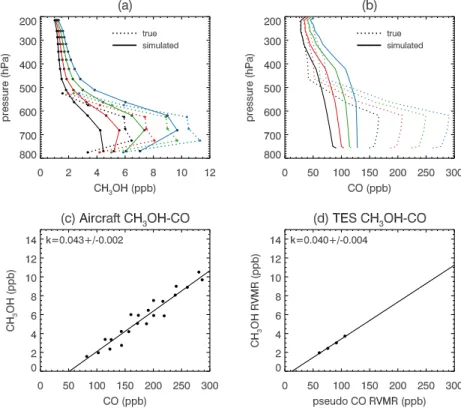
Starting with averaged C-130 aircraft profiles of CH3OH and CO near the Mexico
City center (<300 km), we constructed a base profile for each species, which was then scaled by factors of 1.25, 1.5 and 1.75 to create four profiles in total. These four profiles (shown as dashed lines in Fig. 5a and b) were used as “truth” to generate four sets of simulated TES radiances. Realistic noise was included in the simulated radiances.
10
CH3OH retrievals were then performed on the simulated radiances. Simulated CO retrievals were generated from the assumed “true” profiles by applying the a priori and averaging kernel from a typical TES case with relatively strong sensitivity (from Version 4 of the TES operational algorithm). Retrieved profiles are shown as solid lines in Fig. 5a and b. Thus, for each set of CH3OH and CO retrieved profiles, we have a pair
15
of CH3OH and CO RVMRs, resulting in the TES∆CH3OH/∆CO ratio shown in Fig. 5d.
Despite the coarse vertical resolution of the TES measurements, TES is able to recover the true∆CH3OH/∆CO ratio when both CH3OH and CO retrievals show relatively high
sensitivity.
3.4 Spatial variability in the∆CH3OH/∆CO ratio
20
In order to explore the utility of CH3OH-CO correlations from TES observations, we evaluated the extent to which variability in the CH3OH/CO enhancement ratio
is captured by TES based on in-situ aircraft observations during MILAGRO. The
∆CH3OH/∆CO ratio observed by TES reflects the bulk enhancements of CH3OH and CO in the Mexico City outflow, smoothed by the TES vertical sensitivity. For
25
TES/aircraft comparisons of the ∆CH3OH/∆CO ratio, only aircraft data in the 600–
ACPD
12, 5705–5738, 2012Methanol-CO correlations in Mexico City pollution
outflow
Y. Xiao et al.
Title Page
Abstract Introduction
Conclusions References
Tables Figures
◭ ◮
◭ ◮
Back Close
Full Screen / Esc
Printer-friendly Version Interactive Discussion
Discussion
P
a
per
|
Dis
cussion
P
a
per
|
Discussion
P
a
per
|
Discussio
n
P
a
per
Figure 6a shows the CH3OH-CO correlations from the two aircraft. In contrast with the CH3OH and CO concentrations themselves, ∆CH3OH/∆CO ratios for air
masses with significant source influence vary little with geographical location. Instead, slightly higher ratios are seen outside the 300 km range as compared to within 300 km around the city. This may be explained by photochemical production of CH3OH. The
5
∆CH3OH/∆CO ratios based on the C-130 aircraft measurements are 41–55 ppt ppb
−1
, while the DC-8 observations show much lower values of 26–39 ppt ppb−1. The different
∆CH3OH/∆CO ratios between the C-130 and DC-8 measurements appear to reflect a
calibration offset (see Sect. 2.1) rather than the different sampling strategy for the two aircraft (Singh et al., 2009), since the discrepancy persists regardless of the distance
10
from the MCMA (Fig. 6a).
Figure 6b shows the corresponding CH3OH-CO correlations as measured by TES.
As with the aircraft observations (Fig. 6a), TES∆CH3OH/∆CO ratios display little varia-tion with distance from the city center (ranging from 18 to 24 ppt ppb−1), and are closer to the values derived from the DC-8 measurements during MILAGRO than to those
de-15
rived from the C-130 measurements. Note that close to Mexico City center, we expect TES CO retrievals using the Version 4 algorithm to under-represent the true values due to the issues with the constraints discussed above. This particular issue should not be present in the TES CH3OH observations as our retrieval shifts the constraints. With more appropriate CO constraints, it is expected that the TES data will exhibit some
20
spatial variation in the enhancement ratios, with slightly lower ratio values (increased CO values) closer to the city center, as seen in the aircraft data.
Any discrepancies between TES and aircraft ratios for the MILAGRO dataset may be due to aircraft instrument calibration issues, or to systematic errors in the TES re-sults. Possible sources of systematic error in the TES retrievals include forward model
25
ACPD
12, 5705–5738, 2012Methanol-CO correlations in Mexico City pollution
outflow
Y. Xiao et al.
Title Page
Abstract Introduction
Conclusions References
Tables Figures
◭ ◮
◭ ◮
Back Close
Full Screen / Esc
Printer-friendly Version Interactive Discussion
Discussion
P
a
per
|
Dis
cussion
P
a
per
|
Discussion
P
a
per
|
Discussio
n
P
a
per
|
aircraft measurements of CH3OH, it is difficult at this stage to use the aircraft observa-tions as evaluation of the absolute TES enhancement ratios.
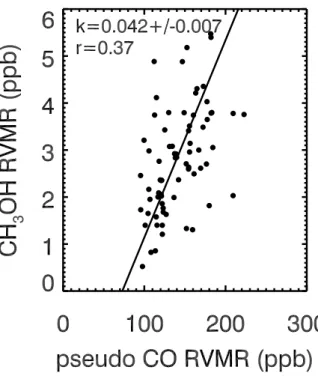
In contrast with Mexico City, a region dominated by strong anthropogenic emissions, we also examine the TES∆CH3OH/∆CO ratios over the Amazon Basin, a region dom-inated by biogenic emissions (with an additional biomass burning source contribution)
5
(Karl et al., 2007). Similar to the MILAGRO domain the Amazon region exhibits ele-vated CH3OH values, which provides a relatively high signal-to-noise ratio for the TES observations. Figure 7 shows TES∆CH3OH/∆CO ratios over the Amazon Basin
dur-ing August–September of 2005. The ratio of 42±7 ppt ppb−1 is a factor of 2 higher than that observed near Mexico City during MILAGRO (18–24 ppt ppb−1). The
signif-10
icant ratio difference between Mexico City and the Amazon Basin indicates that the TES-derived∆CH3OH/∆CO ratio has potential for differentiating source categories of
CH3OH and other chemical species with multiple sources (e.g. CO2). With future work, the TES-derived ratio could be applied globally to other regions and time periods where no in situ measurements are available.
15
It should be noted that connecting the observed∆CH3OH/∆CO ratio from either air-craft or TES with the actual CH3OH/CO emission ratio from “urban” sources in Mexico
City is complicated, since the∆CH3OH/∆CO ratio could have already been enhanced
due to photochemical production of CH3OH even in the plumes thought to be “fresh”. Ground-based estimates of emission ratios tend to show lower values than the
en-20
hancement ratios measured aboard aircraft. For example, Bon et al. (2011) report CH3OH/CO emission ratios of 2.1±0.5 ppt ppb
−1
and 6.1±2.1 ppt ppb−1 from
bound-ary layer observations at urban sites during MILAGRO. The complicated relationship between emission ratios at the source and enhancement ratios in plumes does not apply just too urban sources. For instance, Holzinger et al. (2005) observed relatively
25
ACPD
12, 5705–5738, 2012Methanol-CO correlations in Mexico City pollution
outflow
Y. Xiao et al.
Title Page
Abstract Introduction
Conclusions References
Tables Figures
◭ ◮
◭ ◮
Back Close
Full Screen / Esc
Printer-friendly Version Interactive Discussion
Discussion
P
a
per
|
Dis
cussion
P
a
per
|
Discussion
P
a
per
|
Discussio
n
P
a
per
3.5 ∆CH3OH/∆CO ratio from other campaigns
The∆CH3OH/∆CO ratios derived in this analysis from the C-130 observations during
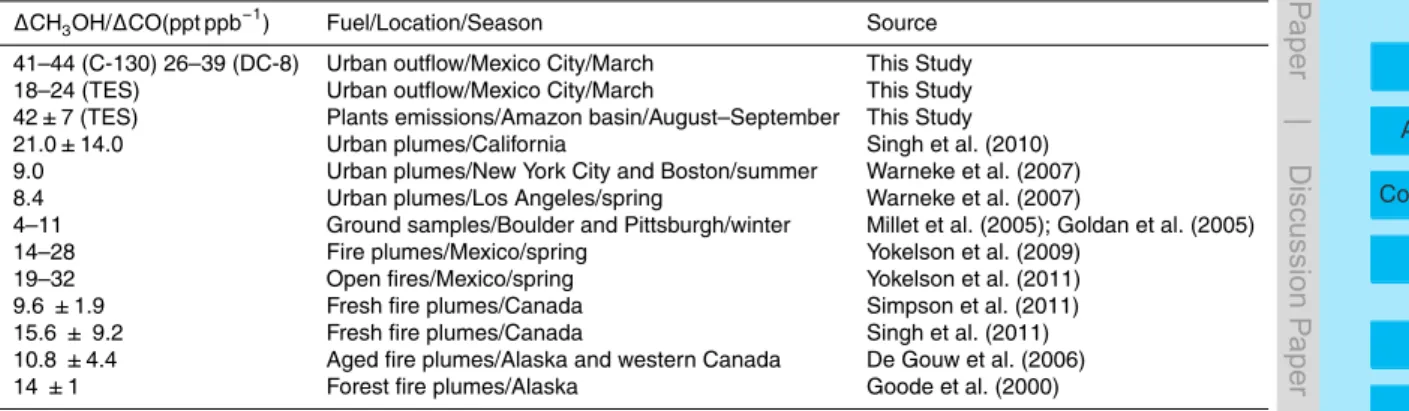
MILAGRO (41–55 ppt ppb−1) are significantly higher than ratios from other aircraft stud-ies in US citstud-ies (Table 1). Singh et al. (2010) derived a ratio of 21.0±14.0 ppb ppb−1 in urban plumes mainly sampled over California. Warneke et al. (2007) derived a ratio
5
of 9 ppt ppb−1in fresh New York City and Boston plumes in July and August of 2004, and 8.4 ppt ppb−1from aircraft observations over the Los Angeles Basin in the spring of 2002. The ratios from the C-130 measurements during MILAGRO are also much higher than the ratios of 4–11 ppt ppb−1over Boulder, Colorado and Pittsburgh, Penn-sylvania reported from ground-based winter measurements (Millet et al., 2005; Goldan
10
et al., 1995).
To put these urban values into context, ∆CH3OH/∆CO ratios have also been re-ported for biomass burning plumes during the MILAGRO experiment. High ratios of 14–28 ppt ppb−1 were reported by Yokelson et al. (2009) based on aircraft measure-ments of fresh plumes from fires in the Yucatan region of Mexico. Comparable ratios of
15
19–32 ppt ppb−1can be derived from the data presented by Yokelson et al. (2011), who reported emission factors for 25 open fires based on airborne measurements during March 2006.
The aircraft ∆CH3OH/∆CO ratios from Mexico City are also much higher than those reported from biomass burning at northern mid/high latitudes. Simpson et
20
al. (2011) and Singh et al. (2010) derived mean ratios of 9.6±1.9 ppt ppb−1, and
15.6±9.2 ppb ppb−1, respectively, in fresh Canadian fire plumes. De Gouw et
al. (2006) derived a ratio of 10.8±4.4 ppt ppb−1from aged fire plumes in Alaska and Western Canada. Goode et al. (2000) derived a ratio of 14±1 ppt ppb−1 for forest fire
plumes in Alaska.
ACPD
12, 5705–5738, 2012Methanol-CO correlations in Mexico City pollution
outflow
Y. Xiao et al.
Title Page
Abstract Introduction
Conclusions References
Tables Figures
◭ ◮
◭ ◮
Back Close
Full Screen / Esc
Printer-friendly Version Interactive Discussion
Discussion
P
a
per
|
Dis
cussion
P
a
per
|
Discussion
P
a
per
|
Discussio
n
P
a
per
|
4 Conclusions
The correlation between CH3OH and carbon monoxide (CO) is of interest for
charac-terizing sources of CH3OH and other species. Coincident measurements of CH3OH and CO in the lower to middle troposphere from TES and aircraft observations dur-ing MILAGRO allowed us to assess the utility of satellite-based observations of the
5
CH3OH-CO correlation.
TES retrievals of CH3OH and CO show relatively high sensitivity in the 600–800 hPa
range, where Mexico City pollution outflow peaks. In-situ aircraft observations of CH3OH and CO downwind of Mexico City center during MILAGRO in March 2006 were used to evaluate the extent to which variability in the∆CH3OH/∆CO enhancement ratio
10
is captured by TES special observations. During MILAGRO there are sharply peaked outflow profiles (from shallow plumes) that are particularly challenging for TES (or any nadir satellite measurements) to capture due to its vertical resolution (∼5 km). The
analysis suggests that the TES operational CO retrieval algorithm (Version 5) maybe improved in regions of elevated topography (e.g. Mexico City) by updating algorithm
15
CO constraints to better handle elevation changes.
∆CH3OH/∆CO ratios derived from the TES observations reflect bulk enhancements
(smoothed according to the TES sensitivity) of CH3OH and CO in the Mexico City
outflow. ∆CH3OH/∆CO ratios derived from the TES observations (18–24 ppt ppb−1) are closer to those observed from DC-8 aircraft during MILAGRO (26–39 ppt ppb−1),
20
than those from C-130 observations (41–55 ppt ppb−1). In a test case of simulated TES CH3OH and CO retrievals with relatively high sensitivity, TES is able to reproduce
the∆CH3OH/∆CO correlation in spite of the coarse vertical resolution of the retrievals.
A discrepancy in observed ∆CH3OH/∆CO ratios between the TES and aircraft data could be due to a number of possible systematic errors, including aircraft instrument
25
ACPD
12, 5705–5738, 2012Methanol-CO correlations in Mexico City pollution
outflow
Y. Xiao et al.
Title Page
Abstract Introduction
Conclusions References
Tables Figures
◭ ◮
◭ ◮
Back Close
Full Screen / Esc
Printer-friendly Version Interactive Discussion
Discussion
P
a
per
|
Dis
cussion
P
a
per
|
Discussion
P
a
per
|
Discussio
n
P
a
per
ratios for this analysis. However, the CH3OH/CO enhancement ratios derived from the TES and aircraft data during MILAGRO are both high relative to previous studies over US cities. This may be partly explained by photochemical production of CH3OH in fresh
plumes as well as to the different types of fuel burned in the MCMA.
TES derived∆CH3OH/∆CO ratios show a significant difference between Mexico City
5
and the Amazon Basin, with substantially higher ratios over the Amazon. Both regions feature strong CH3OH emissions: from anthropogenic sources in the first case and from biogenic sources in the second. This analysis shows that TES can clearly dis-tinguish differences in the∆CH3OH/∆CO ratio due to two different source categories
of CH3OH, which indicates the potential of utilizing TES derived ratios globally as a
10
diagnostic for emission sources in other regions and time periods.
Acknowledgements. This work was supported by NASA through the Atmospheric Chemistry
Modeling and Analysis Program (Grant #NNX10AG65G). Research was partially supported by the Jet Propulsion Laboratory, California Institute of Technology under contract to the National Aeronautics and Space Administration (NASA). We also thank John Worden at NASA/JPL
15
for helpful discussions. We acknowledge Don Blake at University of California, Irvine and Paul Wennberg at California Institute of Technology for sharing their measurements.
References
Apel, E. C., Emmons, L. K., Karl, T., Flocke, F., Hills, A. J., Madronich, S., Lee-Taylor, J., Fried, A., Weibring, P., Walega, J., Richter, D., Tie, X., Mauldin, L., Campos, T., Weinheimer, A.,
20
Knapp, D., Sive, B., Kleinman, L., Springston, S., Zaveri, R., Ortega, J., Voss, P., Blake, D., Baker, A., Warneke, C., Welsh-Bon, D., de Gouw, J., Zheng, J., Zhang, R., Rudolph, J., Junkermann, W., and Riemer, D. D.: Chemical evolution of volatile organic compounds in the outflow of the Mexico City Metropolitan area, Atmos. Chem. Phys., 10, 2353–2375, doi:10.5194/acp-10-2353-2010, 2010.
25
ACPD
12, 5705–5738, 2012Methanol-CO correlations in Mexico City pollution
outflow
Y. Xiao et al.
Title Page
Abstract Introduction
Conclusions References
Tables Figures
◭ ◮
◭ ◮
Back Close
Full Screen / Esc
Printer-friendly Version Interactive Discussion
Discussion
P
a
per
|
Dis
cussion
P
a
per
|
Discussion
P
a
per
|
Discussio
n
P
a
per
|
in Biomass Burning Smoke as Seen by the Tropospheric Emission Spectrometer (TES), Atmosphere, 2, 633–654, 2011.
Beer, R., Glavich, T. A., and Rider, D. M.: Tropospheric emission spectrometer for the Earth Observing System’s Aura Satellite, Appl. Opt., 40, 2356–2367, 2001.
Beer, R., Shephard, M. W., Kulawik, S. S., Clough, S. A., Eldering, A., Bowman, K. W., Sander,
5
S. P., Fisher, B. M., Payne, V. H., Luo, M., Osterman, G. B., and Worden, J. R.: First satellite observations of lower tropospheric ammonia and methanol, Geophys. Res. Lett., 35, L09801, doi:10.1029/2008GL033642, 2008.
Blake, D. R. and Rowland, F. S.: Urban Leakage of Liquefied Petroleum Gas and Its Impact on Mexico-City Air-Quality, Science, 269, 953–956, 1995.
10
Blando, J. D. and Turpin, B. J.: “Secondary organic aerosol formation in cloud and fog droplets: a literature evaluation of plausibility”, Atmos. Environ., 34, 1623–1632, 2000.
Bon, D. M., Ulbrich, I. M., de Gouw, J. A., Warneke, C., Kuster, W. C., Alexander, M. L., Baker, A., Beyersdorf, A. J., Blake, D., Fall, R., Jimenez, J. L., Herndon, S. C., Huey, L. G., Knighton, W. B., Ortega, J., Springston, S., and Vargas, O.: Measurements of volatile
15
organic compounds at a suburban ground site (T1) in Mexico City during the MILAGRO 2006 campaign: measurement comparison, emission ratios, and source attribution, Atmos. Chem. Phys., 11, 2399–2421, doi:10.5194/acp-11-2399-2011, 2011.
Cady-Pereira, K. E., Shephard, M. W., Millet, D. B., Xiao, Y., Luo, M., Wells, K. C., Payne V. H., and Worden, J.: Methanol from Space: Retrieval Strategy and Seasonal and Spatial
20
Variability from TES Global Observations, in preparation, 2012.
Coheur, P.-F., Herbin, H., Clerbaux, C., Hurtmans, D., Wespes, C., Carleer, M., Turquety, S., Rinsland, C. P., Remedios, J., Hauglustaine, D., Boone, C. D., and Bernath, P. F.: ACE-FTS observation of a young biomass burning plume: first reported measurements of C2H4, C3H6O, H2CO and PAN by infrared occultation from space, Atmos. Chem. Phys., 7, 5437–
25
5446, doi:10.5194/acp-7-5437-2007, 2007.
Connor, T. C., Shephard, M. W., Payne, V. H., Cady-Pereira, K. E., Kulawik, S. S., Luo, M., Osterman, G., and Lampel, M.: Long-term stability of TES satellite radiance measurements, Atmos. Meas. Tech., 4, 1481–1490, doi:10.5194/amt-4-1481-2011, 2011.
Crounse, J. D., DeCarlo, P. F., Blake, D. R., Emmons, L. K., Campos, T. L., Apel, E. C., Clarke,
30
ACPD
12, 5705–5738, 2012Methanol-CO correlations in Mexico City pollution
outflow
Y. Xiao et al.
Title Page
Abstract Introduction
Conclusions References
Tables Figures
◭ ◮
◭ ◮
Back Close
Full Screen / Esc
Printer-friendly Version Interactive Discussion
Discussion
P
a
per
|
Dis
cussion
P
a
per
|
Discussion
P
a
per
|
Discussio
n
P
a
per
de Gouw, J. A., Middlebrook, A. M., Warneke, C., Goldan, P. D., Kuster, W. C., Roberts, J. M., Fehsenfeld, F. C., Worsnop, D. R., Canagaratna, M. R., Pszenny, A. A. P., Keene, W. C., Marchewka, M., Bertman, S. B., and Bates, T. S.: Budget of organic carbon in a polluted atmosphere: Results from the New England Air Quality Study in 2002, J. Geophys. Res., 110, D16305, doi:10.1029/2004JD005623, 2005.
5
de Gouw, J. A., Warneke, C., Stohl, A., Wollny, A. G., Brock, C. A., Cooper, O. R., Holloway, J. S., Trainer, M., Fehsenfeld, F. C., Atlas, E. L., Donnelly, S. G., Stroud, V., and Lueb, A.: Volatile organic compounds composition of merged and aged forest fire plumes from Alaska and western Canada, J. Geophys. Res., 111, D10303, doi:10.1029/2005JD006175, 2006. de Gouw, J. A., Welsh-Bon, D., Warneke, C., Kuster, W. C., Alexander, L., Baker, A. K.,
Bey-10
ersdorf, A. J., Blake, D. R., Canagaratna, M., Celada, A. T., Huey, L. G., Junkermann, W., Onasch, T. B., Salcido, A., Sjostedt, S. J., Sullivan, A. P., Tanner, D. J., Vargas, O., Weber, R. J., Worsnop, D. R., Yu, X. Y., and Zaveri, R.: Emission and chemistry of organic carbon in the gas and aerosol phase at a sub-urban site near Mexico City in March 2006 during the MILAGRO study, Atmos. Chem. Phys., 9, 3425–3442, doi:10.5194/acp-9-3425-2009, 2009.
15
de Foy, B., Varela, J. R., Molina, L. T., and Molina, M. J.: Rapid ventilation of the Mex-ico City basin and regional fate of the urban plume, Atmos. Chem. Phys., 6, 2321–2335, doi:10.5194/acp-6-2321-2006, 2006.
Dufour, G., Boone, C. D., Rinsland, C. P., and Bernath, P. F.: First space-borne measurements of methanol inside aged southern tropical to mid-latitude biomass burning plumes using the
20
ACE-FTS instrument, Atmos. Chem. Phys., 6, 3463–3470, doi:10.5194/acp-6-3463-2006, 2006.
Duncan, B. N., Logan, J. A., Bey, I., Megretskaia, I. A., Yantosca, R. M., Novelli, P. C., Jones, N. B., and Rinsland, C. P.: Global budget of CO, 1988–1997: Source estimates and validation with a global model, J. Geophys. Res., 112, D22301, doi:10.1029/2007jd008459, 2007.
25
Fischer, E. V., Jacob, D. J., Millet, D. B., Yantosca, R. M., and Mao, J.: The role of the ocean in the global atmospheric budget of acetone, Geophys. Res. Lett., 39, L01807, doi:10.1029/2011GL050086, 2012.
Galbally, I. E. and Kirstine, W.: The production of methanol by flowering plants and the global cycle of methanol, J. Atmos. Chem., 43, 195–229, 2002.
30
ACPD
12, 5705–5738, 2012Methanol-CO correlations in Mexico City pollution
outflow
Y. Xiao et al.
Title Page
Abstract Introduction
Conclusions References
Tables Figures
◭ ◮
◭ ◮
Back Close
Full Screen / Esc
Printer-friendly Version Interactive Discussion
Discussion
P
a
per
|
Dis
cussion
P
a
per
|
Discussion
P
a
per
|
Discussio
n
P
a
per
|
inventories, J. Geophys. Res., 100, 22771–22783, 1995.
Goode, J. G., Yokelson, R. J., Ward, D. E., Susott, R. A., Babbitt, R. E., Davies, M. A., and Hao, W. M.: Measurements of excess O3, CO2, CO, CH4, C2H4, C2H2, HCN, NO NH3, HCOOH, CH3COOH, HCHO and CH3OH in 1997 Alaskan biomass burning plumes by airborne Fourier transform infrared spectroscopy (AFTIR), J. Geophys. Res., 105, 22147–22166, 2000.
5
Harley, P., Greenberg, J., Niinemets, ., and Guenther, A.: Environmental controls over methanol emission from leaves, Biogeosciences, 4, 1083–1099, doi:10.5194/bg-4-1083-2007, 2007. Harley, R. A., Hannigan, M. P., and Cass, G. R.: Respeciation of organic gas emissions and
the detection of excess unburned gasoline in the atmosphere, Environ. Sci. Technol., 26, 2395–2408, doi:10.1021/es00036a010, 1992.
10
Heikes, B. G., Chang, W., Pilson, M. E. Q., Swift, E., Singh, H. B., Guenther, A., Jacob, D. J., and Brand, L.: Atmospheric methanol budget and ocean implication, Global Biogeochem. Cy., 16, 1133, doi:10.1029/2002GB001895, 2002.
Hirsch, R. M. and Gilroy, E. J.: Methods of fitting a straight line to data: Examples in water resources, Water Resour. Bull., 20, 705–711, 1984.
15
Holloway, J. S., Jakoubek, R. O., Parrish, D. D., Gerbig, C., Volz-Thomas, A., Schmitgen, S., Fried, A., Wert, B., Henry, B., and Drummond, J. R.: Airborne intercomparison of vacuum ultraviolet fluorescence and tunable diode laser absorption measurements of tropospheric carbon monoxide, J. Geophys. Res., 105, 24251–24261, 2000.
Holzinger, R., Williams, J., Salisbury, G., Kl ¨upfel, T., de Reus, M., Traub, M., Crutzen, P. J., and
20
Lelieveld, J.: Oxygenated compounds in aged biomass burning plumes over the Eastern Mediterranean: evidence for strong secondary production of methanol and acetone, Atmos. Chem. Phys., 5, 39–46, doi:10.5194/acp-5-39-2005, 2005.
Hu, L., Millet, D. B., Mohr, M. J., Wells, K. C., Griffis, T. J., and Helmig, D.: Sources and seasonality of atmospheric methanol based on tall tower measurements in the US Upper
25
Midwest, Atmos. Chem. Phys., 11, 11145–11156, doi:10.5194/acp-11-11145-2011, 2011. Jacob, D. J., Field, B. D., Li, Q. B., Blake, D. R., de Gouw, J., Warneke, C., Hansel, A., Wisthaler,
A., Singh, H. B., and Guenther, A.: Global budget of methanol: Constraints from atmospheric observations, J. Geophys. Res., 110, D08303, doi:10.1029/2004JD005172, 2005
Karl, T., Guenther, A., Spirig, C., Hansel, A., and Fall, R.: Seasonal variation of biogenic VOC
30
emissions above a mixed hardwood forest in Northern Michigan, Geophys. Res. Lett., 30, 2186, doi:10.1029/2003GL018432, 2003.
ACPD
12, 5705–5738, 2012Methanol-CO correlations in Mexico City pollution
outflow
Y. Xiao et al.
Title Page
Abstract Introduction
Conclusions References
Tables Figures
◭ ◮
◭ ◮
Back Close
Full Screen / Esc
Printer-friendly Version Interactive Discussion
Discussion
P
a
per
|
Dis
cussion
P
a
per
|
Discussion
P
a
per
|
Discussio
n
P
a
per
P.: The tropical forest and fire emissions experiment: Emission, chemistry, and transport of biogenic volatile organic compounds in the lower atmosphere over Amazonia, J. Geophys. Res.-Atmos., 112, D18302, doi:10.1029/2007jd008539, 2007.
Karl, T., Apel, E., Hodzic, A., Riemer, D. D., Blake, D. R., and Wiedinmyer, C.: Emissions of volatile organic compounds inferred from airborne flux measurements over a megacity,
5
Atmos. Chem. Phys., 9, 271–285, doi:10.5194/acp-9-271-2009, 2009
Karl, T., Harley, P., Emmons, L., Thornton, B., Guenther, A., Basu, C., Turnipseed, A., and Jardine, K.: Efficient Atmospheric Cleansing of Oxidized Organic Trace Gases by Vegetation, Science, 330, 816–819, 2010.
Kleb, M. M., Chen, G., Crawford, J. H., Flocke, F. M., and Brown, C. C.: An overview of
mea-10
surement comparisons from the INTEX-B/MILAGRO airborne field campaign, Atmos. Meas. Tech., 4, 9–27, doi:10.5194/amt-4-9-2011, 2011.
Lopez, J. P., Luo, M., Christensen, L. E., Loewenstein, M., Jost, H., Webster, C. R., and Osterman, G.: TES carbon monoxide validation during two AVE campaigns using the Argus and ALIAS instruments on NASA’s WB-57F, J. Geophys. Res., 113, D16S47,
15
doi:10.1029/2007JD008811, 2008.
Luo, M., Rinsland, C. P., Rodgers, C. D., Logan, J. A., Worden, H., Kulawik, S., Eldering, A., Goldman, A., Shephard, M. W., Gunson, M., and Lampel, M.: Comparison of carbon monoxide measurements by TES and MOPITT: Influence of a priori data and instrument characteristics on nadir atmospheric species retrievals, J. Geophys. Res., 112, D09303,
20
doi:10.1029/2006JD007663, 2007a.
Luo, M., Rinsland, C., Fisher, B., Sachse, G., Diskin, G., Logan, J., Worden, H., Kulawik, S., Osterman, G., Eldering, A., Herman, R., and Shephard, M.: TES carbon monoxide validation with DACOM aircraft measurements during INTEX-B 2006, J. Geophys. Res., 112, D24S48, doi:10.1029/2007JD008803, 2007b.
25
Madronich, S. and Calvert, J. G.: Permutation reactions of organic peroxy radicals in the tropo-sphere, J. Geophys. Res., 95, 5697–5715, 1990.
Millet, D. B., Jacob, D. J., Turquety, S., Hudman, R. C., Wu, S., Fried, A., Walega, J., Heikes, B. G., Blake, D. R., Singh, H. B., Anderson, B. E., and Clarke, A. D.: Formaldehyde distri-bution over North America: Implications for satellite retrievals of formaldehyde columns and
30
isoprene emission, J. Geosphys. Res., 111, D24S02, doi:10.1029/2005jd006853, 2006. Millet, D. B., Jacob, D. J., Custer, T. G., de Gouw, J. A., Goldstein, A. H., Karl, T., Singh, H.
terres-ACPD
12, 5705–5738, 2012Methanol-CO correlations in Mexico City pollution
outflow
Y. Xiao et al.
Title Page
Abstract Introduction
Conclusions References
Tables Figures
◭ ◮
◭ ◮
Back Close
Full Screen / Esc
Printer-friendly Version Interactive Discussion
Discussion
P
a
per
|
Dis
cussion
P
a
per
|
Discussion
P
a
per
|
Discussio
n
P
a
per
|
trial and oceanic sources of atmospheric methanol, Atmos. Chem. Phys., 8, 6887–6905, doi:10.5194/acp-8-6887-2008, 2008.
Molina, L. T., Madronich, S., Gaffney, J. S., Apel, E., de Foy, B., Fast, J., Ferrare, R., Herndon, S., Jimenez, J. L., Lamb, B., Osornio-Vargas, A. R., Russell, P., Schauer, J. J., Stevens, P. S., Volkamer, R., and Zavala, M.: An overview of the MILAGRO 2006 Campaign: Mexico
5
City emissions and their transport and transformation, Atmos. Chem. Phys., 10, 8697–8760, doi:10.5194/acp-10-8697-2010, 2010.
Payne, V. H., Clough, S. A., Shephard, M. W., Nassar, R., and Logan, J. A.: Information-centered representation of retrievals with limited degrees of freedom for signal: Application to methane from the Tropospheric Emission Spectrometer, J. Geophys. Res., 114, D10307,
10
doi:10.1029/2008jd010155, 2009.
Paton-Walsh, C., Wilson, S. R., Jones, N. B., and Griffith, D. W. T.: Measurement of methanol emissions from Australian wildfires by ground-based solar Fourier transform spectroscopy, Geophys. Res. Lett., 35, L08810, doi:10.1029/2007GL032951, 2008.
Razavi, A., Karagulian, F., Clarisse, L., Hurtmans, D., Coheur, P. F., Clerbaux, C., M ¨uller,
15
J. F., and Stavrakou, T.: Global distributions of methanol and formic acid retrieved for the first time from the IASI/MetOp thermal infrared sounder, Atmos. Chem. Phys., 11, 857–872, doi:10.5194/acp-11-857-2011, 2011.
Rinsland, C. P., Mahieu, E., Chiou, L., and Herbin, H.: First ground-based infrared solar ab-sorption measurements of free tropospheric methanol (CH3OH): Multidecade infrared time
20
series from Kitt Peak (31.9◦N 111.6◦W): Trend, seasonal cycle, and comparison with previ-ous measurements, J. Geophys. Res., 114, D04309, doi:10.1029/2008JD011003, 2009. Sachse, G. W., Hill, G. F., Wade, L. O., and Perry, M. G.: Fastresponse, high-precision carbon
monoxide sensor using a tunable diode-laser absorption technique, J. Geophys. Res., 92, 2071–2081, 1987.
25
Shephard, M. W., Worden, H. M., Cady-Pereira, K. E., Lampel, M., Luo, M., Bowman, K. W., Sarkissian, E., Beer, R., Rider, D. M., Tobin, D. C., Revercomb, H. E., Fisher, B. M., Tremblay, D., Clough, S. A., Osterman, G. B., and Gunson, M.: Tropospheric Emission Spectrometer Spectral Radiance Comparisons, J. Geophys. Res., 113, D15S05, doi:10.1029/2007JD008856, 2008.
30
ACPD
12, 5705–5738, 2012Methanol-CO correlations in Mexico City pollution
outflow
Y. Xiao et al.
Title Page
Abstract Introduction
Conclusions References
Tables Figures
◭ ◮
◭ ◮
Back Close
Full Screen / Esc
Printer-friendly Version Interactive Discussion
Discussion
P
a
per
|
Dis
cussion
P
a
per
|
Discussion
P
a
per
|
Discussio
n
P
a
per
Chem. Phys., 11, 10743–10763, doi:10.5194/acp-11-10743-2011, 2011.
Shim, C., Li, Q., Luo, M., Kulawik, S., Worden, H., Worden, J., Eldering, A., Diskin, G., Sachse, G., Weinheimer, A., Knapp, D., Montzca, D., and Campos, T.: Satellite observations of Mex-ico City pollution outflow from the Tropospheric Emissions Spectrometer (TES), Atmos. En-viron., 43, 1540–1547, doi:10.1016/j.atmosenv.2008.11.026, 2009.
5
Simpson, I. J., Akagi, S. K., Barletta, B., Blake, N. J., Choi, Y., Diskin, G. S., Fried, A., Fu-elberg, H. E., Meinardi, S., Rowland, F. S., Vay, S. A., Weinheimer, A. J., Wennberg, P. O., Wiebring, P., Wisthaler, A., Yang, M., Yokelson, R. J., and Blake, D. R.: Boreal forest fire emis-sions in fresh Canadian smoke plumes: C1–C10 volatile organic compounds (VOCs), CO2, CO, NO2, NO, HCN and CH3CN, Atmos. Chem. Phys., 11, 6445–6463,
doi:10.5194/acp-11-10
6445-2011, 2011.
Singh, H. B., Kanakidou, M., Crutzen P. J., and Jacob, D. J.: High-Concentrations and Photo-chemical Fate of Oxygenated Hydrocarbons in the Global Troposphere, Nature, 378, 50–54, 6552, doi:10.1038/378050a0, 1995.
Singh, H. B., Tabazadeh, A., Fukui, Y., Bey, I., Yantosca, R., Jacob, D., Arnold, F., Wohlfrom
15
K., Atlas, E., Flocke, F., Blake, D., Blake, N., Heikes, B., Snow, J., Talbot, R., Gregory, G., Sachse, G., Vay, S., and Kondo, Y.: Distribution and fate of selected oxygenated organic species in the troposphere and lower stratosphere over the Atlantic, J. Geophys. Res., 105, 3795–3805, 2000.
Singh, H. B., Salas, L. J., Chatfield, R. B., Czech, E., Fried, A., Walega, J., Evans, M. J., Field,
20
B. D., Jacob, D. J., Blake, D., Heikes, B., Talbot, R., Sachse, G., Crawford, J. H., Avery, M. A., Sandholm, S., and Fuelberg, H.: Analysis of the atmospheric distribution, sources, and sinks of oxygenated volatile organic chemicals based on measurements over the Pacific during TRACE-P, J. Geophys. Res., 109, D15S07, doi:10.1029/2003JD003883, 2004.
Singh, H. B., Brune, W. H., Crawford, J. H., Flocke, F., and Jacob, D. J.: Chemistry and transport
25
of pollution over the Gulf of Mexico and the Pacific: spring 2006 INTEX-B campaign overview and first results, Atmos. Chem. Phys., 9, 2301–2318, doi:10.5194/acp-9-2301-2009, 2009. Singh, H. B., Anderson, B. E., Brune, W. H., Cai, C., Cohen, R. C., Crawford, J. H., Cubison,
M. J., Czech, E. P., Emmons, L., Fuelberg, H. E., Huey, G., Jacob, D. J., Jimenez, J. L., Kaduwela, A., Kondo, Y., Mao, J., Olson, J. R., Sachse, G. W., Vay, S. A., Weinheimer,
30
ACPD
12, 5705–5738, 2012Methanol-CO correlations in Mexico City pollution
outflow
Y. Xiao et al.
Title Page
Abstract Introduction
Conclusions References
Tables Figures
◭ ◮
◭ ◮
Back Close
Full Screen / Esc
Printer-friendly Version Interactive Discussion
Discussion
P
a
per
|
Dis
cussion
P
a
per
|
Discussion
P
a
per
|
Discussio
n
P
a
per
|
2010.
Stavrakou, T., Guenther, A., Razavi, A., Clarisse, L., Clerbaux, C., Coheur, P.-F., Hurtmans, D., Karagulian, F., De Mazi `ere, M., Vigouroux, C., Amelynck, C., Schoon, N., Laffineur, Q., Heinesch, B., Aubinet, M., Rinsland, C., and M ¨uller, J.-F.: First space-based derivation of the global atmospheric methanol emission fluxes, Atmos. Chem. Phys., 11, 4873–4898,
5
doi:10.5194/acp-11-4873-2011, 2011.
Tie, X., Guenther, A., and Holland, E.: Biogenic methanol and its impacts on tropospheric oxidants, Geophys. Res. Lett., 30, 1881, doi:10.1029/2003GL017167, 2003.
Tyndall, G. S., Cox, R. A., Granier, C., Lesclaux, R., Moortgat, G. K., Pilling, M. J., Ravis-hankara, A. R., and Wallington, T. J.: Atmospheric chemistry of small organic peroxy radicals,
10
J. Geophys. Res., 106, 12157–12182, 2001.
Warneke, C., Karl, T., Judmaier, H., Hansel, A., Jordan, A., Lindinger, W., and Crutzen, P. J.: Acetone, methanol, and other partially oxidized volatile organic emissions from dead plant matter by abiological processes: Significance for atmospheric HOx chemistry, Global Biogeochem. Cy., 13, 9–17, doi:10.1029/98gb02428, 1999.
15
Warneke, C., McKeen, S. A., de Gouw, J. A., Goldan, P. D., Kuster, W. C., Holloway, J. S., Williams, E. J., Lerner, B. M., Parrish, D. D., Trainer, M., Fehsenfeld, F. C., Kato, S., Atlas, E. L., Baker, A., and Blake, D. R.: Determination of urban volatile organic compound emis-sion ratios and comparison with an emisemis-sions database, J. Geophys. Res., 112, D10S47, doi:10.1029/2006JD007930, 2007.
20
Wells K., Millet, D., Cady-Pereira, K., Shephard, M., Xiao, Y., Razavi, A., Clerbaux, C., Clarisse, L., Coheur, P. F., E. Apel, de Gouw, J., Warneke, C., Singh, H., Goldstein, A., Hu, L., and Sive, B.: Tropospheric methanol observations from space: Retrieval evaluation and constraints on the seasonality of biogenic emissions, Atmos. Chem. Phys., in press, 2012.
Xiao, Y. P., Jacob, D. J., Wang, J. S., Logan, J. A., Palmer, P. I., Suntharalingam, P., Yantosca,
25
R. M., Sachse, G. W., Blake, D. R., and Streets, D. G.: Constraints on Asian and European sources of methane from CH4-C2H6-CO correlations in Asian outflow, J. Geophys. Res., 109, D15S16, doi:10.1029/2003JD004475, 2004
Yokelson, R. J., Urbanski, S. P., Atlas, E. L., Toohey, D. W., Alvarado, E. C., Crounse, J. D., Wennberg, P. O., Fisher, M. E., Wold, C. E., Campos, T. L., Adachi, K., Buseck, P. R., and
30
Hao, W. M.: Emissions from forest fires near Mexico City, Atmos. Chem. Phys., 7, 5569– 5584, doi:10.5194/acp-7-5569-2007, 2007.
ACPD
12, 5705–5738, 2012Methanol-CO correlations in Mexico City pollution
outflow
Y. Xiao et al.
Title Page
Abstract Introduction
Conclusions References
Tables Figures
◭ ◮
◭ ◮
Back Close
Full Screen / Esc
Printer-friendly Version Interactive Discussion
Discussion
P
a
per
|
Dis
cussion
P
a
per
|
Discussion
P
a
per
|
Discussio
n
P
a
per
Shinozuka, Y., Kapustin, V., Clarke, A. D., Weinheimer, A., Knapp, D. J., Montzka, D. D., Holloway, J., Weibring, P., Flocke, F., Zheng, W., Toohey, D., Wennberg, P. O., Wiedinmyer, C., Mauldin, L., Fried, A., Richter, D., Walega, J., Jimenez, J. L., Adachi, K., Buseck, P. R., Hall, S. R., and Shetter, R.: Emissions from biomass burning in the Yucatan, Atmos. Chem. Phys., 9, 5785–5812, doi:10.5194/acp-9-5785-2009, 2009.
5