revbrashematolhemoter.2016;38(3):264–266
w w w . r b h h . o r g
Revista
Brasileira
de
Hematologia
e
Hemoterapia
Brazilian
Journal
of
Hematology
and
Hemotherapy
Case
Report
Diminished
expression
of
B
antigen
mimicking
B3
phenotype
in
a
patient
with
AML-M3:
a
rare
case
report
Rajeswari
Subramaniyan
∗YashodaHospital,Hyderabad,India
a
r
t
i
c
l
e
i
n
f
o
Articlehistory:
Received28December2015 Accepted13May2016 Availableonline22June2016
Introduction
TheABObloodgroupsystemplaysanimportantrolein trans-fusionandtransplantationpractices.Correctidentificationof thebloodgroupofanindividualisofparamountimportance asminorerrorscanleadtofataltransfusionreactions.Weak expressionofA,BandHantigensontheredcellsurfacecanbe inheritedoracquired.Theyareprobablytheleastfrequently encounteredandposeachallengeintheroutine immunohe-matologypractice.1Suchantigenicchangesinhematological malignanciesmostcommonlyinvolve theABObloodgroup system.2Thestrengthofagglutinationwithanti-B,anti-A,B, andanti-Hserum,presenceorabsenceofABOisoagglutinins intheserum,adsorption-elutionstudiesandthepresenceor absenceofA, BandH substanceinsalivaalongwith pedi-greeanalysishelptocharacterizetheweakervariantsofA andBserologically.PossiblephenotypicsubgroupsincludeA3, Aend,Ax,Am,Ay,andAel.SubgroupsofBareveryrare,less frequentthan those ofA and are classified as B3,BX, Bm andBelindecreasingorderoftheamountoftheBantigen (Table1).
∗ Correspondingauthorat:DepartmentofTransfusionMedicine,YashodaHospital,Malakpet,500036Hyderabad,India.
E-mailaddress:[email protected]
HerewewouldliketoshareacaseoftheB3bloodgroup inapatientwhowasrecentlydiagnosedwithacutemyeloid leukemia(AML)M3withnoknowncomorbidillness.Tothe bestofourknowledge,thisisthefirstreportfromIndia.
Case
report
A 50-year-oldgentleman was admittedtoourtertiary care center with aone-month history of generalizedweakness. AcompletebloodcountrevealedHb:7.9g/dL,plateletcount: 20,000/LandtotalWBCcount:148,300/L.Peripheralsmear
examinationrevealed90%atypicalcellssuggestive ofacute leukemia and flow cytometric immunophenotyping of the peripheralbloodsampleconfirmedAML-M3.
Blood grouping was done using the standard tube techniqueandcolumnagglutinationtechnology(Ortho Diag-nostics, USA). Forward/cell grouping was performed using twodifferentbatchesofmonoclonalanti-A,anti-B,anti-A,B (Eryclone,Tulipdiagnostics,Goa,India),anti-Dantisera (Rho-final,Tulipdiagnostics,Goa,India)andanti-Hlectin(Erybank, Tulip diagnostics, Goa, India) reagents and reverse/serum
http://dx.doi.org/10.1016/j.bjhh.2016.05.008
revbrashematolhemoter.2016;38(3):264–266
265
Table1–SerologicalcharacteristicsofBphenotypes.1
Phenotypes Anti-A Anti-B Anti-A,B Anti-H Antibodiesinserum Substancesinsaliva
B 0 4+ 4+ 2+ AntiA B,H
B3 0 2+mf 2+mf 3+ AntiA B,H
Bx 0 Wk 3+ AntiA,weakantiB H
Bm 0 0/wk 0/wk 3+ AntiA B,H
Bel 0 0 0 3+ AntiA,sometimesweakantiB H
0:noagglutination;mf:mixedfieldagglutination;wk:weakagglutination.
Table2–SerologicalevaluationoftheABOdiscrepancy(usingtubetechnique).
Anti-A Anti-B Anti-D Anti-A,B Anti-H A1cell Bcell 0cell Autocontrol
0 2+/mf
3+/mfat4◦C incubationfor1h
3+ 2+/mf
3+/mfat4◦C incubationfor1h
3+ 4+ 0 0 0
0:noagglutination;mf:mixedfieldagglutination.
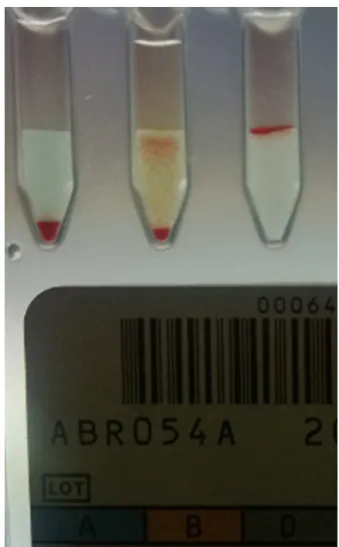
Figure1–Resultsofforwardbloodgroupingbycolumn agglutinationtechnologyshowingmixedfield
agglutinationwithanti-B.
groupingwasdoneusingin-housepreparedpooledgroupA1,
BandOreagentredcells.Theblood groupwasinterpreted basedontheagglutinationinforwardandreversegrouping (Table2).
Forwardgroupingusingthetubetechniqueshowedmixed fieldappearancewithanti-Bandanti-A,Bantisera.Incubation oftheforwardgroupingtubesat4◦Cshowed3+/mf
agglutina-tionreactionwithanti-Bandanti-A,Bantiserawhilereverse groupingresultsremainedthesame.Repeatbloodgrouping wascarriedoutbythetubetechniquewithanotherfresh sam-pleanditwasfoundtobenodifferenttothepreviousresults. Resultswereconfirmedbycolumnagglutinationtechnology (ORTHOBioVueTM,OrthoClinicalDiagnostics,USA)(Figure1).
HisbloodgroupwasBRhDpositiveasperhispreviousrecords. The adsorption and elution test was performed as describedintheAmericanAssociationofBloodBanks(AABB) technicalmanual.3Adsorptionofpatientredcellswasdone at4◦Cwithhumanpolyclonalanti-BfromgroupA
individ-uals.Heatelutionwasperformedat56◦Cfor10min.Eluate
andfinalwashsupernatantweretestedwiththreeunpooled A,BandObloodgroupreagentredcellsamples.Eluatereacted onlywithgroupBcellswhereasfinalwashsupernatantwas non-reactivewithA,BorOcells.
Hissalivasecretorstatuswasdeterminedusingthe hemag-glutinationinhibitiontestasdescribedintheAABBtechnical manual.4BandHantigenswereabsentinhissalivaandso hewasanon-secretor.Accordingtothestandardterminology ofABOsubgroups,hisbloodgroupingandRhtypingwasB3 RhDpositive.Sincehehadalowplateletcount,singledonor apheresisplateletsofgroupBweretransfused;theprocedure wasuneventful.ABOdiscrepancyinhisbloodgroupingwas weakBantigenexpressionwithmixedfieldappearance.This isanexampleofanacquiredvariantofB(secondarytothe underlyingmyeloidleukemia).
Discussion
266
revbrashematolhemoter.2016;38(3):264–266inthe inactiveenzymeischaracteristicofO alleles.Single nucleotidesubstitutionsinexon6and7giverisetodifferent ABOalleles.1
In ourpatient, the characteristic finding was weakened Bexpressionwithmixedfield agglutination mimickingthe B3phenotype. Diminished expressionofABHantigenscan occurwithvariantABOallelesandinhematologicaldisorders suchasleukemia,myeloproliferativedisorders, myelodysplas-ticsyndromeandinsomecasesofHodgkin’slymphoma.Ithas alsobeenfoundinhealthyelderlyadults,pregnantfemales andneonates.2,5,6Myeloidneoplasmshavebeenreportedto bemorefrequentlyassociatedwithABHantigenicalterations thanlymphoidmalignancies.AMLassociatedwithaweakA antigenwasfirstelucidatedbyVanLoghemetal.in1957ina patientwhohadapreviouslynormalAantigenonredcells. Flowcytometricanalysishasshowndecreasedexpressionof ABHbloodgroupantigensinpatientswithmyeloidleukemia. DiminishedexpressionofAand/orBantigenscouldbedue toablockageoftheconversionofHsubstancetoAand/orB substancesordecreasedsynthesisofHantigens.7Sincethe ABOlocusencodingAandBtransferasesisinthe9q34region, thechromosomaltranslocation(9and22)observedinpatients withmyeloidleukemia(bothchronicmyeloidleukemiaand rarelyAML) hasalsobeenlinked toABHredcell antigenic changesinthesepatients.2
Apart from the A3 and B3 alleles, mixed field reactiv-itycanbeencounteredinrecenttransfusion,hematopoietic (bone marrow and stem cell) transplantation, fetomater-nal hemorrhage, and twin or dispermic chimerism.8 Our patienthadnosuchhistory.Mixedfieldreactionscanalsobe observedinhematologicalmalignancies(particularlymyeloid leukemia)whereavaryingproportionofredbloodcellsdonot agglutinate.2,7WeakenedexpressionoftheAantigenonred cellsmimickingtheA3phenotypewasreportedbySalmon etal.inpatientswithleukemia.5
TheB3phenotypeischaracterizedbymixedfield hemag-glutinationwithanti-Bandanti-A,Bserum,absenceofanti-B antigen in the serum and normal B antigen in the saliva (secretors). The B3 subgroup is the most frequent weak B phenotype.1 TheB3 phenotype occurs witha frequencyof 1/900Band1/1800A1BintheChinesepopulation9andwith a frequency of1:116,667 in French donors.10 Reports from India show the frequency of the weak B phenotype to be 1:86,687amongthedonorsofnorthIndia10and1:24,000from Bombay.11Howevertheexactfrequencyisnotknown. Infre-quent reporting of these findings could be due to lack of knowledgeandthecomplexclassificationofsubgroups.
B3 alleles arise duetoamino acid substitutions(due to nucleotidesubstitutionsinexon7)intheglycosyltransferase Benzymealthoughasplicesitemutationinexon3hasbeen reported in only one B3 allele.5 There may be qualitative (differenceintheabilitytobindtheantibody)aswellas quan-titative(numberofantigensonredbloodcells)differencesin theBantigenofB3redcellsfromnormalBcells.9Itissafeto transfuseOgroupredcellsinapatientwithredbloodcells expressingavariantABO.12
Weakening of ABH antigen expression suggests a pre-leukemicstate asthey appearevenbefore recognizingthe
malignancy.Follow-upofthesepatientswillbehelpfulasthe amountofantigensreturnstonormalonredbloodcellswith complete remission.5 CorrectABO groupingisrequirednot onlyforensuringasafetransfusiontopatientsbutalsofor understandingthetrueepidemiologyofweaksubgroupsina givenpopulation.
Conclusions
WeaksubgroupsoftheABO bloodgroupsystemarehardly reported in the day-to-day practice. Such ABO discrepan-ciesareresolvedbyextendedincubationofforwardgrouping tubesat4◦C,salivasecretorstudies,adsorption-elution
meth-ods and pedigree analysis. Early recognitionof the lossof ABHantigensisextremelyimportantbecauseitmayindicate underlying sinistrouspre-leukemicstates.Follow-up ofthe patientsisnecessaryastheseantigenicchangesmirrorthe courseofleukemia.Inpatientswithhematological malignan-cies,correctABObloodgroupingisimportantastheyrequire multipletransfusionsandoftenundergohematopoieticstem celltransplantation.
Conflicts
of
interest
Theauthordeclaresnoconflictsofinterest.
r
e
f
e
r
e
n
c
e
s
1.HarmeningDM.TheABObloodgroupsystem.In:Modern bloodbankingandtransfusionpractices.6thed.Philadelphia: FADavisCompanyPublications;2012.p.119–45.
2.WintersJL,HowardDS.Redbloodcellantigenchangesin malignancy:casereportandreview.Immunohematology. 2001;17(1):1–9.
3.RobackJD,GrossmanBJ,HarrisT,HillyerCD,editors. Technicalmanual–AmericanAssociationofBloodBanks. 17thed.Bethesda:AABBPress;2011.p.880–1.
4.RobackJD,GrossmanBJ,HarrisT,HillyerCD,editors. Technicalmanual–AmericanAssociationofBloodBanks. 17thed.Bethesda:AABBPress;2011.p.881–2.
5.DanielsG.Humanbloodgroups.3rded.UnitedKingdom: Wiley-BlackwellLtd.Publications;2013.p.11–95.
6.KleinHG,AnsteeDJ.Mollison’sbloodtransfusioninclinical medicine.12thed.Oxford:BlackwellPublishing;2013.p.128.
7.BiancoT,FarmerBJ,SageRE,DobrovicA.LossofredcellA,B, andHantigensisfrequentinmyeloidmalignancies.Blood. 2001;97(11):3633–9.
8.RobackJD,GrossmanBJ,HarrisT,HillyerCD,editors. Technicalmanual–AmericanAssociationofBloodBanks. 17thed.Bethesda:AABBPress;2011.p.370.
9.Lin-ChuM,BroadberryRE,ChiouPW.TheB3phenotypein Chinese.Transfusion.1986;26(5):428–30.
10.ThakralB,SalujaK,BajpaiM,SharmaRR,MarwahaN. ImportanceofweakABOsubgroups.LabMed.2005;36(1):32–4.
11.BhatiaHM,SatheMS.IncidenceofBombay(Oh)phenotype andweakervariantsofAandBantigeninBombay(India). VoxSang.1974;27(6):524–32.