ISSN 0104-6632 Printed in Brazil
www.abeq.org.br/bjche
Vol. 33, No. 02, pp. 251 - 260, April - June, 2016 dx.doi.org/10.1590/0104-6632.20160332s20140111
Brazilian Journal
of Chemical
Engineering
NOVEL APPLICATION OF POROUS AND
CELLULAR MATERIALS FOR COVALENT
IMMOBILIZATION OF PEPSIN
K. Sza
ł
apata
1, M. Osi
ń
ska-Jaroszuk
1, J. Bryjak
2, M. Jaszek
1and A. Jarosz-Wilko
ł
azka
1*1
Department of Biochemistry, Maria Curie-Sklodowska University, Akademicka 19, 20-033 Lublin, Poland. Phone: + 48 81 537 50 44; Fax: + 48 81 537 51 02
*
E-mail: [email protected]
2
Department of Bioorganic Chemistry, Wroclaw University of Technology, Norwida 4/6, 50-373 Wroclaw, Poland.
(Submitted: October 14, 2014 ; Revised: March 5, 2015 ; Accepted: May 5, 2015)
Abstract - Pepsin was immobilized via covalent bonds on different carriers: a silica gel carrier, acrylic beads, and a cellulosebased carrier Granocel. All carriers were functionalized through the presence of OH, -COOH, -NH2, or glycidyl groups on their surfaces. Three different cross-linkers were used for activation
thereof. The results showed that Granocel activated by glutaraldehyde or carbodiimide and silica gel activated by glutaraldehyde were suitable carriers for the expression of enzyme activity. The optimum pH range for the native enzyme was 2.5-3.5 and this range was extended to the value 6.5 in the case of enzyme immobilized on the silica gel carrier and on Granocel. The optimum temperature values for the native and immobilized enzyme were in the range 37-40 °C and 40-50 °C, respectively. The activity of the immobilized pepsin at different values of pH and temperature was higher in comparison with the activity of the free enzyme. Keywords:Covalent immobilization; Silica gel carriers; Acrylic beads; Cellulose-based carriers; Pepsin.
INTRODUCTION
Pepsin (EC 3.4.23.1) is one of the principal en-zymes in the digestive system from the group of aspartic proteases. As an endopeptidase, pepsin de-composes most proteins and peptides to oligopep-tides, and has milk-curdling activity (Konkular and Gunasekaram, 2002). Moreover, this enzyme is capa-ble of efficient proteolysis, even at low temperatures (Ahn et al., 2012). Its potential applications in food production or biomedical industries have become more common and have replaced many traditional methods. For example, bovine or porcine pepsin is regarded as a substitute for calf rennet or is used for protein digestion prior to studies on identification of proteins as well as characterization and production of bioactive peptides (Konkular and Gunasekaram, 2002; Ticu et al., 2004; Shukla and Devi, 2005). Especially in the latter practical application of
pep-sin, immobilization is a prerequisite step that allows increasing the stability of biocatalysts in order to achieve higher profitability (Cooper et al., 1990, Ka-matari et al., 2003; Gamze and Senay, 2007).
Immobilized enzymes are frequently used in vari-ous industrial and biotechnological processes (Liese and Hilterhaus, 2013) owing to their higher stability, allowing longer operation at higher temperatures, a wider pH range, high ionic strength, or the presence of toxic substances (Bahar and Celebi, 1998; Mateo
et al., 2007). There are many known methods for
mul-Brazilian Journal of Chemical Engineering tipoint and multisubunit attachment of enzymes to
surfaces, generation of a favourable microenviron-ment (e.g., promoting the partitioning of some dele-terious compounds), and in the fact that they can also prevent intermolecular interactions (e.g., contact with the gas/liquid interface, aggregation, hydrolysis by proteolytic enzymes) (Liese and Hilterhaus, 2013). Studies on the immobilization of pepsin have been conducted for a long time. One of the invaluable advantages of immobilization of proteases on an insoluble matrix is prevention of enzyme autolysis. Currently, immobilized pepsin is mainly used for fragmentation of antibodies in the biomedical indus-try (generation of F(ab’)2 from IgG) or in strictly specific digestion of proteins which are soluble in an acid medium (Rea and Ultee, 1993). Although there are several commercial preparations of immobilized pepsin (e.g. immobilized on agarose beads by Thermo Scientific - Pierce or immobilized on poly(styrene divinylbenzene) particles by Life Technologies - Applied Biosystems), there is no systematic study on the immobilization of this enzyme on a broader spec-trum of carriers with different porosity and with dif-ferent functional groups on their surface. So far, pepsin has been immobilized on different types of carriers using different methods of immobilization. For example, Stigter et al. (2008) described the use of pepsin microreactors consisting of pepsin immobi-lized in a fused-silica capillary. Pepsin was also im-mobilized on chitosan beads (Altun and Cetinus, 2007), acrylic copolymers with methacrylates as a co-monomer (Li et al., 2004; Shukla and Devi, 2005;
Hu et al., 2006), a modified alumina complex (Ticu
et al., 2005), agarose beads (Kurimoto et al., 2001),
silica gels (Line et al., 1971), and cellulose-based car-riers (Dumitriu et al., 1987). Most researchers fo-cused their attention on one carrier (Hu et al., 2006) or a limited number of carriers but with the same basic structure (Poojari et al., 2009). Moreover, a com-parative study on the preparations obtained is very difficult as the authors used different analytical meth-ods and different substrates such as casein (Dhar-mapuri and Saiprakash, 1999), hemoglobin (Anson, 1938), and albumin (Gray and Billings, 1983).
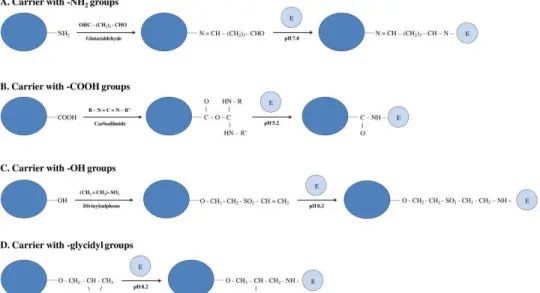
The main goal of our work was to bind pepsin on a range of carriers via various anchor groups to find the matrix and its functionality that is preferred by pepsin (Figure 1). For this reason, pepsin from hog stomach was covalently immobilized on acrylic beads (a cheap, synthetic, and non-biodegradable carrier with a medium pore diameter – dm= 9.4 nm), silica gel carrier (an expensive carrier inert for the microenvironment with a narrow pore diameter – dm= 4.0-4.6 nm), and a cellulose-based carrier (a moderately expensive, biodegradable carrier with wide pores with size exclusion limit 105-106 Da). These materials were selected because they possess -glycidyl, -NH2, -COOH, and/or –OH groups on their surface and could be activated with different cross-linkers (none, glutaraldehyde, carbodiimide, and divi-nylsulfone, respectively). The activity of immobi-lized pepsin at different values of pH and tempera-ture was studied with special attention devoted to extension of pH profiles that would allow specific digestion of proteins soluble not only in an acidic environment. Finally, the reusability of the pepsin-carrier preparations obtained in a batch reactor is also discussed.
MATERIALS AND METHODS
Materials
Tris(hydroxymethyl)aminomethane (Tris), glutaraldehyde (GLA), divinylsulfone (DVS), (N-(3-dimethylaminopropyl)-N’-ethylcarbodiimide (CDI), Folin & Ciocalteu’s phenol reagent, bovine serum albumin, (3-glycidoxypropyl)triethoxysilane (GPTS), 3-aminopropyltriethoxysilane (APTS), and 2-aminoethyl-3-aminopropylmethyl-dimethoxysilane (AEAPMDS) were purchased from Sigma-Aldrich (Germany). Pentaethylenehexamine and pepsin (EC 3.4.23.1) were provided by Fluka (Germany). The other reagents, all of analytical grade, were supplied by POCh (Poland).
Carriers
The acrylic carrier (A; carriers 1-3), composed of butyl acrylate and ethylene glycol dimethacrylate, was modified by reaction with ethylenediamine in tolu-ene (Bryjak, 2003). It should be emphasised that the aminolysis in a large excess of ethylenediamine led to formation of N-amidoamine (A-NH2) and a stoichiometric amount of hydroxyl groups (A-OH) (Bryjak, 2005). Simultaneously, carboxylic groups appeared in the polymer network (A-COOH) as a result of hydrolysis of the ethylene glycol di-methacrylate copolymer. The carrier was selected due to its very high capability of immobilization of other enzymes such as penicillin acylase (Bryjak et al., 1993), amylases (Line et al., 1971), trypsin (Bry-jak et al., 2008), and laccase (Bryjak et al., 2007). It
was donated by Tarchomin Pharmaceutical Plant (Poland).
The medium mesoporous silica gel matrix, Kie-selgel 60 (K; carriers 4-7), was purchased from De-gussa (Essen, Germany). The gel surface was modi-fied by direct grafting of organosilanes (GPTS in the case of K1-glyc, AEAPMDS in the case of K2-NH2 and K3-NH2, and APTS in the case of K4-NH2) as described previously (Jarzębski et al., 2007). The Kie-selgel 60 matrix was selected due to its better proper-ties than those of other silica gels with a narrower diameter of pores (IE Int. Enzymes silica gel) tested for casein hydrolysis with immobilized trypsin (Jar-zębski et al., 2007). Moreover, this matrix was very good for laccase immobilization (Rekućet al., 2010). The cellulose-based carrier Granocel (G; carriers 8-12) was obtained as described previously (Serys et al., 1994; Bryjak et al., 2007). For the experiments, two basic Granocel matrices were selected: Granocel-500 (G1 with a size exclusion limit of 105 Da) and Granocel-2000 (G2 with a size exclusion limit of 106 Da). NH2-functionalized G1 was prepared using pentaethylenehexamine as a long spacer arm (G1-NH2), whereas G1-COOH was obtained according to the procedure described previously (Bryjak et al., 2007). Unmodified G2-OH was the third basic car-rier. It must be pointed out that carriers G1 have – OH groups as well. The Granocel matrix was se-lected as a material with a very good potential for immobilization of other enzymes: tyrosinase (Labus
et al., 2011), laccase (Bryjak et al., 2007), or inver-tase and trypsin (Bryjak et al., 2008).
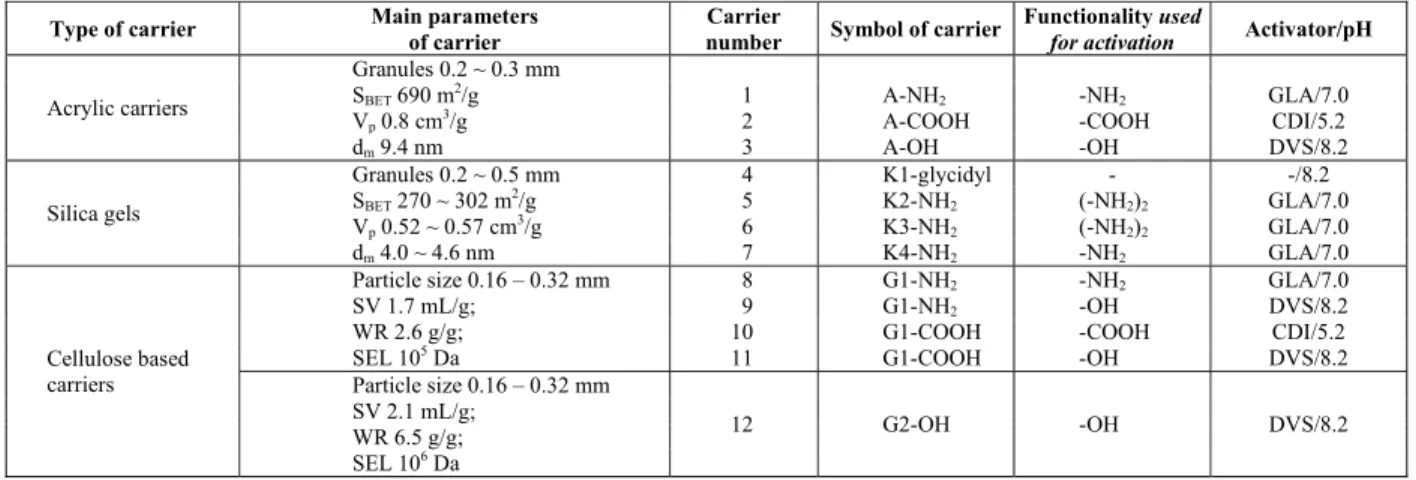
The basic properties of the tested carriers are sum-marised in Table 1.
Table 1: Structural parameters of acrylic (A), silica gels (K1 - K4) and cellulose-based carriers (G1 - G2), activators of functional groups (DVS - divinyl sulfone, GLA - glutaraldehyde, CDI - carbodiimide) and pH values of the coupling mixtures (Labus et al., 2011; Zynek et al., 2011).
Type of carrier Main parameters of carrier
Carrier
number Symbol of carrier
Functionality used
for activation Activator/pH
Acrylic carriers
Granules 0.2 ~ 0.3 mm
SBET 690 m2/g 1 A-NH2 -NH2 GLA/7.0
Vp 0.8 cm3/g 2 A-COOH -COOH CDI/5.2
dm 9.4 nm 3 A-OH -OH DVS/8.2
Silica gels
Granules 0.2 ~ 0.5 mm 4 K1-glycidyl - -/8.2
SBET 270 ~ 302 m2/g 5 K2-NH2 (-NH2)2 GLA/7.0
Vp 0.52 ~ 0.57 cm3/g 6 K3-NH2 (-NH2)2 GLA/7.0
dm 4.0 ~ 4.6 nm 7 K4-NH2 -NH2 GLA/7.0
Cellulose based carriers
Particle size 0.16 – 0.32 mm 8 G1-NH2 -NH2 GLA/7.0
SV 1.7 mL/g; 9 G1-NH2 -OH DVS/8.2
WR 2.6 g/g; 10 G1-COOH -COOH CDI/5.2
SEL 105
Da 11 G1-COOH -OH DVS/8.2
Particle size 0.16 – 0.32 mm
12 G2-OH -OH DVS/8.2 SV 2.1 mL/g;
WR 6.5 g/g; SEL 106
Da
Abbreviations: SBET - specific surface area, VP - mesopore volume, d - pore sizes, SV - specific volume, WR - water retention, SEL - size
Brazilian Journal of Chemical Engineering Immobilization of Pepsin
To have better insight into the efficiency of immo-bilization based on the reaction of different anchor groups, the following protocol was completed. Each group of carriers has a fixed superstructure and dif-ferent types of functional groups: -glycidyl, -COOH, -OH, and -NH2. The procedures of immobilization were selected to be applied mainly to protein amine groups during enzyme-carrier coupling. However, this can be performed at different values of pH (see Fig. 1). The functionalized carrier (5 mL) was washed with distilled water and then with a buffer appropriate to the kind of anchor groups. 5 mL of functionalized carrier contained 9 g of acrylic car-riers (A), or 7 g of Granocel (G) or 12 g of silica gel (K). The activation of the carriers and the process of enzyme immobilization were carried out as described earlier (Bryjak et al., 2007). The activators (DVS, GLA, CDI) and the pH values of the enzyme solu-tion used for immobilizasolu-tion are provided in Table 1. The activated carrier was suspended in a pepsin solu-tion containing 3 mg/mL of protein (5 mL of the enzyme solution per 5 mL of the carrier). The un-bonded protein was removed by washing with the following buffers with different pH and ionic strength values: 0.1 M phosphate buffer pH 7.0, 0.5 M NaCl, 0.1 M phosphate-citrate buffer pH 3.5, and distilled water. The active groups remaining on the carriers were blocked by washing with 0.5 M Tris-HCl buffer (pH 5.0). The obtained enzyme-carrier preparations were intensively rinsed with 0.1 M phos-phate buffer (pH 3.5), then were stored in 0.1 M phosphate-citrate buffer, pH 3.5, at 4 °C, and shortly prior to the experiments were washed with this buffer several times.
All the eluates with unbound proteins were col-lected and analysed for the presence of proteins and for measurement of proteolytic activity. The amount of bound proteins was calculated from the difference between the amount of protein used for immobiliza-tion and the amount washed off during the immobili-zation process. Protein yields were calculated as a ratio of the amount of bound proteins to the concen-tration of protein in the solution of enzyme used for the immobilization process. Activity yield was calcu-lated as a ratio of the activity of immobilized pepsin to the activity of native pepsin in solution used for the immobilization process. These yields were ex-pressed as a percentage.
Pepsin Activity Assay
The native pepsin activity was determined by the Anson method with some modification (Anson,
1938). The activity of native enzyme (0.5 mL) was measured in the presence of 0.5 mL 1% bovine albu-min in 0.1 M phosphate-citrate buffer (pH 3.5). The reaction mixture was incubated for 1 hour at 37 °C and after this time the reaction was stopped by addi-tion of 2 mL of 5% trichloroacetic acid (TCA), and the denaturated protein was centrifuged (10 min, 15 000 rpm). The absorbance of the digested product in the supernatant was measured spectrophotometri-cally at 280 nm (Varian Cary 50 Bio, Germany). In the control samples, TCA was added before incuba-tion of the substrate and enzyme. The proteolytic activity unit (AU) was defined as the amount of the enzyme (native or immobilized) that yielded a rise in absorbance of 0.001 per minute of incubation with the substrate under the assay conditions. The protein concentration was determined by the Lowry method, using bovine serum albumin as a standard (Lowry et al., 1951).
The activity of the immobilized enzyme was
meas-ured in a well-mixed (150 rpm) thermostated (37 °C) batch reactor. The immobilized enzyme (0.25 mL) was suspended in 5 mL of 0.1 M phosphate-citrate buffer pH 3.5 and placed into the reactor. Next, 5 mL of preheated 1% bovine albumin in 0.1 M phosphate-citrate buffer pH 3.5 was added. After 1 hour of incu-bation, 1 mL of the sample was taken out and added to the stopping solution (1 mL of TCA). After cen-trifugation (10 min, 15 000 rpm), the absorbance of the released product was determined spectropho-tometrically.
Effect of Temperature and pH Values on Native and Immobilized Enzyme Activity
The effect of different pH values on the native and immobilized biocatalyst activities was studied at 37 °C using 0.1 M phosphate-citrate buffer with a pH range from 2.5 to 8.0. The optimum temperature was determined by incubation of the samples in a tem-perature range of 20-60 °C. The other reaction condi-tions were the same as in the activity assay.
Operational Stability of Immobilized Pepsin in a Batch Reactor
spectrophotometri-cally at 280 nm after centrifugation (10 min, 15 000 rpm). The immobilized enzyme was collected by filtration, washed five times with the buffer, and suspended in a new solution of the substrate to begin the next cycle of activity measurement.
Statistical Analysis
All the results are expressed as mean ± SD from three experiments (n=3). The data were analysed using one-way ANOVA followed by a post hoc Tukey test. Values of P ≤ 0.05 only were reported as a statistically significant.
RESULTS AND DISCUSSION
Proper selection of the immobilization carriers has a significant impact on the quality and efficiency of enzyme binding. A suitable carrier should have a proper structure characterized by the presence of suitable functional groups, an applicable chemical and mechanical strength, easy regeneration, and low manufacturing costs.
Enzyme Immobilization
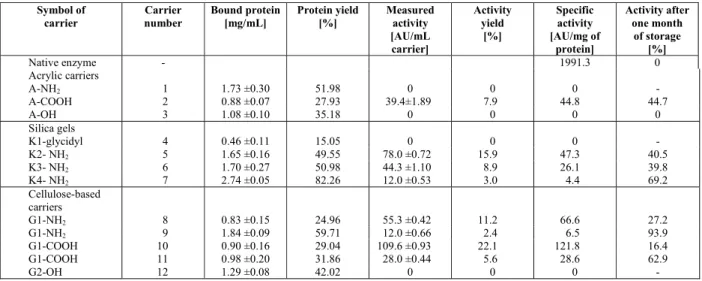
The usefulness of carriers for enzyme immo-bilization can be evaluated on the basis of four main parameters: the amount of bound protein, enzyme activity, specific activity of bound protein, and stor-age stability. According to the common procedures, pepsin was immobilized on activated matrices and the results obtained are shown in Table 2.
In the first stage of this study, we examined the
ability of pepsin to bind to the acrylic carriers (carri-ers 1-3) containing three different functional groups (-OH, -NH2, and -COOH). These types of carriers were activated for the immobilization process by the addition of divinylsulphone (DVS), glutaraldehyde (GLA), or carbodiimide (CDI), respectively. The schematic enzyme immobilization used in this work is presented in Fig.1. Since pepsin loses its activity at high pH values, the enzyme preparation was dis-solved in solutions with pH 3.5 and the activity assay was performed. Then, depending on the crosslinking agent and immobilization techniques used, the en-zyme preparation was adjusted to the appropriate value of pH of the reaction mixture. It was observed that pepsin immobilized on the acrylic supports via
the -OH and -NH2 activator groups had no enzymatic activity (Table 2), in spite of the confirmed binding of the enzymatic protein on the surface of this type of carrier. In the case of GLA (carrier 1) there was a 51.9% yield of protein bound to the carrier and in the case of DVS (carrier 3) 35.1% of protein yield. It can be assumed that amino acids responsible for enzy-matic activity are involved in the enzyme binding on the surface of different carriers. In the case of pepsin, carboxylic groups (-COOH) are very important, as they were not blocked only in the case of the acrylic carrier activated by CDI (carrier 2) and the activity of the bound enzyme was 39.4 AU/mL of the carrier and the protein yield was 27.9%. For comparison, Poojari et al. (2009) obtained 23% protein yield dur-ing pepsin immobilization on silicone elastomers. Additionally, pepsin immobilized by the -COOH groups of the acrylic supports showed very good stability during one month of storage (about 44.7%) compared to the native enzyme (Table 2).
Table 2: Efficiency and storage stability of pepsin immobilized on the tested carriers.
Symbol of carrier
Carrier number
Bound protein [mg/mL]
Protein yield [%]
Measured activity [AU/mL
carrier]
Activity yield
[%]
Specific activity [AU/mg of
protein]
Activity after one month
of storage [%]
Native enzyme - 1991.3 0
Acrylic carriers
A-NH2 1 1.73 ±0.30 51.98 0 0 0 -
A-COOH 2 0.88 ±0.07 27.93 39.4±1.89 7.9 44.8 44.7
A-OH 3 1.08 ±0.10 35.18 0 0 0 0
Silica gels
K1-glycidyl 4 0.46 ±0.11 15.05 0 0 0 -
K2- NH2 5 1.65 ±0.16 49.55 78.0 ±0.72 15.9 47.3 40.5
K3- NH2 6 1.70 ±0.27 50.98 44.3 ±1.10 8.9 26.1 39.8
K4- NH2 7 2.74 ±0.05 82.26 12.0 ±0.53 3.0 4.4 69.2
Cellulose-based carriers
G1-NH2 8 0.83 ±0.15 24.96 55.3 ±0.42 11.2 66.6 27.2
G1-NH2 9 1.84 ±0.09 59.71 12.0 ±0.66 2.4 6.5 93.9
G1-COOH 10 0.90 ±0.16 29.04 109.6 ±0.93 22.1 121.8 16.4
G1-COOH 11 0.98 ±0.20 31.86 28.0 ±0.44 5.6 28.6 62.9
G2-OH 12 1.29 ±0.08 42.02 0 0 0 -
a
Brazilian Journal of Chemical Engineering The second group of tested carriers were
cellu-lose-based supports, Granocel, having a different specific volume and water content (carriers 8-12). It was shown that carrier G1, characterized by a lower specific volume (SV = 1.7 mL/g) and water retention (WR = 2.6 g/g), exhibited more effective binding of pepsin. The best activity yield of immobilized pepsin (22.1%) was obtained for Granocel activated by car-bodiimide (carrier 10) comprising -COOH groups on its surface (Table 2). Substantially lower activity of pepsin was achieved after activation of the supports by glutaraldehyde (11.2%) and divinylsulphone (from 2.4 to 5.6%). In the case of G2 (carrier 12), a carrier with high water retention (WR = 6.5 g/g), no proteolytic activity of immobilized pepsin was dem-onstrated. Similar to the acrylic carriers, the cellu-lose-based support Granocel showed different bind-ing capacity dependbind-ing on the pH value of the immo-bilization reaction. The best activity of immobilized pepsin (109.6 ± 0.93 AU/mL of carrier) was ob-served for the preparation obtained under acidic con-ditions of immobilization. The activity of the bound enzyme decreased with increasing pH value of the reaction medium. The results are not surprising if we consider that the optimum pH value for native pepsin is an acidic pH in the range 2-3.
In our study, we also tested classical silica gel supports (carriers 4-7) functionalized by attachment of glycidyl (K1) or amino groups (K2-NH2, K3-NH2, K4-NH2) and activated by glutaraldehyde. The re-sults presented in Table 2 show that the silica gel matrix with active amino groups allowed binding of pepsin with activity yields from 8.9 to 15.9% and protein yields amounting to 50% (carriers 5-7).
Taking into account that pepsin acts on large sub-strates (e.g., albumin), the glutaraldehyde method should offer the best preparations due to its tendency to form dimeric or trimeric structures, resulting in the formation of a long spacer arm. In contrast, the lowest effectiveness should be expected for car-bodiimide activation or by bonding directly via gly-cidyl residues. In this case, the enzyme is bound directly onto the carrier surface. Thus, the effect of activation via DVS could give intermediate results. However, this expectation does not match the results obtained. The longest spacer arm can be formed in the case of carrier no. 8, which was functionalized with pentaethylenehexamine. Moreover, the worst results should be obtained for carriers no. 2, 4 and 11, which was not the case.
The use of carriers with a defined pore size is im-portant in obtaining efficient immobilization yield. It is assumed that, with increasing diameter of the pore, the surface area is increased, which allows better
access of protein to this surface during enzyme im-mobilization (Zynek et al., 2011). In our studies, we did not observe this relationship. The silica gel support with an associated pore diameter (dm = ~4.0-4.6 nm) immobilized pepsin better than the acrylic support with a large pore diameter (dm = 9.4 nm).
Interestingly, the same carriers were used for im-mobilization of trypsin, but the effects of the immo-bilization were much different. Jarzębski et al. (2007) achieved similar amounts of protein bound to the carrier in the case of silica gel support (33.8-74.7%), but trypsin practically lost its proteolytic activity after the immobilization process. In our ear-lier work trypsin was immobilized very effectively onto acrylic and cellulose-based supports (Bryjak et al., 2008). Trypsin immobilized on the acrylic carrier activated with carbodiimide was also almost entirely inactivated (carrier 2) and immobilization via the – OH and –NH2 groups was more effective (carriers 1 and 2). The yield of bound protein ranged here from 7 to 65%, but the immobilization efficiency was not satisfying (the highest amount was 26.5%). The best results were obtained for the cellulose-based carrier. The yield of bounded protein for the carrier activated by divinylsulfone was relatively high (33.1-49.9%) and the immobilization efficiency achieved was the highest (97%).
These results indicate that the immobilization con-ditions must be chosen strictly and carefully for each biocatalyst. Pepsin and trypsin are two proteins with proteolytic activities, but they differ in their require-ments for optimal environrequire-ments in the biocatalysis process. These features have a potent influence on the immobilization process as we obtained completely different results while using the same carriers.
Effect of Temperature and pH Values on Native and Immobilized Enzyme Activity
We can conclude that, in terms of the effective-ness of pepsin immobilization, the pH value of the coupling mixture is a crucial point.
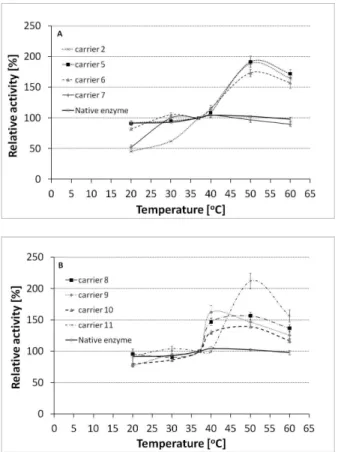
In order to compare the properties of the immobi-lized pepsin with those of the native enzyme, the ef-fects of temperature and pH values on the enzymatic activities were examined. The effects of temperature on the activity of the native and immobilized pepsin in the temperature range of 20-60 °C are presented in Fig. 2 A and B. The optimum temperature values for the native and immobilized pepsin were found in the range from 37 to 40 °C and from 40 to 50 °C, respec-tively. The results are similar to results described for pepsin immobilized on chitosan beads, silicone elas-tomers, and on an aldehyde-modified polymethacry-late monolith (Altun and Cetinus, 2007, Poojari et al, 2009; Han et al., 2014), where the optimum tempera-ture for the immobilized pepsin was higher than that for native enzyme and depended on the tested sup-port. The increase in optimum temperature is caused by the change of the physical and chemical proper-ties of the enzyme by the immobilization process.
Figure 2: Activity under various conditions of tem-perature for native enzyme and pepsin immobilized on silica gel (carriers 5-7) and acrylic support (car-rier 2) (Fig. 2 A) or cellulose-based support (car(car-riers 8-11) (Fig. 2 B). The value at 37 °C was set arbitrarily as 100%.
The covalent bond formation via amino groups of the immobilized enzyme might also have reduced the conformational flexibility, as immobilized enzymes need a higher temperature to form the proper confor-mation to recognize and bind substrate molecule (Hu
et al., 2006; Altun and Cetinus, 2007). In the case of pepsin, the immobilization process probably gave rise to increased rigidity of the tertiary structure of the enzyme, which prevented the molecule from ex-panding (Mateo et al., 2007). These physico-chemical changes in the structure of the immobilized enzyme can explain the thermal activity shift.
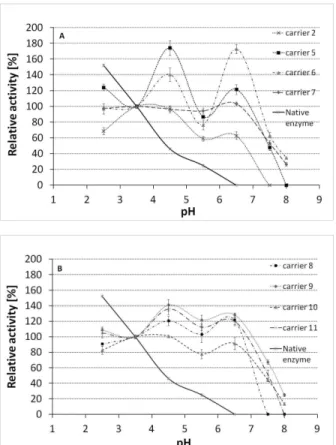
The activities of the native and immobilized pep-sin at various pH values are presented in Figs. 3 A and B and a pH-dependent activity shift to higher pH values in the case of immobilized pepsin was ob-served. Enzyme immobilized on all tested carriers (silica gel, acrylic support, cellulose-based support) exhibited higher activities than native enzymes in the range of pH values from 3.5 to 6.5. In terms of chemi-cal structure, pepsin is a single polypeptide chain with a molecular weight of 35 kDa. The inactive form of pepsin, pepsinogen, has 44 amino acids more than the native enzyme. The enzyme active site con-tains two aspartate residues lying on both sides of the water molecule. The enzyme is activated when one of the aspartate groups is ionized and the other oc-curs in the unionized form. These interactions make pepsin active in an acidic environment with optimum pH between the values of 1.5 and 2.0 and inactive at pH 6.5 and above. In our study, the optimum pH values for native pepsin were in the range of 2.5-3.5. The pepsin preparation immobilized on the silica gel support exhibited a pH optimum in the range of 2.5-6.5 for the K4-NH2 carrier (carrier 7) and 4.5-6.5 for the K2-NH2 (carrier 5) and K3-NH2 (carrier 6) carri-ers. Similarly, in the case of the cellulose-based sup-ports, we observed that immobilized pepsin did not lose its activity in the pH range from 2.5 to 6.5. At pH 6.5 the native enzyme was totally inactive. Altum and Cetinus (2007) reported that pepsin immobilized on chitosan beads had no activity at pH 7.0, while Li
et al. (2012) reported that pepsin immobilized in a
Brazilian Journal of Chemical Engineering amine groups in pepsin, including the N-terminus,
but these interactions do not disturb the proteolytic activity of pepsin.
Figure 3: Activity under various conditions of pH for native enzyme and pepsin immobilized on silica gel (carriers 5-7) and acrylic support(carrier 2) (Fig. 3A) and cellulose-based support (carriers 8-11) (Fig. 3 B). The value of pH 3.5 was set arbitrarily as 100%.
The results obtained confirm that inorganic sup-ports have greater dimensional stability than organic ones. The process of pepsin immobilization can in-crease the scope of its activity over a broader range of pH values in comparison to the native enzyme. Furthermore, the immobilization process probably resulted in formation of two different enzyme forms with different optima for temperature and the value of pH (Fig. 2A, B; Fig. 3A, B), which may be very suitable for industrial processes. This feature may facilitate using immobilized pepsin in the digestion of proteins soluble in slightly alkaline solutions.
Operational Stability of Immobilized Pepsin in a Batch Reactor
The operational stability, which specifies the time after which half of the initial activity of enzyme is
lost, is the basic technological parameter allowing evaluation of the desirability of applying the chosen immobilization method. This parameter is very important for preparative and industrial use of different form of enzymes. In our study, the operational stability of the immobilized pepsin was tested in consecutive batch processes (Fig. 4 and Fig. 5). Among the tested immobilization carriers, the best results were obtained for silica gel (carrier 7) activated by glutaraldehyde, which retained 70% of the immobilized pepsin activity after three cycles and for Granocel activated by glutaraldehyde (carrier 8), which retained 40% or by carbodiimide (carrier 10) which retained 43% activity of the immobilized enzyme.
Figure 4: Operational stability for pepsin immobi-lized on cellulose-based carriers.
Figure 5: Operational stability for pepsin immobilized on silica-gel (carriers 5-7) and acrylic carriers (carrier 2).
cycles of application (Shukla and Devi, 2005). The ability of immobilized pepsin to maintain the enzy-matic activity for several operating cycles gives it advantages over native, non-immobilized enzyme.
CONCLUSIONS
Three different groups of carriers (acrylic, cellu-lose-based, and silicagel supports) were tested for immobilization of pepsin from hog stomach. The results showed that only the cellulose-based carriers activated by glutaraldehyde or carbodiimide and silicagel activated by glutaraldehyde may be used to bind pepsin effectively. Very significant improve-ment in the stability of the immobilized pepsin over a broader pH range was observed, in comparison to the native enzyme. Promising results for thermal and operational stability of the immobilized pepsin were also shown, compared to the free enzyme. The re-sults obtained are promising due to the possibility of industrial application of immobilized pepsin.
REFERENCES
Ahmed, S. A., El-Shayeb, N. M. A., Hashem, A. M., Saleh, S. A. and Abdel-Fattah, A. F., Biochemical studies on immobilized fungal β-glucosidase. Braz. J. Chem. Eng., 30(4), 747 (2013).
Ahn, J., Jung, M. Ch., Wyndham, K., Yu, Y. Q. and Engen, J. R., Pepsin immobilized on high-strength hybrid particles for continuous flow online diges-tion at 10 000 psi. Anal. Chem., 84, 7256 (2012). Altun, G. D. and Cetinus, S. A., Immobilization of
pepsin in chitosan beads. Food Chem., 100, 964 (2007).
Anson, M. L., The estimation of pepsin, trypsin, papain and cathepsin with hemoglobin. J. Gen. Physiol., 22, 79 (1938).
Bahar, T. and Celebi, S. S., Characterization of glu-coamylase immobilized on magnetic poly(styrene) particles. Enzyme Microb. Technol., 23, 301 (1998).
Bryjak, J., Trochimczuk, A. and Noworyta, A., Effect of polymer matrix on penicillin acylase immobili-sation on copolymers of butyl acrylate and ethyl-ene glycol dimethacrylate. J. Chem. Technol. Bio-technol., 57, 73 (1993).
Bryjak, J., Aniulyte, J. and Liesiene, J., Evaluation of main-tailored cellulose-based carriers in glucoa-mylase immobilization. Carbohydr. Res., 342, 1105 (2007).
Bryjak, J., Kruczkiewicz, P., Rekuć, A. and Peczyń -ska-Czoch, W., Laccase immobilization on copoly-mer of butyl acrylate and ethylene glycol di-methacrylate. Biochem. Eng. J., 35, 325 (2007). Bryjak, J., Liesene, J. and Kolarz, B. N., Application
and properties of butyl acrylate/pentaerythritetri-acylate copolymers and cellulose-based Granocel as carriers for trypsin immobilization. Colloids Surf., B, 61, 66 (2008).
Bryjak, J., Liesiene, J. and Stefuca, V., Man-tailored cellulose-based carriers for invertase immobiliza-tion. Cellulose, 15, 631 (2008).
Bryjak, J., Glucoamylase, -amylase and -amylase immobilisation on acrylic carriers. Biochem. Eng. J., 16, 347 (2003).
Cooper, J. B., Khan, G., Taylor, G., Tickle, I. J. and Blundeli, T. L., X-ray analyses of aspartic pro-teinases. II. Three-dimensional structure of the hexagonal crystal form of porcine pepsin at 2.3 Å resolution. J. Molec. Biol., 214, 199 (1990). Dharmapuri, A. and Saiprakash, P. K., Effect of
sol-vents on the hydrolysis of casein catalysed by pepsin-A kinetic study. Indian J. Chem., 38(A), 1181 (1999).
Dumitriu, S., Popa, M. and Duritriu, C., Bioactive Polymers. XLVI. Immobilization of pepsin on N -[4-carboxyphenylcarbamoylmethyl]-cellulose. J. Macromol. Sci. Chem., 24, 1135 (1987).
Esawy, M. A., Mahmoud, D. A. R. and Fattah, A. F. A., Immobilisation of Bacillus subtilis NRC33a levansucrase and some studies on its properties. Braz. J. Chem. Eng., 25(2), 237 (2008).
Gamze, D. A. and Senay, A. C., Immobilization of pepsin on chitosan beads. Food Chem., 100, 964 (2007).
Gray, S. P. and Billings, J. A., Kinetic assay of human pepsin with albumin-bromphenol blue as substrate. Clin. Chem., 29(3), 447 (1983).
Han, W., Yamauch, M., Hasegawa, U., Noda, M., Fukui, K., van der Vlies, A. J., Uchiyama, S. and Uyama, H., Pepsin immobilization on an alde-hyde-modified polymethacrylate monolith and its application for protein analysis. J. Biosci. Bioeng., (2014). <http://dx.doi.org/10.1016/j.jbiosc.2014.10. 018>
Hu, J., Li, S. and Liu, B., Properties of immobilized pepsin on modified PMMA microspheres. Bio-technol. J., 1, 75 (2006).
Brazilian Journal of Chemical Engineering Kamatari, Y. O., Dobson, C. M. and Konno, T.,
Structural dissection of alkaline denatured pepsin. Prot. Sci., 12, 717 (2003).
Konkular, G. and Gunasekaram, S., Rennet-induced milk coagulation by continuous steady shear stress. J. Colloid Interface Sci., 250, 149 (2002). Kurimoto, E., Harada, T., Akiyama, A., Sakai, T. and
Kato, K., In vitro refolding porcine pepsin immo-bilized on agarose beads. J. Biochem., 130, 295 (2001).
Labus, K., Turek, A., Liesiene, J. and Bryjak, J., Efficient Agaricus bisporus tyrosinase immobili-zation on cellulose-based carriers. Biochem. Eng. J., 56, 232 (2011).
Li, S., Hu, J. and Liu, B., Use of chemically modi-fied PMMA microspheres for enzyme immobi-lization. Biosystems, 77, 25 (2004).
Li, B., Zhang, J., Dai, F. and Xia, W., Purification of chitosan by using sol-gel immobilized pepsin de-proteinization. Carbohydr. Polym., 88, 206 (2012). Liese, A. and Hilterhaus, L., Evaluation of immobi-lized enzymes for industrial applications. Chem. Soc. Rev., 42, 6236 (2013).
Line, W. F., Kwong, A. and Weetall, H. H., Pepsin insolubilized by covalent attachment to glass: preparation and characterization. Biochem. Bio-phys. Acta, 242(1), 194 (1971).
Lowry, O. H., Rosebrough, N. J., Farr, A. L. and Randall, R. J., Protein measurement with the Folin phenol reagent. J. Biol. Chem., 193, 265 (1951).
Mateo, C., Palomo, J. M., Fernandez-Lorente, G., Guisan, J. M. and Fernandez-Lafuente R., Im-provement of enzyme activity, stability and selec-tivity via immobilization techniques. Enzyme Mi-crob. Technol., 40, 1451 (2007).
Poojari. Y., Palsule, A. S., Clarson, S. J. and Gross, R. A., Immobilization and activity of pepsin in silicone elastomers. Silicon, 1, 37 (2009).
Rea, D. W. and Ultee, M. E., A novel method for controlling the pepsin digestion of antibodies. J. Immunol. Meth., 157, 165 (1993).
Rekuć, A., Bryjak, J., Szymańska, K. and Jarzębski, A., Very stable silica gel-bound laccase biocata-lysts for the selective oxidation in continuous sys-tems. Bioresour. Technol., 101, 2076 (2010). Serys, A., Liesene, J., Urbonaviciene, J., Maruska,
A., Radzevicius, K., Valatkeviciute, D. and Bu-melis, V., Preparation and characterisation of cel-lulose based adsorbents for large-scale hydropho-bic interaction chromatography. J. Liq. Chroma-togr., 17, 748 (1994).
Shukla, S. P., Devi, S., Immobilization of pepsin on an acrylamide/2-hydroxyethyl methacrylate co-polymer and its use in casein hydrolysis. J. App. Polym. Sci., 96, 1544 (2005).
Stigter, E. C. A., de Jong, G. J. and van Bennekom, W. P., Pepsin immobilized in dextran-modified fused-silica capillaries for on-line protein diges-tion and peptide mapping. Anal, Chem, Acta, 619, 231 (2008).
Ticu, E., Vercaigne-Marko, D., Huma, A., Artenie, V., Toma, O. and Guillochon, D., A kinetic study of bovine haemoglobin hydrolysis by pepsin im-mobilized on a functionalized alumina to prepare hydrolysates containing bioactive peptides. Bio-technol. Appl. Biochem., 39, 199 (2004).
Ticu, E. L., Vercaigne-Marko, D., Froidevaux, R., Huma, A., Artenie, V. and Guillochon, D., Use of protease-modified-alumina complex to design a continuous stirred tank reactor for producing bio-active hydrolysates. Proc. Biochem., 40(8), 2841 (2005).
Zynek, K., Bryjak, J., Szymańska, K. and Jarzębski, A. B., Screening of porous and cellular materials for covalent immobilisation of Agaricus bisporus