ISSN 0104-6632 Printed in Brazil
www.abeq.org.br/bjche
Vol. 33, No. 02, pp. 261 - 270, April - June, 2016 dx.doi.org/10.1590/0104-6632.20160332s20150146
Brazilian Journal
of Chemical
Engineering
NITROGEN SOURCES ON TPOMW
VALORIZATION THROUGH SOLID STATE
FERMENTATION PERFORMED BY
Yarrowia lipolytica
V. R. O. Lopes
1, M. A. Farias
1, I. M. P. Belo
2and M. A. Z. Coelho
1*1
Escola de Química, Universidade Federal do Rio de Janeiro, Centro de Tecnologia, Bloco E, Lab 103, CEP: 21941-909, Cidade Universitária, Rio de Janeiro - RJ, Brasil.
E-mail: [email protected]
2
IBB-Centre of Biological Engineering, University of Minho, Campus de Gualtar, 4710-057, Braga, Portugal.
(Submitted: March 3, 2015 ; Revised: May 7, 2015 ; Accepted: June 1, 2015)
Abstract - This manuscript reports the valorization of two-phase olive mill waste (TPOMW) as raw material and carbon source for solid state fermentation using Yarrowia lipolytica as biocatalyst. Due to its chemical characteristics, a combination of different raw materials (TPOMW and wheat bran, WB) was evaluated and two distinct nitrogen sources were applied as supplementation for lipase production. A TPOMW/WB ratio of 1:1 and supplementation with ammonium sulfate was chosen as the best condition. The productivity in 24 h reached 7.8 U/g*h and, after four days of process, only decreased about 35%. Process pH ranged from 5.5 - 5.9, remaining in an acid range. Thus, the successful use of TPOMW, a watery solid by-product with high content of lipids, as raw material for Yarrowia lipolytica growth and lipase production provided an environmental friendly alternative to valorize such waste.
Keywords: Yarrowia lipolytica; Solid state fermentation; TPOMW valorization; Nitrogen.
INTRODUCTION
The olive oil industry is characterized by its great environmental impact due to the production of a highly polluted wastewater and/or a solid residue, olive skin and stone (olive husk), depending on the extraction process. The two-phase centrifugation system for olive oil production, developed to drasti-cally reduce the water consumption, produces olive oil plus a semi-solid residue, known as two-phase olive mill waste (TPOMW). The resulting solid waste corresponds to 800 kg per ton of processed olives, containing 2.5–3.5% of residual oil and about 60% of water (Darvishi, 2012). Thus, more research is needed on the development of new bioremediation
technologies and strategies for olive mill wastes, as well as its valorization by microbial biotechnology.
Yarrowia lipolytica is a non-conventional yeast,
now as a model organism for several academic stud-ies, making this dimorphic yeast significant for bio-technological applications. Properties like intracellu-lar accumulation of oil, secretion of intracellu-large amounts of organic acids, high capacity for enzyme secretion and its acceptance as generally recognized as safe (GRAS) focus the interest on this yeast as a potential producer of basic commodities (Barth and Gail-lardin, 1997; Papanikolaou and Aggelis, 2010).
Lipases (E.C. 3.1.1.3), defined as triacylglycerol acylhydrolases, are ubiquitous enzymes that can catalyze the hydrolysis of the ester bond of long-chain fatty acids into fatty acids and glycerol and also the reverse reaction when in organic solvents with low-water content. Besides hydrolysis, lipases can catalyze a wide range of reactions including inter-esterification, alcoholysis, acidolysis, esterifica-tion and aminolysis (Bora et al., 2013). These are one of the most important classes of enzymes with industrial applications such as in fine chemistry, detergent, textile, and food additives (Fickers et al., 2011). Lipases are naturally produced by plants, animals and microorganisms; however, enzymes produced by microorganisms have received increas-ing attention. Microbial lipases present a great vari-ety of catalytic activities, possible high yields, easy genetic manipulation, a regular supply due to the absence of seasonal fluctuations and the rapid micro-organism growth rate (Hasan et al., 2006).
Lipases are one the most important biocatalysts secreted by Y. lipolytica. There are several papers reporting three extracellular lipases that present dif-ferent substrate specificities, Lip2, Lip7, and Lip8 (Pignède et al., 2000; Fickers et al., 2011; Najjar et al., 2011). Among these, Lip2 attracts more attention because it is the main secreted extracellular lipase and presents high hydrolysis, transesterification and esterification activities (Yan et al., 2013). Lipase production is induced by fatty acids derived from fat breakdown, like oleic, elaidic and linoleic acids. Inductors of lipase secretion when used as carbon source were also reported in the literature (Najjar et al., 2011). Although it is well known that the produc-tion of lipolytic enzymes is modulated by carbon and nitrogen sources, there is a lack of information about the role of specific substrates in lipase synthesis (Almeida et al., 2012). Microbial lipases are usually produced in submerged fermentation processes. How-ever, solid state fermentation (SSF) seems to be an interesting alternative to microbial enzyme produc-tion due to the possibility of using agro-industrial residues as the source of carbon and other nutrients, as well as support for microorganism growth (Rigo
et al., 2010). Industrial enzymes have been
success-fully produced at the commercial level by SSF.
Never-theless efforts to obtain higher production with lower costs have to be continued (Thomas et al., 2013).
The choice of nitrogen source, organic or inor-ganic, has proven to be an important parameter for the improvement of lipase production. Playing a dif-ferent role in enzyme synthesis, organic sources can supply cells with growth factors and amino acids, while inorganic sources can be quickly used
(Alme-ida et al., 2012). Ammonia for example can be used
not only as nitrogen source, but also as pH regulator during the induction stage. The ammonium ion re-leased into the fermentation broth has a deep impact on cell growth, expression and degradation of for-eign protein (Yu et al., 2013). Yeast extract and hy-drolyzed casein are usually great nitrogen sources for lipase stimulation (Fickers et al., 2004; Moftah et al., 2012; Veerabhadrappa et al., 2013). Turki et al. (2010) reported valuable production of extracellular lipases by the yeast Yarrowia lipolytica LgX64.81, using a defined medium supplemented with tryptone. According to the authors the lipase production was higher using the medium enriched with tryptone than that using a complex medium, commonly employed for yeast cell growth.
The agro-industrial wastes used in SSF can differ in many properties, like the chemical nature of the constituents and water retention capacity, affecting directly the microorganism growth. TPOMW is a watery solid by-product of the olive oil industry that may represent an environmental problem due to its highly polluting organic load (Lama-Muñoz et al., 2013). At the same time, it represents an inexpensive and unexploited source of nutrients, rich in lipids that can act as inducers and make this waste a great alternative for lipase production in SSF. Although the presence of aromatic compounds, such as tannins and polyphenols, and the low nitrogen content in TPOMW generally inhibit microorganism growth (Muktadirul et al., 2013; Reina et al., 2013), the combination with other wastes can reduce the con-centration of phenolic compounds and counteract the lack of nitrogen, improving the production of bio-catalysts (Salgado et al., 2013).
WB is one of the most popular agro-industrial resi-dues and is well accepted for microbial production of important enzymes applying SSF. Since it is a by-product of the milling of wheat into white flour, WB usually accounts for 14–19% of the grains’ weight (Maes and Delcour, 2002; Demir and Tari, 2014). This residue is also an inexpensive carbon source that has already been reported as a good inductor for lipase activity (Romdhane et al., 2010).
In this study, the effect of different solid state media for lipase production by Yarrowia lipolytica
mill waste (TPOMW) and wheat bran (WB) were used as raw material and carbon source and two dis-tinct nitrogen sources were applied as supplementa-tion. The best ratio between the two raw materials for lipase production was also tested.
MATERIALS AND METHODS Microorganism
A wild-type strain of Yarrowia lipolytica (IMUFRJ 50682), isolated from an estuary of Guanabara Bay in Rio de Janeiro, Brazil (Haegler et al., 1981), was used in this work. The yeast was maintained and propagated in YPD medium containing (w/v): 1% yeast extract, 2% peptone and 2% glucose. For lipase production, cells previously grown for 72 hours under orbital agitation (160 rpm, 28 °C) were inoculated in SSF medium.
Raw Materials
Two agro-industrial residues, TPOMW and WB, were tested as substrate. TPOMW was collected from olive oil mill industries in the northern region of Portugal. This residue usually has high moisture content, in this case 73%, so it was necessary to dry it prior to the fermentations. After the required dry-ing, the solid matrix was milled to a particle size lower than 2 mm. WB, collected from industries in the area (Braga, Portugal), was also dried, despite its low moisture content, due to the necessity of mois-ture standardization.
Solid State Fermentation
The fermentation was carried out in 250 mL Er-lenmeyer flasks with 10 g of dry solid substrate with different ratios of the two residues. For lipase pro-duction using a mixture of raw materials, solutions of urea and ammonium sulfate were tested as nitro-gen supplementation; they were also used to adjust the fermentation moisture level to 53% (wet basis). Solutions and substrates were sterilized separately at 121 °C, for 15 min. The sterilized solid substrate was inoculated with 1 mL (108 cells) of cell suspension and the necessary volume of nitrogen solution was added. After mixing, the fermentation flasks were incubated at 28 °C for 96 hours.
Crude Lipase Extraction
The crude lipase was extracted with a solution composed of 1% NaCl and 0.5%Triton X-100 at 4 °C in a solid/liquid ratio of 1:5. After 2 hours of
agita-tion in a rotary shaker (200 rpm, 28 °C), the raw ex-tract was obtained by pressing the mixture and sub-sequent filtration through Whatman No. 1 filter paper.
Lipase Assay
Extracellular lipase was measured by a colorimet-ric method using p-nitrophenyl-laurate (pNPL) as substrate. The pNPL was prior dissolved in dimethyl sulfoxide (DMSO) and potassium phosphate buffer, 50 mmol L−1 (pH 7.0). After incubation for 15 min at 37 °C the reaction was stopped by adding 2 mL of acetone, and the p-nitrophenol released was detected at 410 nm in a spectrophotometer (Gomes et al., 2011). One unit of activity was defined as the amount of enzyme that produces 1 µmol of p-nitrophenol per minute under the assay conditions.
Statistical Analysis
The results are presented on a mean and standard error basis, using Tukey’s test (p < 0.05) with the aid of the program Statistica® 7.0.
RESULTS AND DISCUSSION Raw Materials Characterization
TPOMW and WB have distinct characteristics that make each of them suitable for SSF applications (Table 1). Considering TPOMW characteristics like high water content (≈75%) and aromatic compounds (expressed as total phenols), the use of such a raw material as the sole carbon source in SSF may be unfeasible. Unlike TPOMW, WB has a high nitrogen content that results in a low C/N ratio. Relatively high nitrogen concentrations and lower C/N ratios are better conditions for yeast growth, and typically required for lipase production by fungi (Lima et al., 2003; Cheirsilp and Louhasakul, 2013).
Table 1: Composition of TPOMW and WB.
Parameters TPOMWa WBb
Moisture (%) 75.31±0.14 20.0±3.41 C (%) 51.66±1.54 54.3±4.21 N (%) 0.86±0.19 2.6±0.31
C/N 60.06 17.3-24.91
Total phenols (mg/g) 2.57±0.04 - Protein (mg/g) 0.30±0.03 15.3±0.82 Lipids (mg/g) 102.46±0.04 0.3±0.01 Klason lignin (g/100g) 58.16±0.41 5.03
a
Adopted from Salgado et al., 2013.
b1
Adopted from Jang et al., 2000.
b2
Adopted from Seguin et al., 2012.
b3
Thus, a mixture of both solids may represent a new strategy for application of non-useful waste such as TPOMW to obtain bioproducts with high added value.
Solid Matrix Composition
For the choice of the culture medium, both WB and TPOMW were tested as raw materials and the lipase production was evaluated after 24 hours of fermentation (Table 2). As expected, when used sin-gly, TPOMW did not permit a suitable growth of Y.
lipolytica (data not shown), which directly affected
the lipase production by the yeast. This result is probably a consequence of the high amount of aro-matic compounds, which are toxic for the cell. In addition, this residue has small particles that result in substrate stickiness, leading to poor water retention capacity. With a low capacity for moisture content, any high level can cause a porosity decrease, oxygen transfer limitation and poor growth (Moftah et al., 2012).
Table 2: Lipase activity in different solid matrix compositions.
Culture medium Activity (U/g)
TPOMW 0.79 ± 0.15
WB 14.08 ± 0.78
TPOMW and WB (1:1) 9.69 ± 0.45
On the other hand, the combination between TPOMW and WB proved to be a good alternative for lipase production by the strain Y. lipolytica 50682.
When used as sole carbon source, WB also showed potential for microorganism growth and the lipase activity was slightly superior (around 30%).
Considering that TPOMW is produced in large amounts and that a proper disposal of this material is not commonly realized, the utilization of viable man-agement strategies is imperative (López-Piñeiro et al., 2008). The olive oil industry is very important in the Mediterranean, with a cultivated area of about 8.2 Mha and production of 0.8 ton of solid waste per ton of processed olives. Numerous investigations concerning the treatment of TPOMW have been made, but the solution of an adequate disposal has not yet been found (Federico et al., 2010).
To bypass the growth inhibition problem, the use of a second residue proved to be a good alternative. WB characteristics, such as high water retention capacity and high nitrogen level, ensured its potential for SSF (Javed et al., 2012). At the same time, the lipid content of TPOMW is higher and makes this residue interesting for lipolytic enzyme production. There are many researches in the SSF area showing
the great potential of integrated use of wastes. Dif-ferent residues can supply several nutrients for the fermentation, causing a synergic effect on enzyme production (Cordova et al., 1998; Babu and Rao, 2007; Santis-Navarro et al., 2011; Salgado et al., 2013). In the results reported herein, wastes combi-nation showed potential for lipase production, since the limitation caused by TPOMW was apparently overcome, providing a new possibility for TPOMW utilization, adding value to the olive mill waste.
Relevant to this new strategy, some works deal with different materials, like Cordova et al. (1998) that increased the lipase activity produced by two species of Rhizomucor genus by using an equal mix-ture of olive oil cake and sugarcane bagasse. The authors first tested only sugarcane bagasse for lipase production and the maximal activity obtained was 4.99 U/g. But when the olive oil cake was added to SSF, lipase production reached 79.60 U/g. The au-thors believed that the olive oil cake had the appro-priate precursors necessary for lipase production.
Sun and Xu (2008) evaluated various agro-prod-ucts including rice, corn flour, wheat flour, barley, oat, wheat bran, rice bran, wheat husk and soybean powder for lipase production by R. chinensis. Among all residues tested, wheat bran and wheat flour gave the highest activity. Since wheat flour and wheat bran both favored lipase production, the authors de-cided to experiment different residue combinations, and after some tests the ratio 3/2 (w/w) of wheat flour and wheat bran was chosen as the base medium for subsequent experiments. Coradi et al. (2012) also perceived that the combination of two residues was the most suitable for lipase production by T.
har-zianum. The highest enzyme activity of 4.0 U/g was
obtained after 96 h of fermentation, in a medium containing castor bean and sugarcane bagasse. When the authors used both residues singly, the activities decreased despite the same cultivation conditions. For them, more important for lipase production than lipid content and nitrogen concentration, is the inter-action between these variables.
It is important to note that, until now, no process optimization was carried out, this being a prelimi-nary experiment to demonstrate the viability of using a mixture of TPOMW and WB. Thus, lipase produc-tion in SSF using these raw materials has to be studied to increase its productivity.
Lipase Production in SSF
solution was used as nitrogen supplementation and for the adjustment of moisture content. A total of 10 g of solid matrix were used with the following waste quantities (TPOMW/WB): 1:1; 1:3 and 3:1. The fermentations were carried out for 96 hours and the lipase production was evaluated daily.
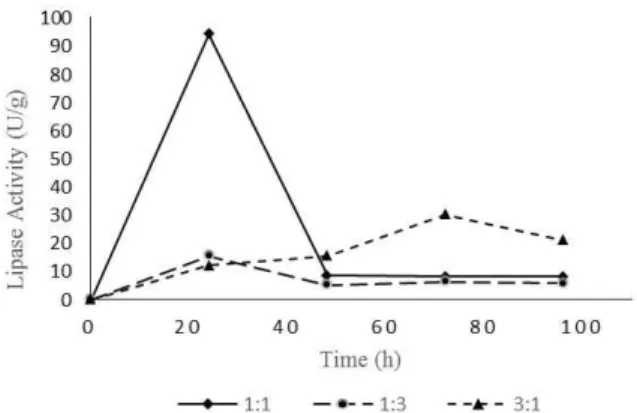
As shown in Figure 1, lipase production was higher in the medium with equal proportions of each raw material, reaching 94 U/g of lipase activity after 24 hours of fermentation. The medium with a mini-mum of TPOMW also showed its best result in the first 24 hours of fermentation (15.5 U/g), different from the medium with maximum of TPOMW that had its best lipase production only after 72 hours of fermentation (30 U/g). This result demonstrates how lipase activity is affected by lipid-rich substrates; even with the presence of phenolic compounds that could inhibit fungal growth, the medium with 75% of TPOMW also produced an expressive lipase activ-ity. Several extracellular elements that affect the expression of lipase are described in the literature, but the carbon source seems to be a critical one. These enzymes are usually produced in the presence of lipid, such as plant seed-oils (triacylglycerols), free fatty acids, surfactants, bile salts, and glycerol, that are included in the nutrient medium as inducers (Kebabci and Cihangir, 2012). Lip2, for example, is strongly affected by oleic acid, the end product of the hydrolysis of its preferred substrate (Fickers et al., 2011).
Figure 1: Lipase activity of three different raw mate-rials ratios.
However, it is possible to observe a delay in li-pase production, probably due to the high C/N ratio. It is known that the lipase produced by yeasts usually stays internally bound to the cell wall and it is only secreted to the culture medium when the carbon source becomes scarce, i.e., in the transition to di-auxie (when more than one substrate is used) or to
the stationary phase. In a medium with a high C/N ratio there is a surplus of carbon sources that can retard the lipase secretion (Pereira-Meireles et al., 2000). Similarly, a strain of Yarrowia lipolytica
showed a delay in the transition between the two phases when an oleic acid rich medium was used. At the early stage of the culture when oleic acid was abundant, lipases remained cell-bonded, which were sufficient to support yeast growth. The enzymes were only released into the culture medium as the oleic acid concentrations decreased (Fickers et al., 2004).
Effect of Nitrogen Source on Lipase Production
The nitrogen source, organic or inorganic, also plays an important role in lipase production. For this reason, the effect of ammonium sulfate on lipase pro-duction was evaluated and compared to urea as nitro-gen supplementation. The fermentations were per-formed for 96 hours with a ratio of 1:1 (TPOMW/ WB). Lipase activity and pH were evaluated daily.
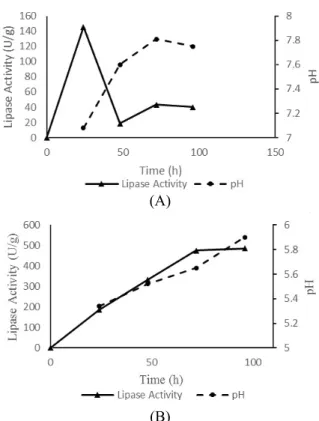
Ammonium sulfate showed a different production profile when compared to urea. The presence of this mineral source not only increased lipase activity, but also kept levels rising throughout most of the fer-mentation process, reaching 486 U/g at the end of the process (Figure 2). Similar to previous experiments, urea supplementation promoted a positive effect on lipase production with a peak at 24 hours of fer-mentation. However, the maximal lipase activity was 145 U/g (Figure 2), almost three fold lower than that obtained with ammonium sulfate. Nitrogen com-pounds also modulate the synthesis of Lip2 and, ac-cording to several authors, organic sources are better for this purpose. While the presence of nitrogen com-pounds such as casein tryptone, urea and yeast extract usually yields significant lipase synthesis, the oppo-site occurs when a mineral source is used (Pereira-Meireles et al., 1997; Fickers et al., 2004). Turki et al. (2009) studied the extracellular lipase production
by Yarrowia lipolytica overproducing mutant under
the effect of several organic nitrogen sources. They concluded that enzymatic hydrolyzed casein (tryp-tone and pep(tryp-tone) had a relevant stimulatory effect on lipase production, suggesting that the enhance-ment relies most probably on the presence of some specific bioactive peptides that act as lipase inducers. Urea is also reported as a better nitrogen supplemen-tation than ammonium sulfate for lipase production
by Yarrowia lipolytica. Usually, when this mineral
Figure 2: Influence of nitrogen supplementation on lipase activity.
Our results, in disagreement with other research-ers, showed the great potential of ammonium sulfate for lipase production by the yeast Y. lipolytica. In some level, the conditions offered by the raw materi-als and ammonium sulfate allowed an improvement of the productivity (Figure 3). The fermentations with ammonium sulfate supplementation not only had higher lipase production than urea, but also presented higher productivity. In the first 24 hours, the produc-tivity reached its best range with 7.8 U/g*h, and after four days of the process only decreased about 35%. This promising result confirms the potential of our experiments since the lipase productivity was higher than most of the productivities reported in the litera-ture (Imandi et al., 2010; Moftah et al., 2012; Coradi
et al., 2012; Vaseghi et al., 2013; Salgado et al.,
2013), which is very important for an economically viable process. Although the organic nitrogen sources are generally cited for lipase production, the use of inorganic ones has been studied due to their low cost and to facilitate the subsequent stages of enzyme purification.
Figure 3: Influence of urea and ammonium sulfate on lipase productivity.
In recent research, the impact of NH4+ nitrogen source on lipase production by Pichia pastoris was
investigated, and the results demonstrated the posi-tive effect of this ion. Ammonium sulfate was added in order to provide the ammonium ion and keep it constant at three levels, 400 mmol/L, 440 mmol/L and 500 mmol/L. The highest lipase activity was obtained at a concentration of 440 mmol after 52 hours, with an increase of 71% considering the con-trol system. The presence of NH4+ in the broth also prevented protease production (Yu et al., 2013), a fact that can explain the higher maintenance of lipase production all along the fermentation with this nitro-gen source.
The use of ammonium sulfate showed a linear in-crease in lipase production with bath time that pro-vided an almost constant productivity up to 72 h (Figure 3), meaning that no decrease in enzyme ac-tivity was observed. On the other hand, the use of urea showed a decreased in lipase activity after 24 h, which led to a low productivity. These results permit one to plan the process strategy to obtain higher pro-ductivities.
Kebabci and Cihangir (2012) studied lipase pro-duction by three different Y. lipolytica strains, evalu-ating different nitrogen supplementation (proteose-peptone, (proteose-peptone, yeast extract, casein, urea, ammo-nium sulfate, ammoammo-nium oxalate, ammoammo-nium nitrate and ammonium carbonate) with and without olive oil. The authors concluded that addition of ammo-nium compounds led to the best increase in lipase production. In their case, the combination between ammonium sulfate and olive oil permitted the best condition for enzyme production in an acid pH range.
In the study reported herein, the pH was also evaluated for both nitrogen sources. Similarly, the best pH for lipase production with ammonium sul-fate varied in an acid range, between 5.5-5.9 (Figure 4B). When urea was used, the pH profile was differ-ent, ranging between 7.0-7.8 (Figure 4A). The opti-mal pH reported for Lip2 hydrolytic activity was found to be slightly acid, although it can vary de-pending on the substrates and the experimental con-ditions (Fickers et al., 2011). In addition, the opti-mum hydrolytic activity of lipases from Y. lipolytica
is usually obtained between pH 6.0 and 10.0, de-pending on the strain used (Brígida et al., 2013). According to Dominguez et al. (2003), low pH in the fermentation broth can be attributed to the release of fatty acids in the presence of lipase, which can ex-plain the better productivity in acid pH.
Y. lipolytica can produce large amounts of proteolytic enzymes; among them, alkaline protease (AEP) and acid protease (AXP) are the most common. Alkaline proteases, however, are the major protein secreted, reaching several grams per litre under optimized conditions (Nicaud et al., 2002). The secretion of this enzyme can occur in parallel to lipase and it is induced at neutral/basic pH. Although in this work no proteolytic data was available, the pH verified in our experiments can give us some information about the fermentations. In addition, other work in the group using the same strain in SSF demonstrated that, up to 14h of the process there is no detectable protease activity (data not shown).
(A)
(B)
Figure 4: Comparison of lipase activity and pH in the medium with urea supplementation (A) and am-monium sulfate supplementation (B).
Nevertheless, Najjar et al. (2011) demonstrated that, independent of the culture medium, the lipase activity was always lost in the late stage of culture when the pH reached alkaline values, suggesting a proteolytic degradation by AEP. Similarly, our results show that, in the medium with neutral/ basic pH, the lipase activity reached its lowest value. In the me-dium with urea, a greater pH increase (pH 7.0 to pH 7.6) was followed by an expressive decrease in lipase production (Figure 4A). In the medium containing ammonium sulfate, that had higher lipase activity,
the pH was not optimum for AEP (Figure 4B). More-over, protease production is tightly controlled by a combination of environmental stimuli, which in-cludes nutrient availability such as carbon, nitrogen, and sulfur starvation (Gonzalez-Lopez et al., 2002). The presence of nitrogen (ammonium ions, amino acids) and sulfur can have a repressive effect on AEP and AXP production (Young et al., 1996).
CONCLUSIONS
The yeast Yarrowia lipolytica IMUFRJ 50682 showed great potential for lipase production in solid state fermentation using agro-industrial residues. The raw materials TPOMW and WB had complementary effects, offering suitable conditions for SSF when used in equal proportions due to their characteristics concerning toxic compounds, moisture content and C/N ratio. In addition, the supplementation with a mineral nitrogen source enhanced lipolytic activity, reaching the best result of 486 U/g after 96 hours. Ammonium sulfate improved lipase production and the productivity of the process, whereas urea had a less significant effect.
ACKNOWLEDGEMENTS
The authors kindly acknowledge the financial aid and research scholarships given by CAPES. Maria Alice Zarur Coelho thanks CNPq (Proc. 308890/ 2013-2).
REFERENCES
Almeida, A. F., Taulk-Tornisielo, S. M. and Car-mona, E. C., Influence of carbon and nitrogen sources on lipase production by a newly isolated
Candida viswanathii strain. Annals of
Microbi-ology, 63, 1225-34 (2012).
Babu, I. S. and Rao, G. H., Lipase production by
Yarrowia lipolytica NCIM 3589 in solid state
fer-mentation using mixed substrate. Research Jour-nal of Microbiology, 2, 469-74 (2007).
Brígida, A. I. S., Amaral, P. F. F., Coelho, M. A. Z. and Gonçalves, L. R. B., Lipase from Yarrowia
lipo-lytica: Production, characterization and
applica-tion as an industrial biocatalyst. Journal of Mo-lecular Catalysis, B, Enzymatic, 101, 148-58 (2013).
Cervantes-Chávez, J. A. and Ruiz-Herrera, J., The regulatory subunit of protein kinase A promotes hyphal growth and plays an essential role in
Yar-rowia lipolytica. FEMS Yeast Research, 7, 929-40
(2007).
Cheirsilp, B. and Louhasakul, Y., Industrial wastes as a promising renewable source for production of microbial lipid and direct transesterification of the lipid into biodiesel. Bioresource Technology, 142, 329-37 (2013).
Coelho, M. A. Z., Amaral, P. F. F. and Belo, I.,
Yar-rowia lipolytica: An industrial workhorse. In: A.
Méndes-Vilas, Editor. Current Research, Technol-ogy and Education. Topics in Applied Microbiol-ogy and Microbial BiotechnolMicrobiol-ogy. FORMATEX (2010).
Coradi, G. V., Visitação, V. L., Lima, E. A., Saito, L. Y. T., Palmieri, D. A., Takita, M. A., Oliva Neto, P., Lima, V. M. G., Comparing submerged and solid-state fermentation of agro-industrial residues for the production and characterization of lipase by
Trichoderma harzianum. Annals of Microbiology,
63, 553-540 (2012).
Cordova, J., Nemmaoui, M., Ismaıli-Alaoui, M., Morin, A., Roussos, S., Raimbault, M., Benjilali, B., Lipase production by solid state fermentation of olive cake and sugar cane bagasse. Journal of Molecular Catalysis B: Enzymatic, 5, 75-8 (1998).
Corzo, G. and Revah, S., Production and characteris-tics of the lipase from Yarrowia lipolytica 681. Bioresource Technology, 70, 173-80 (1999). Darvishi, F., Microbial Biotechnology in Olive Oil
Industry, Olive Oil - Constituents, Quality, Health Properties and Bioconversions. Dr. Dimitrios Boskou (Ed.), InTech (2012).
Demir, H. and Tarı, C., Valorization of wheat bran for the production of polygalacturonase in SSF of
Aspergillus sojae. Ind. Crops Prod., 54, 302-9
(2014).
Domínguez, A., Costas, M., Longo, M. A. and San-román, A., A novel application of solid state cul-ture: production of lipases by Yarrowia lipolytica. Biotechnology Letters, 25, 1225-9 (2003). Federico, C, Sánchez-Peinado, M. M., Juárez-Jimenez,
B., González-López, J., Pozo, C., Biological Treatment of Two-Phase Olive Mill Wastewater (TPOMW, alpeorujo): Polyhydroxyalkanoates
(PHAs) Production by Azotobacter Strains. J. Microbiol. Biotechnol., 20, 594-601 (2010). Fickers, P., Nicaud, J. M., Gaillardin, C., Destain, J.
and Thonart, P., Carbon and nitrogen sources modulate lipase production in the yeast Yarrowia
lipolytica. Journal of Applied Microbiology, 96,
742-9 (2004).
Fickers, P., Marty, A. and Nicaud, J. M., The lipases from Yarrowia lipolytica: Genetics, production, regulation, biochemical characterization and bio-technological applications. Biotechnology Ad-vances, 29, 632-44 (2011).
Gomes, N., Gonçalves, C., García-Román, M., Tei-xeira, J. A. and Belo, I., Optimization of a colori-metric assay for yeast lipase activity in complex systems. Analytical Methods, 3, 1008-13 (2011). Gonzalez-Lopez, C. I., Szabo, R., Blanchin-Roland,
S., Gaillardin, C., Genetic control of extracellular protease synthesis in the yeast Yarrowia
lipol-ytica. Genetics, 160, 417-27 (2002).
Haegler, A. N. and Mendonça-Haegler, L. C., Yeast from marine and estuarine waters with different levels of pollution in the State of Rio de Janeiro, Brazil. Applied and Environmental Microbiology, 41, 173-178 (1981).
Hasan, F., Shah, A. A. and Hameed, A., Industrial applications of microbial lipases. Enzyme and Microbial Technology, 39, 235-51 (2006).
Imandi, S. B., Karanam, S. K. and Garapati, H. R., Optimization of process parameters for the pro-duction of lipase in solid state fermentation by
Yarrowia lipolytica from niger seed oil cake
(Guizotia Abyssinica). Journal of Microbial &
Bio-chemical Technology, 02, 028-33 (2010).
Jang, H., Lin, Y. and Yang, S., Polyunsaturated fatty acid production with Mortierella alpina by solid substrate fermentation. Botanical Bulletin-Acade-mia Sinica Taipei, 41, 4-11 (2000).
Javed, M. M., Zahoor, S., Shafaat, S., Mehmooda, I., Gul, A., Rasheed, H., Bukhari, S. A. I., Aftab, M. N. and Haq, I., Wheat bran as a brown gold: Nu-tritious value and its biotechnological applica-tions. African Journal of Microbiology Research, 6, 724-33 (2012).
Kebabçı, Ö., Cihangir, N., Comparison of three
Yar-rowia lipolytica strains for lipase production:
NBRC 1658, IFO 1195, and a local strain. Turk-ish Journal of Biology, 36, 15-24 (2012).
Lima, V. M. G., Krieger, N., Sarquis, M. I. M., Mitchell, D. A., Ramos, L. P. and Fontana, J. D., Effect of nitrogen and carbon sources on lipase production by Penicillium aurantiogriseum. Food Technology and Biotechnology, 41, 105-10 (2003). López-Piñeiro, A., Albarrán, A., Nunes, J. M. R.,
Barreto, C., Short and medium-term effects of two-phase olive mill waste application on olive grove production and soil properties under semi-arid mediterranean conditions. Bioresour. Tech-nol., 99, 7982-7 (2008).
Maes, C. and Delcour, J. A., Structural characterisa-tion of water-extractable and water-unextractable arabinoxylans in wheat bran. Journal of Cereal Science, 35, 315-26 (2002).
Moftah, O. A. S., Grbavčić, S., Zuža, M., Luković, N., Bezbradica, D. and Knežević-Jugović, Z., Adding value to the oil cake as a waste from oil processing industry: Production of lipase and pro-tease by Candida utilis in solid state fermenta-tion. Applied Biochemistry and Biotechnology, 166, 348-64 (2012).
Muktadirul Bari Chowdhury, A. K. M., Akratos, C. S., Vayenas, D. V. and Pavlou, S., Olive mill waste composting: A review. International Biodeteriora-tion and BiodegradaBiodeteriora-tion, 85, 108-19 (2013). Najjar, A., Robert, S., Guérin C., Violet-Asther, M.
and Carrière, F., Quantitative study of lipase se-cretion, extracellular lipolysis, and lipid storage in the yeast Yarrowia lipolytica grown in the pres-ence of olive oil: Analogies with lipolysis in hu-mans. Applied Microbiology and Biotechnology, 89, 1947-62 (2011).
Nicaud, J-M., Madzak, C., van den Broek, P., Gysler, C., Duboc, P., Niederberger, P., Gaillardin, C., Protein expression and secretion in the yeast
Yar-rowia lipolytica. FEMS Yeast Res., 2, 371-9 (2002).
Palmarola-Adrados, B., Choteborská P., Galbe, M. and Zacchi, G., Ethanol production from non-starch carbohydrates of wheat bran. Bioresource Technology, 96, 843-50 (2005).
Papanikolaou, S. and Aggelis, G., Yarrowia
lipo-lytica: A model microorganism used for the
pro-duction of tailor-made lipids. European Journal of Lipid Science and Technology, 112, 639-54 (2010). Pereira-Meireles, F. V., Rocha-Leão, M. H. M. and
Sant’Anna, G. L. Jr. A., Stable lipase from
Can-dida lipolytica: Cultivation conditions and crude
enzyme characteristics. Applied Biochemistry and Biotechnology, 63, 73-85 (1997).
Pereira-Meireles, F. V., Rocha-leão, M. H. M. and Sant’Anna, G. L. Jr. A., Lipase location in
Yar-rowia lipolytica cells. Biotechnology Letters, 22,
71-5 (2000).
Pignède, G., Wang, H., Fudalej, F., Gaillardin, C., Seman, M., Nicaud, J.-M., Characterization of an Extracellular Lipase Encoded by LIP2 in
Yar-rowia lipolytica. Journal of Bacteriology, 182,
2802-10 (2000).
Reina, R., Liers, C., Ocampo, J. A., García-Romera, I. and Aranda, E., Solid state fermentation of olive mill residues by wood- and dung-dwelling Agaricomycetes: Effects on peroxidase produc-tion, biomass development and phenol phyto-toxicity. Chemosphere, 93, 1406-12 (2013). Rigo, E., Polloni, A. E., Remonatto, D., Arbter, F.,
Menoncin S., Oliveira, J. V., de Oliveira, D., Trei-chel, H., Kalil, S. J., Ninow, J. L., Di Luccio, M., Esterification activity of novel fungal and yeast lipases. Applied Biochemistry and Biotechnology, 162, 1881-8 (2010).
Romdhane, I. B., Fendri, A., Gargouri, Y., Gargouri, A. and Belghith, H., A novel thermoactive and al-kaline lipase from Talaromyces thermophilus fun-gus for use in laundry detergents. Biochemical En-gineering Journal, 53, 112-20 (2010).
Salgado, J. M., Abrunhosa, L., Venâncio, A., Domín-guez, J. M. and Belo, I., Screening of winery and olive mill wastes for lignocellulolytic enzyme pro-duction from Aspergillus species by solid-state fermentation. Biomass Conversion and Biorefin-ery, 172, 1832-45 (2013).
Santis-Navarro, A., Gea, T., Barrena, R. and Sánchez, A., Production of lipases by solid state fermenta-tion using vegetable oil-refining wastes. Biore-source Technology, 102, 10080-4 (2011).
Seguin, A., Marinkovic, S. and Estrine, B., New pretreatment of wheat straw and bran in hexa-decanol for the combined production of emulsify-ing base, glucose and lignin material. Carbohy-drate Polymers, 88:657-62 (2012).
Sun, S. Y. and Xu, Y., Solid-state fermentation for “whole-cell synthetic lipase” production from
Rhizopus chinensis and identification of the
func-tional enzyme. Process Biochemistry, 43, 219-24 (2008).
Thomas, L., Larroche, C. and Pandey, A., Current developments in solid-state fermentation. Bio-chemical Engineering Journal, 81, 146-61 (2013). Turki, S., Kraeim, I. B., Weeckers, F., Thonart, P. and
Kallel, H., Isolation of bioactive peptides from tryptone that modulate lipase production in
Yar-rowia lipolytica. Bioresource Technology, 100,
2724-31 (2009).
lipolytica. Applied Biochemistry and Biotechnol-ogy, 160, 1371-85 (2010).
Vaseghi, Z., Najafpour, G. D., Mohseni, S., Mahjoub, S., Production of active lipase by Rhizopus oryzae
from sugarcane bagasse: Solid state fermentation in a tray bioreactor. Int. J. Food Sci. Technol., 8, 283-9 (2013).
Veerabhadrappa, M. B., Shivakumar, S. B. and Devappa, S., Solid-state fermentation of Jatropha
seed cake for optimization of lipase, protease and detoxification of anti-nutrients in Jatropha seed cake using Aspergillus versicolor CJS-98. Journal of Bioscience and Bioengineering, 117 (2), 1-7 (2013).
Yan, Y., Zhang, X. and Chen, D., Enhanced catalysis
of Yarrowia lipolytica lipase LIP2 immobilized
on macroporous resin and its application in en-richment of polyunsaturated fatty acids. Biore-source Technology, 131, 179-87 (2013).
Young, T. W., Wadeson, A., Glover, D. J., Quincey, R. V., Butlin, M. J., Kamei, E. A., The extracellular acid protease gene of Yarrowia lipolytica: Se-quence and pH-regulated transcription. Microbi-ology, 142, 2913-21 (1996).
Yu, X. W., Lu, X., Zhao, L. S. and Xu, Y., Impact of NH4+ nitrogen source on the production of
Rhizopus oryzae lipase in Pichia pastoris. Process