Red mud is a solid waste produced in the alumina production process and, due to its high pH, is classiied as hazardous. Its incorporation in concrete mixtures, acting as iller due to the particles ineness, might be an interesting reuse alternative. The focus of this paper is to study the chloride diffusivity of concrete mixtures containing red-mud. The concentration of chlorides was monitored by measuring the conductivity of the anolyte, which was distilled water initially. In addition, the estimation of the chloride ions diffusion coeficients in steady and non-steady conditions, Ds and Dns, was obtained from the ‘‘time-lag’’ and ‘‘equivalent time’’ between diffusion and migration experiments. Due to superine particle-size distribution and the “iller” effect, the red mud addition seems to assure lower chloride diffusivity.
Keywords: concrete, red mud, chloride diffusion, corrosion.
A lama vermelha é um resíduo sólido gerado no processo de produção de alumina e, devido a seu elevado pH, é considerado “perigoso”. A ca-racterística de elevada alcalinidade associada à presença de aluminossilicatos facilitam a assimilação e formação de compostos pela reação com os íons cloreto. No presente estudo, a concentração de cloretos foi monitorada por meio da medida da condutividade do anólito, que inicialmente era água destilada. Adicionalmente, foram estimados os coeicientes de difusão nos estados estacionário e não-estacionário, obtidos através do “time lag” e do “tempo equivalente” de medida. Os resultados obtidos mostraram que a adição da lama vermelha é benéica ao concreto, reduzin-do a taxa migração reduzin-dos cloretos (coeicientes de difusão) devireduzin-do à elevada inura da lama vermelha (efeito iller) e à ação reduzin-dos aluminossilicatos.
Palavras-chave: concreto, lama vermelha, difusão de cloretos, corrosão.
Analysis of chloride diffusivity in concrete containing
red mud
Análise da difusão de cloretos no concreto contendo
lama vermelha
D.V. RIBEIRO a
J.A. LABRINCHA b
M.R. MORELLI c
a Universidade Federal da Bahia, Departamento de Ciência e Tecnologia dos Materiais, [email protected], Escola Politécnica - Rua Aristides Novis, 02, Federação, 40210-630. Salvador/BA, Brasil;
b Universidade de Aveiro, Departamento de Engenharia Cerâmica e do Vidro, [email protected], Campus Universitário de Santiago, 3810-193. Aveiro, Portugal; c Universidade Federal de São Carlos, Departamento de Engenharia de Materiais, [email protected], Rodovia Washington Luis, Km 235. 13566-550.
São Carlos/SP, Brasil.
Received: 12 Mar 2010 • Accepted: 27 Jan 2012 • Available Online: 02 Apr 2012
Abstract
1. Introduction
The huge volumes of industrial waste produced today represent one of the world’s greatest environmental problems, with an annu-al volume of up to 25 million tons of waste generated in São Paulo alone [1]. The red mud studied in the present paper is a by-product of aluminum production from bauxite ore produced by the Bayer process. The vast quantities of wastes call for the search for widely consumed target products into which they can be incorporated, such as civil construction.
The world’s production of bauxite in 2009 was 205 million tons, and the main producing countries were Australia, China, Brazil, Guinea, India and Jamaica. Ranking third in worldwide production in 2009, Brazil produced 26.6 million tons of bauxite. It also has the world’s third largest bauxite ore reserves (around 3.5 billion tons), concentrated mainly in the northern part of the country (state of Pará) [2].
Roughly 0.3 – 1.0 tons of red mud waste are generated per ton of aluminum produced. Brazil has discarded about 10.6 million tons/ year of caustic red mud in recent years and the worldwide genera-tion of red mud exceeds 117 million tons/year [3].
Approximately 35–40% of bauxite ore is discarded in the form of strongly alkaline RM slurry [4]. This mud contains about 60 vol. % of solid content in the form of superine particles. Therefore, this mate-rial has a large surface área and a strong water absorbing capacity. Alkaline matrices such as those provided by Portland cement in mortars and concrete are commonly used in waste conditioning. They are inexpensive, have an extensively documented history of safe use, and are a draw-upon readily-accessible technology. Al-kalinity greatly reduces the solubility of many hazardous inorganic species and inhibits microbiological processes. Moreover, since these matrices require water for hydration, they may readily incor-porate wet wastes [5] such as red mud.
The search for an economically and environmentally viable alterna-tive has led to the study of red mud for various applications, such as adsorbent for the removal of heavy metals from aqueous solu-tions [6], building materials such as bricks [7], ceramics and tiles [8], ceramic glazes [9], as polymer-based composites to replace wood [10], iron-rich cement [11, 12], component of clinker [4, 11, 12], and the addition to mortar and concrete formulations was also reported [13]. The use as common building material has been suggested as an alternative that ensures high rates of consumption [14].
It is widely known that chloride ions cause local breakdown of the passive layer and subsequent corrosion of reinforcing steel bars (rebars) in concrete structures.
Several studies [15, 16, 17] report the use of migration tests to evaluate the resistance of concrete to penetrating chloride ions. Initially, these tests were used to evaluate this penetration based on the total penetrated load, according to the ASTM C 1202/1992 standard, and to estimate the diffusion coeficient in steady-state conditions, as suggested by ANDRADE [15]. More recently, sev-eral authors have used migration tests to calculate the diffusion coeficient in nonsteady-state conditions [16, 17]. Depending on the proposed objective, these tests may vary in terms of procedure and parameters, but all are based on the induction of the move-ment of ions under the action of an external electric ield [18]. The migration test is based on the principle of applying a poten-tial difference between two cells: one containing a chloride
solu-tion (cathode) and the other without chlorides (anode), which are placed on each side of the concrete sample under analysis. The externally applied electric potential forces the passage of chloride ions through the concrete sample from the irst (cathode) to the second (anode) cell. By this method, the passage of chloride ions through the specimen is induced by the electric current generated by the potential difference of 12 volts applied to a direct current source through the electrodes contained in each cell.
The positive cell (anode) is illed with distilled water to prevent cor-rosion-induced deposition of chlorides. The negative cell (cathode) is composed of a solution containing a concentration of 1 M of sodium chloride (NaCl).
2. Materials and methods
2.1 Materials
Ordinary CP-II 32 Z Portland cement (OPC), according to the Brazil-ian NBR 11578 standard, commercially available in São Carlos, Bra-zil, was selected as reference in all the tests. The coarse aggregate was dense, crushed granitic stone and the sand was supplied from a river deposit commercially available in São Carlos, Brazil.
The red mud came from Poços de Caldas-MG and was supplied by ALCOA Brazil. It is a mixture containing about 60% of solids, collect-ed immcollect-ediately after alumina recovery from the digestion process.
2.2 Methods
2.2.1 Materials characterization and Concrete Dosage
The materials characterization involved X-ray diffraction (Rigaku Geirgelex ME 210GF2 Diffractometer) and X-ray luorescence (Philips PW1480 X-ray Fluorescence Spectrometer) analyses, while physical parameters such as the speciic surface area (es-timated by BET, using a Micrometrics Gemini 2370 V1.02 equip-ment) and speciic gravity (Helium Pycnometer Accupyc 1330 V2.01 from Micrometrics) were also determined. Similar determi-nations were performed on sand and on the red mud.
The concrete formulation used as reference was prepared in a 1.0 : 1.5 : 1.3 : 0.5 (Portland cement + red mud : sand : coarse ag-gregate : water) weight ratio. The mortar content was 65.8% and the cement consumption was 540 kg/m3 compared to a reference mixture. Distinct concrete mixtures in which cement was partially replaced by red mud (10, 20, and 30% in weight) were analyzed. All the specimens were cylindrical. To perform the migration tests, specimens of 50 mm in diameter and 100 mm in length were mold-ed, from which 40 mm thick slices were cut, discarding the outer top and bottom parts in order to minimize heterogeneities and en-sure water saturation.
2.2.2 Chloride Migration Testing
as ine sand. The gravel has a speciic gravity of 2.74 kg/dm3 and maximum dimension of 19 mm.
The red mud was received in the form of a paste containing about 40% free water. In the present study, the material was dried and crushed, and then used as a powdered additive. Ideally, if its po-tential as a constituent of concrete is conirmed, red mud should be incorporated and tested in the as-received condition, and the free water present in the mud should be considered a component of the mortar mix.
were soaked in water for 24 hours prior to testing, according to SANTOS [18] studies.
PVC cells were used, consisting of a 50 mm diameter “T” tube with a top cover for output measurements and a side containing the electrode, properly sealed to prevent loss of solution. The speci-mens were placed at the interface between the two chambers, and were also glued with a silicone-based adhesive. Thus, the ion exchange between cells took place only through the body surface-to-test exposed area. The test setup and its implementation are illustrated in Figures 1a and 1b, respectively. A 12-Volt current was applied to the system by means of electrodes positioned at the ends of the cell, which were connected to copper wires from a controlled voltage source.
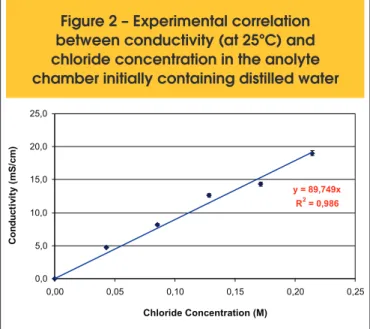
The concentration of chlorides in the anolyte chamber (initially free of chlorides) was analyzed at regular intervals during the experiment using a portable digital conductivitimeter (CD-880, Instrutemp). The chloride concentration was estimated based on the correlation between this parameter and the electrical conduc-tivity, as indicated in Figure 2. Conductivity values were refer-enced to a temperature of 25°C, by considering an increase of 2% in the conductivity of the solution when the temperature rose by one degree centigrade.
3. Results and discussion
3.1 Caracterização das matérias-primas
The Portland cement used in this work has a speciic surface area 0.93 m2/g and its speciic gravity is 3.11 Kg/dm3. The sand has a speciic surface area of 0.68 m2/g and its speciic gravity is 2.70 Kg/dm3. According to Brazilian NBR 7211 standard, it is classiied
Figure 1 – (A) Layout and assembly of the chloride migration test; (B) Chloride migration test apparatus
Figure 2 – Experimental correlation
between conductivity (at 25ºC) and
chloride concentration in the anolyte
chamber initially containing distilled water
y = 89,749x R2 = 0,986
0,0 5,0 10,0 15,0 20,0 25,0
0,00 0,05 0,10 0,15 0,20 0,25
Chloride Concentration (M)
C
on
du
ct
iv
ity
(m
S/
cm
The speciic surface area of bauxite waste is 20.27 m2/g, the spe-ciic gravity is 2.90 kg/dm3 and the pH is very high (12.95), exceed-ing the limit (12.5) for non-hazardous wastes established by the Brazilian NBR 10004 standard.
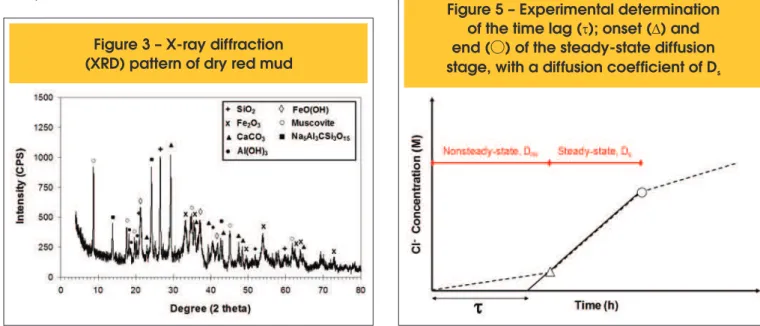
Table 1 gives the chemical composition of the waste, while Figure 3 shows the corresponding XRD pattern. As expected, aluminium hydroxide (Al(OH)3), calcium carbonate (CaCO3), and iron oxide (Fe2O3) are the predominant components, but the relative amounts of SiO2, muscovite, FeO(OH) and Na2O (or NaOH) are also relevant. Some of these oxides were also detected by XRD, in addition to aluminum hydroxide and a com-plex Na5Al3CSi3O15 phase.
3.2 Ensaio de migração de cloretos
Figure 4 shows the evolution of chloride concentration in the ano-lyte chamber during migration tests. Four samples were used for each addition content and the results presented are the mean val-ues obtained with their standard deviations. As expected, Cl- con -centration increases with time once the voltage is applied, follow-ing the predictable trend.
Initially, there is a period in which the amount of chlorides passing into the anolyte chamber is negligible. Its duration corresponds to the so-called “time lag” (t), and can be deined as the time required for chlorides to pass through the concrete disc, causing its satura-tion. This period of time will later serve as the basis for estimating
the Dns values. After this period, the lux of chloride ions through
the specimen becomes constant, which corresponds to the steady-state period.
Table 1 – Chemical composition of red mud estimated by XRF
Component
Al O
2 3Fe O
2 3Na O
2CaO
SiO
2K O
2MnO
TiO
2Others
a
LOI
Content (wt.) %
19.87
19.85
7.35
4.61
14.34
1.87
0.21
2.66
1.01
27.20
aLOI = Loss on ignition
Figure 3 – X-ray diffraction
(XRD) pattern of dry red mud
–
Figure 4 – Evolution of Cl
concentration in the anolyte
chamber of a migration test cell
over time, based on samples
of concrete containing different
amounts of red mud (0 – 30%). (
∆
= onset of
steady-state and
○
= end of nonsteady-state)
The “time lag” is empirically obtained from the intersection between the extension of the line that characterizes the steady-state and the time axis, according to the diagram of Figure 5.
Figure 6 shows that the “time lag” increases with increasing waste content, probably due to the reduction of a relative number of capillary pores [19]. Moreover, the mud particles may close or interrupt the con-nectivity between some of those pores, thus diminishing the capillary suction of the concrete and hindering the transport of substances [20]. This occurs even in samples showing higher total porosity, meaning that within certain limits this parameter is not relevant.
After the time lag, the lux of chloride ions through the specimen in-creases at a constant rate, which corresponds to the steady-state regime [16]. The steady-state diffusion coeficient (Ds) in migration
tests is estimated using the Modiied Nernst–Planck equation:
(1)
DF
=
g
Cl Cl
S
zFC
J
RTl
D
where: Ds = steady-state diffusion coeficient; JCl = lux of chloride
ions (mol/cm2.s); R = gas constant (1.9872 cal/mol.K); T = tempera-ture (K); l = sample thickness (4 cm); z = ion valence (chlorides = 1); F = Faraday´s constant (23063 cal/volt.eq); Ccl = chlorides concen
-tration in the catholyte (mol/cm3); g = activity coeficient of the catho-lyte solution (Cl- = 0.657) and ΔФ = effective applied voltage (12V). The chloride ion lux (JCl) represents the speed at which the ions are transported through the concrete, and the steady-state and nonsteady-state diffusion coeficients are calculated based on this lux. The chloride ion lux can be calculated using the linear slope, between the start and the end of steady-state diffusion on the graph representing the evolution of the chloride concentration in the anodic cell as a function of time (see Figure 5):
dt
dC
A
V
J
Cl=
×
where, A= exposed area (cm²); V = volume of the cathodic cham-ber (cm3) and; dC/dt = linear slope of steady-state diffusion, on the graph of chloride concentration as a function of time.
The time that chlorides would require under natural conditions of diffusion to reach the penetration depth observed in migration
tests, tdif , is calculated according to Equations (B) and (C),
pro-posed by CASTELLOTE et al. [16].
(2)
úû
ù
êë
é
×
-×
=
2
2
coth
6
1
2
n
n
tn
dift
(3)
kT
ze
DF
=
n
where: t = time-lag in the migration test; tdif = time equivalent of diffusion (s); e = electron charge (1.6 10-19 C); k = Boltzmann’s constant (1.38 10-23 J/K).
This mathematical solution allows migration tests to be “converted” into natural tests. In other words, using this “equivalent” time (tdif),
Dns is obtained directly from Equation (D):
(4)
difns
t
l
D
3
2=
where: l = specimen thickness (cm).
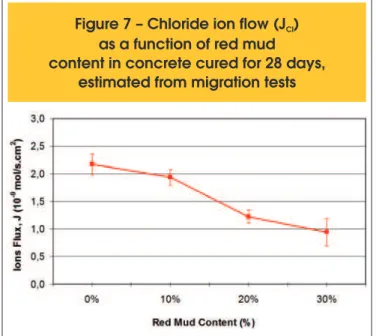
Figure 7 shows the flow of chloride ions, JCl, through the con -crete as a function of red mud content in the material. This
pa-rameter represents the speed at which the ions are transported
through the concrete and from which the steady-state and
non-Figure 6 – Time lag estimated
from chloride migration tests
as a function of red mud content
in concrete cured for 28 days
Figure 7 – Chloride ion flow (J )
Clas a function of red mud
content in concrete cured for 28 days,
steady-state diffusion coefficients (Figure 8) are calculated. A clear decrease in the low of chloride ions is observed in samples containing increasing amounts of waste. This is very positive because it reveals a delay in the onset of the corrosion process caused by the migration of chloride ions. These observations are in agreement with indings reported SANTOS [18] e AÏTCIN [21], who showed the tendency of supplementary cementitious materials (such as red mud) to signiicantly reduce the mobility of chloride ions, relecting the effect of increased tortuosity and better pore diameter distribution resulting from the pozzolanic reactions, which hinder ionic movement. Moreover, red mud contains mineralogical phases such as sodium aluminosilicates, known as sodalites, i.e., zeolite-type compounds with an extremely high ion-exchange capacity, which makes red mud a good absorber of heavy metals [22] and inluences their surface properties [23], including the formation of compounds by reaction with chloride ions. Other authors [24] also cite the impor-tance of the presence of aluminates, which play an important role in anchoring the chloride ions, which would otherwise be free and available to start the corrosion process.
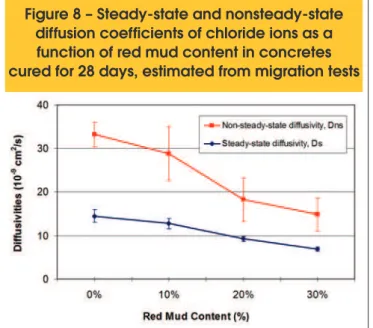
The aspects discussed in the above paragraph are also relected in the steady-state and nonsteady-state diffusion coeficients of chloride ions shown in Figure 8, both of which decreased due to the addition of a higher red mud content.
Some authors [16, 18, 25] attribute reductions of the diffusion coef-icient to reductions in the water/binder (in this case, cement + red mud). However, they report a decrease in total porosity as this ratio di-minishes, which was not the case in the present study. Therefore, the results cannot be correlated with a decrease in the water/binder ratio. In an attempt to have more sensitive representations about the beneits of the red mud use, the results of chloride penetration are related with the service life of reinforced concrete. For this pur-pose, the Fick’s second law of diffusion (equations E and F) was used, according to proposed by recent studies [24, 26].
(5)
t
D
z
PC
=
2
(
)
s.
(6)
o S
o cl
C
C
C
C
z
erf
(
)
=
1
-
-
-where Ds is the steady-state diffusion (cm2/year), t is the service life
(years), erf(z) is the Gaussian error function, CP (chloride penetra-tion) is the depth at which the chloride reaches the threshold limit concentration for rebar depassivation (cm), C0 is the initial chloride
concentration (in this case, 0%), CS is the chloride concentration at
the surface (%), and CCl is the chloride concentration as a function of depth and time (%), by cement mass.
Additionally, in line with the literature [26, 27], several parameters were ixed: CS = 1.8% and CCl = Cdep = 0.4% per weight of cement,
where Cdep is the chloride threshold limit concentration to depas
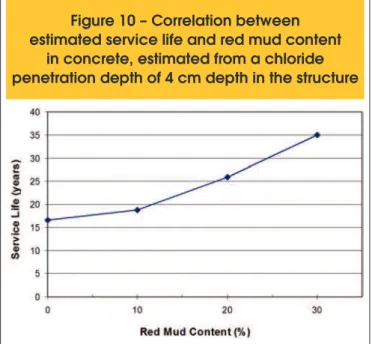
-sivate the rebars (per weight of cement). The results obtained are shown in Figure 9, which highlights the service life values for chlo-ride penetration in structures with a concrete layer equal to 4 cm thick (minimum required by standards for heavy environments, with presence of chlorides). These values are best viewed in Figure 10. The formulation without red mud shows a service life of 16.5 years. As can be seen, the addition of red mud extends the service life of the concrete to up to 35 years (twice the service life of the reference concrete) to specimens containing 30 wt.% of red mud addition.
4. Conclusions
This research led to the following conclusions:
n The time lag increases with increasing red mud content as a
result of the reduction in the relative amount of capillary pores;
n The decrease in the interconnectivity between capillary pores
in samples containing red mud and the presence of
typi-cal mineralogitypi-cal phases such as sodium aluminosilicates,
known as sodalites, are responsible for reducing the low of
Figure 8 – Steady-state and nonsteady-state
diffusion coefficients of chloride ions as a
function of red mud content in concretes
cured for 28 days, estimated from migration tests
Figure 9 – Correlation between time and
depth of chloride penetration in concrete
containing different amounts of red mud
–chloride ions, and hence, the steady-state and nonsteady-state diffusion coeficients;
n The chloride migration tests of samples of concrete
contain-ing red mud showed a longer service life, reachcontain-ing more than double that of the reference samples (16.5 versus 35 years).
5. Acknowledgements
The authors wish to thank the FAPESB - Bahia Research Founda-tion, PPGCEM/UFSCar - The Postgraduate Program in Materials Science and Engineering at the Federal University of São Car-los (Brazil) and the UA/DECV - Ceramics and Glass Engineering Dept., University of Aveiro & CICECO (Portugal) - Project FCT-PTDC/CTM/65243/ 2006, for their support of this research. *This project did not have the inancial support of Alcoa Brazil.
6. References
[01] ABRELPE – Associação Brasileira de Empresas de Limpeza Pública e Resíduos Especiais. PANORAMA DOS RESÍDUOS SÓLIDOS NO BRASIL 2009. Abrelpe, 2009. 210 p.
[02] IBRAM – Brazilian Mining Association. Bauxita. Available in: <www.ibram.org.br/sites/1300/1382/00000033.pdf>. Accessed in oct., 15th, 2010.
[03] ROSKILL REPORTS. The Economics of Bauxite & Alumina. Available in: <www.roskill.co.uk/index.html>. Accessed in nov., 20th, 2010.
[04] SINGH, M.; UPADHAYAY, S.N.; PRASAD, P.M. Preparation of special cements from red mud. Waste Management, v. 16, n. 8, p. 665-670, 1996.
[05] GLASSER, F.P. Fundamental aspects of cement solidiication and stabilization. Journal of Hazardous Material, v. 52: p. 151-170, 1997.
[06] AMRITPHALE, S.S. et al. A novel process for making radiopaque materials using bauxite—Red mud. Journal
of the European Ceramic Society. v. 27, n. 4, p. 1945-1951, 2007.
[07] AMRITPHALE, S.S.; PATEL, M. Utilisation of red mud, ly ash for manufacturing bricks with pyrophyllite. Silicates Ind, v. 2, n. 3, p. 31-35, 1987.
[08] VINCENZO, M.S.; RENZ, C.; STEFANO, M.; GIOVANNI, C. Bauxite red mud in the ceramic industry. Part 2:
production of clay based ceramics. Journal of the European Ceramic, v. 20, n. 3, p. 245–252, 2000.
[09] YALCIN, N.; SEVNIC, V. Utilization of bauxite waste in ceramic glazes. Ceramics International, v. 26, n. 5, p. 485-493, 2000.
[10] ASOKAN, P.; SAXEAN, M.; ASOLEKAR, S.R. Coal combustion residues-environmental implications and recycling potentials. Resources, Conservation and Recycling, v. 43, n. 3, p. 239-262, 2005.
[11] TSAKIRIDIS, P.E.; AGATZINI-LEONARDOU, S.; OUSTADAKIS, P. Red mud addition in the raw meal for the production of Portland cement clinker. Journal of Hazardous Material, v. 116, n. 1-2, p. 103-110, 2004. [12] SINGH, M.; UPADHAYAY, S.N.; PRASAD, P.M.
Preparation of iron rich cement from red mud. Cement and Concrete Research, v. 27, n. 7, p. 1037-1046, 1997. [13] CABEZA, et al. Red mud as a corrosion inhibitor for
reinforced concrete. The Journal of Corrosion Science and Engineering, v. 6, n. 32, p. 1-4, 2003.
[14] GORDON, J.N.; PINNOCK, W.R.; MOORE, M.M. A preliminary investigation of strength development in Jamaican red mud Composites. Cement and Concrete Composites, v. 18, n. 6, p. 371-379, 1996.
[15] ANDRADE, C. Calculation of diffusion coeficients in concrete from ionic migration measurements. Cement and Concrete Research, v.23, n. 3, p. 724-742, 1993. [16] CASTELLOTE, M.; ANDRADE, C.; ALONSO, C.
Measurement of the steady and non-steady-state chloride diffusion coeficients in a migration test by means of monitoring the conductivity in the anolyte chamber. Comparison with natural diffusion tests. Cement and Concrete Research, v.31, n. 10, p. 1411–1420, 2001. [17] TONG, L.; GJØRV, O.E. Chloride diffusivity based on
migration testing. Cement and Concrete Research. v.31, n. 7, p. 973-982, 2001.
[18] SANTOS, L. Avaliação da resistividade elétrica do concreto como parâmetro para a previsão da iniciação da corrosão induzida por cloretos em estruturas de concreto. 161p. Dissertação (Mestrado em estruturas), Departamento de Estruturas, Universidade de Brasília, Brasília, 2006. [19] RIBEIRO, D.V.; LABRINCHA, J.A.; MORELLI, M.R. Use
of Red Mud as Addition for Portland Cement Mortars. Journal of Materials Science and Engineering, v. 4, n. 8, p. 1-9, 2010.
[20] SONG, G. Equivalent circuit model for SAC electrochemical impedance spectroscopy of concrete. Cement and Concrete Research, v. 30, n.11, p. 1723-1730, 2000.
[21] AÏTCIN, P.C. The durability characteristics of high performance concrete: a review. Cement and Concrete Composites, v. 25, n. 4-5, p. 409-420, 2003.
[22] CHVEDOV, D.; OSTAP, S.; LE, T. Surface properties of red mud particles from potentiometric titration. Colloids Surface A, v. 182, n. 1, p. 131-141, 2001.
[23] LOPEZ, E.; SOTO, B.; ARIAS, M. Adsorbent properties
Figure 10 – Correlation between
estimated service life and red mud content
of red mud and its use for wastewater treatment. Water Research, v. 32, n. 4, p. 1314-1322, 1998.
[24] YADAV, V.S.; et al. Sequestration of carbon dioxide (CO2) using red mud. Journal of Hazardous Materials, v. 176, n. 1-3, p. 1044–1050, 2010.
[25] AMPADU, K.O.; TORII, K.; KAWAMURA M. Beneicial effect of ly ash on chloride diffusivity of hardened cement paste. Cement and Concrete Research, v. 29, n. 4, p. 585-590, 1999.
[26] MEDEIROS, M.H.F.; HELENE, P. Surface treatment of reinforced concrete in marine environment: Inluence on chloride diffusion coeficient and capillary water absorption. Construction and Building Materials, v. 23, n. 3,
p. 1476–1484, 2009.