Mercury Exposure in a Riverside Amazon
Population, Brazil: A Study of the Ototoxicity of
Methylmercury
Ana Hoshino
1,2Heloisa Pacheco-Ferreira
3Seisse Gabriela G. Sanches
4Renata Carvallo
5Nathália Cardoso
1Maurício Perez
1Volney de Magalhães Câmara
11Universidade Federal do Rio de Janeiro, Instituto de Estudos em
Saúde Coletiva, Rio de Janeiro, Brazil
2Department of Otorhinolaryngology, Faculdade de Medicina da
Universidade de São Paulo (FMUSP), São Paulo, Brazil
3Universidade Federal do Rio de Janeiro, Faculdade de Medicina, Rio de
Janeiro, Brazil
4Universidade de São Paulo, FOFITO, São Paulo, Brazil 5FMUSP, FOFITO, São Paulo, São Paulo, Brazil
Int Arch Otorhinolaryngol 2015;19:135–140.
Address for correspondence Ana Hoshino, PhD, Department of
Otorhinolaryngology, Hospital das Clínicas, R. Vigário Albernaz, 843/ 74, São Paulo 04134-021, Brazil (e-mail: [email protected]).
Introduction
The health impacts due to acute and/or chronic exposure are already well defined for most chemicals. Organizations such
as the US Environmental Protection Agency and World Health Organization established exposure limits, but many people live above this limit. Environmental contamination with persistent pollutants showing toxic and cumulative effects Keywords
►
mercury
►
methylmercury
compounds
►
auditory pathways
►
medial olivocochlear
system
►
otoacoustic emissions
►
ototoxicity
Abstract
Introduction
Mercury poisoning causes hearing loss in humans and animals. Acute
and long-term exposures produce irreversible peripheral and central auditory system
damage, and mercury in its various forms of presentation in the environment is ototoxic.
Objective
We investigated the otoacoustic emissions responses in a riverside
popula-tion exposed to environmental mercury by analyzing the inhibitory effect of the medial
olivocochlear system (MOCS) on transient otoacoustic emissions (TEOAE).
Methods
The purpose of the research was to evaluate the entire community
independently of variables of sex and age. All of the participants were born and lived
in a riverside community. After otolaryngologic evaluation, participants were received
tympanometry, evaluation of contralateral acoustic re
fl
exes, pure tone audiometry, and
recording of TEOAEs with nonlinear click stimulation. Hair samples were collect to
measure mercury levels.
Results
There was no signi
fi
cant correlation between the inhibitory effect of the
MOCS, age, and the level of mercury in the hair.
Conclusions
The pathophysiological effects of chronic exposure may be subtle and
nonspeci
fi
c and can have a long period of latency; therefore, it will be important to
monitor the effects of mercury exposure in the central auditory system of the Amazon
population over time. Longitudinal studies should be performed to determine whether
the inhibitory effect of the MOCS on otoacoustic emissions can be an evaluation method
and diagnostic tool in populations exposed to mercury.
received
November 6, 2014 accepted
December 11, 2014 published online February 19, 2015
DOI http://dx.doi.org/ 10.1055/s-0034-1544115. ISSN 1809-9777.
Copyright © 2015 by Thieme Publicações Ltda, Rio de Janeiro, Brazil
on organisms, as in the case of mercury, has reached global proportions due to the persistence and mobility of these substances.1Because it is very toxic and has the tendency to bioaccumulate and because of biomagnification along the food chain, mercury is recognized as a potentially dangerous pollutant in the marine environment.
Historically, two great exposures to methylmercury have occurred. In Minamata (Japan), women showed hair mercury concentrations between 10 and 100 µg/g. The other great exposure occurred in Iraq, where women with elevated hair mercury levels (10 µg/g) had children in whom neurologic alterations were observed after birth.2Passos and Mergler, studying mercury exposure in Amazon communities, reported that even different bioindicators have revealed mean hair mercury levels higher than 15 µg/g, which are the highest reported mercury levels in the world.3
The Amazon region occupies a prominent place in this scenario,4and the riverside populations of that region suffer the health impacts associated with environmental contami-nation. Fish, the main source of dietary protein for riverside populations, is consumed at an average of 406 g/d and is contaminated with mercury.5The consumption of mercury-contaminatedfish gives rise to a series of neurotoxic effects that are observed in pregnant women, fetuses, and newborns, particularly when they are exposed to mercury during brain development. The prenatal exposure may result in small alterations in development that appear over time.6
Mercury poisoning causes hearing loss in humans and animals. In a systematic review, the authors conclude that acute and long-term exposures produce irreversible periph-eral and central auditory system damage and that mercury in its various forms of presentation in the environment is ototoxic.7The consequences of hearing loss can be irrevers-ible, with clinical alterations that often go undetected by neurologic examination and biological markers, thus jeopar-dizing the quality of life of these individuals. Follow-up of ototoxicity is important for detecting hearing changes, there-by suggesting new treatment strategies for the patient and intervention when a disabling hearing impairment occurs.8
Mercury is a liquid that expands or shrinks very accurately according to the temperature. These particular properties are extremely useful for various applications such as the produc-tion of electronic measuring equipment,fluorescent lamps, batteries, dental amalgam, and cosmetics (in small amounts). The mercury used can be released to the environment at different stages of the production, such as industrial gas, industrial waste, and contaminated waste. Thus, it can destroy the soil, air, and water, affecting environmental and human health directly.4
Once mercury enters the aquatic ecosystems, the micro-organisms transformed into a highly toxic form of mercury called methylmercury, which is accumulated and biomagni-fies infish and shellfish and those who consume them. The levels of methylmercury in some fish species can reach millions of times above the levels present in water from its surroundings.
Even at low doses of exposure, mercury, especially meth-ylmercury, can penetrate the placenta and appear in breast
milk. This can disturb development of brain functions and can create deficits in language skills, memory, attention, and motor and visual skills. When exposure to mercury combines with malnutrition, the risk grows considerably.
Mercury exposure can be monitored through hair, blood, breast milk, urine, and nails. The level of mercury in blood and urine shows a recent exposure. Levels in hair reflect long-term exposure.9The Agency for Toxic Substances and Disease Registry estimated that the minimum risk level for methyl-mercury intake would be 0.3 mg/kg per day.10This value is based on estimated level of adverse effects (NOAEL) of 1.3 mg/ kg per day calculated for methylmercury hair levels. The estimated level of adverse effects was obtained from a study of the Seychelles population that observed the neurodevel-opment of children.9
Our objective was to analyze the inhibitory effect of the medial olivocochlear system (MOCS) with transient otoa-coustic emissions (TEOAE) responses in a riverside population exposed to environmental mercury. To date,this survey is unprecedented in a population exposed to mercury.
Methods
Background
The INPTAm (Instituto Nacional de Pesquisa Translacional da Amazônia) is formed by a group of researchers interested in the health of the environment of the Amazon and its impli-cations for the health of the local population, conducting research in several areas and expecting aggregate knowledge of suitable proposals for improving the quality of life of riverside populations of the Amazon. The INPTAm also works to transfer the knowledge to local professionals, recovery, and environmental protection.
The area selected for the proposed research was the community of Lago do Puruzinho, located in Amazonas state, Brazil. This population was selected for the study because the people are subsistence farmers who are exposed to environ-mental methylmercury from fish, the primary source of animal protein in their diet.
This study was conducted according to the ethical aspects recommended by Resolution 196/96 of the National Health Council on studies involving humans, and informed consent was obtained from the research subjects. The research was approved by the Ethical Committee (Institutional Review Board/EC) from the Instituto de Estudos em Saúde Coletiva (IESC), under number 79/2011.
between 0.3 and 1.2 mL), and presence of contralateral acoustic reflexes. Individuals who showed an absence of TEOAEs or a hearing loss (at any level, of any type, and affecting either ear) were excluded from the study.
The study was conducted among 58 individuals (30 females and 28 males) with a mean age of 17.3 years (range 1 to 47). The purpose of the research was to evaluate the entire community independently of variables of sex and age. After otolaryngologic evaluation, participants had tympanometry and investigation of contralateral acoustic reflexes (AT-235 Interacoustics, Denmark, Middelfart), pure tone audiometry (AC-33 Interacoustics), and recording of TEOAEs (ILO v6, dual channel, Otodynamics, London, United Kingdom) with nonlin-ear click stimulation (260 sweeps) presented at 802 dB peak sound pressure level (SPL). We considered that otoacous-tic emissions were present when a signal-to-noise ratio above 3 dB occurred in at least three frequency bands. The tests, including tonal audiometry, were performed in a very quiet, although not acoustically treated, room. The earphones used in pure tone audiometry were AUDIOCUP (Amplivox Ltd, Oxford-shire, UK) (noise-reducing headset enclosures).
To evaluate the inhibitory effect of the MOCS, a test of linear click-evoked otoacoustic emissions at 602-dB peak SPL was performed, with and without the contralateral presentation of white noise at 60 dB SPL (contralateral acoustic stimulation, CAS). White noise was generated by the equipment and delivered in the contralateral ear by a second channel. The presentation mode was alternate, with 10 seconds of TEOAE recording collected without CAS being followed by 10 seconds collected with CAS. The alternating pattern was continued until 260 sweeps in each condition were completed. Thefinal result was the sum of the alternate responses obtained in each condition. The inhibitory effect was calculated from the response values by subtracting the value obtained in the condition with contralateral noise from the value in the condition without contralateral noise (inhib-itory effect¼TEOAE without CAS TEOAE with CAS). An inhibitory effect was considered to be present when the result showed a positive value.
The collection of mercury from hair samples was con-ducted by professionals from the Universidade Federal de Rondônia. Hair samples underwent digestion and chemical oxidation with nitric acid (HNO3) and potassium perman-ganate (KMnO4). A total mercury assay was conducted at the Universidade Federal de Rondônia, utilizing an atomic absorption spectrophotometry technique through genera-tion of cold vapor (Flow Injecgenera-tion Mercury System, FIMS-400 by Perkin Elmer, Waltham, Massachusetts). The mercury assay was performed on 38 individuals who con-sented to participate in the study. The mean mercury level in the hair samples was 11.26 µg/g (range 2.93 to 23.45). Participants were classified into three groups according to detected levels of mercury: group 1, up to 6 µg/g; group 2, from 6.1 to 14.9 µg/g; and group 3,15 µg/g.
For the statistical analysis, the measures of central ten-dency and dispersion were calculated for all the numerical variables, and the measures of frequency and percentage frequency were calculated for all the categorical and ordinal Table
variables. The comparison between the discrete variables noted in tables was calculated by the chi-square test with Yates’correction. In the correlation analysis, the Pearson test was used to measure the linear association between two variables. The comparison of means was performed by un-paired Student t test. The data were analyzed using the Statistical Package for the Social Sciences program (SPSS version 14.0, IBM, NY, USA). The level of significance was set atp<0.05.
Results
The presence of nonlinear TEOAEs was observed in all re-search participants for the right ear and in 56 participants for the left ear (►Table 1). It is important to emphasize that, in the absence of response, the affected side was excluded for evaluation of TEOAEs with linear click stimuli. Among 58 right ears, 47 showed linear TEOAEs for stimulations of 60 dB SPL (sound pressure level) with and without contralateral noise, and these were considered for analysis. Among 56 left ears, 49
showed linear TEOAEs and were considered for analysis. The mean linear TEOAEs were 9.34 dB for the right ear and 7.14 dB for the left ear. The mean value of the inhibitory effect of the MOCS was 1.20 dB for the right ear and 1.26 dB for the left ear.
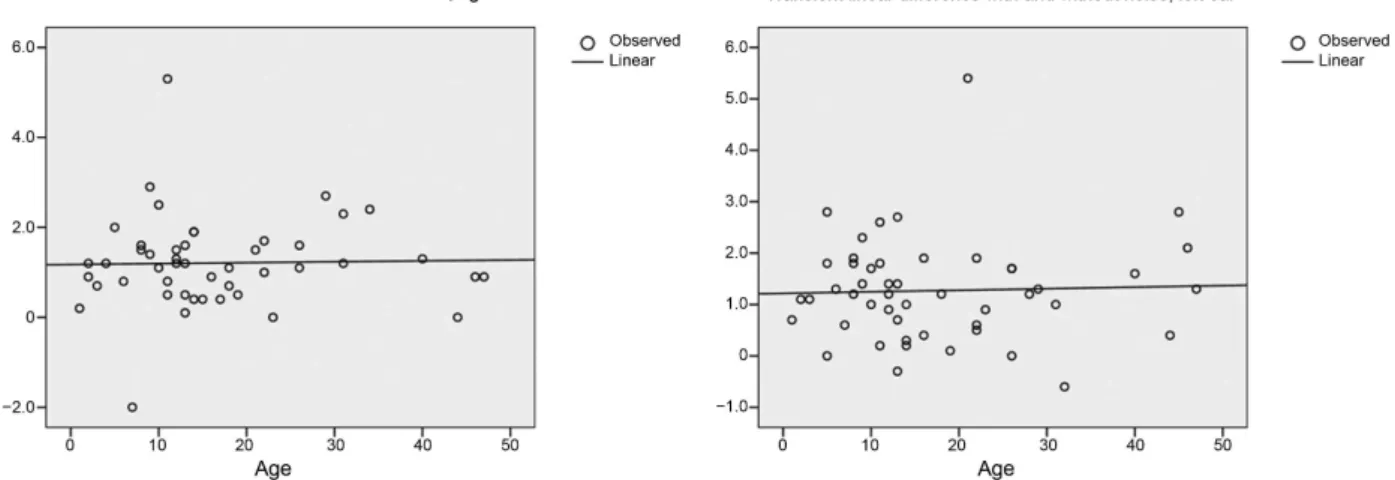
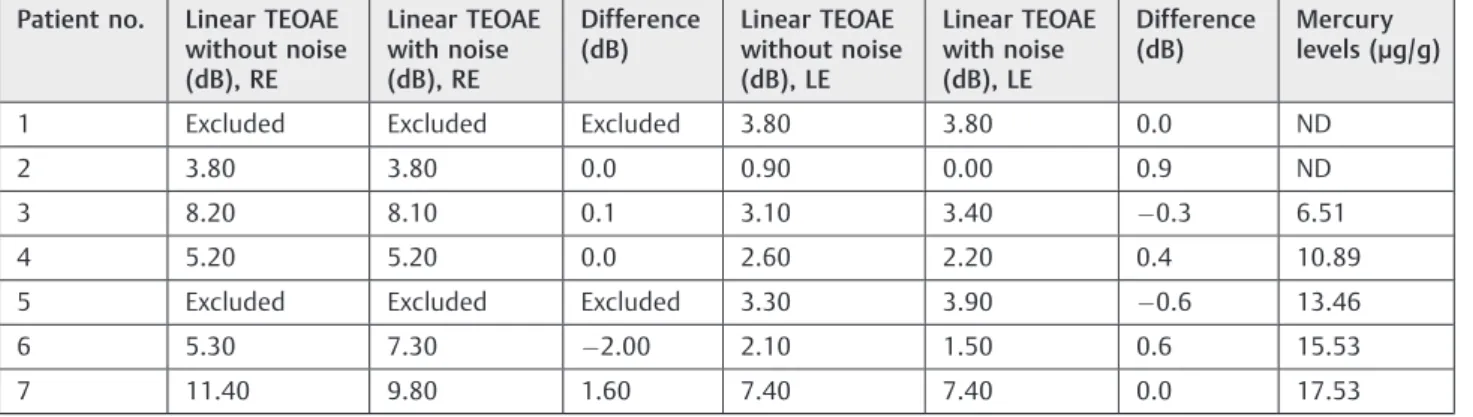
There was no significant correlation between the values of the inhibitory effect for the right and left ears and age (►Fig. 1). Furthermore, there was no significant correlation between values of the inhibitory effect and hair mercury levels (►Fig. 2). Among the 58 participants, 7 (12%) showed an absence of inhibitory effect of the MOCS. The mean level of mercury in the hair of these individuals was 12.78 µg/g. Five participants had hair mercury levels above the acceptable limit according to the World Health Organization (6.0 µg/g). Two participants were not tested (►Table 2).
►Table 3shows participants classified into three groups
according to their hair mercury levels. Individuals who showed altered results of the inhibitory effect of the MOCS in both right and left ears were excluded from each group (groups 1, 2, and 3). The mean amplitude of the inhibitory Fig. 1 Inhibition of medial olivocochlear system values of the right ear and left ear compared with ages of the population from Puruzinho Community, Amazon, Brazil, 2012.
effect of the MOCS was lower for participants with higher concentrations of mercury in their hair.
Discussion
The same team that analyzed the mercury levels for this project also analyzed hair mercury levels of the Puruzinho population in 2005 to 2006.5The median values in the female and male populations were 12.93 µg/g (range 2.48 to 57.04) and 18.41 µg/g (range 2.28 to 70.56), respectively. In the present study, the median value was 10.91 µg/g (range 2.93 to 23.45). The population remains exposed to high levels of methylmercury that are comparable to the historical great exposures of populations in other parts of the world.
Several studies concerning the inhibitory effect of the efferent pathway demonstrated an asymmetry between the right and left ears, suggesting an advantage of effectiveness of the right ear and dominance of the left hemisphere.11The inhibitory effect of the MOCS and the measure of the TEOAE amplitude in children and adults are valid indicators of peripheral auditory lateraliza-tion; however, they are independent.12Such asymmetry may be related to the effectiveness of the efferent system in processing acoustic signals and, consequently, to its role in auditory perfor-mance with background noise. The Puruzinho population showed higher amplitude of responses evaluated by the TEOAEs for the right ear; however, the inhibitory effect of the efferent pathway was equivalent for both sides, and an advantage of the right ear was not seen, contrary to other studies.
We observed that the amplitude of responses of the right and left ears showed a tendency to decrease as the mercury
levels increased significantly. A previous study reported that higher biological marker values are associated with increased presence of signals and symptoms of exposure.13
The inhibitory effect values of the MOCS in the Puruzinho population did not present a significant correlation with age. This may be because the Puruzinho population is a young population, with a mean age of 17.3 years and a maximum age of 47 years.
It was not possible to correlate mercury levels with the inhibition of otoacoustic emissions; similarly, it was not possible to conclude that the 12% (7 participants) of the population who showed absence of the inhibitory effect of the MOCS had alterations arising from exposure to methylmer-cury. Population studies concerning the inhibition of otoa-coustic emissions cannot be found in the literature.
The population presented high levels of long-term expo-sure to methylmercury. The lack of a significant relationship between the results of the auditory evaluation and hair mercury levels at the time the hair samples were collected should not be interpreted as implying that mercury does not alter the efferent auditory system. For this analysis, a longi-tudinal monitoring of the population and a higher number of individuals participating in the research would be necessary. The pathophysiological effects of chronic exposure may be subtle and nonspecific and have a long period of latency14; therefore, it will be important to monitor the effects of mercury exposure in the central auditory system of the Puruzinho population over time.
Limitations can be pointed out for this study: the number of residents that agreed to participate in the study; the young
Table 2 Amplitude values of linear TEOAE, inhibitory effect, and mercury levels for participants with altered examinations from the
population of Puruzinho Community, Amazon, Brazil, 2012
Patient no. Linear TEOAE without noise (dB), RE
Linear TEOAE with noise (dB), RE
Difference (dB)
Linear TEOAE without noise (dB), LE
Linear TEOAE with noise (dB), LE
Difference (dB)
Mercury levels (µg/g)
1 Excluded Excluded Excluded 3.80 3.80 0.0 ND
2 3.80 3.80 0.0 0.90 0.00 0.9 ND
3 8.20 8.10 0.1 3.10 3.40 0.3 6.51
4 5.20 5.20 0.0 2.60 2.20 0.4 10.89
5 Excluded Excluded Excluded 3.30 3.90 0.6 13.46
6 5.30 7.30 2.00 2.10 1.50 0.6 15.53
7 11.40 9.80 1.60 7.40 7.40 0.0 17.53
Abbreviations: LE, left ear; ND, not determined; RE, right ear; TEOAE, transient otoacoustic emissions.
Table 3 Suppression mean distribution in individuals participating in the hair mercury level research across three groups
Average G1 0–6 µg/g Hg (n¼10) G2 6.1–14.9 µg/g Hg (n¼13) G315 µg/g Hg (n¼10)
Hg 4.39 9.97 19.03
Suppression of RE 1.17 1.22 0.84
Suppression of LE 1.05 1.28 0.95
Abbreviations: LE, left ear; RE, right ear.
population that prevented comparisons between age groups; and the difficulty in finding a control group that was not exposed to mercury in a riverside population.
Conclusions
The Amazon population, and in particular the riverside population in whichfish is a main source of dietary protein, should be clinically monitored. Some studies, taking into account utilization of different methodologies, point toward the possibility that the Amazon region is seeing the signifi -cant silent action of methylmercury in exposed riverside populations,14with the presumable appearance of the clini-cal expression of mercury poisoning in the Amazon.
Although the literature refers to mercury as ototoxic, damaging the afferent auditory system, this study cannot claim that methylmercury alters the function of the MOCS. Existing studies indicate that the inhibitory effect of the MOCS is a promising tool for evaluation of the efferent auditory pathways, and its specificity is very important for diagnosing central auditory disorders.
The present study proposes that longitudinal monitoring studies of the riverside population should be performed to learn whether analysis of the inhibitory effect of the MOCS by measuring otoacoustic emissions may be used as an evaluation method and diagnostic tool in populations exposed to mercury. It is important to emphasize that this study is an initial and exploratory study; therefore, the results may be used as a reference for new studies of other populations exposed to methylmercury and may help to open new frontiers for multidisciplinary research.
Declaration of Interest
The authors report no conflicts of interest.
Funding
This work was supported by the INCT for Translational Research in Health and Environment in the Amazon Region (Public notice MCT/CNPq no015/08
–National Institutes of Science and Technology).
Acknowledgments
I would like to thank Dra. Denise Carvalho (INPETAM) and Dra. Jaqueline Quintanilha Brucha (UFRJ) for the scientific contributions.
References
1 Dias ACL, Guimarães JR, Malm O, Costa PA. Mercúrio total em músculo de cação Prionace glauca (Linnaeus, 1758) e de espadarte Xiphias gladius Linnaeus, 1758, na costa sul-sudeste do Brasil e suas implicações para a saúde pública. Cad Saude Publica 2008; 24(9):2063–2070
2 Castoldi AF, Johansson C, Onishchenko N, et al. Human develop-mental neurotoxicity of methylmercury: impact of variables and risk modifiers. Regul Toxicol Pharmacol 2008;51(2): 201–214
3 Passos CJS, Mergler D. Human mercury exposure and adverse health effects in the Amazon: a review. Cad Saude Publica 2008; 24(4, Suppl 4):s503–s520
4 OPAS/OMS. Cooperación técnica entre Brasil, Bolivia e Colômbia: teoría y prática para el fortalecimiento de la vigilancia de salud de poblaciones expuestas a mercúrio. 2011. Available at: http:// www.paho.org/bra/index.php?option¼com_docman&task¼doc_ download&gid¼1428&Itemid¼423. Accessed October 21, 2013 5 Oliveira RC, Dórea JG, Bernardi JVE, Bastos WR, Almeida R,
Manzatto AG. Fish consumption by traditional subsistence villag-ers of the Rio Madeira (Amazon): impact on hair mercury. Ann Hum Biol 2010;37(5):629–642
6 Giordano G, Costa LG. Developmental neurotoxicity: some old and new issues. ISRN Toxicol 2012:2012:814795
7 Hoshino ACH, Ferreira HP, Malm O, Carvallo RM, Câmara VM. A systematic review of mercury ototoxicity. Cad Saude Publica 2012; 28(7):1239–1248
8 American Academy of Audiology (AAA)—Position Statement and Clinical Practice Guidelines. Ototoxicity monitoring. Octo-ber 2009. Available at: http://www.audiology.org/publications-resources/document-library/ototoxicity-monitoring Acessed in January 2014
9 ATSDR—Agency for Toxic Substances and Disease Registry. Toxico-logical profile for mercury. Atlanta, GA: U.S. Department of Health and Human Services, Public Health Service; 1999
10 ATSDR—Agency for Toxic Substances and Disease Registry. Tech-nical support document for a methylmercury reference dose as a basis forfish consumption screening values (FCSVs). [cited 2013 Jan 31]. Available at: http://www.atsdr.cdc.gov/hac/pha/Methyl- mercuryReference/TechnicalSupportDocumentforAMethylcer-curyReferenceDoseasaBasisforFCSVs9-10-2009.pdf. Accessed in January 17, 2012
11 Khalfa S, Collet L. Functional asymmetry of medial olivocochlear system in humans. Towards a peripheral auditory lateralization. Neuroreport 1996;7(5):993–996
12 Durante AS, Carvallo RMM, da Costa FS, Soares JC. [Characteristics of transient evoked otoacoustic emissions in newborn hearing screening program]. Pro Fono 2005;17(2):133–140
13 Choi AL, Weihe P, Budtz-Jorgensen E, et al. Methylmercury expo-sure and adverse cardiovascular effects in Faroese whaling men environmental. Environmental Health Perspectives 2009;117(3): 367–372