ABSTRACT: Introduction: Active aging is the process of optimizing opportunities for health, participation and security, aiming to improve quality of life as people age. A series of studies had demonstrated that a lower prevalence of depression is found among more active elderly. Objective: To evaluate the association between indicators of active aging and depressive symptoms among the elderly (aged 60 years or more). Method: A population-based cross-sectional study was conducted with 1,006 elderly people (aged 60 years or over) from a small-sized Brazilian municipality. Depressive symptoms were assessed using the Geriatric Depression Scale - 15, with cutof point ≥ 6 symptoms. Active aging was evaluated using indicators such as: active occupational situation, manual work, reading and physical activities. Data analyses used modiied Poisson regression to obtain crude and adjusted prevalence ratios (PR). Results: Most of the elderly people were: white, women and aged between 60 and 74 years. All the indicators of active aging were associated with the outcome. After controlling for socioeconomic, demographic and health variables, elderly people who worked, participated in groups, did manual work and maintained interests such as reading and talking to friends had lower prevalence of depressive symptoms compared to those not doing these activities. Conclusions: Active aging approaches may serve as a valuable mental health promotion strategy aimed at the elderly.
Keywords: Depression. Aged. Aging. Depressive symptoms. Physical activity. Cross-sectional studies.
Active aging is associated with low prevalence of
depressive symptoms among Brazilian older adults
Envelhecimento ativo está associado com baixa prevalência
de sintomas depressivos em idosos brasileiros
Rosangela GalliI, Emílio Hideyuki MoriguchiI,II, Neide Maria BruscatoIII, Rogerio Lessa HortaI, Marcos Pascoal PattussiI
IGraduate program in Public Health, Universidade do Vale do Rio dos Sinos – São Leopoldo (RS), Brazil. IISchool of Medicine, Universidade Federal do Rio Grande do Sul – Porto Alegre (RS), Brazil.
IIIAssociação Veranense de Assistência à Saúde, Hospital Comunitário São Peregrino Lazziozi – Veranópolis (RS), Brazil. Corresponding author: Marcos Pascoal Pattussi. Programa de Pós-Graduação em Saúde Coletiva. Universidade do Vale do Rio dos Sinos. Avenida Unisinos, 950, Caixa Postal 275, CEP: 93022-000, São Leopoldo, RS. Brasil. E-mail: [email protected] Conlict of interests:nothing to declare – Financial support: none.
INTRODUCTION
According to the World Health Organization, it is estimated that around 14% of the overall burden of disease is due to neuropsychiatric disorders1. A common mental disorder and one of the main causes of disability worldwide is depression. It is estimated that about 400 million peo-ple of all ages sufer from depression globally2,3. This especially important in more advanced ages. Depressive syndromes in old age frequently occur within the context of medical and neurological disorders, and in elderly individuals with chronic diseases and cognitive dei-ciencies or functional disability4, thereby causing diiculties in achieving adequate treat-ment and increasing mortality4,5.
Among the elderly, depression generally presents atypical symptoms and is generally underdiagnosed and undertreated because of confusion with coexisting physical problems6,7. In addition, although many depressed elderly people are usually treated within primary care, healthcare professionals rarely diagnose depression and, when they do, the treatment provided is often inadequate5, since depressive symptoms are regarded as natural manifestations of aging7.
Although pharmacological treatment is generally efective among elderly people8, the side efects from antidepressants are greater among this population, because these individuals usu-ally present comorbidities and risks of clinical complications and drug interactions. Therefore, initiatives that enable recovery without drug use are needed. In this context, the World Health Organization has proposed the concept of active aging as the process of optimizing opportunities for health, participation and security in order to improve quality of life as people age2. A series of studies had demonstrated that a lower prevalence of depression is found among physically active
elderly people7,9. This study aimed to assess the association between indicators of active aging and depressive symptoms among elderly people. The hypothesis was that elderly people report-ing active lives would also report fewer depressive symptoms compared to inactive individuals.
METHODS
This was a population-based, cross-sectional study with elderly people, i.e. individuals aged 60 years or over, living in the urban or rural zones of the municipality of Veranópolis, state of Rio Grande do Sul, in southern Brazil. This municipality is located in the northeastern State, 170 km from Porto Alegre. According to the Brazilian Institute of Geography and Statistics (IBGE), the municipality had 22,810 inhabitants in the year 2010; 3,493 were elderly individuals, which accounts for approximately 15.3% of the population, consisting mainly of Italian descendants.
The sample was calculated for another study, which used the outcome vaccination and the variable that provided the largest size (sex). Thus, assuming that the prevalence of vac-cination among men was 67.1%, with a female to male ratio of 1:1, a sample of 988 elderly people would be needed in order to have a power of 80% for detecting an odds ratio of 1.5. After adding 15% to account for possible losses, 1,136 elderly individuals were invited to par-ticipate. For the outcome depression, the focus of this study, this sample size had a power of 80% to detect a diference of seven percentage points between exposed and non-exposed individuals, with a signiicance level of 5% and a 95% conidence interval.
The sample was selected by means of a systematic randomization process. To this end, a list of the eligible individuals (individuals aged 60 years or over), containing their names, addresses and telephone numbers, was obtained from the Municipal Health Department. The municipality has been targeted in several studies assessing successful aging among its elderly population, and keeps updated records of all elders residing in the town. Elderly people with severe cognitive problems or any disability or diseases that impeded them from answering the questionnaire were excluded from the sample.
Structured interviews were conducted at the elderly individuals’ homes in 2009. The outcome studied was assessed by means of the Geriatric Depression Scale. This is one of the most used screening instruments for depressive symptoms among elderly people. Several studies have shown that it provides valid and reliable measurements10-12. The original scale of 30 items was described in English by Yesavage et al.13 and was developed especially for the screening of mood disorders among elderly individuals, with questions that avoid the sphere of somatic complaints. Each response compatible with depression is given a score of one point. In this study, we reported data for the short version comprised of 15 items (GDS-15). Main results were pre-sented for the cutof (5/6). This has been suggested as the optimal cutof point for GDS-1511,14. Thus, individuals were considered depressive if their score was six or more points11,14.
The health-related variables that were evaluated included self-rated health (excellent/ very good/good or fair/poor), number of morbidities reported (0, 1, 2 or ≥ 3 morbidities) and number of medical consultations in the last month (0, 1 or ≥ 2 consultations).
To assess active aging, a series of individual indicators was used asking if the following activities were done frequently: participation in groups (non-participation, or participa-tion in one or more groups), occupaparticipa-tional situaparticipa-tion (working or not working), talking to friends (yes or no), doing manual work (yes or no), reading habit (yes or no) and physical activities (yes or no).
A pilot study was conducted with 20 elderly individuals who were not included in the sam-ple for the main study. The aim of the pilot study was to test the instrument and the logistics of the study. Data gathering took place during the year 2009, and was done by a team composed of ive interviewers who had been trained and standardized for carrying out the interviews.
Quality control was carried out by the coordinator of the study, by telephone, on a ran-dom sample of 10% of the individuals participating in the study. The control instrument was similar to that of the main study, but was shorter and included only the variables that would not undergo changes over a short space of time (e.g. sex, age, marital status, skin color, income, schooling). An acceptable agreement was achieved for all variables (kappa > 0.7).
In order to avoid typing errors and data inconsistencies, double data entry was performed using the Epi Info 6.0 software. The data analysis was conducted using the STATA 9.0 soft-ware. To compare the prevalence of the outcomes between the exposure categories, the χ² test was used. To provide an estimate for the crude and adjusted prevalence ratios and their respective conidence intervals, Poisson regression with robust variance was performed.
Multivariable analysis was carried out as follows: three blocks of variables were incorporated in the multivariable model. The irst included the socioeconomic and demographic variables, the sec-ond included health- and healthcare-related variables and the third included the indicators of active aging. The variables were adjusted for all the other variables at the same block and plus the variables at higher blocks. A backward elimination procedure was adopted within each block. A two-tailed p-value of < 0.05 was used for determining statistically signiicant associations. We run this analysis using three cutof points frequently reported in the literature (4/5), (5/6) and (6/7).
This study was compliant to the ethical issues involved in studies of this nature, as laid down in Resolution 196/96 of the National Health Board. The research project was approved by the Ethics Committee of Universidade do Vale do Rio dos Sinos (Resolution 100, of December 18, 2008), and all the participants signed an informed consent. The authors state that there is no conlict of interest.
RESULTS
In addition, ive individuals had incomplete data regarding depressive symptoms. Therefore, the data analysis was conducted on 1,006 elderly people.
Most of the elderly people were: white, married and women. The mean age, income and educational level were, respectively: 73 years (SD = 4), R$ 1,836.00 (SD = 170.00) and 5 years of education (SD = 4).
Higher prevalence (p < 0.05) of depressive symptoms was found among women, indi-viduals aged 75 years or over, indiindi-viduals with low income and low schooling levels and individuals with greater numbers of consultations, morbidities and reporting poor self-rated health. All indicators of active aging were associated with the outcome regardless the cutof point adopted. Lower prevalence of depressive symptoms was found among elderly people who worked, did physical activities or manual work and maintained interest through reading and usually talked to friends (Table 1).
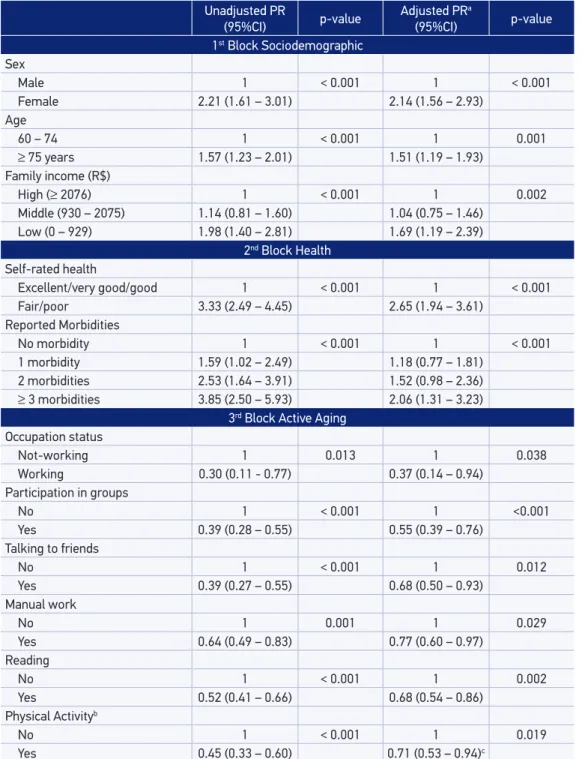
The multivariable analysis maintained the efect of the socioeconomic and demographic factors (sex, age, income), health-related variables (self-rated health, morbidities and med-ical consultations), and indicators of active aging (manual work, physmed-ical activities and reading). After controlling for socioeconomic, demographic and health related variables, elderly people who worked, participated in groups, did manual work and maintained inter-est through reading and talking to friends had lower prevalence of depressive symptoms (cutof 5/6) compared to those not doing these activities (Table 2). Only participation in groups, reading habit and physical activity remained in the inal model using the cutof 6/7 for depressive symptoms.
n % ≥ 6 depressive
symptoms p-value
Demographic
Sex
Male 380 11.4 < 0.001
Female 632 25.2
Age
60 – 74 630 16.5 < 0.001
≥ 75 years 382 26.0
Marital status
Married 647 15.0 < 0.001
Widower 291 30.4
Other 73 23.6
Skin color
White 968 20.0 0.654
Black/Mixed/Other 44 22.7
Table 1. Description of the sample and prevalence of depressive symptoms (GDS15, cutof point 5/6) according to the socioeconomic, demographic, health-related variables and indicators of active aging among elderly people in Veranópolis, RS, Brazil (n = 1,006).
n % ≥ 6 depressive
symptoms p-value
Socioeconomic
Family income (R$)
High (≥ 2076) 251 15.6 < 0.001
Middle (930 – 2075) 539 17.7
Low (0 – 929) 222 30.9
Schooling (years)
High (≥ 7) 210 18.7 0.005
Middle (3 – 6) 589 17.7
Low (0 – 2) 209 28.2
Health
Self-rated health
Excellent/very good/good 541 9.6 < 0.001
Fair/poor 470 32.1
Morbidities
No morbidity 242 10.0 < 0.001
1 morbidity 366 15.9
2 morbidities 256 25.2
≥ 3 morbidities 147 38.4
No. Medical appointments
No appointment 564 16.8 < 0.001
1 appointment 378 22.3
≥ 2 appointments 69 34.8
Active aging Occupation status
Not-working 946 21.1 0.004
Working 64 6.3
Participation in groups
No 652 25.7 < 0.001
Yes 359 10.0
Talking to friends
No 41 48.7 < 0.001
Yes 969 18.9
Manual work
No 527 24.3 0.001
Yes 483 15.5
Reading
No 371 28.9 < 0.001
Yes 639 15.0
Physical Activitya
No 430 23.2 < 0.001
Yes 580 10.3
Table 1. Continuation.
χ2 Pearson or linear-by-linear χ2 test.
aVariables were adjusted for all other variables in the same block plus the variables from higher blocks. bResults for
GDS15 cutof point 6/7. cAdjusted for sex, age, marital status, schooling, self-rated health, morbidities, participation in groups and reading.
Unadjusted PR
(95%CI) p-value Adjusted PR
a
(95%CI) p-value
1st Block Sociodemographic
Sex
Male 1 < 0.001 1 < 0.001
Female 2.21 (1.61 – 3.01) 2.14 (1.56 – 2.93)
Age
60 – 74 1 < 0.001 1 0.001
≥ 75 years 1.57 (1.23 – 2.01) 1.51 (1.19 – 1.93)
Family income (R$)
High (≥ 2076) 1 < 0.001 1 0.002
Middle (930 – 2075) 1.14 (0.81 – 1.60) 1.04 (0.75 – 1.46)
Low (0 – 929) 1.98 (1.40 – 2.81) 1.69 (1.19 – 2.39)
2nd Block Health Self-rated health
Excellent/very good/good 1 < 0.001 1 < 0.001
Fair/poor 3.33 (2.49 – 4.45) 2.65 (1.94 – 3.61)
Reported Morbidities
No morbidity 1 < 0.001 1 < 0.001
1 morbidity 1.59 (1.02 – 2.49) 1.18 (0.77 – 1.81)
2 morbidities 2.53 (1.64 – 3.91) 1.52 (0.98 – 2.36)
≥ 3 morbidities 3.85 (2.50 – 5.93) 2.06 (1.31 – 3.23)
3rd Block Active Aging
Occupation status
Not-working 1 0.013 1 0.038
Working 0.30 (0.11 - 0.77) 0.37 (0.14 – 0.94)
Participation in groups
No 1 < 0.001 1 <0.001
Yes 0.39 (0.28 – 0.55) 0.55 (0.39 – 0.76)
Talking to friends
No 1 < 0.001 1 0.012
Yes 0.39 (0.27 – 0.55) 0.68 (0.50 – 0.93)
Manual work
No 1 0.001 1 0.029
Yes 0.64 (0.49 – 0.83) 0.77 (0.60 – 0.97)
Reading
No 1 < 0.001 1 0.002
Yes 0.52 (0.41 – 0.66) 0.68 (0.54 – 0.86)
Physical Activityb
No 1 < 0.001 1 0.019
Yes 0.45 (0.33 – 0.60) 0.71 (0.53 – 0.94)c
DISCUSSION
The main aim in this study was to evaluate the association between indicators of active aging and depressive symptoms among elderly people. Those with a more active life presented lower prevalence of depressive symptoms than those who were less active. Active aging is applicable both to individuals and to population groups. It allows people to perceive their potential for physical, social and mental development. It leads to wellbeing throughout life and greater par-ticipation in society, according to individuals’ needs, desires and capacities. It furnishes adequate protection, security and comfort when these elderly people require care. An active life improves mental health and often promotes social contacts. Being active may help elderly individuals to remain independent for longer periods of time2.
We found a strong association between participation in groups and depressive symptoms. A sys-tematic review followed by a meta-analysis showed that social activities (especially those that provide an active role for the participants) contributed signiicantly to reduction of depressive symptoms and improvement in the mental health and quality of life of the elderly15. This result agrees with the indings of a Brazilian study with 1,656 elderly16. We considered participation in groups as an indicator of active aging. However, this variable has usually been considered an indicator of social capital17,18. In a diferent analysis with the same data set and using the GDS-30, we reported higher levels of collective eicacy to be associated with lower depressive symptoms19.
In our study, elderly individuals who reported working, talking to friends and reading habits had fewer depressive symptoms. A protective efect of paid work, of leisure time activ-ities and of relationship with friends on functional incapacity in retired Brazilian elders has been reported by D’Orsi et al.20. The authors suggest these variables could have a protective efect through social support, learning and competition mechanisms that keep workers active. Cognitive deiciency and depressive symptoms are linked and interrelated factors16.
Physical activity was related to depressive symptoms when we used a more strict cutof point of seven or more symptoms. The beneicial efect of physical activity for diminishing depressive states in adults and in elderly people has been reported7,9,16,21. Blumenthal et al.22 reported that eleven weeks of treatment with aerobic exercises was just as efective as using antidepressants for major depression among individuals aged 50 years or over.
One of the limitations of this study relates to the design that was used. Because this was a cross-sectional study, it cannot be determined whether the exposure caused or was a consequence of the outcome. It could be argued both that worse indicators of active aging may lead to depression and that depression, when untreated, may favor greater physical inactivity. For example, a cohort study in the Netherlands concluded that depression is a risk factor for sedentary lifestyles26. Cross-sectional studies are more appropriate for identifying associations, rather than causal relationships. Moreover, presence of Neyman bias (incidence-prevalence bias)27 cannot be discarded. Depressive elders that were not active could have had a shorter life than those who were depressive and active. Thus, they would have less probability to be detected (selected) with the cross-sectional design. As a result, the associations reported here could be underestimated. Therefore, this relationship would be better investigated through prospective studies, in which the indicators of active aging and depression would both be measured repeatedly. In addition, because indicators of active aging were not validated, measurement errors may exist. Therefore, caution must be exercised when interpreting the results of this research. Studies using biological markers or validated instruments relecting the multidimensional concept of aging active aging are necessary28.
The empirical evidence supports the airmation that depression is not a normal compo-nent of aging29. Elderly people experience many losses: health, social role, economic power and human relationships. All these losses that they experience make them more vulnerable to depression6. This inding emphasizes the need for initiatives that may complement traditional approaches, or that may help to deal with depressive symptoms more naturally, with fewer drugs. This is especially important because drug therapy among elderly people carries greater risk due to treatment of existing comorbidities and consequent greater possibility of side efects caused by drug interactions30. The rapid aging of Brazilian population and the increased use of health services poses challenges for policymakers and agencies31,32. Health and mental care policies for the elderly should have an integrative approach, including prevention, risk factors and treatment33. The associations reported here demonstrate strong and consistent associa-tions between indicators of active aging and fewer depressive symptoms in Brazilian elderly.
CONCLUSION
Our results suggest that active aging approaches may play an important role in promot-ing mental health of older adults.
1. Prince M, Patel V, Saxena S, Maj M, Maselko J, Phillips MR, et al. No health without mental health. Lancet 2007; 370(9590): 859-77.
2. World Health Organization. Active ageing: a policy framework. Madrid: WHO; 2002.
3. World Health Organization. Mental disorders. Fact sheet N°396. Geneva: WHO; 2014. Disponível em:
http://www.who.int/mediacentre/factsheets/fs396/ en/. (Acessado em 9 de março de 2015).
4. Alexopoulos GS. Depression in the elderly. Lancet 2005; 365(9475): 1961-70.
5. Blazer DG. Depression in late life: review and commentary. J Gerontol A Biol Sci Med Sci 2003; 58(3): 249-65.
6. Takeda M, Tanaka T. Depression in the elderly. Geriatr Gerontol Int 2010; 10(4): 277-9.
7. Guimarães JMN, Caldas CP. A inluência da atividade física nos quadros depressivos de pessoas idosas: uma revisão sistemática. Rev Bras Epidemiol 2006; 9(4): 481-92. 8. Hollon SD, Jarrett RB, Nierenberg AA, Thase ME,
Trivedi M, Rush AJ. Psychotherapy and medication in the treatment of adult and geriatric depression: which monotherapy or combined treatment? J Clin Psychiatry 2005; 66(4): 455-68.
9. Barbour KA, Blumenthal JA. Exercise training and depression in older adults. Neurobiol Aging 2005; 26(Suppl 1): 119-23.
10. Montorio I, Izal M. The Geriatric Depression Scale: a review of its development and utility. Int Psychogeriatr 1996; 8(1): 103-12.
11. Almeida OP, Almeida SA. Short versions of the geriatric depression scale: a study of their validity for the diagnosis of a major depressive episode according to ICD-10 and DSM-IV. Int J Geriatr Psychiatry 1999; 14(10): 858-65. 12. Almeida OP, Almeida SA. [Reliability of the Brazilian
version of the ++abbreviated form of Geriatric Depression Scale (GDS) short form]. Arq Neuropsiquiatr 1999; 57(2B): 421-6 [Portuguese].
13. Yesavage JA, Brink TL, Rose TL, Lum O, Huang V, Adey M, et al. Development and validation of a geriatric depression screening scale: a preliminary report. J Psychiatr Res 1983; 17(1): 37-49.
14. Herrmann N, Mittman N, Silver IL, Shulman KI, Busto UA, Shear NH, et al. A validation study of the Geriatric Depression Scale (GDS) short form. Int J Geriatr Psychiat 1996; 11(5): 457-60.
15. Forsman AK, Nordmyr J, Wahlbeck K. Psychosocial interventions for the promotion of mental health and the prevention of depression among older adults. Health Promot Int 2011; 26(Suppl.1 ): 85-107. 16. Borges LJ, Benedetti TRB, Xavier AJ, D’orsi E. Fatores
associados aos sintomas depressivos em idosos: estudo EpiFloripa. Rev Saude Publica 2013; 47(4): 1-10. 17. Putnam RD, Leonardi R, Nanetti RY. Making democracy
work: Civic traditions in modern Italy. Princeton: Princeton University Press; 1993.
18. Coleman J. Foundations of social theory. Cambridge: Harvard University Press; 1990. p. 300-21.
19. Quatrin LB, Galli R, Moriguchi E, Gastal FL, Pattussi MP. Collective eicacy and depressive symptoms in Brazilian elderly. Arch Gerontol Geriatr 2014; 59(3): 624-9. 20. D’orsi E, Xavier AJ, Ramos LR. Work, social support
and leisure protect the elderly from functional loss: EPIDOSO Study. Rev Saude Publica 2011; 45(4): 685-92.
21. Mammen G, Faulkner G. Physical activity and the prevention of depression: a systematic review of prospective studies. Am J Prev Med 2013; 45(5): 649-57.
22. Blumenthal JA, Babyak MA, Moore KA, Craighead WE, Herman S, Khatri P, et al. Efects of exercise training on older patients with major depression. Arch Intern Med 1999; 159(19): 2349-56.
23. Brosse AL, Sheets ES, Lett HS, Blumenthal JA. Exercise and the treatment of clinical depression in adults: recent findings and future directions. Sports Med 2002; 32(12): 741-60.
24. Kritz-Silverstein D, Barrett-Connor E, Corbeau C. Cross-sectional and prospective study of exercise and depressed mood in the elderly: the Rancho Bernardo study. Am J Epidemiol 2001; 153(6): 596-603. 25. Ruuskanen JM, Ruoppila I. Physical activity and
psychological well-being among people aged 65 to 84 years. Age Ageing 1995; 24(4): 292-6.
26. van Gool CH, Kempen GI, Penninx BW, Deeg DJ, Beekman AT, van Eijk JT. Relationship between changes in depressive symptoms and unhealthy lifestyles in late middle aged and older persons: results from the Longitudinal Aging Study Amsterdam. Age Ageing 2003; 32(1): 81-7.
27. Neyman J. Statistics: servant of all sciences. Science 1955; 122(3166): 401-6.
28. Zaidi A, Gasior K, Hofmarcher MM, Lelkes O, Marin B, Rodrigues R, et al. Active ageing index 2012. Concept, methodology and inal results. Viena: European Centre Viena; 2013.
29. Fiske A, Wetherell JL, Gatz M. Depression in older adults. Annu Rev Clin Psychol 2009; 5:3 63-89. 30. Scalco MZ. Tratamento de idosos com depressão
utilizando tricíclicos, IMAO, ISRS e outros antidepressivos. Rev Bras Psiquiatr 2002; 24(Supl I): 55-63.
31. Veras RP. [Disease prevention in the elderly: misconceptions in current models]. Cad Saude Publica 2012; 28(10): 1834-40 [Portuguese].
32. Veras RP. [International experiences and trends in health care models for the elderly]. Cien Saude Colet 2012; 17(1): 231-8 [Portuguese].
33. Veras RP. [Chronic disease management: mistaken approach in the elderly]. Rev Saude Publica 2012; 46(6): 929-34 [Portuguese].
Received on: 05/30/2014