Purification and characterization of cold-adapted beta-agarase
from an Antarctic psychrophilic strain
Jiang Li
1, Qiushi Hu
2,Yuquan Li
3, Yuan Xu
3 1Key Laboratory of Marine Bioactive Substances, The First Institute of Oceanography, Qingdao, China. 2
College of Chemical Engineering, Qingdao University of Science & Technology, Qingdao, China. 3
Marine Science and Engineering College, Qingdao Agriculture University, Qingdao, China.
Submitted: December 6, 2013; Approved: November 28, 2014.
Abstract
An extracellularb-agarase was purified fromPseudoalteromonassp. NJ21, a Psychrophilic agar-degrading bacterium isolated from Antarctic Prydz Bay sediments. The purified agarase (Aga21) re-vealed a single band on sodium dodecyl sulfate-polyacrylamide gel electrophoresis, with an apparent molecular weight of 80 kDa. The optimum pH and temperature of the agarase were 8.0 and 30 °C, re-spectively. However, it maintained as much as 85% of the maximum activities at 10 °C. Significant activation of the agarase was observed in the presence of Mg2+, Mn2+, K+; Ca2+, Na+, Ba2+, Zn2+, Cu2+, Co2+, Fe2+, Sr2+and EDTA inhibited the enzyme activity. The enzymatic hydrolyzed product of agar was characterized as neoagarobiose. Furthermore, this work is the first evidence of cold-adapted agarase in Antarctic psychrophilic bacteria and these results indicate the potential for the Antarctic agarase as a catalyst in medicine, food and cosmetic industries.
Key words:psychrophilic bacteria, cold-adapted agarase, purification, characterization.
Introduction
Agar, an important polysaccharide derived from red algal (GelidiumandGracilaria) cell walls, comprises aga-rose and agaropectin. Agaaga-rose is a linear chain consisting of alternating residues of 3-O-linked b-D-galactopyranose and 4-O-linked 3,6-anhydro-a-L-galactose (Duckworth and Yaphe, 1972). Agarase, a glycoside hydrolase (GH), can hydrolyze agarose. Based on the pattern of hydrolysis of the substrates, agarases are grouped intoa-agarases and b-agarases (Araki, 1959; Hassairiet al., 2001).a-Agarases cleave thea-1,3 linkages to produce a series of agarooligo-saccharides related to agarobiose (Potin et al., 1993), whereasb-agarases cleave theb-1,4 linkages to produce a series of neoagarooligosaccharides related to neoagaro-biose (Kirimuraet al., 1999). Most of the reported agarases are b-agarases, which are classified into four glycoside hydrolase (GH) families, GH16, GH50, GH86, and GH118, based on the amino acid sequence similarity on the Carbohydrate-Active EnZyme database (CAZy) (Cantarel
et al., 2009; Chiet al., 2012). To date, most of the agarases
have been isolated from various sources, including seawa-ter, marine sediments, marine algae, marine mollusks, fresh water, and soil(Fu and Kim, 2010); however, agarases iso-lated from the Antarctic environment have not yet been re-ported.
The Antarctic marine environment is perennially cold, and in some cases, it is permanently covered with ice. Spatial heterogeneity, combined with extreme seasonal fluctuations such as those experienced during the annual sea-ice formation events, results in a high diversity of mi-crobial habitats and, therefore, mimi-crobial communities (Karl, 1993). Extreme environments are proving to be a valuable source of microorganisms that secrete interesting novel molecules, including enzymes, lipids, exopoly-saccharides, and other active substances. The enzymes pro-duced by psychrophilic and psychrotrophic microorgan-isms with unique physiological and biochemical characteristics have significant advantages in some areas in comparison to the enzymes from mesophiles (Chintalapati
et al., 2004; Garcia-Viloca et al., 2004; Georlette et al., 2013). These cold-adapted enzymes are important
bio-Send correspondence to J. Li. Key Laboratory of Marine Bioactive Substances, The First Institute of Oceanography, Qingdao, China. E-mail: [email protected].
catalysts for various industrial applications due to their high catalytic activity at low temperatures and low thermo-stability (D’Amicoet al., 2003; Siddiqui and Cavicchioli, 2006). Until recently, agarases produced by Antarctic mi-croorganisms were an unknown entity. In this paper, a new exo-b-agarase Aga21 from an Antarctic psychrophilic strain was isolated and identified asPseudoalteromonassp. After the enzyme was purified, its characteristics in terms of enzyme activity were analyzed under different tempera-ture and pH conditions. This study is the first to report on a cold-adapted agarase derived from the Antarctic psychro-philic strain.
Materials and Methods
Isolation and identification of agarase-producing bacterial strain
The agarase-producing psychrophilic strain was iso-lated from sediments collected from Antarctic Prydz bay (75°45.9’E; 68°5.65’S). The strain was inoculated on a 2216E medium containing 0.5% (w/v) peptone, 0.1% (w/v) yeast extract and 2.0% (w/v) agar, and incubated at 10 °C. After being cultured for 24 h on 2216E, the strain was inoc-ulated on selection plates containing agar as the sole source of energy and carbon; positive colonies showing clear zones or pits were selected.
The chromosomal DNA of the agarase-producing strain was extracted using the DNA Extraction Kit (TianGen, Biotech CO., LTD., Beijing, China). Using the chromosomal DNA as the template, the 16S rRNA was PCR amplified with primers 27F and 1492R, and the PCR products were sequenced by Shanghai Sunny Biotechnol-ogy Co, Ltd.
Purification of agarase
To isolate agarase, the agarase-producing strain was grown in 500 mL vials containing 300 mL of the 2216E liq-uid medium supplemented with 0.3% agarose and incu-bated at 10 °C. The culture supernatant separated from bacteria grown for 56 h were obtained via centrifugation at 6000 x g for 10 min at 4 °C. Solid ammonium sulfate was added to the crude enzyme solution to 70% saturation with slow stirring for 1 h. The precipitate was dissolved in so-dium phosphate buffer (pH 6.5) and dialyzed against 1000 mL of the same buffer overnight with intermittent change of buffer every 4 h. The dialyzed sample was concentrated with a polyethylene glycol 20,000 solution.
The crude enzyme solution was filtered through a 0.45mm filter membrane to remove any undissolved sub-stances. The concentrated crude enzyme solution was then applied onto a Q-Sepharose F.F. column (2.6 x 40 cm) equilibrated with sodium phosphate buffer (pH 6.5). The column was washed with 50 mL of the same buffer to re-move the unbound proteins. The enzyme was eluted in 1.5 mL fractions by a discontinuous gradient of NaCl
(0-0.5 M) in the same buffer. The fractions with the highest enzyme activities were pooled and further purified via gel filtration on a Sephacryl S-200 column using the same buffer. The active fractions were analyzed for protein con-tent by reading the absorbance at 280 nm and stored at 4 °C until further use. Sodium dodecyl sulfate-polyacrylamide gel electrophoresis (SDS-PAGE) was carried out to esti-mate the protein molecular weight with a stacking gel (4% polyacrylamide) and a separating gel (10% poly-acrylamide).
Agarase enzyme assay
The specific activity of the purified Aga21 was deter-mined according to a modified method developed by Ohta
et al.(2005). Appropriately diluted enzyme solution was added to different substrates in Tris-HCl (pH 8.0) and incu-bated at 40 °C for 30 min. The activity was expressed as the initial rate of agar hydrolysis by measuring the release of reducing ends using the 3,5-dinitrosalicylic acid (DNS) procedure with D-galactose as the standard (Miller, 1959). One unit of enzyme activity was defined as the amount of enzyme that can catalyze the production of 1mmol of re-ducing sugar (in the present study, D-galactose) per minute.
Effect of pH, temperature, and additives
In each experiment, 1.0% agar solution and purified agarase were mixed and incubated at various durations and temperatures. The relative agarase activity was determined using the DNS method. The optimum temperature of Aga21 activity was determined by monitoring the relative enzymatic activity at temperatures ranging from 10 °C to 60 °C at pH 8.0. The optimum pH was tested at a pH range of 3.5-10.0 with pH intervals of 0.5 at 40 °C. HAc-NaAc buffer, KH2PO4-NaOH buffer, Tris-HCl buffer, and NaCO3-NaHCO3 buffer were used to achieve pH 3.5-6.0, pH 6.0-7.0, pH 7.0-9.0, and pH 9.0-10.0, respec-tively. The thermostability of Aga21 was evaluated by measuring the residual activity of the enzyme after incuba-tion at a temperature range of 10-50 °C for 30, 60, and 180 min. The effects of various metal ion salts and chelator on the purified Aga21 activity were tested by determining the enzyme activity in the presence of various ions or chelator (CaCl2, CuSO4, FeSO4, KCl, MgSO4, MnCl2, NaCl, and EDTA) at a final concentration of 2 mmol/L, in-cubated at 40 °C for 30 min. The assay mixture without the addition of metal ion salts or chelator was used as the con-trol.
Identification of Aga21-hydrolyzed agar products
(24 units/mL) and 90 mL of 1.0% agar at 40 °C for 30, 60, and 120 min. Subsequently, the reaction mixtures were ap-plied to a silica gel 60 TLC plate (Merck, Germany). The TLC plates were developed using a solvent system consist-ing of n-butanol, acetic acid, and water (2:1:1, v/v). After hydrolysis of the substrates, the resultant oligosaccharide spots were visualized by spraying 10% H2SO4on the TLC plate and then heating it on a hot plate.
Carbon-13 nuclear magnetic resonance spectroscopy
After enzymatic hydrolysis, the oligomers were pre-cipitated with iso-propanol and dried at room temperature. The dried material was dissolved in D2O for 13C NMR spectroscopy. The NMR spectrum was recorded on Varian Inova 600 at room temperature.
Results
Isolation and identification of strain NJ21
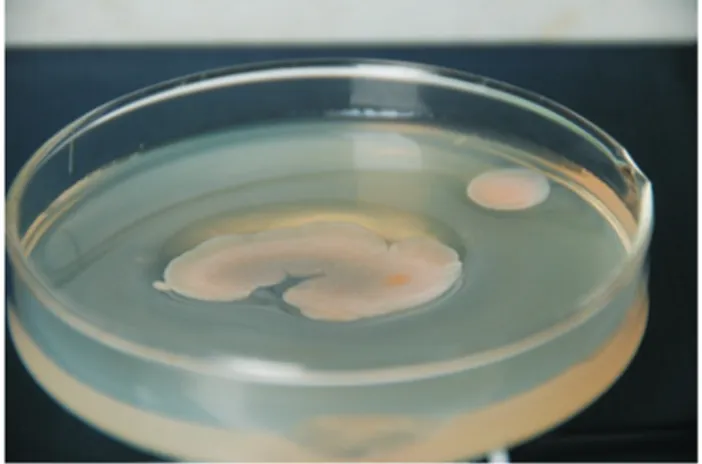
Initially, the agarase-producing Antarctic psychro-philic strain was isolated from the selection plates showing a clear hydrolysis pit (Figure 1). The 16S rRNA sequence analysis results showed that the isolated bacterium from the sediment samples was 99% similar toPseudoalteromonas
sp. And, hence, was assigned to the genus
Pseudoalteromonas and named Pseudoalteromonas sp.
NJ21 (GenBank accession number: KF700697). The pure strains are conserved in the key Laboratory of Marine Bio-active SubstancesSOA.
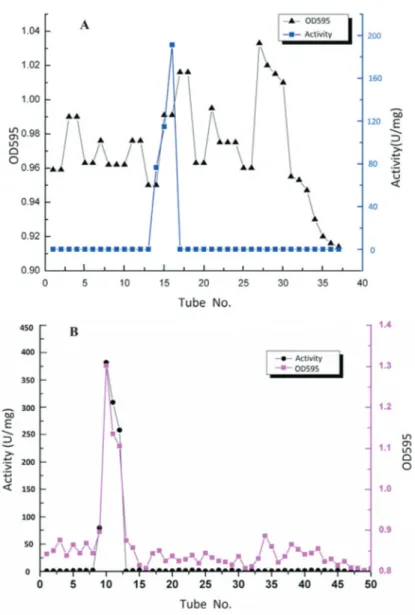
Separation and purification of Aga21
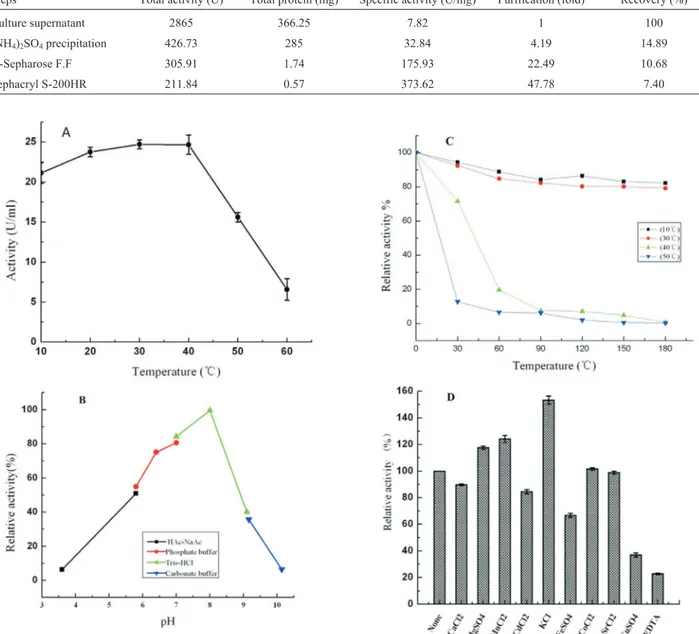
The Aga21 was purified via ammonium sulfate frac-tionation followed by a combination of two chromato-graphic steps (Figure 2). The Aga21 was purified 47.78-fold with a specific activity of 373.62 U/mg and a final yield of 10.68% (Table 1). SDS-PAGE revealed the pres-ence of a single protein band with agarase activity, whose
apparent molecular weight was estimated to be 80 kDa (Figure 3).
Influence of pH and temperature on enzyme activity and stability
Although the optimum reaction temperature of the purified Aga21 was 30 °C (Figure 4A), as much as 85% of the maximum activity was observed at 10 °C. The effect of pH on the purified enzyme is shown in Figure 4B. The maximum enzyme activity was observed at pH 8.0, and the enzyme was stable (> 70% relative activity) in buffers with a pH range of 6.5-8.5 under the assay conditions. The tem-perature dependence of the Aga21 activity on agar was de-termined by measuring the enzyme activity at various tem-peratures for 180 min. The effect of temperature on the stability of Aga21 is shown in Figure 4C. Up to 80% thermostability of Aga21 was retained at 10 °C and 30 °C for 180 min. However, when the temperature was increased to 50 °C for 30 min, the enzyme relative activity was de-creased to 10-20%. Nevertheless, the enzyme was fairly stable (almost 70% relative activity) at 40 °C for 30 min.
Effect of various additives
The effect of metal ion salts and chelators on the ac-tivity of purified Aga21 is shown in Figure 4D. Divalent metal salts such as CuSO4, CdCl2, FeSO4, and CaCl2(each at 2 mM final concentration) completely inhibited the rela-tive activity of Aga21, whereas 2 mM EDTA inhibited 60% of the enzyme activity. In contrast, 2 mM KCl, MnCl2,and MgSO4enhanced the activity of Aga21 compared to the other metal ion salts.
Identification of the hydrolysis products of Aga21
The hydrolysis patterns of the purified Aga21 against food-grade agar are shown in Figure 5. The agarooligo-saccharides, which were purchased by Sigma, were also run along with the agarose hydrolyzed products by Aga21 on TLC. None of the agar hydrolysis products produced by the purified Aga21 matched the Rf values of agarooligo-saccharides (data not shown), whereas the Rf values did match with the standard neoagarooligosaccharides. When Aga21 was incubated with agar, only one distinct spot, NA2, was observed on the TLC plates at 30, 60, and 120 min after the reaction.
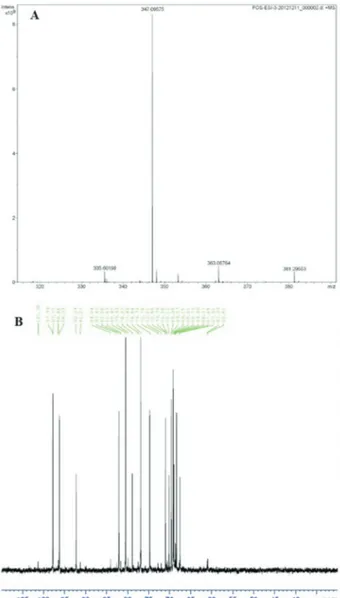
Further, the predicted molecular mass of deproto-nated disaccharide showed a peak at 347.3 [M+Na]+after LC-MS analysis (Figure 6A). The MW of 324.3 Da corre-sponds to the disaccharide unit neoagarobiose (C12H20O10) with formula weight of 324.28 indicative of theb-cleavage. The b-cleavage of agar was further confirmed with 13C NMR spectroscopy. The NMR result showed typical reso-nance signals at 102 and 98 ppm, which matched the reduc-ing end of neoagarobiose (Figure 6B).
Discussion
An increasing number of research programs are being sponsored to examine the enzymes produced by microor-ganisms isolated from Antarctica, some of which may have commercial potential. Examples of the enzymes identified from these studies include a-amylase (used in bread-making, textiles, brewing, and detergents), cellulase (used in textiles and pulp and paper industries),b-galactosidase (which eliminates lactose from milk), lipase (used in deter-gents and flavorings), proteases (used in deterdeter-gents and for tenderizing meat), and xylanase (used in bread-making) (Gerdayet al., 2000). However, to date, studies of agarases from Antarctic microorganisms have not yet been reported. In the present study, a newly found agarase-producing Ant-arctic psychrophilic bacterial isolate was assigned to the genus Pseudoalteromonas based on the 16S rDNA se-quence analysis. Earlier, mesophilic agarolytic
microor-Figure 3- Electrogram of SDS-PAGE of the purified Aga21.
ganisms were discovered in marine habitats, where marine red algae could be the source of agar as a substrate for them. However, the data demonstrate that agarolytic prokaryotes can also live when a polysaccharide of cyanobacteria form-ing cyanobacterial mats (Namsaraevet al., 2006) is the sub-strate for agarase. Because there are many cyanobacteria in the Antarctic Ocean, the polysaccharide of cyanobacteria may be the substrate for agarolytic Antarctic bacteria.
The reported molecular weight of agarase varies from values as low as 12 kDa (Khambhatyet al., 2008), in the case ofB. megaterium, to as high as 210 kDa, in the case of
Pseudomonas-like bacteria (Malmqvist, 1978).b-agarases
are classified into three groups by their molecular weights: Group I (20-49 kDa), Group II (50-80 kDa), and Group III (> 60 kDa) (Leonet al., 1992). The result of SDS-PAGE of purified Aga21 revealed a molecular mass of 80 kDa and may belong to group IIIb-agarases.
Temperature and pH are considered to be decisive pa-rameters for enzyme activity. It was observed that the activ-ity of Aga21 consistently increased from 10 to 40 °C, with optimum activity at 30 °C. However, a drastic decrease was observed when the Aga21 was incubated at temperatures above 40 °C. The activity of Aga21 was stable at a low perature and retained more than 85% of its activity at a
tem-Table 1- Summary of the purification of Aga21.
Steps Total activity (U) Total protein (mg) Specific activity (U/mg) Purification (fold) Recovery (%)
Culture supernatant 2865 366.25 7.82 1 100
(NH4)2SO4precipitation 426.73 285 32.84 4.19 14.89
Q-Sepharose F.F 305.91 1.74 175.93 22.49 10.68
Sephacryl S-200HR 211.84 0.57 373.62 47.78 7.40
perature of 10-30 °C, which is lower than many other agarases (Kirimuraet al., 1999; Ohtaet al., 2005; Vander Meulen and Harder, 1975). Temperature optima of various agarases are higher than the gelling temperature of agar be-cause compact bundles of gelled agar hinder enzyme action (Jonnadula and Ghadi, 2011; Ohtaet al., 2005; Suzukiet al., 2003; Vander Meulen and Harder, 1975). However, the agarase Aga21 can efficiently liquefy solid agar at a tem-perature of 10 °C. When compared with the other agarases, the Aga21 had a comparatively lower optimum tempera-ture and very low temperatempera-ture tolerance as a cold-adapted enzyme. This unique characteristic may be useful for pre-paring protoplasts and extracting biological substances from algae at low temperatures. The enzyme exhibited the maximum agarase activity at pH 8.0, whereas the opti-mum pH for many other agarases is 7.0 (Jonnadula and Ghadi, 2011; Longet al., 2010; Shi et al., 2008). Other agarases active in alkaline pH have been reported (Fu and Kim, 2010). Aga21 was stable in a wide pH range of 6.5-8.5, retaining more than 70% of its residual activity, which was similar to those of some other agarases such as AgaY (6.0-8.0) (Shiet al., 2008) and that fromBacillussp. MK03 (7.1-8.2) (Suzukiet al., 2003). As observed with
otherb-agarases, KCl, MgSO4, and MnCl2acted positively on the activity of the Aga21, which is consistent with the fact that V134, the source strain of AgaV, is a marine inhab-itant. However, CaCl2exhibited no apparent effect on the activity of the enzyme at 2 mM concentrations, which is in contrast to the observations of the b-agarase AgaO and AgaB of thePseudoalteromonassp. reported by Ohtaet al.
(2004a) and Maet al.(2007), who found that CaCl2 stabi-lizes the activity of AgaO and enhances the activity of AgaB. Similar to other agarases, the activity of the agarase identified in the present study was strongly inhibited by EDTA and several reagents, particularly, heavy metal ions.
Theb-agarases are known for their endo- and exolytic cleavage producing neoagarobiose and other intermediate products such as neoagarotetrose and neoagarohexose (Fu
et al., 2008). Theb-agarase fromAlteromonassp. (Wanget al., 2006) and the agarase Ag50D fromS. degradans have
Figure 5- Thin-layer chromatogram of the hydrolysis products of purified Aga21 reaction NA2, neoagarobiose; NA4, neoagarotetraose; NA8, neoagarooctaose; NA10, neoagarodecaose.
exolytic cleavage modes that mainly produce the neoa-garobiose (Kimet al., 2010). The agarase enzyme investi-gated in this study also yielded neoagarobiose as a major product indicating the exolytic cleavage of agar.13C NMR analysis of oligosaccharides deduced that the agarase pro-duced 3, 6-anhydrogalactose as the non-reducing end and galactose as the reducing end. This was also confirmed with LC-MS analysis. The abovementioned findings provide ev-idence that the enzyme investigated in this study is ab -aga-rase with exolytic cleavage of agar.
There are few bacteria (Aokiet al., 1990; Konget al., 1997; Suganoet al., 1993; Arakiet al., 1998) that are capa-ble of producingb-agarases and can hydrolyze agarose and neoagaro-oligosaccharides to yield neoagarobiose. Neoa-garobiose produces both moisturizing and whitening ef-fects on skin (Kobayashiet al., 1997), and the agarase-degraded extract from a red seaweed, Gracilaria verrucosa, has been reported to increase the phagocytic ac-tivity of mice (Yoshizawaet al., 1996). Hence, the oligo-saccharide extracts from agar or seaweeds hydrolyzed by the newly cold-adapted Aga21 may be a useful source to obtain physiologically functional products with antioxi-dative or immunopotentiating activities.
Acknowledgments
This study was financially supported by the Public Science and Technology Research Funds Project of Ocean (201105027), Chinese Polar Environment Comprehensive Investigation & Assessment Programs (CHINARE2014-01-05), Shandong Province Young and Middle-Aged Sci-entists Research Awards Fund (BS2010HZ001), and Basic Scientific Research Funds of FIO, SOA (GY0214T09).
References
Aoki T, Araki T, Kitamikado M (1990) Purification and charac-terization of a novel beta-agarase from Vibrio sp. AP-2. Eur J Biochem 187:461-465.
Araki C (1959) Seaweed polysaccharides. In: Wolfrom ML (ed.), Carbohydrate chemistry of substances of biological inter-ests. Pergamon Press, London, pp 15-30.
Araki T, Lu Z, Morishita T (1998) Optimization of parameters for isolation of protoplasts from Gracilaria verrucosa (Rhodophyta). J Mar Biotechnol 6:193-197.
Cantarel BL, Coutinho PM, Rancurel Cet al.(2009) The Carbo-hydrate-Active EnZyme database (CAZy): an expert re-source for glycogenomics. Nucleic Acids Res 37:233-238. Chi WJ, Chang YK, Hong SK (2012) Agar degradation by
micro-organisms and agar-degrading enzymes. Appl Microbiol Biotechnol 94:917-930.
Chintalapati S, Kiran MD, Shivaji S (2004) Role of membrane lipid fatty acids in cold adaptation. Cell Mol Biol 50:631-642.
D’Amico S, Gerday C, Feller G (2003) Temperature adaptation of proteins: engineering mesophilic-like activity and stability in a cold-adapted a amylase. J Mol Biol 332:981-988.
Duckworth M, Yaphe W (1972) The relationship between struc-tures and biological properties of agars. In: Nisizawa K (ed) Proceedings of the 7th international seaweed symposium. Halstead Press, New York, pp 15-22.
Fu XT, Kim SM (2010) Agarase: Review of Major Sources, Cate-gories, Purification Method, Enzyme Characteristics and Applications. Mar Drugs 8:200-218.
Fu XT, Lin H, Kim SW (2008) Purification and characterization of a novel b-agarase, AgaA34, from Agarivorans albus YKW-34. Appl Microbiol Biotechnol 78:265-273. Garcia-Viloca M, Gao J, Karplus Met al.(2004) How enzymes
work: analysis by modern rate theory and computer simula-tions. Science 303:186-195.
Georlette D, Damien B, Blaise Vet al.(2003) Structural and func-tional adaptations to extreme temperatures in psychrophilic, mesophilic and thermophilic DNA ligases. J Biol Chem 278:37015-37023.
Gerday C, Aittaleb M, Bentahir Met al.(2000) Cold-adapted en-zymes: from fundamentals to biotechnology. Trends Bio-technol 18:103-107.
Hassairi I, Ben AR, Nonus Met al.(2001) Production and separa-tion of alpha-agarase from Altermonas agarlyticusstrain GJ1B. Biores Technol 79:47-51.
Jonnadula R, Ghadi SC (2011) Purification and characterization of b-agarase from seaweed decomposing bacterium Microbulbifersp. strain CMC-5. Biotechnol Bioprocess Eng 16:513-519.
Karl DM (1993) Microbial processes in the Southern Ocean. In: Antarctic Microbiology, Friedmann EI, ed. New York, pp 1-64.
Khambhaty Y, Mody K, Jha B (2008) Purification, characteriza-tion and applicacharacteriza-tion of a novel extracellular agarase from a marine Bacillus megaterium. Biotechnol Bioprocess Eng 13:584-591.
Kim HT, Lee S, Lee Det al.(2010) Overexpression and molecular characterization of Aga50D from Saccharophagus degradans 2-40: an exo-type b-agarase producing neoa-garobiose. Appl Microbiol Biotechnol 86:227-234. Kirimura K, Masuda N, Iwasaki Yet al.(1999) Purification and
characterization of a novelb-agarase from an alkalophilic bacterium, Alteromonassp. E-1. J Biosci Bioeng 87:436-441.
Kobayashi R, Takisada M, Suzuki Tet al.(1997) Neoagarobiose as a novel moisturizer with whitening effect. Biosci Bio-technol Biochem 61:162-163.
Kong JY, Hwang SH, Kim BJet al.(1997) Cloning and expres-sion of agarase gene from a marine bacterium Pseudomonas sp. W7. Biotechnol Lett 19:23-26.
Leon O, Quintana L, Peruzzo Get al. (1992) Purification and properties of an extracellular agarase fromAlteromonassp. strain C-1. Appl Environ Microbiol 58:4060-4063. Long M, Yu Z, Xu X (2010) A novel beta-agarase with high pH
stability from marine Agarivorans sp. LQ48. Mar Bio-technol 12:62-69.
Ma C, Lu X, Shi Cet al.(2007) Molecular cloning and character-ization of a novel beta-agarase, AgaB, from marine Pseudoalteromonassp. CY24. J Biol Chem 282:3747-3754. Malmqvist M (1978) Purification and characterization of two
Miller GL (1959) Use of dinitrosalicylic acid reagent for determi-nation of reducing sugar. Anal Chem 31:426-428.
Namsaraev ZB, Gorlenko VM, Namsaraev BBet al.(2006) Mi-crobial Communities of Alkaline Hydrotherms. Novosi-birsk, Russia, pp 10-41.
Ohta Y, Hatada Y, Ito Set al.(2005) High-level expression of a neoagarobiose-producing beta-agarase gene from Agarivoranssp. JAMB-A11 inBacillus subtilisand enzy-mic properties of the recombinant enzyme. Biotechnol Appl Biochem 41:183-191.
Ohta Y, Hatada Y, Nogi Yet al.(2004a) Cloning, expression, and characterization of a glycoside hydrolase family 86 beta agarase from a deep-sea Microbulbifer-like isolate. Appl Microb Biotechnol 66:266-275.
Potin P, Richard C, Rochas Cet al.(1993) Purification and char-acterization of thea-agarase fromAlteromonas agarlyticus (Cataldi) comb. nov., strain GJ1B. Eur J Biochem 214:599-607.
Shi YL, Lu XZ, Yu WG (2008) A newb-agarase from marine bac-teriumJanthinobacteriumsp. SY12. WorldJ Microbiol Bio-technol 24:2659-2664.
Siddiqui KS, Cavicchioli R (2006) Cold-adapted enzymes. Annu Rev Biochem 75:403-433.
Sugano Y, Terada I, Arita Met al.(1993) Purification and charac-terization of a new agarase from a marine bacterium,Vibrio sp. Strain JT0107. Appl Environ Microbiol 59:1549-1554. Suzuki H, Sawai Y, Suzuki Tet al.(2003) Purification and
char-acterization of an extracellularb-agarase fromBacillussp. MK03. J Biosci Bioeng 93:456-463.
Vander Meulen HJ, Harder W (1975) Production and character-ization of the agarase ofCytophagaflevensis. Antonie Van Leeuwenhoek 41:431-447.
Wang J, Jiang X, Mou Het al.(2004) Anti-oxidation of agar oli-gosaccharides produced by agarase from a marine bacte-rium. J Appl Phycol 16:333-340.
Wang J, Mou H, Jiang Xet al.(2006) Characterization of a novel b-agarase from marineAlteromonassp. SY37-12 and its de-grading products. Appl Microbiol Biotechnol 71:833-839. Yoshizawa Y, Tsunehiro J, Nomura K et al. (1996) In vivo
macrophage-stimulation activity of the enzyme-degraded water-soluble polysaccharide fraction from a marine alga (Gracilaria verrucosa). Biosci Biotechnol Biochem 60:1667-1671.
Associate Editor: Lara Durães Sette