452 Brazilian Journal of Physics, vol. 34, no. 2A, June, 2004
Monte Carlo Simulations of Antiferromagnetic Small Particles
Vanessa S. Leite and Wagner Figueiredo
Departamento de F´ısica, Universidade Federal de Santa Catarina, 88040-900, Florian´opolis, SC, Brazil
Received on 9 August, 2004
We performed Monte Carlo simulations considering two different models for antiferromagnetic small particles with Ising spins. The spins of the particle are disposed at the sites of the two dimensional arrays with coordi-nation numbersz= 4andz= 6, around a central spin. The core spins interact antiferromagnetically and the
spins at the surface of the particle are disordered. In the first model, we consider an antiferromagnetic core sur-rounded by a disordered surface of the spin-glass type. In the second model, the core is still antiferromagnetic, but some bonds at the surface are broken. We determined the hysteresis curves, the zero-field-cooling (ZFC) and field-cooling (FC) curves. We have shown that the model with a disordered surface of the spin-glass type fits better the experimental measurements determined for the antiferromagnetic nanoparticles.
Recently, the antiferromagnetic small particles have re-ceived great attention due to their special behavior in the presence of external magnetic fields. For these particles, the traditional analysis of the antiferromagnetism based on a di-vision of the lattice in two or more interpenetrating sublat-tices, can not be applied due to the lack of symmetry. The finite size effects are inherent to these small particles, and the observed reduction in the coordination number of the surface spins causes fundamental changes in the magnetic order of the whole particle [1, 2].
Recent experiments [3, 4, 5] are consistent with the idea that these small particles are formed by a core, where the spins interact antiferromagnetically, and it is surrounded by a magnetic disordered shell. The disorder of the spins at the surface induces a weak ferromagnetic ordering of the spins in the antiferromagnetic core. This behavior has been ob-served in ferrimagnetic nanoparticles [1].
In this work we report some results on the magnetic properties of the antiferromagnetic small particles through Monte Carlo simulations in square and hexagonal lattices. In this study we considered an Ising spin model to describe the magnetic properties of the antiferromagnetic small par-ticle. We also take two different types of disorder at the surface of the particle. In the first case the disorder is of the spin-glass type, while in the second case, we take some broken bonds at the surface.
Our model for the small particle consists of a two-dimensional arrangement of spins, disposed in concentric shells of the square and hexagonal lattices [6]. We assume that the small particle has a large uniaxial anisotropy, and the spins can point only in a single direction. We considered particles with six shells, where the ratio between the surface and core spins is around0.30. The Hamiltonian model for the antiferromagnetic particle is written as
H=−
<ij>
Jijσiσj−H
i
σi, (1)
whereH is the external magnetic field, andJij is the
ex-change interaction between pairs of nearest neighbor spins. The spin variables are the Ising ones with the valuesσi =
±1. Jij assumes the valueJij = J, withJ < 0, when
σi and σj are spins in the core of the particle. The core includes the central spin and all spins up to the fifth shell. For the spins at the surface (sixth shell in our model), the value ofJij is given in the first model, where the surface is modeled by a spin-glass disordered structure, by
Ps(Jij) =
1
2[δ(Jij+J) +δ(Jij−J)], (2)
where δ(x) is the Dirac’s delta function. For the second model, where the surface is modeled by a layer of broken bonds, we have
Ps(Jij) =xδ(Jij) + (1−x)δ(Jij+J), (3) wherexis the fraction of broken bonds.
We used the standard importance sampling techniques to simulate the model described above. Configurations are generated by randomly choosing spins of the particle, and flipping them once a time, according to the Metropolis algo-rithm [7]. In each Monte Carlo step (M Cs), we performed a complete sweep through the particle. In order to get re-liable results, we performed around5000M Cs, where the first1000were discarded due to the thermalization process. We also considered averages over100different particles in our calculations.
We started our investigation considering the hysteresis loops of the small particles at different temperatures. The loops have been computed by starting from a demagnetized state atH = 0. Then, after we reach the saturated state, the magnetic field is reduced in uniform steps(δH = 0.10J), first downward from high values (positive saturation), and then upward by reversing the field.
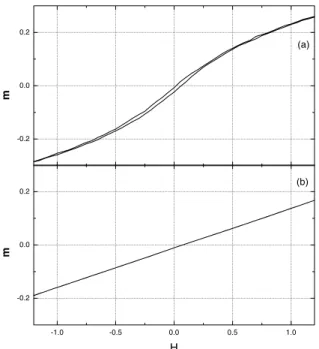
In Fig. 1 we show, for the model of small particles with spin-glass disorder at the surface, the typical curves at low
Vanessa S. Leite and Wagner Figueiredo 453
respect to the external field. Actually, all the curves for which T < 4.5J/kB exhibit this characteristic behavior. For the curves at temperatures above this value, the loops are symmetrical and are typical of paramagnetic states. For very low temperatures, that is, for T ≤ 0.6J/kB, besides the shifted loops, the curves also indicate the presence of the hysteresis phenomena, as we can see in Fig. 1(a), for
T = 0.5J/kB.
-1.0 -0.5 0.0 0.5 1.0
-0.2 0.0 0.2
(a)
m
-1.0 -0.5 0.0 0.5 1.0
-0.2 0.0 0.2
H
m
(b)
Figure 1. Hysteresis curves for the magnetization of a hexago-nal antiferromagnetic small particle with spin-glass disorder at the surface. (a)T = 0.5J/kB, (b)T = 2.0J/kB. We only show the
results aroundH = 0. The field necessary to saturate the particle
isH= 9.0J
For the model with broken bonds at the surface, the hys-teresis loops are very similar to those shown in Fig. 1. How-ever, the hysteresis phenomena, observed at low tempera-tures, are not present here. Fig. 2 shows this typical be-havior at low temperatures for an antiferromagnetic small particle containing75%of broken bonds at its surface. Ac-tually, the uncompensated spins (present in both models) is responsible for the presence of a small remanent magneti-zation in these systems. This behavior is illustrate by the shifted loops in the curves. The simultaneous appearance of the loop shift and the hysteresis phenomena can only be de-scribed in terms of the Stoner-Wohlfarth model [8], if there is a broad distribution of reversal fields. This broad distri-bution of the reversal fields, can only be achieved with a randomness in the exchange couplings at the surface that is extended to the layers of the core. We note that this be-havior is observed only in the model where we consider a disordered spin-glass surface.
-0.4 -0.2 0.0 0.2 0.4
-0.2 -0.1 0.0 0.1 0.2
H
m
Figure 2. Hysteresis curve for the magnetization of a hexagonal antiferromagnetic small particle with broken bonds at the surface. The temperature isT = 0.5J/kB. The field to saturate the particle
isH= 6.0J.
The curves shown in Figs. 1 and 2 were obtained con-sidering that the small particles are simulated in a hexago-nal lattice, with coordination numberz= 6. The hysteresis curves we found for the particles simulated in a square lat-tice (z= 4) are all symmetrical with respect to the external field. For this lattice, with a smaller coordination number, the influence of the surface into the core spins is less pro-nounced, due to the small number of bonds between surface and core [1, 2, 5, 9].
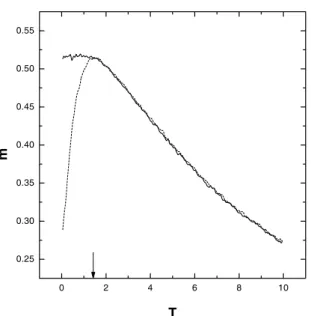
Figure 3 shows forH = 4.0J, the field-cooling (F C) and zero-field-cooling (ZF C) magnetizations as a func-tion of temperature for the hexagonal antiferromagnetic small particles, with a disordered surface of the spin-glass type. The maximum observed in theZF C curve, atT = 1.4J/kB, is usually ascribed to the blocking temperature,
TB, of the magnetic moment [8]. TheZF CandF Ccurves, which are different for temperatures belowTB, coalesce for
T ≥ TB, at the superparamagnetic states. The tempera-ture at which the hysteresis phenomena disappears for this particle isTN = 0.56J/kB. In general this temperature increases with the size of the particle [10]. In our case,
454 Brazilian Journal of Physics, vol. 34, no. 2A, June, 2004
0 2 4 6 8 10
0.25 0.30 0.35 0.40 0.45 0.50 0.55
T
m
Figure 3.F C(continuous) andZF C(dashed) curves for a hexag-onal antiferromagnetic small particle with spin-glass disorder at the surface. The field isH = 4.0Jand the blocking temperature
is indicate by the arrow.
Acknowledgments
This work was partially supported by the Brazilian
agency CNPq and FUNCITEC(SC).
References
[1] R.H. Kodama, S.A. Makhlouf, and A.E. Berkowitz, Phys. Rev. Lett.79, 1393 (1997).
[2] S.A. Makhlouf, F.T. Parker, F.E. Spada, and A.E. Berkowitz, J. Appl. Phys.81, 5561 (1967).
[3] D. Lin, A.C. Numes, C.F. Majkrzak, and A.E. Berkowitz, J. Magn. Magn. Mater145, 343 (1995).
[4] A.H. Morrish and K. Haneda, J. Appl. Phys.52, 2496 (1981).
[5] R.H. Kodama, A.E. Berkowitz, E.J. McNiff Jr., and S. Foner, Phys. Rev. Lett.77, 394 (1996).
[6] L.G.C. Rego and W. Figueiredo, Phys. Rev. B64, 144424 (2001).
[7] N. Metropolis, A.W. Rosenbluth, M.N. Rosenbluth, A.H. Teller, and E. Teller, J. Chem. Phys.21, 1087 (1953).
[8] E. C. Stoner and E. P. Wohlfarth, Phil. Trans. Roy. Soc. A 240, 599 (1948); Reprinted by IEEE Trans. Magn. 27(4), 3475 (1991).
[9] B. Mart´ınez, X. Obradors, L. Balcells, A. Rouanet, and C. Monty, Phys. Rev. Lett.80, 181 (1998).