www.jped.com.br
ORIGINAL
ARTICLE
Age
at
menarche
in
schoolgirls
with
and
without
excess
weight
夽
,
夽夽
Silvia
D.
Castilho
∗,
Luciana
B.
Nucci
FaculdadedeMedicina,PontifíciaUniversidadeCatólicadeCampinas(PUC-Campinas),Campinas,SP,Brazil
Received30January2014;accepted14May2014 Availableonline10September2014
KEYWORDS Menarche; Adolescent; Bodymassindex
Abstract
Objective: Toevaluatetheageatmenarcheofgirls,withorwithoutweightexcess,attending
privateandpublicschoolsinacityinSoutheasternBrazil.
Methods: Thiswasacross-sectionalstudycomparingtheageatmenarcheof750girlsfrom
pri-vateschoolswith921studentsfrompublicschools,agedbetween7and18years.Themenarche
wasreportedbythestatusquomethodandageatmenarchewasestimatedbylogarithmic
trans-formation.Thegirlsweregroupedaccordingtobodymassindex(BMI)cut-offpoints:(thin+
normal)and(overweight+obesity).Inordertoensurethattheybelongedtodifferentstrata,
328 parentsoftheseschoolsanswered aquestionnairetoratethestudent’ssocioeconomic
level.
Results: Menarche was reported by 883 girls. Although they belonged to different classes
(p<0.001),therewasnodifferenceinthenutritionaldiagnosis(p=0.104)betweenthem.There
wasalsonodifferenceinageatmenarchebetweenthegirlsstudyinginprivate(12.1years,95%
CI:12.0-12.2)andpublicschools(12.2years,95%CI:12.1-12.3;p=0.383).Whenevaluatedby
nutritionalstatus,therewasdifferenceonlyintheageatmenarchebetweengirlsfromprivate
schoolswithexcessweightandwithoutexcessweight(11.6and12.3years;p<0.001).Thegirls
withexcessweightattendingprivateschoolsalsohadearlieranmenarchethanthoseattending
publicschools(respectively,11.6and12.1years;p=0.016).
Conclusions: Althoughthestudentsfromprivateschoolsbelongedtoahighersocioeconomic
status,thereiscurrentlynolongeralargegap betweenthem andgirlsfrom publicschools
regardingnutritionalandsocioeconomicfactorsthatmayinfluencetheageatmenarche.
©2014SociedadeBrasileiradePediatria.PublishedbyElsevierEditoraLtda.Allrightsreserved.
夽 Pleasecitethisarticleas:CastilhoSD,NucciLB.Ageatmenarcheinschoolgirlswithandwithoutexcessweight.JPediatr(RioJ).
2015;91:75---80.
夽夽
StudyconductedatPontifíciaUniversidadeCatólicadeCampinas,Campinas,SP,Brazil.
∗Correspondingauthor.
E-mail:[email protected],[email protected],[email protected](S.D.Castilho). http://dx.doi.org/10.1016/j.jped.2014.05.008
PALAVRAS-CHAVE Menarca;
Adolescente; Índicedemassa corporal
Idadedamenarcaemescolarescomesemexcessodepeso
Resumo
Objetivo: Avaliaraidadedamenarcaemmeninas,comesemexcessodepeso,quefrequentam
escolasparticularesepúblicasdeumacidadedosudestedoBrasil.
Métodos: Estudo transversal quecomparou aidade damenarcade 750meninas deescolas
particularescom921alunasdeescolaspúblicas,comidadesentresetee18anos.Amenarca
foirelatadapelométodostatusquoeaidadedamesmaestimadapelologito.Asmeninasforam
agrupadaspelospontosdecortedoIMCem(magreza+eutrofia)e(sobrepeso+obesidade).
Comointuitodecertificarqueelaspertenciamaclassesdiferentes,328paisresponderama
umquestionárioparaclassificaroníveleconômicodosalunos.
Resultados: Amenarcafoireferidapor883meninas.Emboraelaspertenc¸amaclasses
econômi-cas distintas (p<0,001),não houve diferenc¸a quanto ao diagnóstico nutricional (p=0,104).
Tambémnãohouvediferenc¸anaidadedamenarcaentreasqueestudamemescolas
particu-lares(12,1anos;IC95%%:12,0-12,2)epúblicas(12,2anos;IC95%%:12,1-12,3);p=0,383.Quando
avaliadaspelodiagnósticonutricionalsóhouvediferenc¸anaidadedamenarcadasmeninascom
esemexcessodepesodeescolasparticulares(11,6e12,3anos;p<0,001).Asmeninascom
excessodepesodasescolasparticularestambémmenstruarammaiscedodoqueasdasescolas
públicas(respectivamente,11,6e12,1anos;p=0,016).
Conclusões: Emboraasalunasdasescolasparticularesaindapertenc¸amaclassesmaisaltas,
atualmente,não existemaisumabismonutricionalesocioeconômicotãograndeentreelas
quantoafatoresquepodeminfluenciarnaidadedamenarca.
©2014SociedadeBrasileiradePediatria.PublicadoporElsevierEditoraLtda.Todososdireitos
reservados.
Introduction
The age at which menarche occurs is of interest, asthis eventestablishestheendofthe sexualmaturationperiod in girls, signaling that they areready to procreate.1 This
implies their introduction into the adult world and, con-sequently, the onset of sexual activity, exposing them to both the risk of sexually transmitted diseases and pregnancy, whose early occurrence brings a number of difficulties.2,3
Severalfactorshavebeenassociatedwithsexual matura-tion,whichinfluencesageatmenarche.AccordingtoTanner, girlsofhighersocial classandthosewhoarebetter nour-ished menstruate earlier.1 Other studies have shown that
obesityalsoanticipatesmenarche.4,5
Inrecentdecades,Brazilandotherdevelopingcountries havefacedproblems relatedtochanges inthenutritional profileoftheirpopulations.6---8If,previously,thehigh
preva-lenceof malnutrition was of concern,currently the most noteworthy issues are related to overweight and obesity rates.9 Duringthefirstdecade ofthis century,therehave
alsobeensignificantchangesinthesocioeconomic distribu-tionofBrazilians,reflectingthesocialmobilitythatstarted inthe1970s.10,11 Withtheadvent ofindustrialization,the
baseof the socialpyramid slowly begantonarrow,but it wasnotuntil2005thatthesechangescreatedanewform ofsocioeconomicdistributionofthepopulation.Withpeople migrating from lower to higher levels, the old pyramid-shapedrepresentationofsocialclassdistributionhasbeen replacedbythediamond-shapeddistribution,inwhichthe majorityofthepopulationbelongstoanintermediate pur-chasingpowerstratum.10
Recentchangesinthenutritionalandsocioeconomic pro-file of the Brazilian population have raised the question abouttheinfluencethatthesefactorshavehadontheage atmenarche.Facedwiththisnewreality,thisstudyaimed toevaluateandcomparetheageatmenarcheingirlswith and without excessweightwho attendprivate andpublic schoolsinacityofsoutheasternBrazil.
Methods
Thisstudydescribedandcompareddataon1,671girls,aged 7-18years,evaluatedinprivate(in2010,n=750)andpublic (in2012,n=921)schoolsinCampinas,SP,Brazil.Theschools wereselectedbydrawinglotsamongallprivateandpublic schoolsof themunicipality,andthegirls enrolledin study did so after an informed consent was obtained from the principalsandparents/guardians,whoagreedwithdata col-lection.Oftheassessedgirls,thosewhoreportedpregnancy, non-controlled diseases that could interfere with growth or weightgain,andthosewhohadat thetimeofstudy a conditionthatcouldinterferewithmeasurements,suchas wheelchairuse orwearingaplastersplint,wereexcluded fromthestudy.
Thesamplesizewascalculatedsothattheadolescents wouldbedistributedevenlyaccordingtotheTanner matu-rationstagesforbreast(B)development,basedonBrazilian studiesthatestablishedthemeanageforeachstage12 and
thebodymassindex(BMI)variabilityforthatage.13 Using
the sample size formula for the mean of a quantitative variable(BMI)fromadescriptivestudy,consideringthe low-est sampling error (d=0.7kg/m2), the highest estimated
of1%,itwasestablishedthatatleast114girlswouldbe nec-essaryforeachmaturationstageineachsample(minimum of1,140girls).
Weight and height were measured according to the internationalstandards14 usingTanitascaleSC331S(Tanita,
Illinois,UnitedStates)andWISOwallanthropometer(WISO, Santa Catarina, Brazil), respectively, and the girls were questioned regarding the occurrence of menarche by the
status quo method (menarche: yes or no). As matura-tion obtained by comparativeself-assessment of pubertal developmentillustrativeboards(Tannerstages)hadahigh correlation withthatdeterminedby theresearcherin the firstsample(privateschools),accordingtoalreadypublished data,5,7inpublicschoolsmaturationwasobtainedby
self-assessment.BasedontheBMI/ageZ-scoreassessedbycutoff pointsofWorldHealthOrganization(WHO)curvesof2007, the girlswere divided intotwogroups: those withexcess weight(overweightandobesity)andthosewithout excess weight(underweightandnormalweight).
Datawerecollectedinpublicandprivateschoolsinorder to represent different socioeconomic classes. To confirm thischoice,in2012,328parentsofstudents(assessed pro-portionally in each school) answered the Brazil Economic ClassificationCriterion(CritériodeClassificac¸ãoEconômica Brasil--- CCEB)questionnaireoftheBrazilianAssociationof ResearchCompanies.15
The analyses were performed using SPSS for Windows v.17.0 (SPSS Inc., Chicago, United States) software; the chi-squared test was used to compare proportions, the Mann-Whitney test to comparethe numerical means, and logisticregressiontocompareageat menarcheperschool (publicandprivate)andnutritionaldiagnosis(withand with-outexcessweight).Thelogarithmictransformationmethod wasusedtocalculatethemedianageofmenarche(ageat which50%ofthegirlsstatedhavingmenstruated).Thelevel ofsignificancewassetat5%.
Thisresearchcomplieswiththeethicalprinciplesofthe DeclarationofHelsinkiandwasapprovedbytheEthics Com-mitteeofPUC-Campinas(protocol693/09and574/11).
Results
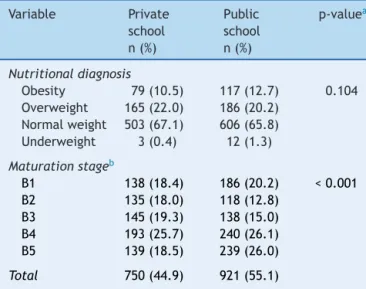
Table1includesdescriptivedataofthesampleregardingthe distributionofgirlsevaluatedinprivateandpublicschools per nutritional diagnosis and maturation stage. It can be observedthattherewasnosignificantdifferenceregarding the nutritional diagnosis in girls attending different edu-cationalsystems(p=0.104).The prevalenceofoverweight was32.5%ofthestudentsfromprivateschoolsand32.9%of studentsfrompublicschools.
The applicationof theCCEBshowedstatistically signif-icant differences in the socioeconomic class of children attendingschoolsassessedintheprivateandpublicnetwork (p<0.001).Whileintheprivateschools90%ofthestudents belongedtoclassesAandB(withapredominanceofA2and B1)andonly10%belongedtoclassC,inpublicschools53% belongedtotheclassB(predominantlyB2),nonebelonged toclassA,and47%belongedtothelowerclasses(CandD). There wasno difference between the number of girls from public and private schools who reported menarche
Table 1 Distribution of1,671 girls evaluated in private
andpublicschoolsinCampinas,SP,Brazilbetween2010and
2012,accordingtoBMI/agecutoffpointsinWHO2007curves
andmaturationstage(Tanner).
Variable Private
school
n(%)
Public school
n(%)
p-valuea
Nutritionaldiagnosis
Obesity 79(10.5) 117(12.7) 0.104
Overweight 165(22.0) 186(20.2)
Normalweight 503(67.1) 606(65.8)
Underweight 3(0.4) 12(1.3)
Maturationstageb
B1 138(18.4) 186(20.2) <0.001 B2 135(18.0) 118(12.8)
B3 145(19.3) 138(15.0) B4 193(25.7) 240(26.1) B5 139(18.5) 239(26.0)
Total 750(44.9) 921(55.1)
a Chi-squaredtest.
b Tannermaturationstageforbreastdevelopment.
(p=0.717); 400 (53.3%) and 483 (52.4%), respectively.
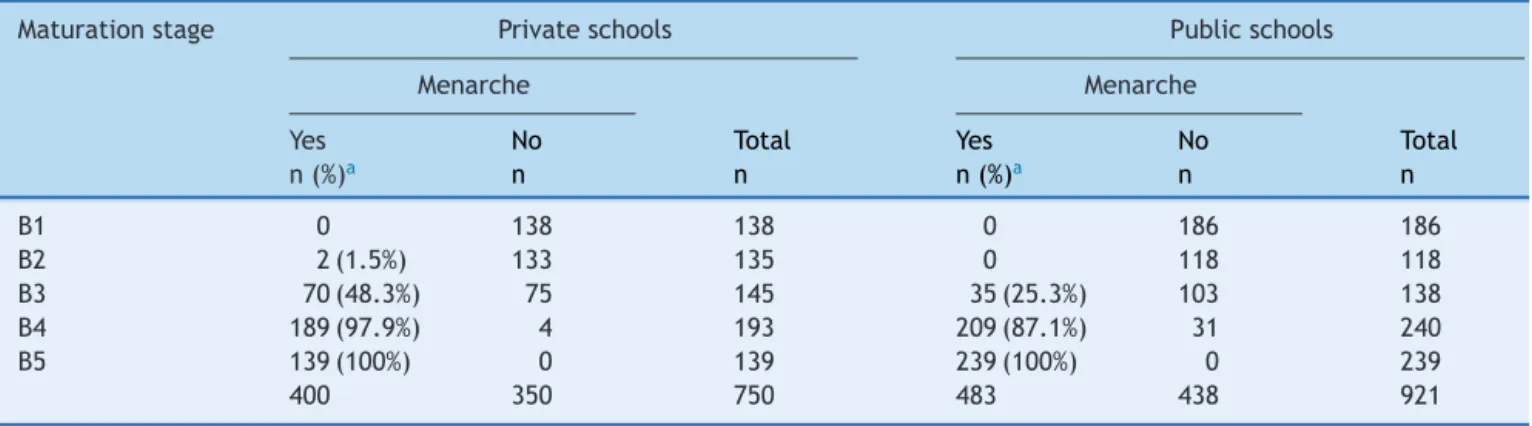
Table2showstheirdistributionbymaturationstage. Amongthegirlsincluded,only16wereclassifiedas hav-ingearlyorlatemenarche.Sixgirlsfromprivateschoolsand twofrompublicschoolshadmenarchebeforeage9,while onlytwofromprivate schools andsixfrom publicschools hadmenarcheafterage15.Theyoungestwas8.4yearsand theoldestwas15.9yearsatmenarche.
Themedianageatmenarcheingirlsfromprivateschools was12.1years(95%CI:12.0to12.2)andingirlsfrompublic schoolsitwas12.2years(95%CI:12.1to12.3).Althoughage atmenarchewasyoungeringirlsassessedinprivateschools, therewasnostatisticallysignificant differencein relation tothoseassessedinpublicschools(p=0.383).When evalu-atedaccordingtothenutritionaldiagnosis,itwasobserved that overweight girls from private schools had an earlier menarche(Table3).
Discussion
This study found thatthere wasactually nodifferencein ageatmenarchebetweenadolescentgirlsattendingprivate (12.1years)andpublic(12.2years)schoolsinCampinas,SP, Brazil.Regardingnutritionaldiagnosis,overweightgirlsfrom privateschoolhave anearlier menarche(11.6years)than thosewithnormalweight(12.3years),buttherewasno dif-ferenceinageatmenarcheofgirlsenrolledinpublicschools (12.1and12.3years,respectively).Moreover,therewasno differenceinageatmenarcheingirlswithoutexcessweight fromprivateandpublicschools(12.3and12.3years, respec-tively),butthosewithoverweightfromprivateschoolshad anearliermenarche(11.6and12.1years,respectively).
Table2 Proportionofgirls(evaluatedinprivateandpublicschoolsinCampinas-SP,in2010-2012)whoreportedmenarche,by
maturationstage.
Maturationstage Privateschools Publicschools
Menarche Menarche
Yes
n(%)a
No n
Total n
Yes n(%)a
No n
Total n
B1 0 138 138 0 186 186
B2 2(1.5%) 133 135 0 118 118
B3 70(48.3%) 75 145 35(25.3%) 103 138
B4 189(97.9%) 4 193 209(87.1%) 31 240
B5 139(100%) 0 139 239(100%) 0 239
400 350 750 483 438 921
a%ofweightperTannerstageofbreastdevelopment(B).
Table3 Comparisonofageatmenarcheaccordingtotypeofschooltheyattended(privateorpublicschool)andnutritional
diagnosis(withandwithoutexcessweight)ofschoolgirls;Campinas,SP,Brazil(2010-2012).
School Nutritionaldiagnosis n Medianageatmenarche(years) p-value
Private Underweight+normalweight 506 12.3a <0.001
Overweight+obesity 244 11.6b
Public Underweight+normalweight 618 12.3a 0.271
Overweight+obesity 303 12.1b
Logisticregression.
ap=0.5436. b p=0.0166.
enrolled.16---19 The familiesfromtheupperclasses,seeking
toensurebetterlearningandaplaceinhighereducation, oftenchoosetoenrolltheirchildreninprivateschools.Thus, presupposingtheassessmentoftwodifferentsocioeconomic levels, data were obtained from students attending pub-lic and private schools. However, considering the recent socioeconomicchangesinBrazil,the authorsalsodecided toapplytheCCEB(questionnaire)toverifywhethersocial mobilityhadchangedthatassumption.Forthatpurpose,a subsampleofparentsofstudentsenrolledintheseschools answered this questionnaire, which defines social class basedonthepurchasingpoweroftheintervieweesandthe headofthehouseholdlevelofschooling.
Itcanbeobservedthatalthoughthestudentsfromthe privateschoolsstillbelongtohigherclasses,currentlythere is no longersuch a large economic gap between the lat-terandthosewhostudyinpublicschools,regardingfactors thatmayinfluencetheageatmenarche.Afewdecadesago (1978),astudythatassessedsexualmaturationof3,368girls (10-19years)inSantoAndré,SP,Brazil,demonstratedthat menarcheoccurredat12.6years.12Whenthegirlswere
sub-dividedaccordingtothemeanmonthlyhouseholdpercapita income,itwasobservedthatthoseinthetwolower socio-economic levelshada latermenarche (12.8 years),when comparedwiththoseinlevel3(12.4years)andthatthose athigherlevelshadanevenearliermenarche(12.2years). Thesocialmobilityrecordedinthelastdecade,withthe riseofthelowerclassestoanintermediatestratum,10,11has
ledtothe adoptionof unhealthyhabitsby thepopulation thatmovedfromalowertoahighersocialclass.
Ingestionofahigh-caloriedietoflowernutritionalvalue (lowinfiberandhighinfatandsugarcontent),whichwas previouslyaccessible onlytotheclasses withgreater pur-chasing power, has excessively increased the weight gain inpartofthepopulationvulnerabletomalnutritiondueto food scarcity.9,20 Unfortunately, that nutritional transition
hasoccurredfasterinBrazilthaninothercountriesthatare experiencing the same process,probably because dietary habitsareinfluencedbysocioculturalfactors.6Theincrease
intheprevalenceofoverweightandobesityamongthe Chi-nesepopulation(14.7%and2.6%,respectively)isamatter of concern for the Chinesegovernment, eventhough the incidenceof overweightandobesity arewell belowthose detectedintheBrazilianpopulation.21
Itisknownthatexcessweightresultsfroman inappro-priateassociationbetweenenergygainandexpenditure,so thatthesedentarylifestylealsocontributestotheincreased prevalence of overweight and obesity.22,23 In Brazil, the
Decreeestablishingguidelinesandbasesofeducation(No. 9,394/1996,amendedinApril2013,No.12,796)determines themandatorypresenceofphysicaleducationintheschool curriculum without, however, establishing the number of class-hoursperweek.24
regularschoolsdoit.The authorsbelievethatthelackof andthepoorqualityoffacilitiesinpublicschoolsindicate theneglectofthegovernment,andthesocialdisregardin relationtothedisciplineofphysicaleducation.25
The SchoolHealth National Survey (PeNSE), conducted in2009 withstudentsfromtheninthgradeof elementary educationatpublicandprivateschoolsacrossthecountry, aimed to assess the exposure to risk factors (behavioral) that may compromise the health of these young individ-ualsregardingthedevelopmentofchronicdiseases.26 This
research, which included, among other things, questions about diet, physical activity, and inactivity, showed that overhalf ofadolescentsdidnotpracticephysicalactivity, varyingfrom65.8%to49%.Inactivestudentspredominated inbothprivateandpublicschools(54.9%and57.4%, respec-tively).
Regardinggender, thestudyfoundthatgirlsweremore sedentary (68.7%) when compared to boys (43.8%). It also observed that consumption of sweets/snacks (50.9%) exceededthatoffruitsandvegetablesbynearly20%.Eighty percentofstudentsreportedwatchingTVfortwohoursor moredaily,whichexceedsthemaximumrecommendedby theWHO.
For years, the Brazilian government has implemented actionstoimprovethenutritionalstatusofthepopulation.27
Accordingly,schoollunches,initiallyofferedonlyinschools intheNortheastRegiontofightmalnutrition,havegradually gainednationalcoverage,andbecameaconstitutionalright during thelate1980s. Thus,all studentsattending public schoolsreceivefoodatschool,inordertoensureaminimum dailynutritionalintake.InCampinas,SP,wherethegirlswho participatedinthisstudywereevaluated,themenuofthese meals has been prepared by dietitians/nutritionists since 2002(PMAE2013-MunicipalSchoolFeedingProgramme).28
Withtheimprovementofthesocioeconomicstatus,many of the families with children enrolled in public schools no longer suffer fromlack of food, and this becomes an extra meal, which may be contributing tothe increasing prevalenceofoverweightinthispopulation.Moreover, con-tributingtothispictureisthefactthatmanystudentsdonot eatthesemeals,preferringasnackbroughtfromhomeor purchasedinthecafeteriaitself,whereingeneral,bothin publicandinprivateschools,unhealthyfoodsaresold,such asfriedfoods,processedsnacks,candy,andsoda. Consider-ingthisreality,thehighprevalenceofoverweightobserved ingirlsevaluatedinthisstudycanbeunderstood.
Several authorshave indicated that,for hormonal rea-sons,obesityanticipatesthematurationofgirls,leadingto anearliermenarche.4,29 Asexcessweightcurrentlyaffects
both girls from the upper classes, as well as those from intermediateones,itisnotsurprisingthatbotharehaving menarcheatthesameage.
The distributionofthestudentsaccordingtothe nutri-tionaldiagnosisinbothgroupsshowedthatoverweightgirls fromprivateschoolshaveanearliermenarchethanthosein publicschools,evenwithnodifferenceintheprevalenceof obesityamongthem.However,itissurprisingthattherewas nodifferenceinageatmenarchebetweenstudentswithand withoutexcessweightfrompublicschools.Itislikelythat otherfactorsknowntoinfluencemenarche,notassessedin thisstudy,suchassedentarylifestyle,numberofchildren inthefamily,characteristicsofhousing,employment,and
characteristicsofthecityareasinhabitedbythesegirls,may haveinfluencedtheseresultsandthus,furtherstudiesare requiredtoclarifythesefindings.30
Thus,itisacknowledgedthatthepresentstudyhad lim-itationsfor not assessingvariables other thanthe typeof schoolandnutritionalstatus,aswellasforfailingtoapplyan adequatequestionnairetoassessthesamplesocioeconomic profile,butratherwhichreportedonlyaccessto consump-tiongoods.However,therearenootherstudies thathave addressedthisissueafterthedrasticchangesinthe Brazil-iansocioeconomicscenariothatoccurredinthelastdecade. Thus,itisrecommendedthat thesubjectcontinuestobe investigatedtobetterunderstandtheseresults.
Funding
PUC-Campinas.
Conflicts
of
interest
Theauthorsdeclarenoconflictsofinterest.
References
1.TannerJM.Growthatadolescence.2nded.Oxford:Blackwell;
1962.
2.GranadaC,OmarH,LovelessMB.Updateonadolescent gyne-cology.AdolescMedStateArtRev.2013;24:133---54.
3.EatonDK,KannL,KinchenS,ShanklinS,FlintKH,HawkinsJ, etal. Youthrisk behaviorsurveillance- UnitedStates, 2011. MMWRSurveillSumm.2012;61:1---162.
4.WangY.Isobesityassociatedwithearlysexualmaturation?A comparison oftheassociation inAmerican boysversusgirls. Pediatrics.2002;110:903---10.
5.CastilhoSD,PinheiroCD,BentoCA,Barros-FilhoAdeA,Cocetti M.Seculartrendsinageatmenarcheinrelationtobodymass index.ArqBrasEndocrinolMetabol.2012;56:195---200. 6.WangY,MonteiroC,PopkinBM.Trendsofobesityand
under-weightinolderchildrenandadolescentsintheUnitedStates, Brazil,China,andRussia.AmJClinNutr.2002;75:971---7. 7.CastilhoSD, Bento CA,PinheiroCD,Barros-FilhoAA, Cocetti
M.Trends ofbodycompositionamong adolescentsaccording tomaturationstageandbodymassindex.JPediatrEndocrinol Metab.2013;26:651---6.
8.FloresLS,GayaAR,PetersenRD,GayaA.Trendsofunderweight, overweight,andobesityinBrazilianchildrenandadolescents. JPediatr(RioJ).2013;89:456---61.
9.InstitutoBrasileirodeGeografiaeEstatística(IBGE).Pesquisa nacionaldeorc¸amentosfamiliares2008-2009.Antropometriae estadonutricionaldecrianc¸asadolescenteseadultosnoBrasil. RiodeJaneiro:IBGE;2010.
10.PochmannM.Social structureinBrazil:recentchanges.Serv SocSoc.2010;104:637---49.
11.AntigoMF,MachadoAF.Mobilidadeintrageracionalde rendimen-tosnoBrasil.RevEconPolit.2013;33:166---78.
12.Colli AS. Crescimento e desenvolvimento pubertário em crianc¸aseadolescentesbrasileirosVI:maturac¸ãosexual.São Paulo:EditoraBrasileiradeCiências;1988.
13.dosAnjosLA,daVeigaGV,deCastroIR.Distributionofbody massindicesofaBrazilianpopulationunder25yearsofage. RevPanamSaludPublica.1998;3:164---73.
15.Associac¸ão Brasileira de Empresas de Pesquisa. Critério de classificac¸ão econômica Brasil.[cited 2014 Jan6]. Available from:http://www.abep.org/new/criterioBrasil.aspx
16.Soares JF, César CC, Mambrini J. Determinantes de desem-penhodosalunosdoensinobásicobrasileiro:evidênciasdoSAEB de 1997. In:Franco C,org. Avaliac¸ão, ciclosepromoc¸ãona educac¸ão.PortoAlegre:ArtesMédicas;2001.p.121-53. 17.Alves MT, Soares JF. Medidas de nível socioeconômico em
pesquisassociais: umaaplicac¸ãoaosdados deuma pesquisa educacional.OpiniãoPública.2009;15:1---30.
18.Curi AZ, Meneses-Filho NA. Determinantes dos gastos com educac¸ãonoBrasil.PPE.2010;40:1---20.
19.CostaLO, ArraesRA,Vera-HernandesM.Identificac¸ãoparcial doefeitodasescolasprivadasbrasileiras.FórumBNBde Desen-volvimento,EncontroRegionaldeEconomia;2011.Fortaleza, CE:Anais;2011.p.1---25.
20.Tardido AP, FalcãoMC. The impact of the modernization in the nutritional transition and obesity. Rev Bras Nutr Clin. 2006;21:117---24.
21.WuY.OverweightandobesityinChina.BMJ.2006;333:362---3. 22.HillJO.Understandingandaddressingtheepidemicofobesity:
anenergybalanceperspective.EndocrRev.2006;27:750---61. 23.Pereira HR, Bobbio TG, Antonio MÂ, Barros Filho A de A.
Childhood and adolescent obesity: how manyextra calories
are responsible for excess of weight? Rev Paul Pediatr. 2013;31:252---7.
24.Brasil.PresidênciadaRepública. In:Lei no.9.394,de 20de dezembrode1996.DiretrizeseBasesdaEducac¸ãoNacional. Brasília:DiárioOficialdaUnião;1996.
25.TenórioMC,TassitanoRM,LimaMC.Knowingtheschool envi-ronmentfor physicaleducationclasses:isthereadifference betweenschools?RevBrasAtivFiseSaúde.2012;17:307---13. 26.Instituto Brasileiro de Geografia e Estatística (IBGE).
Pesquisa Nacional de Saúde do Escolar 2009. [cited 2013 Dec 9]. Available from: http://www.ibge.gov.br/home/ estatistica/populacao/pense/pense.pdf
27.Reis CE, Vasconcelos IA, Barros JF. Policies on nutrition for controlling childhood obesity. Rev Paul Pediatr. 2011;29: 625---33.
28.Campinas. Prefeitura. Programa Municipal de Alimentac¸ão Escolar. [cited 2013 Dec 9]. Available from: http://www. campinas.sp.gov.br/governo/gestao-e-controle/alimentacao-escolar.php
29.Burt Solorzano CM, McCartney CR. Obesity and the puber-taltransitionin girlsand boys. Reproduction. 2010;140:399---410.