Small cross-sectional survey of composite
restoration attributes associated with
choices for replacement
Abstract: The aim of this work was to present a small cross-sectional survey of composite restoration clinical attributes associated with choic-es for replacement. Ninety-four composite illings selected to be replaced were included in this study. A questionnaire was illed out after each pro-cedure in order to assess the clinical conditions that indicated the restora-tion replacement (marginal staining, unsatisfactory restorarestora-tion anatomy, marginal fracture, fractured restoration body, painful symptoms, dental fracture, composite discoloration and/or restoration displacement). These conditions could be combined. The chi-square and Exact Fisher tests were performed to analyze the different variables (p < 0.05). The results showed that composite shade discoloration was the main cause of resto-ration replacement (63.8%). Marginal staining (50%), unsatisfactory res-toration anatomy (50%), marginal fracture (14.9%), painful symptoms (8.5%), fractured restoration body (4.3%), dental fracture (1.1%) and to-tal displacement of the restoration (1.1%) were conditions that could be associated. The main cause of dental composite restoration replacement was material shade mismatch with the dental structure (anterior teeth) or marginal staining and unsatisfactory restoration shape (posterior teeth). Marginal staining and composite shade discoloration contrasting with dental structure were related to the presence of caries.
Descriptors: Clinical trial; Esthetics; Dental leakage. Alessandra Ramos Parpaiola(a)
Priscilla Santos Guimarães(b) Fabiana Mantovani Gomes França(c)
Roberta Tarkany Basting(d)
(a) MSc Student; (c)PhD, Professor; (d)ScD,
PhD, Professor – Department of Restorative Dentistry, São Leopoldo Mandic Research Center, Campinas, SP, Brazil.
(b) ScD, Professor, Department of Restorative
Dentistry and Dental Materials, School of Health and the Environment (FAESA), Vitória, ES, Brazil.
Corresponding author:
Roberta Tarkany Basting
Faculdade de Odontologia e Centro de Pesquisas Odontológicas São Leopoldo Mandic
Departamento de Odontologia Restauradora - Dentística
Rua José Rocha Junqueira, 13, Bairro Ponte Preta
Campinas - SP - Brazil CEP: 13045-755
E-mail: [email protected]
Introduction
In the early 1960s, Bowen started his research using epoxy resins, which presented limited clini-cal use, culminating in the development of dental composite. Since then, signiicant improvements in the manipulation, adhesion, mechanical resistance, wear resistance and shade stability characteris-tics have been observed.1 However, differences still
persist between the properties of the materials and those of dental tissues. The hybridization between the restorative material and the dental substrate is the base for interface maintenance. However, it is known that leakage is an inevitable process, and polymerization shrinkage, thermal expansion co-eficient and elastic modulus are the main physical properties of dental composites that inluence adhe-sion durability.2,3
The differences between the physical properties of teeth and those of restorative materials lead to the formation of gaps at the tooth/restoration inter-face and consequent marginal microleakage, which is considered the main cause of failures in dental composite restorations.4 The main clinical signs that
indicate microleakage are marginal staining of the restoration, recurrent caries, injuries to the dentin-pulp complex and marginal fractures.3,5-10
In view of the large number of clinical signs sug-gestive of marginal microleakage, it is necessary to establish which of these signs really indicate the replacement or repair of the restoration. Thus, the aim of this work was to present a small cross-sec-tional survey of the clinical attributes of composite restorations that are associated with the decision for replacement.
Material and Methods
Patients who presented the need to replace one or more direct dental composite restorations in anteri-or anteri-or posterianteri-or teeth were assessed, after the project was approved by the local Research Ethics Commit-tee (Process No. 05/189). Patients of both genders, ages ranging from 19 to 62 years old, treated during the period from March to December 2005, at the Dentistry Course of the FAESA (School of Health and the Environment) Dental Clinic were selected for this study.
The patients were assessed by clinical examina-tion after prophylaxis, drying and illuminating the region with a relector. The restorations were evalu-ated by 3 calibrevalu-ated examiners who are faculty at the University. The clinical conditions were recorded on a speciic chart in accordance with the following criteria:
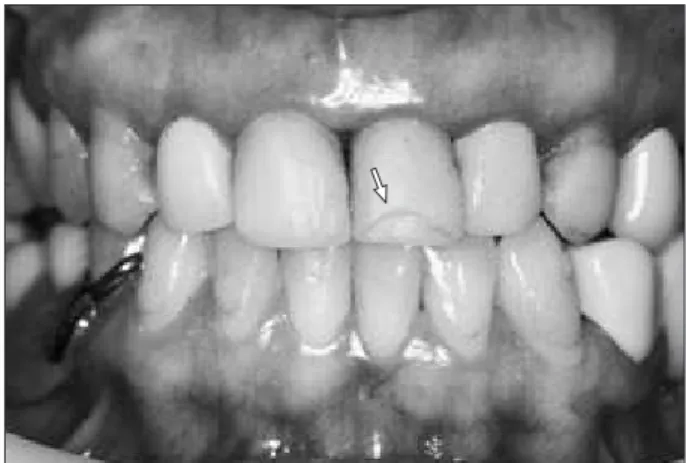
Presence of marginal staining (Figure 1);
•
presence of unsatisfactory restoration anatomy
•
(Figure 2);
presence of marginal fracture of the restoration
•
(Figure 3);
presence of restoration body fracture (Figure 4);
•
presence of painful symptoms;
•
presence of tooth fracture;
•
presence of unsatisfactory composite shade
(Fig-•
ure 5);
presence of a displacement of the restoration.
•
The decision to indicate replacement was based exclusively on the clinical criteria. When one of these conditions was found, and there was no pos-sibility of repairing it, replacement was indicated; there could also be a combination of clinical signs. So, more than one reason for replacement per resto-ration could be recorded (not only the main reason for replacement). Radiographs were also taken to de-termine the presence of caries around restorations.
The presence of caries below the replaced resto-ration was also recorded. The criteria used for car-ies diagnosis was the presence of soft dentin tissue when an excavator was used. The approximate date when the restoration was made was recorded after
information was provided by the patients.
The non-parametric chi-squared (χ2) and the
Fisher exact tests were used to analyze a possible association among the variables with a 5% signii-cance level.
Results
Ninety-four (94) restorations to be replaced in anterior and posterior teeth were evaluated. The distribution of the restorations in accordance with Black classiication and location is shown in Table 1. The restorations comprised approximately the same amount in anterior and posterior segments: 51% (n = 48) and 49% (n = 46), respectively.
Of the clinical conditions assessed, it was found that composite discoloration was observed in 63.8%
Table 1 - Distribution of frequencies according to Black cavity classification and surfaces affected.
Cavity Classification Frequency %
Class I 24 25.5
Class II (DO/MO) 12 12.8 Class II (MOD) 4 4.3 Class III 31 32.9
Class IV 13 13.9
Class V 10 10.6
Total 94 100.0
Surfaces affected
Proximal 47 50.0
Occlusal 36 38.3
Vestibular 27 28.7
Lingual 22 23.4
Figure 2 - Unsatisfactory restoration shape.
Figure 4 - Restoration body fracture. Figure 5 - Unsatisfactory material shade.
(n = 60). When relating the clinical signs present in anterior restorations, material shade mismatch was the one most frequently observed in 77% (n = 37) of the cases, followed by marginal staining and unsat-isfactory restoration shape, both present in 45.8% (n = 22). The clinical signs observed in posterior restorations indicated for replacement were material shade mismatch in 50% of the cases (n = 23) and marginal staining and unsatisfactory restoration shape, both in 54.3% (n = 25) of the cases (Table 2).
In 61.7% of the cases, the presence of caries was observed after the restorative material was removed
(Table 3). Caries lesions were diagnosed in 79% (n = 37) of the restorations with marginal staining, 70% (n = 42) of the restorations with shade mis-match and 66% (n = 31) of restorations with unsat-isfactory shape (Table 4).
In regard to the approximate date on which the restoration indicated for replacement was inserted, only 46.8% (n = 44) of the patients provided this information and assumed that 70.4% of the resto-rations had been made less than 5 years previously (Table 5). The other patients did not know exactly when the restoration had been made.
The chi-squared test (χ2) showed the association of the variables “Marginal Staining” and “Material shade mismatch” with “Carious Tissue” during re-moval for replacement of the composite restoration (Table 6).
Table 2 - Distribution of frequencies according to the clinical condition found (total and for anterior and posterior teeth)*.
Clinical condition (total) Frequency % Material shade mismatch 60 63.8 Marginal staining 47 50.0 Unsatisfactory restoration shape 47 50.0 Fractured restoration margins 14 14.9 Painful symptoms 8 8.5 Fractured restoration body 4 4.3 Tooth fracture 1 1.1 Displacement of the restoration 1 1.1
Clinical condition (anterior teeth)
Material shade mismatch 37 77.0 Marginal staining 22 45.8 Unsatisfactory restoration shape 22 45.8 Fractured restoration margins 3 6.3 Painful symptoms 0 0 Fractured restoration body 0 0 Tooth fracture 0 0 Displacement of the restoration 1 2.1
Clinical condition (posterior teeth)
Material shade mismatch 23 50 Marginal staining 25 54.3 Unsatisfactory restoration shape 25 54.3 Fractured restoration margins 11 23.9 Painful symptoms 9 19.5 Fractured restoration body 4 8.7 Tooth fracture 1 2.2 Displacement of the restoration 0 0
*The restorations observed could present one or more clinical signs.
Table 3 - Distribution of frequencies according to the pres-ence of caries after removal of the restoration.
Caries Frequency %
Yes 58 61.7
No 36 38.3
Total 94 100.0
Table 4 - Distribution of frequencies according to the pres-ence of caries and marginal staining, shade mismatch and unsatisfactory shape.
Caries lesion associated with
Frequency (%)
Total (%) Yes No
Marginal staining 37 (79) 10 (21) 47 (100.0) Shade mismatch 42 (70) 18 (30) 60 (100.0) Unsatisfactory shape 31 (66) 16 (34) 47 (100.0)
Table 5 - Distribution of frequencies according to the ap-proximate time at which the replaced restoration was origi-nally inserted.
Time No. of cases Frequency (%) Less than 1 year previously 9 20.5 From 1 to 5 years previously 22 50 Over 5 years previously 13 29.5 Patients reporting approximate
Discussion
In this study, when the clinical signs that were most frequently present in the replaced restoration were analyzed, caries lesions were observed in 79% of the restorations with marginal staining and 70% of the cases with material shade mismatch. Mar-ginal staining is mentioned as a clinical sign of mi-croleakage6,8 and according to the present results,
its clinical presence is a good parameter for indicat-ing esthetic restoration replacement. Other clinical signs have been mentioned, such as tooth discol-oration11 and marginal fractures.6,12 Post-operative
sensitivity, recurrent caries, injuries and pulp necro-sis are also considered clinical signs of
microleak-age.6,8,10,13-16
When the clinical condition of restorations re-placed in anterior and posterior teeth were related, 77% (n = 37) of the restorations in anterior teeth were replaced because of material shade mismatch, either associated with other factors, or not. In poste-rior teeth, the main reasons were marginal staining and unsatisfactory restoration anatomy. Li et al.11
(2001) afirmed that extensive microleakage could occur around the restoration without it becoming dislocated. In an in vivostudy in which composite restorations were followed up for a period of 36 months,6 a high retention rate was observed (86%),
even when supericial marginal discoloration and marginal degradation were noted.
In this study, a higher rate of clinical signs that indicated restoration replacement was diagnosed on the proximal surfaces (50% of cases). In the
proxi-mal regions, mainly in Class II cavities in which the gingival margin of the restoration is in dentin or ce-ment, bonding and polymerization procedures are critical.12 When the cervical margins of the
prepara-tion are located in enamel, the microleakage rate is signiicantly lower.17-19
The presence of marginal leakage is a limiting factor in the longevity of composite restorations.8,20
Microleakage can lead to secondary caries, as relat-ed by Mjör, Toffenetti21 (2000) and Mjör22 (2005).
The technique for inserting and polymerizing the resin composite is sensitive and time consuming.3
The operator’s understanding of the bonding mech-anism of the resin composite to tooth hard tissues is of fundamental importance for optimizing the per-formance of the material.
It was observed that 70.4% of the esthetic res-torations that were indicated for replacement had been placed a maximum of 5 years previously. The longevity of composite restorations is a common concern,23 but no identiication of problems
dur-ing the restoration procedure (such as the use of an incorrect technique) was performed. In this study, the information about the date of the initial restora-tion was obtained by a report made by the patients, however, sometimes they were vague and inexact in remembering the time when it was done.
A large number of composite restorations are re-placed because of dissatisfaction with esthetics. Ma-terial shade alteration was the topic most indicated by the questionnaires in 60 cases, 37 of them being in anterior teeth and 23 in posterior teeth. Mate-rial shade mismatch can be due to several factors, such as those occuring during shade selection, and those after restoration placement, such as unsatis-factory hygiene, use of beverages such as coffee and tea, among others that could lead to staining both the restoration and the tooth. In cases in which this staining is slight, polishing the restoration may re-turn its satisfactory esthetic appearance, thus allow-ing the restoration to be kept for a longer period. Nevertheless, in some situations, this shade altera-tion is serious and dificult to remove with polishing and may be associated with other clinical signs.
The main cause of composite restoration replace-ment is the formation of caries, as a result of mar-Table 6 - Study of the relation between the clinical
condi-tion and observacondi-tion of caries.
Clinical condition ×
Observation of caries Test Statistics- χ
2 p-Value
Marginal staining 11.525 0.001* Fractured restoration margins 0.145 0.704 Fractured restoration body 0.242 0.636 (a) Painful symptoms 2.167 0.253 (a) Tooth fracture 0.627 1.000 (a) Material shade mismatch 4.833 0.028* Unsatisfactory restoration shape 0.720 0.396
ginal leakage.24 It is important that signs and
con-sequences of microleakage be differentiated, so that diagnosis can be made as soon as possible, and that microleakage of a small extent be prevented from developing into severe conditions, such as caries le-sions, complete loss of the restoration or even pulp necrosis.
Conclusions
The main cause of dental composite restoration replacement in anterior teeth was material shade mismatch with the dental structure, while in pos-terior teeth it was marginal staining and unsatisfac-tory restoration shape. Marginal staining and mate-rial shade mismatch with the dental structure were related to the presence of caries.
References
1. Nakabayashi N, Pashley DH. Hybridization of dental hard tissues. Tokyo: Quintessence; 2000.
2. Agosta C, Estafan D. Eliminating microleakage from the com-posite resin system. Gen Dent. 2003;51(6):506-9.
3. Leinfelder KF. Posterior composite resins: the materials and their clinical performance. J Am Dent Assoc. 1995;126(1):663-76.
4. Franco EB, Gonzaga Lopes L, Lia Mondelli RF, da Silva e Souza MH Jr, Pereira Lauris JR. Effect of the cavity configura-tion factor on the marginal microleakage of esthetic restorative materials. Am J Dent. 2003;16(3):211-4.
5. Amaral CM, Castro AKBB, Pimenta LAF, Ambrosano GM. Influence of resin composite polymerization techniques on microleakage and microhardness. Quintessence Int. 2002;33(9):685-9.
6. Aw TC, Lepe X, Johnson GH, Mancl LA. A three-year clinical evaluation of two-bottle versus one-bottle dentin adhesives. J Am Dent Assoc. 2005;136(3):311-22.
7. Braga RR, Ferracane JL. Alternatives in polymerization contraction stress management. Crit Rev Oral Biol Med. 2004;15(3):176-84.
8. Kidd EAM. Microleakage: a review. J Dent. 1976;5(4):199-206.
9. Kubo S, Yokota H, Yokota H, Hayashi Y. Microleakage of cer-vical cavities restored with flowable composites. Am J Dent. 2004;17(1):33-7.
10. Mjör IA, Qvist V. Marginal failures of amalgam and compos-ite restorations. J Dent. 1997;26(1):25-30.
11. Li HP, Burrow MF, Tyas MJ. The effect of long-term storage on nanoleakage. Oper Dent. 2001;26(6):609-16.
12. Muangmingsuk A, Senawongse P, Yudhasaraprasithi S. In-fluence of different softstart polymerization techniques on marginal adaptation of class V restorations. Am J Dent. 2003;16(2):117-9.
13. Cavalcante LM, Peris AR, Amaral CM, Ambrosano GM, Pimenta LA. Influence of polymerization technique on
micro-leakage microhardness of resin composite restorations. Oper Dent. 2003;28(2):200-6.
14. Chimello DT, Chinelatti MA, Ramos RP, Palma Dibb RG. In vitro evaluation of microleakage of a flowable composite in class V restorations. Braz Dent J. 2002;13(3):184-7. 15. Demarco FF, Ramos OLV, Mota CS, Formolo E, Justino LM.
Influence of different restorative techniques on microleakage in class II cavities with gingival wall in cementum. Oper Dent. 2001;26(3):253-9.
16. Glayds S, Meerbeek BV, Lambrechts P, Vanherle G. Mi-croleakage of adhesive restorative materials. Am J Dent. 2001;14(3):170-6.
17. Brunton PA, Kassir A, Dashti M, Setcos JC. Effect of different application and polymerization techniques on the microleak-age of proximal resin composite restorations in vitro. Oper Dent. 2004;29(1):54-9.
18. Kubo S, Yokota H, Sata Y, Hayashi Y. Microleakage of self-etching primers after thermal and flexural load cycling. Am J Dent. 2001;14(3):163-9.
19. Loguercio AD, Bauer JRO, Reis A, Grande RH. In vitro mi-croleakage of packable composites in class II restorations. Quintessence Int. 2004;35(1):29-34.
20. Alonso RCB, Sinhoreti MAC, Sobrinho LC, Consani S, de Góes MF. Effect of resin liners on the microleakage of class V dental composite restorations. J Appl Oral Sci. 2004;12(1):56-61.
21. Mjör IA, Toffenetti F. Secondary caries: a literature review with case reports. Quintessence Int. 2000;31(3):165-79. 22. Mjör IA. Clinical diagnosis of recurrent caries. J Am Dent
Assoc. 2005;136(10):1426-33.
23. Leinfelder KF. Ask the expert. J Am Dent Assoc. 2000;131(8):1185-7.