ISSN 0104-6632 Printed in Brazil
www.abeq.org.br/bjche
Vol. 32, No. 02, pp. 501 - 508, April - June, 2015 dx.doi.org/10.1590/0104-6632.20150322s00003048
*To whom correspondence should be addressed
Brazilian Journal
of Chemical
Engineering
OPTIMIZATION OF PRODUCTION OF
5-HYDROXYMETHYLFURFURAL
FROM GLUCOSE IN A WATER:
ACETONE BIPHASIC SYSTEM
A. D. M. Mendonça
1, P. M. Siqueira
1*, M. M. V. M. Souza
2and N. Pereira Jr.
21
Federal Institute of Education, Science and Technology of Rio de Janeiro, (IFRJ), Rua Lúcio Tavares, 1045, 26530-060, Nilópolis/RJ, Brazil.
2School of Chemistry, Federal University of Rio de Janeiro, (UFRJ), Centro de Tecnologia,
Bloco E, 21941-909, Rio de Janeiro/RJ, Brazil.
*
E-mail: [email protected];
[email protected]; [email protected]; [email protected]
(Submitted: October 21, 2013 ; Revised: May 28, 2014 ; Accepted: June 6, 2014)
Abstract - 5-Hydroxymethylfurfural (HMF) is considered to be an important building block for biorefineries and has a high potential for the production of chemicals and fuels. Production of HMF from glucose was studied using phosphoric acid as catalyst, in a water:acetone system with volume ratio of 1:2 and NaCl. An experimental design was applied to examine the influence of temperature, time and concentration of catalyst on the HMF yield. HMF yields of more than 50 % were obtained when using 200 °C, 8.4 min and 0.8% of catalyst. The temperature is the main factor influencing the HMF yield.
Keywords: 5-hydroxymethylfurfural; Glucose; Acetone; Design of experiments.
INTRODUCTION
There is a growing interest in fuels and chemicals from renewable sources and furan compounds are an alternative platform for biorefinery processes (Román-Leshkov and Dumesic, 2009; Huang et al., 2010). This versatile family of compounds may re-sult in derivatives which can replace fossil fuels as the source of traditional chemical intermediates for the production of polyesters, polyamides and poly-urethanes (Moreau et al., 2004).
One of the most attractive furan compounds is 5-hydroxymethylfurfural (HMF), which occurs natu-rally as a product of thermal degradation of sugars and nowadays is considered to be a biorefinery
build-ing block, or a key compound for the development of an advanced biorefinery (Rasrendra et al., 2010). From this compound, 2,5-dimethylfuran (Román-Leshkov
et al., 2007), esters of levulinic acid and HMF ethers (Yang. et al., 2012, Peng et al., 2011, Peng et al., 2012) can be obtained, for possible use in Otto cycle or diesel engines, besides furan dicarboxylic acid (FDCA), applied in the production of polyesters (Ribeiro and Schuchardt, 2003).
al., 1990, Lecomte et al., 2002, Moliner et al., 2010, Watanabe et al., 2005). Other important point to note is that yields from fructose are not reproduced by using glucose in aqueous medium, due to the higher ring stability that causes a higher rate of enolization of fructose (ketose) in relation to glucose (aldose), which is an important step to facilitate the dehydra-tion reacdehydra-tion (Pidko et al., 2010, Zakrzewska et al., 2011). Zakrzewska (2011) reported several studies us-ing ionic liquids for conversion of hexoses, Simeonov and coworkers (2013) studied integrated chemo-en-zymatic systems for glucose conversion and the yields were higher than obtained with aqueous me-dium, but the trend to lower yields with glucose that with fructose was also observed. Biphasic systems can improve the yields because HMF is continuous extracted from the aqueous phase to the organic phase, avoiding rehydration and condensation reac-tions, and the use of solvent with low boiling point is desirable to facilitate the product separation. Wa-ter:acetone mixtures have been used as reaction me-dium for HMF production to promote the rearrange-ment of fructose to the furanoid form (Biker et al., 2003). Roman-Leshkov and Dumesic (2009) tested a biphasic system water (saturated with NaCl):acetone at 150 °C for 35 min, with HCl as catalyst and ob-tained 62% of fructose conversion with 79% of HMF selectivity, however, the system was not tested for glucose. Acetone can also be used as solvent for HMF extraction after reaction (Zhang et al., 2010). Phosphoric acid was used as catalyst in aqueous media and the maximum glucose conversion was approximately 60% at 220 °C for 5 min, with HMF yield of 9.6% (Daorattanachai et al., 2012).
In general, most of the studies use a dilute solu-tion of glucose, resulting in low product concentra-tions, increasing the cost of separation and purifica-tion. Despite their efforts, the industrial production of HMF is not yet a reality. It is still necessary to find a process that is highly selective with high iso-lated yields of HMF so that the final price is com-petitive. According to Putten et al. (2013), the use of glucose or cellulose and starch for the production of HMF is still a challenge because the more extreme conditions of conversion are also possible degrada-tion condidegrada-tions for HMF, a barrier that must be over-come to make the process economically more favor-able. The purpose of this study was to evaluate dif-ferent reaction conditions (temperature, time and catalyst concentration) in acetone/water systems saturated with NaCl, using H3PO4 as catalyst and concentrated solutions of glucose for HMF
produc-tion. For this, response surface methodology (RSM) was applied in order to obtain an optimum condition for HMF production from glucose.
EXPERIMENTAL
Dehydration Procedure
For the tests 1-17, 100 mL of glucose solution (250 g.L-1), 200 mL of acetone and 30 g of sodium chloride were used, and the temperature, time and catalyst concentration (H3PO4) were varied in accor-dance with the experimental design matrix. All ex-periments were performed in a stainless steel reactor (450 mL) with agitation at 350 rpm. The salt pro-motes the phase separation water:acetone by satura-tion of the aqueous phase. The pressure was the re-sult of system dynamics (20-21 bar). After cooling the reactor the two phases were separated using a separatory funnel and the products were analyzed by high performance liquid chromatography (HPLC) using a Shimadzu Prominence instrument with Aminex HPX-87H column at 55 °C, an injection loop of 20 μL and 5mM sulphuric acid at 0.8 mL.min-1 as the mo-bile phase. Glucose residue was detected by refrac-tive index (RID-10A) and HMF by the UV detector at 210 nm (SPD-20AV). Acetone was recovered using a rotary evaporator at 30 °C and reused.
Glucose conversion (X), HMF yield (Y) and HMF selectivity (S) were calculated according to Eqs. (1)-(3):
moles of glucose reacted
X=
x 100
moles of glucose initial
(1)moles of HMF produced
Y=
x
100
moles of glucose initial
(2)Y
S=
x 100
X
(3)Brazilian Journal of Chemical Engineering Vol. 32, No. 02, pp. 501 - 508, April - June, 2015
Experimental Design
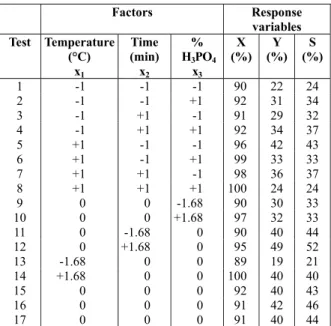
The central composite design (CCD) was used to evaluate the effects of three independent variables or factors: temperature (x1), time (x2) and concentration of catalyst (x3). The design consisted of 8 factorial points (2n = 2³ = 8), 6 axial points and 3 central points, totaling 17 trials. The glucose conversion (X), the HMF yield (Y) and the HMF selectivity (S) are the de-pendent variables. The studied levels for each factor are described in Table 1. STATISTICA version 6 was utilized to estimate the approach of RSM with CCD.
Table 1: The range and levels of the independent variables for CCD.
Levels Factors
-α -1 0 +1 +α
Temperature (°C) – x1 183.2 190 200 210 216.8
H3PO4 (% v/v) – x2 0.33 0.5 0.75 1.0 1.17
Time (min) – x3 1.6 3.0 5.0 7.0 8.4
RESULTS AND DISCUSSION
Glucose can form true oligosaccharides that still contain reactive reducing groups, resulting in a greater risk of cross-polymerisation with reactive intermedi-ates and HMF (Rosatella et al., 2011), coupled with the fact that the stability of the ring limits the yield in aqueous media. In many reactions the formation of black solid residues was observed, especially in tests conducted at high temperatures, as reported in Shi et al. (2013). The high concentration of glucose could favor the reverse reaction to form oligosaccharides that can be dehydrated and form char. For the tests 1-17, the conversions were greater than 89% (Table 2). Yield values ranged from 19% to 49 %, and the se-lectivity from 21 % to 52 %; the worst results were obtained in test 9, which was carried out at the low-est temperature, 183 °C. The effect of temperature on yield is observed when comparing this test with the ones at the central point (tests 15-17), where the conditions were the same except that the temperature was 200 °C: the HMF yield obtained was almost double that of test 9. In addition to HMF, levulinic acid, formic acid and furfural have been identified as products in a few tests.
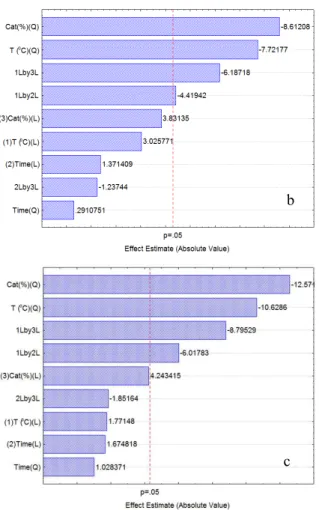
The statistical analysis was performed in four steps: significance test of the factors, graphical analy-sis of the residuals, ANOVA and application of F test to subsequently trace the response surface. The mag-nitude of the effects of the factors temperature, time and catalyst concentration on the response variables is shown in the diagrams of Figure 1, which presents
Pareto charts for glucose conversion (a), HMF yield (b) and selectivity (c). For the conversion, the tem-perature was the most influential factor, which is consistent with the natural tendency of glucose to be converted with increasing temperature, and all of the other factors were significant. On the other hand, the major influence on the yield was the catalyst concen-tration, for which the Pareto diagram indicates a reduction in the initial concentration of acid. The time factor was statistically significant for the conversion factor, and not significant for yield and selectivity, for the range of values studied. Since the yield is the main parameter of the study, all subse-quent analysis will be directed to evaluate the opti-mization of this factor.
Table 2: Experimental design matrix and results for CCD.
Factors Response variables
Test Temperature (°C)
x1
Time (min) x2
% H3PO4
x3 X (%)
Y (%)
S (%)
1 -1 -1 -1 90 22 24
2 -1 -1 +1 92 31 34
3 -1 +1 -1 91 29 32
4 -1 +1 +1 92 34 37
5 +1 -1 -1 96 42 43
6 +1 -1 +1 99 33 33
7 +1 +1 -1 98 36 37
8 +1 +1 +1 100 24 24
9 0 0 -1.68 90 30 33
10 0 0 +1.68 97 32 33
11 0 -1.68 0 90 40 44
12 0 +1.68 0 95 49 52
13 -1.68 0 0 89 19 21
14 +1.68 0 0 100 40 40
15 0 0 0 92 40 43
16 0 0 0 91 42 46
17 0 0 0 91 40 44
X = Conversion, S = Selectivity and Y = Yield (molar)
b b
cc
Figure 1: Pareto charts of CCD. Glucose dehydra-tion for glucose conversion (a) HMF yield (b) and selectivity (c).
The graphical analysis of the residuals was used to assess the normality of the data, which is indicated in Figure 2a. The expected behavior for a normal sample is observed in the graph, for which the points approximate a straight line. Once verified the nor-mality of the data, other tests can be performed in order to assess the statistical model generated by the program. One important analysis is shown in Figure 2b, comparing the values predicted versus values observed, in which the deviation from the straight line through the origin is small and the points show a linear trend, indicative of model fit.
Table 3 summarizes the regression analysis for HMF yield. Analysis of variance (ANOVA) was ap-plied to test the mathematical modeling with α = 0.05 (level of significance) and is presented in a simpli-fied form. The F test was used to verify that the change of the independent variable had a significant influence on the variation of the dependent variable; if so, the calculated value of F (Fcalc) is greater than the tabulated F (Fvalue). This hypothesis was verified
for the three response variables, indicating that the model generated adequately described the phenome-non. The F test was used to verify that the change of the independent variable had a significant influ-ence on the variation of the dependent variable; since Fcalc = 17.3074 is greater than Fvalue = 3.63, this hy-pothesis was verified, indicating that the model gen-erated describes adequately the phenomenon.
Figure 2: Graphical analysis of residuals. a) com-parison of normal probability to residuals; b) Ob-served vs. predicted values for HMF yield.
Table 3: ANOVA of glucose conversion, HMF yield and selectivity.
Mode Sum of
squares
Degrees of freedom
Mean Squares
FValue FTable
HMF Yield
Regression 875.75 9 925.207 17.3074F0.05=3.63 Residual 255.286 7 53.4573
Total 1131.036 16
Brazilian Journal of Chemical Engineering Vol. 32, No. 02, pp. 501 - 508, April - June, 2015
an acceptable degree of agreement between the pre-dicted and the observed values. For the response variable in question the R² obtained was 0.75165 and the lack of fit with p = 0.099531, greater than 0.05, therefore not significant and is within of significance level established. The equation is obtained for the coded values of the variables.
2
1 1 3
3 1 3
Y 42.428 1.638x 4.651(x ) 2.074x
5.181(x ) – 4.375x x
= + − +
− (4)
The model generates the response surface of Figure 3, in which the relation between the HMF yield and the significant response variables, temperature and catalyst concentration, is shown graphically. For this, the time at the central point, 5 min, was set. Despite the borderline fit of the model, it is possible to verify the advantage of modeling the data showing clearly that the HMF yield is optimized for the system stud-ied. This result is consistent because at higher tem-peratures, the yield decreases due to the occurrence of side reactions, and at higher catalyst concentra-tions the same effect occurs.
Figure 3: Response surface for HMF yield based on temperature and catalyst concentration.
Effect of Biphasic System
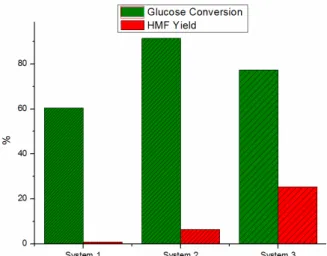
To evaluate the effect of the two-phase system on the HMF yield and the possibility that formic and levulinic acids promote dehydration of glucose with-out catalyst, three tests were performed and yields are shown in Figure 4. It was observed that only at 200 °C were significant yields obtained for the three systems. Ranoux et al. (2013) reported a 19% conversion of glucose to HMF to 195 °C with 38% selectivity using only water. As shown in Figure 5,
approximately 60% conversion was reached at 200 °C for the system water-glucose. The most probable hypothesis is that the use of the closed and agitated reactor contributed to a higher rate of mass transfer and thus increased the conversion of glucose. How-ever, it had a negative effect on the stability of the HMF yield leading to only 0.4% in this condition. By adding the catalyst, as expected, conversion increased considerably and this trend was also observed for the yield, yet in the experiment with acetone increases to 25.3%. Therefore, there is overwhelming evidence that the addition of a solvent to form a second phase that takes up HMF is critical to achieve high yields at higher temperatures.
Figure 4: HMF molar yields at different tempera-tures. Reaction conditions: glucose solution 250 g.L-1 for all systems, phosphoric acid 1% (v/v) when pre-sent and acetone:água 1:1 for the biphasic systems (HMF not isolated).
The formation of formic acid, levulinic acid, fur-fural and HMF is shown in Figure 6 for the different temperatures tested for the system glucose, water and phosphoric acid. The results corroborate the hypothesis of HMF rehydration due to the high concentration of formic acid formed. Qi et al. (2008) observed that the fructose conversion and HMF yield improved with an increase in acetone concentration in the acetone–water mixtures attributed to a conformational change of fruc-tose to the furanoid form in the presence of acetone, and to the suppression of HMF dehydration. The mechanism of glucose dehydration is still unclear for this mixture. In this study, small amounts of fructose were detected as product, but were insufficient to state that isomerization had occurred. Shi et al. (2013) reached a 45.2% yield of HMF in a biphasic system using water:tetrahydrofuran (THF) 1:10, NaHSO4 and
ZnSO4 as a catalyst and 0.2 g of glucose in 44 mL of solvent. However, the authors employed THF as the major solvent, which does have some disadvantages, such as high cost and environmental effects. A slightly higher yield (58%) was obtained by Caes et al. (2013) in a system with N, N-dimethylacetamide (ionic liquid), CrCl2 and 10% glucose by weight.
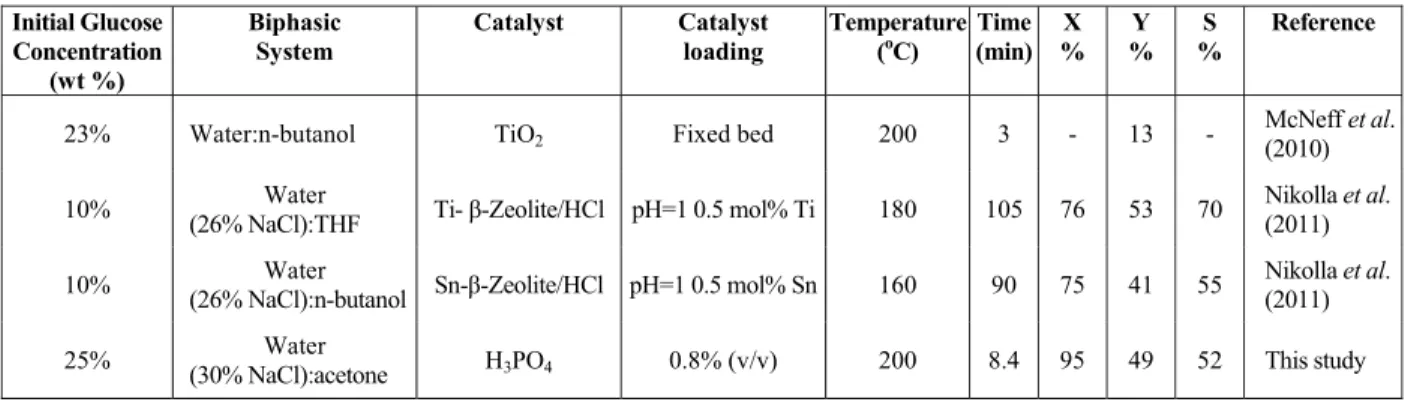
Table 4 shows a comparison between HMF yields and initial concentrations of glucose using biphasic systems. McNeff et al. (2010) used an initial glucose concentration, time and temperature similar to those used in this study. Nikolla et al. (2011) obtained a yield similar to that obtained in this work, however, using an inorganic acid and a solid catalyst. How-ever, HMF yields from glucose remain low when compared to fructose, as noted by Putten et al. (2013) in their recent review.
120 140 160 180 200
0 5 10 15 20
HMF Formic Acid Levulinic Acid Furfural
Temperature (°C)
Pr
o
d
u
c
ts
C
o
n
c
e
n
tr
a
ti
o
n
(g
.L
-1)
Figure 6: Product concentration versus temperature, using 1% H3PO4 (v/v) and initial glucose solution.
Table 4: HMF yields from glucose obtained in two-phase systems.
Initial Glucose Concentration
(wt %)
Biphasic System
Catalyst Catalyst loading
Temperature (oC)
Time (min)
X %
Y %
S %
Reference
23% Water:n-butanol TiO2 Fixed bed 200 3 - 13 -
McNeff et al. (2010)
10% Water
(26% NaCl):THF Ti- β-Zeolite/HCl pH=1 0.5 mol% Ti 180 105 76 53 70
Nikolla et al. (2011)
10% Water
(26% NaCl):n-butanol Sn-β-Zeolite/HCl pH=1 0.5 mol% Sn 160 90 75 41 55
Nikolla et al. (2011)
25% Water
(30% NaCl):acetone H3PO4 0.8% (v/v) 200 8.4 95 49 52 This study
Brazilian Journal of Chemical Engineering Vol. 32, No. 02, pp. 501 - 508, April - June, 2015
CONCLUSIONS
The analysis of the response surface for the vari-able yield, keeping the time constant at 5 minutes, demonstrated that the system was otimized, consider-ing the inlet variables: temperature (183.2 to 216.8 °C) and catalyst (0.33 to 1.17%). The water:acetone system studied was able to convert glucose into 5-hydroxy-methylfufural, using an aprotic solvent with low boiling point, enabling a less energy-intensive recov-ery of the solvent. The use of a biphasic system with acetone and NaCl to extract the HMF promoted an increase in the reaction yield compared to the aque-ous system because HMF migrates preferentially into the organic phase, avoiding its rehydration. The sta-tistical analysis showed that the HMF yield is opti-mized within the range of factors used. The best result obtained was an approximately 50% HMF yield at 200 °C, in 8.4 minutes and 0.75% of catalyst, which is appreciable when considering the low reac-tion time, ease of solvent recovery and low toxicity of the reagents; however, HMF was not totally iso-lated from the reaction medium. The relativity low cost of the reaction system (catalyst and solvent), when compared to the cost of ionic liquids or other aprotic solvents, makes this system even more attractive.
ACKNOWLEDGMENTS
Special thanks to Luiz Claudio for the support, Professor Nielson Ribeiro and other coworkers of LADEBIO and LABTECH.
REFERENCES
Antal, M. J., Mok, W. S. L. and Richards, G. N., Mechanism of formation of 5-(hydroxymethyl)-2-furaldehyde from d-fructose and sucrose. Carbohydr. Res., 199, 91-109 (1990).
Bicker, M., Hirth, J. and Vogel, H., Dehydration of fructose to 5-hydroxymethylfurfural in sub- and supercritical acetone. Green Chem., 5, 280-284 (2003).
Caes, B. R., Palteb, M. J. and Raines, R. T., Organo-catalytic conversion of cellulose into a platform chemical. Chemical Science, 4, 196-199 (2013). Combs, E., Cinlar, B., Pagan-Torres, Y., Dumesic, J.
A. and Shanks, B. H., Influence of alkali and al-kaline earth metal salts on glucose conversion to 5-hydroxymethylfurfural in an aqueous system. Cat. Comm., 30, 1-4 (2013).
Daorattanachai, P., Khemthong, P., Vriya-empikul, N., Laosiripojana, N. and Faungnawakij, K., Conversion of fructose, glucose, and cellulose to 5-hydroxymethylfurfural by alkaline earth phos-phate catalysts in hot compressed water. Carbo-hyd. Res., 363, 58-61 (2012).
Huang, R., Qi W., Su, R. and He, Z., Integrating enzymatic and acid catalysis to convert glucose into 5-hydroxymethylfurfural. Chem. Commun., 46, 1115-1117 (2010).
Lecomte, J., Finiels, A. and Moreau, C., Kinetic study of the isomerization of glucose into fructose in the presence of anion-modified hydrotalcites. Starch/Stärke, 54, 75-79 (2002).
McNeff, C. V., Nowlan, D. T., McNeff, L. C., Yan, B. and Fefie, R. L., Continuous production of 5-hydroxymethylfurfural from simple and complex carbohydrates. App. Catal., A, 384, 65-69 (2010). Moliner, M., Roman-Leshkov, Y. and Davis, M., Tin-containing zeolites are highly active catalysts for the isomerization of glucose in water. Proc. Natl. Acad. Sci., 107, 6164-6168 (2010).
Moreau, C., Belgacem, M. N. and Gandini, A., Re-cent catalytic advances in the chemistry of substi-tuted furans from carbohydrates and in the ensu-ing polymers. Top. Catal., 27(1-4), 11-30 (2004). Nikolla, E., Román-Leshkov, Y., Moliner, M., Davis,
M. E., “One-pot” synthesis of 5-(hydroxymethyl) furfural from carbohydrates using tin-beta zeolite. ACS Catal., 1, 408-410 (2011).
Peng, L., Lin, L. and Li, H., Extremely low sulfuric acid catalyst system for synthesis of methyl levu-linate from glucose. Ind. Crops Prod., 40, 136-144 (2012).
Peng, L., Lin, L., Zhang, J., Shia, J. and Liub, S., Solid acid catalyzed glucose conversion to ethyl levulinate. App. Catal., A, 397, 1-2, 259-265 (2011). Pidko, E. A., Degirmenci, V., Santen, R. A. and
Hensen, E. J. M., Glucose Activation by Transient Cr2+ Dimers. Angew. Chem. Int. Ed., 49, 2530-2534 (2010).
Putten, R.-J., Waal, J. C., Jong, E., Rasrendra, C. B., Heeres, H. J. and Vries, J. G., Hydroxymethylfur-fural, a versatile platform chemical made from renewable resources. Chem. Reviews, 113, 1499-1597 (2013).
Qi, X., Watanabe, M., Aidaa, T. M., Smith Jr. R. L., Catalytic dehydration of fructose into 5-hydroxy-methylfurfural by ion-exchange resin in mixed-aqueous system by microwave heating. Green Chem., 10, 799-805 (2008).
from hexoses is autocatalytic. ACS Catal., v. 3, 4, 760-763 (2013).
Rasrendra, C. B., Makertiharth, I. G., Adisasmito, S. and Heeres, H. J., Green chemicals from d-glu-cose: Systematic studies on catalytic effects of in-organic salts on the chemo-selectivity and yield in aqueous solutions. Top. Catal., 53, 1241-1247 (2010).
Ribeiro, M. L. and Schuchardt, U., Cooperative ef-fect of cobalt acetylacetonate and silica in the catalytic cyclization and oxidation of fructose to 2,5-furandicarboxylic acid. Catal. Commun., 4, 83-86 (2003).
Román-Leshkov, Y. and Dumesic, J. A., Solvent effects on fructose dehydration to 5-hydroxymethylfurfural in biphasic systems saturated with inorganic salts. Top. Catal., 52, 297-303 (2009).
Román-Leshkov, Y., Barrett, C. J., Liu, Z. Y. and Dumesic, J. A., Production of dimethylfuran for liquid fuels from biomass-derived carbohydrates. Nature, 447, 982-986 (2007).
Rosatella, A. A., Simeonov, S. P., Frade, R. F. M. and Afonso, C. A. M., 5-Hydroxymethylfurfural (HMF) as a building block platform: Biological proper-ties, synthesis and synthetic applications. Green Chem., 13, 754-793 (2011).
Shi, N., Liu, Q., Zhang, Q., Wang, T. and Ma L., High yield production of 5-hydroxymethylfurfural from cellulose by high concentration of sulfates in biphasic system. Green Chemistry, 15, 1967-1974 (2013).
Simeonov, A. P., Coelho, J. A. S., Afonso, C. A. M., Integrated chemo-enzymatic production of 5-hy-droxymethylfurfural from glucose. ChemSusChem, 6, 997-1000 (2013).
Watanabe, M., Aizawa, Y., Lida, T. M., Ainda, T. M., Levy, C., Sue, K. and Inomata, H., Glucose reac-tions with acid and base catalysts in hot compressed water at 473 K. Carbohyd. Res., 340, 1925- (2005). Yang, Y., Hua, C. and Abu-Omar, M. M., Conversion
of glucose into furans in the presence of AlCl3 in an ethanol–water solvent system. Biores. Tech., 116, 190-194 (2012).
Zakrzewska, M. E., Bogel-Łukasik, E., Bogel-Łukasik, R., Ionic liquid-mediated formation of 5-hy-droxymethylfurfuralsa promising biomass-de-rived building block. Chemical Reviews, 111, 397-417 (2011).