ISSN 0104-6632 Printed in Brazil
www.abeq.org.br/bjche
Vol. 31, No. 02, pp. 561 - 570, April - June, 2014 dx.doi.org/10.1590/0104-6632.20140312s00002760
Brazilian Journal
of Chemical
Engineering
SOLUBILITY MEASUREMENT AND
SOLID-LIQUID EQUILIBRIUM
MODEL FOR THE TERNARY SYSTEM
MgBr
2
+ MgSO
4
+ H
2
O AT 288.15 K
Dan Li
1*, Bo Huang
2, Lingzong Meng
3,4and Qinhong Xu
31
School of Media Communications, Phone/Fax: +86-539-8766336, Linyi University, Linyi 276000, P. R. China. E-mail: [email protected]
2
Linyi Institute of Product Quality Supervision, Inspection and Testing, Linyi, 276000, P. R. China.
3School of Chemistry and Chemical Engineering, Linyi University, Linyi, 276000, P. R. China. 4
Tianjin Key Laboratory of Marine Resources and Chemistry, Tianjin University of Science and Technology, Tianjin, 300457, P. R. China.
(Submitted: July 12, 2013 ; Revised: August 28, 2013 ; Accepted: September 23, 2013)
Abstract - The solubility of magnesium minerals and the refractive index of the ternary system MgBr2 +
MgSO4 + H2O at 288.15 K were investigated using an isothermal dissolution method. It was found that there
are two invariant points in the phase diagram and the solubility isotherm of this ternary system consists of three branches, corresponding to equilibrium crystallization of Epsomite (MgSO4·7H2O, Eps), hexahydrite
(MgSO4·6H2O, Hex) and magnesium bromide hexahydrate (MgBr2·6H2O, Mb). Neither solid solutions nor
double salts were found. The refractive indices calculated from empirical equation are in good agreement with the experimental data. Combining the results from solubility measurements with the single-salt parameters for MgBr2 and MgSO4, and the mixed ion-interaction parameter
4
Br,SO
θ , the parameter
4
Mg,Br,SO
ψ at 288.15 K was fitted using the Pitzer theory and Harvie-Weare (HW) approach. In addition, the average equilibrium constants of the stable equilibrium solids at 288.15 K were obtained by a method using the activity product constant. A chemical model, which combined the Pitzer parameters and the average equilibrium constants, was constructed to calculate the solid + liquid equilibria in the ternary system MgBr2 + MgSO4 + H2O at
288.15 K. The model agreed well with the equilibrium solubility data for the magnesium salts.
Keywords:Phase equilibrium; Phase diagram; Magnesium bromide; Solubility; Pitzer model.
INTRODUCTION
Bromine-containing brine is widely distributed in the Qinghai-Tibet Plateau and the Sichuan basin of China (Zheng et al., 1988; Sang et al., 2011). These brines belong mostly to the complex system Li + Na + K + Mg (Ca) + Cl +SO4 + Br + borate + H2O. The phase equilibria and phase diagrams are the theoreti-cal foundations for exploiting the brine resources and describing the geochemical behaviour of the brine
and mineral systems. Therefore, investigations of the thermodynamics and the phase diagram of bromine-containing systems at different temperatures are valu-able, because this investigation provides the theoreti-cal foundation and scientific guidance for the com-prehensive and effective exploitation of bromine resources.
2012a, 2012b and 2012c; Christov, 2011). The ternary system MgBr2 + MgSO4 + H2O has previously been investigated at 273.15, 298.15 and 308.15 K since the 1960s, but the solubility data and the reports of the corresponding equilibrium solid phases are not complete. In the literature (Howard and Silcock, 1979), both MgSO4·7H2O and MgSO4·6H2O occur at 273.15 K, but no invariant points saturated with MgSO4·7H2O + MgSO4·6H2O have been reported yet. More complicatedly, at 298.15 K, there are five crys-tallisation fields, corresponding to MgSO4·7H2O, MgSO4·6H2O, MgSO4·5H2O, MgSO4·H2O and MgBr2·6H2O, but there is only one invariant point saturated with MgBr2·6H2O + MgSO4·H2O. At 308.15 K, there are only two crystallisation fields (MgBr2·6H2O and MgSO4·7H2O). All the data for the system MgBr2 + MgSO4 + H2O system at 273.15, 298.15 and 308.15 K need to be investigated again. Recently, we reported a detailed study on the system at 323.15 K (Meng et al., 2013). It was found that there are four crystallisation fields MgSO4·6H2O, MgSO4·4H2O, MgSO4·H2O and MgBr2·6H2O. As it is known, the temperature in the Qinghai-Tibet Plateau in summer is nearly 288.15 K, but the ter-nary system at 288.15 K has not been reported in the literature to date.
Computer models, which can predict the behav-iour of solutions and solid + liquid equilibria with close to experimental accuracy, have wide applica-bility. The current theory for aqueous solutions of electrolytes is reliable for calculating the solubilities of a salt-water system. There are also studies that embrace currently available theories of electrolyte solution chemistry to simulate the physicochemical processes of solutes, and these studies are able to predict thermodynamic behaviour. These widely used models are important for studying the geo-chemistry of natural waters and mineral deposits, as well as for solving environmental problems and op-timising industrial processes (Christov, 2012a). Pitzer and co-workers developed an ion-interaction model and published a series of papers (Pitzer 1973; Pitzer 1992), which gave a set of expressions for the osmotic coefficients of a solution and the mean ac-tivity coefficients of electrolytes in solution. Single ion activity coefficients, which are more convenient to use in solubility calculations, are given in the Harvie and Weare modelling approach (Harvie and Weare, 1980; Harvie et al, 1984). On the basis of the Pitzer approach and its extension the Harvie-Weare (HW) model (denoted hereafter as the Pitzer and HW model), the solubilities of the systems containing bromine were predicted (Meng, 2013; Christov, 2012a, 2012b and 2012c; Christov, 2011), and these
predictions demonstrated that the Pitzer and HW model could be expanded to calculate the solubility of bromine minerals in complex brines accurately. However, studies modelling the ternary system MgBr2 + MgSO4 + H2O at 288.15 K are still lacking in the literature.
In this study, the solubilities and the relevant re-fractive indices of the ternary system MgBr2 + MgSO4 + H2O at 288.15 K were determined. Addi-tionally, a chemical model incorporating Pitzer theory and the HW approach was constructed to calculate the solid + liquid equilibrium in the ternary system.
EXPERIMENTAL SECTION
Apparatus and Reagents
A thermostatic shaker (model THZ-82, Jintan Yitong Electronics Co., Ltd., China) was used to pre-pare the solution in its equilibrium state. The tem-perature in the thermostatic bath was maintained at a constant temperature of (288.15 ± 0.1) K, and the de-tailed experimental procedures were described previ-ously (Meng et al., 2011). The solid phase minerals were determined using Schreinemaker’s method (Song, 1991) and an X-ray diffractometer (D8 Advance, Bruker Ltd., Germany). All the analytical grade chemi-cals, which were obtained from the Chengdu Aike Chemical Reagent Plant or the Shanghai Xinbao Fine Chemical Plant, were recrystallised before use, includ-ing magnesium bromide hexahydrate (MgBr2·6H2O, with mass fraction 0.98) and epsomite (MgSO4·7H2O, 0.99). Doubly deionised water (DDW) with a conductivity of less than 1.2×10⁻⁴ S·m-1 at 298.15 K was used to prepare the series of artificial, synthe-sised brines and for the chemical analysis.
Experimental Methods
Solubility Measurement and Solid-Liquid Equilibrium Model for the Ternary System MgBr2 + MgSO4 + H2O AT 288.15 K 563
measurement. If the difference between two refrac-tive index measurements was within ± 0.0002, then the equilibrium state was achieved. Otherwise, the solution was rotated continually until the equilibrium state was achieved. Generally, it took approximately 20 days to reach the equilibrium state. Twice, at different times, a sample of approximately 5.0 mL was taken, weighed and diluted to a final volume of 250 mL using a volumetric flask filled with DDW. Then, a quantitative analysis was performed. If the difference between the concentrations of the two liquid phases was within ± 0.3% in mass fraction, then the solubility of this equilibrium point, which was the average of the experimental data, was ob-tained. Meanwhile, some of the wet residue was separated from the solution, and one portion of the wet residue was weighed and dissolved to a final volume of 250 mL using a volumetric flask filled with DDW for chemical analysis by Schreinemaker's wet residue method (Song, 1991) (i.e., the solid phase mineral point lies on the extension of the line on the phase diagram through the composition points of the liquid phase and the wet residue). Another portion was dried, ground into powder and analysed by X-ray diffraction. The solid phase could then be identified.
Analytical Methods
The concentrations of the liquid phases and the wet residues were analysed with chemical analytical methods. The concentration of Mg2+ was determined with a precision of within ± 0.3% in mass fraction by titration with an EDTA standard solution in the pres-ence of the indicator Eriochrome Black-T. The Br -concentration was measured by titration with a stan-dard solution of Hg(NO3)2 using a mixed indicator of diphenylcarbazone and bromophenol blue (precision: ±0.3%) (Zhai et al., 1988). The SO42- concentration was calculated by subtraction via charge balance. An Abbe refractometer (model WZS-1) was used to measure the refractive index (nD) with an uncertainty of ± 0.0001. Through control with a thermostat, all measurements were conducted at the desired tem-perature of (288.15 ± 0.1) K.
RESULTS AND DISCUSSION
Solubility and Refractive Index Data
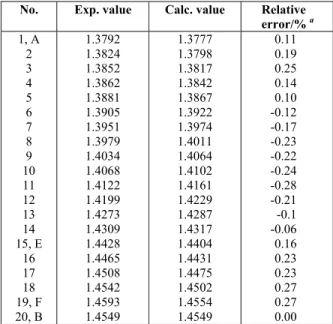
The solubility and the refractive index data of the system MgBr2 + MgSO4 + H2O at 288.15 K are pre-sented in Tables 1 and 2. The mineral concentrations
in the stable equilibrium solutions and the wet resi-due are expressed as mass percentage. Based on the experimental data (Table 1), the stable phase dia-gram of the system at 288.15 K was plotted, as shown in Figure 1.
Table 1: Solubility data of the ternary system MgBr2 + MgSO4 + H2O at 288.15 K.
Liquid phase, 102wa
Wet residue, 102w
No.
MgBr2 MgSO4 MgBr2 MgSO4
Equilibrium solid phaseb
1, A 2 3 4 5 6 7 8 9 10 11 12 13 14 15, E 16 17 18 19, F 20, B 0.00 4.37 7.38 10.15 13.34 17.59 21.62 24.06 27.51 29.50 32.82 35.71 38.25 39.61 43.33 44.52 45.60 46.89 49.10 49.70 24.60 20.10 17.22 14.99 12.19 9.67 7.24 6.06 4.43 3.83 2.69 2.55 2.31 2.14 1.87 1.72 1.57 1.29 1.03 0.00 —c 1.82 3.31 4.51 5.78 7.32 8.85 10.77 12.46 13.58 15.08 16.43 18.13 18.69 20.47 22.34 27.67 28.05 28.41 — — 36.34 35.75 35.14 34.31 32.81 32.24 30.3 29.45 28.55 27.95 28.09 27.33 26.70 27.40 27.21 21.34 21.76 24.12 — Eps Eps Eps Eps Eps Eps Eps Eps Eps Eps Eps Eps Eps Eps Eps + Hex
Hex Hex Hex Hex + Mb
Mb
a
w, mass percentage; b
Eps, MgSO4·7H2O; Hex, MgSO4·6H2O; Mb,
MgBr2·6H2O; c—, means not detected.
Table 2: Experimental and calculated refractive index data of the ternary system at 288.15 K.
No. Exp. value Calc. value Relative
error/% a 1, A 2 3 4 5 6 7 8 9 10 11 12 13 14 15, E 16 17 18 19, F 20, B 1.3792 1.3824 1.3852 1.3862 1.3881 1.3905 1.3951 1.3979 1.4034 1.4068 1.4122 1.4199 1.4273 1.4309 1.4428 1.4465 1.4508 1.4542 1.4593 1.4549 1.3777 1.3798 1.3817 1.3842 1.3867 1.3922 1.3974 1.4011 1.4064 1.4102 1.4161 1.4229 1.4287 1.4317 1.4404 1.4431 1.4475 1.4502 1.4554 1.4549 0.11 0.19 0.25 0.14 0.10 -0.12 -0.17 -0.23 -0.22 -0.24 -0.28 -0.21 -0.1 -0.06 0.16 0.23 0.23 0.27 0.27 0.00 a
0 20 40 60 80 100 0
20 40 60 80 100
w
(
Mg
SO
4
)
×
10
2
w(MgBr2)×102
F E
Eps
Hex Mb
B A
H2O
Figure 1: Stable phase diagram of the ternary system MgBr2 + MgSO4 + H2Oat 288.15 K; ●, experimental solubility data; —, experimental stable isotherm curve.
The stable phase diagram of the system at 288.15 K consists of three stable crystallisation fields corre-sponding to Epsomite (MgSO4·7H2O, Eps), hexahy-drite (MgSO4·6H2O, Hex) and magnesium bromide hexahydrate (MgBr2·6H2O, Mb). Points E and F are the invariant points, which are saturated with Eps + Hex and Hex + Mb. Curves AE, EF and FB are the univariant curves, which are saturated with a single salt (Eps, Hex or, Mb). The Eps crystallisation area is relatively large; whereas, the Hex crystallisation area is relatively small. The smallest crystallisation area is that of Mb. These results indicate that magne-sium sulphate is relatively easy to saturate and that magnesium bromide has a high solubility. Neither solid solutions nor double salts were found. Because it is known that the phase diagram of the MgCl2 + MgSO4 + H2O system at 288.15 K (Howard and Silcock, 1979) also consists of crystallisation fields corresponding to Eps, Hex and MgCl2·6H2O (Bis), it is shown that magnesium bromide reacts with mag-nesium sulphate in solution similarly to magmag-nesium chloride.
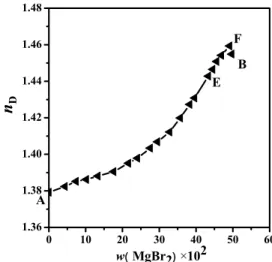
Using the refractive index data shown in Table 2, the relationships of the solutions’ refractive index to the concentration of magnesium bromide were plot-ted in Figure 2. It is seen that the refractive indices of the solutions increase with the increase in magne-sium bromide concentration, reach their maximum values at invariant point F (Hex + Mb), and then decrease. Using the diagram (Figure 2), the refrac-tive index could be used to roughly estimate the magnesium bromide concentration in the ternary system.
0 10 20 30 40 50 60 1.36
1.38 1.40 1.42 1.44 1.46 1.48
w(MgBr2)×102
A
F
B E
n
DFigure 2: Refractive index data versus composition of the ternary system MgBr2 + MgSO4 + H2O at 288.15 K. ▲, experimental data; —, experimental curve.
Comparison of the Ternary System at Different Temperatures
Solubility Measurement and Solid-Liquid Equilibrium Model for the Ternary System MgBr2 + MgSO4 + H2O AT 288.15 K 565
various minerals at different temperatures is impor-tant for the recovery of hydrated magnesium sul-phate. Because of the lack of invariant points and of some crystallisation fields in the system at 273.15, 298.15 and 308.15 K, the differences between the dia-grams at the five temperatures were not developed further.
0 10 20 30 40 50 60 0
10 20 30 40
w
(
MgS
O4
)
×
10
2
w(MgBr2)×102
273.15 K
288.15 K
298.15 K
308.15 K
323.15 K
B A
H2O
Figure 3: Comparison of the phase diagrams of the ternary system MgBr2 + MgSO4 + H2O at different temperatures; ○, 273.15 K [11];▲, 288.15 K [11]; , 298.15 K; ●, 308.15 K [11]; , 323.15 K.
Empirical Equation for the Refractive Index
Song and Du (Song and Du, 1986) have given an expression, which has been widely used in brine systems, for the refractive index and solubility data. The following empirical equation was used to cal-culate the refractive index:
(
0)
ln n n/ = ∑ ×Bi Wi (1)
where n0 = 1.333390, the refractive index of water at 288.15 K. Bi is the coefficients of each possible component i in the system. Wi is the salt of i in the solution in mass fraction. For the calculation of the refractive index of MgBr2 and MgSO4,coefficients Bi were set to be 0.001725, 0.001328, respectively. The calculated results and experimental values are pre-sented for comparison in Table 2, and the maximum relative deviations for all of the calculated results are less than 0.28%. The reasons for the relative errors in the data in Table 2 are multifarious and include the error in the solubility data caused by temperature deviations, the uncertainty in the concentration, and the uncertainty in the measurements of refractive index. The calculated values agree well with the experimental data, and this agreement shows that the coefficients Biobtained in this work are reliable and can be used for more complicated systems contain-ing MgBr2 and MgSO4 at 288.15 K.
SOLUBILITY PREDICTION
Ion-Interaction Model
The Pitzer theory and HW approach, which in-corporate concentration dependent equations show-ing the specific interactions of the solutes (Pitzer 1973; Pitzer 1992; Harvie and Weare, 1980; Harvie
et al, 1984), were used for the aqueous solutions in this study. Additional work has centred on develop-ing variable temperature models below 298.15 K, which have increased applicability to a number of diverse geochemical systems (Spencer et al., 1990; Marion and Farren, 1999). The following equations, which are described in the literature (Pitzer 1992), are the main expressions related to the solubility calculation of this model.
i
'
Ø 3/2 1/2 Ø
Ø Ø
' ' ' ' ' '
a '
(ø 1) (2 / ) [ / 1( ) ( )
( ) ( )]
< <
+
+
− = − + +
Φ + Ψ + Φ + Ψ
∑
∑ ∑
∑ ∑
∑
∑ ∑
∑
i c a ca ca
c c cc a cc a a a aa c ca
c a
c c a a c
a
m A I bI m m B ZC
m m m m m m
(2)
(
)
2
' '
'
(
ln 2 2 )
a c a
a
M M a Ma Ma c Mc a Mca
a a Maa M c a ca
a c a
z F m B ZC m m
m m z m m C
<
=
+
γ + + + Φ + Ψ
Ψ +
∑
∑
∑
(
)
2' '
'
(
ln 2 2 )
c a c
X X c cX cX a Xa c cXa
c c cc X X c a
c
c
c c a
a
z F m B ZC m m
m m z m m C
<
+
+
γ = + + Φ + Ψ
Ψ +
∑
∑
∑
∑ ∑
∑ ∑
(4)In expressions (2) to (4), M, C and C′ represent cations, X, A and A′ represent anions, and NC and NA refer to the number of cations and anions, respec-tively. Additionally, mi and i represent the concen-tration (mol·kg−1) and the activity coefficient of the ions, respectively, Zirefers to the valence of the ions, and ø refers to the permeability coefficient. The other symbols in Eqs. (3) to (5), for example, F, C, Z, AØ, Ψ, Φ, BØ, and B, are all described in the refer-ences (Harvie and Weare, 1980; Harvie et al, 1984).
For a hydrated salt,
M X 0
υ υ υ 2
M X ּ H O, the
solubil-ity equilibrium constant (Ksp) for the dissolution reaction at a definite temperature and pressure is expressed as follows:
M X
M
Z Z
M X
2 0
0 2
H
H X
O
O M
X
Mυ Xυ + −
υ
⋅ υ = υ + υ
+ (5)
M M M X X X 0
ln spK = υ ln(m γ )+ υ ln m( γ )+ υ αln w (6)
The activity of water is related to the osmotic co-efficient ø, by the equation
i
lnα = −w øMW∑m (7)
where Mw is the molar mass of water (kg·mol-1), and the sum covers all the solute species. The activity coefficients i, and the osmotic coefficients ø can be calculated using the Pitzer and HW model.
M X M X
1
( )
M X
= ( ) +
±
γ γ ν × γ ν ν ν
(8)
The mean activity coefficients ±, which are a function of the activity coefficients M and X in Equation (8), can also be calculated using the Pitzer theory and HW approach.
According to the Pitzer theory and HW approach, the activity and osmotic coefficients are parametric functions of (0), (1), (2), CØ, θcc′ and ψcc′a; (0), (1),
(2)
, and CØare the parameters of a single salt; θcc′ represents the interaction between the two ions with
the same sign, and ψcc a′ represents the interactions among the three ions, in which the sign of the third ion is different from the first two ions. By combining the Pitzer parameters and the equilibrium constants of single salts, a chemical model could be con-structed to calculate the solid + liquid equilibrium in the ternary MgBr2 + MgSO4 + H2O system at 288.15 K from Eqs. (2)-(8).
Model Parameterization
The Debye–Hückel parameter Aø = 0.385646 at 288.15 K was obtained from the literature (Spencer
et al., 1990). The Pitzer binary parameters for MgBr2, and the mixing parameters θBr,SO4were cal-culated from the temperature-dependent equations presented in the literature (Christov, 2011; Christov, 2012b). The Pitzer binary parameters for MgSO4 can be gotten from the literature (Spencer et al., 1990; Marion and Farren, 1999), but the parameter (2) for MgSO4 is not mentioned in the literature (Spencer et
al., 1990). Therefore, the parameters for MgSO4 used in this study were calculated using the literature (Marion and Farren, 1999). The solubility data for the ternary system MgBr2 + MgSO4 + H2O in this study were used to fit the mixing parameters
4
Mg Br SO
Solubility Measurement and Solid-Liquid Equilibrium Model for the Ternary System MgBr2 + MgSO4 + H2O AT 288.15 K 567
Therefore, the average equilibrium constants (lnKaver) of equilibrium solid salts were used to cal-culate the solubilities in this study. These average equilibrium constants (lnKaver) and uncertainties for the equilibrium solid salts of MgSO4·7H2O, MgSO4·6H2O are presented in Table 4.
Table 3: Single-salt and mixing ion-interaction parameters of the systems at 288.15 K.
Parameters Value Reference
(0)
(MgBr2) (1)
(MgBr2)
C(ø) (MgBr 2) (0)
(MgSO4) (1)
(MgSO4) (2)
(MgSO4)
C(ø) (MgSO 4) 4
Br,SO
θ
4
Mg,Br,SO
Ψ
0.409524 1.945165 0.005198 0.109518 3.004927 0.725033 0.067418 0.03 0.138242
Christov, 2011 Christov, 2011 Christov, 2011 Marion and Farren, 1999 Marion and Farren, 1999 Marion and Farren, 1999 Marion and Farren, 1999
Christov, 2012b This work
Table 4: Values for the average equilibrium con-stants of the ternary system at 288.15 K.
Species lnKsp Uncertainty
MgBr2·6H2O 11.6742 ±0.0342
MgSO4·7H2O -3.4955 ±0.6120
MgSO4·6H2O 2.7152 ±0.3701
Validation and Application of the Model
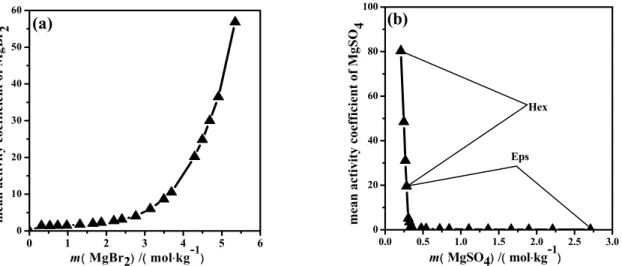
In Figure 4, we calculated the mean activity coef-ficients of magnesium bromide and magnesium sul-phate in the solutions ( ± vs. molality) up to the
satu-ration molality at 288.15 K using Equation (8). In Figure 4(a), the mean activity coefficients of magne-sium bromide increase with increasing concentra-tions of magnesium bromide. The ± values first de-crease with concentration to a wide minimum at low to moderate concentration, and an additional increase in molality leads to a sharp increase up to the equi-librium precipitation of the corresponding solids. The trend for the curve at 288.15 K is similar to that for the curve at 323.15 K, but the activity coeffi-cients in bromide electrolyte systems at 288.15 K are smaller than those for systems at 323.15 K (Meng et al., 2013). This result represents another step that validates the present parameters for the bromide systems presented in Table 3. Compared with the curve in Figure 4(a), the curve in Figure 4(b) shows the opposite trend. The ± values of magnesium sul-phate first decrease sharply with concentration and then change relatively smoothly with concentration. The solubilities for the ternary system at 288.15 K were also calculated using Eqs. (2)-(7) to validate the accuracy of the model. It should be noted that solutes below their saturation molalities were fixed at their experimental values and the saturated solubilities were calculated. The comparison of the calculated and the experimental phase diagrams of the ternary system is shown in Figure 5. The calculated phase diagram and the experimental phase diagram are found to be in good agreement. These results indi-cate that the model obtained in this work that com-bines the Pitzer parameters and the equilibrium con-stants is reliable and is capable of predicting equilib-rium in the system studied.
0 1 2 3 4 5 6
0 10 20 30 40 50 60
mean activity coefficient of M
g
Br
2
m(MgBr2)/(mol∙kg-1)
(a)
0.0 0.5 1.0 1.5 2.0 2.5 3.0
0 20 40 60 80 100
(b)
Eps Hex
mean
activi
ty coeffi
cient of
M
g
SO
4
m(MgSO4)/(mol∙kg-1)
0 10 20 30 40 50 60 0
10 20 30
Experimental data Calculaed data
w
(
Mg
S
O4
)
×
10
2
w(MgBr2)×102
B A
H2O
F Hex
E Eps
Mb
Figure 5: Comparison of the experimental and calculated phase diagrams of the stable ternary system MgBr2 + MgSO4 + H2O at 288.15 K; ○, Experimental data;▲, calculated data; —, experimental isotherm curve; …, calculated isotherm curve; Eps, MgSO4·7H2O; Hex, MgSO4·6H2O; Mb, MgBr2·6H2O.
CONCLUSIONS
The stable equilibria of the aqueous ternary sys-tem MgBr2 + MgSO4 + H2O were investigated at 288.15 K. The phase diagram and diagram of the variation in the refractive indices with composition were plotted for this system at 288.15 K. It was found that there are two three-salt cosaturated invari-ant points, three univariinvari-ant solubility isotherms, and three stable crystallisation fields in the ternary sys-tem. Neither solid solutions nor double salts are found. The refractive indices of the solution are positively correlated with the concentration of mag-nesium bromide, with the maximum value occurring at point F (Hex + Mb). No significant differences are found among the diagrams of the ternary system at different temperatures; however, the crystallisation fields are very different, especially the fields for hydrated magnesium sulphate. The empirical equa-tions were used to calculate the refractive indices; the coefficients have been fitted, and the calculated values for the refractive index are in good agreement with the experimental data.
The parameter
4
Mg,Br,SO
ψ
at 288.15 K was fitted using the measured solubility data in this study, and the average equilibrium constants for stable equilib-rium solids at 288.15 K were obtained with a method using the activity product constant. Based on Pitzer theory and the HW approach, a new chemical model, including the Pitzer parameters and the equilibrium constants, was constructed for the ternary system at 288.15 K. The model gave very good agreement with the equilibrium solubility data of the magnesium salts.ACKNOWLEDGEMENTS
Financial support from the Foundation of Tianjin Key Laboratory of Marine Resources and Chemistry at Tianjin University of Science & Technology (Gant. 201101) and the Science Foundation of Linyi University (Grant. BS201005) are greatly acknowl-edged. We also thank Prof. P.S. Song from the Qinghai Institute of Salt Lakes for his kind help.
NOMENCLATURE
AØ Debye–Hückel parameter
BØ parametric functions of Pitzer parameter
B parametric functions of Pitzer parameter
B' parametric functions of Pitzer parameter
CØ single-salt Pitzer parameter
C parametric functions of Pitzer parameter
f parametric functions of Pitzer parameter
g(x), g'(x) parametric functions of Pitzer parameter
I ionic strength mol/kg
Ksp solubility equilibrium constant
m molality mol/kg
M,C cation
Solubility Measurement and Solid-Liquid Equilibrium Model for the Ternary System MgBr2 + MgSO4 + H2O AT 288.15 K 569
X, A anion
z valence of ions
Z parametric functions of the molality of species i
Greek Letters
αw water activity (0)
single-salt Pitzer parameter (1)
single-salt Pitzer parameter (2)
single-salt Pitzer parameter υ number of ions in the
molecule
activity coefficient of the ions
ø osmotic coefficients
θ mixing ion interaction Pitzer parameter
Ψ mixing ion interaction Pitzer parameter
REFERENCES
Christov, C., Study of bromide salts solubility in the (m1KBr + m2CaBr2)(aq) system at T = 323.15 K. Thermodynamic model of solution behaviour and (solid + liquid) equilibria in the ternaries (m1KBr + m2CaBr2) (aq), and (m1MgBr2 + m2CaBr2)(aq), and in the quinary (Na + K + Mg + Ca + Br + H2O) systems to high concentration and tem-perature. J. Chem. Thermodyn., 55, 7-22 (2012). Christov, C., Temperature variable chemical model
of bromide–sulfate solution interaction parame-ters and solid–liquid equilibria in the Na–K–Ca–Br– SO4–H2O system. CALPHAD, 36, 71-81 (2012). Christov, C., Study of bromide salts solubility in the
(m1NaBr + m2MgBr2)(aq) system at T = 323.15 K. Thermodynamic model of solution behavior and (solid + liquid) equilibria in the (Na + K + Mg + Br + H2O) system to high concentration and temperature. J. Chem. Thermodyn., 47, 335-340 (2012).
Christov, C., Isopiestic investigation of the osmotic coefficients of MgBr2(aq) and study of bromide salts solubility in the (m1KBr + m2MgBr2)(aq) system at T = 323.15 K. Thermodynamic model of solution behaviour and (solid + liquid) equilib-ria in the MgBr2(aq), and (m1KBr + m2MgBr2) (aq) systems to high concentration and tempera-ture. J. Chem. Thermodyn., 43, 344-353 (2011). Cui, R. Z., Sang, S. H., and Hu, Y. X., Solid−liquid
equilibria in the quaternary systems KCl−KBr−
K2B4O7−H2O and KCl−KBr−K2SO4−H2O at 373 K. J. Chem. Eng. Data, 58, 477-481 (2013). Harvie, C. E., Møller, N. and Weare, J. H., The
pre-diction of mineral solubilities in nature waters: The Na-K-Mg- Ca-H-SO4-OH-HCO3-CO3-H2O system to high ionic strengths at 25 °C. Geochim. Cosmochim. Acta,48, 723-751 (1984).
Harvie, C. E., and Weare, J. H., The prediction of mineral solubilties in nature waters: The Na-K-Mg- Cl-SO4-H2O system from zero to high con-centration at 25 °C. Geochim. Cosmochim. Acta, 44, 981-997 (1980).
Howard, D. and Silcock, L., Solubilities of Inorganic and Organic Compounds. Pergamon Press, New York (1979).
Marion, G. M. and Farren, R. E., Mineral solubilities in the Na-K Mg-Ca-Cl-SO4-H2O system: A re-evaluation of the sulfate chemistry in the Spencer-Moller-Weare model. Geochim. Cosmo-chim. Acta, 63, 1305-1318 (1999).
Meng, L. Z., Deng, T. L., Guo, Y. F., Li, D. and Yang, L., Measurement and thermodynamic model study on solid + liquid equilibria and physicochemical properties of the ternary system MgBr2 + MgSO4 + H2O at 323.15 K. Fluid Phase Equilib., 342, 88-94 (2013).
Meng, L. Z., Li, D., Guo, Y. F. and Deng, T. L., Stable phase equilibrium of the aqueous quaternary system (MgCl2 + MgSO4 + MgB6O10 + H2O) at 323.15 K. J. Chem. Eng. Data, 56, 5060-5065 (2011).
Pitzer, K. S., Thermodynamics of electrolytes I: Theoretical general equation. J. Phys. Chem., 77, 268-277 (1973).
Pitzer, K. S., Activity coefficients in electrolyte so-lutions. 2nd Ed., CRC Press, London (1992). Sang, S. H., Sun, M. L., Li, H., Zhang, X. and
Zhang, K. J., A study on equilibria of the quater-nary system Na+,K+//Br-,SO42-–H2O at 323 K. Chin. J. Inorg. Chem., 27, 845-849 (2011).
Song, P. S., Studies on the application of the wet residues method in phase equilibrium for the salt-water systems. J. Salt Lake Res., (China), 1, 42-46 (1991).
Song, P. S., and Du, X. H., Phase equilibrium and properties of the saturated solution in the quater-nary system Li2B4O7–Li2SO4–LiCl–H2O at 25 °C. Chin. Sci. Bull., (China),3, 209-213 (1986). Spencer, R. J., Moller, N., and Weare, J. H., The
prediction of mineral solubilities in natural water: A chemical equilibrium model for the Na-K-Ca-Mg- Cl-SO4-H2O system at temperature below 25 °C. Geochim. Cosmochim. Acta, 54, 575-590 (1990).
Y. K. and Liu, F. M., Analytical Methods of Brines and Salts. 2nd Ed., Qinghai Institute of Salt Lakes, Chinese Academy of Science. Chin.
Sci., Press, Beijing (1988).
![Figure 3: Comparison of the phase diagrams of the ternary system MgBr 2 + MgSO 4 + H 2 O at different temperatures; ○, 273.15 K [11];▲, 288.15 K [11]; , 298.15 K; ●, 308.15 K [11]; , 323.15 K](https://thumb-eu.123doks.com/thumbv2/123dok_br/18896357.426477/5.918.132.409.254.522/figure-comparison-phase-diagrams-ternary-mgbr-different-temperatures.webp)